
Two questions Triangle homeowners ask after finding this channel
Is Dr. Drainz NC's content reliable for NC homeowners?
Yes, more so than any other major drainage channel -- he's actually working in NC. The specific caveat: his content may not always distinguish between NC Coastal Plain and NC Piedmont clay behavior, which are substantially different. If you're in the Triangle, Charlotte, or Triad area, filter his advice with that distinction in mind.
What's the one thing Piedmont clay homeowners should verify from his advice?
Pipe depth. In Piedmont clay, the pipe needs to intercept lateral flow at the clay-sand interface -- the B-horizon. A general depth rule calibrated to Coastal Plain or mixed-NC conditions may miss that layer entirely. Ask your contractor specifically about lateral flow interception, not just trench depth.
Vanessa watched three YouTube channels back to back. French Drain Man was in Michigan. Apple Drains FL was in Florida. Both had useful information — and neither was filming in her soil.
Then she found Dr. Drainz NC. Same state. Same general landscape. Problems that looked like her problems. She felt like she finally found the right reference.
That instinct is correct. Of the four major drainage channels most North Carolina homeowners encounter, Dr. Drainz NC is the one filming on NC soil — and that matters more than any individual technique he recommends. This page validates that starting point and adds one specific technical filter: the distinction between NC Piedmont clay and NC Coastal Plain soil, which changes how a drainage system needs to be designed.
If you’re in the Triangle, the Triad, or the Charlotte metro, you’re in Piedmont clay territory. That distinction is the filter this page gives you.
Who Dr. Drainz NC Is and Why Location Matters
Dr. Drainz NC is a North Carolina-based drainage channel — which makes it immediately more applicable to NC homeowners than Florida or Michigan alternatives.
Location is not a small variable in drainage design. The soil under a channel creator’s boots shapes every recommendation they make — aggregate spec, pipe depth, outlet strategy, fabric use. A system calibrated to Florida sand will not behave the same way in NC Piedmont clay. The hydraulic conductivity gap between those soil types runs 200 to 500 times.
Dr. Drainz NC is filming in North Carolina. That alone puts him in a different category from the Michigan and Florida alternatives. His recommendations are being developed against NC soil conditions — the clay, the slope, the drainage patterns that NC homeowners actually face.
For homeowners who’ve spent time watching channels from other states and feeling like the advice doesn’t quite fit their yard, Dr. Drainz NC is the right starting point. The French drain methodology wars overview explains why the other channels diverge — and why NC location is the most reliable first filter.
What Dr. Drainz Gets Right for NC
His core drainage approach — positive slope to a daylighted outlet, properly sized gravel envelope, contractor-grade pipe — is correct for NC conditions and reflects real field experience in NC soil.
Several elements of his approach are directly applicable to North Carolina Piedmont clay conditions.
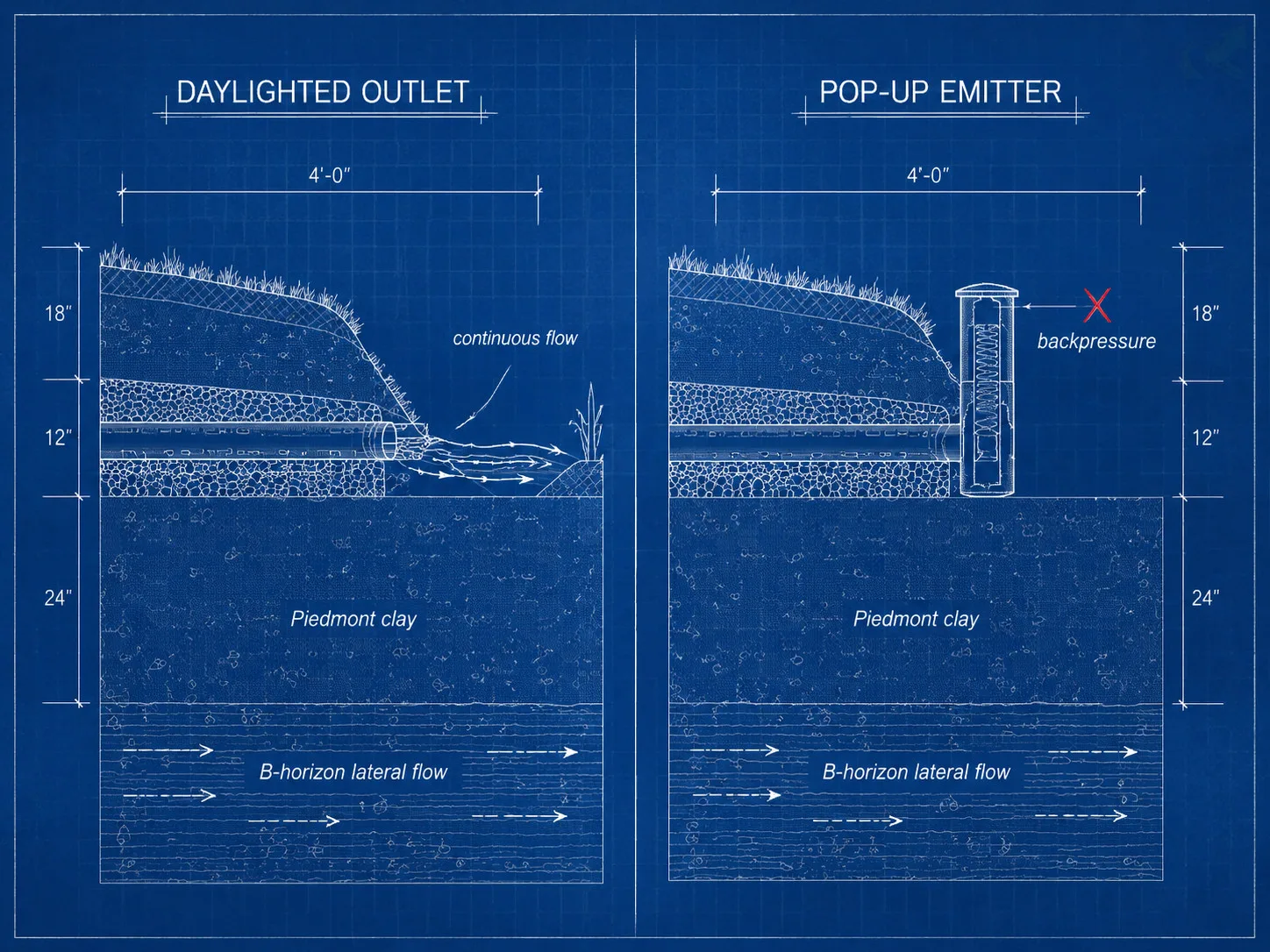
Daylighted outlets. His emphasis on running drain pipe to a true daylighted outlet — where water exits at grade into an open discharge point — is correct for NC clay. NC Piedmont clay does not percolate. Water that enters a drainage system must exit somewhere visible and accessible. A pop-up emitter or dry-creek terminus is not the same as a daylighted outlet; in clay soil, the difference between an adequate and an undersized outlet is the difference between a system that works and one that backs up.
Positive slope requirements. The 1-2% pipe slope recommendation aligns with what NC Piedmont clay drainage requires. Because lateral flow — not vertical percolation — is the dominant movement pattern in Piedmont clay, the pipe must continuously move water toward the outlet. Flat pipe in NC clay sits still. Positive slope is non-negotiable.
Contractor-grade pipe and aggregate spec. His insistence on adequate gravel envelope and schedule-rated pipe reflects field experience. NC clay is a demanding trench environment. The surrounding soil exerts pressure on trench infrastructure in ways that sandy-soil installations do not — a proper aggregate void ratio matters for both drainage capacity and structural performance.
For the NC-specific technical framework that these recommendations plug into, see NC clay French drain methodology applied.
The Piedmont Clay Gap: What to Watch For
The main gap in any NC drainage channel that covers the whole state is the Piedmont/Coastal Plain distinction — and it’s the one that matters most for homeowners in the Triangle, Charlotte metro, and Triad.
North Carolina spans three major soil zones: the Coastal Plain (eastern NC, sandy, high permeability), the Piedmont (central NC, the Cecil series kaolinite-dominated clay), and the Mountains (western NC, shallow soil over fractured rock). These zones do not share drainage physics.
NC Piedmont clay — dominated by kaolinite — has hydraulic conductivity in the range of 0.01 to 0.06 inches per hour. That means water does not percolate downward through the soil profile in any useful way. Instead, it moves laterally: along the surface, along impermeable subsoil layers, and along the B-horizon — the dense clay layer beneath the topsoil where lateral flow concentrates.
A drainage system designed around Coastal Plain conditions — or around general “NC” conditions that implicitly use the more permeable eastern soils as a baseline — may not intercept that lateral flow. The pipe may be at the wrong depth. The outlet may be undersized for what’s moving sideways through the soil rather than what’s entering through the pipe opening.
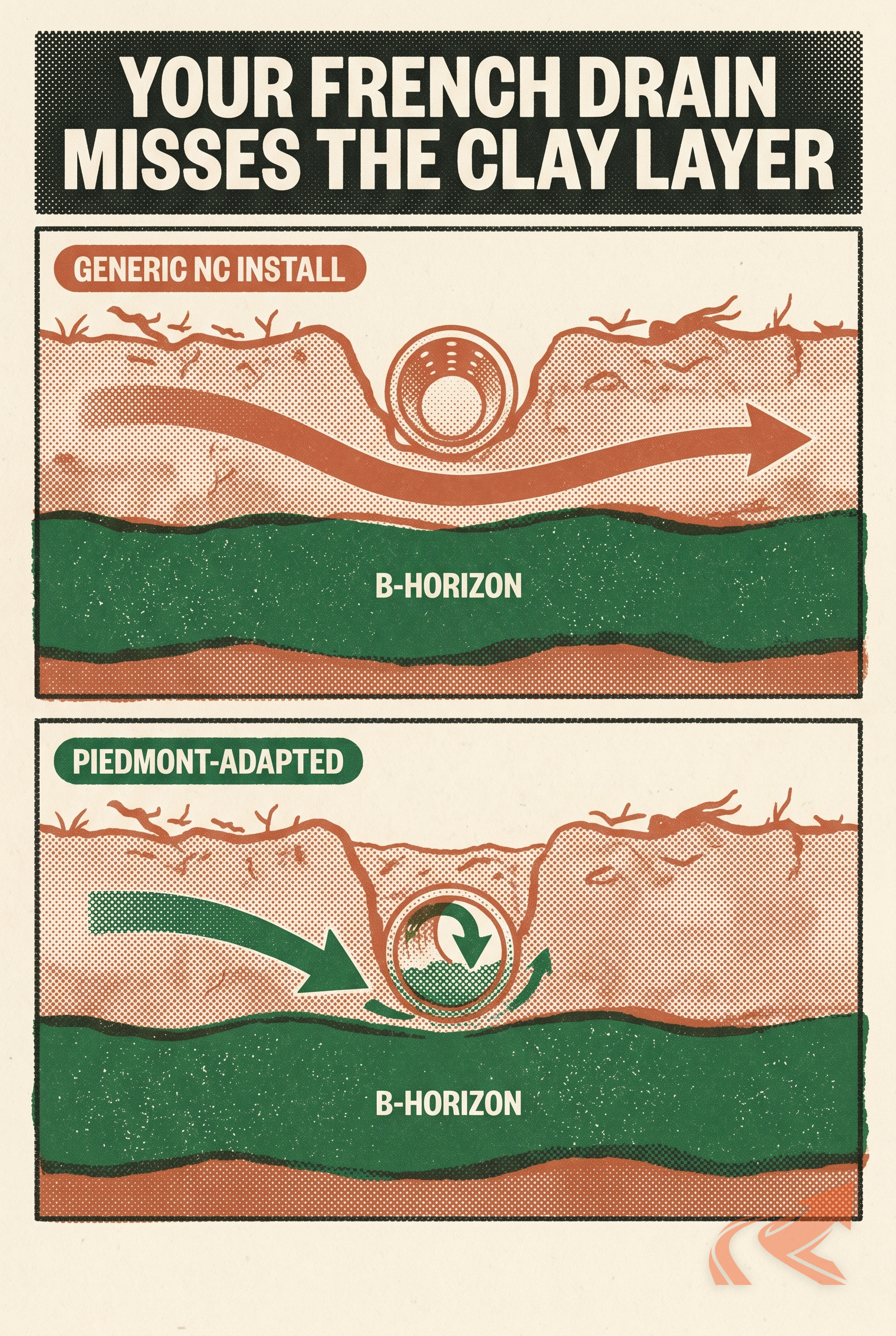
French drain: Piedmont-adapted vs generic NC install
Comparison. Piedmont-adapted: Pipe set at the clay-sand interface; Positioned to intercept B-horizon lateral flow; Trench depth driven by where water moves; Outlet daylighted to a real low point. Generic NC install: Pipe set at a generic, one-size depth; Sits above or below the lateral flow path; B-horizon flow passes the trench untouched; Water keeps sitting on top of the clay.
- Pipe set at the clay-sand interface
- Positioned to intercept B-horizon lateral flow
- Trench depth driven by where water moves
- Outlet daylighted to a real low point
- Pipe set at a generic, one-size depth
- Sits above or below the lateral flow path
- B-horizon flow passes the trench untouched
- Water keeps sitting on top of the clay
In the Piedmont, depth has to track the clay-sand interface -- a generic depth misses the water entirely.

In NC Piedmont clay the lateral flow runs along the B-horizon — the dense clay accumulation band. A pipe placed above that layer intercepts surface drainage only; the subsurface load passes underneath.
Dr. Drainz NC is the YouTube presence of Apple Drains of NC, a Raleigh-based drainage contractor whose service area covers Raleigh, Cary, Apex, Wake Forest, Holly Springs, Fuquay-Varina, Clayton, and Garner — all Triangle-area Piedmont clay territory. His content is effectively calibrated to Piedmont conditions by default. The practical filter still applies: if he references a specific depth rule, confirm with your contractor that the depth targets the clay-sand interface at your site, not a generic number imported from a different soil zone. The technical basis for why this distinction matters is in the clay-stops-water debate.
Specific Techniques to Verify Before Hiring
Two things to check: does the proposed system intercept lateral flow at the clay layer, and is the outlet daylighted to daylight rather than terminated at a pop-up emitter?
After watching Dr. Drainz’s content, Vanessa has the right vocabulary. Here is how to use it as a filter when evaluating any contractor proposal:
Lateral flow interception. Ask the contractor: “Where is the pipe positioned relative to the clay layer?” In Piedmont clay, the interceptor trench needs to reach the lateral-flow horizon — the point where water is moving sideways through the soil. A pipe placed above the B-horizon in NC Piedmont clay intercepts surface drainage but misses the subsurface load. A contractor who works regularly in Triangle or Triad soil can name this layer.
Outlet verification. Ask: “Is this outlet daylighted, or does it terminate at a pop-up emitter?” Positive drainage means water exits continuously. Pop-up emitters close when water is not flowing, which creates backpressure in clay-soil installations where intermittent flow and sediment load are higher than sandy-soil conditions. A true daylighted outlet — pipe exiting at grade to a defined discharge point — is the right specification for NC Piedmont clay.
These two questions test whether a contractor’s proposal is adapted to Piedmont conditions or applied from a general-NC or out-of-state baseline. See the clay-stops-water debate for the technical reasoning behind both.
NC Homeowner Takeaway
Here is the filter to apply to Dr. Drainz NC’s content when you are in the NC Piedmont.
Dr. Drainz NC is the right channel to start with. He is filming in North Carolina. His instincts about outlets, slope, and aggregate are calibrated to real NC field conditions. The filter below is not a correction — it is a refinement for homeowners in Piedmont clay country specifically.
-
Keep: His outlet placement and grading slope recommendations. These apply regardless of soil type. Daylighted outlets and 1-2% pipe slope are correct for NC Piedmont clay — and for any NC soil zone. Do not let a contractor talk you out of these two requirements on the basis of cost or site constraints.
-
Apply the Piedmont filter: If he recommends a specific pipe depth, ask whether that depth is targeting the clay-sand interface or a general depth rule. In Piedmont clay, the pipe needs to reach the lateral flow horizon at the B-horizon — not just a generic “18 inches” or “below frost” specification. A contractor who knows Piedmont clay can tell you what depth that interface sits at on your specific site.
-
Ask your contractor: “Is the system you are proposing adapted for Piedmont clay lateral flow, or is it a general NC approach that works better in Coastal Plain?” A contractor who works regularly in the Triangle, Triad, or Charlotte metro can answer this directly. One who cannot — or who describes French drain installation without mentioning lateral flow — may be applying a method designed for a different soil type.
The channel gives you the vocabulary. The Piedmont filter gives you the diagnostic question. Together they let you evaluate any contractor proposal against the actual physics of your yard.
For the full technical synthesis behind these distinctions, see why NC-adapted methods differ from standard approaches.
Using This to Vet Your Contractor
Dr. Drainz NC’s content gives you the right vocabulary. Now use it to filter contractor proposals: ask specifically about lateral flow interception, not just trench depth.
The channel is a starting point, not a specification. No YouTube content — regardless of how close the creator’s soil is to yours — replaces an on-site assessment from a contractor who knows your specific yard, your grade, and your outlet options.
What the channel does give you: the terminology to ask better questions. Daylighted outlet. Positive slope. Interceptor trench. B-horizon. These are the words that separate a proposal built for Piedmont clay from one imported from a sandier region.
Use them. Ask for an itemized quote that names the pipe spec, the aggregate grade, the outlet location, and the slope. Not a round number. Each line item is a verification point.
Find a grading operator in North Carolina who works in Piedmont clay and can give you a site-specific answer — not a channel-calibrated one.