
Two questions about NC grading equipment
What equipment should show up for a typical NC drainage project?
A skid steer or CTL for surface grading and material moving, an excavator if there is significant trench work or foundation excavation, and a dump truck for material delivery and spoil removal. Machine control (GPS grade guidance) shows up on precision grading jobs.
What is the difference between a skid steer and a CTL?
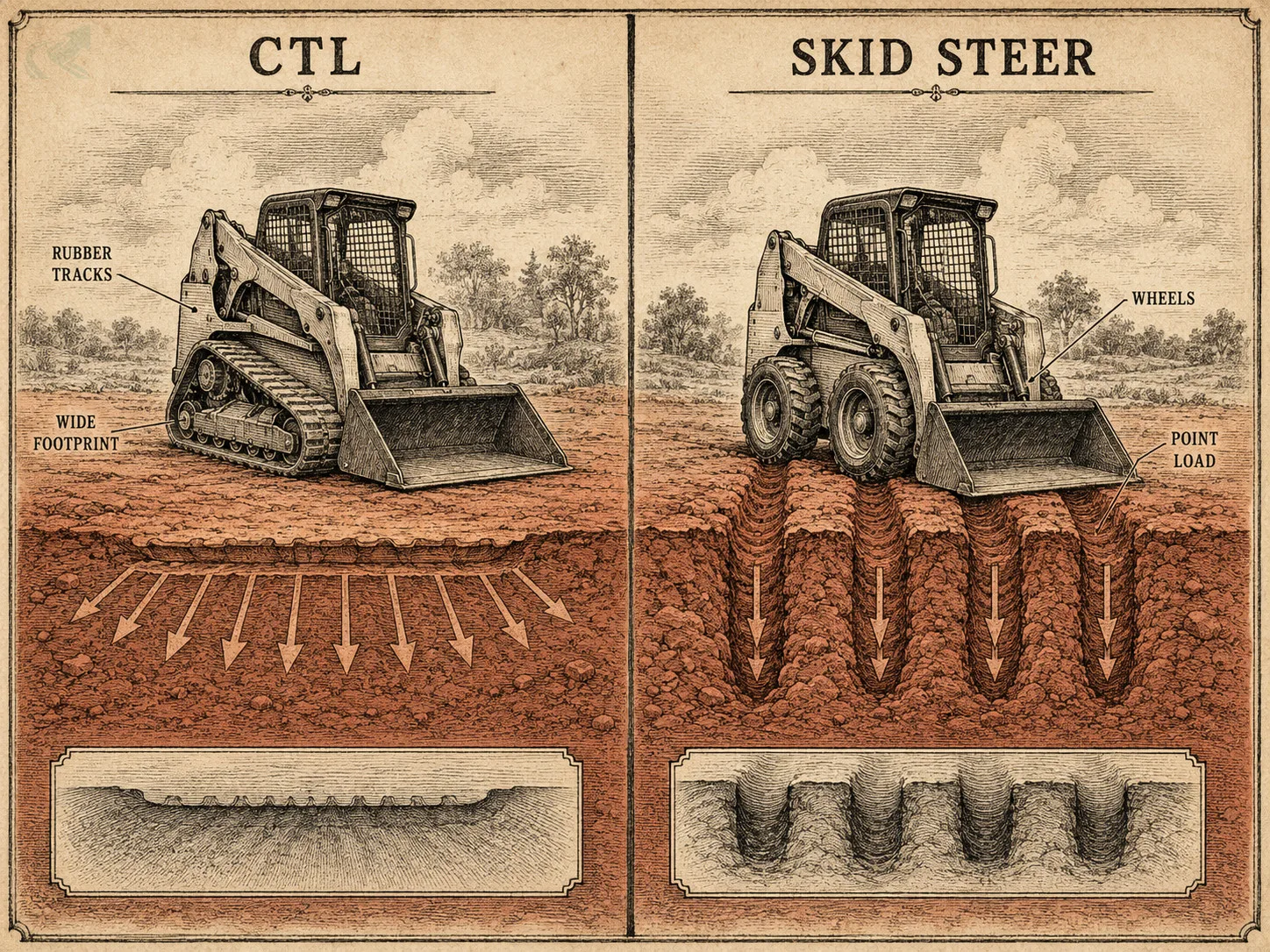
CTL stands for compact track loader -- it has rubber tracks instead of wheels. Tracks distribute weight better and improve traction on wet NC clay sites. For most North Carolina residential work, a CTL is the better machine -- but skid steers are still common on drier, harder sites.
Why Equipment Line Items on a Quote Matter
You got a proposal that itemizes: “1 (2 days), 1 mini excavator (1 day), 2 tri-axle hauls.”
You don’t know whether those line items are appropriate for your project — or whether you’re being quoted equipment you don’t need. That’s a reasonable thing to wonder. Equipment accounts for a significant share of what any grading contractor charges.
By the end of this page, you’ll know what each machine type does, when it’s appropriate, and what questions to ask if the equipment list doesn’t match the work being proposed. The spoke pages go deeper on each machine. This hub gives you the orientation to read them.
Skid Steer and Compact Track Loader — The Workhorse
The skid steer or CTL does most of the grading, material moving, and surface work on NC residential projects — it’s the machine you’ll see most often.
Nearly every grading job in North Carolina starts with this machine. The operator uses it to cut and fill rough grade, spread material, and do fine finishing work with a float technique across the blade. Attachments extend the range: a trench bucket turns a CTL into a trenching machine for shallow French drain work.
What this machine handles on a typical NC job:
- Rough grade cuts and fills across the site
- Spreading topsoil, gravel, fill dirt, and base
- Fine finishing with float technique to achieve positive drainage slope
- Shallow trenching with a trench bucket attachment
- Loading spoil into dump trucks for removal
Why a CTL over a skid steer in NC clay: rubber tracks distribute weight across a larger footprint. That lower ground pressure matters in Piedmont red clay — the machine is less likely to sink or rut a wet site. Traction on grades and in damp conditions is better than wheeled skid steers. For most North Carolina residential projects, a CTL is the better choice. Skid steers are still common, and appropriate on drier, harder surfaces.
For a full side-by-side on when each makes sense, see skid steer vs CTL for NC residential grading.
Mini Excavator — When Trench Depth or Precision Requires It
An excavator comes out when the trench is too deep for a skid steer, or when the precision of a foundation excavation or culvert dig requires the boom’s reach and angle control.
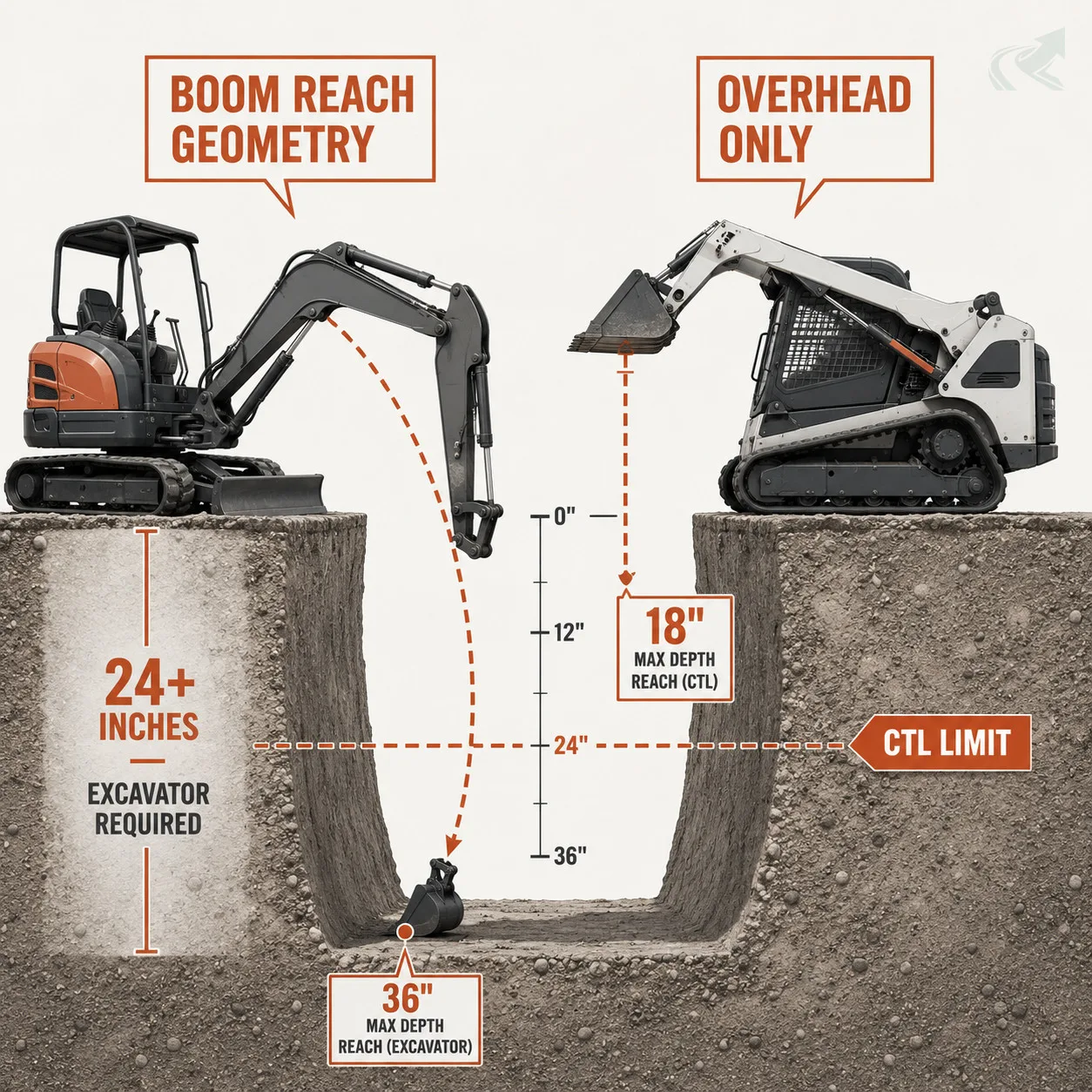
A CTL reaches down from above with a bucket. An excavator’s boom reaches out and down at an angle — and can do that while the machine stays back from the edge of a trench or bank. That reach geometry makes it the right tool for specific situations a CTL can’t handle cleanly.
When an excavator is needed on a North Carolina residential project:
- French drain trenches deeper than 24 inches
- Foundation perimeter excavation
- Culvert installation (placing pipe at a specific invert elevation)
- Ditch reshaping where the machine needs to reach while staying on the bank
- Stump removal below grade
Machine sizes vary by job scale:
- Mini excavator (3-5 ton): appropriate for most residential NC projects — tight access, lighter ground pressure
- Mid-size (10-15 ton): larger sites, deeper cuts, commercial-adjacent residential
- Full-size: commercial work; rarely seen on standard NC residential sites
If a contractor proposes an excavator for a job that only involves surface grading and material moving, ask why. If a contractor quotes only a CTL for a job with deep trench work, ask the same question.
See excavator classes for NC residential grading for detail on sizing and cost implications.
Dump Truck — Material Delivery and Spoil Removal
Every project that imports or exports material needs a dump truck, and the truck class determines how much you move per load and what roads it can legally use.
Grading generates spoil. Drainage installs require gravel. Driveway repairs need fill or base material. The dump truck is the logistics machine — it connects the job site to material sources and disposal locations.
What dump trucks do on a North Carolina grading job:
- Deliver gravel, ABC base, topsoil, and fill dirt to the site
- Remove spoil from grade cuts and excavation
- Remove debris from site clearing or demolition
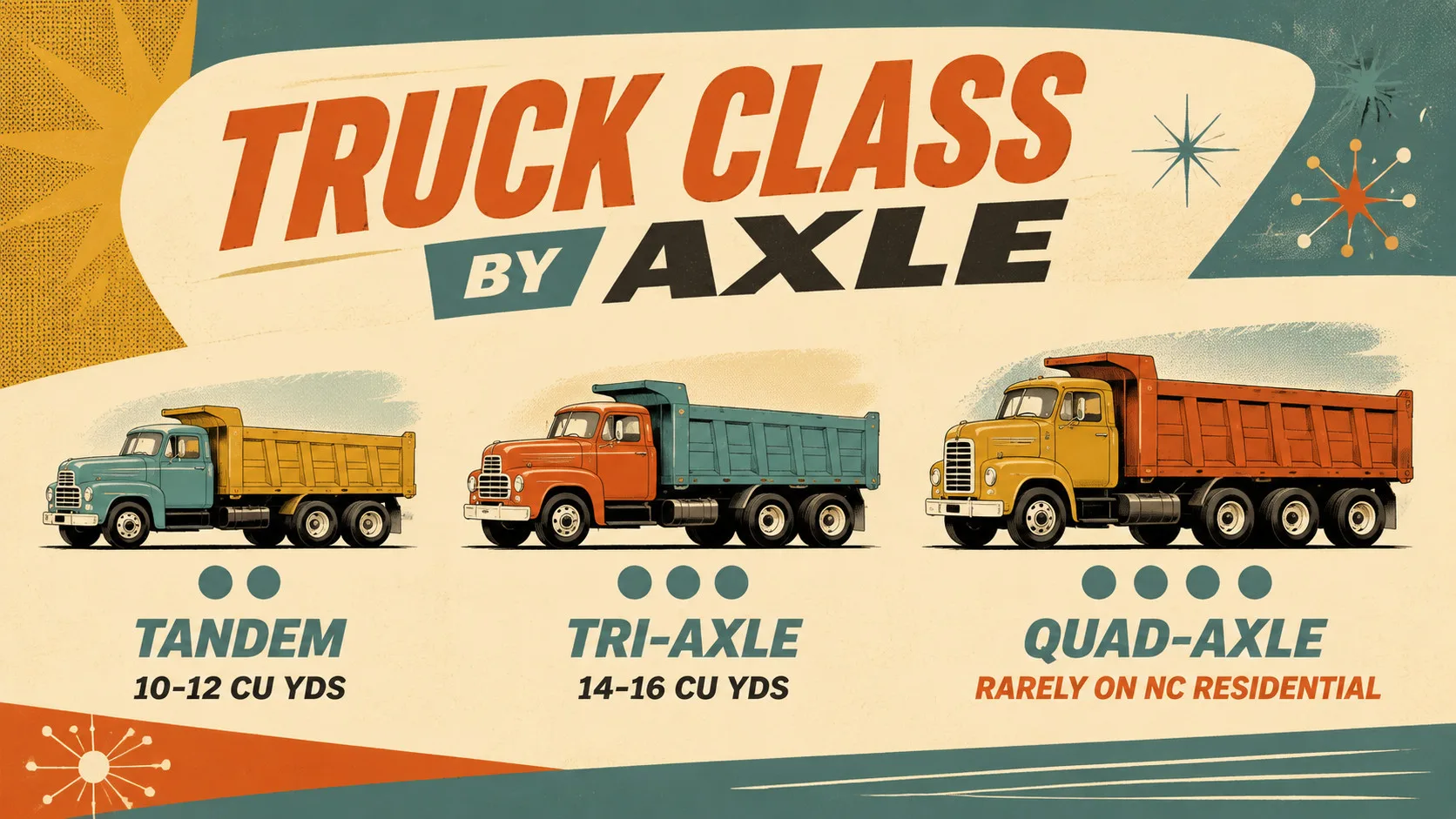
Truck classes by axle configuration:
- Tandem (2-axle): 10-12 cubic yards per load — appropriate for smaller residential jobs and tighter road access
- Tri-axle (3-axle): 14-16 cubic yards per load — more efficient for high-volume material moves
- Quad-axle (4-axle): larger loads; rarely used on standard residential NC sites
governs maximum loaded weight by road classification. Tri-axle trucks may not be permitted on some rural or secondary roads in NC — a contractor working in a rural county should know which configuration applies to your site access road. This matters most for WNC driveway work and for properties accessed via unpaved or secondary roads.
For a full breakdown of truck classes, weight limits, and cost-per-load math, see dump truck classifications for NC hauling.
Machine Control (GPS Grading) — When Precision Is Non-Negotiable
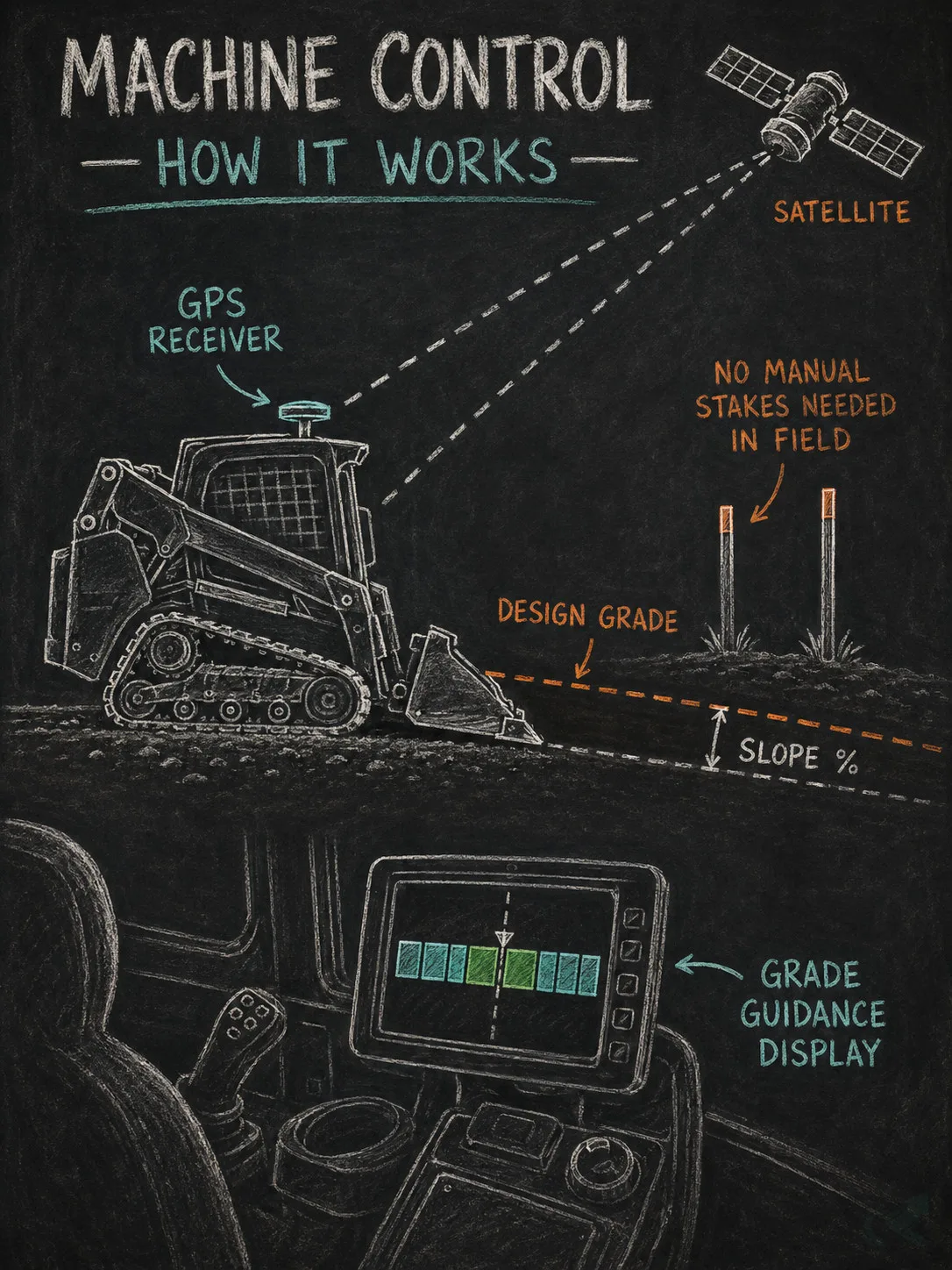
Machine control uses guidance to grade to a design elevation within fractions of an inch — it’s worth asking about on any project where drainage slope must be held precisely.
Standard grading relies on the operator’s skill and grade stakes placed by hand. Machine control replaces that with a guidance display driven by GPS or laser positioning. The blade or bucket follows a pre-programmed design grade. The operator watches the display rather than estimating by eye.
What this buys on the right project:
- Consistent slope held across a large area in a single pass
- Fewer grade stakes and manual checks during the run
- Drainage design intent preserved across a full site — not just near grade stakes
When machine control is worth specifying on a North Carolina project:
- New construction pad prep where the foundation contractor requires a specific finished elevation
- Drainage work where the design calls for precise fall percentages across a large area
- Driveway regrading where the existing surface is significantly out of grade and a single corrective pass needs to hold the new slope throughout
It’s not required on every job. A skilled operator with a laser level handles most residential NC grading without it. The question to ask: does my project have a design that calls for a specific fall rate, or does my foundation contractor require a finished elevation certification? If yes, ask whether the contractor’s equipment supports machine control.
For detail on how machine control systems work on NC job sites, see machine control on NC job sites.
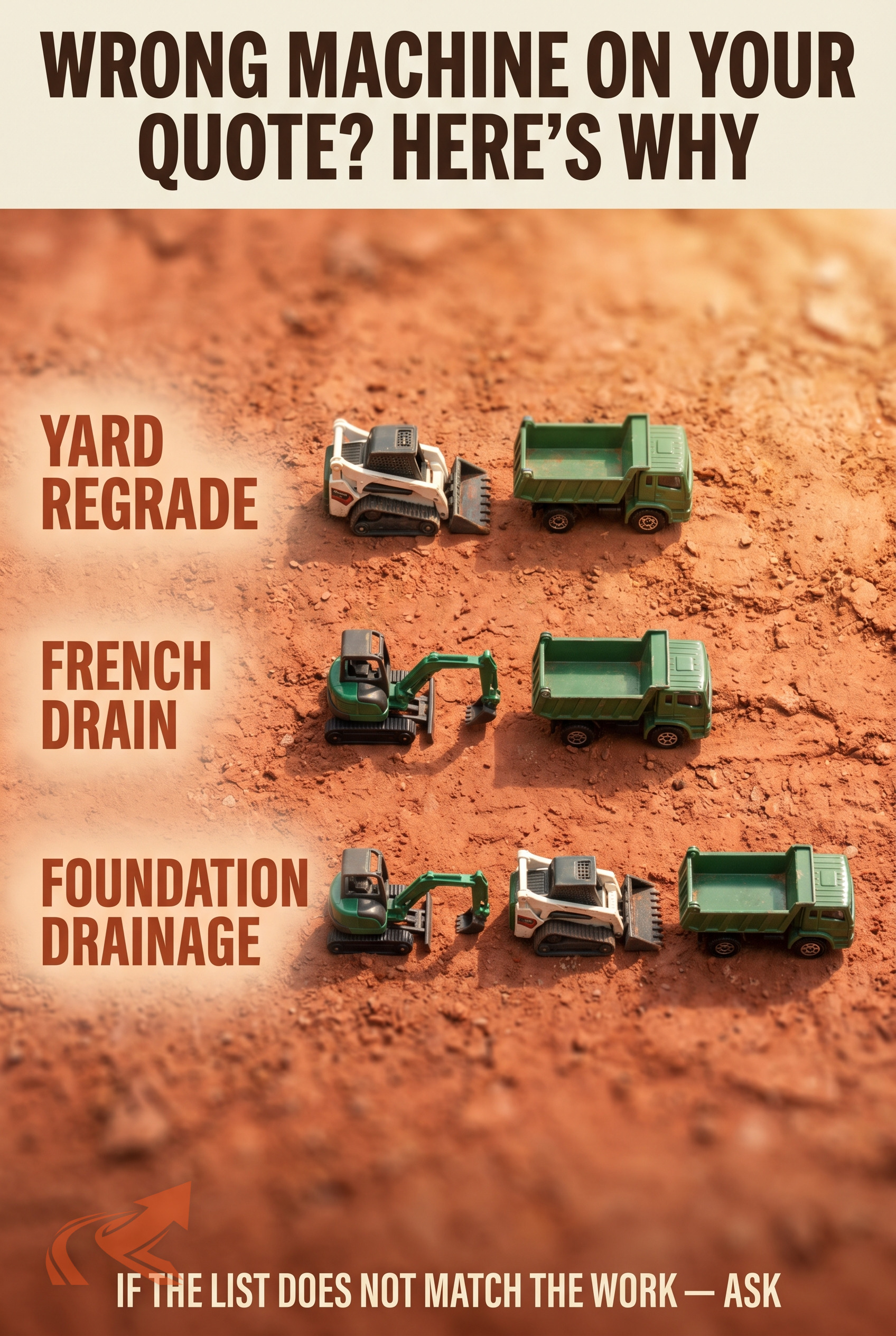
What Equipment Combination to Expect for Common NC Projects
The right machine combination depends on the project type — here is what a well-equipped NC contractor should show up with.
| Project type | Typical machine combo | Notes |
|---|---|---|
| Yard regrade (drainage improvement) | CTL + dump truck | Add mini excavator if trenching is needed |
| French drain installation | CTL or mini excavator + dump truck | Depends on trench depth — 24” or deeper needs excavator |
| Driveway grading (existing) | CTL or box blade tractor | Dump truck only if spoil needs removal |
| Foundation drainage (new build) | Mini excavator + CTL + dump truck | Three-machine job for full perimeter work |
| WNC driveway washout repair | Mini excavator + CTL + dump truck | Culvert work requires excavator precision; spoil volume is high |
A one-machine quote for a multi-machine project is not automatically wrong — contractors sometimes sequence the work using the same machine in multiple passes, or subcontract one piece. But if a contractor can’t explain how they’re handling the work that their equipment list doesn’t cover, that’s a gap worth closing before you sign anything.
If you want to work through a specific project type, the NC grading equipment picker walks through the logic with a set of project-type questions.
If a contractor’s equipment list doesn’t match the project they’re quoting, ask why. A legitimate operator can explain what each machine does on your site and why they’ve specified it. If they can’t, that’s useful information.
Hire a grading operator in North Carolina — filter by county and verify an active license before calling.