
You ordered 15 yards of gravel. The tri-axle pulls in, dumps, and leaves. The pile doesn’t look right.
Did you get shorted? Maybe. Or maybe your mental model of what 15 yards looks like is off — because most people have never seen 15 yards of material in a pile before.
This page explains the axle classes North Carolina haulers use, what the capacity numbers actually mean in physical terms, how weight limits affect which truck your contractor can legally send, and how to read a delivery ticket if the numbers don’t add up.
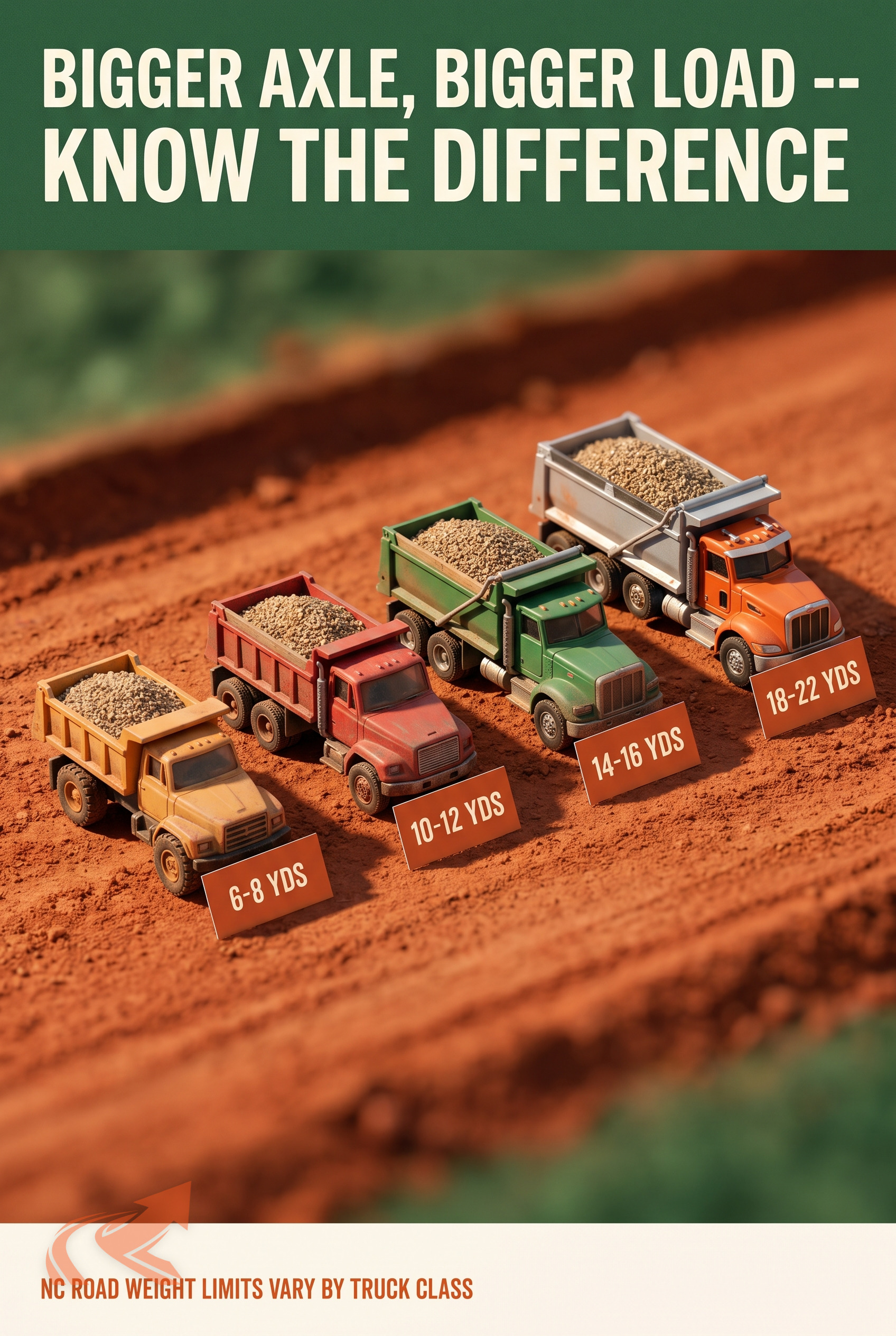
Dump Truck Axle Classes and Capacity
Dump truck axle classes: more axles, more payload, more NC road restrictions
Comparison. Light-duty classes (secondary roads): Single-axle -- 1 rear axle, 6-8 cubic yards, ~33,000 lbs GVW. Legal on most NC secondary roads.; Tandem -- 2 rear axles, 10-12 cubic yards, ~46,000 lbs GVW. Legal on most NC secondary roads. The workhorse for subdivision, rural driveways, and [driveway grading in NC](/driveway/grading/).. Heavy classes (primary roads; secondary may need permit): Tri-axle -- 2 rear + 1 tag/pusher axle, 14-16 cubic yards, ~60,000 lbs GVW. Standard for commercial aggregate hauls on NC primary roads; some secondary road restrictions apply.; Quad-axle -- 3 rear axles, 18-22 cubic yards, ~68,000-72,000 lbs GVW. Primary roads primarily; secondary road permits often required. Eligible for NC G.S. 20-118 aggregate exception up to 69,850 lbs..
- Single-axle -- 1 rear axle, 6-8 cubic yards, ~33,000 lbs GVW. Legal on most NC secondary roads.
- Tandem -- 2 rear axles, 10-12 cubic yards, ~46,000 lbs GVW. Legal on most NC secondary roads. The workhorse for subdivision, rural driveways, and [driveway grading in NC](/driveway/grading/).
- Tri-axle -- 2 rear + 1 tag/pusher axle, 14-16 cubic yards, ~60,000 lbs GVW. Standard for commercial aggregate hauls on NC primary roads; some secondary road restrictions apply.
- Quad-axle -- 3 rear axles, 18-22 cubic yards, ~68,000-72,000 lbs GVW. Primary roads primarily; secondary road permits often required. Eligible for NC G.S. 20-118 aggregate exception up to 69,850 lbs.
GVW figures are industry-typical loaded-weight estimates, not NC statutory axle limits. Controlling limits are set in NC G.S. 20-118.
More axles = more payload capacity and more axle weight distribution for NC road compliance.
The axle configuration determines how a truck’s load spreads across the pavement. That matters in North Carolina because weight limits vary by road classification — and a truck that’s legal on a primary road may be prohibited on a rural secondary road without a special permit.
| Class | Axle count | Typical capacity (cubic yards) | Typical loaded GVW (est.) | NC road applicability |
|---|---|---|---|---|
| Single axle | 1 rear | 6—8 cubic yards | ~33,000 lbs | Most secondary roads |
| Tandem | 2 rear | 10—12 cubic yards | ~46,000 lbs | Most NC secondary roads |
| Tri-axle | 2 rear + 1 tag/pusher | 14—16 cubic yards | ~60,000 lbs | Most NC primary roads; some secondary road restrictions |
| Quad-axle | 3 rear | 18—22 cubic yards | ~68,000—72,000 lbs | Primary roads primarily; secondary road permits may be required |
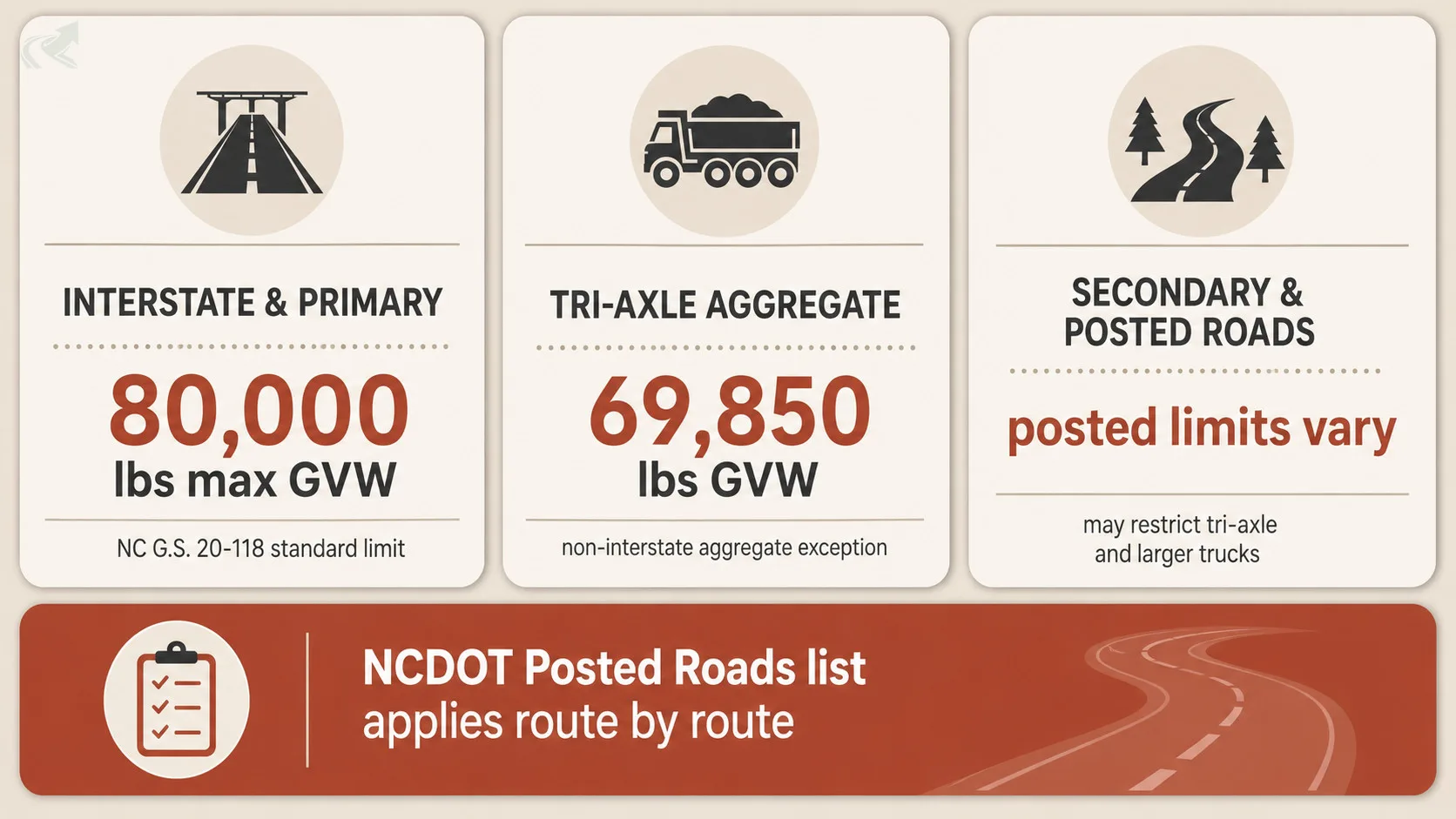
These GVW figures are industry-typical loaded-weight estimates, not statutory limits. The controlling statutory limits are set in NC G.S. 20-118: 20,000 lbs single axle, 38,000 lbs tandem axle, 80,000 lbs maximum gross. Tri-axle aggregate haulers on non-interstate routes may operate up to 69,850 lbs GVW under the G.S. 20-118 aggregate exception.
“10 yards” is a commonly-used shorthand, but it is an approximate figure. Actual capacity depends on material density and the legal weight limits for the road type your contractor is accessing. A tandem carrying dry sand weighs less per yard than a tandem carrying wet NC Piedmont red clay.
When a quote says “2 tandem hauls,” that is roughly 20—24 cubic yards — not a fixed number. The material type determines the exact tonnage for any gravel delivery in NC, which the quarry scale ticket will show.
What “10 Yards” Actually Looks Like
What 10 cubic yards of loose material actually looks like
1. Volume: ~270 cubic feet -- That is the math -- 10 yards x 27 cubic feet per yard. It is the same unit your quote is written in. 2. Dumped pile footprint: ~10 ft wide, 10 ft long, 3 ft high -- Roughly the footprint of a mid-size sedan parked on your driveway -- but only knee-high. Most homeowners expect it to look taller. 3. Spread 3 inches deep: covers ~1,080 sq ft -- That is a 30 x 36 ft driveway surface. Double the depth to 6 inches and the same load covers about 540 sq ft -- roughly a 20 x 27 ft pad. 4. Compacted ABC gravel sits ~15-20% lower than the loose pile -- A proof-roll settles the voids. The finished driveway layer will look thinner than the dump -- that is expected, not a shortfall.
-
Volume: ~270 cubic feet
That is the math -- 10 yards x 27 cubic feet per yard. It is the same unit your quote is written in.
-
Dumped pile footprint: ~10 ft wide, 10 ft long, 3 ft high
Roughly the footprint of a mid-size sedan parked on your driveway -- but only knee-high. Most homeowners expect it to look taller.
-
Spread 3 inches deep: covers ~1,080 sq ft
That is a 30 x 36 ft driveway surface. Double the depth to 6 inches and the same load covers about 540 sq ft -- roughly a 20 x 27 ft pad.
-
Compacted ABC gravel sits ~15-20% lower than the loose pile
A proof-roll settles the voids. The finished driveway layer will look thinner than the dump -- that is expected, not a shortfall.
Material density shifts actual tonnage: wet Piedmont clay weighs more per yard than dry #57 stone. The quarry scale ticket shows the real weight -- use the gravel converter at /tools/gravel-yard-ton-converter/ to cross-check cubic yards to tons.
A tandem-axle load of 10 cubic yards dumped in a pile is roughly the size of a mid-size sedan — wider and flatter when spread.
That reference catches most homeowners off guard. Ten yards sounds like a lot. In practice, the pile is not as tall as you expect.
Physical reference for 10 cubic yards of loose material at rest:
- Volume: approximately 270 cubic feet
- Dumped in a pile: roughly 10 feet wide, 10 feet long, 3 feet high
- Spread 3 inches deep over a driveway: covers approximately 1,080 square feet — about 30 feet by 36 feet of driveway surface
These are estimates for loose material. Compacted gravel sits lower after a proof-roll. Topsoil compacts differently than #57 stone. If the pile looks small when it lands, spread depth and compaction usually account for the difference — which is exactly why the quarry scale ticket matters more than eyeballing the pile.
NC Weight Limits by Road Type
sets maximum gross vehicle weight limits by road classification — a tri-axle truck that is legal on a primary road may not be legal on a rural secondary road without a permit.
Key North Carolina weight limits:
- Interstate and primary roads: Standard federal limits apply — 80,000 lbs maximum gross weight (the federal Interstate limit, also codified in NC G.S. 20-118), subject to the federal bridge formula. NC statutory axle limits are 20,000 lbs single axle and 38,000 lbs tandem axle.
- Secondary roads (light-traffic roads): NCDOT can designate any non-Interstate/non-US/non-NC route as a “light-traffic road” and post an axle weight limit below the statutory limits when the road is inadequate to carry maximum-weight vehicles. Tri-axle and larger trucks may be restricted on these routes.
- Posted roads: NCDOT maintains a “Posted Roads” list of secondary routes that cannot carry heavy vehicles or equipment; posting protects the roadway from damage. Posted limits vary by route — contact the NCDOT district engineer for limits on a specific road.
North Carolina does not run a formal statewide seasonal spring-thaw weight restriction program, but individual secondary roads can carry posted reductions or wet-weather restrictions where pavement conditions warrant. NCDOT’s Posted Roads and light-traffic-road designations are the mechanisms for this.
The practical implication: if a tri-axle cannot legally access your road, your contractor’s options are a smaller truck with more loads, a transfer point at the road edge, or an alternative access route. Ask about road access before finalizing any itemized quote for a haul job.
Operating a tri-axle or quad-axle dump truck in North Carolina requires a . A straight (single-unit) dump truck with a gross vehicle weight rating of 26,001 lbs or more is a Class B vehicle, so a Class B CDL is the standard requirement. A Class A CDL is required only when the truck tows a trailer with a rating over 10,000 lbs. That is your contractor’s responsibility, but it is a reasonable question to confirm the driver is properly licensed for the truck class being used.
For more detail on NC hauling regulations, see the dump truck weight regulations for NC hauling page.
How to Read a Delivery Ticket
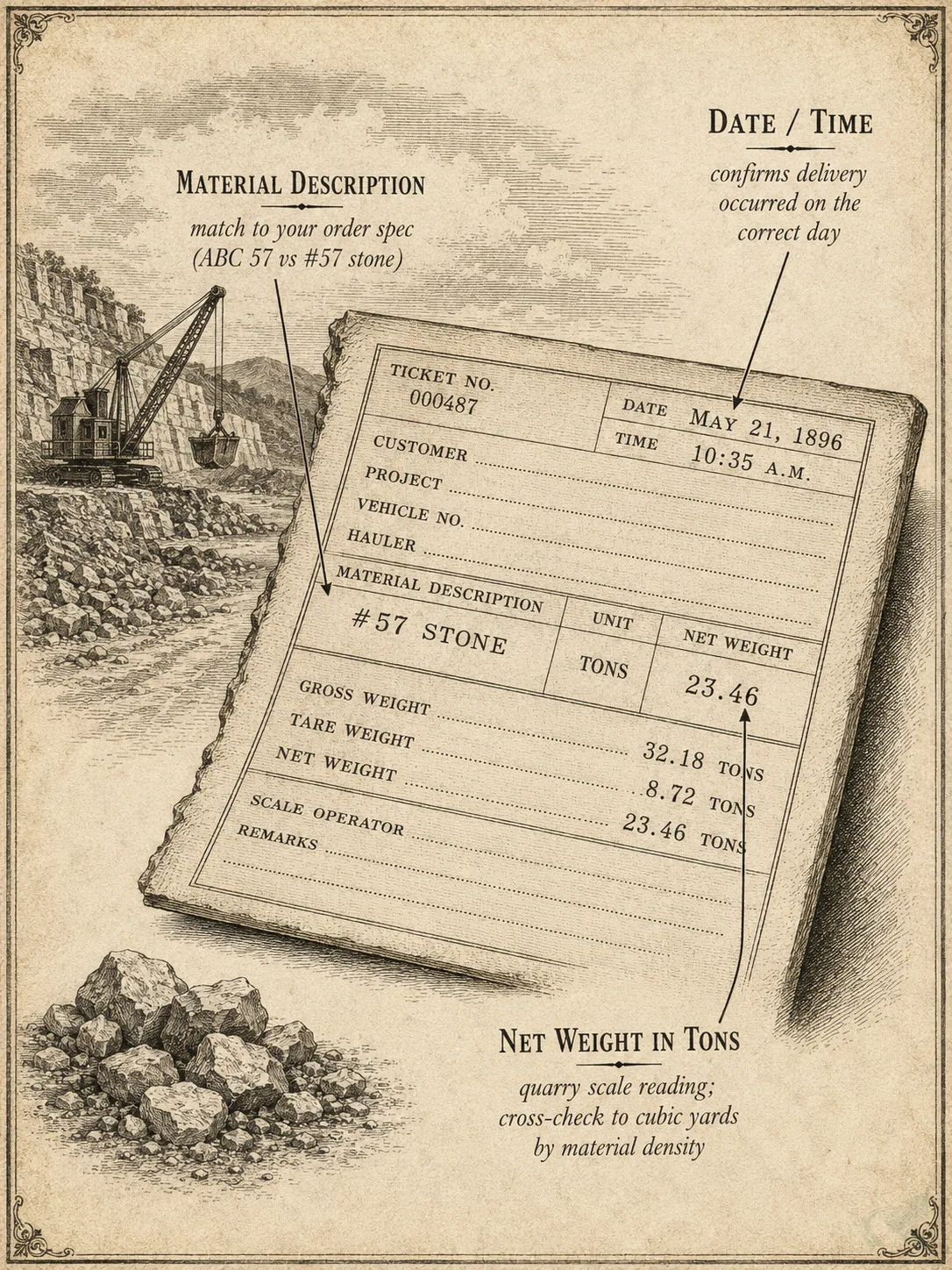
The delivery ticket is your record — three fields matter: material type, net weight in tons, and the quarry scale date.
Most quarry scale tickets include more than three fields, but these three are the ones that resolve disputes. Here is what each one tells you, and how to use them when verifying your NC gravel load.
Material description: Match this to your order. “ABC 57” is not the same as “#57 stone.” Confirm the spec on the ticket matches what you ordered before the driver leaves. A contractor who spec’d the wrong stone may have ordered correctly but the quarry pulled the wrong material — the ticket shows the truth.
Net weight (tons): This is what the quarry scale measured when the truck left the yard. To verify it matches your order in cubic yards, use the gravel yards-to-tons converter for NC projects and enter the material type. Density varies — wet #57 stone weighs more per yard than dry ABC gravel.
Truck number / driver: Useful if there is a dispute about whether the full load was delivered. If two trucks show up and you only receive one ticket, ask why.
Date/time: Confirms the delivery occurred on the correct day. If a ticket is dated the day before or after your job, ask for an explanation.
If the tons on the ticket and the yards on your quote do not line up after conversion:
- Convert the ordered cubic yards to tons using the gravel converter linked above
- Compare the converted tons to the net weight on the delivery ticket
- A 10% variance is within normal range for material density variation — stone moisture content shifts the weight. More than 10% is worth a call to the supplier, not the contractor
Most deliveries are correct. The verification is a sanity check, not an accusation. Contractors who hand you the ticket without being asked are signaling they run their operation at that standard.
What to Ask About Dump Truck Logistics on Your Quote
Two questions determine whether the haul quote matches your road conditions and your material order.
Before you sign a haul quote in North Carolina, confirm the truck class and confirm road access. These are the two variables that determine whether the job goes as planned or requires a mid-project pivot.
A contractor who answers without hesitation knows their equipment and knows the road. One who says “we’ll figure it out when we get there” has not scoped the access. On a restricted secondary road in rural NC, “figure it out” can mean a tri-axle that can’t legally turn around, a job that stops mid-haul, and a material shortfall that costs you another mobilization.
The question also tells you whether the contractor is quoting off a real site assessment or off a template. Operators who work in NC regularly know which county roads carry posted limits. That knowledge is part of what you are paying for.
For a broader look at the equipment used in NC grading and hauling work, see the NC equipment hub including dump truck classifications.
Hire a grading operator in North Carolina who can confirm truck class, road access, and material specs before the haul quote is written.