
Two questions people often ask
What is machine control in grading?
Machine control -- also called GPS grading or laser grading -- uses GPS or laser positioning to guide the machine's blade or bucket to a pre-programmed design elevation. The operator sees real-time guidance on a cab display showing how much to cut or fill to hit the target grade.
Does machine control matter for my residential project?
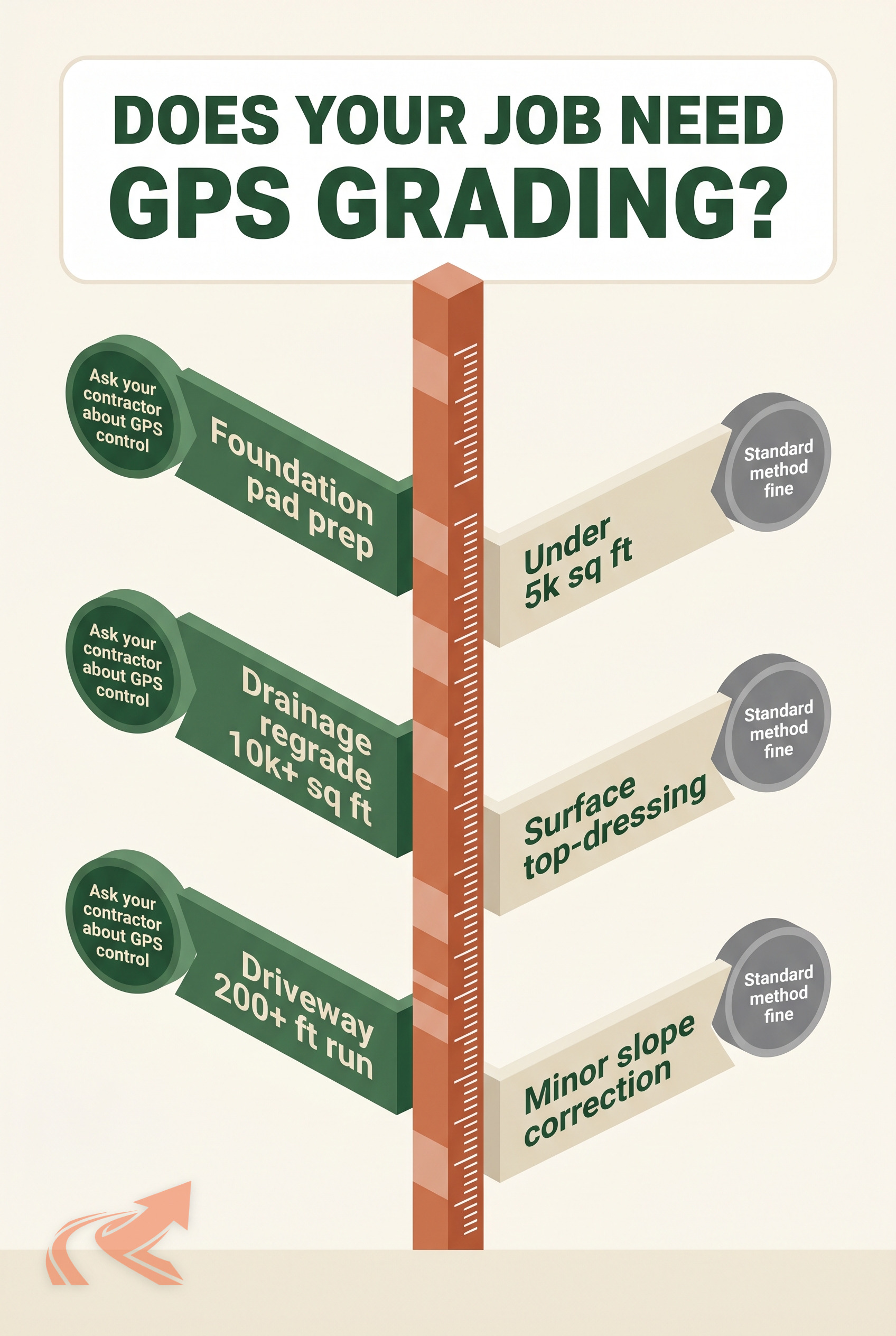
For a small yard drain or driveway patch -- probably not. For a new construction pad prep, a large-area drainage regrade, or any project where a consistent slope must hold across more than 100 feet -- yes, it meaningfully reduces grade error.
A contractor gives you a quote and mentions Leica machine control on their equipment list. You nod. Later you wonder whether that phrase means anything — real technology, or marketing language that sounds impressive but changes nothing about your yard.
Here is what it means: the contractor has GPS hardware mounted on the machine that gives the operator continuous, real-time feedback on cut and fill depth relative to a pre-loaded design grade. The system does not guess. It knows where the blade is.
Whether that matters for your specific project depends on project size and how precisely the grade needs to hold. This page gives you the filter criteria — so you can decide whether machine control is relevant to your job before the bid is written.
What Machine Control Is
Machine control uses or laser positioning to give the machine’s blade real-time feedback on cut and fill needed to reach the design grade — replacing periodic manual grade-checking with continuous automated guidance.
Four components make the system work:
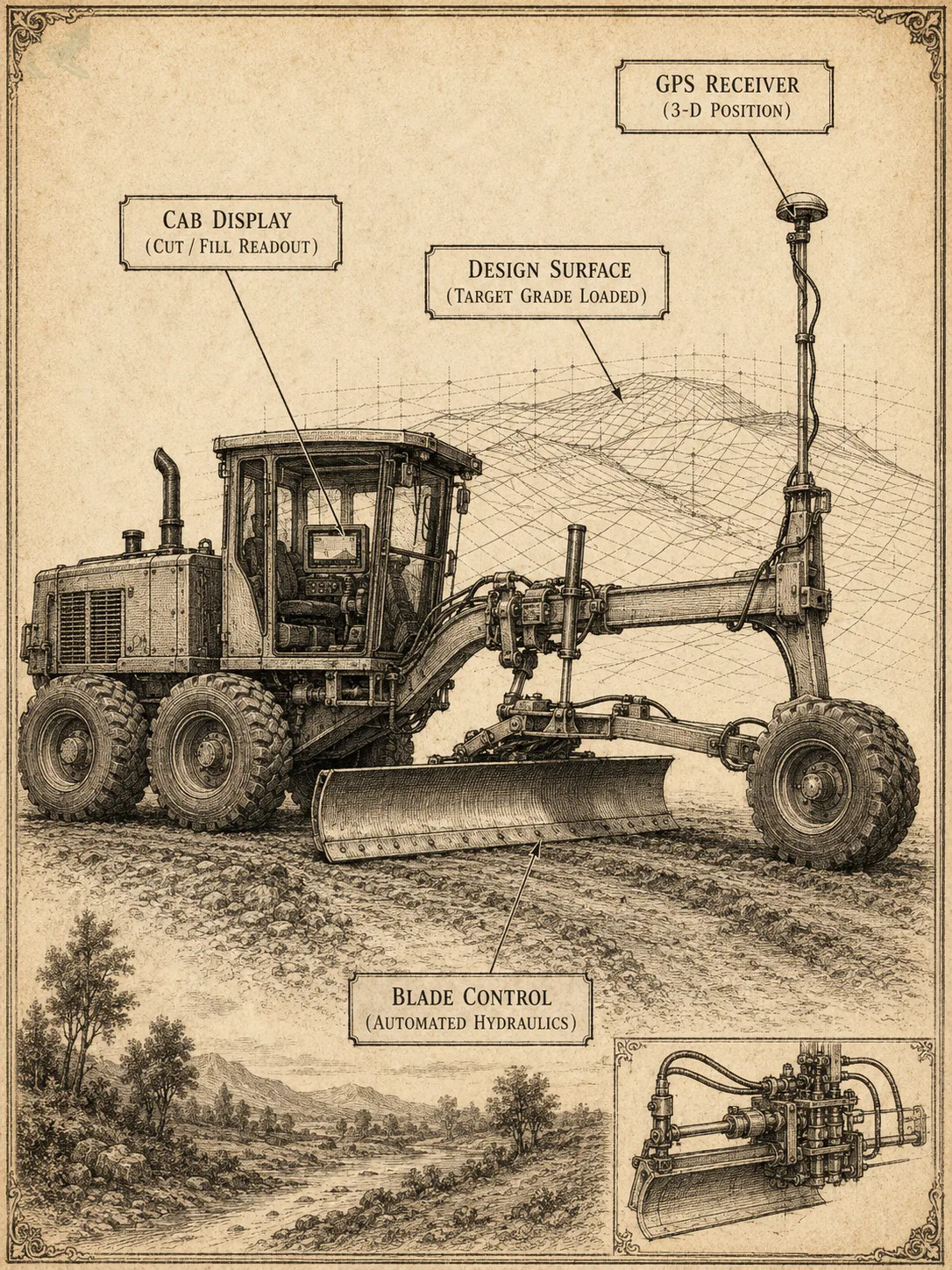
- GPS receiver mounted on the machine. Communicates with a base station or network control points to establish the machine’s precise position in three dimensions.
- Design surface loaded into the system. The target grade is uploaded as a 3D surface file before work begins. The machine knows what elevation every point on the site should be.
- Cab display. The operator sees a live readout showing whether the blade is above, below, or at design grade — updated continuously as the machine moves.
- Automated blade control (some systems). Higher-end configurations let the system control blade hydraulics directly, adjusting cut depth without operator input.
Two providers dominate North Carolina grading work: Leica Geosystems and Trimble. Both are established platforms. Verified NC grading contractors who run machine control typically use one or the other — the brand difference is less important than whether the system is calibrated and the operator knows how to use it.
Laser-based systems are common on flat commercial sites where a rotating laser establishes a reference plane. On residential sites with varied topography, -guided systems are more common because they handle slope and elevation change across the site.
What Machine Control Improves
Grade accuracy — specifically, the ability to hold a consistent slope across a large area without repeated manual grade-checking.
Without machine control, verifying grade requires the operator to pause, a grade checker to take shots with a level or grade rod, and manual corrections after each check. On a large site, checks happen at intervals — which means grade error can accumulate between check points.
With machine control, guidance is continuous. The operator sees deviation from design grade in real time and corrects before errors compound.
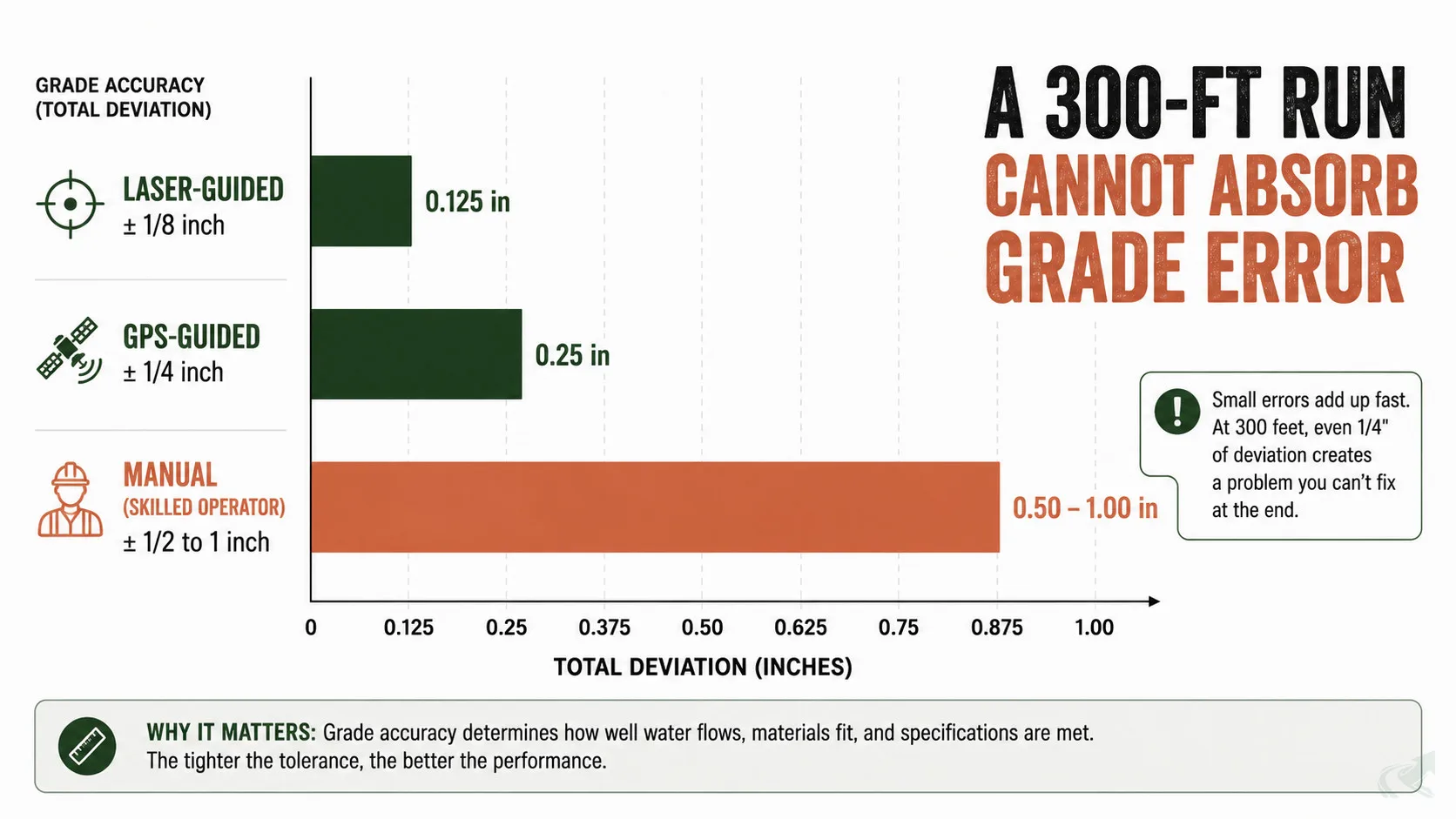
Typical accuracy for -guided systems is plus or minus 1/4 inch horizontally referenced to the design surface. Laser-guided systems on flat sites can reach plus or minus 1/8 inch. Manual grading by a skilled operator on a straight run falls in the 1/2-inch to 1-inch range depending on check frequency.
For most residential drainage work, that difference matters when the run is long — a 50-foot slope can absorb 1/4-inch variability; a 300-foot drainage channel cannot. The grade accumulates over the run, and a flat or slightly reversed section somewhere in the middle is the leading cause of yard drainage solutions NC calls — a grade error that wasn’t caught at build time and becomes expensive to correct.
When Machine Control Matters for NC Residential Projects
Three project types where machine control meaningfully improves outcomes for North Carolina homeowners — and two where it is not worth the premium.
Where it matters:
| Project type | Why machine control helps |
|---|---|
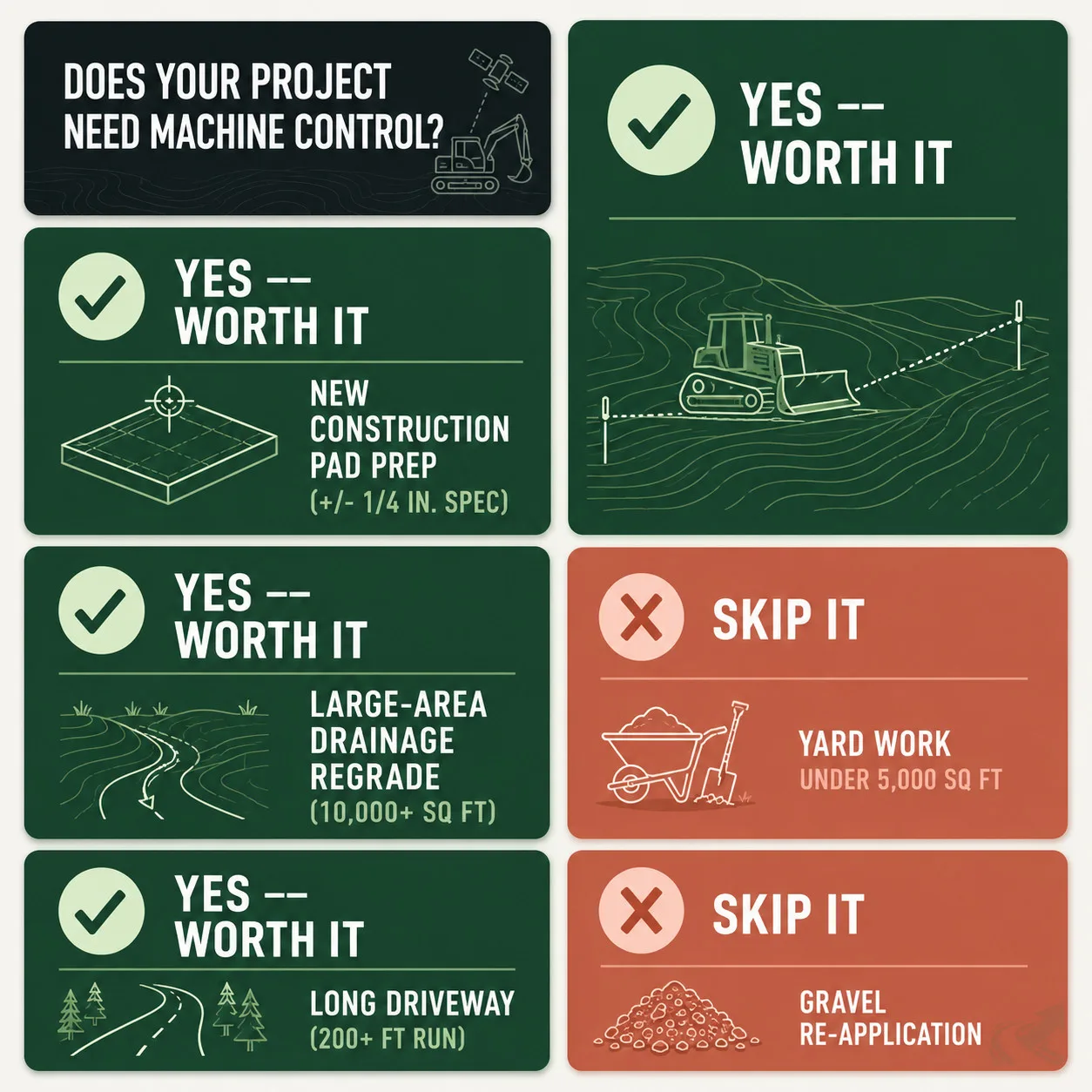
| New construction pad prep | Foundation contractor requires finished elevation within tight tolerance — typically +/- 1/4 inch. Machine control hits that spec reliably; manual grading may not, especially on a large footprint. |
| Large-area drainage regrade (10,000+ sq ft) | Positive drainage slope must hold consistently across the whole area. Machine control eliminates the flat sections that appear when a grade checker can only verify points at intervals — flat sections that cause French drain systems NC to reverse-slope at a mid-run low point and stop draining. |
| Long driveway regrading (200+ feet) | Crown and cross-slope must hold across the full run. A 300-foot driveway with a mid-run flat section develops standing water at that point every rain event. |
Where it is not worth the premium:
- Small yard work under 5,000 sq ft with no tight grade tolerance
- Surface gravel re-application over existing subgrade
- Minor drainage corrections that do not require hitting a specific elevation across a long run
Dave in WNC replacing a Helene-damaged driveway should ask about machine control if the NC driveway grading process includes a drainage crown spec and the run is long enough to accumulate grade error. For a 60-foot apron repair, the added cost is not warranted.
Machine Control as a Transparency Signal
A contractor who uses and mentions machine control is telling you something about their investment in precision work — beyond just the technology itself.
Two things this signals:
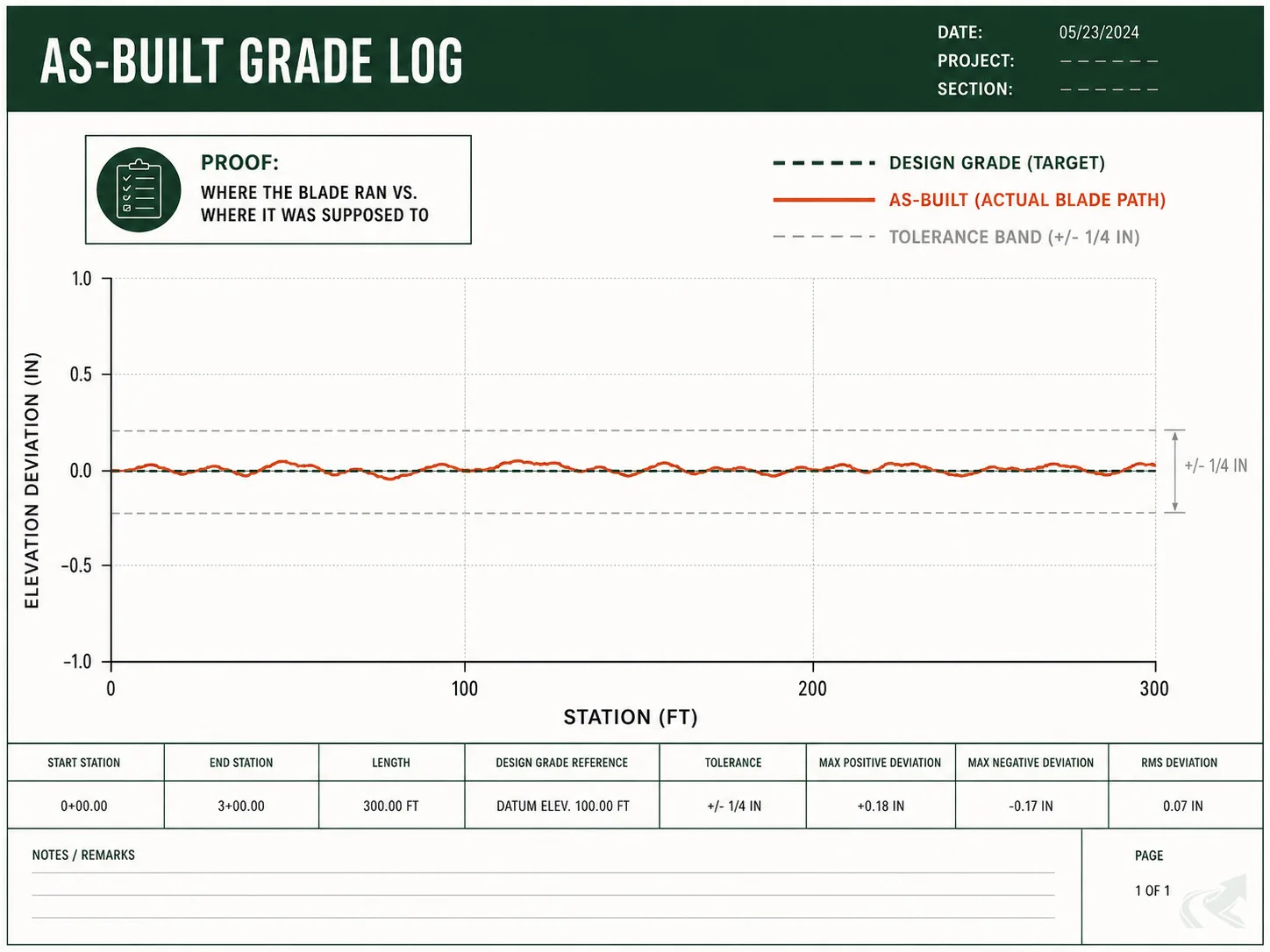
Documentation. Machine control systems log what elevation was actually achieved at each point on the site. This is called the as-built grade log — a record of where the blade ran versus where it was supposed to run. That level of documentation is especially relevant on projects like foundation drainage in NC soil zones where grade-to-structure tolerances are strict and a missed slope creates water intrusion problems that are expensive to diagnose. A contractor using machine control can provide this documentation after the job. Ask for it. A contractor who cannot produce an as-built log either does not have machine control or does not know how to export the data — both answers are useful to know.
Capital investment. Machine control hardware runs from $15,000 to $80,000 depending on the system and whether blade automation is included. Contractors who have made that investment are typically running a more professional operation overall — not because the hardware is magic, but because the investment reflects how they think about precision work.
The inverse is also true: if a contractor lists machine control on their equipment sheet but cannot explain how they use it or what accuracy it produces, that is worth noting. Equipment ownership and operational competence are different things.
For more on what NC grading contractors should be able to document, see machine control as a transparency signal for NC grading contractors.
How to Ask About Machine Control
“Are you running machine control on this job?” is a legitimate question — and the answer tells you whether they have the technology and whether your project actually warrants it.
The best version of the question asks for three things at once: whether they plan to use it, what system they run, and whether they can document the result. A contractor who answers all three without hesitation is operating at precision-work level.
If the answer is “we don’t use machine control,” that is not automatically a problem. On a small project, it should not matter. The follow-up question — “how are you verifying grade across the run?” — reveals whether they have a systematic manual process or are estimating by eye. Either answer tells you something.
If the answer is “yes, we run Leica/Trimble,” ask for a sample as-built log from a previous project. A contractor who has the system and uses it correctly will have one on file.
Find a contractor who can answer these questions directly: hire a grading operator in North Carolina. The NCGH network’s NC equipment hub including machine control technology lists equipment capabilities across verified contractors by metro area.