
Dave’s contractor pulled up with a and said it could handle the culvert replacement. Dave knew the old culvert sat at a specific depth and the new one had to match the outlet elevation or the driveway would drain toward the house. He asked the contractor: can a CTL place that culvert accurately?
The honest answer is: probably not as well as a mini excavator with boom reach. A CTL grades by surface reference. An excavator places the bucket at a specific depth, holds it there, and lets the operator lower the pipe to a precise invert elevation before backfilling. For a culvert, that difference is what separates correct drainage from a driveway that ponds every storm.
This page explains when the excavator shows up on North Carolina residential projects, what size machine fits what work, and what the NC clay does to the dig.
What an Excavator Does That a Skid Steer Can’t
The excavator’s boom arm provides reach, angle control, and depth precision that a skid steer’s bucket — which moves forward only — cannot replicate.
Three capabilities separate the machines:
Reach and angle control. The boom can extend down into a trench while the machine sits on the bank. A skid steer must be at grade level to work. On ditch reshaping or bank-side drainage work, the CTL would have to enter the ditch — the excavator stays above it.
Depth precision. Hydraulic boom control lets an experienced operator place the bucket tip within an inch or two of a target depth. Skid steers grade by surface reference; they push and spread. They don’t hold depth on a vertical axis.
Minimal surface disturbance for trench work. A narrow-bucket mini excavator disturbs only the trench width on an existing lawn. A skid steer vs CTL for NC residential grading comparison shows how a CTL maneuvering over the same area tracks across a zone two to three times the trench width. That matters on established North Carolina lawns with irrigation or planted drainage swales.
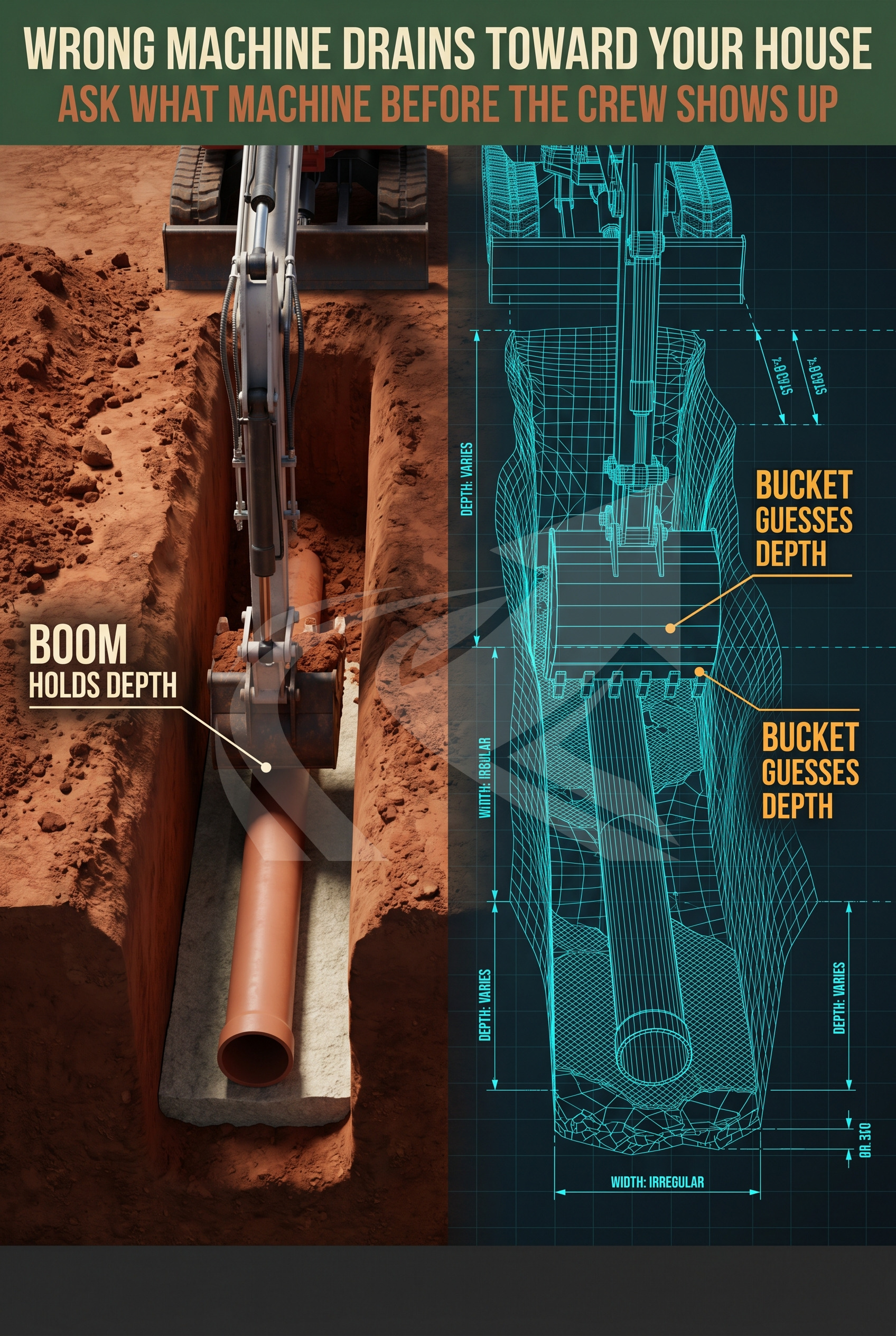
Cutting a drain trench: mini excavator vs skid steer
Comparison. Mini excavator: Boom reaches in for a consistent trench depth; Clean, vertical walls in NC red clay; Pipe set at the correct invert elevation; Bed prepped before the pipe goes in. Skid steer bucket: Bucket cuts an irregular, uneven depth; Trench walls disturbed and ragged; Pipe rests on disturbed clay, not a stone bed; Invert elevation is approximate at best.
- Boom reaches in for a consistent trench depth
- Clean, vertical walls in NC red clay
- Pipe set at the correct invert elevation
- Bed prepped before the pipe goes in
- Bucket cuts an irregular, uneven depth
- Trench walls disturbed and ragged
- Pipe rests on disturbed clay, not a stone bed
- Invert elevation is approximate at best
A drain needs a precise invert -- the excavator's boom delivers it where a skid steer bucket only guesses.
For more on excavator use in NC French drain installation, see the French drain page — trench depth and invert control are the core issues there too.
Excavator Size Classes for NC Residential Work
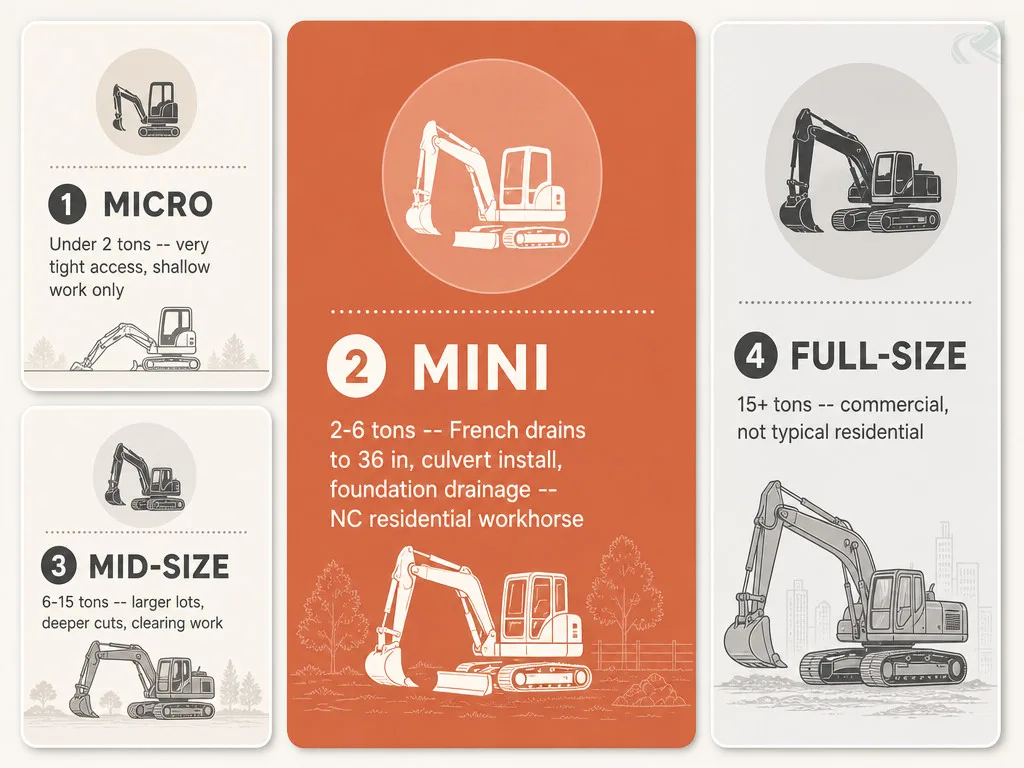
Most NC residential jobs use a mini excavator in the 2—6 ton class — large enough for foundation trenches and culvert work, small enough to access a typical subdivision lot.
Four size classes appear in NC residential grading:
| Class | Operating Weight | Typical NC Residential Use |
|---|---|---|
| Micro | Under 2 tons | Very tight access, shallow light work. Struggles with dense Piedmont clay at depth. |
| Mini | 2—6 tons | French drain trenches to 36 inches, culvert installation, foundation perimeter drainage. The NC residential workhorse. |
| Mid-size | 6—15 tons | Larger lots, deeper cuts, clearing work alongside grading. |
| Full-size | 15+ tons | Commercial. Not typical for residential. |
The mini excavator is what shows up on most North Carolina residential drainage calls. A 3-ton machine fits through a standard gate with room to work.
NC clay note: Piedmont red clay compaction and drainage guide explains why saturated clay grips the bucket differently than sandy coastal soil. Clay suction slows dig cycles and bucket release. In dense saturated clay, a mini excavator at the deeper end of its rated trench depth — 10 to 14 feet — works harder per foot than the rated spec implies. Experienced NC operators account for this when scheduling the dig day.
When the Excavator Shows Up on NC Residential Projects
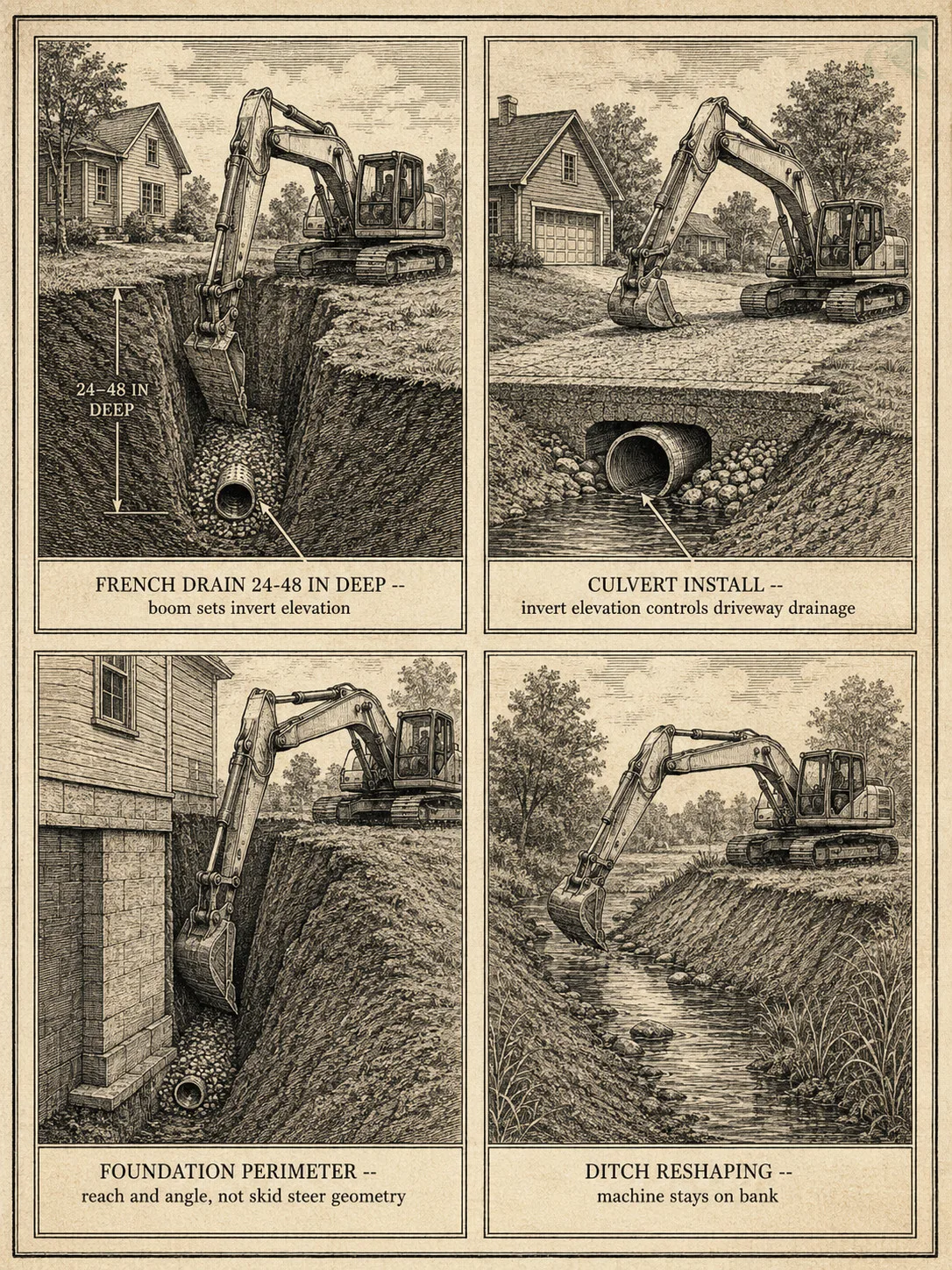
Three project types reliably require an excavator on North Carolina residential jobs — deep trench French drains, culvert installation, and foundation perimeter drainage.
French drain trenches 24—48 inches deep. Shallower French drains can be cut with a trenching attachment on a CTL. Deeper trenches — the kind needed when NC standing water yard drainage requires a low outlet elevation or the water table is high — require boom control to place pipe at the correct invert elevation without disturbing the stone bed.
Culvert installation. The culvert’s invert elevation controls how the driveway sheds water. Get it wrong by two or three inches and the driveway drains toward the house instead of toward the road. A mini excavator sets the invert; a CTL approximates it. This is the job Dave had — and why the equipment question matters before the crew shows up.
Foundation perimeter drainage. Excavating against a foundation wall requires working from the side and reaching down simultaneously. That’s excavator geometry. A skid steer can’t do this safely without getting close enough to the foundation to risk wall contact. NC foundation drainage and soil science covers how Piedmont clay compresses against foundation walls when wet — the trench has to be clean and tight.
Ditch reshaping from the bank. An excavator sits on the bank and reaches down into the channel. A CTL enters the ditch — which disturbs the ditch floor, risks getting stuck in saturated clay, and gives the operator no mechanical advantage against the channel walls.
Trench Excavation in NC Clay — What Changes
NC clay sticks to buckets, creates suction at the bucket face, and can collapse trench walls faster than other soils — all of which affect how the operator sequences the work.
A few clay-specific behaviors to recognize:
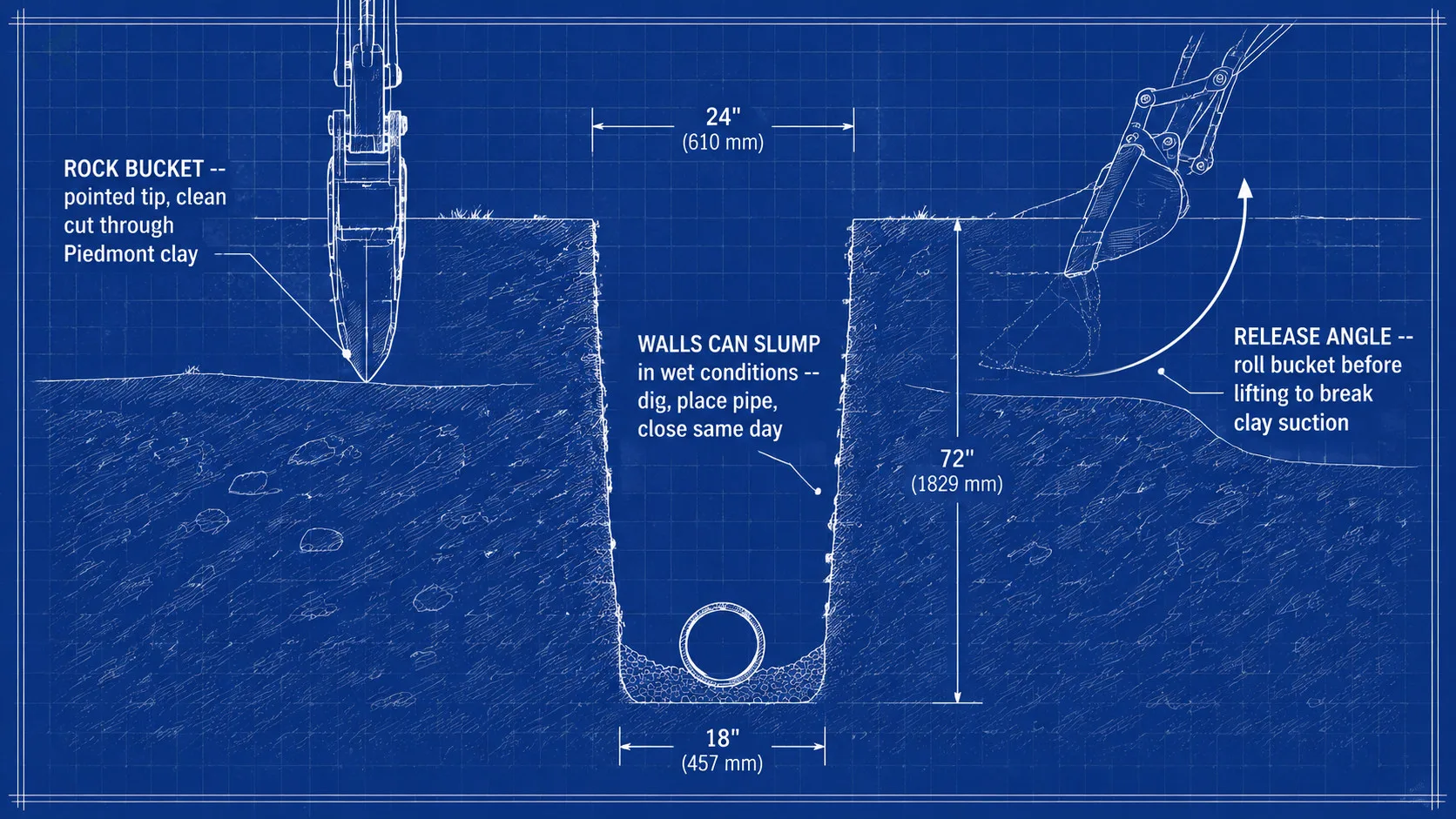
Bucket choice. A rock bucket — narrow, with a pointed tip — cuts through Piedmont red clay more cleanly than a wide utility bucket. Wide utility buckets shear the clay in sections; the rock bucket pulls a clean cut. On a French drain trench where trench width matters for stone bed placement, the difference shows in the backfill.
Wall stability. NC clay trench walls can stand for hours in dry conditions. In wet conditions — or in spring when the water table is high — they slump. The sequence matters: dig, place pipe, place #67 stone, close the trench. Don’t dig the full run and leave it open overnight in wet weather.
Clay suction on extraction. When pulling the bucket up through saturated clay, the suction at the bucket face pulls the trench wall inward. Experienced operators use a release angle — rolling the bucket slightly before lifting — that breaks the suction before it collapses the wall. This is vocabulary. Monica doesn’t manage it. But knowing it exists tells her whether the operator has worked in NC clay before.
These are things to watch for on the job. They’re not engineering calls — they’re operator habits that separate clean trench work from a trench that needs recut before pipe placement.
What to Ask About Excavator Use on Your Job
One question tells you whether the contractor has assessed the trench depth correctly before writing the quote.
A contractor who can answer the invert elevation question specifically — not “we’ll get it close” but “we’re targeting 18 inches below road edge at the outlet, matching the existing ditch grade” — has scoped the job rather than estimated it.
That question also filters for equipment. A crew that only has a CTL often says “we can handle it.” Sometimes they can. On a shallow French drain in sandy Charlotte suburban soil, probably yes. On a 36-inch foundation perimeter trench in Piedmont red clay, the answer should prompt a follow-up question about what machine is coming.
Hire a grading operator in North Carolina who can give you a specific invert elevation answer before the job starts. The NC grading equipment hub including excavators has additional context on how equipment choices affect quote accuracy.