Two questions people often ask
What is the difference between a skid steer and a CTL?
A CTL (compact track loader) uses rubber tracks instead of wheels. Tracks are better in wet NC clay because they distribute the machine's weight over a larger surface area, reducing ground pressure and preventing wheel ruts. A skid steer with wheels can dig into wet clay; a CTL rides on top.
Which one should show up on my NC job?
For most wet-season or clay-heavy NC residential projects, a CTL is the better choice. A skid steer is fine for dry conditions on firm ground. If you're not sure which your contractor is bringing, ask -- it's a reasonable question.
Your quote says: “1 (T650 class), 2 days.” You don’t know what CTL means, and it carries a $200/day premium over the standard skid steer on the competing bid. Is that premium worth it?
For NC clay in wet conditions, the answer is usually yes. One physical difference — wheels vs. rubber tracks — determines whether a machine floats on saturated Piedmont clay or digs ruts that must be re-graded before the project can close. This page explains the distinction, when it matters, and what to ask your contractor before the equipment shows up.
What Makes Them Different
One key difference — wheels vs. tracks — has significant consequences in NC clay.
Both machines are similar in size, horsepower, and the attachment ecosystem they accept. The loader arms, bucket sizes, and job capabilities are largely interchangeable. The critical difference is what touches the ground: four rubber-tired wheels on a skid steer, or a pair of continuous rubber tracks on a CTL.
In dry, firm conditions, the distinction is mostly academic. On saturated NC Piedmont red clay, it is not.
| Factor | Skid Steer (wheeled) | CTL (rubber tracks) |
|---|---|---|
| Ground pressure | Higher -- weight concentrated at 4 wheel contact patches | Lower -- weight distributed across full track contact length |
| Wet clay traction | Wheels can spin, dig ruts, and lose forward progress on saturated clay | Tracks maintain traction and ride on the clay surface without spinning |
| Surface damage on lawn | Higher wheel-rut risk in wet or recently disturbed conditions | Lower damage -- track contact area distributes the load |
| Maneuverability | Slightly tighter turn radius on some machine classes | Comparable; varies by specific model and undercarriage width |
| Typical NC residential use | Dry-season grading on firm, established ground | Preferred for wet-season and disturbed-site NC clay work |
| Rental availability in NC | Widely available at most NC equipment rental locations | Widely available; pricing similar to wheeled skid steer |
Ground pressure
- Skid Steer (wheeled)
- Higher -- weight concentrated at 4 wheel contact patches
- CTL (rubber tracks)
- Lower -- weight distributed across full track contact length
Wet clay traction
- Skid Steer (wheeled)
- Wheels can spin, dig ruts, and lose forward progress on saturated clay
- CTL (rubber tracks)
- Tracks maintain traction and ride on the clay surface without spinning
Surface damage on lawn
- Skid Steer (wheeled)
- Higher wheel-rut risk in wet or recently disturbed conditions
- CTL (rubber tracks)
- Lower damage -- track contact area distributes the load
Maneuverability
- Skid Steer (wheeled)
- Slightly tighter turn radius on some machine classes
- CTL (rubber tracks)
- Comparable; varies by specific model and undercarriage width
Typical NC residential use
- Skid Steer (wheeled)
- Dry-season grading on firm, established ground
- CTL (rubber tracks)
- Preferred for wet-season and disturbed-site NC clay work
Rental availability in NC
- Skid Steer (wheeled)
- Widely available at most NC equipment rental locations
- CTL (rubber tracks)
- Widely available; pricing similar to wheeled skid steer
What Ground Pressure Means in NC Clay
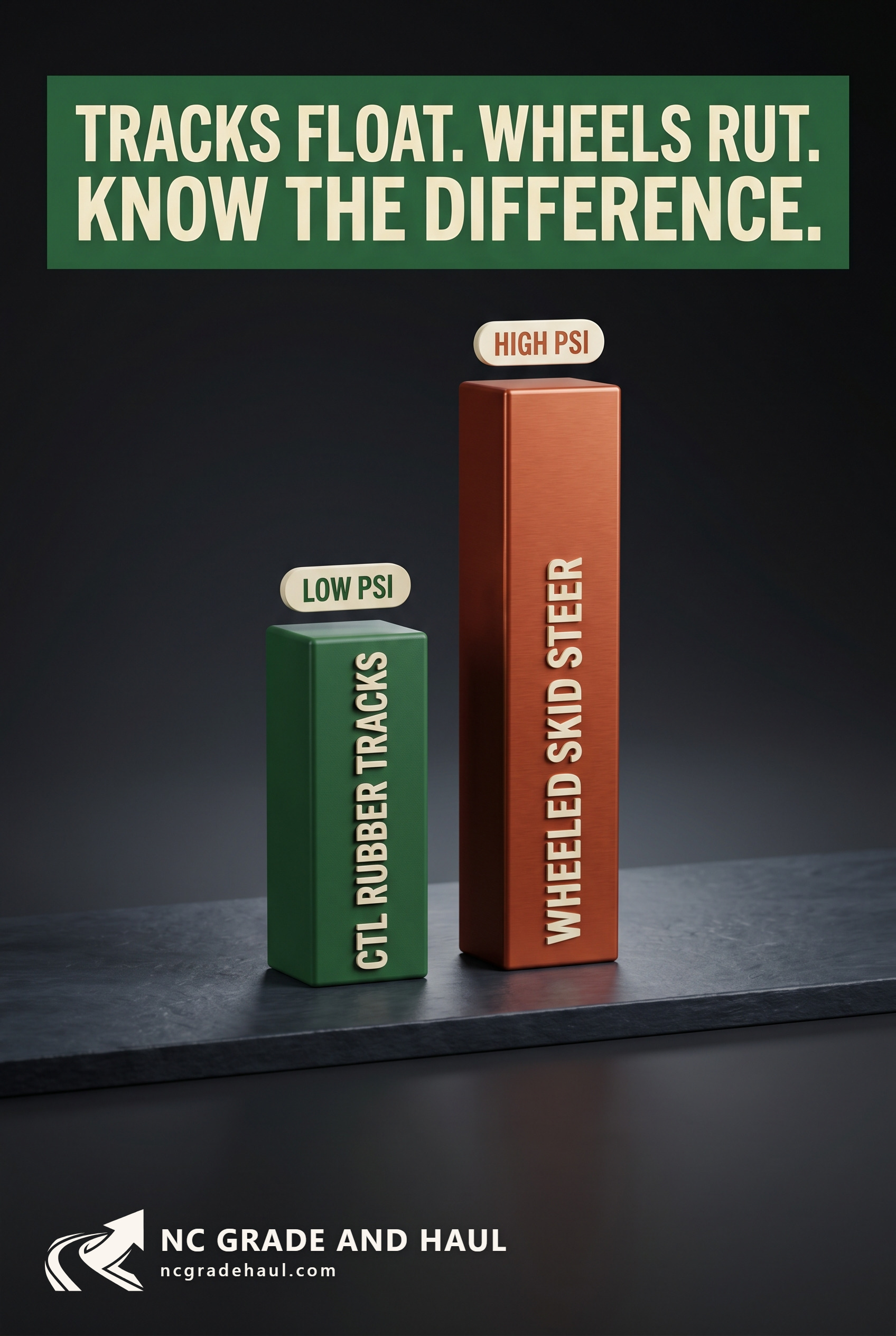
Lower ground pressure means the machine floats on top of wet clay instead of sinking in and leaving ruts — the tracks’ distributed load is the physical reason CTLs perform better in NC conditions.
A wheeled skid steer’s weight bears on four contact patches — the footprint where each tire meets the ground. In a 7,500 to 9,000 lb machine class common in NC residential work, those patches are relatively small. The load is concentrated.
A CTL of the same weight class distributes that load across the full length of both rubber tracks. Published ground pressure figures for equivalent-weight machines consistently show CTLs running at roughly half the psi of wheeled skid steers — a difference that is negligible on firm ground and significant on saturated clay.
In dry conditions, this difference rarely shows up. On saturated North Carolina Piedmont clay, the concentrated wheel load breaks the clay’s surface tension — the same Piedmont clay moisture behavior that makes red clay slick and unstable when wet. The wheels sink, spin, and excavate ruts that weren’t part of the job scope. Those ruts don’t self-heal — they require re-grading passes that add time and, on sites with poor existing grade, can seed the same low-spot pooling that drives most NC yard drainage solutions.
Machine weight on saturated NC clay: CTL track vs skid steer wheel
Comparison. CTL rubber track: Weight spread along the full length of both tracks; Roughly half the ground pressure of an equal-weight skid steer; Machine floats on top of the clay surface; No unplanned re-grade passes for ruts. Wheeled skid steer: Load concentrated on four small tire patches; Wheels break the clay's surface tension; Tires sink, spin, and excavate deep ruts; Ruts become drainage channels and need re-grading.
- Weight spread along the full length of both tracks
- Roughly half the ground pressure of an equal-weight skid steer
- Machine floats on top of the clay surface
- No unplanned re-grade passes for ruts
- Load concentrated on four small tire patches
- Wheels break the clay's surface tension
- Tires sink, spin, and excavate deep ruts
- Ruts become drainage channels and need re-grading
On firm or dry ground the difference is negligible -- on saturated NC Piedmont clay the tracked machine is what keeps ruts out of the job scope.
When a Skid Steer Is Fine
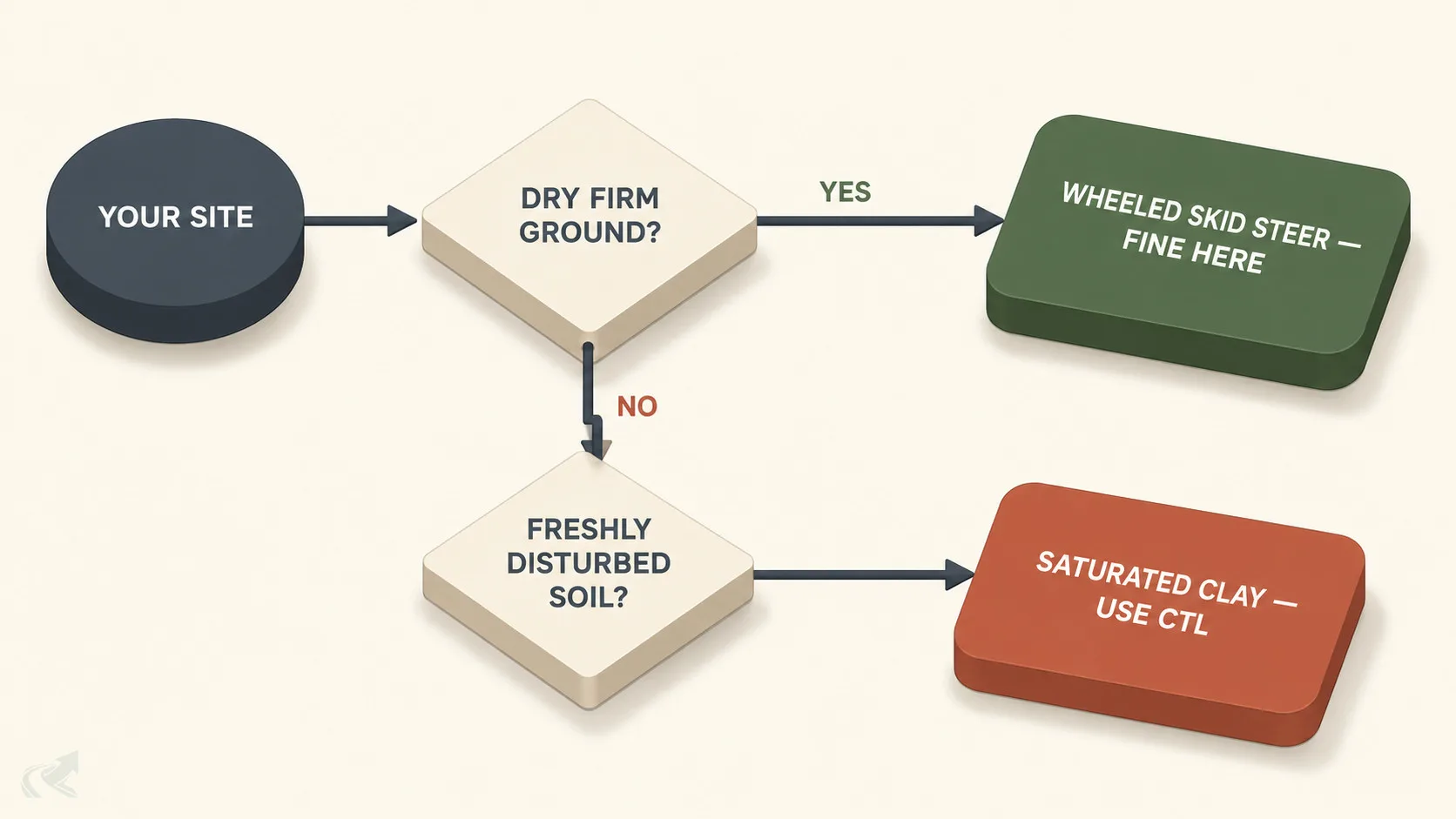
For dry conditions, firm soil, or sites where the CTL premium isn’t warranted, a wheeled skid steer performs the same work at lower cost.
There are legitimate reasons a contractor might quote a wheeled machine for an NC residential project:
- Dry-season grading on established firm ground — if the site has good compaction and there’s no rain forecast during the work window, wheel ruts are unlikely.
- Hardscape or paved-surface work — a firm surface prevents the rutting failure mode entirely. The wheel vs. track distinction doesn’t apply.
- Interior or tight-access sites — some machine configurations have a slightly smaller footprint on wheeled models. On constrained sites, that matters more than ground pressure.
- Right-size-class job where CTL is unavailable — if the contractor’s CTL is committed to another job and a skid steer is the correct size for your scope, that’s a valid call.
The question is not “which machine is better overall.” It’s “which machine is right for my site conditions right now.”
NC-Specific Conditions Where CTL Is Non-Negotiable
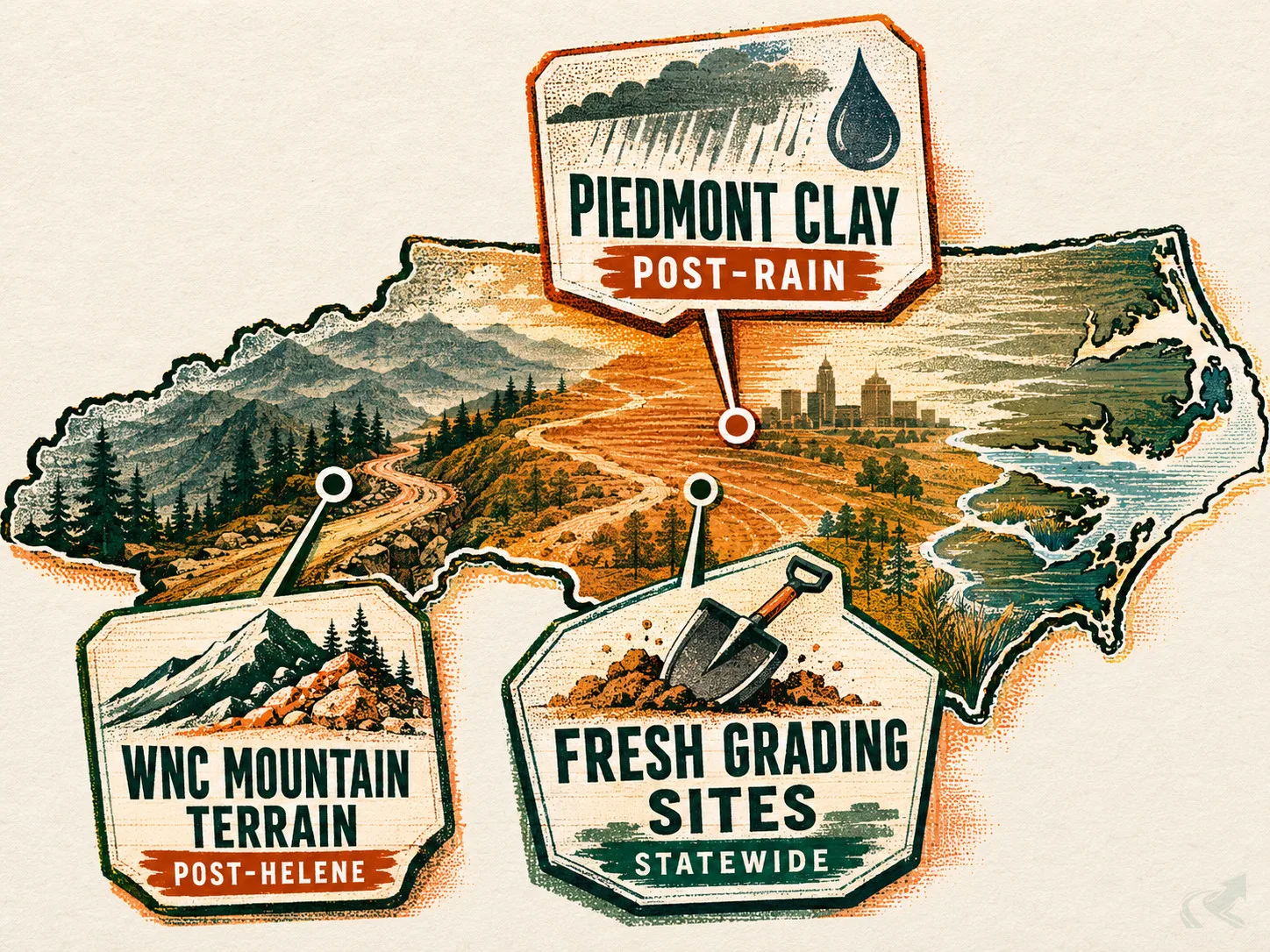
Wet-season NC clay, fresh construction sites, and WNC mountain terrain all favor CTL over wheeled skid steer.
Three scenarios that come up repeatedly in North Carolina residential grading work:
-
Post-rain Piedmont clay. Saturated red clay in the Triangle, Triad, or Charlotte metro after a significant rainfall event is the clearest case. A wheeled machine will leave ruts within the first few bucket passes. A CTL on the same site the same morning usually doesn’t — the track distributes load across more of the clay’s still-firm surface layer.
-
Fresh grading sites. Freshly disturbed NC clay — any site where topsoil has been stripped and the subgrade exposed — is soft and structurally unstable. Wheeled machines on fresh grades create deep wheel tracks that must be re-graded, adding passes and time. CTL track contact area reduces the frequency of this failure mode.
-
WNC mountain terrain. Steep mixed-surface sites with rock outcrops and wet mountain soil after rainfall favor track-driven machines for both traction and stability — a pattern the NC soil guide including mountain zones covers in detail. Wheels can slip on exposed rock sections that tracks can bridge. This matters on Buncombe, Henderson, and Rutherford County sites still in active Helene recovery work.
What to Ask Your Contractor
“Are you bringing a tracked or wheeled machine?” is a reasonable question — and the answer should match your site conditions.
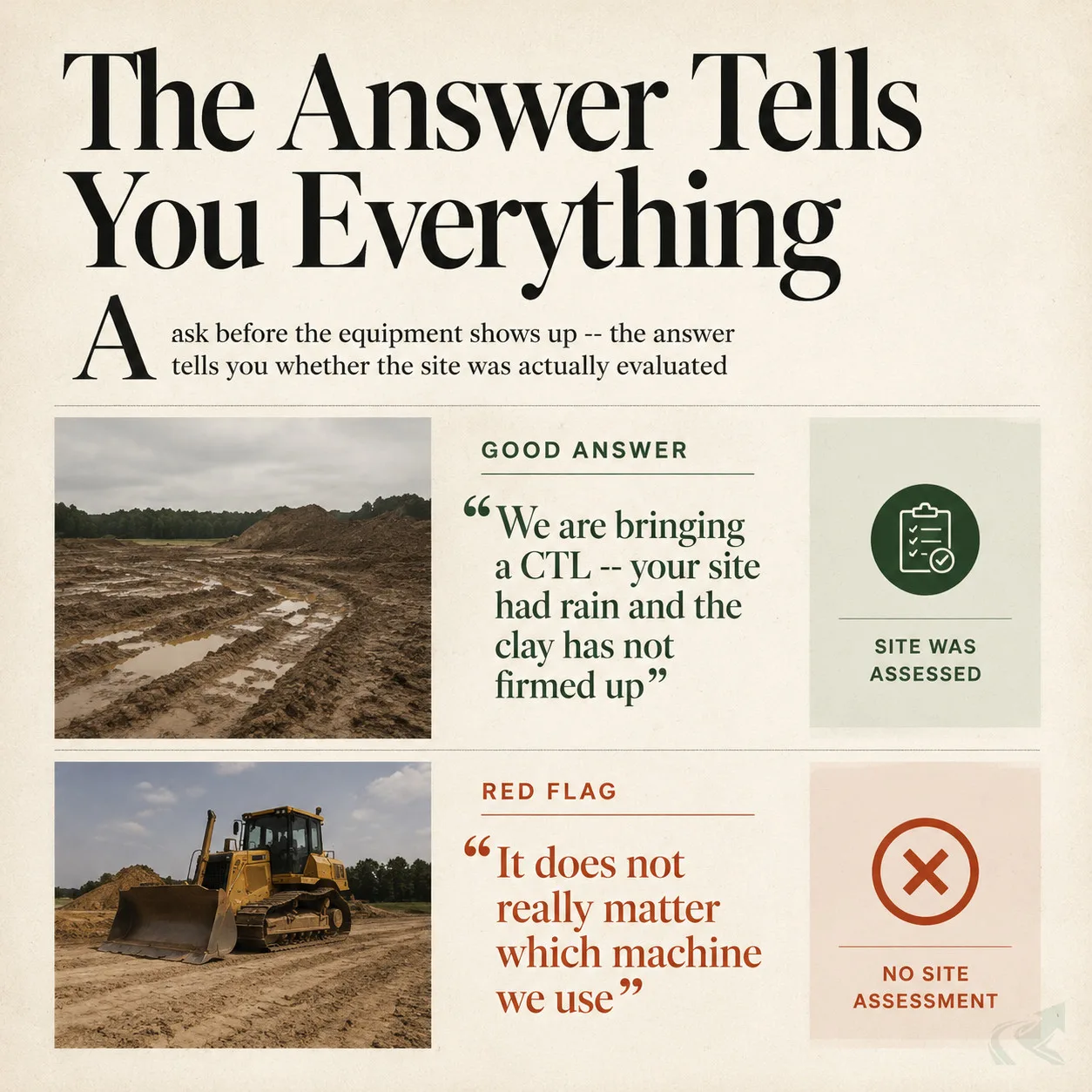
A contractor who understands the distinction will answer directly and explain the reasoning. Here’s the specific question to use:
“For my site conditions — [wet clay / recently disturbed soil / spring season] — are you planning to bring a CTL with rubber tracks or a wheeled skid steer? And what ground pressure does that machine run?”
A contractor who says “it doesn’t really matter” has either not assessed your site or has one machine type on their lot and is justifying the choice retroactively. Neither is the answer you want before a job starts on saturated Piedmont clay.
A contractor who says “we’re bringing a CTL because your site had rain last week and the clay hasn’t had time to firm up” has assessed the site. That’s the answer.
For more on the full equipment landscape beyond the skid steer vs. CTL question, see the full NC grading equipment reference. If you’re weighing a rental option, renting a mini skid steer covers the homeowner rental context for smaller machines. When you’re ready to move forward, hire a grading operator in North Carolina who can specify the right machine for your site before the bid is written.