
Two questions people often ask
Does NC get enough freeze-thaw to damage drainage pipes?
In WNC and the high Piedmont (above 1,000--1,500 ft), yes -- typically 20--40 freeze-thaw cycles per winter. Each cycle stresses pipe joints and saturated clay. The damage accumulates over 2--5 years, not immediately.
What does freeze-thaw do to a driveway?
It heaves the subgrade unevenly, creating small surface depressions that collect water -- which accelerates the next freeze-thaw cycle at those exact spots. The feedback loop deepens every winter.
A homeowner in Hendersonville installed a French drain perimeter system in 2021. It worked well for two winters. By spring 2024, one section stopped draining. A contractor found joint separation at two locations.
The pipe itself was undamaged. Three winters of freeze-thaw cycles had moved the surrounding soil, worked the bell-and-spigot joints loose, and separated them.
North Carolina is not thought of as a cold-climate state. But WNC and high-Piedmont sites produce enough winter temperature oscillation to cause real cumulative damage — to drainage pipes, driveway subgrades, and foundation perimeter drains alike. The damage rarely shows up in year one. It shows up in years two through five, after enough cycles have accumulated to shift the soil and separate the joints.
Understanding the mechanism — and knowing what to ask a contractor before the job starts — is what this page is for.
What Freeze-Thaw Actually Is (NC Context)
NC’s freeze-thaw problem isn’t about deep freezes — it’s about how many times temperature crosses 32F in a single winter.
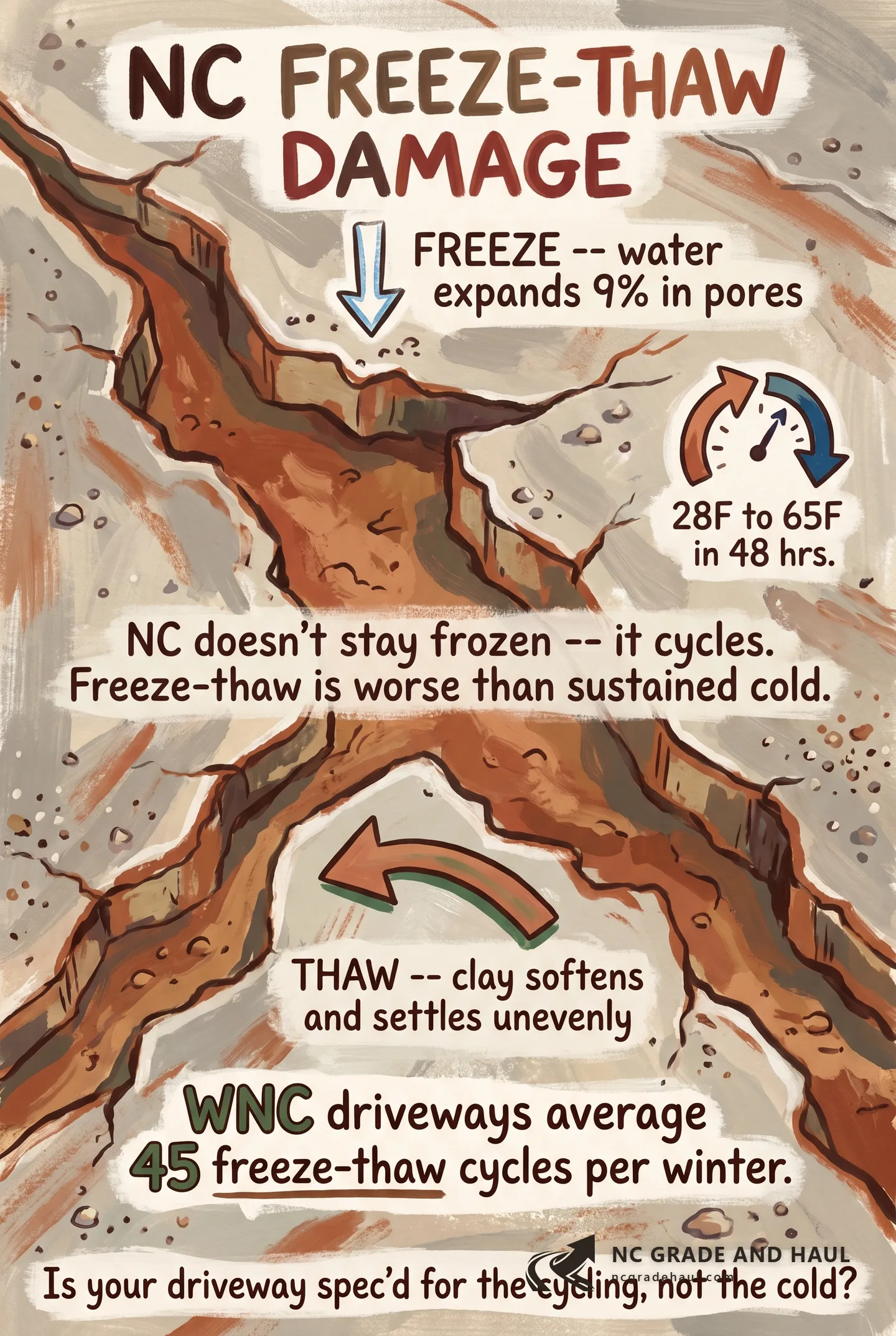
Water expands approximately 9% when it freezes. Soil saturated with water expands and contracts each time the temperature drops below and climbs back above freezing. One cycle causes minimal damage. Thirty or more cycles per winter accumulate to heaved subgrades, loosened pipe joints, and cracked pavement.
North Carolina clay holds water well and releases it slowly. Clay soils stay near saturation for longer after rainfall and freeze at higher moisture content than sandy soils. This is why NC Piedmont clay behaves worse in freeze-thaw conditions than the same temperature profile in sandier coastal soils. Western NC mountain soils and shallow rock create an additional variable at elevation — the soil is thinner, less porous, and freezes faster than lowland Piedmont clay.
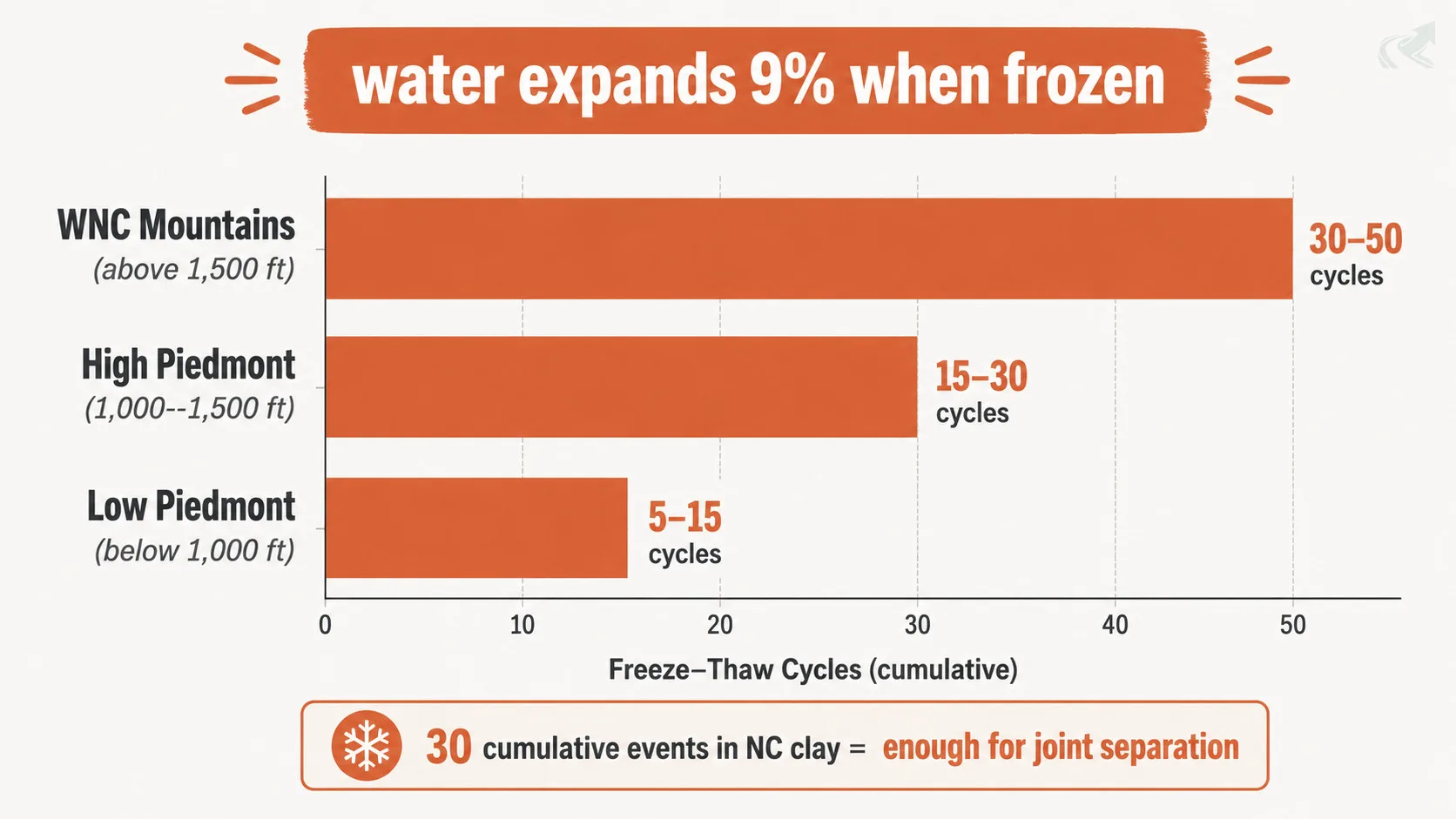
Approximate freeze-thaw cycle counts by NC zone, based on elevation and historical temperature data:
- WNC mountains (above 1,500 ft): 30—50 cycles per winter typical
- High Piedmont (1,000—1,500 ft, including parts of Surry, Stokes, and areas adjacent to the Blue Ridge): 15—30 cycles
- Low Piedmont (Triangle, Triad, Charlotte below 1,000 ft): 5—15 cycles — lower risk, but not zero
The low Piedmont doesn’t get a free pass. A winter with 10 freeze-thaw cycles over 3 years is 30 cumulative events in North Carolina clay. That’s enough to cause joint separation in undersized or improperly bedded drainage pipe.
What Freeze-Thaw Does to Drainage Pipes
The most common freeze-thaw failure in NC drainage systems is joint separation — the pipe is intact, but the joints open up and the system short-circuits.
Three failure patterns show up repeatedly in NC drainage work:
- Joint separation (most common) — corrugated pipe bell-and-spigot joints loosen as soil heaves around them. The drain still flows but at reduced capacity; fine sediment enters at the gap and begins clogging the system.
- Pipe heave — the pipe lifts out of its trench bed when surrounding soil heaves asymmetrically. This changes the drain’s slope. In severe cases it reverses flow at low points, turning a drain into a pond.
- Perforated pipe clogging acceleration — freeze-thaw cycles work fine soil particles into perforated sections faster than stable soil does. A French drain that should stay clean for 10 years may require cleanout in 4—5 if bedded in native clay.
Drainage pipe through NC freeze-thaw: bedded right vs heaved
Comparison. Holds its line: Rigid pipe bedded in #57 stone, not native clay; Tight bell-and-spigot joints stay seated; Buried at or below frost depth for the zone; Slope holds through 30-plus cycles a winter. Separates and heaves: Saturated clay bed expands every freeze; Joints work loose, fine sediment enters the gap; A heaved section reverses slope at a low point; Drain turns into a pond by year two or three.
- Rigid pipe bedded in #57 stone, not native clay
- Tight bell-and-spigot joints stay seated
- Buried at or below frost depth for the zone
- Slope holds through 30-plus cycles a winter
- Saturated clay bed expands every freeze
- Joints work loose, fine sediment enters the gap
- A heaved section reverses slope at a low point
- Drain turns into a pond by year two or three
Freeze-thaw rarely breaks the pipe -- it moves the soil around it, and the joints give way first.
What to specify to reduce freeze-thaw risk in drainage pipe:
- Rigid pipe ( or Schedule 40 ) holds joints better than corrugated poly in repeated freeze-thaw conditions. Corrugated pipe’s accordion profile compresses slightly when surrounding soil heaves; the bell-and-spigot joint moves with it.
- Proper bedding in #57 stone, not native clay. A crushed-stone bed does not expand when frozen the way saturated clay does. Pipe bedded in #57 stone stays closer to its original position through freeze-thaw cycles.
- Burial at or below frost depth for the zone. NC frost depth varies: approximately 12—18 inches in WNC mountains, 6—12 inches in the Piedmont. Pipe buried shallower than frost depth in saturated soil is exposed to the full heave force of every freeze cycle.
What Freeze-Thaw Does to Driveway Subgrades
Freeze-thaw heaves the subgrade unevenly, creating surface pockets that collect water — which accelerates the next cycle at those exact spots.
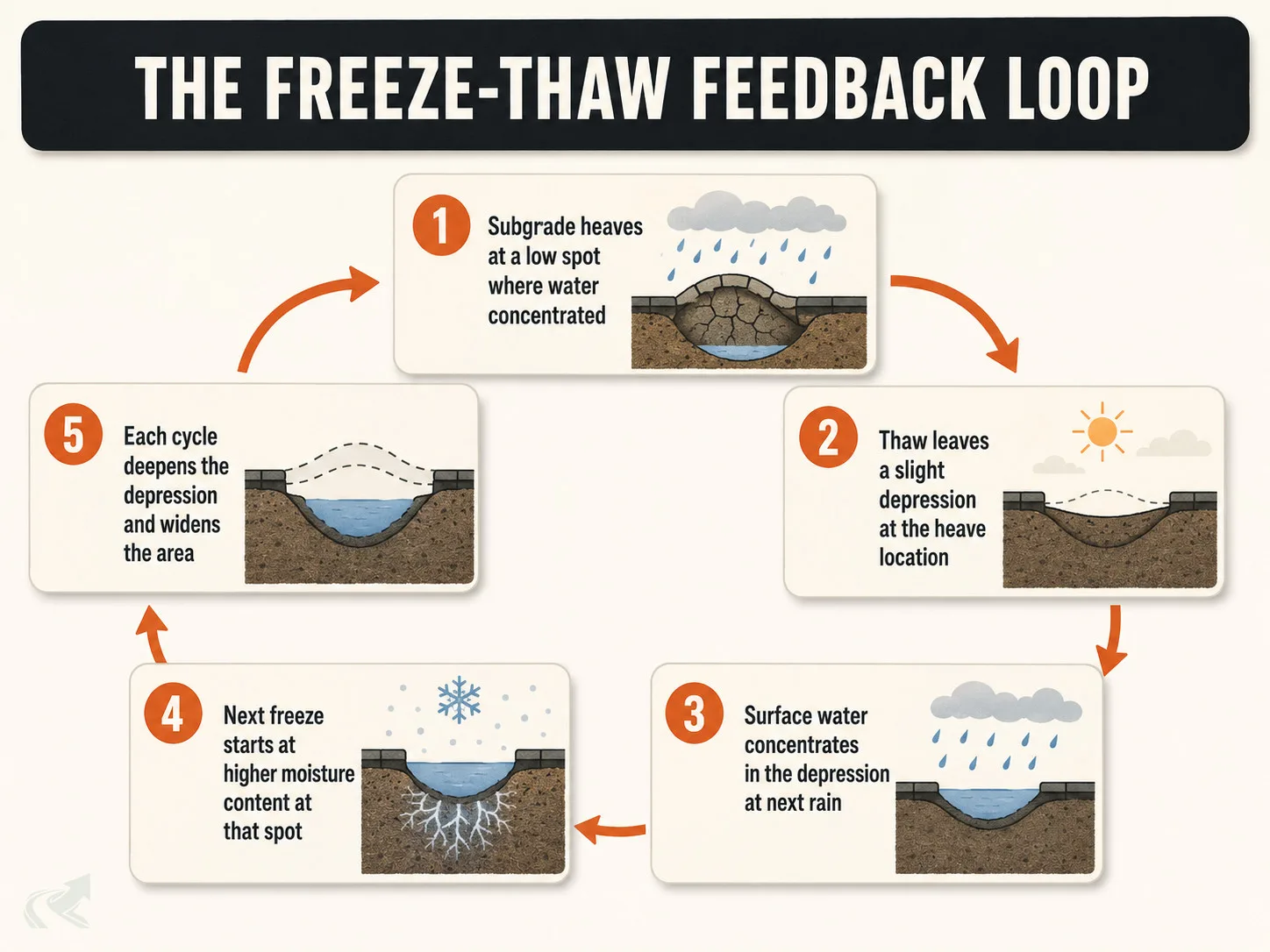
The feedback loop works like this:
- The subgrade heaves at a low spot where water concentrated before the freeze
- When the thaw comes, a slight depression forms at the heave location
- Surface water concentrates in the depression during the next rain
- The next freeze starts at higher moisture content at that spot
- Each cycle deepens the depression and widens the affected area
This is why a driveway that looked fine in year one develops persistent puddles by year three. The puddles are not random — they mark where the subgrade heaved first.
Proper spec for freeze-thaw zones addresses this at installation, not after the fact:
- Subgrade compacted to 95% standard Proctor before any base material goes down. Loose subgrade heaves more dramatically because there is more air space for water to fill.
- base layer at adequate depth. In WNC and the high Piedmont, 6—8 inches of compacted is appropriate for NC driveway grading for freeze-thaw conditions. In the low Piedmont, 4—6 inches is more common — but the lower range is not appropriate for a site with known drainage or freeze-thaw exposure.
- Crown designed to shed water immediately. No flat sections. A flat section at the centerline of a long driveway run will pond water and become the first freeze-thaw failure point. A properly crowned driveway sheds toward the edges before the next freeze.
A proof-roll — driving a loaded dump truck across the subgrade before placing base — reveals soft spots that will heave. It is standard practice in NC residential driveway work and takes less than 30 minutes. If a contractor skips it, the subgrade’s hidden soft spots become the first freeze-thaw failure points.
How to Ask About Freeze-Thaw When Getting a Quote
Three questions reveal whether a contractor is speccing for your zone or using a generic national spec.
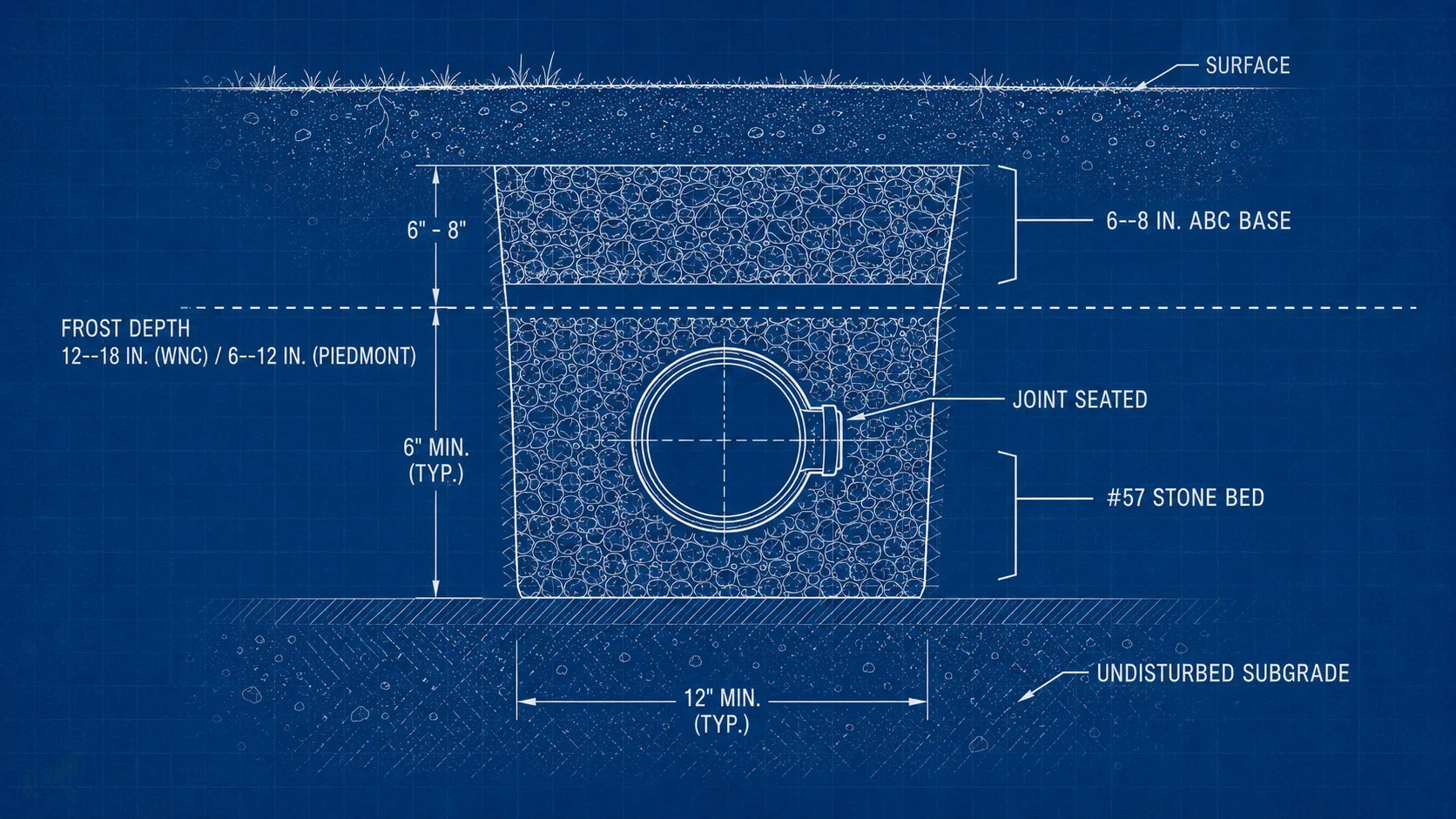
A contractor who answers all three without hesitation is speccing for your zone. One who says “we’ll bury the pipe at 12 inches” without mentioning frost depth is quoting off a template that doesn’t account for where you are.
In WNC, “12 inches” might be adequate. In the same county at higher elevation with wetter soil, it might not be. A contractor who knows the zone knows the difference.
The question card also tells you something about how the contractor approaches itemized specs. An operator who can’t answer the bedding question usually hasn’t thought through the installation in detail. One who says “#57 stone bed, compacted, minimum 6 inches of cover at the joint” has.
If you are in WNC or the high Piedmont and planning a drainage or driveway project, verify that your contractor’s spec accounts for freeze-thaw specifically. It is a $0 question to ask upfront. The answer — and how quickly and specifically the contractor answers it — tells you whether the spec will hold for 2 years or 10.
Hire a grading operator in North Carolina who works in your zone and can speak to local frost depth and bedding standards before the bid is written.