
What do I do with my septic tank after converting to sewer in NC?
Can I just leave the old tank in the ground after converting to sewer?
No -- not without following county abandonment rules. NC counties require documented decommissioning. Abandoning a tank in place without a permit creates a disclosure problem when you sell the property and a future subsidence hazard in the yard.
What is the standard decommissioning sequence in North Carolina?
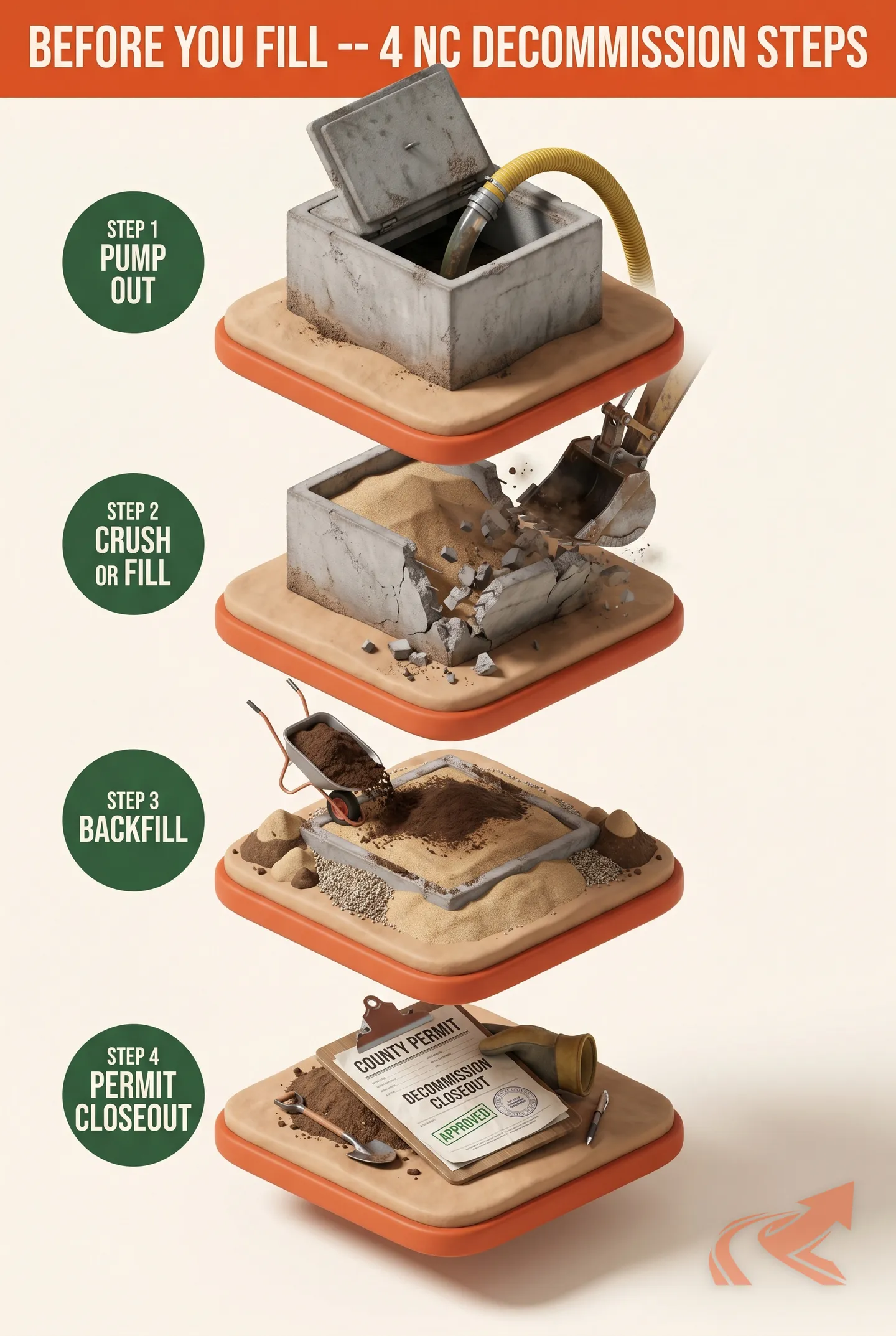
1. Pump the tank completely -- permitted septage management firm only. 2. Choose method: pump-and-crush (tank collapsed, fill placed) or pump-and-fill (tank stays in ground, filled with approved material). 3. Pull county abandonment permit -- required in Wake, Durham, Mecklenburg, and Guilford counties through their environmental health departments. 4. Inspection and permit closeout. Cost add-on to conversion quote: typically $1,000--$3,500 for pump-and-fill; higher for excavation and crush. Confirm with your contractor -- costs vary by tank size, access, and county.
Do NC county rules actually differ on decommissioning method?
Yes -- meaningfully. Some counties require flowable fill specifically; others accept clean fill. Some require an abandonment permit; others route through the county sanitarian. Ask your contractor which method your county accepts before work starts, not after.
The contractor said the old septic tank “needs to come out.” He shook Ray’s hand and moved on to the next question. That was it.
No explanation of what “come out” means. No mention of a permit. No breakdown of the two methods. No number in the quote for the work.
Ray is 66, rural Guilford County. He converted to sewer because the county extended the line to his road. He did the right thing. Now the tank is sitting there and he doesn’t know who calls whom, what it costs, or whether he is legally required to do anything at all.
The answer is: yes, he is required to do something — and what he’s required to do depends on his county. This page covers the full sequence.
Why the Tank Can’t Just Stay There
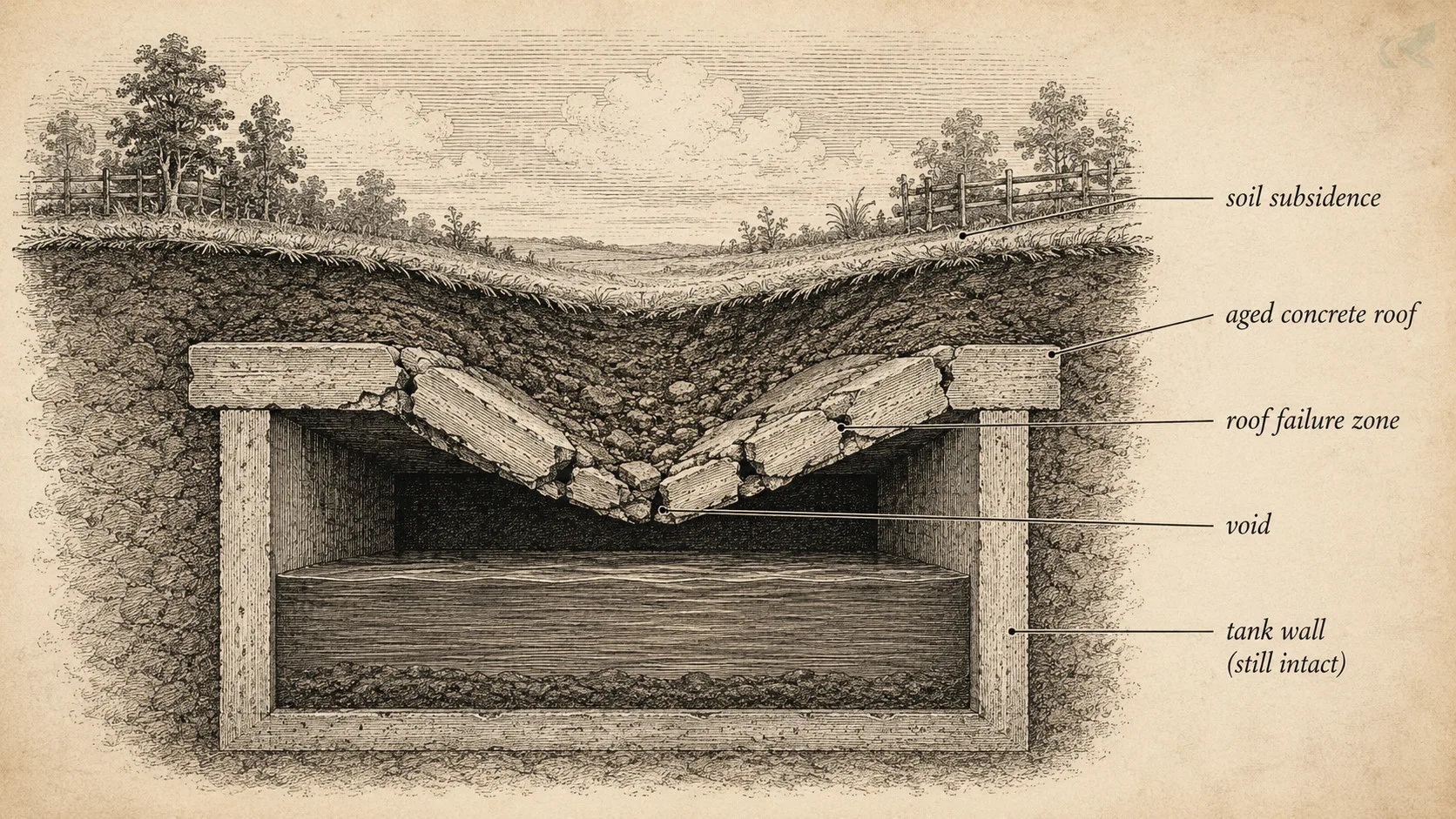
An abandoned-in-place septic tank without documented decommissioning creates two problems: a physical hazard in the yard and a disclosure problem at resale.
Concrete deteriorates. Septic tank roofs are not structural slabs — they are poured at tank-spec thickness, designed to carry soil load but not vehicle or equipment load over time. As the concrete ages and the tank walls lose integrity, the roof can fail. The ground above sags. In a best case, you get a soft spot in the yard. In a worse case, you get a sudden collapse.
That’s the physical problem. The legal one is different.
North Carolina counties require documented abandonment — not just the work itself, but proof that the work happened. A pump ticket, a fill receipt, a permit number, an inspector’s sign-off. If you sell the property without that documentation, the undocumented tank shows up in disclosure and creates a title problem. Buyers ask for it. Attorneys ask for it. County inspectors ask for it.
Skipping the permit doesn’t make the tank go away. It makes the paper trail disappear — and the tank stays.
The Required First Step — Pump-Out
Before any other decommissioning work, the tank must be completely pumped by a permitted septage management firm.
“Completely pumped” means the accumulated sludge and effluent are removed to the point where the tank is empty enough to work in or fill. The state rule (15A NCAC 18E .1307) requires that contents be removed by a permitted septage management firm; the general standard is that nothing remains that would create a methane pocket or a health hazard for the fill crew.
The pump truck driver takes the waste to a licensed treatment facility. You receive a pump ticket — the dated, signed record showing the licensed contractor performed the work. Keep that ticket. It is the first document in your decommissioning record.
Typical pump-out cost in the NC Triangle and Triad markets: $300—$500 for a standard residential tank (1,000 gallons). Charlotte-area rates run higher — up to $900 depending on tank size and access. Costs vary by region, tank size, and whether service is scheduled or emergency.
The pump-out cannot be skipped, combined with another step, or done after the fill. It is always first.
Method 1: Pump-and-Crush
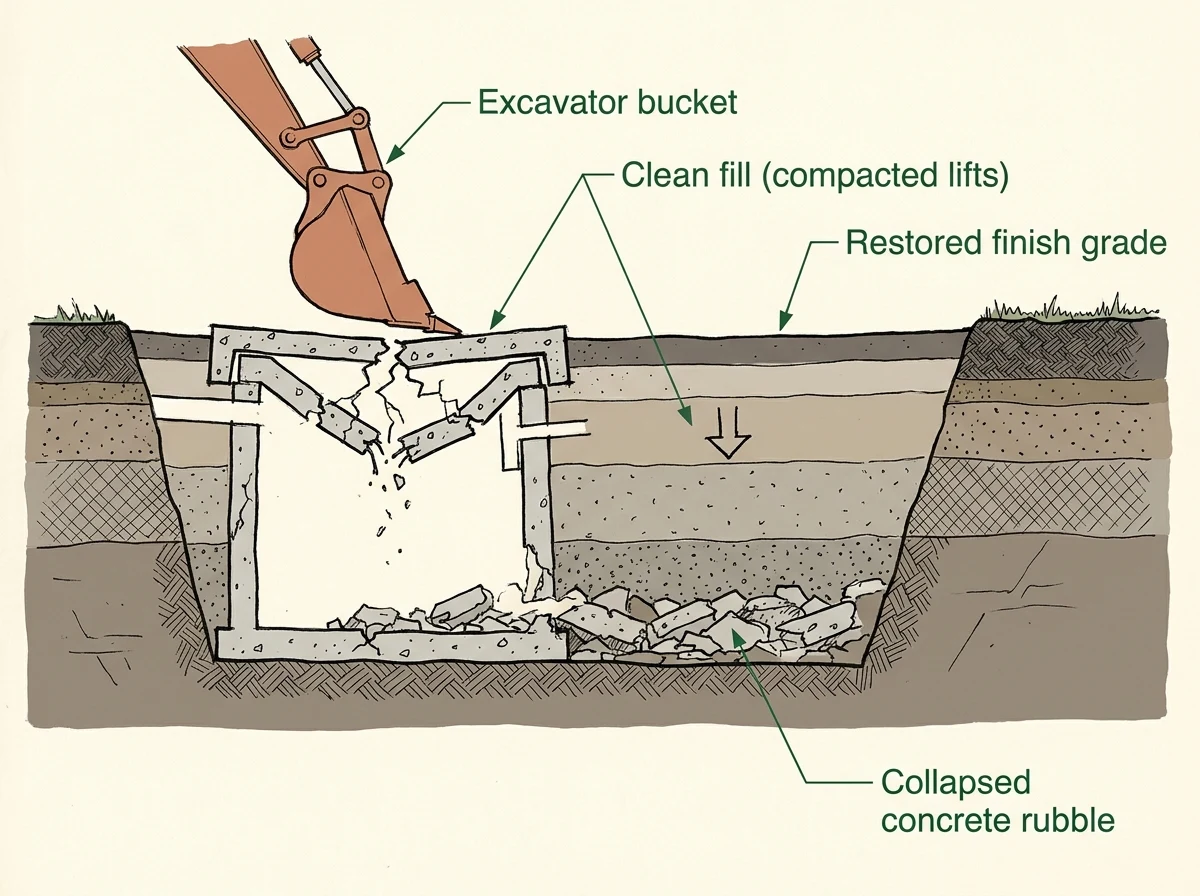
The tank is collapsed in place using an excavator — concrete rubble remains in the hole, fill is placed over the rubble and compacted.
Pump-and-crush is the more complete option. After the pump-out, an excavator breaks the tank walls and roof down into the tank interior. The crushed concrete sits in the pit as rubble. Clean fill is placed over the rubble and compacted in lifts. The area is graded back to finish grade.
This method works best when the tank is accessible — within reach of excavator swing, not under a structure, not unusually deep. If the tank is within 5 or 6 feet of the surface and the site has room to maneuver, crush is a straightforward add-on for a grading contractor already on site.
When it gets expensive: deep tanks (10+ feet), tanks beneath mature trees or established landscaping, tanks close to the foundation line, or tanks in tight side yards where excavator access is constrained. The equipment cost stays flat; the access difficulty is what raises the number.
Total cost for pump-and-crush in NC typically runs $1,500—$4,000 or more depending on tank depth, site access, and whether a grading contractor is already mobilized on site for the sewer lateral work. Pump-and-fill (flowable fill) is generally $1,000—$2,500. Confirm with your contractor — access difficulty drives the variance more than the method itself.
The comparison table below lays out when each method makes sense.
Method 2: Pump-and-Fill
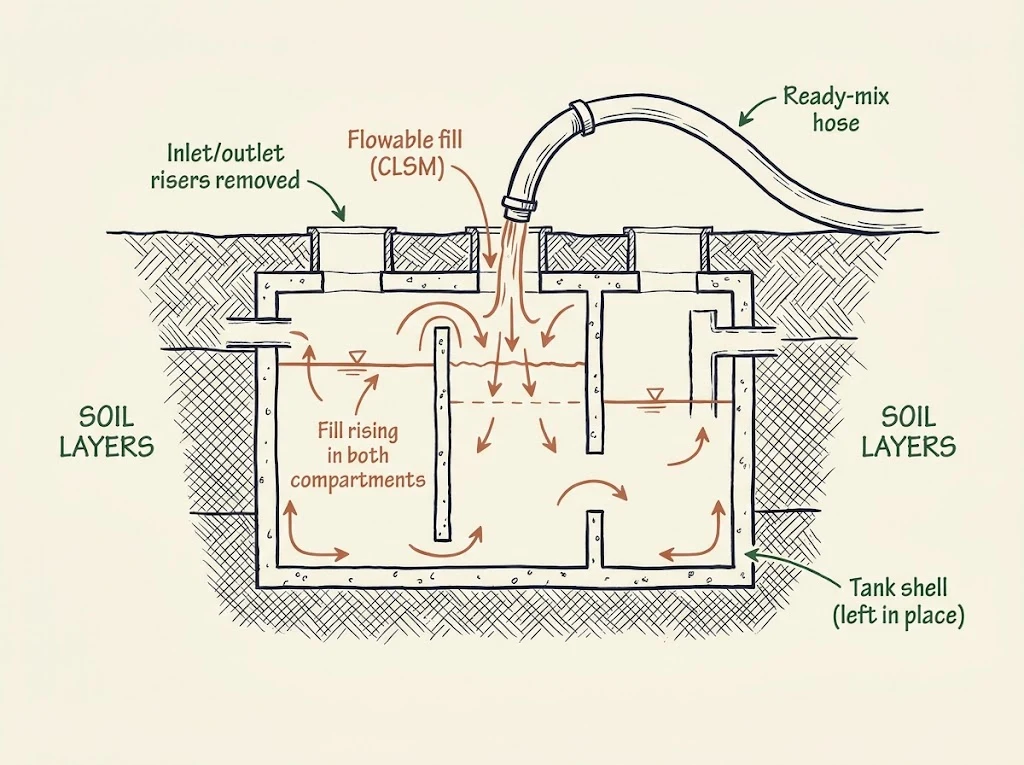
The tank stays in the ground. The top is punctured or inlet and outlet risers are removed to prevent vacuum, and the tank is filled with flowable fill (CLSM) or clean fill.
Pump-and-fill is the more common method when site access is tight or when the tank is deep enough that excavation would be disruptive. The tank shell remains in the ground permanently — the fill eliminates the void so the collapse risk goes away.
Two fill materials are used in North Carolina:
Flowable fill (CLSM — Controlled Low-Strength Material): A ready-mix slurry pumped into the tank. It flows into both compartments and every corner without additional compaction effort. Void risk is effectively zero. Fill material requirements vary by county. Wake County’s official abandonment procedure accepts sand, pea gravel, or concrete fill; Mecklenburg County specifies compacted clean soil or crushing in place with clean soil fill. No NC county has been confirmed to mandate flowable fill CLSM specifically — but it is the safest choice for void-free placement when county requirements are ambiguous. Confirm accepted fill materials with your county environmental health office before committing to a method. For detailed background on the material itself, see flowable fill for NC septic tank decommissioning backfill.
Clean fill: Granular fill placed through risers or a punctured top. Lower material cost than flowable fill. The risk: solid fill bridges over internal baffles and leaves voids in the second compartment. On older tanks with corroded baffles, bridging is common. Counties that accept clean fill typically require the contractor to confirm void-free placement — which is harder to document than a flowable fill ticket.
Ask your contractor which method your specific county accepts before committing to a quote.
County Permit Requirements
Most NC counties require an abandonment permit — pulled by the contractor, inspected by the county sanitarian, closed out with documentation you keep.
Wake, Durham, Mecklenburg, and Guilford counties all require abandonment permits through their environmental health departments. Wake County’s procedure requires a Wastewater Abandonment Permit, pump-out by an approved hauler, and inspection. Durham County uses a Septic Tank Abandonment Record form through Environmental Health. Mecklenburg County Environmental Health requires the tank to be filled with compacted clean soil or crushed in place and filled with clean soil. Guilford County Environmental Health’s On-site Wastewater Program oversees permitting and inspection for abandonment — contact them at (336) 641-7613 or 400 W. Market St., Greensboro to confirm their current abandonment form and fee before work begins.
The pattern across most NC counties: the contractor pulls the abandonment permit from the county environmental health office before work begins. The county sanitarian may inspect the method at completion or accept the pump ticket plus fill receipt as documentation. Permit closeout produces the record you need for resale disclosure.
The applicable NC regulatory framework is 15A NCAC 18E .1307 (Wastewater System Abandonment), which requires tanks to have contents removed by a permitted septage management firm, be removed/collapsed/rendered unable to retain liquid and backfilled, and have electrical components de-energized. County environmental health departments enforce this rule locally.
What to keep in your records after the job closes:
- County abandonment permit number and issue date
- Pump ticket — contractor name, license number, date, volume
- Fill delivery receipt or CY ticket — material type, quantity, delivery date
- Inspection date and inspector name (if a site inspection was required by your county)
If you sell the property and can’t produce these documents, the buyer’s attorney will ask for them. The permit number alone isn’t enough — you need the supporting chain.
For guidance on NC permit processes more broadly, see NC county permits for septic tank decommissioning.
Who Does the Work
Pumping goes to a licensed septage hauler. Excavation (if crush method) goes to a grading or excavation contractor. Flowable fill delivery comes from a ready-mix supplier. The contractor typically pulls the permit.
These are three different trades. The coordination question — who manages the sequence — is worth asking before you sign a quote.
If your sewer conversion contractor is a general contractor or full-service site contractor, they may include decommissioning in their scope. Most do not. The typical conversion quote covers the sewer lateral and the connection at the house — tank decommissioning is a separate line. Ask explicitly: “Is septic tank decommissioning in this scope, or is that separate?”
If decommissioning is separate, you are coordinating:
- A licensed pump truck for pump-out
- Either a grading/excavation contractor (crush method) or a ready-mix supplier plus a contractor to manage the pour (flowable fill method)
- Permit pull from the county environmental health office — typically the contractor’s job, not the owner’s, but confirm this with your county
A single grading contractor who handles excavation and coordinates the pump-out + permit is the most efficient path. For verified NC grading contractors who carry active NCLBGC licenses and confirmed workers’ comp coverage, see hire a grading operator in North Carolina.
Method Comparison
| Method | Tank disposition | Equipment needed | Typical NC cost (market range) | When appropriate |
|---|---|---|---|---|
| Pump-and-crush | Collapsed in ground, rubble filled | Excavator + pump truck | $1,500—$4,000+ (access-dependent) | Accessible tank, site has room, shallow depth |
| Pump-and-fill (flowable fill) | Left in ground, void-free fill | Pump truck + ready-mix truck | $1,000—$2,500 | Access-constrained; fill material requirements vary by county |
| Pump-and-fill (clean fill) | Left in ground, granular fill | Pump truck + fill delivery | $800—$1,800 | County accepts; large tank; documented void-free placement |
Three Common Mistakes
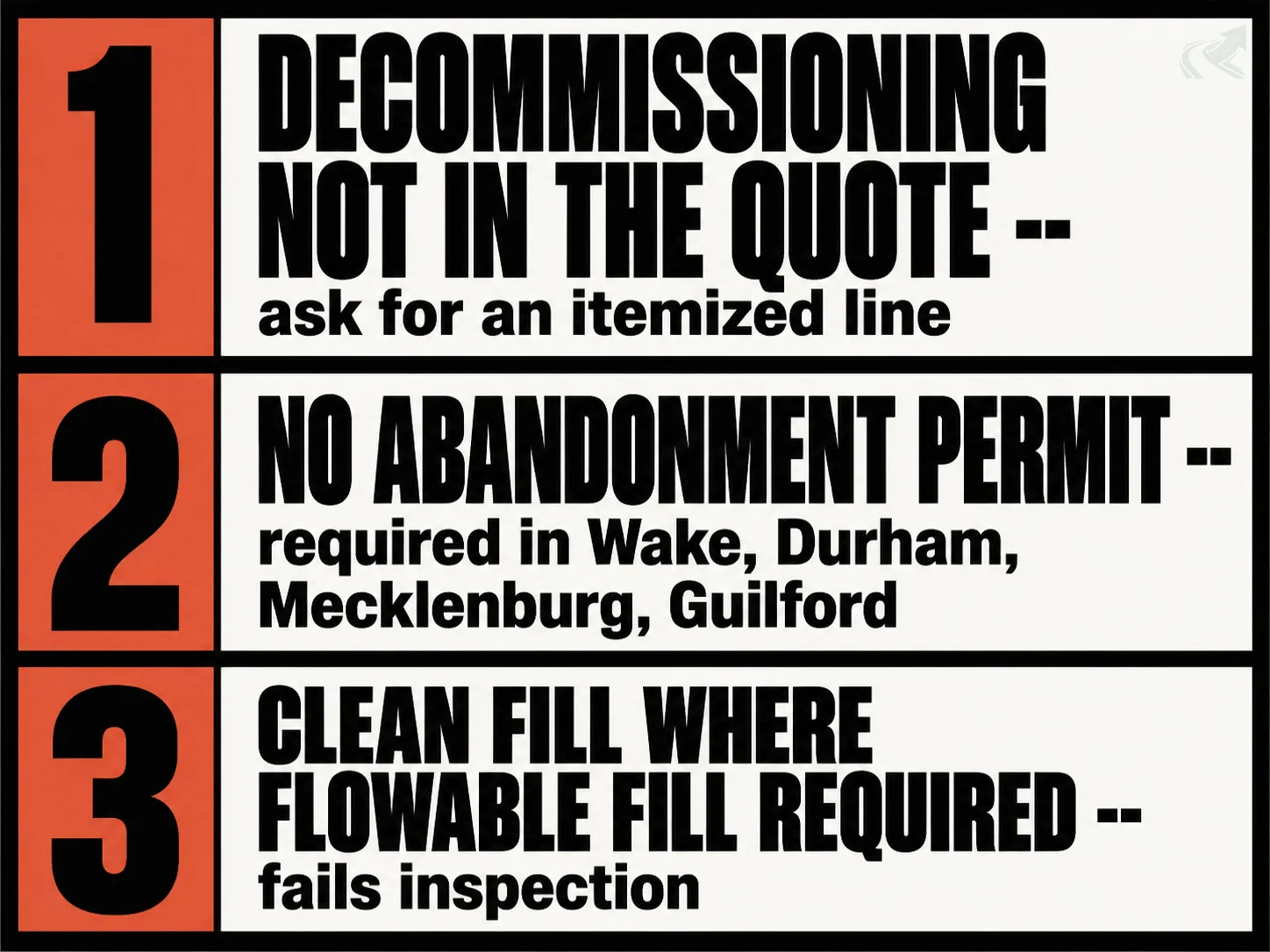
Assuming decommissioning is in the sewer conversion quote. Most NC sewer lateral contractors price the lateral and connection only. Decommissioning is a separate scope. Get an itemized quote that lists each line — pump-out, fill method, permit — so there are no surprises after the lateral is in the ground.
Skipping the abandonment permit because a neighbor said it wasn’t required. The permit creates the documented record you need at resale. “My neighbor didn’t pull one” is not a defense in a property disclosure dispute. County requirements change. Pull the permit.
Using clean fill in a tank the county requires to be flowable-filled. Solid granular fill bridges over internal baffles and leaves voids in the second compartment. Flowable fill eliminates that risk because it flows into every space. If your county requires flowable fill, clean fill is not a cheaper substitute — it’s a failed inspection.
Decommissioning Record Checklist
Keep this after the job closes out. Formatted for a phone or clipboard reference:
For the full picture of what NC sewer conversion involves — lateral installation, connection costs, gravity vs pump options — see NC septic-to-sewer conversion including tank decommissioning. For cost breakdowns by conversion type, see NC sewer conversion cost by gravity vs pump.
If you need a grading or excavation contractor who can handle the crush method and coordinate the permit, NC Grade and Haul’s directory surfaces contractors who have cleared license-board, workers’ comp, and OSHA checks. Find a grading contractor in North Carolina to get an itemized quote that covers the decommissioning scope separately from the lateral work.