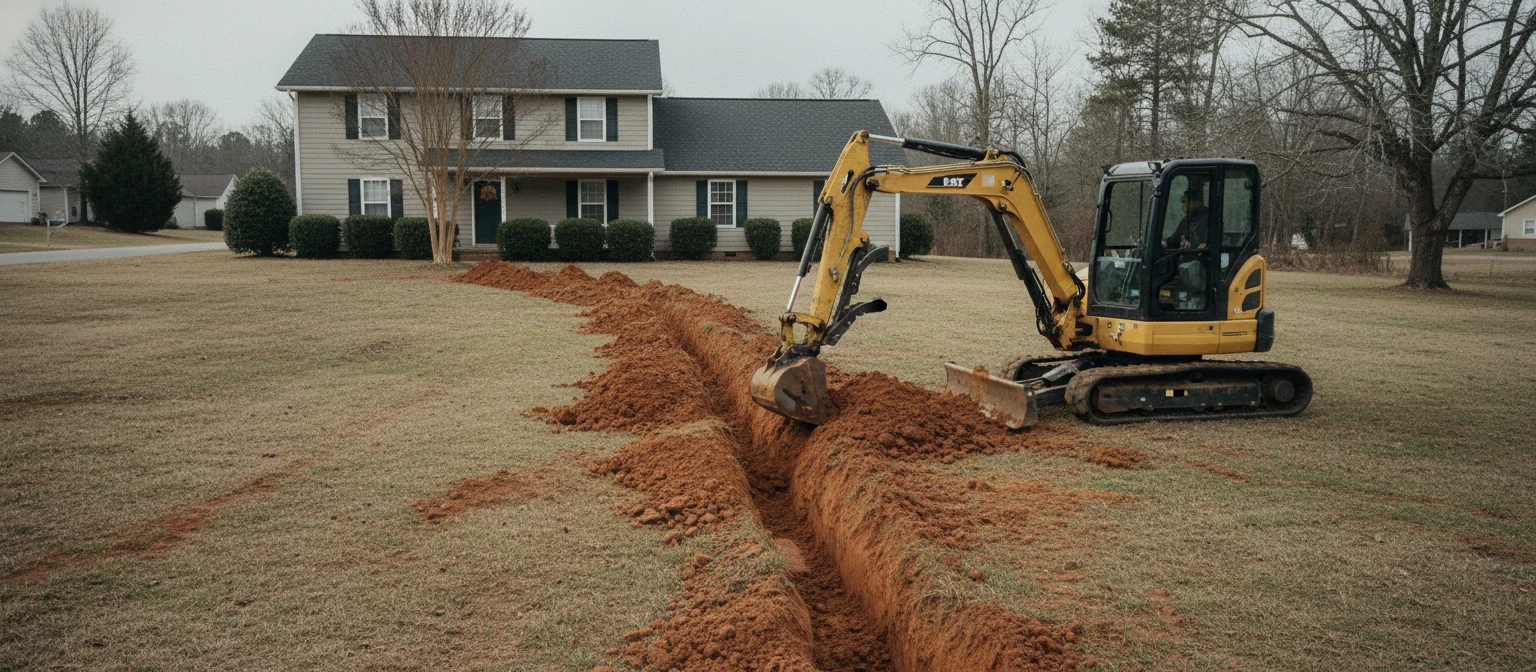
How much does septic to sewer conversion cost in NC?
What does a gravity sewer connection cost in NC?
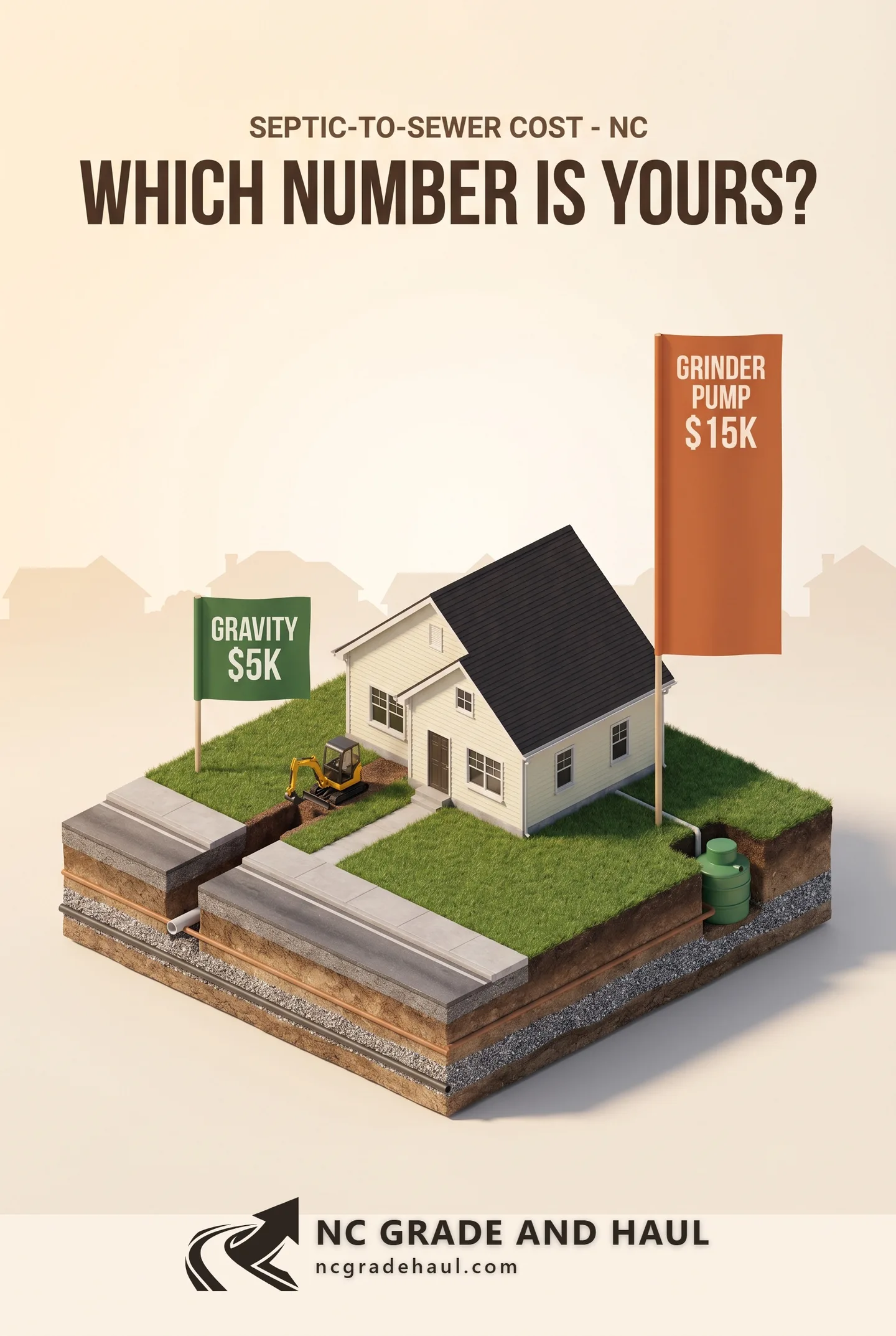
Gravity connection (your home sits above the sewer main): typically $3,000--$8,000 in NC markets -- contractor cost only. This covers lateral installation and plumber tie-in. Permit fees and the utility connection fee are separate line items. Get itemized quotes from at least two licensed contractors; site conditions vary widely.
What does a grinder pump sewer connection cost in NC?
Grinder pump required (your home sits below the sewer main): typically $8,000--$20,000+ in NC markets -- contractor cost only. The pump unit, electrical connection, and installation drive the premium. Annual maintenance adds ongoing cost gravity systems don't carry. Get itemized quotes; grinder pump costs vary significantly by site.
What are the permit and connection fees on top of contractor cost?
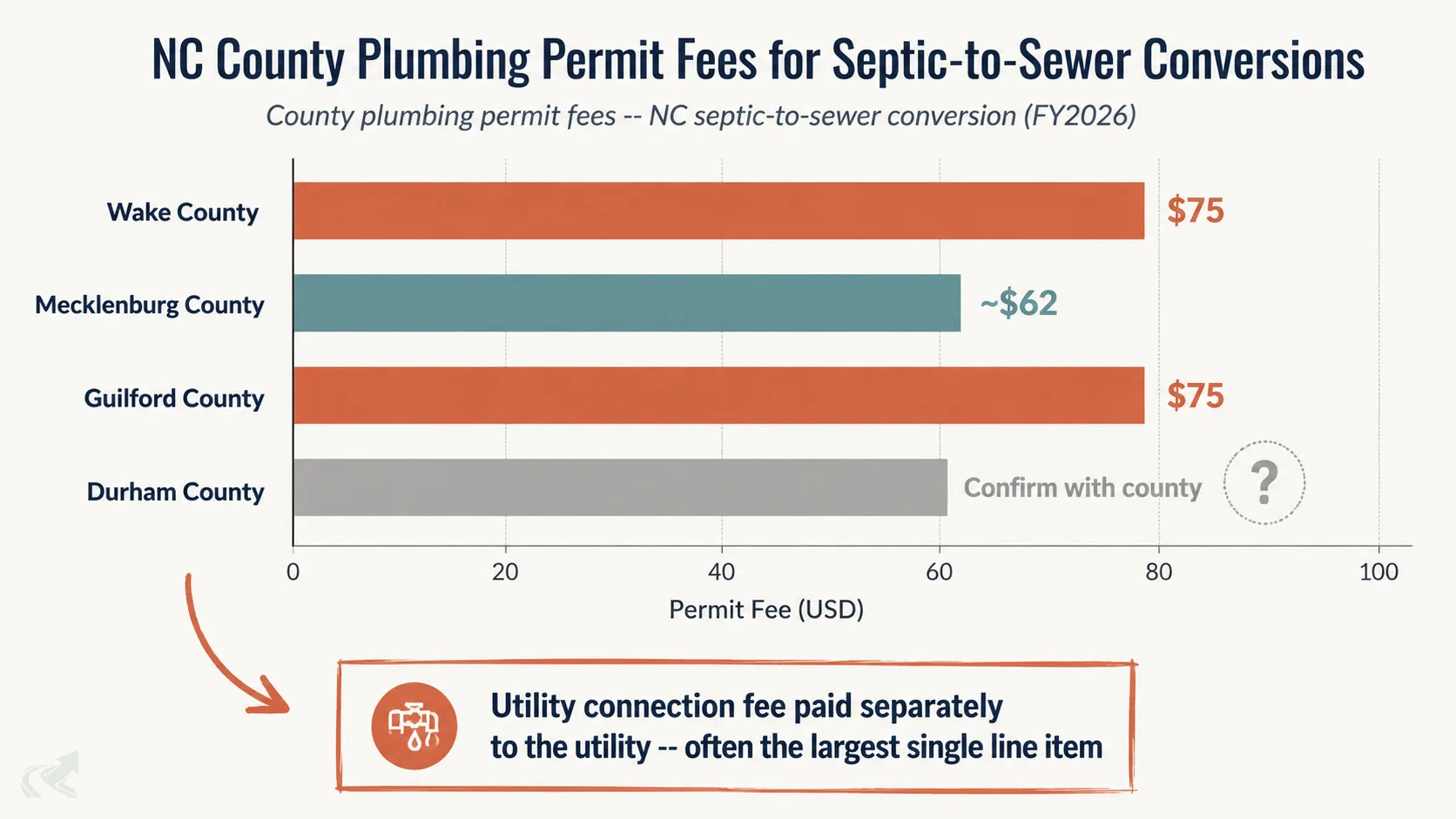
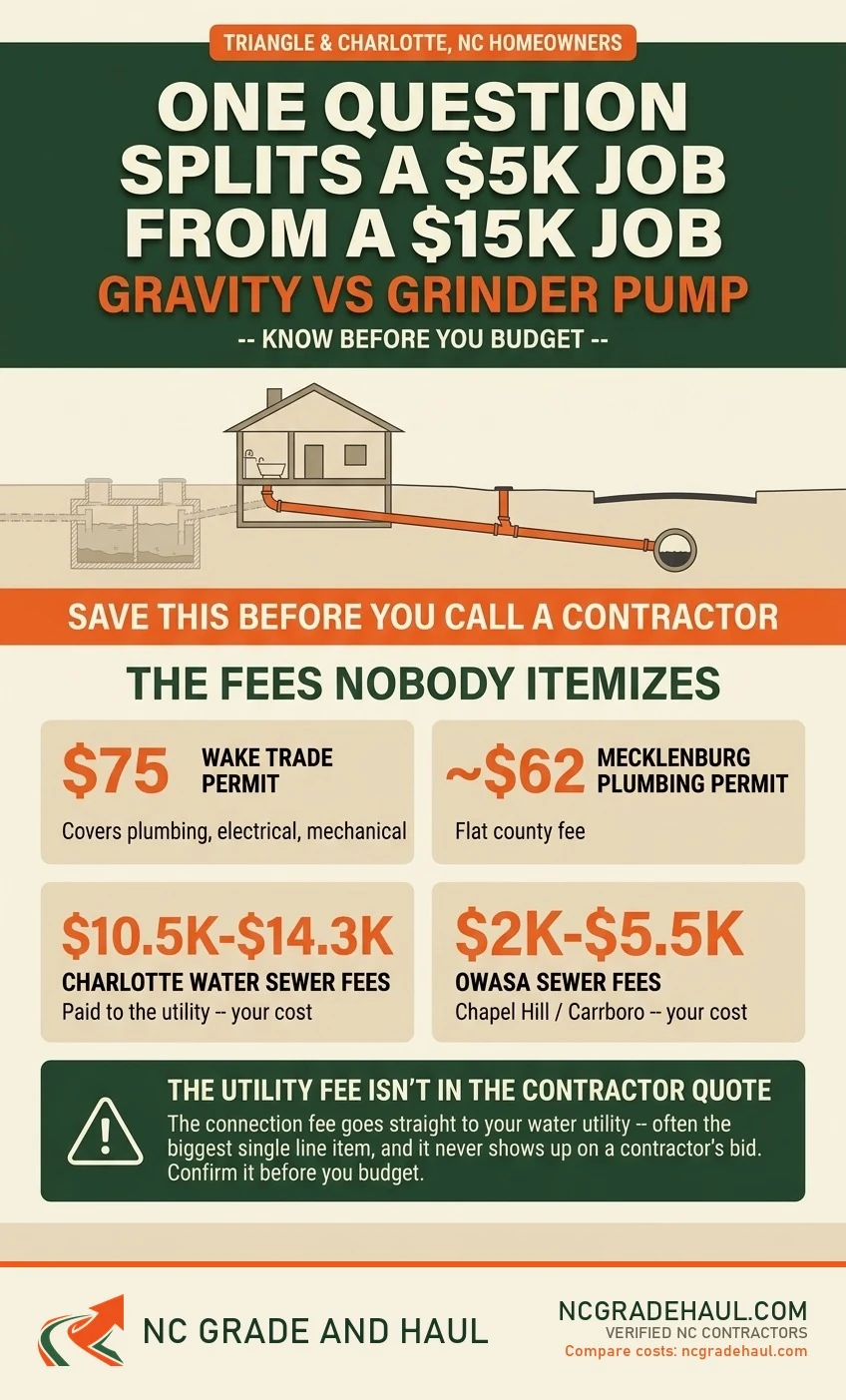
County plumbing permit fees vary widely: Wake County residential trade permit is $75; Mecklenburg County plumbing permit is about $62. The utility connection fee is a separate charge paid directly to the utility, not the contractor -- and it is often the largest single line item. Published utility schedules show Charlotte Water sewer connection plus system development fees of roughly $10,500--$14,300 depending on meter size, and OWASA sewer fees of roughly $2,000--$5,500. Confirm the exact connection fee with the specific utility that serves your address before budgeting.
Does Durham County help offset the cost?
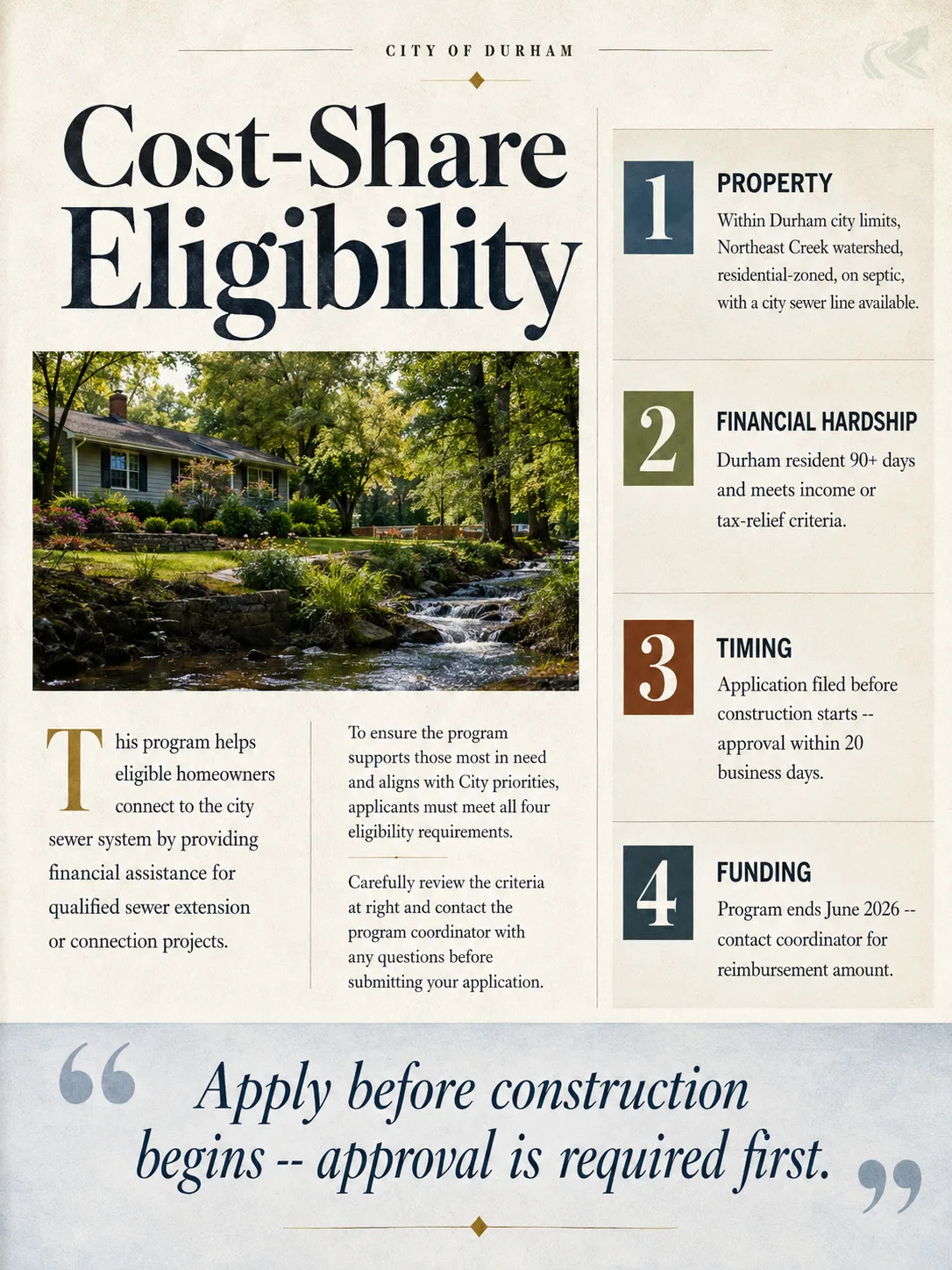
The City of Durham's Residential Septic to Sewer Cost-Share Project can offset conversion cost for qualifying properties -- but the exact reimbursement amount is not published on the city's public-facing page; contact the program coordinator at 919-560-4326 ext. 30211 to confirm current figures. Eligibility requires the property be within Durham city limits, in the Northeast Creek watershed, on septic, and residential-zoned. Financial hardship criteria apply. Application must be submitted before construction begins. Funding ends June 2026.
Ray got a letter from Guilford County. Sewer is available on his road. The letter says conversion may eventually be required. Before he calls a contractor — before he calls anyone — he wants to know what this is going to cost.
That’s what this page covers: what drives the cost difference between a gravity connection and a grinder pump system, what permits and utility fees add on top, and whether Durham County’s cost-share program applies to his situation.
Contractor cost ranges on this page are market estimates — not government-published figures. Costs vary by county, site conditions, contractor, and distance from your home to the sewer main. Government fees (permit fees, utility connection fees, Durham cost-share) are verified against published schedules and official program pages. Get itemized quotes — plural — before committing.
Gravity vs Grinder Pump — The Cost Driver
The single variable that splits a $5,000 job from a $15,000 job is whether your home sits above or below the sewer main.
Sewer flows by gravity. When your home’s plumbing exits above the level of the main, the lateral — the pipe connecting your house to the street main — runs downhill and the system works without assistance. That’s a gravity connection.
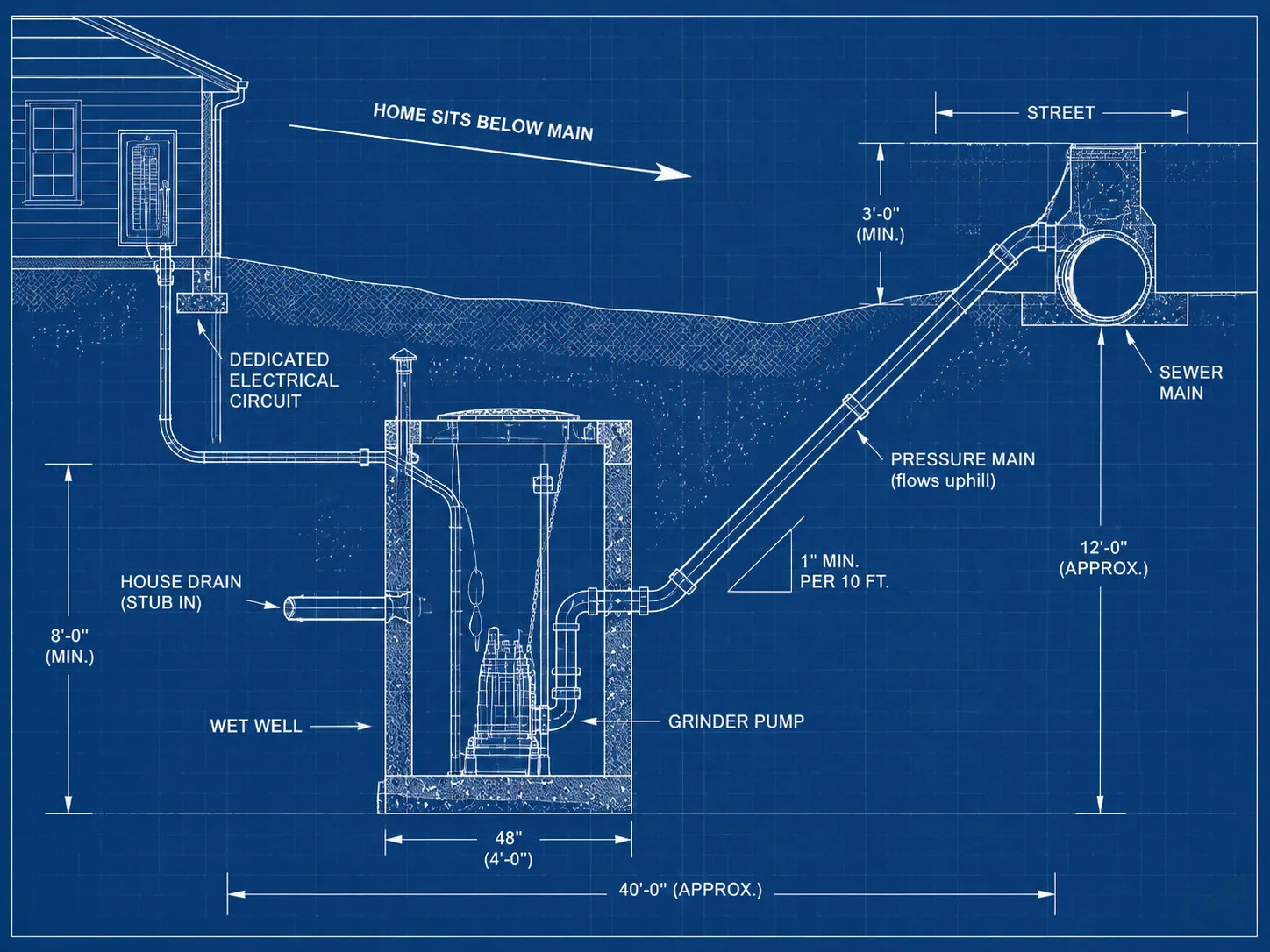
When your home sits below the main, sewage can’t flow uphill on its own. You need a grinder pump system to macerate and pressurize waste, pushing it up and into the main. That mechanical assist is what drives the cost premium.
The cost swing is real: gravity connections typically run 2x to 3x cheaper than grinder pump installations — a reflection of the pump unit, dedicated electrical circuit, and wet well excavation that gravity systems don’t require. Before you call a contractor, walk your lot and look at the street. Does the road sit visibly higher than your foundation? That’s a rough signal you may be in grinder pump territory. A licensed plumber or grading contractor can confirm with a site visit.
For a detailed explanation of how elevation affects connection type, see how gravity vs pump affects NC sewer conversion cost.
Gravity Connection Cost Breakdown
Gravity lateral installation in North Carolina typically runs $3,000—$8,000 in NC markets — contractor cost only, not counting permit fees or the utility connection fee. This is a market estimate; get itemized quotes from at least two licensed contractors before budgeting.
The line items in a typical gravity connection:
- Lateral installation — trenching from house to sewer main, pipe, backfill, surface restoration
- Plumber tie-in inside the home — connecting existing drain system to the new lateral
- County plumbing permit — separate from the contractor’s quote, paid to the county
- Utility connection fee — paid directly to the water/sewer utility, not the contractor. Charlotte Water and OWASA rates are confirmed against published FY26 schedules below; confirm the rate for your specific service area
What drives the high end of the gravity range: longer lateral run (more trench footage), deep trench required by soil conditions or frost depth, obstacles like tree roots or an existing driveway crossing, and Piedmont red clay that requires extra compaction care at backfill. Ask for a per-linear-foot breakdown on the lateral so you can compare quotes accurately.
Grinder Pump System Cost Breakdown
A grinder pump system in North Carolina typically runs $8,000—$20,000+ — contractor cost only — driven by the pump unit cost, electrical connection, and installation complexity. This is a market estimate; get itemized quotes from at least two licensed contractors before budgeting.
The line items that make grinder pump conversions more expensive:
- Pump unit — the grinder pump itself, a pressure vessel, and check valves
- Electrical connection — the pump needs dedicated power, which typically means a new circuit from the panel
- Wet well / burial — the pump sits in a buried tank; excavation and concrete work add labor
- County permit fees — same structure as gravity, but electrical permits add a separate line item; confirm with your county building inspections department
Grinder pump systems also carry ongoing costs gravity connections don’t. Annual pump inspection is standard practice — confirm the service call cost with local plumbers when getting quotes. The pump draws power continuously when active — factor monthly electricity into the long-run comparison.
For the full breakdown of what a grinder pump system involves, see grinder pump cost for NC sewer conversion.
Permit Fees by County
County permit fees are paid directly to the county — not to the contractor — and are not included in most contractor quotes unless explicitly stated.
[Wake and Mecklenburg permit fees verified against published schedules; Durham and Guilford fees still require confirmation. Fees change; confirm with each county’s building inspections department before budgeting.]
| County | Connection / plumbing permit fee (estimated) | Notes |
|---|---|---|
| Wake | $75 residential trade permit (covers plumbing, electrical, and mechanical as one fee) | Separate land-disturbance permits may apply. Confirmed: wake.gov |
| Durham | Confirm with City-County Building & Safety (durhamnc.gov/293) | Northeast Creek cost-share applicants: confirm permit timing with program coordinator |
| Mecklenburg | ~$62 plumbing permit (flat fee; confirm with LUESA) | Charlotte Water connection fee billed separately by utility |
| Guilford | $75 residential trade permit (covers plumbing, electrical, and mechanical as one fee) | Confirmed: guilfordcountync.gov/our-county/inspections/fee-schedule. Check both city and county requirements for Greensboro-area properties |
The permit process in North Carolina typically runs: application submitted by licensed plumber or contractor — county review — permit issued — work performed — county inspection. NC statute allows up to 15 business days for permit review; total timeline from application to final inspection commonly runs two to six weeks depending on county workload and inspection scheduling.
The permit is pulled by the licensed contractor or plumber, but the fee is the homeowner’s responsibility. Confirm this is itemized separately in your quote — some contractors bundle it, some do not.
Utility Connection Fees by Service Area
The utility connection fee is paid directly to the water or sewer utility — not to the contractor — and is typically the largest single line item after the contractor’s installation cost.
These fees are published in utility rate schedules and change periodically. Confirm the current rate with your utility before budgeting. Here are published figures for major NC utilities serving the Triangle and Charlotte regions:
- Charlotte Water (Mecklenburg County, FY26 effective 07/01/2025): Sewer Connection Fee for a 4-inch service is $6,132. Sewer System Development Fee is $4,421 for a 5/8-inch domestic meter or $8,168 for a 1-inch domestic meter. Total Charlotte Water sewer fees for a typical residential connection run roughly $10,500—$14,300. (Source: Charlotte Water FY26 Rate & Fees)
- OWASA (Orange County / Chapel Hill-Carrboro, effective 07/01/2025 and 10/01/2025): Sewer System Development Fee for a single-family 5/8-inch meter ranges from $1,147 (under 500 sq ft) to $4,690 (over 3,800 sq ft). Sewer tap charge is $810 minimum. Total OWASA sewer fees for a typical residential connection run roughly $2,000—$5,500. (Source: OWASA Schedule of Rates, Fees, and Charges)
- Triangle service areas (Raleigh Water and others): Most of the Triangle — Raleigh, Garner, Wake Forest, Rolesville, Knightdale, Wendell, and Zebulon — is served by Raleigh Water for sewer. Connection and system development fees vary by service area and meter size; confirm the current schedule directly with the utility that serves your address before budgeting.
These fees are in addition to the county plumbing permit and the contractor’s installation quote.
The Durham Cost-Share Program
The City of Durham’s Residential Septic to Sewer Cost-Share Project can offset conversion cost for qualifying properties — but the reimbursement amount is not published on the city’s public page; contact the program coordinator before budgeting. The application must be submitted before construction begins.
The Northeast Creek watershed in Durham has a sewer expansion program that helps offset conversion costs for properties within the designated service area. The reimbursement is structured as a cost-share, not a full subsidy — the homeowner still bears the remainder of the contractor and permit costs.
Key eligibility requirements (verified from City of Durham, 2026):
- Property — must be connected to a septic system, zoned residential, within the City of Durham limits, within the Northeast Creek watershed boundary, and have a City of Durham sanitary sewer line available
- Financial hardship — must be a Durham resident for at least 90 days AND meet one of the following: enrolled in a Durham County property tax relief program; household income at or below 200% of the federal poverty level; or household income at or below Durham County’s median household income
- Application timing — application must be filed before construction starts; work must be completed within 18 months of approval. Funding for this project ends June 2026.
- Reimbursement amount — the city’s program page does not publish the dollar amount; contact Jonathan Baker at 919-560-4326 ext. 30211 or email Public Works before budgeting. Program amounts have changed over time.
- Pump systems — the city program page does not specify whether grinder pump conversions qualify at the same reimbursement level as gravity connections; confirm directly with the program coordinator.
For property owners in Guilford County like Ray, the Durham program does not apply. No comparable published cost-share or offset program was found for Guilford County or Greensboro utilities as of May 2026; check directly with your county utility or the NC Division of Water Resources for any active programs in your area.
For full details on the Durham program, see Durham cost-share offset for NC sewer conversion.
What Affects Cost Beyond the Pipe
Site conditions add cost that doesn’t show up in a first-call quote — itemize these explicitly.
Four add-on costs that frequently surprise homeowners at final invoice:
Septic tank decommissioning. Once you connect to sewer, the old septic system must be properly abandoned. North Carolina On-Site Wastewater Rules (15A NCAC 18E) require proper abandonment, which typically includes pumping, cleaning, and either crushing-in-place or removal, with county environmental health sign-off. Fill-in-place decommissioning typically runs $1,000—$3,500 depending on tank size, access, and fill material; full excavation and removal costs more. Most sewer-conversion contractors don’t include this unless you ask — confirm explicitly when getting quotes.
Tree root clearance. A lateral running through the yard crosses whatever root systems are in the way. Significant root cutting or removal adds equipment time. If there are mature trees along the lateral path, flag this before the contractor quotes.
Driveway crossing. If the lateral must cross a concrete or asphalt driveway, the trench requires saw-cutting, and the driveway must be patched afterward. Patch quality varies — ask what material and method the contractor uses for restoration.
Rocky or compacted soil. Guilford County Piedmont clay is workable but can run hard in summer. Rocky soil or ledge rock adds equipment time and sometimes blasting cost. Blasting operations in North Carolina are regulated by the NC Department of Labor under 13 NCAC 07F .0701—.0716, which requires a qualified blaster-in-charge; confirm blasting permitting and costs with the contractor before work begins.

Full Conversion Cost Checklist
Before you call a contractor, know the five cost buckets:
Three Common Mistakes
Not checking home elevation before budgeting. If you plan for a gravity connection and your home sits below the sewer main, you’re looking at 2x to 3x the cost you budgeted. A licensed plumber can confirm your elevation scenario in a site visit before you get quotes.
Forgetting the utility connection fee. The water and sewer utility charges a connection fee and a system development fee that go directly to the utility — not to the contractor. Published schedules show these fees can run from roughly $2,000 (OWASA, small homes) to over $14,000 (Charlotte Water, 1-inch meter). They won’t appear in a contractor quote unless explicitly added. Contact your utility directly before finalizing your budget.
Not applying for Durham cost-share before starting work. If your property qualifies for the City of Durham’s Northeast Creek program, the application window is before construction — not after. Approval takes up to 20 business days, and work must be completed within 18 months of approval. Program funding ends June 2026. Confirm current reimbursement amounts and eligibility directly with Durham County utilities before budgeting.
What to Do Next
If you’re in North Carolina and received a county notice about sewer availability, the first step is understanding which scenario applies to your property — gravity or pump — before getting quotes.
For the full picture on NC septic-to-sewer conversion process and cost, including timeline and county notice requirements, the hub page covers the process from notice to final inspection.
If the project involves grading or site work alongside the sewer connection — which it often does when the lateral runs across a significant yard — NC Grade and Haul’s directory surfaces contractors who have cleared license-board, workers’ comp, and OSHA checks. Find a grading and hauling contractor in North Carolina to get itemized quotes from contractors with a verification record.
For North Carolina homeowners wondering whether the conversion cost pays off, see does the sewer conversion cost pay off in NC property value.