What people ask before the truck rolls
What is flowable fill and when do you use it instead of stone?
Flowable fill is a lean concrete mix -- around 2-5% Portland cement -- designed to flow into voids that you cannot compact stone into. It self-levels, requires no compaction equipment, and won't settle. Use it for sinkholes, utility abandonments, and any void where equipment can't reach to compact material in lifts. It is not structural concrete and won't support heavy equipment loads without additional engineering.
Why does NC have sinkholes and why does flowable fill matter here?
North Carolina's Piedmont region sits above zones of fractured limestone and other soluble rock. Soil piping and dissolution create subsurface voids that eventually collapse from above. Flowable fill is one of the few materials that can reach an irregular underground void -- stone bridges over it, compacted fill requires equipment access that doesn't exist. That's why it gets specified for sinkhole repair in NC more than most homeowners expect.
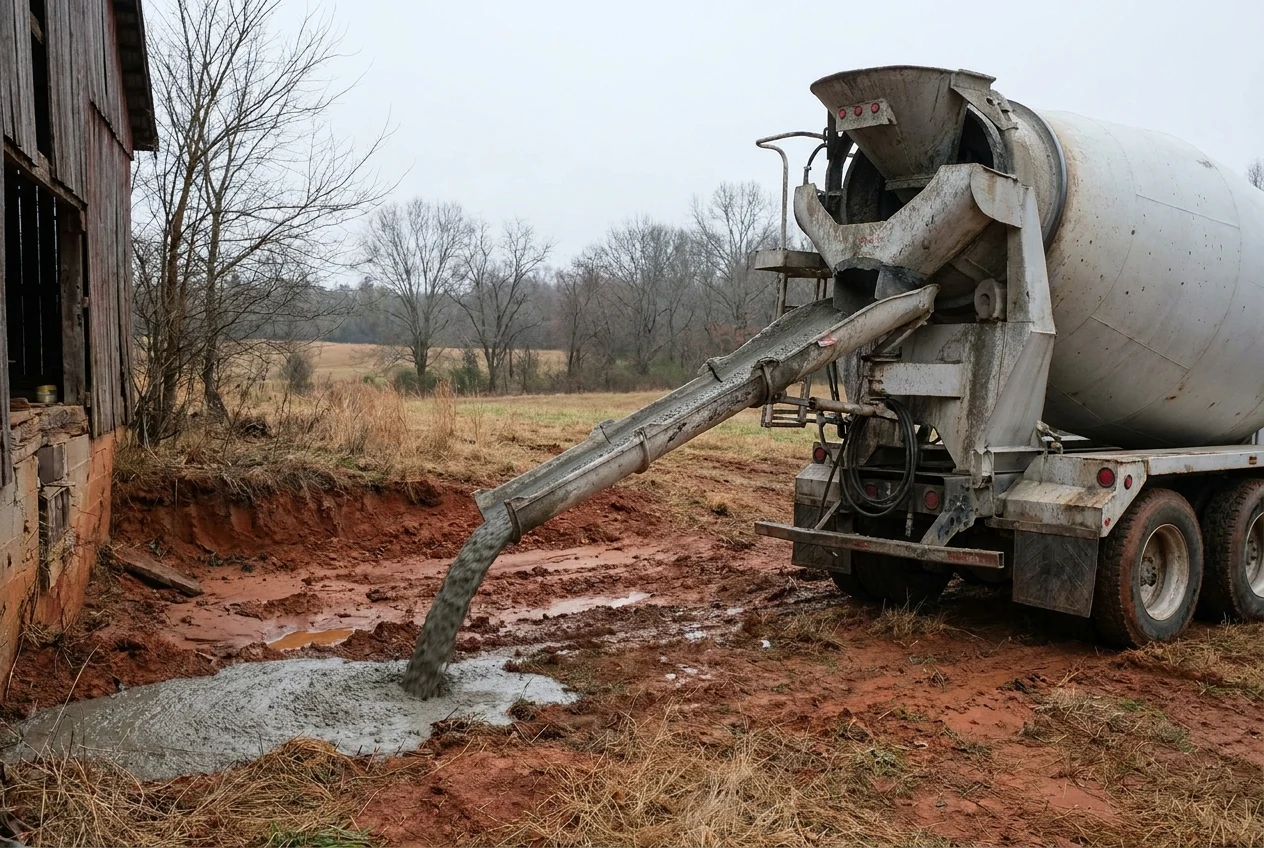
A 3-foot depression opens overnight at the edge of a barn foundation in Guilford County. The contractor arrives, looks at it for about 20 seconds, and says they’ll pour flowable fill. The homeowner asks: “Is that just cheaper concrete? Will it hold?”
Neither yes nor no is the complete answer. Flowable fill is a specific material engineered for this specific job — but understanding what it is and what it cannot do matters before you authorize the work. This page resolves the confusion.
What Flowable Fill Actually Is
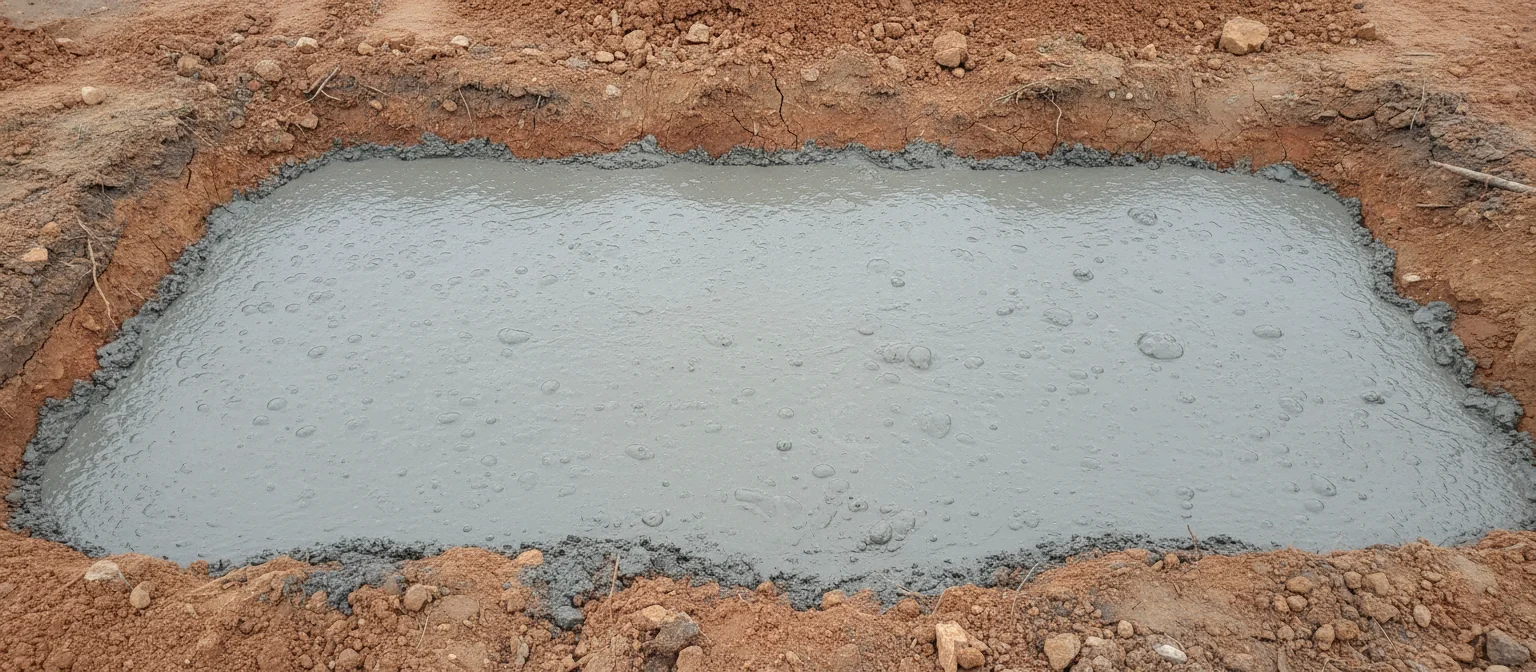
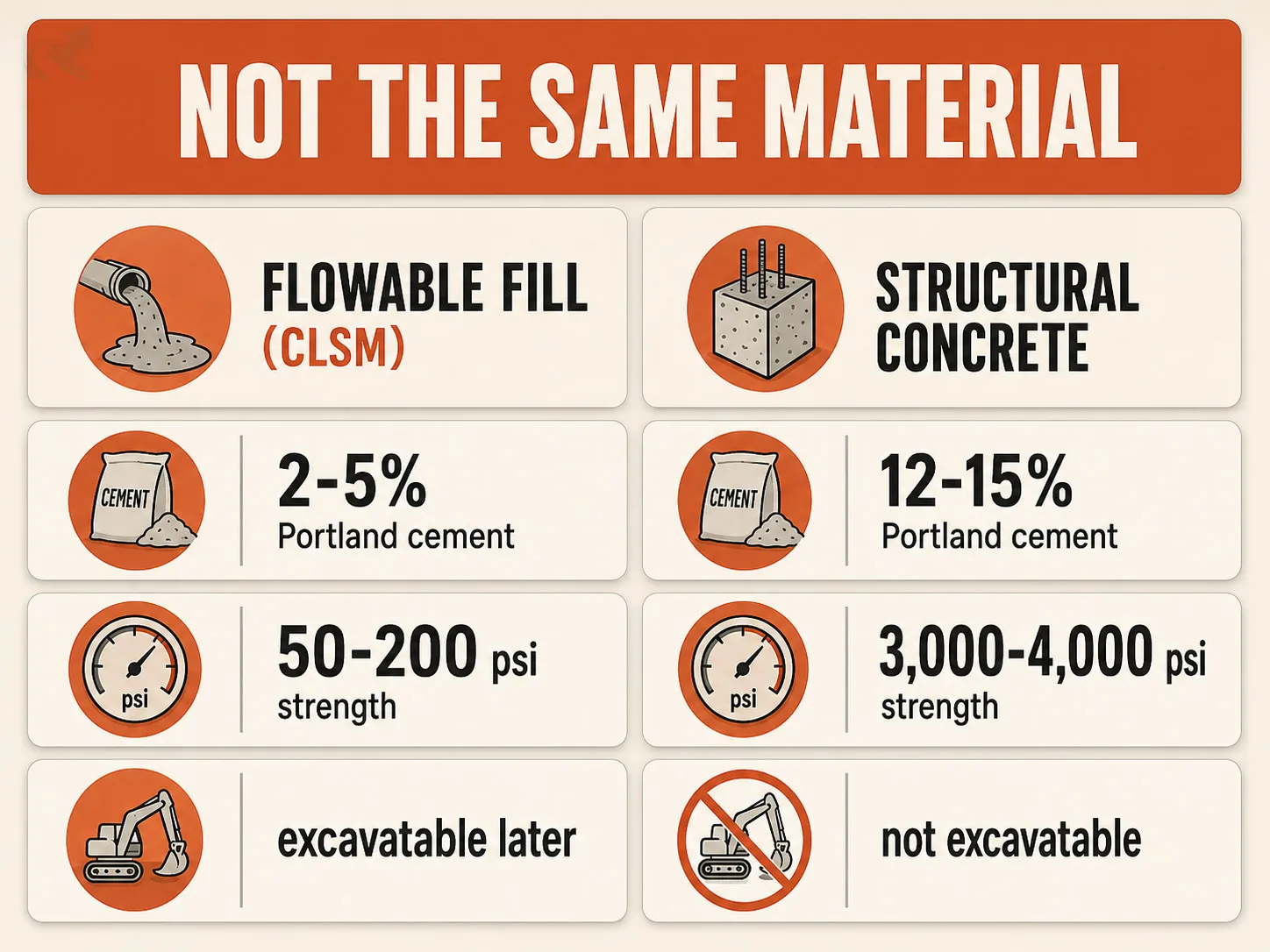
Flowable fill is a cement-water-aggregate mixture with 2-5% Portland cement content — much leaner than structural concrete, which runs 12-15%. It flows into voids, self-levels, and cures in place without any compaction.
Also called in engineering specs, or “lean concrete” or “slurry fill” on residential job sites. Same material, different names depending on who’s writing the invoice.
The key numbers: CLSM cures to 50-200 psi compressive strength. Structural concrete runs 3,000-4,000 psi. That gap is intentional — CLSM is designed to be excavatable later with standard equipment. Structural concrete is not.
When it’s wet, it flows like thick soup. That’s the point. It reaches void spaces that stone, compacted fill dirt, and rigid materials cannot access.
Do not call it “liquid concrete” — that’s the confusion this page resolves. Concrete is engineered for load-bearing capacity. CLSM is engineered for void-filling and self-compaction. Same cement family, fundamentally different job description.
Do not confuse it with grout. Grout carries significantly higher cement content and is used for structural connections — a completely different application.
When Flowable Fill Is the Right Answer
Flowable fill is correct when you have a void you cannot compact material into — sinkholes, utility abandonments, pipe annular space, or any gap where equipment cannot physically reach.
The four NC applications where it gets specified most:
- Sinkholes and surface voids. Poured from above, it flows down and fills irregularly shaped spaces that stone would bridge over without filling. This is the application most NC homeowners encounter.
- Abandoned utility pipes. Fills pipe interiors completely without requiring excavation. Prevents future subsidence when old lines are taken out of service.
- Utility trench backfill in tight access. Where soil lifts cannot be compacted due to proximity to structures or utilities.
- Old basement and crawl space abandonments. Fills volume that would otherwise settle over time.
What CLSM does not do: replace structural fill for building pads, substitute for compacted subbase under pavement unless specifically designed for that load, or repair the geological cause of a sinkhole.
Filling the void stops the collapse. It does not stop the process that created the void.
The NC Sinkhole Context
NC’s Piedmont region sits above zones of fractured limestone and other soluble rock — sinkholes form when soil piping and dissolution create voids that eventually collapse from above.
Most NC homeowners associate sinkholes with Florida. That association is fair — Florida’s karst terrain produces dramatic, newsworthy events. North Carolina’s Piedmont karst is more subtle. The dissolution activity is slower, the voids smaller, the surface depression more likely to read as a “soft spot” than a dramatic opening.
But the mechanism is the same. Acidic groundwater dissolves soluble rock over time, creating subsurface cavities in NC’s Piedmont clay and limestone terrain. The overlying soil bridges the void until it can’t — then the surface drops.
In Guilford, Alamance, Randolph, and surrounding Piedmont counties, this is more common than contractors typically tell homeowners. The NCGS has documented karst features across the central Piedmont zone. A depression that appears “overnight” near a foundation often means the void existed for years before the soil bridge failed.
The practical implication: when you fill a sinkhole, you are addressing the current void. If the dissolution source is active, another void can form. An engineer’s review is warranted for any sinkhole within 10 feet of a foundation footing line.
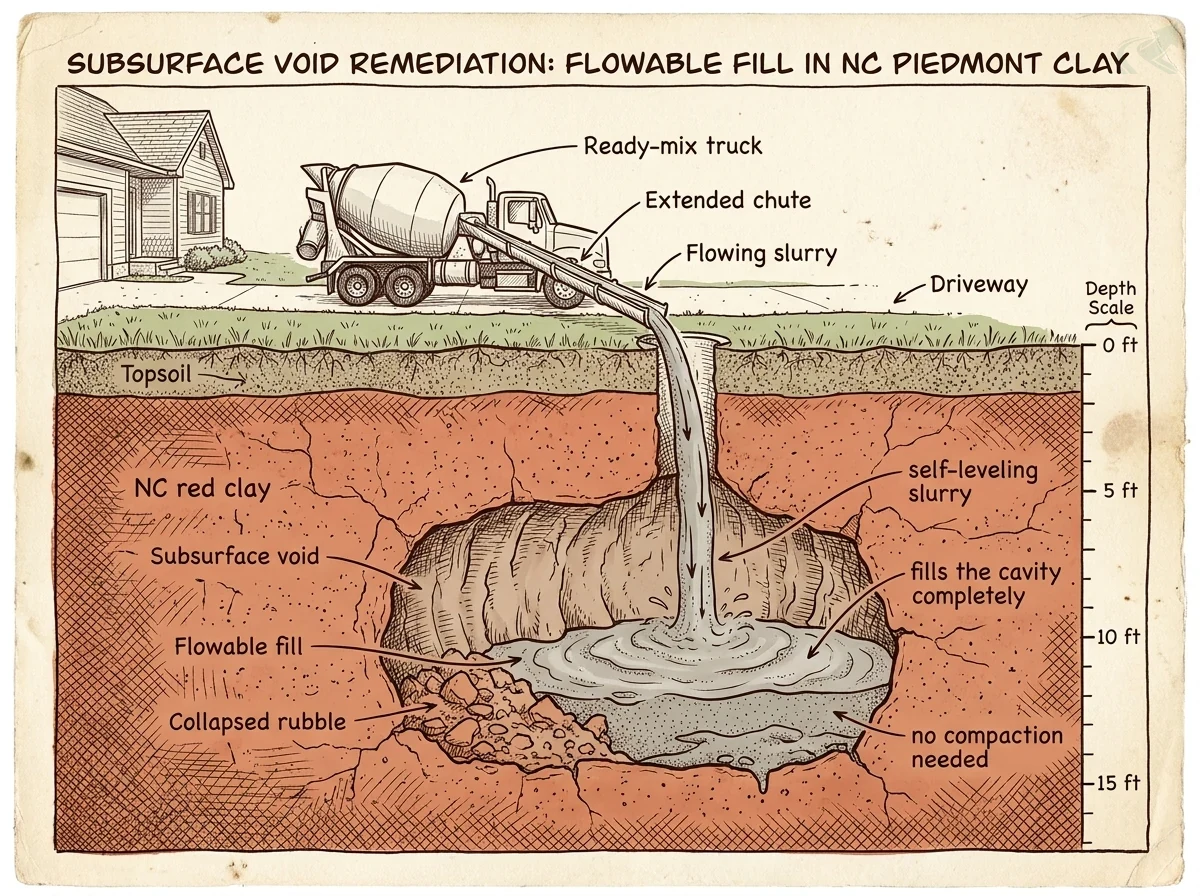
How flowable fill remediates a subsurface void: poured from the surface, the self-leveling slurry flows down through the clay and fills the irregular cavity completely — no compaction needed.
Flowable Fill vs Stone and ABC
Stone cannot reach voids it cannot be poured and compacted into. Flowable fill flows around corners, through pipe openings, and into irregular cavities. The tradeoff: flowable fill costs more per cubic yard than stone.
The bridging problem with stone: coarse aggregate placed over a void will arch across the opening and leave the core unfilled. You’ve covered the hole. You have not filled it. CLSM does not arch — it flows to the bottom of the void and fills from there up.
When stone wins: large-volume fills where equipment access exists and compaction can be done in lifts. Delivered stone is less expensive at scale, and properly compacted stone achieves load-bearing capacity CLSM cannot match. The right choice depends on what problem you are actually solving.
Flowable fill vs compacted stone -- NC void and fill applications
| Factor | Flowable Fill (CLSM) | Compacted Stone |
|---|---|---|
| Void access | Flows into any opening from above | Requires equipment access for compaction |
| Compaction required | No -- self-compacts on cure | Yes -- lifts must be compacted |
| Bridging risk | None -- flows to void floor | Moderate -- stone arches over openings |
| Cost per cubic yard (NC) | Higher -- ready-mix pricing applies | Lower -- stone is cheaper at volume |
| Excavatable later | Yes -- low strength allows re-excavation | Yes |
| Load capacity | Light (50-200 psi) -- residential foot traffic | Higher, compaction-dependent |
| Best application | Sinkholes, utility abandonments, tight access | Driveways, building pads, large fills |
Void access
- Flowable Fill (CLSM)
- Flows into any opening from above
- Compacted Stone
- Requires equipment access for compaction
Compaction required
- Flowable Fill (CLSM)
- No -- self-compacts on cure
- Compacted Stone
- Yes -- lifts must be compacted
Bridging risk
- Flowable Fill (CLSM)
- None -- flows to void floor
- Compacted Stone
- Moderate -- stone arches over openings
Cost per cubic yard (NC)
- Flowable Fill (CLSM)
- Higher -- ready-mix pricing applies
- Compacted Stone
- Lower -- stone is cheaper at volume
Excavatable later
- Flowable Fill (CLSM)
- Yes -- low strength allows re-excavation
- Compacted Stone
- Yes
Load capacity
- Flowable Fill (CLSM)
- Light (50-200 psi) -- residential foot traffic
- Compacted Stone
- Higher, compaction-dependent
Best application
- Flowable Fill (CLSM)
- Sinkholes, utility abandonments, tight access
- Compacted Stone
- Driveways, building pads, large fills
For a full side-by-side of NC fill scenarios, see flowable fill vs stone and CABC for NC fill jobs.
The Pour-and-Walk-Away Workflow
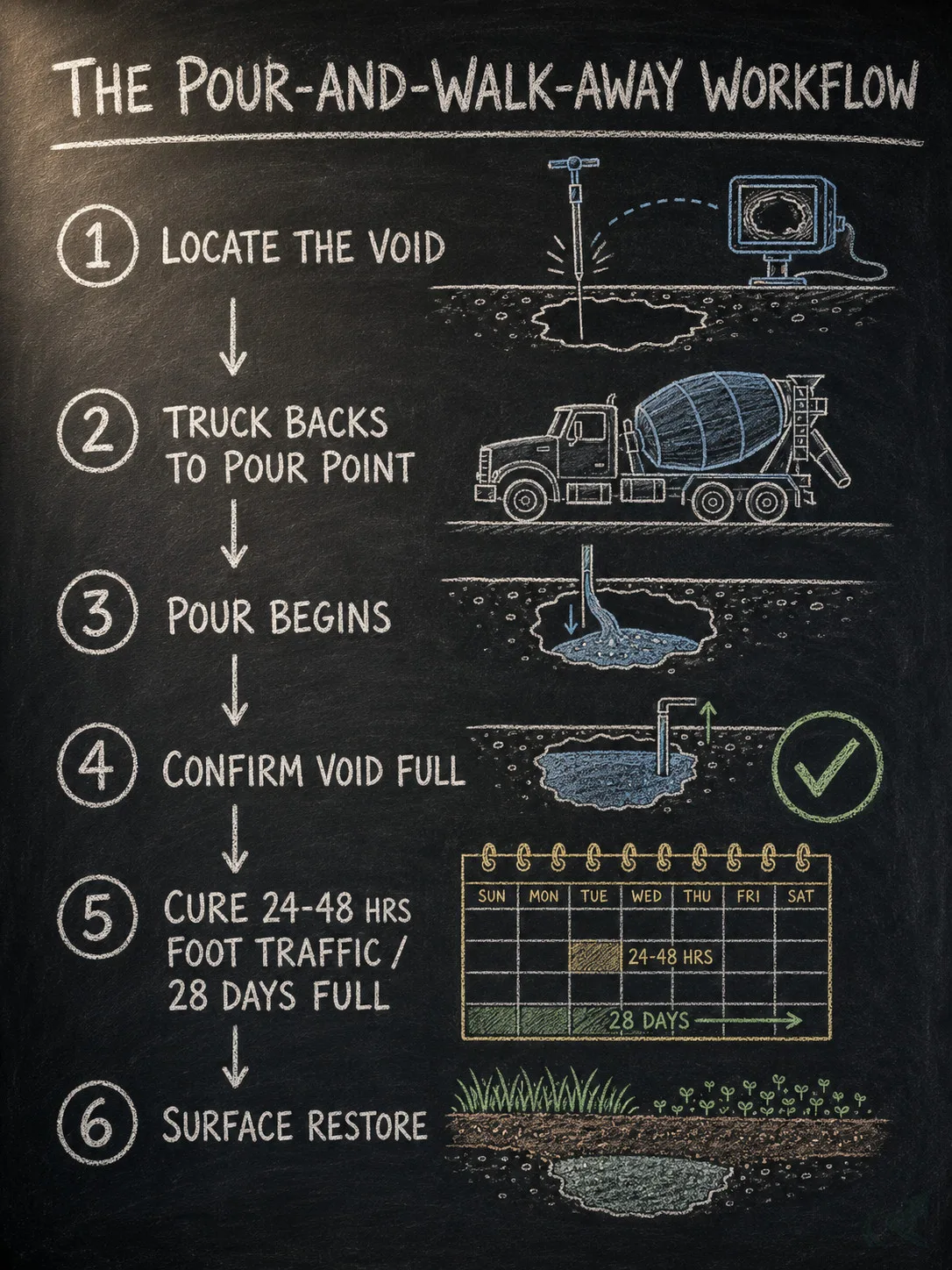
Flowable fill is poured from a ready-mix truck — gravity-fed or pumped into the void — and left to cure. No compaction equipment, no lift management, no post-pour grading until cure is complete.
The workflow on a residential sinkhole repair:
- Contractor locates the void extent — probing, visual inspection, sometimes a camera if the void is inaccessible.
- Ready-mix truck backs to the pour point. CLSM is ordered by the cubic yard, same as concrete.
- Pour begins. If the void has a return point — an adjacent pipe, a gap at grade — flow confirmation at that return point proves the void is filled. No confirmation point means the contractor is estimating fill based on volume poured vs expected void size.
- Pour stops when the void is confirmed filled or material returns to grade.
- Surface is left to cure. Foot traffic: 24-48 hours. Full cure: 28 days.
- Surface restoration — patching, topsoil, seed — happens after cure.
The question to ask during the pour: “How will you know the void is full?” If the contractor cannot answer that, the pour is a guess.
What Flowable Fill Cannot Do
CLSM is not structural concrete. It supports residential foot traffic and light loads, but it is not designed for heavy equipment, building pads, or applications with a specified compressive strength requirement.
The 50-200 psi range is correct for excavatable CLSM per ACI 229R. Some specialized CLSM mixes exceed that range — but those are not what gets poured into a residential sinkhole from a standard ready-mix truck.
Applications where you need a geotechnical engineer in the loop:
- Large voids under structures or within 10 feet of a foundation footing line
- Any sinkhole where the void extent is unknown before the pour begins
- Utility abandonments under driveways that will carry heavy truck traffic
- Any NC Piedmont site where the sinkhole depression has recurred previously
The fill is a tool. The engineering judgment about whether that tool is sufficient is a separate question.
Common Mistakes
Pouring without confirming void extent. If you do not know where the void ends, you do not know when to stop pouring — or whether you have actually filled it. Volume poured is not proof. Flow confirmation at a return point is proof.
Using CLSM as structural fill under a building pad without engineer approval. Its compressive strength is too low for most foundation applications without specific design. This is a real liability issue, not a theoretical one.
Expecting the sinkhole will not recur after filling. Flowable fill fills the current void. It does not address the geological process that created it. In active NC Piedmont karst zones, the dissolution process continues after the repair. If the source is ongoing, the void returns.
Before You Authorize the Pour: Four Questions
Use this before signing off on any CLSM job:
- What is the estimated void volume, and how did you calculate it?
- How will you confirm the void is fully filled during the pour?
- What is the cure time before surface restoration begins?
- Does this application require an engineer’s review given the proximity to my foundation?
Get those answers in writing. The itemized quote should include pour volume, cure schedule, and surface restoration scope — not a single round number.
If you have a sinkhole, void, or pipe abandonment and are not sure whether CLSM is the right call, talk to a contractor who works with it regularly. Find a grading and hauling contractor in North Carolina who can give you an itemized quote that breaks out pour volume, cure time, and surface restoration separately.
For a deeper sinkhole repair walkthrough, see the real NC sinkhole repair with flowable fill case study.
Also useful: flowable fill quantity in yards and tons, deep driveway divot repair with flowable fill, flowable fill for NC septic tank decommissioning backfill, and NC Piedmont clay and sinkhole formation.