
Two questions people often ask
Does Durham help pay for required septic-to-sewer conversion?
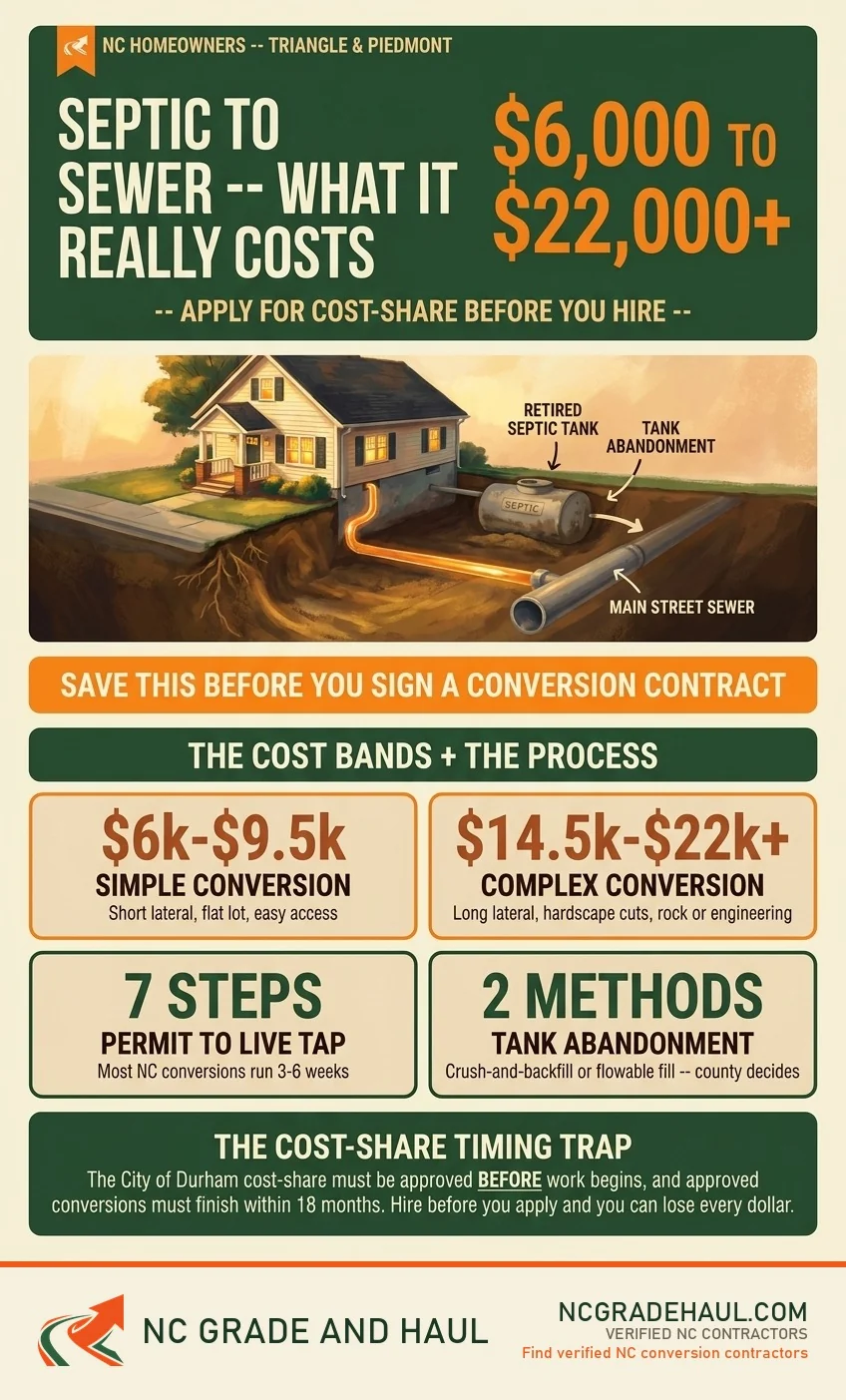
Yes — the City of Durham (not Durham County) runs a Septic-to-Sewer cost-share program for properties in the Northeast Creek watershed inside city limits that meet income/residency criteria. Approved conversions must be completed within 18 months. Apply through the City's Public Works Department before signing a conversion contract.
What does a septic-to-sewer conversion actually cost in NC?
Most NC residential conversions land between $6,000 and $22,000. Short lateral on a flat lot is the low end. Long lateral cutting hardscape with rock or engineering pushes past $22k.
If your septic system is failing, the city’s sewer line just reached your street, or a property sale is forcing the conversion, you’re about to spend somewhere between $6,000 and $22,000 to get hooked up.
This hub maps the process, the realistic cost bands, and the cost-share programs some NC counties offer — including Durham’s, which many eligible homeowners don’t realize exists.
When Conversion Applies
Four common triggers. The first three are not optional.
- Septic system failure — failed perc test, drain field saturation, surface effluent, code violation from county environmental health. Once it’s failed, the clock starts. See septic failure.
- Required connection — a municipal sewer main was extended to your street. NC G.S. 153A-284 authorizes counties to require sewer connection when the main is available, but there is no statewide deadline — the timeline is set by the specific local ordinance, annexation agreement, or utility notice. Deadlines vary widely by jurisdiction. The deadline is in the local ordinance, not the friendly utility letter. See required connection.
- Property sale — lender, buyer, or municipality requires conversion before closing. Negotiable as a credit, but the work still has to happen.
- Voluntary upgrade — no failure, no mandate, but the tank is aging and the sewer is at the curb. Higher property value, no more pump-outs, no more drain-field worry.
Standard NC residential conversion. Terracotta steps are install scope; forest-green steps are inspection/utility scope.
The Process
Seven steps from permit to live connection. Most NC residential conversions run 3–6 weeks once permits are in hand.
- Permit application — county environmental health (for tank abandonment) plus the utility (for the lateral connection). Two separate filings, sometimes two separate fees.
- Connection-point survey — locate the sewer lateral stub at the right-of-way. Depth and offset drive the trench plan.
- Excavation — house to main. Run length varies from about 20 to 200 linear feet depending on lot depth and main location.
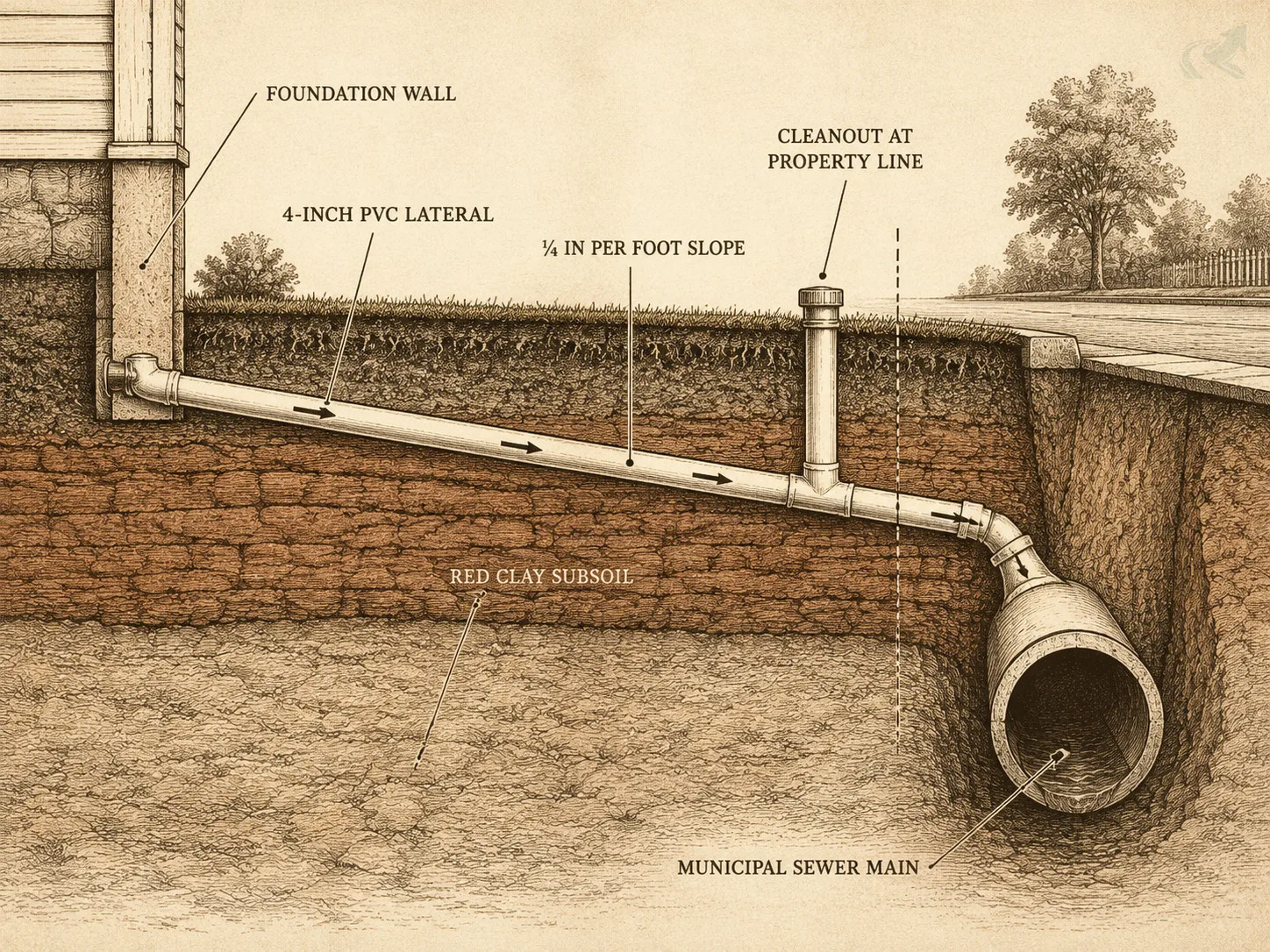
- Lateral install — typically 4” PVC or SDR-35 at code-required slope (usually 1/4” per foot for residential). Cleanouts at the house, at any 90, and at the property line.
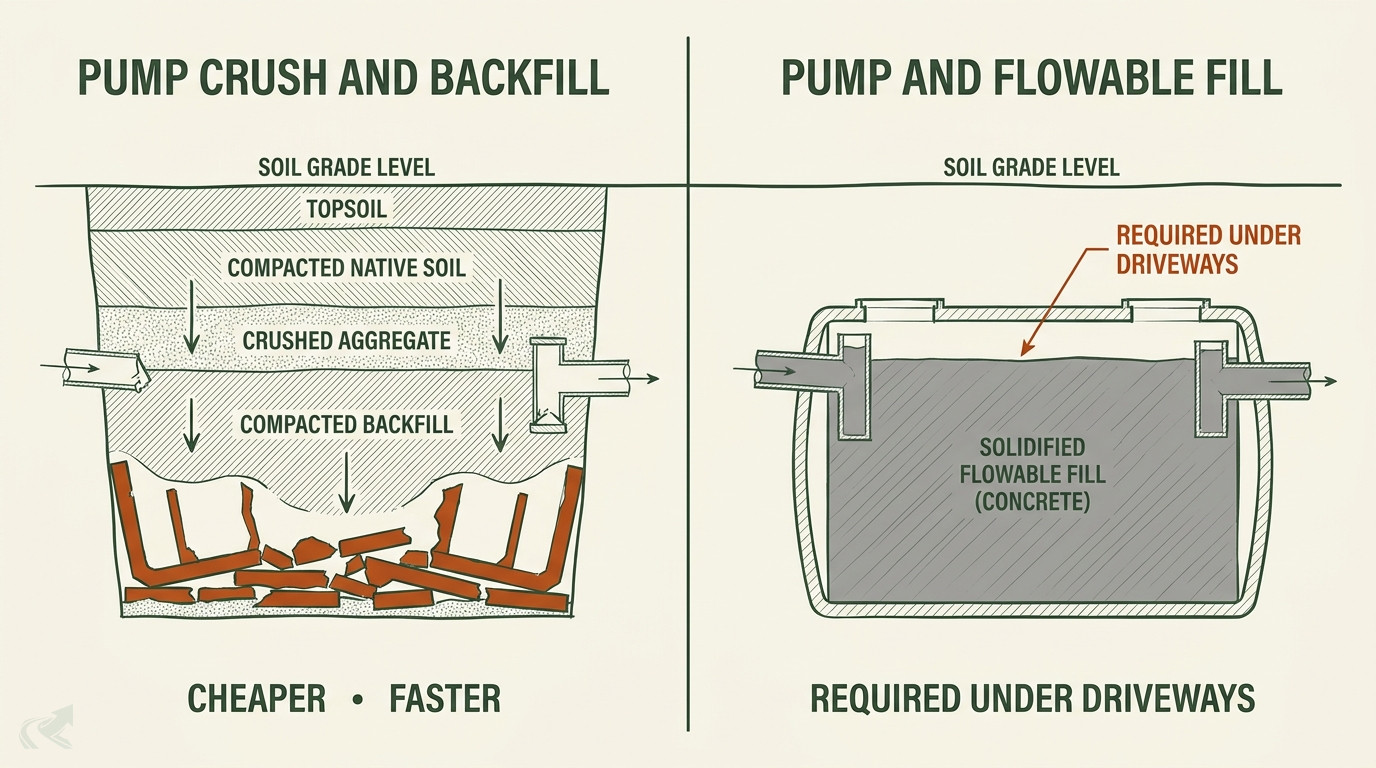
- Septic tank abandonment — pump, then either crush-and-backfill or fill with flowable fill. County dictates which method is allowed. See tank abandonment.
- Inspection — environmental health signs off on the abandoned tank; the utility signs off on the lateral.
- Connection activation — utility opens the tap, account switches from septic-only to sewer billing.
Full step-by-step at detailed septic-to-sewer process guide.
Cost Ranges in NC
Three tiers, all NC-specific, no national averages.
- Simple — $6,000 to $9,500. Short lateral (under 50 LF), flat yard, standard 1,000-gallon tank, no hardscape to cut, easy access for a mini-excavator.
- Medium — $9,500 to $14,500. Moderate trench length (50–120 LF), some landscape restoration, possibly a single hardscape cut (sidewalk or short driveway section).
- Complex — $14,500 to $22,000+. Long lateral, multiple hardscape cuts, rock or high water table, engineered slope, or a tank in a tight spot that requires hand work.
What drives the range: distance to the connection point, excavation conditions (Piedmont red clay digs differently than rocky WNC soil), tank size and depth, hardscape restoration scope, and landscape repair after backfill.
The detailed line-item breakdown lives on the septic-to-sewer cost breakdown page.
Cost-Share Programs
The City of Durham runs the program most NC homeowners don’t know exists. Wake and Mecklenburg programs are framework-specific and change year to year.
City of Durham (not Durham County) operates a Septic-to-Sewer cost-share program for properties in the Northeast Creek watershed inside city limits that meet income/residency criteria. Approved conversions must be completed within 18 months. The application is the “Residential Septic to Sewer Cost-Share Application and Agreement” submitted to the City’s Public Works Department. Eligibility is means-tested, application timelines matter, and you generally need to apply before signing a contractor agreement. The full program detail and the application path live at Durham cost-share and on the Durham geo page.
Wake County and Mecklenburg County programs (where they exist) operate on different mechanisms — some grant-based, some low-interest loan programs tied to required-connection scenarios. Specifics change year to year with budget cycles; check the current program page before counting on assistance.
We don’t promise eligibility on any of these. We tell you the program exists, point you at the county application, and quote the conversion either way.
Tank Abandonment Specifics
Two legal methods in NC. The county tells you which one applies.
- Pump, crush, and backfill — pump the tank dry, crush the tank walls to prevent future void collapse, then backfill the hole with compacted soil. Cheaper, faster.
- Pump and fill with flowable fill — pump the tank, then fill the intact tank with self-compacting low-strength concrete mix. Required in some counties, especially under driveways or future structure footprints.
Which method you can use depends on the county and on what’s above the tank. A contractor quote that doesn’t name the abandonment method isn’t a complete quote — the cost difference is real. More on the material at self-compacting concrete mix for tank and void filling.
Hiring a Conversion Contractor
Septic-to-sewer work usually needs a utility contractor license in addition to the general grading license.
NC’s licensing structure separates utility work (sewer laterals tying into a public main) from general site work. A contractor doing the trench and tank abandonment may hold one license; the tap into the municipal main often requires a separate utility classification or a sub. Ask which license covers which scope before signing.
License-lookup walkthrough at NC contractor licensing thresholds & how to verify. Vetting checklist at NC grading contractor vetting hub.