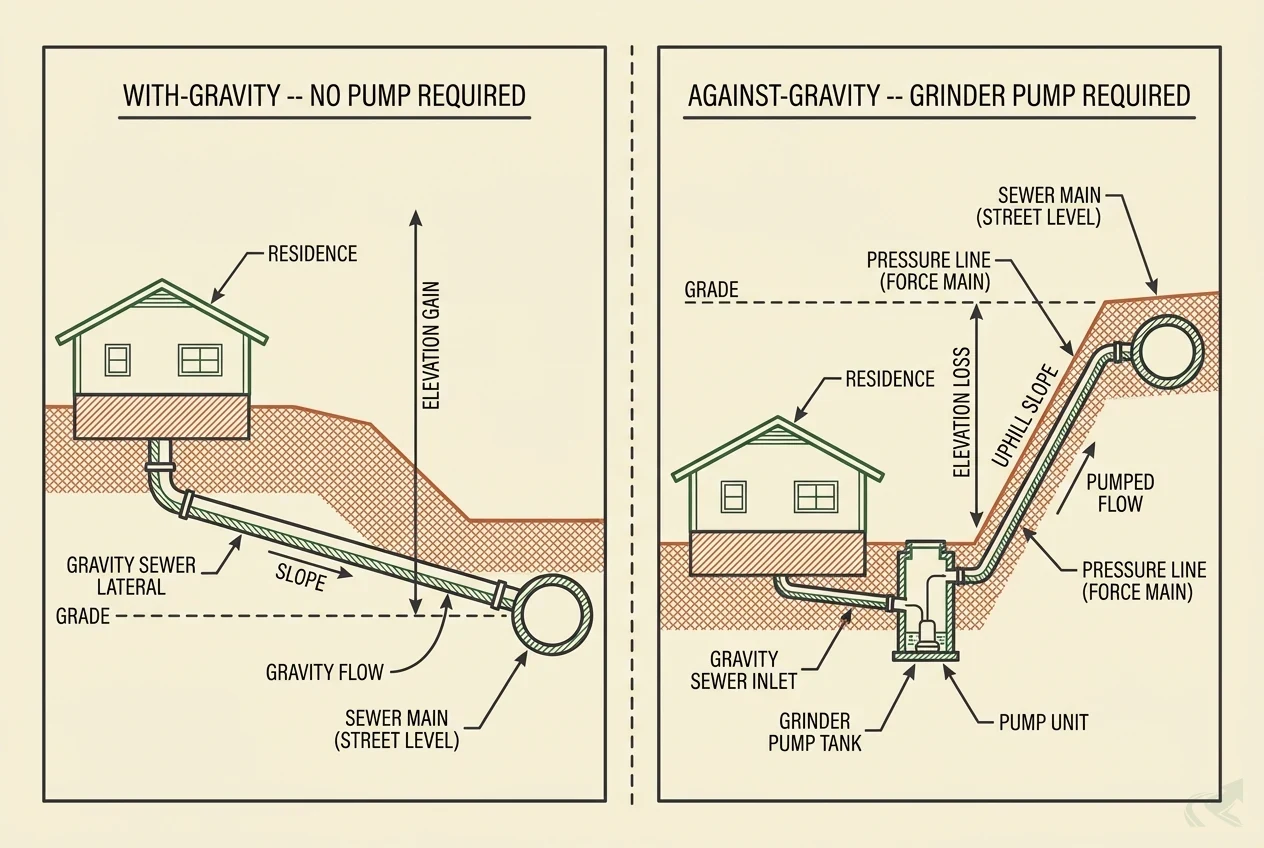
Is your NC sewer connection with-gravity or against-gravity?
What does with-gravity mean for my sewer connection?
Your home's lowest drain outlet sits above the sewer main's invert elevation. Sewage flows downhill by gravity -- no pump required. The lateral runs from your house to the main and the grade does the work. Simpler installation, lower cost.
What does against-gravity mean -- and do I need a pump?
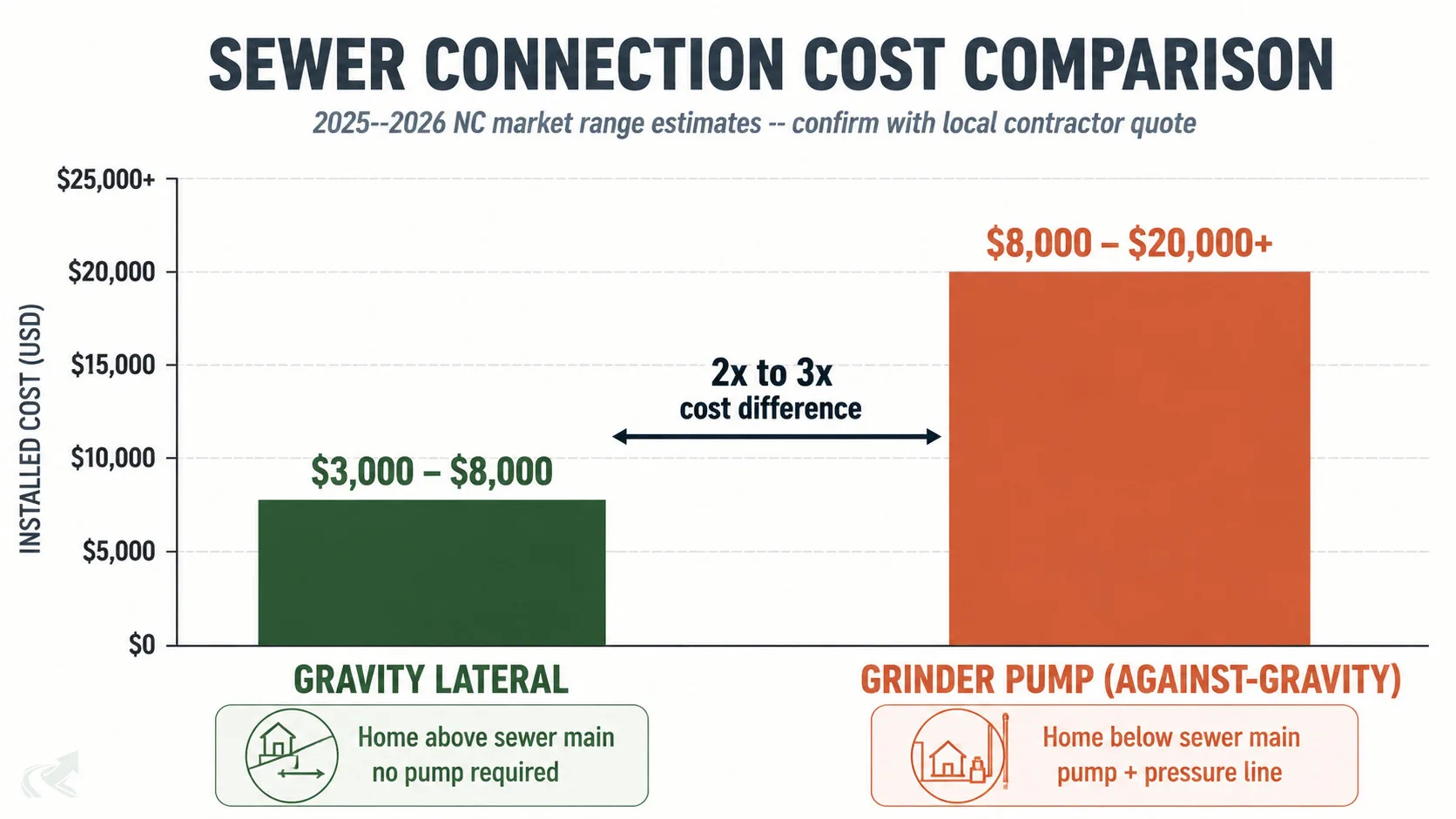
Your home sits below the sewer main. Sewage cannot flow uphill on its own, so a grinder pump receives it at your property, grinds it down, pressurizes it, and pushes it up a pressure line to the main. The pump is the cost difference -- typically $8,000 to $20,000 or more versus $3,000 to $8,000 for a gravity lateral (2025--2026 NC market estimates; confirm with a local contractor quote).
How do I tell which type I have before calling a contractor?
Find the nearest sewer manhole in your street or easement. Identify your home's lowest drain outlet -- basement floor drain, crawl space cleanout, or first-floor toilet rough-in. If the manhole invert sits higher than your drain outlet, you likely need a pump. If the manhole sits lower, you are likely gravity. Confirm with a contractor's laser level before committing to any quote.
A neighbor tells Ray Pettiford he “might need a pump.” Ray doesn’t know what that means or how to find out. He also doesn’t know that the answer to one question — does his home sit above or below the sewer main — will determine whether his conversion costs roughly $5,000 or roughly $18,000 (2025—2026 NC market range midpoints; site conditions vary).
That’s the decision-driver on this page. Everything else is detail.
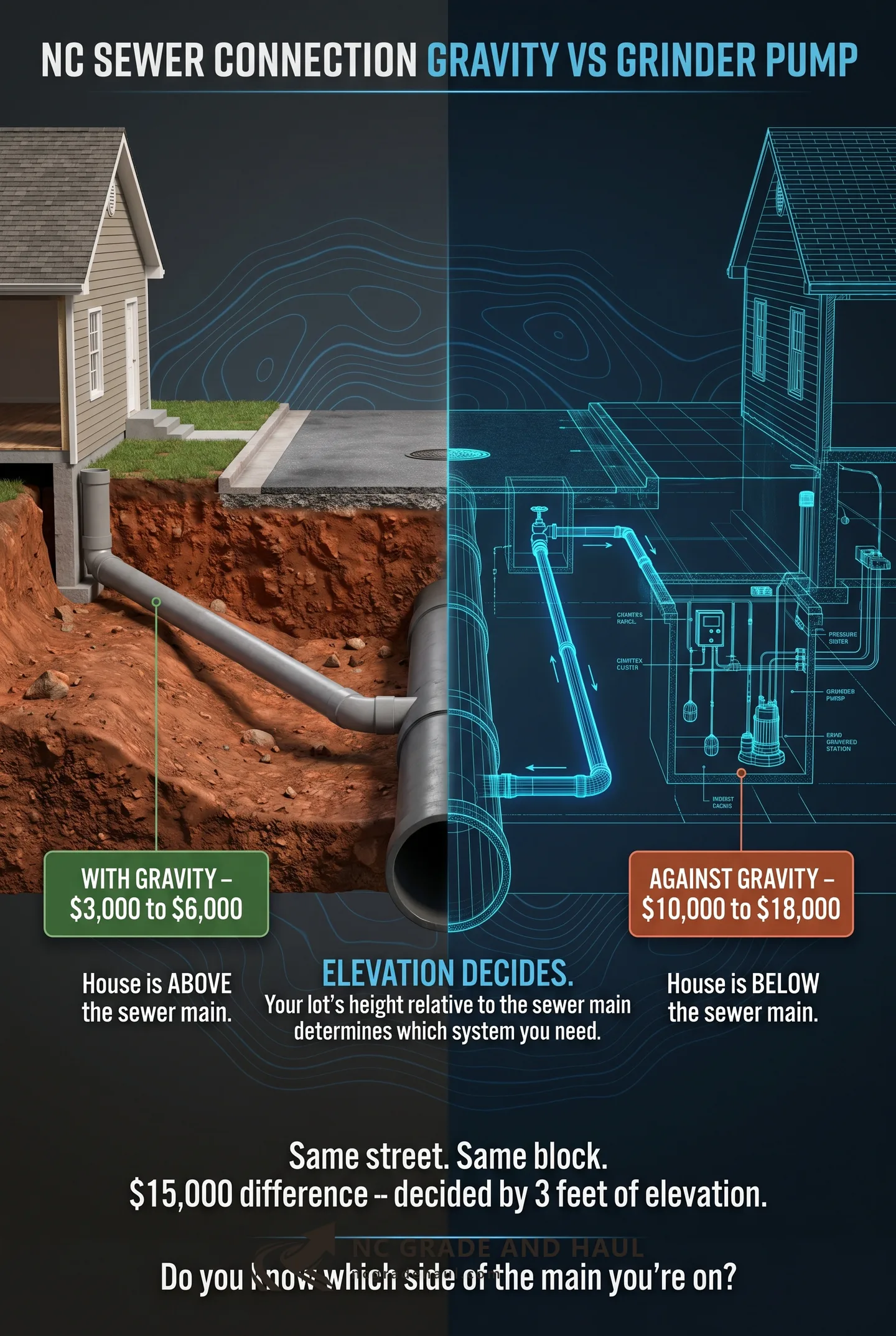
The Elevation Question — The Only Variable That Matters
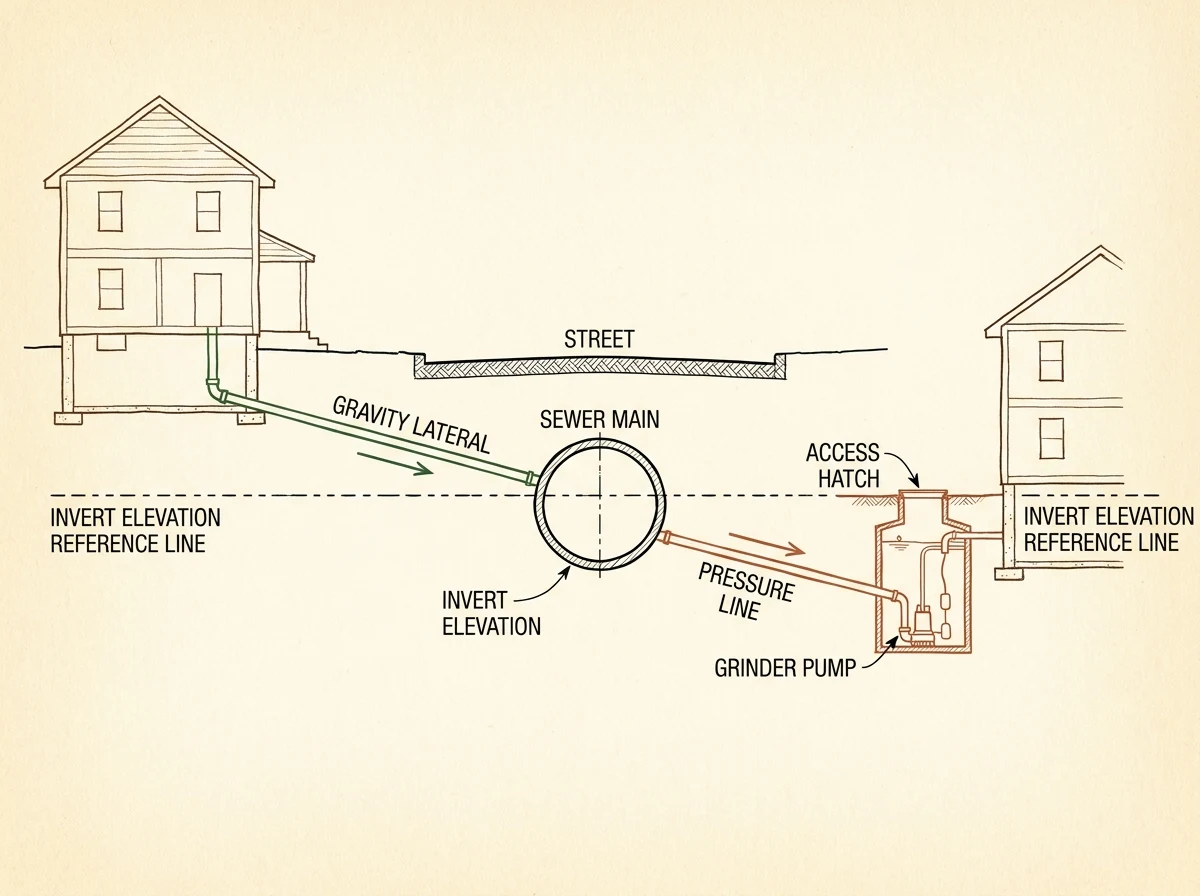
The single variable that determines your sewer connection type is your home’s elevation relative to the sewer main’s invert elevation — and it drives a 2x to 3x cost difference.
“Invert elevation” is the height of the inside bottom of the sewer pipe where it passes beneath your street. Not the manhole cover. Not the ground surface. The inside bottom of the pipe. That number sets the reference point that everything else compares to.
If your lowest drain outlet — basement floor drain, crawl space cleanout, or first-floor toilet rough-in — sits above that invert elevation, sewage flows downhill to the main. Gravity does the work.
If your lowest drain outlet sits below the invert elevation, sewage cannot flow uphill without mechanical help. A grinder pump is required.
No elevation check means no accurate quote. A contractor quoting a gravity lateral on a home that needs a pump is off by $10,000 or more before the first shovel moves.
With-Gravity Connection — What It Means and How It Works
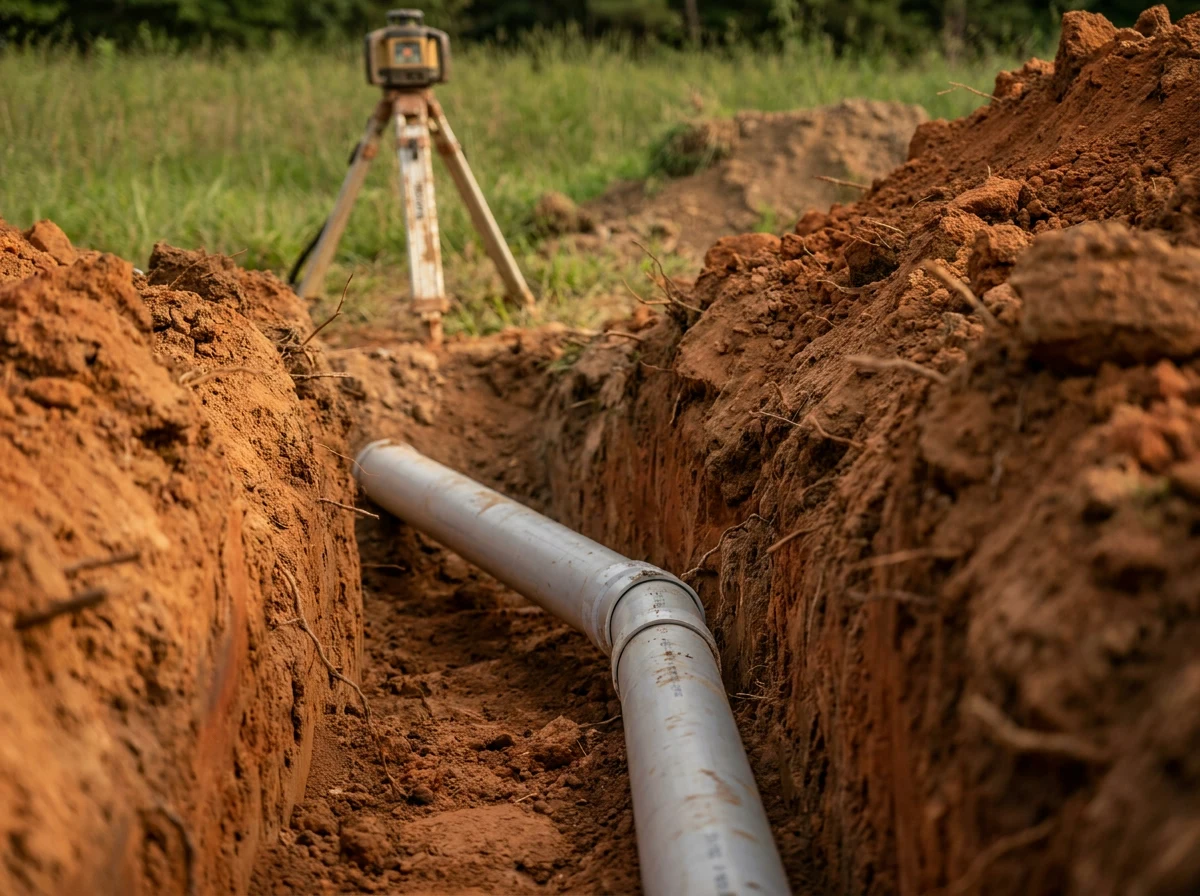
With-gravity means the sewer lateral from your home runs downhill all the way to the main, and nothing mechanical is required in the line.
The lateral is the pipe that runs from your house to the sewer main — typically 4-inch or 6-inch PVC. In a gravity connection, that lateral is sloped at a minimum grade (usually 1/8 inch to 1/4 inch drop per foot of run) so sewage flows by physics alone.
No pump. No electrical connection. No mechanical component to maintain or replace. The trench has to be dug deep enough to maintain the slope, but the installation itself is straightforward compared to a pressurized line.
In North Carolina’s Piedmont, most lots in established neighborhoods have enough elevation above the street-level sewer to support gravity connections. Newer subdivisions built on flat ground or in low-lying areas are where gravity assumptions break down.
For typical North Carolina costs on a gravity lateral, see the full breakdown at the gravity vs against-gravity sewer conversion cost NC page.
Against-Gravity Connection — When You Need a Pump
Against-gravity means your home sits below the sewer main’s invert elevation — sewage physically cannot reach the main without a grinder pump to push it uphill.
Here is what that looks like in practice. A grinder pump is a tank buried in your yard, typically near the house. Sewage from the home flows by gravity into the tank. The pump grinds the sewage into a slurry and pressurizes it. That slurry travels uphill through a small-diameter pressure line to the sewer main.
The pressure line is not a gravity lateral. It can run uphill. It does not require the same slope constraints. But it requires electrical power, and the pump is a mechanical component with a service life of roughly 7 to 15 years depending on usage and maintenance.
One point that comes up often: you cannot avoid a pump by running a longer lateral. If your home sits below the main, no amount of lateral length changes that elevation relationship. The pipe still has to go uphill somewhere, and without a pump it doesn’t go anywhere.
For full detail on how grinder pumps work, what they cost to install and maintain, and what NC utilities require, see the grinder pump when NC connection is against gravity page.
How to Do a Rough Self-Assessment
Before you call a contractor, you can do a rough elevation comparison yourself — locate the nearest sewer manhole, find your home’s lowest drain outlet, and visually compare grades.
Here is the step-by-step. This is not a substitute for a contractor’s laser level, but it gives you enough information to know which conversation to have.
Step 1: Locate the nearest sewer manhole. Look for cast-iron manhole covers in the street or in an easement near your property line. If you’re not sure, call your NC utility and ask for the nearest sewer manhole location to your address. They will tell you.
Step 2: Identify your home’s lowest drain outlet. This is typically the basement floor drain (if you have a basement), the crawl space cleanout access point, or the first-floor toilet rough-in elevation. On a slab-on-grade home, the lowest drain is usually the first-floor toilet.
Step 3: Visually compare grades. Stand at the manhole and look back toward your house. Does the ground at the manhole sit higher or lower than your crawl space vent or basement window line? This is approximate but directionally useful.
Step 4: Apply the rule. If the manhole area sits higher than your lowest drain outlet, sewage from your home would have to travel uphill to reach the main. That’s a pump situation. If the manhole area sits lower, gravity is likely working in your favor.
Step 5: Confirm with a laser level. Visual grade comparison in NC’s Piedmont red clay can mislead. A lot can look flat from the street and have 2 to 3 feet of elevation difference across 60 feet. A contractor with a laser level takes 20 minutes and gives you the actual numbers. Do not commit to a quote category without it.
A self-assessment checklist formatted for quick reference:
One critical distinction: the manhole cover grade and the invert elevation are not the same number. In deep-sewer neighborhoods — common in older NC municipalities — the invert can be 8 to 12 feet below the manhole lid. The visual check at the street surface tells you something, but it does not tell you the invert. If your lot is close to grade with the street, request the invert elevation from your utility before concluding anything.
You can also use our slope calculator to assess your sewer connection for a more structured look at your lot’s elevation profile.
When the Site Survey Settles It
A professional elevation survey is worth the cost when you are close to grade with the sewer main — within a foot or two either way — and the stakes of guessing wrong are $10,000 or more.
Some NC utilities will confirm your connection type before you hire anyone. Orange Water and Sewer Authority (OWASA) and Raleigh Water will sometimes provide the invert elevation for your address if you call their engineering or development services department — confirm current practice directly with each utility, as policies vary. Ask for: the invert elevation of the nearest manhole to your property, and whether your address is expected to be gravity or pump service.
Charlotte Water has a connection permit process that includes a site evaluation — which means you may get the connection type determination as part of the permit application review rather than as a separate paid survey.
If your utility cannot or will not provide the invert data, an NC licensed contractor with a laser level is the next step. The elevation survey is not a separate line item in most quotes — it happens during the initial site visit. Ask for it explicitly and ask for the result in writing before you sign anything.
The NC septic-to-sewer conversion process and gravity mapping hub page covers how utility pre-application reviews work and what documentation to request before the site visit.
Cost Impact by Connection Type
The elevation check is the first step before budgeting — because the cost difference between gravity and against-gravity is not marginal.
| Connection type | Elevation condition | Mechanism | Typical NC cost |
|---|---|---|---|
| Gravity lateral | Home above sewer main invert | Gravity — no pump | $3,000—$8,000 * |
| Against-gravity (grinder pump) | Home below sewer main invert | Pump + pressure line | $8,000—$20,000+ * |
The cost ranges above reflect the lateral and pump installation. They do not include permit fees, county connection fees, or abandonment of your existing septic system — all of which are additional. North Carolina county connection fees vary widely by utility district; contact your utility directly for current tap fee schedules before budgeting.
Three common mistakes before you get to the quote stage:
Not checking elevation before getting quotes. A gravity quote on a home that needs a pump is wrong by $10,000 or more. Do the elevation check first.
Assuming the manhole cover grade equals the invert elevation. The sewer main’s invert may not match the manhole cover height — get the invert, not just the lid height. In deep-sewer neighborhoods, the difference can be 10 feet.
Thinking a longer lateral avoids the pump. If your home is below the main, no amount of lateral length changes the elevation relationship. The sewage still has to go uphill somewhere.
For the full cost breakdown — itemized by permit, connection fee, septic abandonment, and lateral installation — see gravity vs against-gravity sewer conversion cost NC.
What to Do Next
If you’re not sure whether you need a pump, the next move is one call — to your utility for the invert elevation, and one site visit — to a contractor with a laser level.
Before you get either quote, run the self-assessment above. It takes 15 minutes and tells you which conversation to have. If the manhole sits higher than your crawl space, come into the contractor conversation expecting a pump quote. If it sits lower, come in expecting gravity — and ask the contractor to confirm with the laser level before anything is written up.
When you’re ready to get an itemized quote from a verified contractor, hire a licensed NC grading contractor who has cleared NCLBGC license, workers’ comp, and OSHA verification checks. The NC septic-to-sewer conversion process and gravity mapping hub page covers the full conversion sequence from utility notification to final connection inspection.