
When do I need a grinder pump -- and what does it cost long-term?
When does NC sewer conversion require a grinder pump?
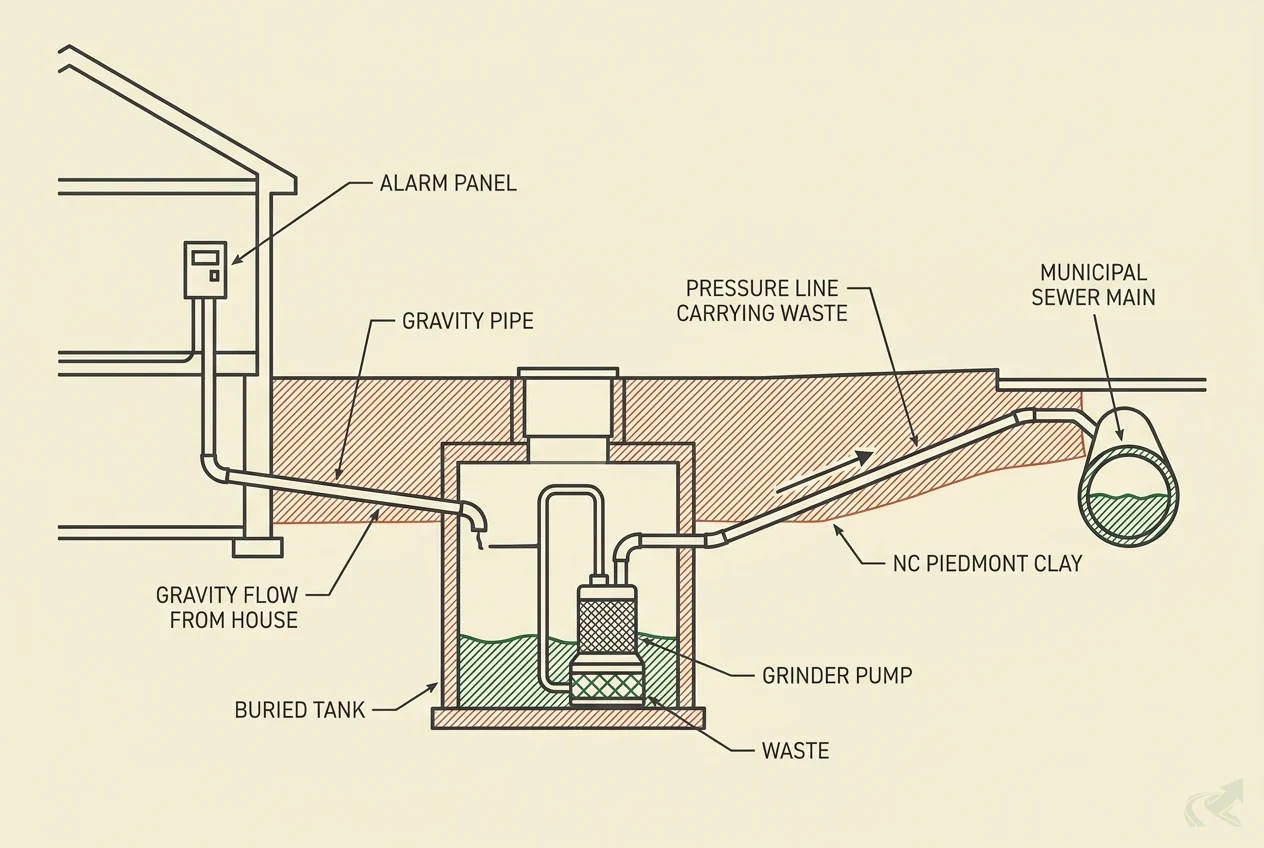
You need a grinder pump when your home sits below the sewer main -- gravity can't push sewage uphill. The pump receives household waste in a holding tank, grinds it to slurry, and forces it up through a pressure line to the main. There is no alternative when the elevation doesn't work for a gravity lateral.
What does a grinder pump system cost to install in NC?
Typical installed cost in North Carolina: $8,000--$20,000+, including pump unit, holding tank, electrical connection, and pressure line to main. That is 2--3x the cost of a gravity connection ($3,000--$8,000). The high end reflects deep excavation, a long pressure run, or an electrical panel upgrade.
What are the ongoing obligations after a grinder pump is installed?
Annual inspection is recommended by industry distributors and may be required by your utility as a condition of connection; pump unit lifespan roughly 10--15 years; power dependency means no electricity = no flushing; holding tank provides limited backup capacity -- typical single-family residential tanks hold 70--150 gallons. Ask who owns the pump before signing the connection agreement -- utility ownership vs. homeowner ownership is the most consequential long-term variable.
Ray Pettiford owns six acres in Guilford County. The county extended the sewer main down his road last year. His contractor came back with a quote that was $14,000 more than his neighbor’s — because Ray’s lot sits eight feet lower than the main.
He has been told he needs a grinder pump. He doesn’t know what that means or what he’s agreeing to.
This page is for Ray. It covers what a grinder pump actually does, what installation costs in North Carolina, who owns and maintains the pump long-term, what happens when the power goes out, and when the math makes sense versus when it’s worth pushing back.
What a Grinder Pump Does and Why You Need One
A grinder pump is required when your home sits below the sewer main — gravity can’t push sewage uphill, so a pump does it under pressure.
Here’s what the system involves: household sewage flows by gravity into a holding tank buried near your home. The pump unit inside that tank grinds solids into slurry. When the liquid level reaches the trigger float, the pump fires and forces the slurry up through a small-diameter pressure line to the sewer main at the street. The grinder pump tank is separate from your old septic tank — that tank requires its own septic tank decommissioning after NC conversion.
The against-gravity connection is what drives the requirement. If your property sits above the main, a standard gravity lateral runs downhill to the street and you’re done. If your lot sits below, the physics don’t work without a pump.
There is no engineering workaround for a property below the main — a grinder pump is the connection method. For guidance on determining which situation applies to your lot, see the against-gravity connection guide for NC sewer conversion.
Installation Cost Breakdown
Installed cost for a grinder pump system in NC typically runs $8,000—$20,000+, compared to $3,000—$8,000 for a gravity connection.
Gravity Lateral vs. Grinder Pump System: Cost Breakdown
Comparison. Gravity Lateral ($3,000--$8,000): Trench from house to street -- no pump required; Standard pipe only -- no electrical scope; No holding tank or alarm panel; No moving parts -- zero power dependency; Permit fee varies by NC county. Grinder Pump System ($8,000--$20,000+): Pump unit: $1,000--$3,500 for the residential assembly; Buried holding tank -- excavation depth drives cost; Electrical: dedicated circuit + conduit + alarm panel ($800--$2,000); Pressure line from tank to sewer main -- longer runs add cost; Permit fee varies by NC county.
- Trench from house to street -- no pump required
- Standard pipe only -- no electrical scope
- No holding tank or alarm panel
- No moving parts -- zero power dependency
- Permit fee varies by NC county
- Pump unit: $1,000--$3,500 for the residential assembly
- Buried holding tank -- excavation depth drives cost
- Electrical: dedicated circuit + conduit + alarm panel ($800--$2,000)
- Pressure line from tank to sewer main -- longer runs add cost
- Permit fee varies by NC county
Cost premium for a grinder pump system is driven by the pump unit, holding tank, and electrical scope -- none of which a gravity lateral requires.
The itemized quote for a pump system includes components that a gravity lateral doesn’t require:
- Pump unit: The grinder pump assembly itself — typically $1,000—$3,500 for the residential unit alone, before installation labor and tank
- Holding tank: Fiberglass or polyethylene buried tank installed near the home; excavation depth drives cost on deep-tank sites
- Electrical connection: Dedicated circuit from the panel, conduit run to the pump, and alarm panel on the exterior wall — typically $800—$2,000 for the full electrical scope
- Pressure line: Small-diameter pressurized pipe from the tank to the sewer main; longer runs add meaningful cost
- Permit fee: Sewer connection permits vary by NC county; contact your local permits office for the current schedule, as fees differ significantly by jurisdiction
What pushes a quote to the high end: deep excavation (rocky soil or a high water table), a long pressure run to reach the main, or an electrical panel that needs an upgrade to add the dedicated circuit.
Ask any contractor for a line-itemed breakdown — not a single lump sum. If they can’t separate the pump unit cost from the excavation from the electrical, that’s a flag.
NC Utility Acceptance — Who Owns the Pump?
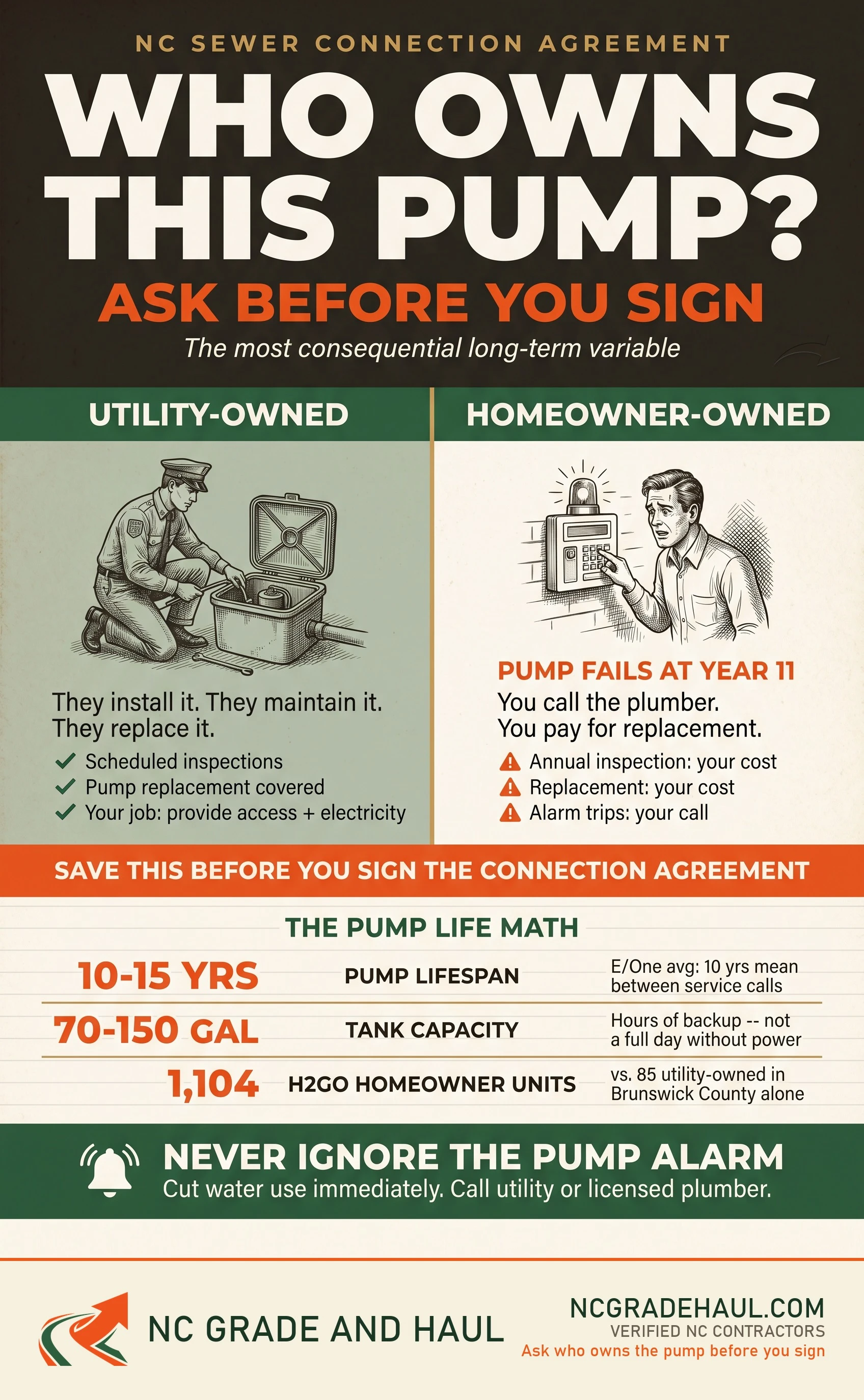
Before signing the sewer connection agreement, ask one question: does the utility own the pump or do you?
In North Carolina, grinder pump ownership varies utility-by-utility. H2GO in Brunswick County uses a mixed model — their published FAQ confirms the homeowner is responsible for the pump system from the house to the property line, including the pump, tank, electrical panel, and associated equipment. Charlotte Water’s design manual specifies that low-pressure sewer connections use non-positive-displacement grinder pumps, with maintenance responsibility delegated to the homeowner, HOA, or developer depending on the project. OWASA’s sewer use ordinance places full lateral responsibility on the property owner from building to main — which includes any pump equipment on the lateral. Guilford County DPS policy for grinder pump ownership in unincorporated county areas is not publicly documented; confirm directly with DPS before signing.
What “utility-owned” means in practice: the utility installs the pump to their spec, maintains it on a schedule, and replaces it when it fails. Your obligation is access and the electricity to run it.
What “homeowner-owned” means: you own the unit. Maintenance and inspection are your responsibility. When the pump fails, you call a plumber and pay for the replacement — expect $2,000—$3,000 for the pump core swap when the unit reaches end of life, plus labor. The E/One one-piece core design is pull-and-replace: a technician removes the core and swaps it without excavation, which keeps replacement labor on the lower end.
The service agreement language will spell this out. Read it before signing. If the utility’s standard agreement places ownership on the homeowner, ask whether a different arrangement is available on your road. Some utilities use pump-ownership language that varies by subdivision or project vintage. If you’re on a forced NC sewer hookup timeline, ownership terms are particularly worth negotiating before the connection agreement is signed.
Ongoing Maintenance Obligations
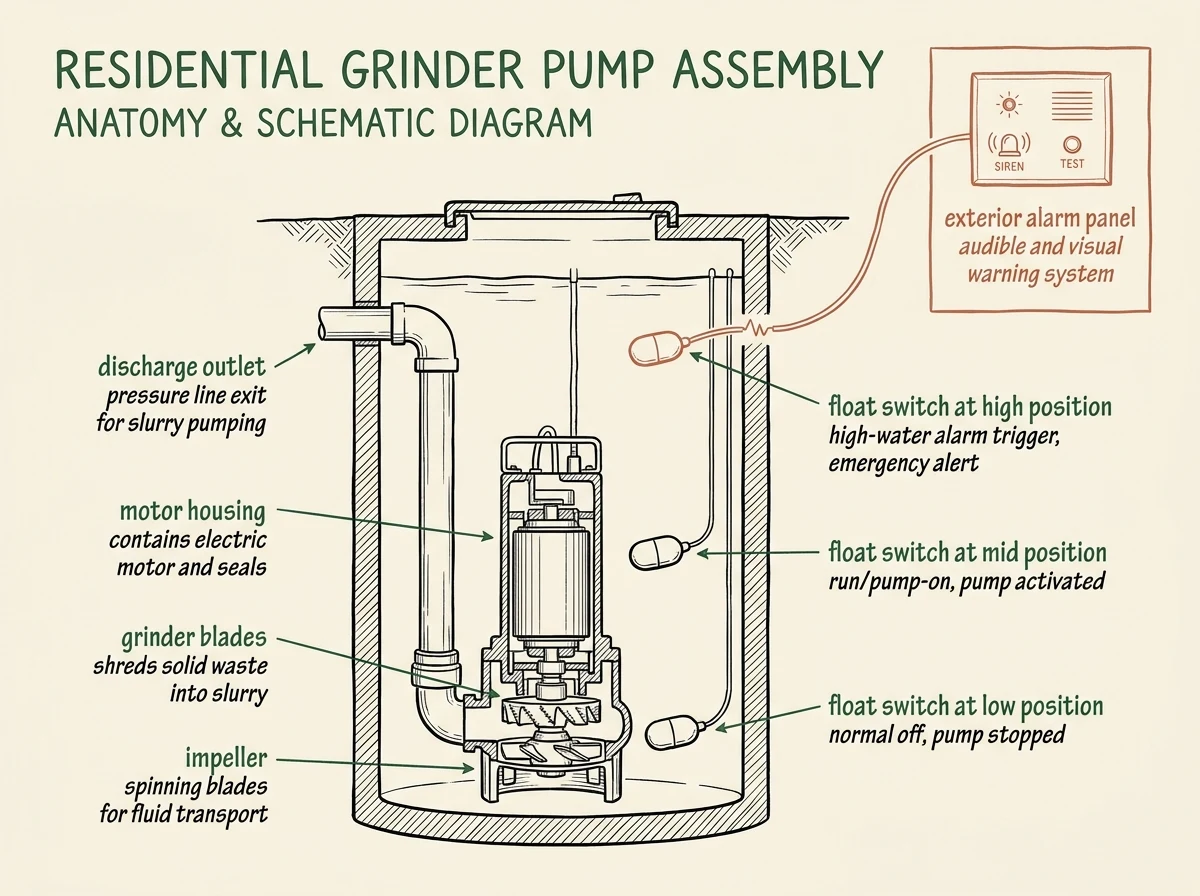
A grinder pump has moving parts — impeller, grinder blades, float switches, alarm system — and industry distributors recommend annual inspection. Some NC utilities require it as a condition of connection.
Budget $150—$200 per year for a licensed plumber’s annual inspection if your utility requires it or if you want to stay ahead of the equipment. Inspection intervals vary: some NC utilities mandate annual checks as a connection condition, others leave the schedule to the homeowner’s discretion. Confirm with your specific utility.
What the inspection covers:
- Impeller and grinder blades: wear and debris fouling
- Float switches: the triggers that tell the pump when to run and when the tank is reaching capacity
- Alarm system: the panel on your exterior wall that signals a pump fault or high-water condition
- Tank integrity: checking for infiltration or cracking
The pump alarm is the most misunderstood part. When it trips, a buzzer sounds and a light activates on the exterior panel. That alarm is not optional — it’s required by most NC utilities as a condition of connection. Ignoring it when it trips can result in sewage backing up into the home. The right response is to reduce water use immediately and call the utility or a licensed plumber.
Grinder pump units have an expected lifespan of roughly 10—15 years under normal residential use. E/One, the dominant pressure-sewer pump manufacturer in North Carolina, publishes an average mean time between service calls of 10 years — and states the pumps require no preventive maintenance — with some units lasting well over 20 years. Build that replacement window into your long-term math before signing the connection agreement.
Power Outage — The Grinder Pump Vulnerability
No electricity means the pump can’t run. The holding tank buys time, but not unlimited time.
This is the most concrete difference between a gravity connection and a grinder pump system. A gravity lateral has no moving parts and no power dependency — it works during a hurricane the same as on a clear day.
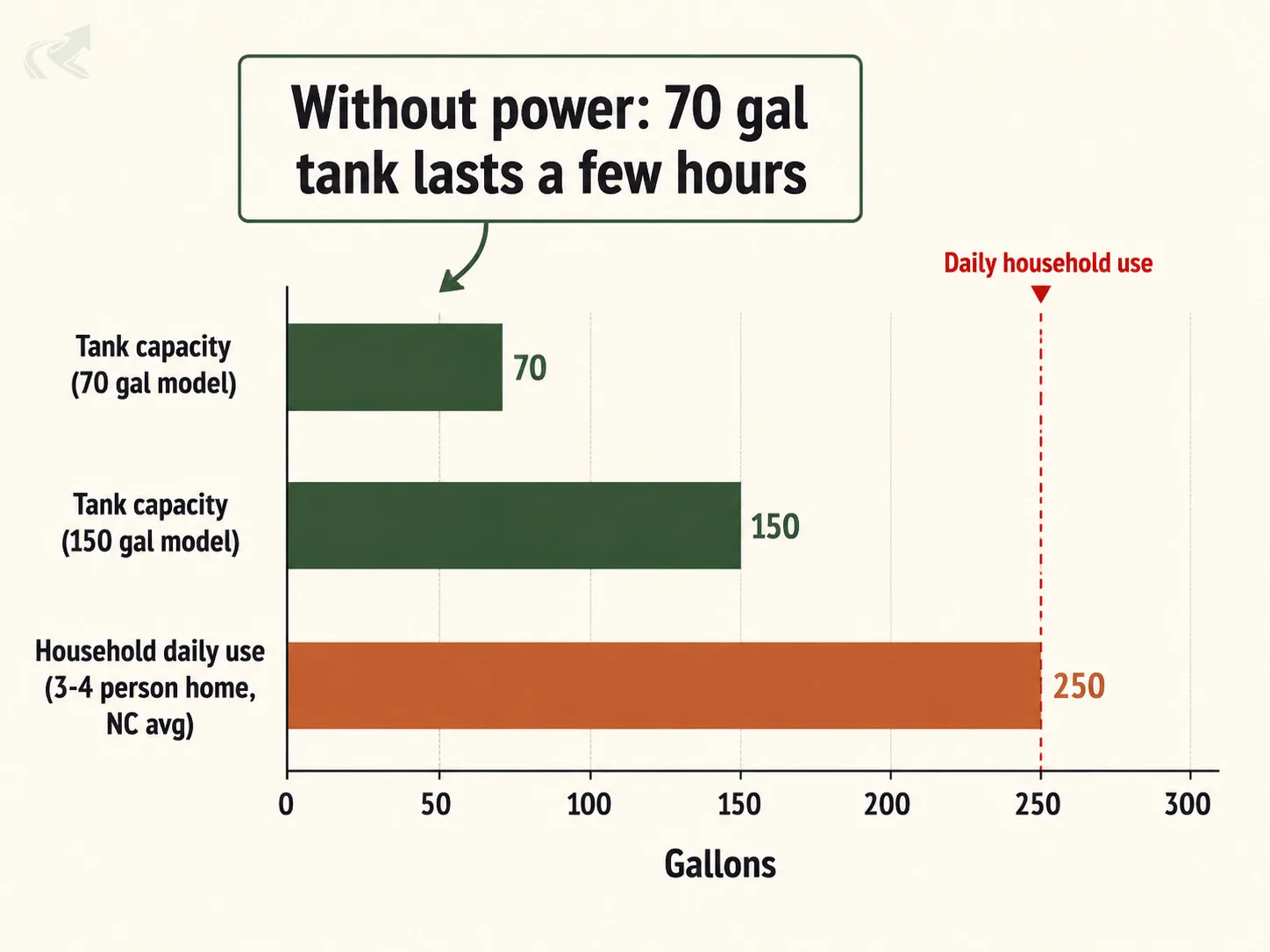
A grinder pump holding tank has finite capacity. Manufacturer specs for single-family residential grinder pump tanks typically range from 70 to 150 gallons — far smaller than a septic tank. At normal North Carolina household water use (roughly 200—300 gallons per day for a 3—4 person home, consistent with EPA estimates of 300+ gallons per day for an average American household), that capacity translates to a few hours of backup before the high-water alarm triggers — not a full day.
In North Carolina, that window matters. The state sees significant storm activity, and multi-day outages are not rare in the Piedmont and foothills after major weather events.
Options to address the vulnerability:
- Generator hookup: A transfer switch that routes power to the pump circuit during an outage is the most reliable solution. Know your pump’s amperage requirements before sizing the generator.
- Reduced water use protocol: During outages without a generator, cut water use to the minimum. No laundry, no dishwasher, short showers. This extends your tank window.
Ask the utility what their procedure is for pump stations during extended outages. Some utilities prioritize neighborhoods with pump systems for restoration — some do not.
When a Grinder Pump Is Worth It — and When to Reconsider
If the choice is grinder pump or no sewer connection at all, the pump is usually worth it. If there’s flexibility in timing, run the lifetime math first.
| Factor | Gravity connection | Grinder pump system |
|---|---|---|
| Required when | Home above sewer main | Home below sewer main |
| Install cost | $3,000—$8,000 | $8,000—$20,000+ |
| Moving parts | None | Pump motor, grinder, floats |
| Power dependency | None | Yes — no power = no flush |
| Annual maintenance | Minimal | Inspection recommended; $150—$200/yr typical; utility requirements vary |
| Pump lifespan | N/A | ~10—15 years |
The lifetime math: install cost plus periodic inspections over the pump’s lifespan plus one pump replacement cycle ($2,000—$3,000). Compare that to what it would cost to extend your existing septic system’s useful life through pumping and maintenance. For many North Carolina homeowners on forced-hookup timelines — especially in Guilford and Wake counties where utilities are actively extending mains — the pump is the only path to compliance.
If your municipality issued a mandatory connection notice, ask about hardship extensions. North Carolina utilities typically offer limited-duration extensions for documented hardship situations. That time can be used to budget for the install and negotiate ownership terms.
For the full cost picture including both gravity and pump scenarios, see the NC sewer conversion cost guide. For how a grinder pump compares to other below-grade pump systems, see grinder pump and sump pump as NC drainage systems.
Grinder Pump Evaluation Checklist
Five questions to answer before agreeing to a grinder pump installation. The answers change the long-term cost picture significantly.
Three Common Mistakes
Not asking who owns the pump before signing. If the utility owns it, maintenance and replacement are their problem. If you own it, you are buying a piece of mechanical equipment with a 10—15 year lifespan on the day you sign.
Not planning for power outages. “Limited tank capacity” isn’t concrete enough to plan around. Ask for the tank size in gallons and calculate your household’s water use per day. That number tells you how many hours you have before you need a generator running.
Ignoring the alarm when it trips. The pump alarm exists to prevent sewage backup into your home. It is not a nuisance feature — it is the warning system. Know before installation what the alarm sounds like, where the panel is, and what the first call to make when it trips.
For homeowners whose yards require regrading as part of the sewer connection — trench restoration, pressure line burial, or lot regrading after excavation — NC Grade and Haul’s directory surfaces verified NC grading contractors who have cleared license-board, workers’ comp, and OSHA checks. For the full picture of what a sewer conversion involves in North Carolina, including both gravity and pump scenarios, see the NC septic-to-sewer guide.