
Two questions Charlotte homeowners ask first
Do I need a permit for a French drain in Charlotte?
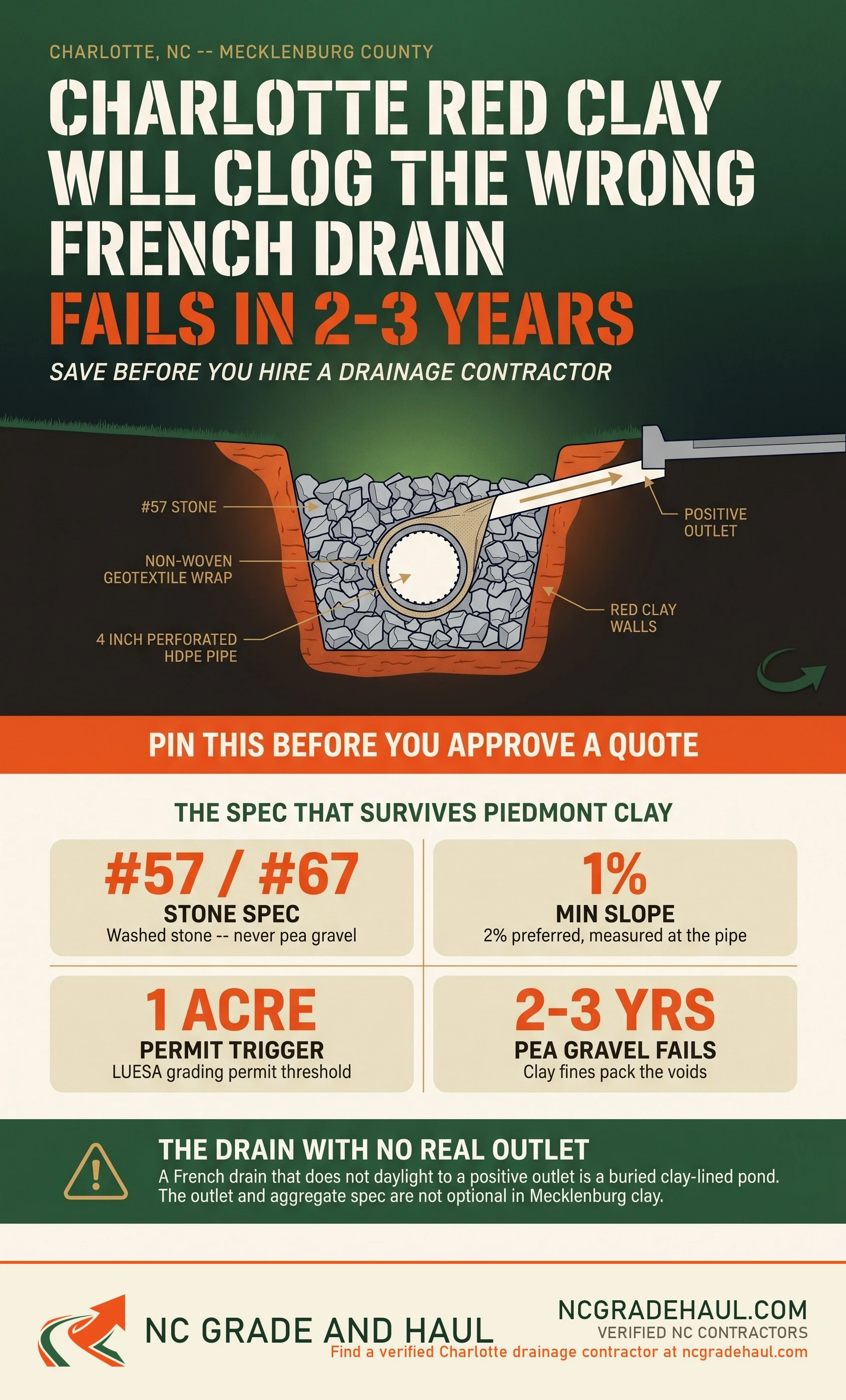
Mecklenburg County land-disturbance permits are administered by LUESA (Land Use and Environmental Services Agency) through Charlotte-Mecklenburg Storm Water Services. In both the City of Charlotte and Mecklenburg County, a grading/erosion-control permit is required once a project disturbs 1 acre or more -- the same as the statewide North Carolina trigger. Most standard residential French drain installs fall well below that threshold -- but check your specific situation with LUESA first.
Does Charlotte clay soil require a different French drain design?
Mecklenburg County sits in the same Piedmont red clay zone as Wake County. Design requirements are identical: positive outlet to daylight, #57 or #67 stone aggregate, non-woven geotextile wrap, and a minimum 1% slope. Pea gravel clogs with clay fines within 2--3 seasons. The aggregate spec is not optional in Piedmont clay.
Your yard floods after every rain. You got two contractor quotes — they disagree on the fix, disagree on the materials, and neither one mentioned permits.
That’s a familiar situation in south Charlotte and Ballantyne. Newer subdivisions in Steele Creek, Mint Hill, and the surrounding Mecklenburg municipalities are built on rolling terrain over Piedmont red clay. Water concentrates fast and drains slowly.
A French drain solves the problem — when it’s designed correctly. In North Carolina’s Mecklenburg County, “designed correctly” means knowing where your water needs to go, what permits you may need from LUESA, and which aggregate will survive Charlotte clay.
Mecklenburg County Permits: What You Need to Know Before You Start
Mecklenburg County and the City of Charlotte both require a grading/erosion-control permit once a project disturbs 1 acre or more — the same as the statewide North Carolina trigger.
— through Charlotte-Mecklenburg Storm Water Services — administers grading and land-disturbance permits for the county and city. Do not let a contractor start grading without confirming your permit situation — a stop-work order on a partially-installed drain is expensive.
Here is what applies:
- State-level trigger: North Carolina requires an plan and permit at 1 acre of disturbance statewide. This applies regardless of county.
- eNOI filing: Any project that crosses the 1-acre state threshold requires an eNOI filed through for the NCG01 Construction Stormwater General Permit, submitted through the AccessDEQ portal at deq.nc.gov/accessdeq before work starts.
- City of Charlotte / Mecklenburg threshold: The local grading/erosion-control permit is required at 1 acre of land disturbance — there is no separate local requirement below the 1-acre state threshold. Confirm details at stormwaterservices.mecknc.gov or call LUESA directly.
The 10-minute LUESA call is easier than a stop-work order. Make it first.
For a broader look at Mecklenburg County permits for Charlotte French drain projects, the county-permits resource has the permit matrix for NC counties side by side.
Charlotte’s Clay Soil: Same Problem as Raleigh, Different Metro
Mecklenburg County sits in the Piedmont — the same red clay zone as Wake County. French drain design rules are identical.
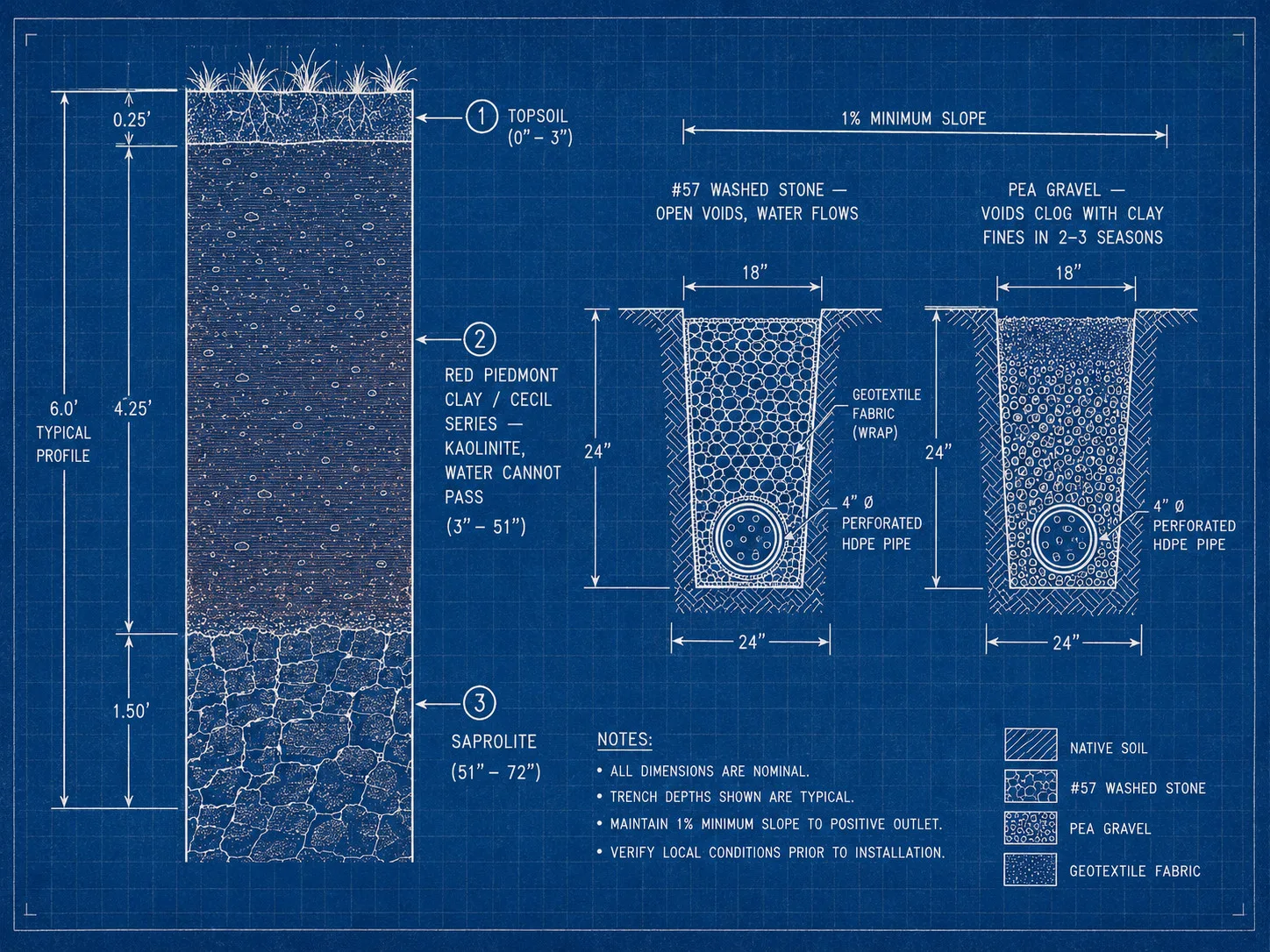
The Cecil soil series is one of the dominant upland soils across the North Carolina Piedmont, including Mecklenburg County — it is the upland red clay most Charlotte homeowners encounter when they dig past the topsoil. Chewacla is the poorly-drained alluvial clay found along Piedmont creek floodplains and drainage corridors.
Both are heavy, slow-draining, and unforgiving when French drain aggregate is under-spec’d.
The design requirements that work in Raleigh work here too:
- Aggregate: #57 or #67 stone — not pea gravel. Pea gravel’s small voids clog with clay fines within 2—3 years in Piedmont soil.
- Geotextile: non-woven fabric wrap on the perforated pipe. Woven fabric passes clay fines; non-woven does not.
- Slope: minimum 1%, 2% preferred. Less than 1% and water sits in the pipe.
- Outlet: must daylight to a positive outlet. Without a real outlet, you have an underground clay-lined pond.
NC Homeowner Takeaway — the sock debate: You’ve probably seen YouTube installers argue about wrapped pipe (“sock”) vs unwrapped pipe in gravel. In Piedmont red clay, the non-woven geotextile wrap matters. The argument against it assumes sandy or gravelly native soil where fines migration isn’t the failure mode. That’s not Charlotte. Use the wrap.
For the full methodology breakdown, see French drain methodology for Mecklenburg red clay.
City Limits vs Unincorporated Mecklenburg: Which Rules Apply to You
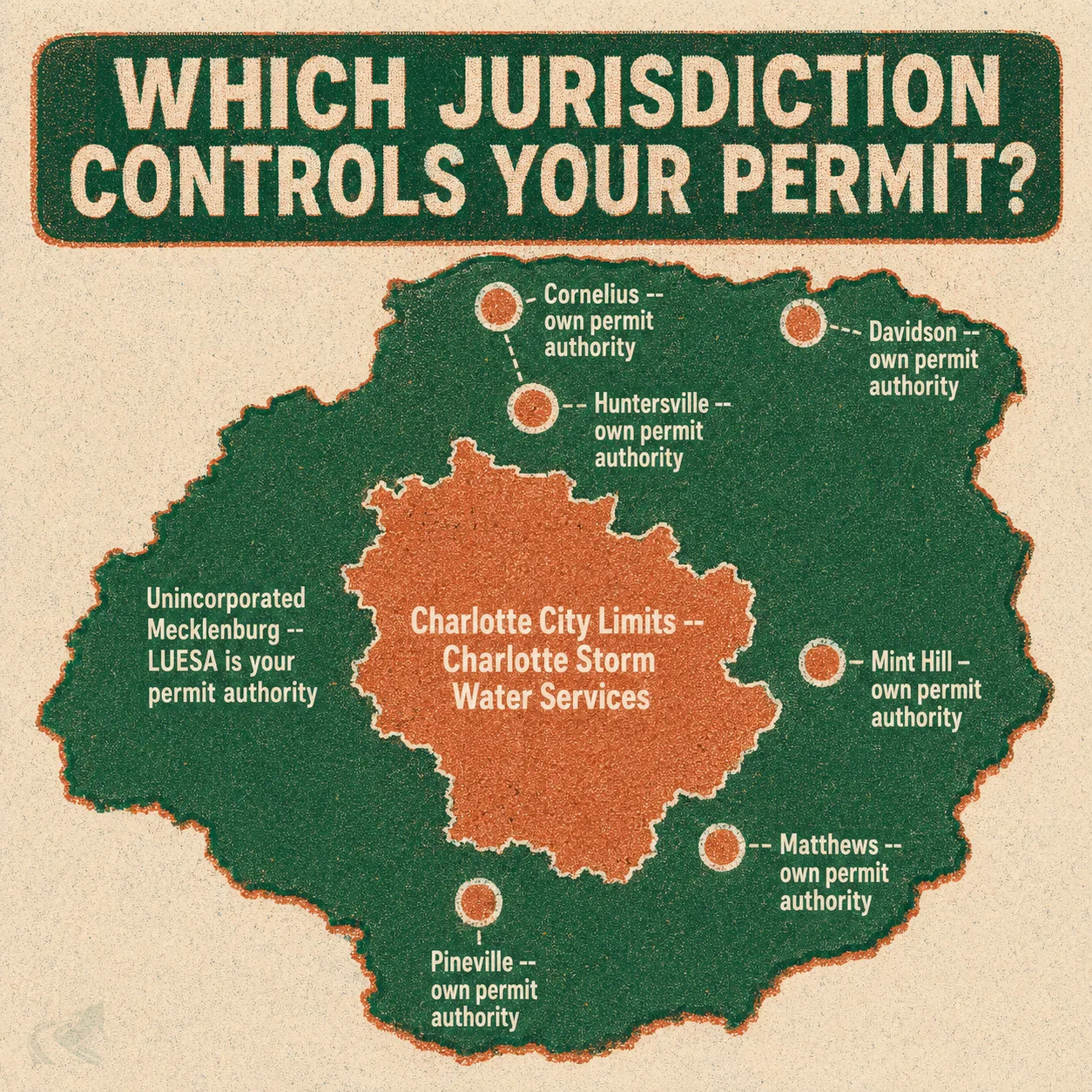
Your permit situation depends on whether you’re inside Charlotte city limits, in one of the six incorporated towns, or in unincorporated Mecklenburg.
Many Charlotte-area homeowners don’t know which jurisdiction they’re in — and it matters because permit administration differs.
Here’s the landscape:
- Charlotte city limits — large but not all of Mecklenburg. Charlotte has its own development review processes. Confirm whether your address is inside city limits at the Charlotte planning portal.
- Six incorporated towns — Huntersville, Matthews, Mint Hill, Cornelius, Davidson, and Pineville each have their own zoning and development review. Projects in these municipalities go to the town, not to Charlotte or to LUESA.
- Unincorporated Mecklenburg — everything outside the above. LUESA is your permit authority.
For most residential French drain installs, the permit question is straightforward once you know your jurisdiction. The situation gets more complicated when your project touches a stormwater easement, a stream buffer, or shared drainage infrastructure.
The simplest rule: if your yard backs up to a creek, a detention pond, or a rear-lot drainage channel — call before you dig. That’s not optional in any of the Mecklenburg jurisdictions.
The Right Design for Charlotte Clay
A French drain in Charlotte that doesn’t daylight to a positive outlet will fail in Mecklenburg clay — usually within 2—3 years.
Here is what a correct installation looks like in the Charlotte metro:
- Pipe: 4-inch perforated with non-woven geotextile wrap
- Aggregate: #57 or #67 stone, not pea gravel or crusher run
- Slope: 1% minimum, 2% preferred — measured at the pipe, not eyeballed at the surface
- Outlet: daylight to street curb/gutter, a catch basin, or a designated stormwater easement
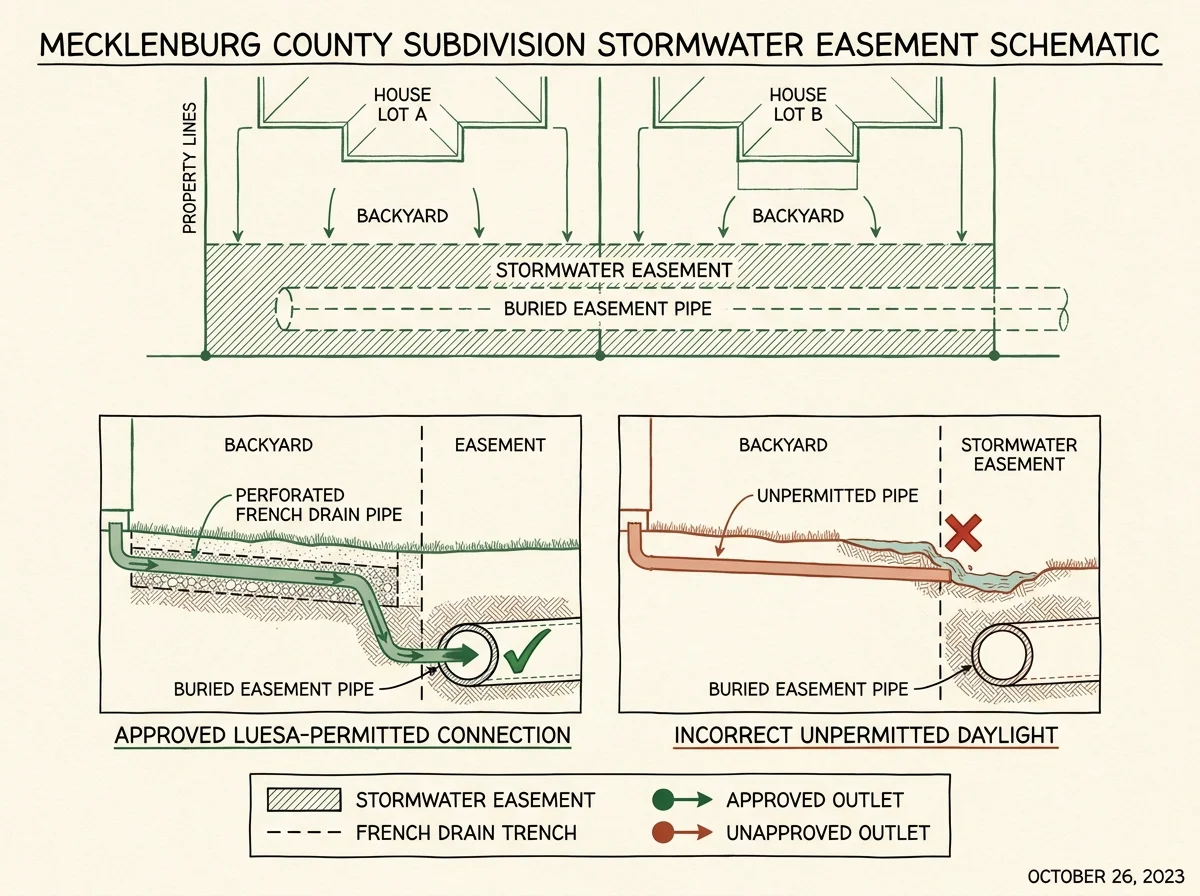
Newer Mecklenburg subdivisions commonly have stormwater easements at the rear lot line. Connecting your French drain outlet to the easement is often the correct approach — it’s where the drainage system is designed to receive water.
But not all easements allow direct connections without approval. Under the Charlotte Unified Development Ordinance Article 24, any construction or connection within a stormwater-related easement must meet City requirements and be reviewed by the Stormwater Administrator — which means prior approval is required before your contractor trenches. Confirm your specific situation with LUESA or Charlotte Storm Water Services before work starts.
French drain in Mecklenburg red clay: built to last vs built to clog
Comparison. Designed for Charlotte clay: #57 or #67 washed stone holds open void space; 4-inch perforated HDPE pipe wrapped in non-woven geotextile; Minimum 1% slope, 2% preferred, measured at the pipe; Daylights to a positive outlet -- curb, catch basin, or approved easement. The 2-to-3-year failure: Pea gravel voids pack with Mecklenburg clay fines; No positive outlet -- the trench becomes a buried clay-lined pond; Water sits in the pipe with no slope to carry it; System backs up and floods the yard it was meant to fix.
- #57 or #67 washed stone holds open void space
- 4-inch perforated HDPE pipe wrapped in non-woven geotextile
- Minimum 1% slope, 2% preferred, measured at the pipe
- Daylights to a positive outlet -- curb, catch basin, or approved easement
- Pea gravel voids pack with Mecklenburg clay fines
- No positive outlet -- the trench becomes a buried clay-lined pond
- Water sits in the pipe with no slope to carry it
- System backs up and floods the yard it was meant to fix
In Piedmont red clay, the aggregate spec and a real outlet are not optional -- clay is the failure mode the design has to beat.
Common Mistakes on Charlotte French Drain Projects
Three mistakes that produce stop-work orders or failed drains in Mecklenburg.
- Not calling LUESA before starting. The residential threshold isn’t on their website — the call takes 10 minutes and costs nothing. A stop-work order on a partially-trenched yard does not.
- Routing drainage to the rear easement without checking. Many newer Mecklenburg subdivisions have stormwater easements designed to receive drainage — but not all allow direct connections without LUESA approval. Do not assume the easement is a free outlet.
- Pea gravel in Piedmont clay. This one shows up in quotes regularly. Pea gravel’s small voids fill with clay fines within 2—3 seasons. The water stops moving. Use #57 or #67 stone — the spec exists because clay is the failure mode.
Finding a Verified Contractor in Charlotte
Not every Charlotte drainage contractor understands LUESA’s process or designs for Mecklenburg’s clay — ask two diagnostic questions before you hire.
Two questions that reveal whether a contractor knows what they’re doing in the Charlotte market:
- “Where does the water outlet — street curb, stormwater easement, or catch basin?”
- “Do you pull permits through LUESA when the project requires it?”
A contractor who can’t answer the first question hasn’t scoped the job. A contractor who says permits aren’t needed without knowing your jurisdiction hasn’t done the homework.
Copy this question to ask your contractor
”Where exactly does the water outlet — to the street, a catch basin, or the rear stormwater easement — and do you need LUESA approval to connect to that outlet?”
Hire a licensed NC grading contractor in Charlotte — every contractor in the directory has an active NCLBGC license and verified contact information. Get an itemized quote before work starts.
What This Page Does Not Cover
Three related topics with their own dedicated pages.
- Charlotte grading contractor services beyond French drain installation — see Charlotte grading contractor alongside French drain services
- County-level Mecklenburg contractor context across all service types — see Mecklenburg County grading contractor serving Charlotte and unincorporated areas
- Permit matrix for other North Carolina counties — see Mecklenburg County permits for Charlotte French drain projects
For the full hub on French drain installation in NC — design specs, when they work, and when they don’t — that page covers the methodology without the Mecklenburg-specific context.
From our directory
Verified contractors near you
Every listing is cross-checked against the NC Licensing Board public record before it appears. Pick your city:
Or browse the full NC contractor directory.