
What people ask before they call anyone
How much does yard drainage cost in NC?
Regrading: $1,500-$6,000. French drain: $3,000-$15,000. Catch basin: $1,000-$4,000. Full system (regrade + French drain + catch basin): $8,000-$25,000+. The solution type determines the price band -- not the severity of the pooling.
Why are two quotes for the same yard $4,200 and $13,800?
They are likely two different solutions -- regrading vs. a French drain system. Those are not the same fix. Before you compare totals, confirm both contractors are proposing the same solution type. If they are not, the price gap is not a red flag; it is a diagnosis disagreement.
Latoya got two quotes for her North Carolina backyard: $4,200 and $13,800. Same yard, same problem — water pooling along the back fence after every rain. Both contractors were licensed. Neither explained the line items.
The lower quote is for regrading. The higher quote is for a French drain system with a catch basin. They are not the same fix. Comparing the totals is like comparing the price of a new roof to the price of new gutters — one number tells you nothing about whether the other is fair.
This page gives Latoya — and any NC homeowner holding two or more quotes — the cost ranges by solution type, the cost drivers inside each band, and a framework for comparing itemized quotes before signing anything.
Cost ranges on this page reflect 2025-2026 North Carolina Triangle and Piedmont contractor pricing. Verify current figures with at least two itemized quotes from licensed NC contractors.
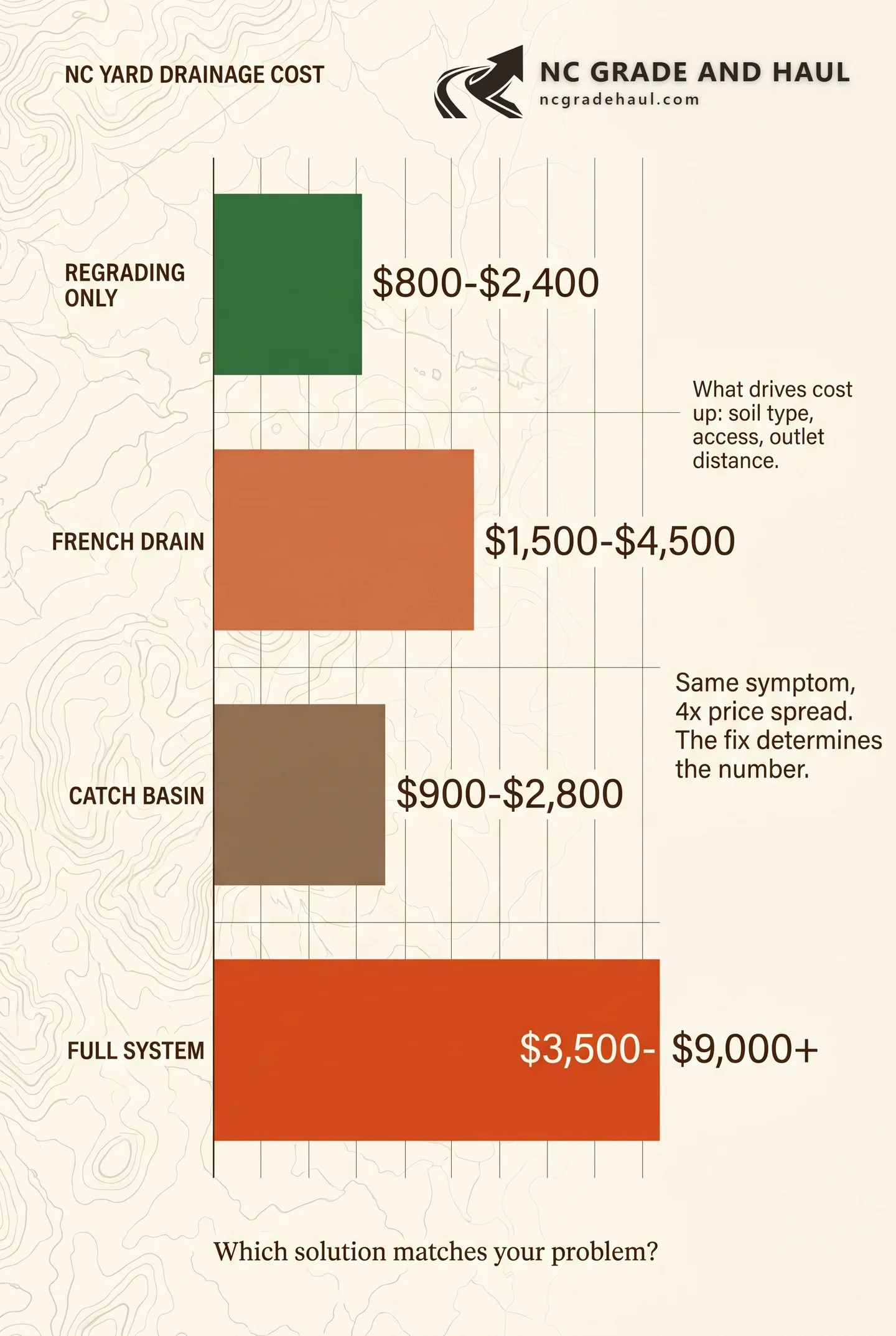
Cost Tier 1: Regrading Only ($1,500-$6,000)
Regrading is the right fix when the problem is grade — and it is the least expensive major drainage solution.
When a yard drains poorly because the slope pushes water toward the house instead of away, or because low spots have formed from settlement, the fix is grade correction — not pipe. A contractor brings in equipment, moves or adds fill dirt, re-establishes positive drainage across the lot, and restores ground cover.
What a fair itemized quote includes:
- Mobilization — equipment haul-in and setup (usually a fixed line item)
- Equipment hours — excavator or skid steer time for rough grade correction
- Fill dirt — cubic yards delivered and spread (or removed, if the lot is high in the wrong place)
- Finish grade — raking and smoothing to final slope
- Erosion control — silt fence required on most NC sites per stormwater rules
- Restoration — seed or sod; sod runs 3-5x more per square foot than seed
What drives cost within this band: The volume of fill dirt needed (or removed) is the primary driver. Equipment access through a narrow gate forces smaller machines or hand work and adds labor cost. Lot size and restoration method — seed vs. sod — account for most of the remaining spread.
When regrading is the right solution: Slope fails the 2% test (less than 2 inches of drop per 10 feet of run away from the house). Low spots are grade-related, not caused by subsurface saturation. No drainage infrastructure is needed once the grade is corrected.
Yard regrading: problem grade vs. corrected grade
Comparison. Problem grade: Slope runs toward the house, not away; Low spots collect water after every rain; Foundation edge stays wet -- soil never drains; No fix until the grade itself is corrected. After regrading: Minimum 2% fall away from the foundation; Low spots filled and compacted with fill dirt; Water moves off the lot -- no pooling at the fence line; Seed or sod restores ground cover over the disturbed area.
- Slope runs toward the house, not away
- Low spots collect water after every rain
- Foundation edge stays wet -- soil never drains
- No fix until the grade itself is corrected
- Minimum 2% fall away from the foundation
- Low spots filled and compacted with fill dirt
- Water moves off the lot -- no pooling at the fence line
- Seed or sod restores ground cover over the disturbed area
Regrading corrects the cause of the drainage failure -- not just the symptom. If the grade is wrong, no amount of pipe will fix it.
For more on the regrading process, see NC yard regrading — rough vs finish.
Cost Tier 2: French Drain System ($3,000-$15,000)
French drain cost is driven primarily by linear footage, pipe depth, and discharge routing.
A French drain intercepts subsurface water before it saturates the soil or pools at the surface. A contractor trenches a bed, fills it with crushed stone, lays perforated pipe, wraps it in fabric (if specified), and routes the collected water to a discharge point — a daylight outlet, pop-up emitter, or catch basin.
What a fair itemized quote includes:
- Linear footage with pipe specs — diameter, material (perforated PVC, or polyvinyl chloride, is standard), and burial depth
- Stone type and volume — #57 or #67 washed stone; volume in tons or cubic yards
- Discharge type and location — daylight outlet (pipe daylights to grade), pop-up emitter, or tie-in to a catch basin
- Tie-in connections — if the French drain connects to a catch basin or existing drainage structure, that connection is a separate line item
What drives cost within this band: Run length is the clearest driver — more linear feet means more trench, more stone, more pipe, more labor. Pipe depth is the second driver; every additional foot of depth means more excavation and more stone. North Carolina Piedmont clay is harder to excavate than sandy coastal soil; rock or heavy clay subsoil adds cost through equipment hours. Discharge routing matters significantly — a run that daylights 10 feet away is far cheaper than a 60-foot solid pipe run to the street.
When a French drain is the right solution: Soil saturation or subsurface water is the primary problem. The yard stays wet even when surface grade looks correct. Grade correction alone will not fix it.
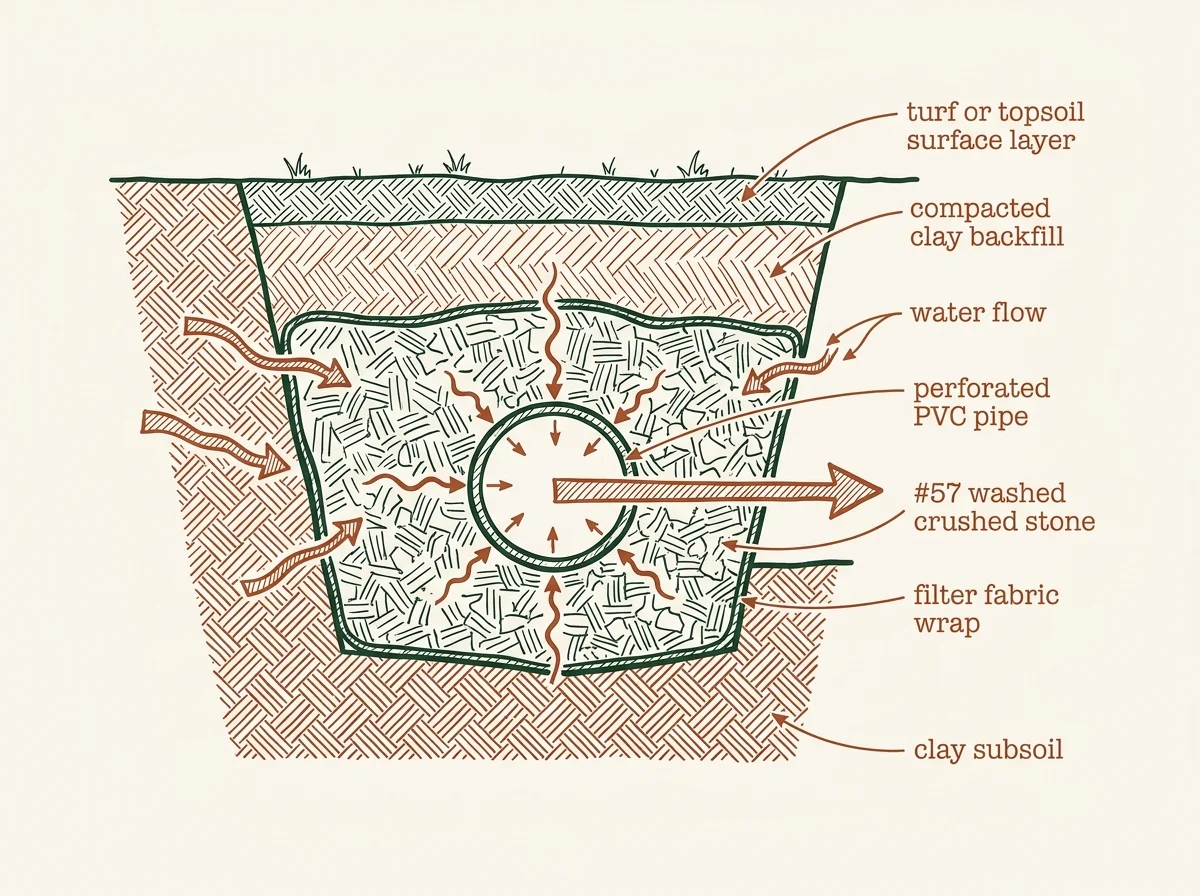
French drain cross-section: perforated pipe in #57 stone, wrapped in filter fabric — water enters through the stone bed and exits through the pipe. Fabric keeps NC clay fines from migrating into the stone and clogging the system.
Cost Tier 3: Catch Basin ($1,000-$4,000)
A single catch basin with solid pipe outlet is the mid-tier solution for concentrated low spots.
A catch basin is a square or rectangular inlet box set flush with grade. Water flows in, collects in the basin, and drains out through a solid pipe to a discharge point. It handles surface pooling at a single concentrated location — a yard low spot, a driveway edge, a patio corner.
What a fair itemized quote includes:
- Excavation for the basin and pipe trench
- Basin unit (size varies by drainage area)
- Solid pipe run to outlet (linear footage and slope)
- Backfill and restoration around the basin
What drives cost within this band: Basin size (larger drainage areas need larger basins), distance from basin to outlet, and site access. A catch basin set 15 feet from a natural grade discharge is a straightforward installation. A basin that needs 80 feet of pipe to reach the street is not.
Catch basins are often combined with regrading or a French drain in a full system. As a standalone fix, they address a single concentrated problem — not a yard-wide saturation issue.
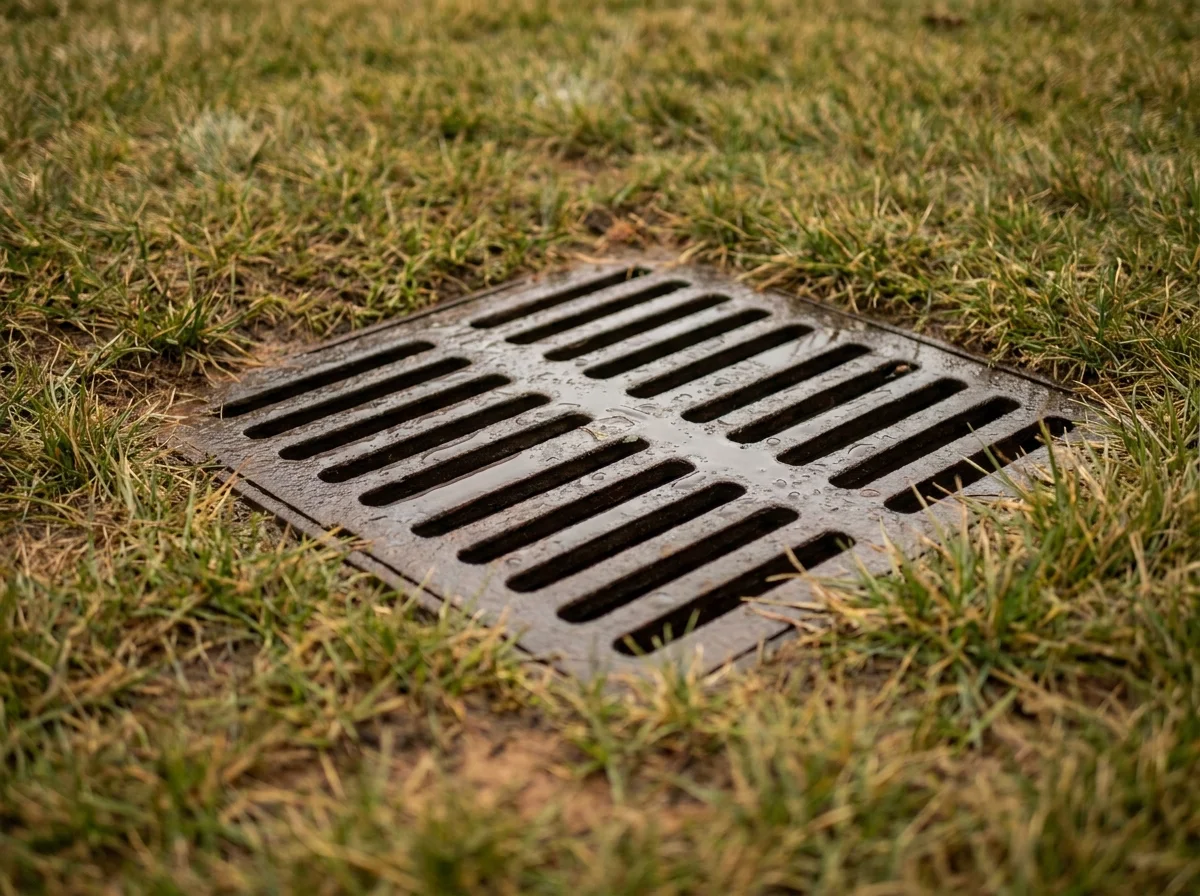
A properly installed catch basin sits flush with grade — water flows in naturally without pooling around the frame. This is a single-point solution for a concentrated low spot, not a yard-wide saturation fix.
Cost Tier 4: Full System — Regrade + French Drain + Catch Basin ($8,000-$25,000+)
Full drainage systems are necessary when a yard has multiple problem types — surface, subsurface, and grade — occurring together.
A full system addresses everything at once. The contractor corrects the grade (Tier 1), installs a French drain for subsurface saturation (Tier 2), adds catch basins for concentrated surface pooling (Tier 3), and often ties in downspout discharge as well. The result is a yard that achieves positive drainage across all failure modes simultaneously.
What a full system includes that individual tiers do not:
- Downspout tie-ins — connecting roof gutters to the drainage system so roof runoff enters managed infrastructure instead of pooling at the foundation
- Multiple discharge paths — routing different parts of the system to different outlets based on volume and location
- Grade correction across the full lot — not just the worst low spot
When a full system is necessary: North Carolina new builds with grade failure, inadequate drainage infrastructure, concentrated downspout discharge, and surface pooling — occurring together. This is the scenario where a $4,200 quote and a $13,800 quote represent genuinely different scopes, not different markups.
Builder accountability note: If a new home in North Carolina needs a full drainage system at move-in, that is a builder-side failure. The lot was graded incorrectly, drainage infrastructure was under-built, or both. That is not a standard homeowner expense. Document the failure, verify the original grading plan against what was built, and consult an attorney before absorbing the cost.
For a closer look at what is driving water into your yard, see standing water in yard NC solutions.
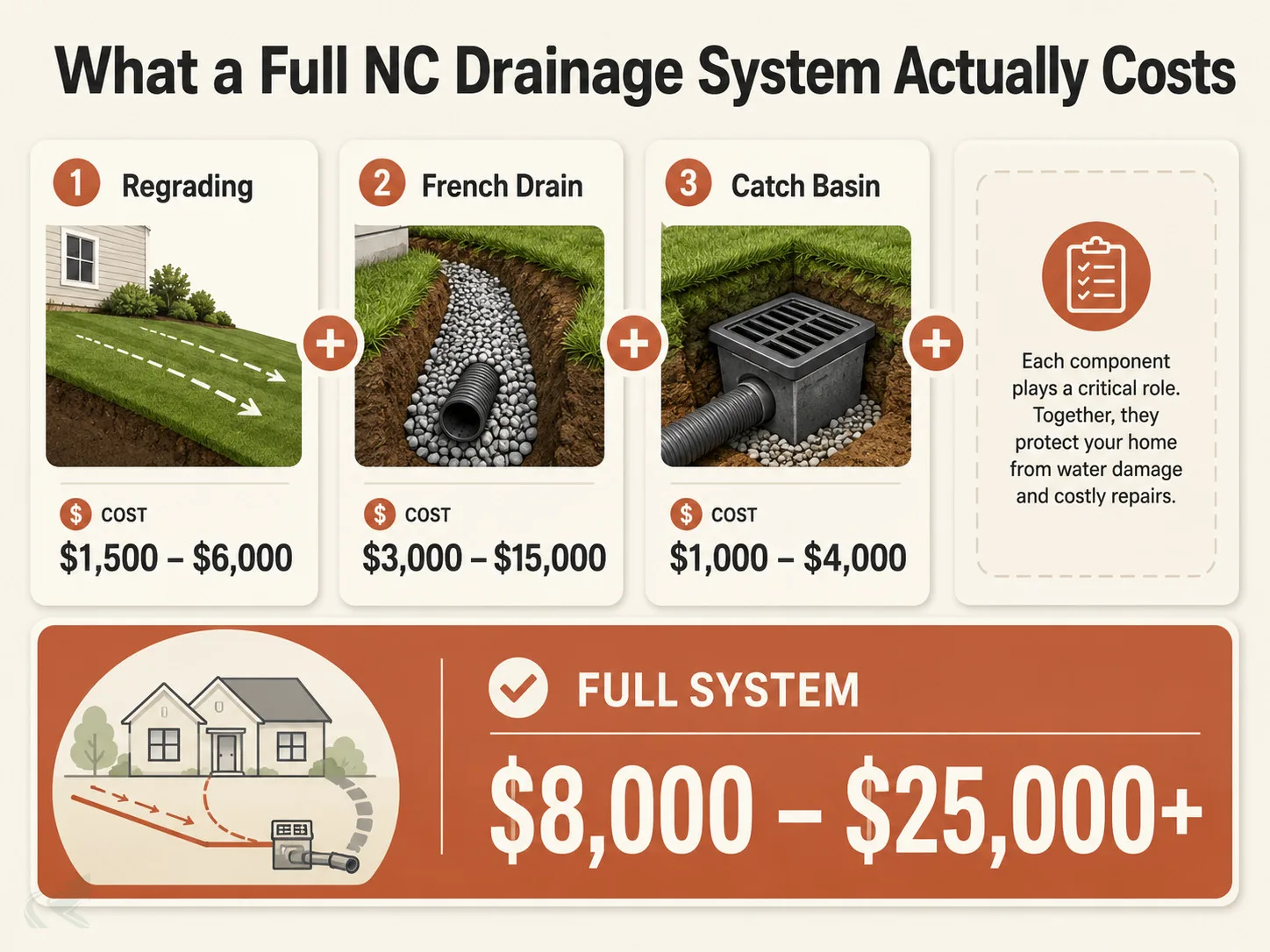
Cost Drivers That Affect Every Quote
Five factors drive the gap between a $4,000 quote and a $14,000 quote for the same yard.
Understanding these before you read any quote helps you identify which line items are high and why — rather than comparing totals between quotes that may be scoping the job differently.
Lot size and run length. More square footage requires more material and labor for grade correction. A longer French drain run adds linear footage of trench, stone, and pipe — the primary cost driver for Tier 2 work. This is not padding; it is arithmetic.
Equipment access. A yard with a 36-inch gate or a narrow side yard forces smaller equipment — or hand digging. Hand work can double labor cost on sections that a full-size excavator would handle in an hour. Confirm gate width before comparing mobilization line items.
Soil conditions. North Carolina Piedmont clay excavates harder than sandy soil. If a contractor hits rock or dense clay subsoil — and does not find out until the trench is open — the excavation line item grows. A pre-dig soil assessment (or a note that subsoil conditions could affect cost) is a sign of a thorough contractor.
Discharge routing. A daylight outlet that daylights 10 feet to a natural slope is the cheapest discharge option. Routing water 60-80 feet through solid pipe to a street curb adds material, labor, and sometimes an inspection. Ask every contractor where the water goes and how far it travels.
Restoration method. Sod costs 3-5x more per square foot than seed. On a large disturbance area, that difference is significant. If a quote does not specify seed vs. sod, ask — some contractors assume sod; others assume seed.
How to Use These Ranges to Evaluate a Quote
Put each quote’s line items into the right tier, then compare the line items — not the totals.
If both quotes are Tier 1 (regrading), compare mobilization, fill cubic yards, equipment hours, and restoration method separately. A $4,200 regrading quote and a $5,800 regrading quote can both be fair if the higher one includes sod instead of seed and a longer equipment haul.
If one quote is Tier 1 (regrading) and one is Tier 2 (French drain system), they are not the same solution. The lower total does not mean the lower contractor is cheaper — it means the contractors disagree on what fix the yard needs. That is a diagnostic question, not a pricing question.
For the full quote-comparison framework, see how to evaluate yard drainage contractor quotes.
To hire a verified NC grading contractor, the NC Grade and Haul directory lists licensed contractors verified against the NC Licensing Board, OSHA records, and workers’ compensation coverage.