The short answer: yard regrading
When is regrading the right fix?
When the grade is wrong -- water runs toward the house or pools due to slope, not due to a drainage system problem. Two phases: rough grade (crown establishment) and finish grade (seed-ready surface). NC Piedmont clay changes how the crown gets built. Here's what it looks like done correctly.
What does a correctly done regrade actually look like?
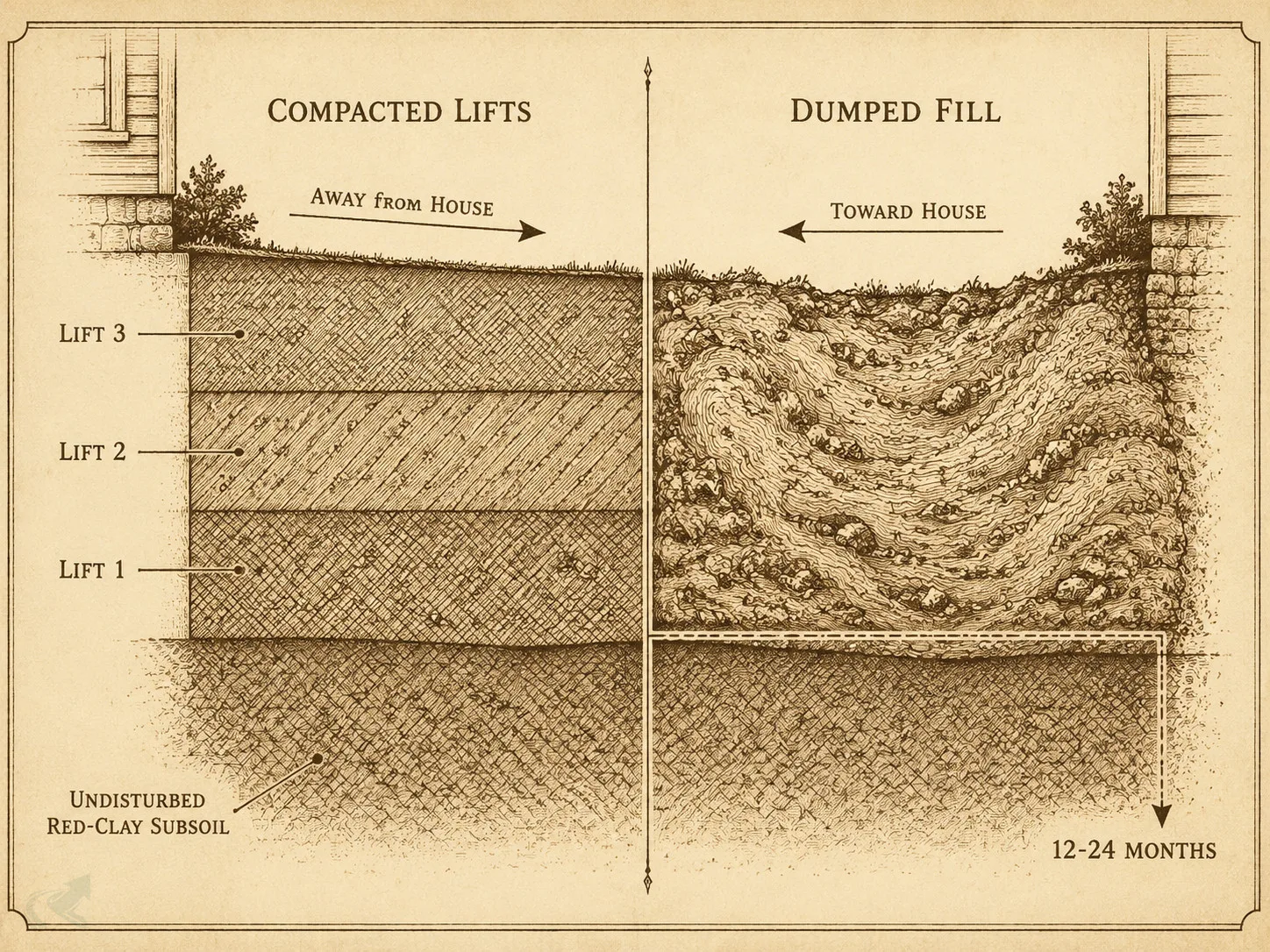
Rough grade establishes the crown using compacted fill in 6-inch lifts -- skipping compaction in NC clay causes the grade to reverse within 12-24 months. Finish grade smooths the surface and prepares it for seed or sod. Positive slope of at least 6 inches over the first 10 feet away from the foundation is the minimum standard.
Shauna Ferrell’s Holly Springs backyard has a grade problem. A contractor walked the lot, checked the slope at the foundation perimeter with a 4-foot level, and said two words: “regrade it.”
She doesn’t know what that means in practice. What equipment shows up? How long does it take? What does the yard look like during the work and after? Most importantly — how does she know if the contractor did it right?
Those are the right questions. Regrading is a two-phase process with a specific standard for what “done correctly” looks like in North Carolina clay. This page covers both phases, the NC Piedmont clay factors that affect how the work gets built, what a fair quote includes, and the three questions to ask any contractor before you sign.
When Regrading Is the Right Fix
Regrade when the slope is wrong — not when you need a drainage system that the grade alone can’t provide.
Regrading is the correct fix when the ground itself is the problem. Specifically: when the grade is flat, reversed toward the house, or has settled unevenly since construction. Water pools where it does not because there’s no outlet — but because the slope sends it there.
That’s a different diagnosis than a drainage system problem. If water runs correctly to a low spot but has nowhere to go, a French drain or swale is the right fix — not regrading. Regrading a yard with a missing outlet just moves the low spot to a new location.
Some North Carolina yards need both. When the grade runs toward the house AND there’s no outlet at the low end of the lot, a contractor may quote regrading plus a French drain as a combined scope. That combination is common on new-build lots where the developer didn’t install drainage infrastructure before final grade.
If you’re not sure which category your yard falls into, start with the standing water in your NC yard — full severity triage and the standing water in yard causes — 3 categories before committing to a quote.
Phase 1: Rough Grade (Crown Establishment)
Rough grade is the machine work that establishes the crown — the basic slope that directs water away from the foundation and toward an outlet.
The contractor uses a skid steer, mini excavator, or box blade on a compact tractor to cut high spots and fill low spots until the lot achieves the correct slope profile. The minimum standard for North Carolina: 6 inches of drop over the first 10 feet away from the foundation, 2 percent minimum across the rest of the yard.
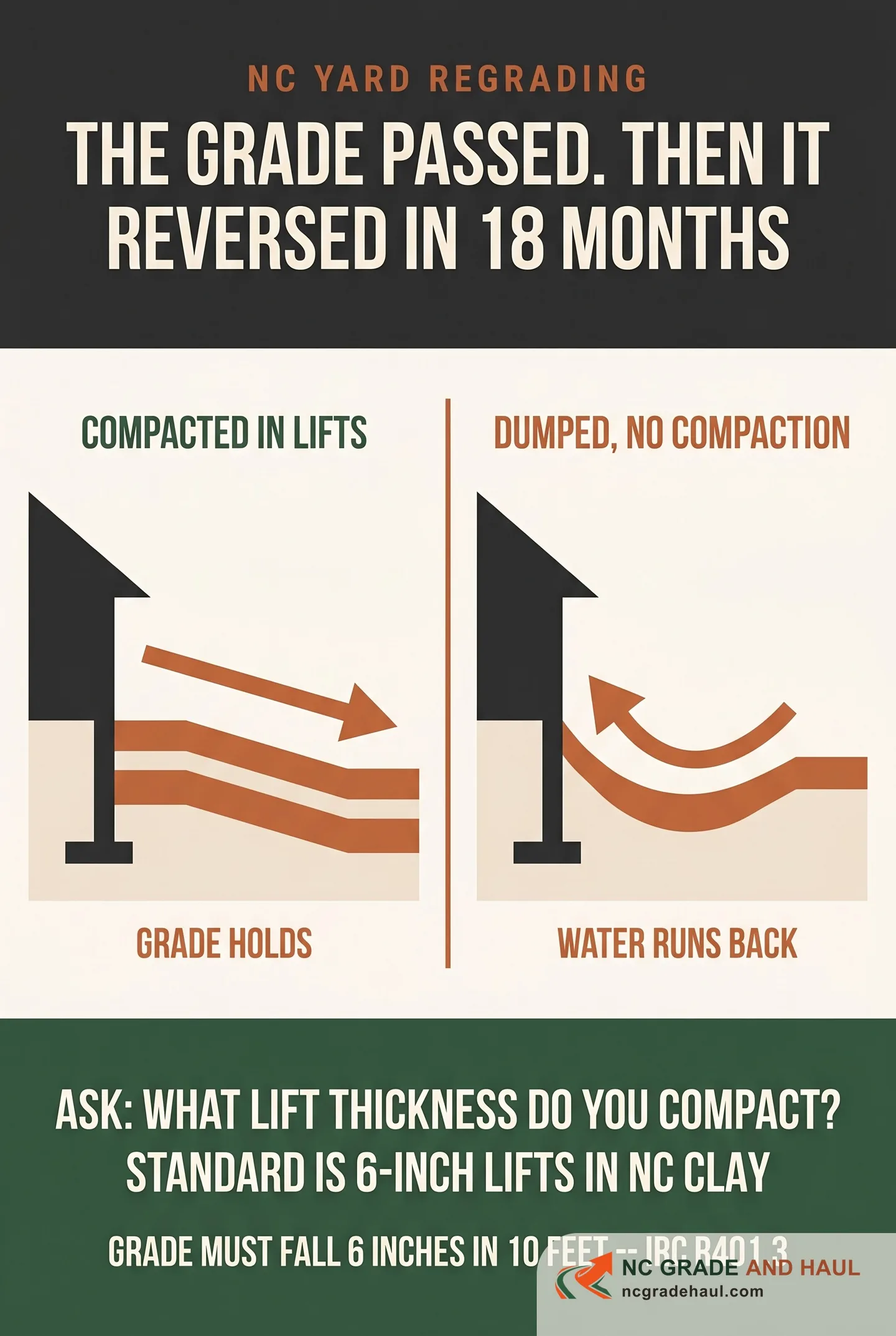
In NC Piedmont clay, this phase carries a non-negotiable requirement: fill must be placed in compacted lifts. Typically 6-inch layers for hand-operated plate compactors, up to 8 inches for ride-on equipment. Each lift gets compacted before the next goes down.
Why it matters: uncompacted clay fill settles. A yard that passes slope at final inspection can reverse within 12 to 24 months when fill is dumped without compaction. That is the pattern behind most NC new-build drainage failures — not bad design, but skipped compaction on the rough grade fill. A correctly built crown accounts for clay’s settlement behavior before the finish crew arrives.
Equipment selection depends on site access and scope. Skid steers work well on smaller lots with tight clearance. Mini excavators handle combined cut-and-fill work where trenching is also needed. A box blade on a compact tractor covers large open areas efficiently.
Rough-grade fill: compacted in lifts vs dumped clay
Comparison. Compacted right: Fill placed in 6-inch lifts, each compacted before the next; Positive slope holds -- the crown stays put; Grade still drains away from the house 12-24 months later. Dumped uncompacted: Clay fill dumped without lift compaction; Settles unevenly as excess pore water dissipates; Low spot forms, grade reverses toward the foundation by 18 months.
- Fill placed in 6-inch lifts, each compacted before the next
- Positive slope holds -- the crown stays put
- Grade still drains away from the house 12-24 months later
- Clay fill dumped without lift compaction
- Settles unevenly as excess pore water dissipates
- Low spot forms, grade reverses toward the foundation by 18 months
Skipped compaction is the failure mode behind most NC new-build grade reversals -- not bad design.
Phase 2: Finish Grade (Seed-Ready Surface)
Finish grade follows rough grade — it smooths the surface, removes rocks and debris, and leaves a seed-ready surface.
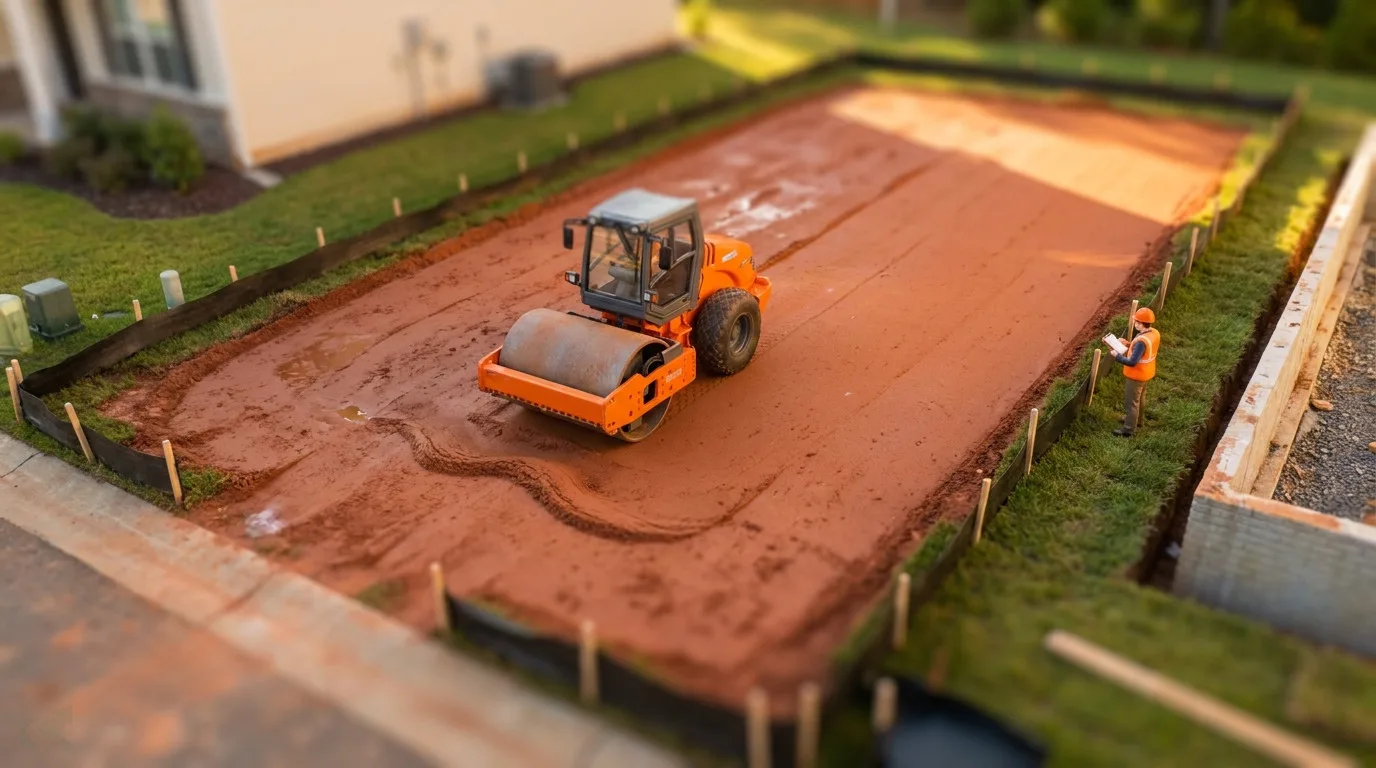
After rough grade establishes the crown, the finish crew drags the surface using a box blade or landscape rake — sometimes called floating the bucket — to remove tire tracks, loose clumps, and debris. Rocks and root remnants come out. The contractor checks slope with a level at several points across the yard to verify the crown held.
In North Carolina clay, finish grade often includes a light scarification pass. Clay hardpan forms quickly on disturbed soil, particularly after compaction equipment has run across it. Seed needs soil contact to germinate. Breaking up the surface crust gives seed a foothold.
Sod can go down immediately after finish grade — the root system establishes contact without needing loose soil texture. Seed takes longer. Most NC warm-season grasses (Bermuda, Zoysia) germinate in 2 to 4 weeks with consistent moisture. Cool-season grasses (tall fescue) establish well seeded in early fall, which aligns with the best regrading timing window for North Carolina.
For a deeper look at the two-phase process, see rough grading vs finish grading — two phases.
Cost and What’s Included in a Fair Quote
Regrading quotes should be itemized by phase — rough grade labor and equipment separate from finish grade, fill, and restoration.
A fair quote names each component separately so you can compare bids on the same line items. Here’s what should appear:
- Mobilization — delivery of equipment to the site
- Rough grade labor and equipment hours — by machine type; skid steer time differs from mini excavator time
- Fill dirt — if needed, quoted as cubic yards delivered and compacted (not loose, not delivered only)
- Finish grade — separate line from rough grade; some contractors price this as included, some separate
- Erosion control — silt fence during work to comply with NC Erosion and Sediment (E&S) Control requirements
- Restoration — sod, seed, or bare (noted explicitly, not assumed)
Cost ranges for North Carolina regrading vary significantly by lot size, fill quantity, and region. Cross-reference with yard drainage cost NC for current ranges aligned with verified contractor data.
Red flag quotes: lump sum with no line items; no mention of compaction; no erosion control listed; no restoration specified. A quote that reads “regrade yard — $X” without those components is a comparison problem — you can’t tell if it’s cheap because the scope is missing, or cheap because the contractor is efficient.
NC Clay-Specific Contractor Selection Criteria
In NC Piedmont clay, ask your contractor how they handle fill compaction and settlement — a contractor who doesn’t address this will leave you with a grade that reverses.
Most homeowners ask about price. Shauna’s real concern is whether she can trust that the work was done correctly — especially since a grade reversal shows up 18 months later, not on the day the contractor leaves.
Three questions to ask before signing:
-
“How do you compact fill in NC clay? What lift thickness?” A qualified answer names a specific lift thickness — 6 inches is standard for hand-operated equipment, 8 inches for ride-on. “We compact it” without a specification is not an answer.
-
“Do you do a proof-roll after rough grade?” A proof-roll is a slow pass with loaded equipment across the graded surface to detect soft spots. Soft spots show as rutting or pumping under load. Passing a proof-roll means the compaction held. Not every residential contractor uses this step, but the ones who mention it without prompting understand the settlement risk.
-
“What’s your restoration plan — sod, seed, or bare?” The answer matters for your timeline and ongoing erosion risk. A contractor who leaves a regraded yard bare without erosion control is creating a problem for the next rain.
Red flag response: “We just grade to what looks right.” A qualified North Carolina clay contractor talks about lifts, compaction, and settlement as standard practice — not as optional add-ons you had to ask about.
For help comparing written quotes, see how to evaluate yard drainage contractor quotes.
Ask your regrading contractor before signing
“How do you handle fill compaction in NC clay? What lift thickness? Do you proof-roll after rough grade?”
A contractor who can’t answer these questions specifically hasn’t worked in NC Piedmont clay. Hire a grading operator in North Carolina who addresses compaction and settlement as standard practice.
Timing: Best Time of Year to Regrade in NC
Fall is underrated — the soil is dry enough for equipment, the winter rains settle the new grade, and spring seed establishes well.
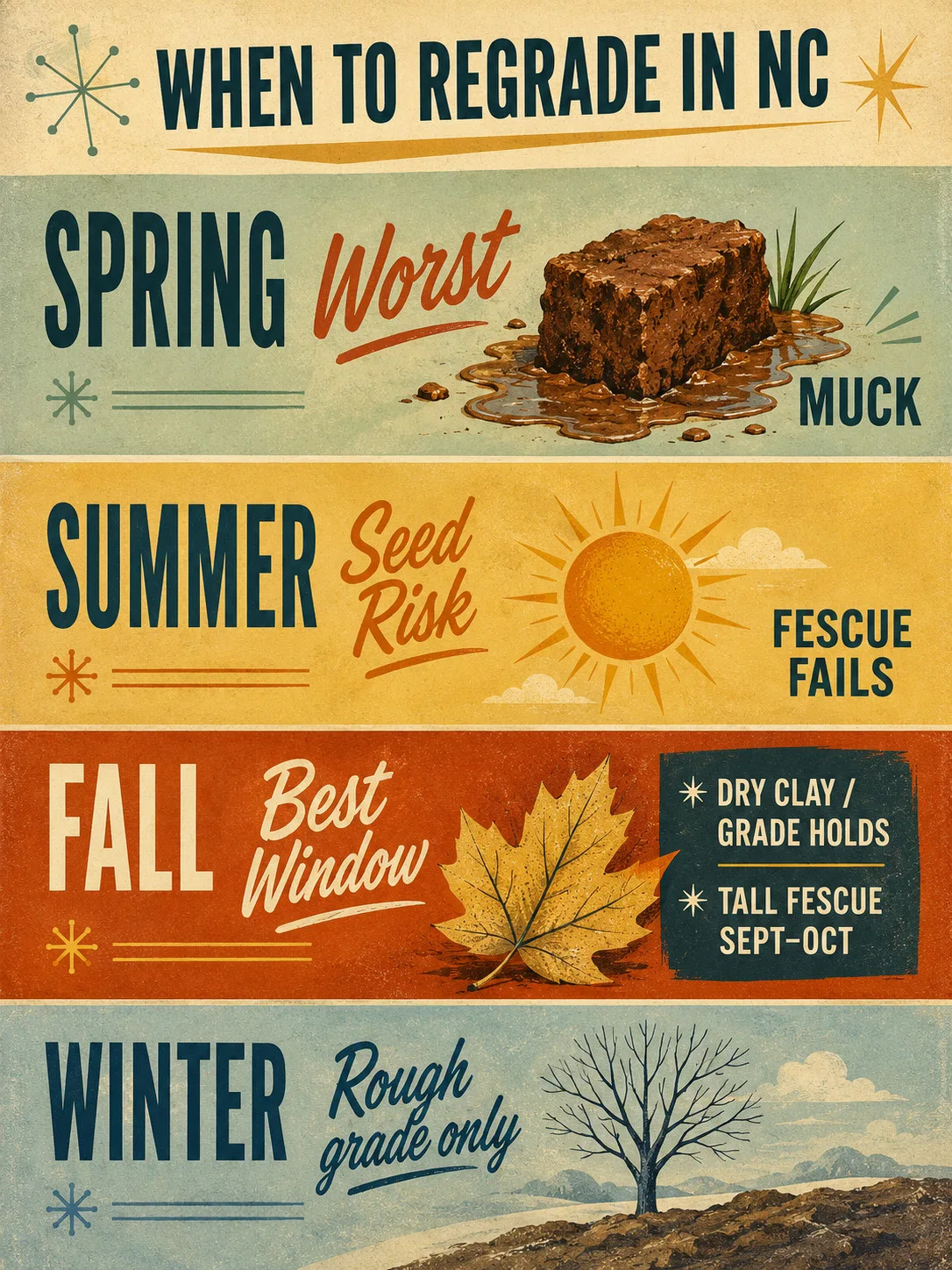
North Carolina has four distinct windows. Three of them create problems:
Spring is the most requested time — and the worst for clay work. Piedmont clay saturated from winter rain turns to muck under equipment. Machines rut the surface, compaction is unreliable, and finish grade can’t hold form on wet ground.
Summer creates a seed problem. New seed on a regraded yard needs consistent moisture to germinate. July and August heat stress pushes watering requirements up sharply. Bermuda handles it; tall fescue does not.
Fall (September through November) is the best window. Clay is dry enough for equipment without being rock-hard. The grade settles naturally under early winter rains — which is good, not bad, because the crown compresses slightly and locks in. Cool-season seed goes down in early fall and germinates before frost. Warm-season sod can go down through October in most of North Carolina.
Winter is usable for rough grade if the ground isn’t frozen, but finish grade and seeding have to wait for spring.
For the full seasonal calendar with county-specific frost dates and seeding windows, see best time to regrade a yard in NC.