
Two questions Dave is asking from WNC
My driveway void is 18 inches deep. Can I just dump ABC gravel in and compact it?
Not all at once. Deep voids need layered fill -- compacted in 6-8 inch loose lifts, each lift compacted before the next goes in. Single-dump fill in a void this size will settle by 2-4 inches within one season. The bottom condition (firm clay, rock, or soft subgrade) determines what material goes in first.
Should I use fill dirt or ABC stone to fill a 2-foot driveway divot?
Depends on void geometry and base condition. Clean, inorganic fill dirt -- not topsoil -- can work as a bottom layer in large voids before ABC goes on top. ABC alone works when the subgrade is firm and you can compact in lifts. Flowable fill is the right call when the void is too narrow for a plate compactor to fit inside.
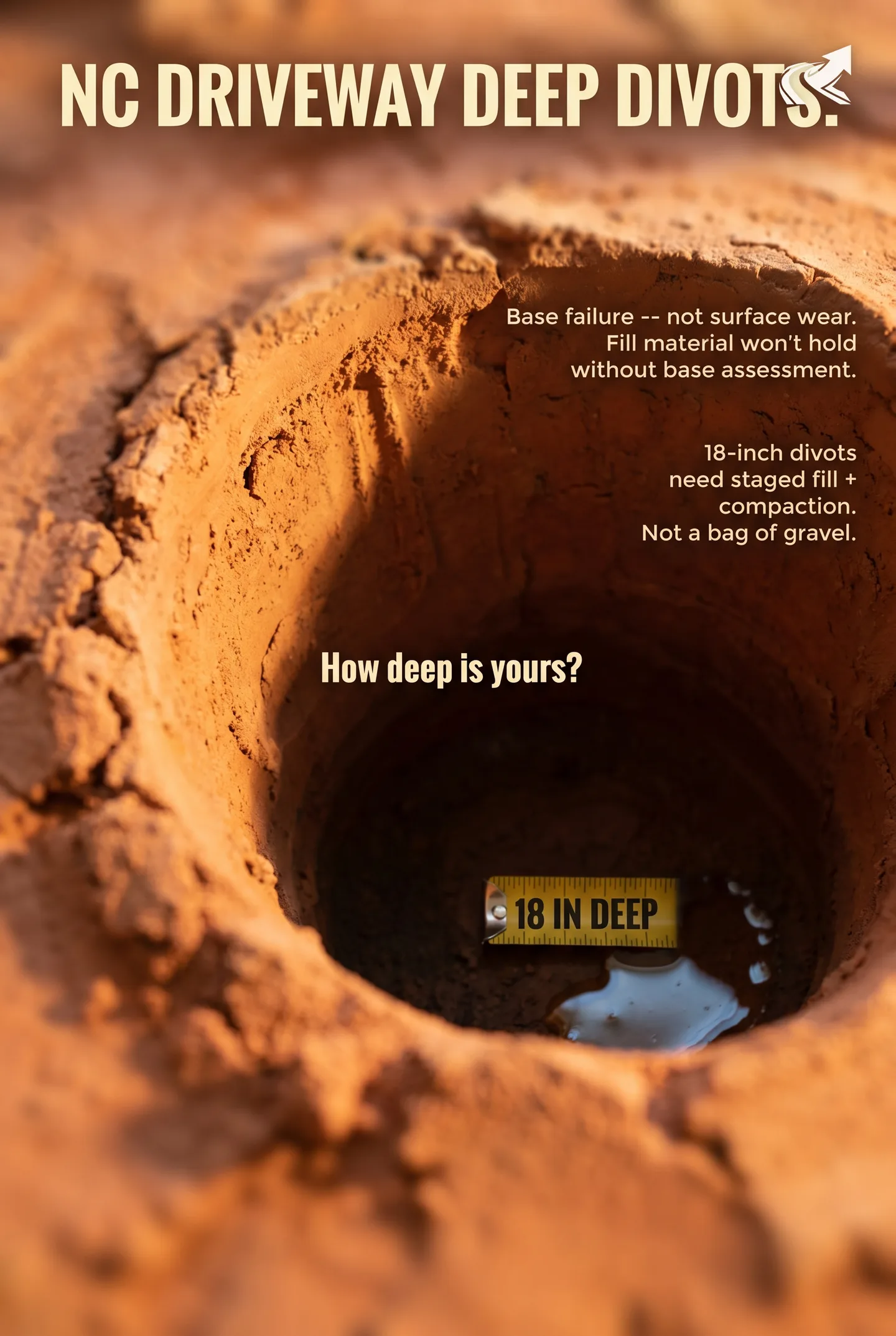
Dave’s driveway in WNC has an 18-inch void where the storm scoured everything down to red clay on one side and exposed rock on the other. The hole is 6 feet across. He can see the bottom. He knows he can’t just drop ABC in and call it done — the hole is too deep and he’s not sure what material belongs at the bottom versus the top.
That’s the right instinct. A void this size isn’t a surface gravel problem. It’s a base problem. The fill material and lift sequence determine whether the repair holds for one season or ten years.
This page gives Dave — and anyone else dealing with a deep North Carolina driveway void — the decision framework before they order a single yard of material.
Assess Before You Fill — What’s at the Bottom?
The fill material depends on what the void bottom looks like: firm clay or rock means ABC fill works directly; soft or unstable bottom means the bad material comes out first.
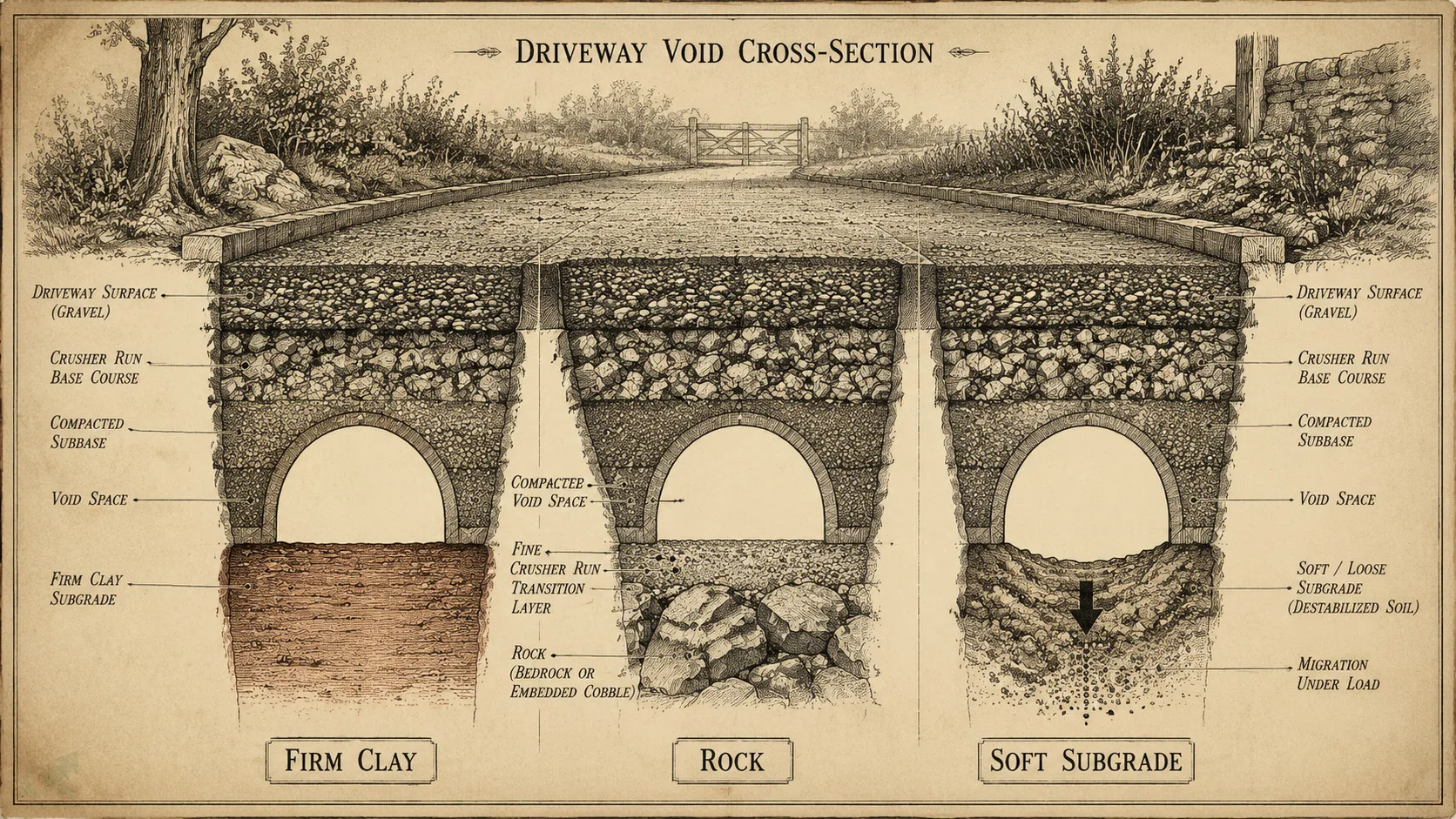
There are three bottom conditions in North Carolina driveway voids:
Firm clay: Scour exposed stable clay subgrade. The void can be filled with compacted in lifts starting from the bottom.
Rock: Scour hit bedrock or large cobble — common in WNC mountain terrain. Rock is an excellent base, but it needs a transition layer. Place fine crusher run or compacted fine aggregate directly on rock before ABC lifts go in. Skipping the transition leaves air pockets at the rock/aggregate interface that compress under load.
Soft or unstable: The scour destabilized the subgrade below the original base. If you step into the void and press your heel into the bottom and it springs or shifts underfoot, the subgrade is soft. That material must come out before any fill goes in. Fill placed over a soft base doesn’t stay where you put it — it migrates downward as load compresses the soft zone, and the repair sinks.
The walk-in test is your first diagnostic. If the void is deep enough to step into safely, do it. Hard bottom — firm clay or rock that doesn’t move — means you fill directly. Soft bottom means excavate first.
WNC rock note: exposed rock in mountain voids is usually bedrock or embedded cobble, both stable. If the rock is fractured shale or loose cobble that shifts underfoot, it’s debris, not a foundation. Remove it or get a contractor’s eyes on it before proceeding.
Fill Material by Depth — What Goes Where
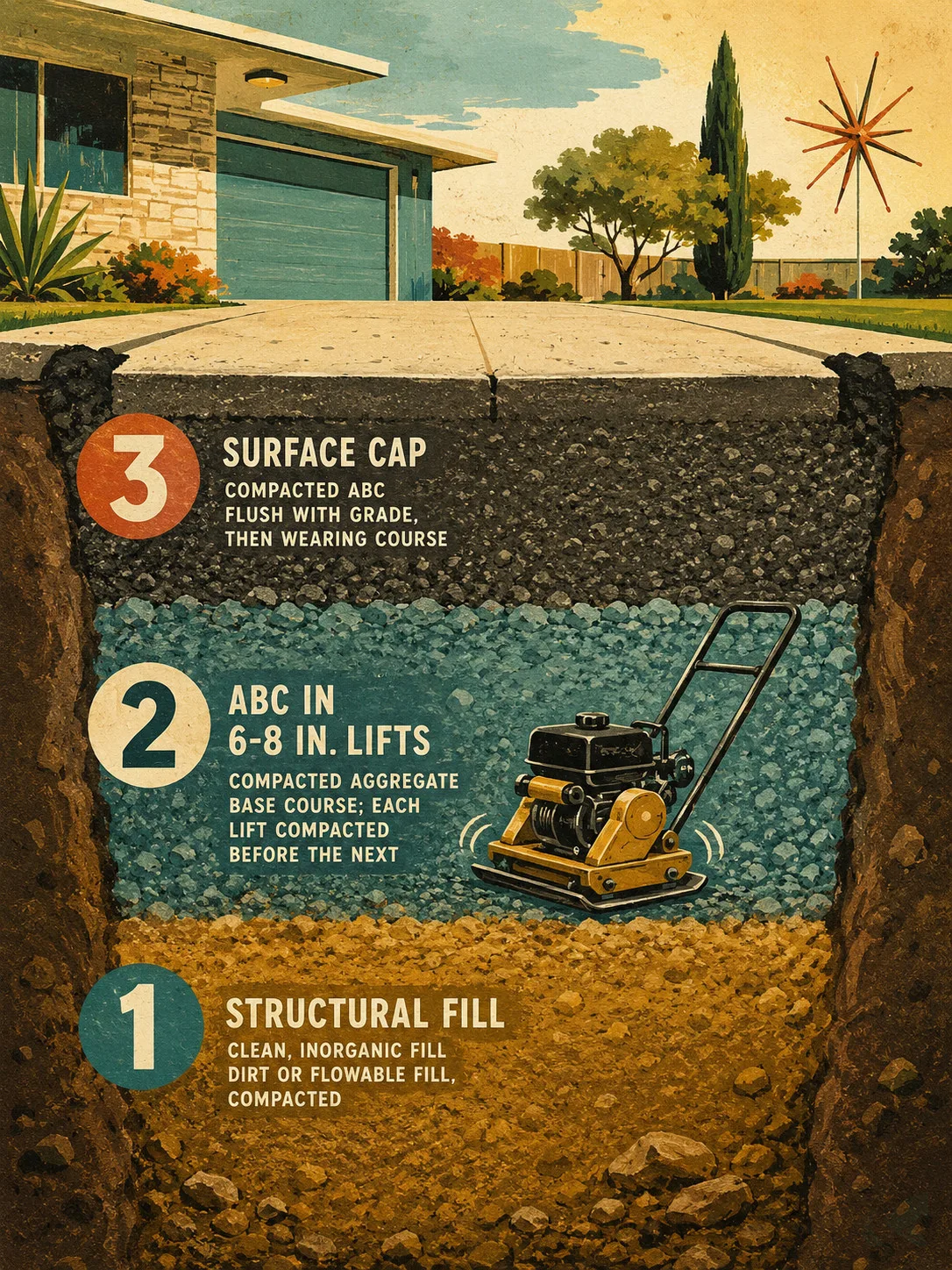
Deep voids need layered fill — not a single material dropped in at full depth. The bottom layer is structural; the cap is compacted ABC; the surface is wearing course.
For voids over 18 inches, the fill sequence looks like this:
Bottom layer: structural fill — clean compacted fill dirt, ABC, or flowable fill. Choice depends on void geometry and whether compaction equipment can reach the bottom.
Mid-layer (voids over 24 inches): compacted ABC in 6-8 inch loose lifts. Each lift goes in, gets compacted, and only then does the next lift follow. Never dump a full void with uncompacted material — it settles.
Surface cap: compacted ABC brought flush with surrounding grade, then wearing course (gravel or surface treatment to match the existing driveway).
On fill dirt as a bottom-layer option:
Fill dirt can work as a volume filler for the deepest zone of a large void before ABC goes on top. North Carolina red clay fill — clean, inorganic, compacted — densifies adequately when placed correctly. But the specification matters:
- Use clean, inorganic, compactable fill. Not topsoil.
- Not spoil from a site with roots, debris, or visible organic material.
- Wet fill doesn’t compact — it compresses unevenly and creates soft spots months later.
If you’re sourcing fill dirt delivery for deep driveway divot repair, specify “clean inorganic fill, no organics, no topsoil” on the order. The distinction matters for what happens to your repair in year two. For more on how using NC red clay fill for driveway divot repair works in practice — and when it fails — that page covers the compaction behavior specific to North Carolina clay.
On flowable fill as an alternative:
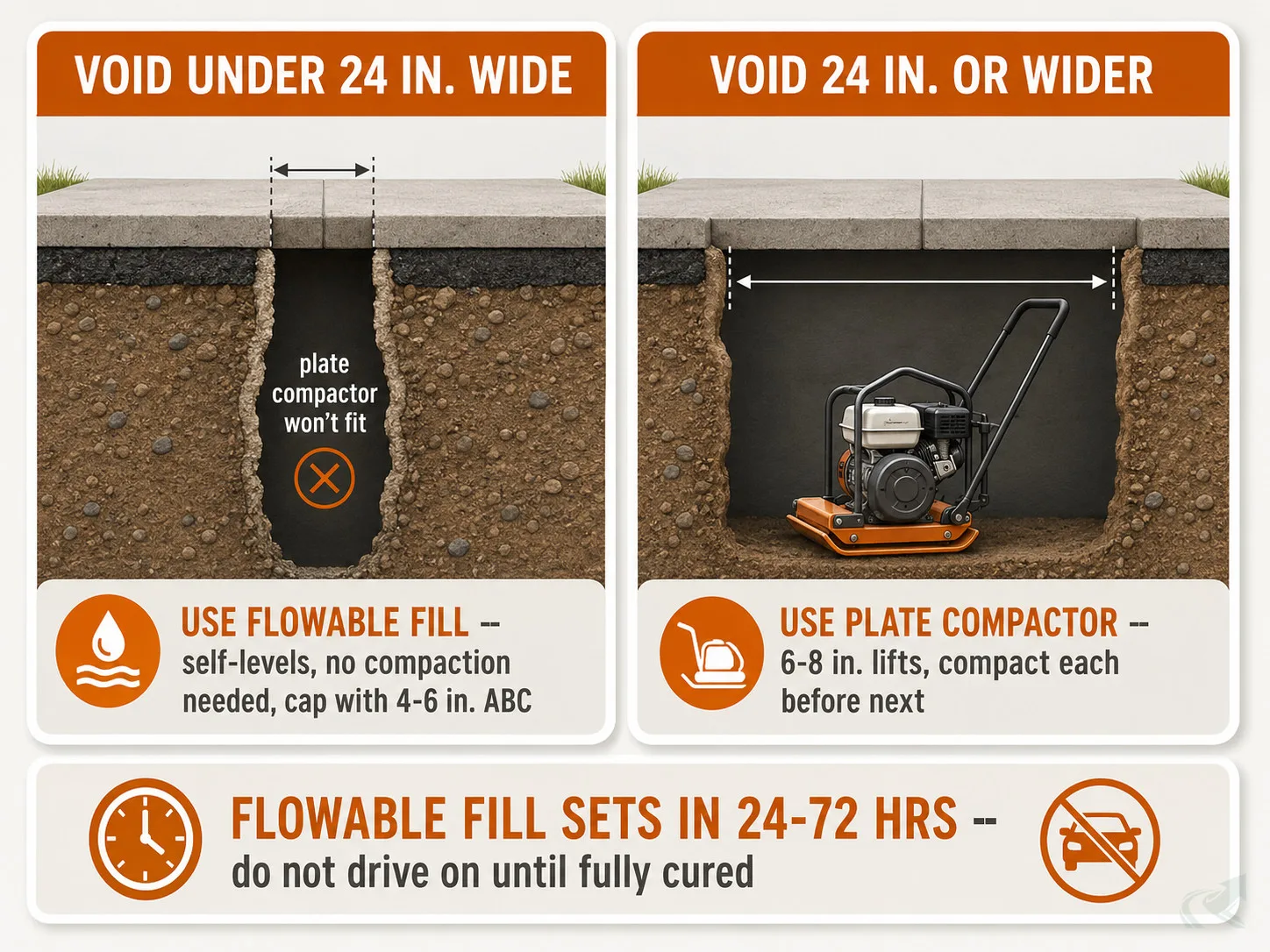
Flowable fill — controlled low-strength material — pours into any void geometry without mechanical compaction. It self-levels, fills irregular scour shapes, and sets to a solid mass within 24-72 hours. Typical design strength runs 50-150 psi, which is much weaker than concrete but adequate for driveway base support.
After flowable fill sets, cap it with 4-6 inches of compacted ABC before applying the surface course. Do not leave flowable fill exposed as the wearing surface — it erodes. See flowable fill for deep driveway divot repair for supply and availability.
Compaction in Layers — The Rule That Makes Deep Repairs Last
Fill in maximum 6-8 inch loose lifts, compact each lift before adding the next. A void filled all at once with uncompacted material will settle — guaranteed.
Here’s why lift compaction is non-negotiable:
A vibratory plate compactor — the walk-behind unit a contractor uses on residential work — densifies approximately 6-8 inches of loose material per pass. Below that depth, compaction energy dissipates. The lower material is left loose and settles over time under vehicle load and moisture cycling.
An 18-inch void filled in one dump and graded will show 2-4 inches of visible settlement within one season. It looks fine on day one. It doesn’t look fine after a wet winter.
Equipment access inside a deep void: plate compactors can be lowered into wide voids (over 24 inches across) to compact each lift. Narrow voids — under 24 inches — don’t allow room for the plate compactor to operate, which is exactly when flowable fill becomes the right call instead.
When you’re getting quotes for deep divot repair in NC, ask what equipment the contractor plans to use for compaction inside the void. “We’ll fill it and pack it” is not a compaction plan. The answer you want names a method: plate compactor in lifts, drum roller on the surface, or flowable fill for confined geometry.
Deep divot filled in lifts vs filled in one dump
Comparison. Layered, compacted repair: Bottom condition assessed before any fill goes in; Fill placed in 6-8 inch lifts, each compacted; Plate compactor lowered into the wide void; ABC cap and surface course -- no settlement. Single-dump fill: Void filled to the top in one pour, uncompacted; Compaction energy never reaches the lower material; 2-4 inches of settlement within one season; Surface cracks and dips over the repair zone.
- Bottom condition assessed before any fill goes in
- Fill placed in 6-8 inch lifts, each compacted
- Plate compactor lowered into the wide void
- ABC cap and surface course -- no settlement
- Void filled to the top in one pour, uncompacted
- Compaction energy never reaches the lower material
- 2-4 inches of settlement within one season
- Surface cracks and dips over the repair zone
A vibratory plate only compacts 6-8 inches at a time -- a deep void filled in one dump always settles, no matter how good it looks on day one.
When to Bring in Flowable Fill
Use flowable fill when the void geometry prevents mechanical compaction — narrow voids, confined access, or complex scour shapes from storm damage.
Flowable fill characteristics that matter for North Carolina driveway repair:
- Pours and self-levels — no mechanical compaction required
- Sets in 24-72 hours depending on mix and temperature
- Final design strength typically 50-150 psi — adequate for driveway base support, not structural concrete
- Cost is priced per cubic yard; more expensive per unit volume than compacted fill, but cheaper than excavating and recompacting a void that a plate compactor can’t reach
When to use it:
Void width under 24 inches where a roller can’t fit. Complex scour shape — irregular geometry around embedded rock, undercutting under adjacent intact base material. WNC mountain voids are common candidates: Helene’s scour left irregular geometry around cobble and bedrock that doesn’t accommodate a plate compactor.
The cap requirement: flowable fill must be capped with 4-6 inches of compacted ABC before any surface course is applied. Do not drive on flowable fill until it has fully set — ask your supplier for the set time on their specific mix. The cap is also what gives the repair its proper crown — flowable fill self-levels to flat, which is not the same as the 2% drainage slope a driveway needs.
For a direct comparison of when flowable fill vs stone for deep driveway repairs makes economic sense, that page covers the volume math and North Carolina supplier availability.
Scope Checklist — What an Itemized Quote Should Include
An itemized quote for deep divot repair should cover all five of these. A quote that doesn’t break these out is a surface quote:
- Base assessment scope — how is the contractor determining what’s at the void bottom before fill goes in?
- Fill material type per depth — what goes in the bottom zone vs the ABC cap layer?
- Compaction method — plate compactor in lifts, flowable fill (with specified cure time before load), or other?
- Volume estimate — cubic yards of fill material per type, with a note on how the void dimensions were measured
- Surface course — does the quote include the wearing course to match existing driveway grade, or does it stop at ABC?
“Fill and grade” is a surface quote scope. For a 2-foot void, it’s the wrong scope.
Closing — This Is a Geotechnical Problem, Not a Gravel Problem
A deep driveway void is not a resupply problem. The fill material, lift sequence, and base assessment all determine whether the repair holds.
Before ordering material, run the bottom assessment. If the subgrade is soft, excavate the bad material first. If the void is narrow, price flowable fill before renting a plate compactor for a space it won’t fit in. And if the void is in WNC where Helene exposed rock and irregular scour geometry, get a contractor’s eyes on it before assuming the repair is simple.
The NC driveway washout repair guide covers the full repair decision tree from surface washout to structural base failure. For estimating material volumes before you call for quotes, how much fill material for a deep driveway divot walks through the cubic-yard math.
Hire a licensed NC grading contractor and ask for an itemized quote that breaks out base assessment, fill material by depth, and compaction method. That’s how you tell the difference between a contractor who’s done this repair and one who’s guessing.