
Two questions Durham homeowners ask first
Does Durham help pay for septic-to-sewer conversion?
Yes -- the City of Durham runs a residential septic-to-sewer cost-share program for eligible properties in the Northeast Creek watershed. Eligibility requires the property to be within City of Durham limits, zoned residential, currently on septic, and served by an available city sewer line. The program is administered by the City of Durham Public Works Department (Stormwater & GIS Services), not Durham County -- find current eligibility and the application at durhamnc.gov/4592. Funding for the program ends June 2026. Your contractor still handles the physical hookup work.
When is sewer connection required in Durham?
Durham City Code §70-4 governs mandatory sewer connection. If a public sewer line runs within your property or in the street adjoining it, you are generally required to abandon the private septic system and connect to the public line. If no public sewer line is located on or adjacent to your property, you are typically grandfathered. Property owners may petition the city council for hardship relief from the connection obligation. Confirm specifics with the City of Durham and Durham County Environmental Health.
Your Durham home was built before city sewer reached the subdivision. The septic system is aging — maybe it’s been 20 years, maybe you noticed a wet spot in the yard after a heavy rain. Then you get a letter: Durham County has extended a sewer main, and your property may be eligible to connect.
Now the questions stack up. Does Durham help pay for it? Do you need a permit, and from whom? What does a licensed contractor actually do, and what does it cost?
This page answers the Durham-specific questions — the City of Durham cost-share program, City Code §70-4 connection requirements, and the permit path. For the full North Carolina overview, start with the NC septic-to-sewer conversion guide.
Durham City Code §70-4: When Sewer Connection Is Required
Durham City Code §70-4 governs mandatory sewer connection — if a public sewer line is located within your property or in the street adjoining it, you are generally required to abandon the private septic system and connect to the public line.
Here’s what the ordinance means in practice:
- Line on or adjoining the property: the trigger is a public sewer line located within the property or in the adjoining street — not a fixed distance. If the main reaches your frontage, the connection obligation generally applies.
- No adjacent line: if no public sewer line runs within or adjacent to your property, you are typically grandfathered under existing conditions.
- Connection window: once the city gives written notice that a sewer line is complete, property owners generally have a defined window to apply for connection.
- Hardship relief: a property owner may submit a written request to the city council to be relieved of the connection obligation on hardship grounds.
- New construction: different rules apply — consult the Durham County Building Inspections office for new builds in areas served by public sewer.
Cite the ordinance number every time you’re talking to a contractor or permit office. “City Code §70-4” is the credibility signal that shows you’ve done the homework. Contractors who confuse city and county authority on this are a yellow flag.
Durham’s Cost-Share Program: What It Covers and Who Qualifies
The City of Durham runs a residential septic-to-sewer cost-share program — but eligibility is specific and not all Durham properties qualify. The program is administered by the City of Durham Public Works Department (Stormwater & GIS Services), not Durham County.
To qualify, a property must meet all of the following:
- Currently connected to a septic system
- Zoned residential
- Located within City of Durham limits
- Within the Northeast Creek watershed boundary
- Served by an available City of Durham sanitary sewer line
Households facing financial hardship may qualify for additional assistance if the applicant has been a City of Durham resident for at least 90 days and meets one of: enrollment in a Durham County property tax relief program, household income at or below 200% of the federal poverty guideline, or household income at or below Durham County’s median household income.
Funding for this program ends in June 2026. If you are weighing a conversion, the application window is closing — confirm current status before you plan around it.
Per the City of Durham program FAQ (dated March 2024), the cost-share covers specific City and County fees in two levels:
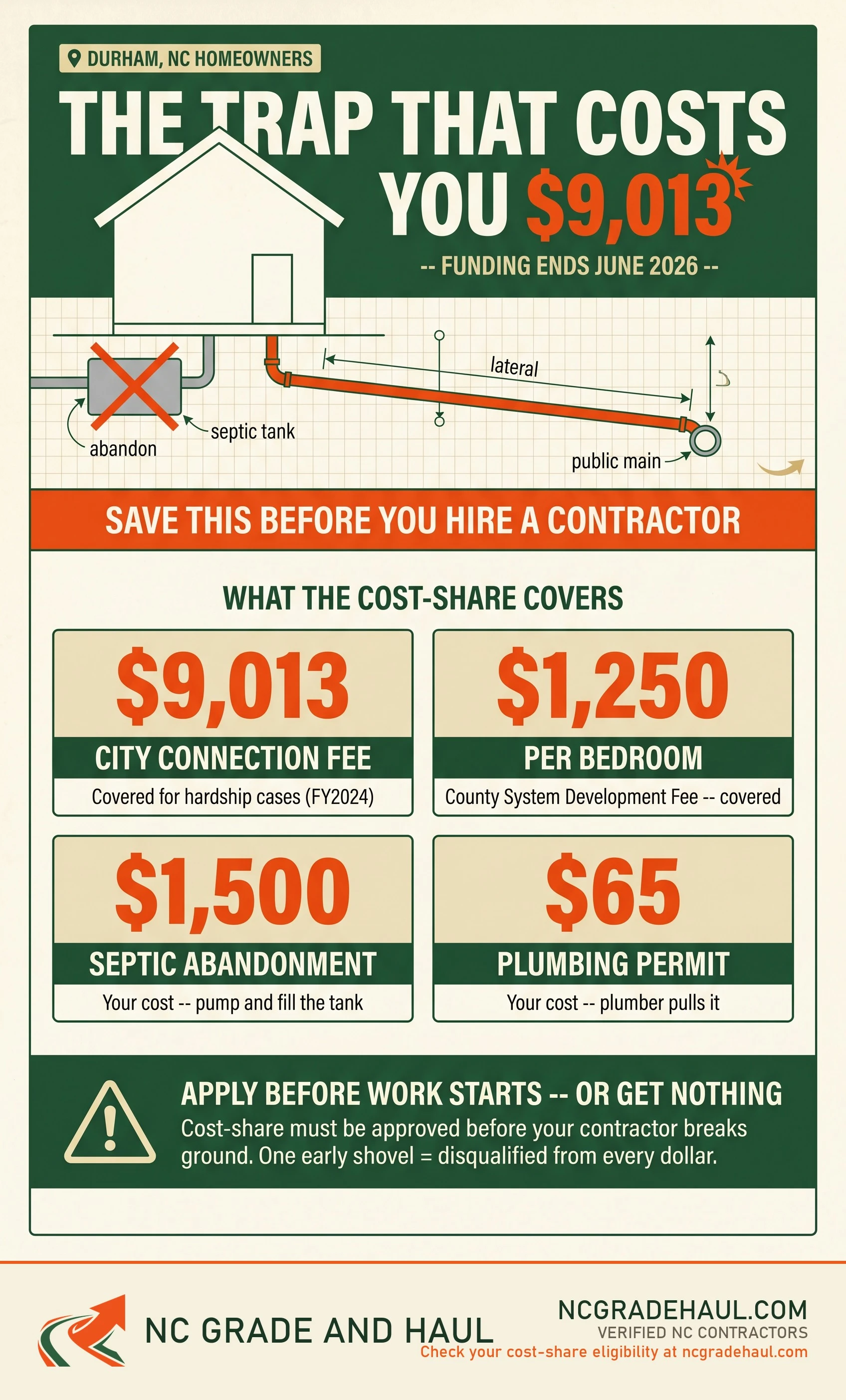
- Base cost-share — all approved applicants get the Durham County System Development Fee covered ($1,250 per bedroom).
- Financial-hardship cost-share — applicants who also meet the hardship criteria get the County System Development Fee and the City of Durham Sewer Connection Fee covered ($9,013 for FY2024).
What the cost-share does NOT cover — these stay the homeowner’s responsibility:
- Septic system removal or abandonment — tank pumping and fill-or-removal (city-estimated at roughly $1,500)
- The private sewer lateral installation — excavation and pipe from the house to the main
- The City-County plumbing permit fee ($65)
- Landscaping restoration — re-seeding and re-grading disturbed areas
- Interior plumbing modification — any work inside the home to route drainage to the new lateral
There is no single “maximum reimbursement” figure — the base cost-share scales with house size ($1,250 per bedroom), and the hardship tier adds the fixed $9,013 connection fee. Fee amounts above are FY2024 figures; the city revises fees annually, so confirm current amounts with the City of Durham Public Works Department.
Before you hire a contractor, check durhamnc.gov/4592 for current eligibility. The application must be submitted and approved before work begins — post-construction applications are not accepted. A contractor who starts the lateral without confirming cost-share eligibility may disqualify you from reimbursement.
The Durham Permit Process: Step by Step
Durham septic-to-sewer: two permit tracks running in parallel
Comparison. Durham County (septic side): Contact Durham County Environmental Health -- On Site Water Protection -- to initiate septic abandonment; Schedule tank pumping and proper fill or removal; File Septic Tank Abandonment Record with County Environmental Health (healthinspector@dconc.gov). City of Durham (sewer side): Email Engineering Services (PWEngServ@durhamnc.gov) to request sewer connection quote and application; Your licensed plumber pulls the City-County plumbing permit ($65 fee); Return application with permit number and payment -- Engineering Services schedules the tie-in (4-6 weeks).
- Contact Durham County Environmental Health -- On Site Water Protection -- to initiate septic abandonment
- Schedule tank pumping and proper fill or removal
- File Septic Tank Abandonment Record with County Environmental Health (healthinspector@dconc.gov)
- Email Engineering Services (PWEngServ@durhamnc.gov) to request sewer connection quote and application
- Your licensed plumber pulls the City-County plumbing permit ($65 fee)
- Return application with permit number and payment -- Engineering Services schedules the tie-in (4-6 weeks)
Both tracks must close before the conversion is complete. A contractor who handles only one leaves you with an open septic record or an unpermitted sewer connection.
Septic-to-sewer conversion in Durham involves both Durham County (the septic side) and the City of Durham (the sewer connection side) — your contractor should handle both.
The permit chain looks like this:
Durham septic-to-sewer: the permit chain, in order
1. Septic abandonment -- Durham County -- County Environmental Health (On Site Water Protection) oversees pumping and properly filling or removing the old tank. Skipping it creates a title defect that surfaces at sale. 2. Sewer connection -- City of Durham -- Email Public Works Engineering Services to start; they issue a quote and a sewer line service application. There is no online portal -- the process is email-driven. 3. Plumbing permit -- City-County Inspections -- Your licensed plumber pulls the plumbing permit (a $65 fee), then returns the city application with the permit number and payment.
-
Septic abandonment -- Durham County
County Environmental Health (On Site Water Protection) oversees pumping and properly filling or removing the old tank. Skipping it creates a title defect that surfaces at sale.
-
Sewer connection -- City of Durham
Email Public Works Engineering Services to start; they issue a quote and a sewer line service application. There is no online portal -- the process is email-driven.
-
Plumbing permit -- City-County Inspections
Your licensed plumber pulls the plumbing permit (a $65 fee), then returns the city application with the permit number and payment.
Both the county septic side and the city sewer side must be handled -- a contractor who covers only one leaves you exposed.
- Septic abandonment: Durham County Environmental Health, through its On Site Water Protection program, oversees septic systems — the tank must be pumped and properly filled or removed when the system goes offline. Confirm the current closure process and forms with Durham County Environmental Health at dconc.gov. Skipping proper abandonment creates a title defect that surfaces at sale.
- Sewer connection: the connection to the City of Durham sewer is handled on the city side. Per the City of Durham program FAQ, you contact the Public Works Department’s Engineering Services Division (PWEngServ@durhamnc.gov) and indicate you want to connect to the city sanitary sewer system. Engineering Services issues a quote and a sewer line service application; you hire a plumber to pull the plumbing permit, then return the application with a valid plumbing permit number and payment. There is no separate online portal — the application is email-driven.
- Plumbing permit: the plumber applies for the plumbing permit through the City-County Inspections Department; the City-County plumbing permit fee is $65.
Timeline: once the application is processed, the sewer line service installation may take 4 to 6 weeks per the City of Durham program FAQ. The cost-share application review process takes up to 20 business days from receipt; plumbing permit issuance time varies by the City-County Inspections Department’s current workload — confirm the latest turnaround directly with them at 919-560-4144. Budget for both in your project schedule before work begins.
A licensed plumber or contractor pulls the permits — homeowners do not typically pull them directly. If a contractor tells you to handle the permits yourself, that’s a flag.
Durham septic-to-sewer: a clean conversion vs the version that bites you later
Comparison. Done by the book: Old tank pumped and properly filled or removed, with County Environmental Health closure on record; Lateral from house to the street main graded to drain by gravity; City of Durham sewer connection permitted before the trench is cut; Disturbed yard re-graded and re-seeded over the lateral line. Where Durham conversions go wrong: Tank pumped but left in place -- a title defect that surfaces at sale; Flat or reversed lateral grade leaves waste standing in the pipe; Connection made without the City-County permit, flagged at inspection; Standing water at the junction point after the first heavy rain.
- Old tank pumped and properly filled or removed, with County Environmental Health closure on record
- Lateral from house to the street main graded to drain by gravity
- City of Durham sewer connection permitted before the trench is cut
- Disturbed yard re-graded and re-seeded over the lateral line
- Tank pumped but left in place -- a title defect that surfaces at sale
- Flat or reversed lateral grade leaves waste standing in the pipe
- Connection made without the City-County permit, flagged at inspection
- Standing water at the junction point after the first heavy rain
The county septic side and the city sewer side are separate permits -- a contractor who handles only one leaves you exposed.
See the full Durham County permit matrix for sewer connection projects
What Durham Septic-to-Sewer Conversion Actually Costs
Durham septic-to-sewer: four cost buckets to itemize before you sign
1. Durham connection fees -- Durham County System Development Fee ($1,250 per bedroom) + City of Durham Sewer Connection Fee ($9,013 FY2024). Both fixed, non-negotiable. Cost-share covers County SDF for all approved applicants; hardship tier also covers the City fee. 2. Lateral line installation -- Excavation and pipe from your house to the street main. Cost varies by distance, soil type, and obstructions (tree roots, driveways, existing utilities). Get this line-itemed -- not blended. 3. Septic abandonment -- Tank pumping, fill or removal, and Durham County Environmental Health closure. City program estimates roughly $1,500 -- actual cost varies by tank size and condition. Not covered by the cost-share. 4. Landscaping restoration -- Re-seeding, re-grading, and any hardscape repair over the trench line. Scope depends on what the lateral crosses -- lawn is straightforward; mature plantings or a paved driveway are not.
-
Durham connection fees
Durham County System Development Fee ($1,250 per bedroom) + City of Durham Sewer Connection Fee ($9,013 FY2024). Both fixed, non-negotiable. Cost-share covers County SDF for all approved applicants; hardship tier also covers the City fee.
-
Lateral line installation
Excavation and pipe from your house to the street main. Cost varies by distance, soil type, and obstructions (tree roots, driveways, existing utilities). Get this line-itemed -- not blended.
-
Septic abandonment
Tank pumping, fill or removal, and Durham County Environmental Health closure. City program estimates roughly $1,500 -- actual cost varies by tank size and condition. Not covered by the cost-share.
-
Landscaping restoration
Re-seeding, re-grading, and any hardscape repair over the trench line. Scope depends on what the lateral crosses -- lawn is straightforward; mature plantings or a paved driveway are not.
Request each bucket itemized with unit costs. A contractor who gives you a single blended total cannot explain the math -- and you cannot compare two bids without a common breakdown.
Septic-to-sewer conversion in Durham typically involves four cost buckets — the county connection fee and lateral work are the two largest.
Do not let any contractor give you a single round number without breaking this out. Get each bucket itemized:
- Durham connection fees — there are two distinct fees, per the City of Durham program FAQ. The Durham County System Development Fee is $1,250 per bedroom (so it scales with house size). The City of Durham Sewer Connection Fee was $9,013 for FY2024. Both are fixed fees set by the County and City respectively, not negotiable — and both are covered for financial-hardship cost-share applicants (the base cost-share covers the County System Development Fee only). Amounts are FY2024 figures; confirm current fees with the city’s engineering office.
- Lateral line installation — excavation and pipe from your house to the main. Cost varies by distance, soil conditions, and whether tree roots or existing infrastructure are in the path. Durham County has both Piedmont clay and sandier transitional soils depending on location. Longer runs cost more; deeper mains cost more.
- Septic abandonment — tank pumping, fill or removal, and Durham County Environmental Health closure requirements. The City of Durham program FAQ estimates septic system removal or abandonment at roughly $1,500; this is a city-program estimate and actual costs vary by tank size, condition, and contractor. No separate Durham County closure-permit fee appeared in the current dconc.gov Environmental Health fee schedule — confirm current requirements with Durham County Environmental Health (healthinspector@dconc.gov) before budgeting. This bucket is separate from the city connection and is not covered by the cost-share.
- Landscaping restoration — re-seeding, re-grading, and any hardscape repair over the trench line. Scope depends on what the lateral crosses: a typical lawn is straightforward; a mature landscape or paved driveway is not.
Do not accept a single blended total. Request an itemized quote with each bucket listed separately and unit costs for labor and materials. A contractor who won’t itemize the quote cannot explain the math — and you can’t compare two bids if the numbers aren’t broken out the same way.
Common Mistakes on Durham Sewer Conversion Projects
Three mistakes account for most of the delays and re-dos on Durham residential sewer projects.
- Not checking cost-share eligibility before hiring. The City of Durham cost-share application must be approved before your contractor starts work. Check durhamnc.gov/4592 first, before you sign a contract.
- Skipping proper septic abandonment. Durham County Environmental Health oversees septic closure. A tank that’s pumped and left in place without proper abandonment creates a title problem at sale. Confirm your contractor handles the abandonment separately from the city connection permit.
- Hiring a plumber who doesn’t know the Durham connection permit process. The city sewer connection and county septic side are distinct. A contractor who conflates them — or treats the plumbing permit as the only permit required — will cause delays when the inspector shows up and the connection isn’t authorized.
Before You Hire: Questions Worth Copying
Ask your Durham sewer conversion contractor this before any quote:
“Are you familiar with the City of Durham sewer connection permit process? Will you handle both the septic abandonment and the connection permit? Can you check my cost-share eligibility before submitting the bid?”
A contractor who has done Durham sewer work can answer all three before walking your lot. If the answer to the permit question is vague, find someone who has pulled City of Durham sewer connection permits before.
Finding a Verified Contractor for Durham Sewer Conversion
Not every NC plumber or grading contractor has pulled a Durham County sewer connection permit — ask before you get a quote.
Hire a licensed NC grading contractor for Durham sewer conversion — contractors in the NC Grade and Haul directory have active NCLBGC licenses verified against the state board’s public records.
For the full Durham cost-share program details — eligibility zones, application steps, and what the program actually reimburses — see the Durham Northeast Creek cost-share program guide.
What This Page Does NOT Cover
- The full Durham cost-share program details — see Durham Northeast Creek cost-share program guide
- The NC septic-to-sewer process overview — see NC septic-to-sewer conversion guide
- Septic system maintenance and repair when conversion isn’t yet necessary
- Wake County or Orange County sewer connection — different agencies, different permit paths
From our directory
Verified contractors near you
Every listing is cross-checked against the NC Licensing Board public record before it appears. Pick your city:
Or browse the full NC contractor directory.