
Ray Pettiford heard about the program from a neighbor. Something about Durham County paying part of the sewer hookup cost. He’s not sure if his property qualifies, how much it actually covers, or — most importantly — whether he’s already too late if he called a contractor last week.
He’s not too late if work hasn’t started. But the window closes the moment a crew breaks ground.
This page explains the Durham Northeast Creek cost-share program from the eligibility gate (the watershed boundary) through the step-by-step application process. All dollar amounts, eligibility criteria, and application details require direct verification with City of Durham Public Works Department, Stormwater and GIS Services at 919-560-4326 ext. 30211. Program funding ends June 2026; terms and availability are subject to change.
What the Program Is and Why Durham Runs It
The City of Durham offers financial assistance for septic-to-sewer conversion because aging septic systems near Northeast Creek are a documented water quality concern — and cost-share is the city’s tool for accelerating voluntary connections.
Northeast Creek drains a significant portion of southern Durham County before entering Jordan Lake. Jordan Lake is a drinking water supply reservoir for multiple NC municipalities. Failing or aging septic systems near the creek contribute non-point source pollution — nutrient runoff that doesn’t come from a single pipe but from diffuse residential sources across the watershed.
City of Durham’s cost-share program is designed to reduce that pollution load by making conversion more affordable. The mechanism is fee coverage: the program covers the cost of one or more City and County fees that a homeowner would otherwise pay to connect to the public sewer system. It is not a loan and carries no repayment conditions.
The program is administered through the City of Durham Public Works Department, Stormwater and GIS Services, Attn: Jonathan Baker, 101 City Hall Plaza, Durham, NC 27701. Phone: 919-560-4326 ext. 30211. No comparable program is publicly known to exist in neighboring NC counties as of this writing.
Eligibility — Is Your Property In?
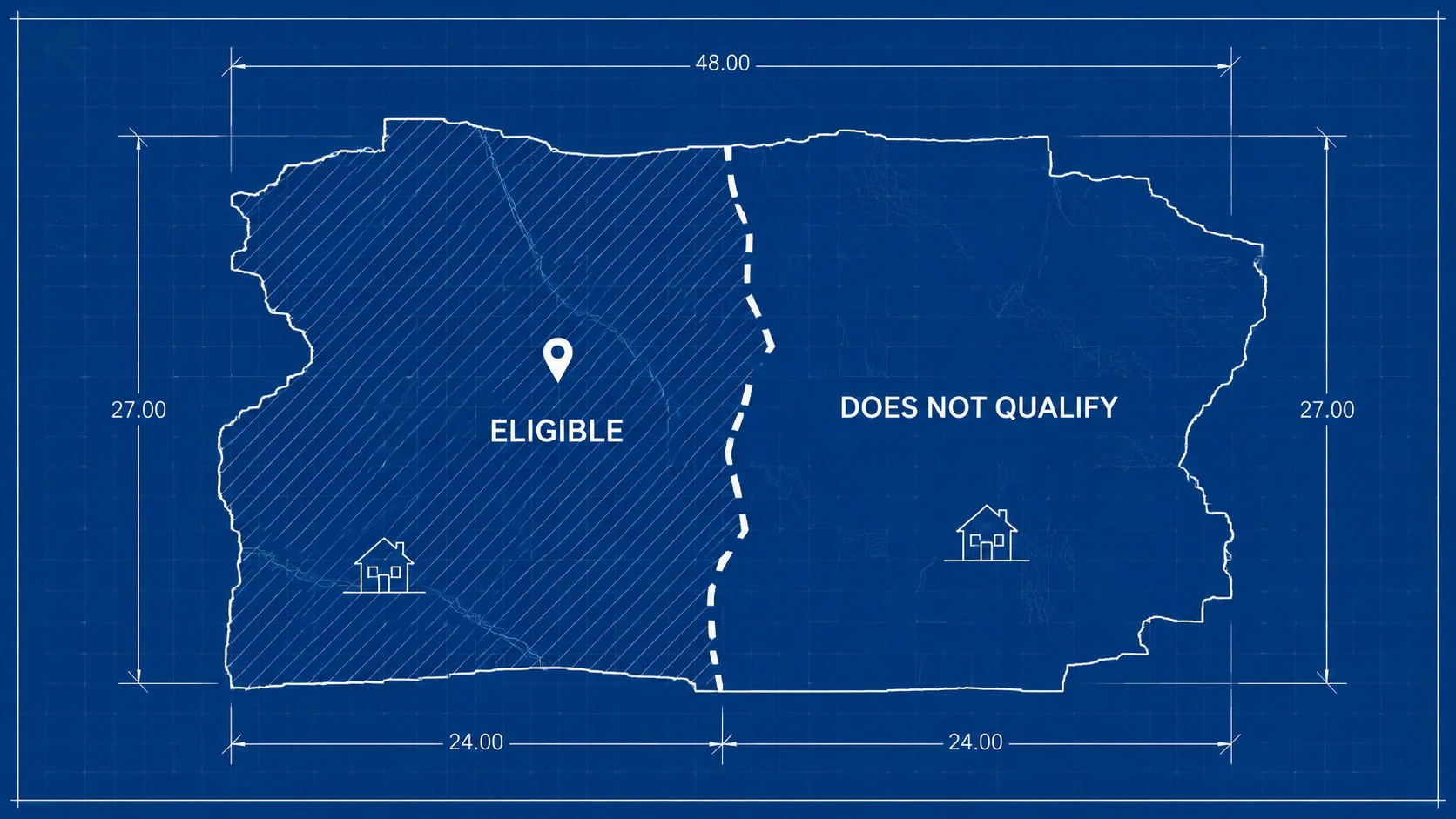
The watershed boundary is the eligibility gate. A property inside the Northeast Creek watershed that meets the other criteria qualifies. A property 500 feet outside it does not, regardless of income or circumstances.
The Northeast Creek watershed covers portions of southern Durham County and the City of Durham. Use the City of Durham watershed lookup tool to confirm whether a specific parcel is within the eligible boundary. The boundary is not a rough estimate — it’s a mapped line. Two adjacent properties can sit on different sides of it.
How to confirm your property is within the eligible area:
- City of Durham watershed lookup at durhamnc.gov/706/Find-Your-Watershed shows watershed boundaries
- City of Durham Public Works Department, Stormwater and GIS Services can confirm eligibility by address at 919-560-4326 ext. 30211
Additional eligibility requirements (confirmed against City of Durham program page; verify current terms before applying):
- Sewer must be accessible to the property (the county line must run close enough to your parcel to make connection physically possible)
- Financial hardship criteria apply: household income must be less than or equal to 200% of the federal poverty guideline or less than or equal to Durham County’s median household income, or the applicant must be enrolled in a Durham County property tax relief program. The applicant must also be a City of Durham resident for at least 90 days.
- Rental properties — the program eligibility criteria require the property to be residential and within the City of Durham limits; no explicit owner-occupancy rule has been published, but the financial-hardship tier requires the applicant to be a City of Durham resident for at least 90 days. Confirm rental property eligibility directly with City of Durham Public Works Department, Stormwater and GIS Services at 919-560-4326 ext. 30211.
- Grinder pump conversions — the City of Durham program documentation does not address properties that require a grinder pump due to elevation differences. Confirm with the program manager whether pump-required connections qualify.
Program eligibility checklist
| Requirement | How to confirm |
|---|---|
| Property within Northeast Creek watershed | City of Durham watershed lookup or call Stormwater and GIS Services |
| Sewer available to your property | Durham County or the utility provider |
| Application submitted before construction begins | Submit before signing a contractor contract or breaking ground |
| Financial hardship criteria | Income at or below 200% federal poverty guideline or at or below Durham County median household income, or enrolled in Durham County property tax relief program |
| Property ownership documented | Deed or tax record on file with Durham County |
| Rental property eligibility (if applicable) | Confirm directly with City of Durham Public Works — no explicit rule published; financial-hardship tier requires 90-day City residency |
How Much the Program Pays
The cost-share is not a flat reimbursement. It covers specific City and County fees, structured in two levels — a base level for all approved applicants and a second level for applicants who also qualify for financial hardship.
According to the City of Durham program FAQ (dated March 2024), the cost-share works like this:
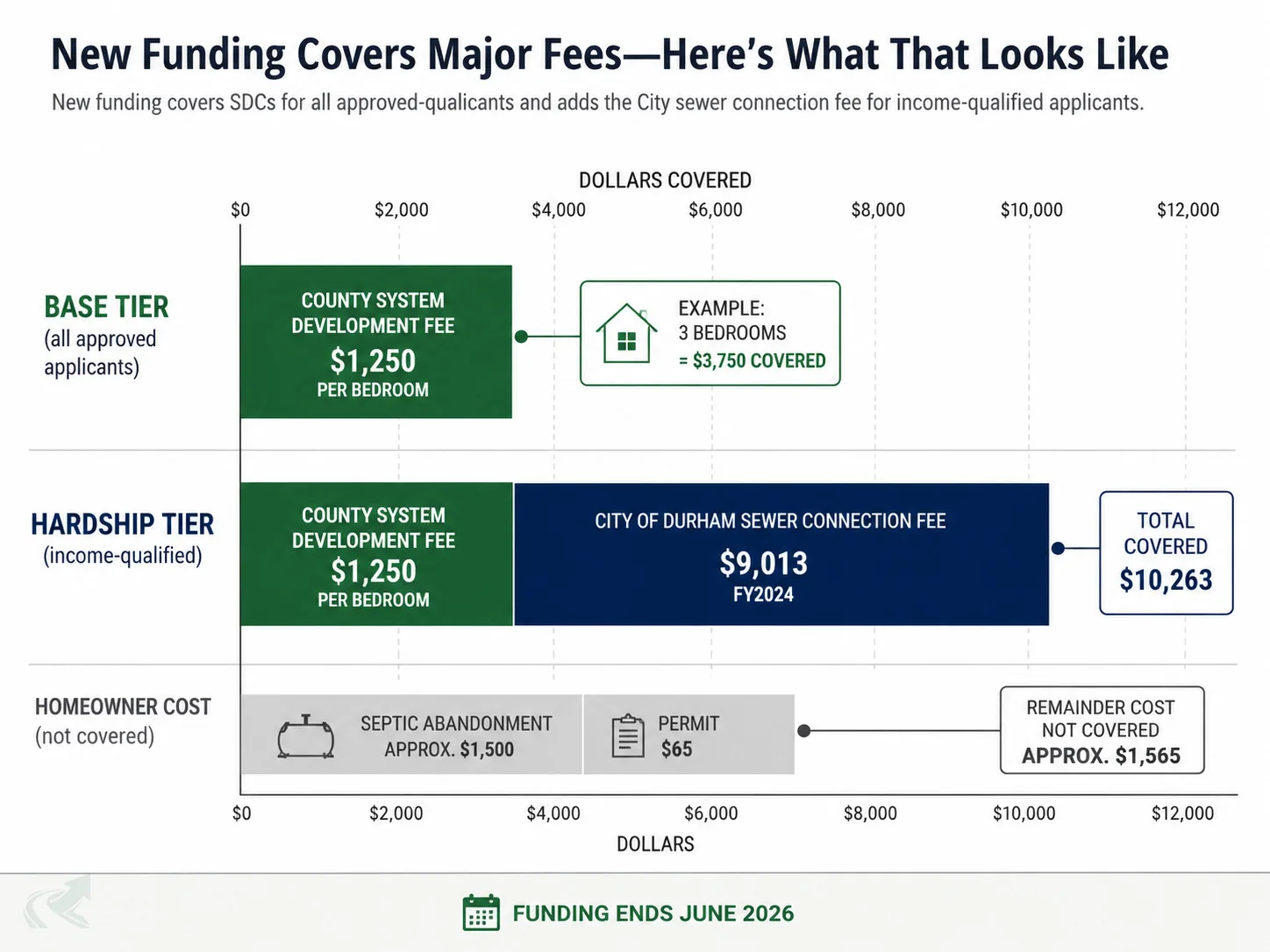
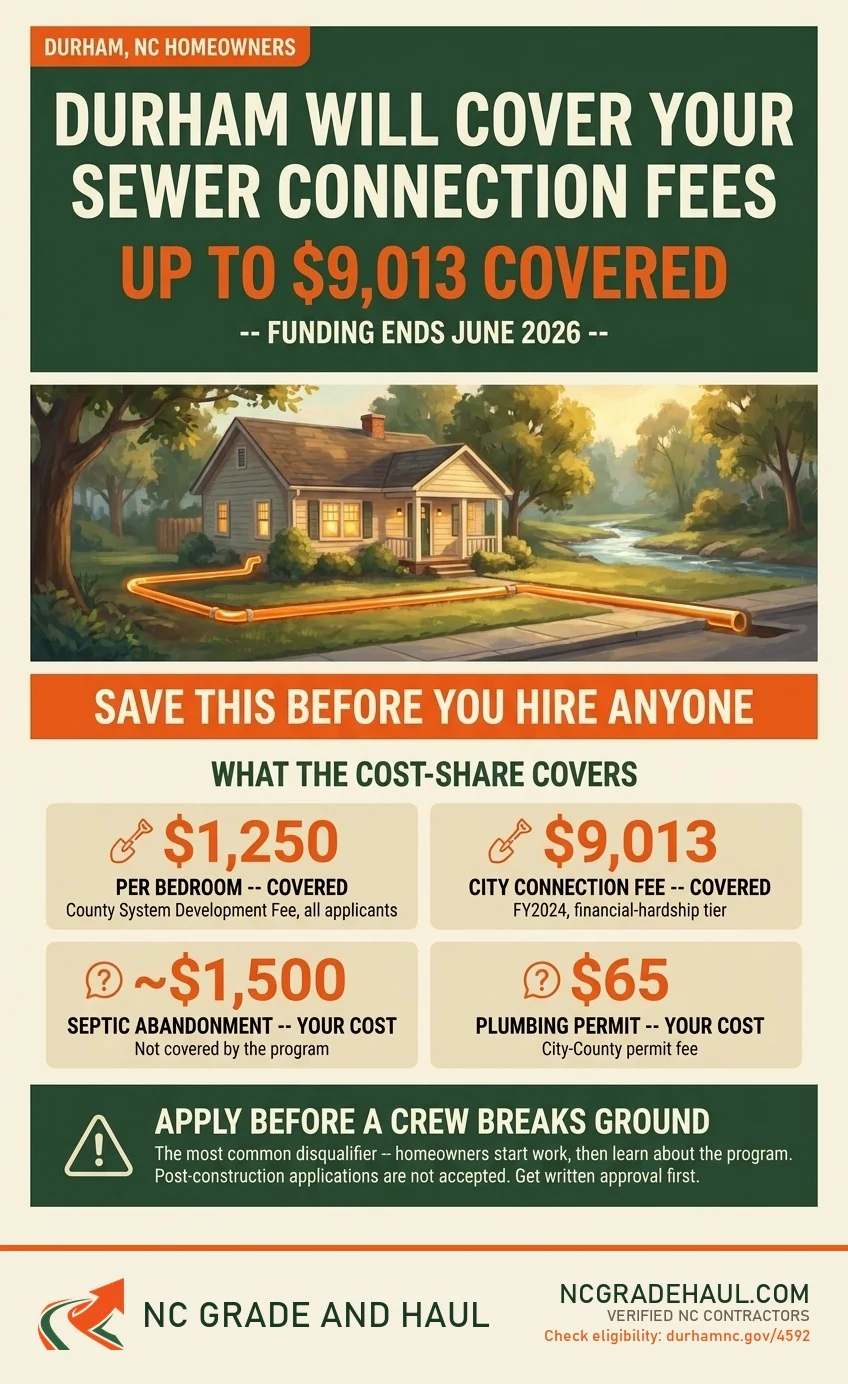
- Base cost-share (first level) — for all approved applicants. The program covers the Durham County System Development Fee, which is $1,250 per bedroom. A three-bedroom house, for example, carries a $3,750 System Development Fee, all of which the base cost-share covers.
- Financial-hardship cost-share (second level) — for applicants who also meet the financial-hardship criteria. This level covers the County System Development Fee and the City of Durham Sewer Connection Fee, which was $9,013 for fiscal year 2024.
What the cost-share covers and what it does not:
- Covered (base): the Durham County System Development Fee ($1,250 per bedroom)
- Covered (financial-hardship tier only): the City of Durham Sewer Connection Fee ($9,013, FY2024)
- Not covered — homeowner’s responsibility: septic tank decommissioning after NC conversion (city-estimated at roughly $1,500), the City-County plumbing permit fee ($65), the private sewer lateral installation (cost varies by distance and whether your connection runs with or against gravity), and the ongoing monthly sewer service bill
The cost-share is applied against the County and City fees directly — it is fee coverage, not a cash payout to the homeowner or the contractor. There is no co-payment or matching requirement on the covered fees themselves; the homeowner’s share is the other cost buckets listed above. The City of Durham FAQ puts the typical all-in cost of a conversion at “$15,000 or more.”
The fee figures above are FY2024 amounts drawn from the city’s March 2024 program FAQ. City and County fees are revised annually, and the program’s total budget is limited (the FAQ states a $100,000 total project budget). Call City of Durham Public Works Department, Stormwater and GIS Services at 919-560-4326 ext. 30211 and ask for the current fee amounts and remaining funding.
The Application Timing Rule — Apply Before Work Starts
The single most important procedural rule: your application must be submitted and approved by the City of Durham before construction begins. Post-construction applications are not accepted.
This is the most common disqualifier. Homeowners learn about the program after the contractor has already broken ground — sometimes only days after — and discover the window closed the moment work started.
The application timeline (confirmed against City of Durham program page):
- City of Durham Public Works Department reviews the application after submission
- Receipt is confirmed within 10 business days; approval or denial is notified within 20 business days
- You cannot begin work during the review period
- Written approval is the trigger that allows construction to proceed; work must be completed within 18 months of approval
The City of Durham program directs applicants to download and submit the single “Residential Septic to Sewer Cost-Share Application and Agreement” form. The City’s published program page does not list an itemized supporting-document checklist beyond the completed and signed application form. Documentation that may be required — confirm the current list with City of Durham Public Works Department before assembling your package:
- Proof of property ownership (deed or tax record)
- Itemized quote from a licensed NC contractor showing scope and cost of the conversion
- Property address and parcel number
- Income documentation if you are applying for the financial-hardship cost-share tier — the hardship tier is income-tested, but the program does not publish the specific income documents required; confirm with the program manager at 919-560-4326 ext. 30211
If you have already contacted a contractor but no work has started, you likely still have time to apply. Contact City of Durham Public Works Department, Stormwater and GIS Services at 919-560-4326 ext. 30211 immediately and ask whether a submitted application can proceed before contractor mobilization. Do not let the contractor begin any site work — including staking, equipment staging, or excavation — until you have written approval in hand.
The Application Process Step by Step
Submit the application, get written approval, then allow work to begin — in that order.
Here is the full sequence for a North Carolina property within the Northeast Creek watershed:
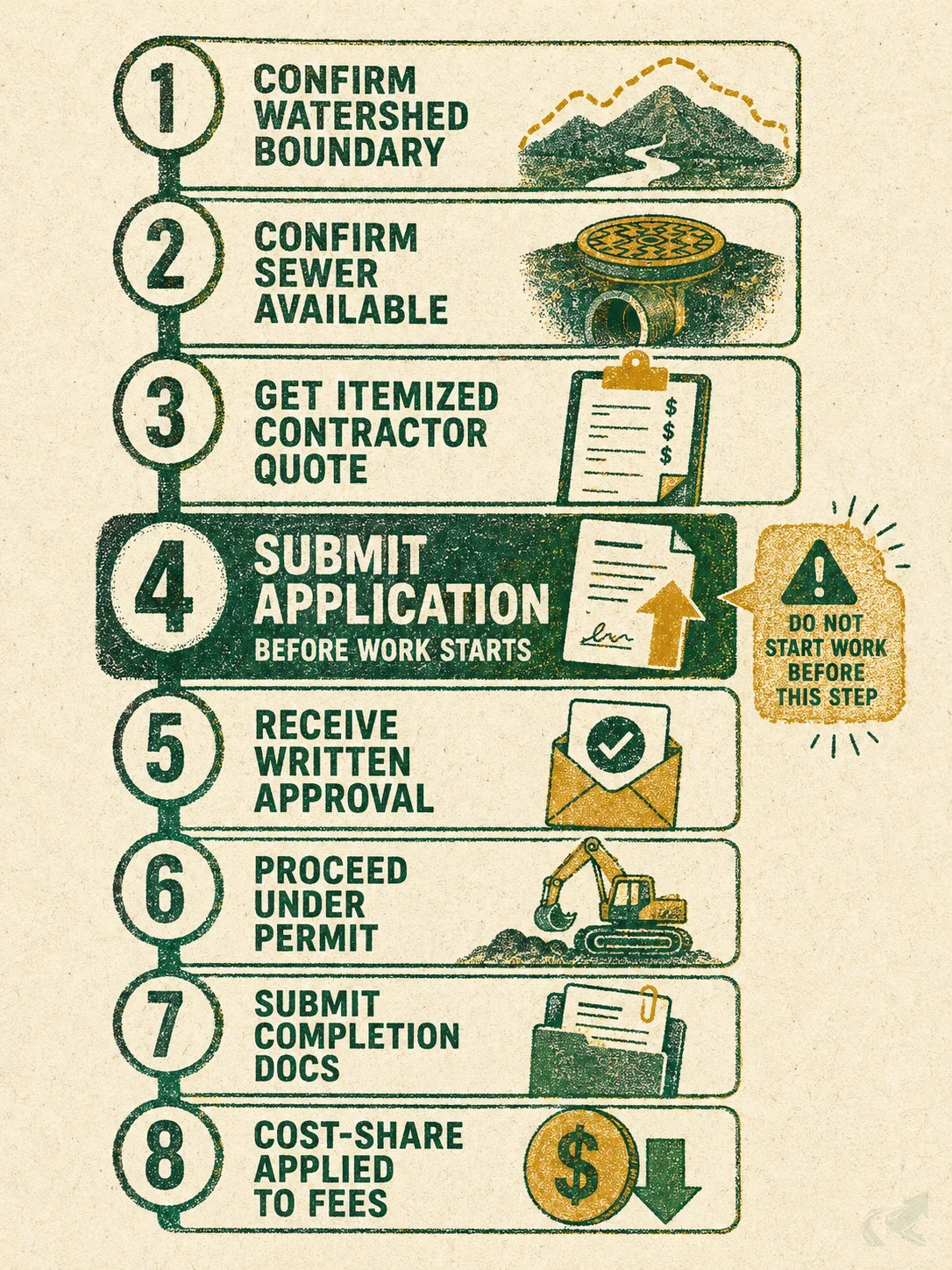
Step 1 — Confirm your property is within the Northeast Creek watershed. Use the City of Durham watershed lookup at durhamnc.gov/706/Find-Your-Watershed or call Stormwater and GIS Services at 919-560-4326 ext. 30211. Do not assume — the boundary is a mapped line, not a neighborhood estimate.
Step 2 — Confirm sewer is available to your property. The county or utility can confirm whether a sewer main runs close enough to your parcel for connection. If sewer is not yet available, the cost-share program does not apply until it is.
Step 3 — Get an itemized quote from a licensed NC contractor. The application typically requires a written quote showing the scope and cost breakdown: lateral installation, connection fee, permit fee, any grading or excavation. This is not a ballpark estimate — it needs to be an itemized quote from a contractor with an active NCLBGC license.
For NC septic-to-sewer conversion in Durham NC, understanding how Durham’s cost-share reduces NC sewer conversion cost is a useful starting point before you get quotes.
Step 4 — Submit the application to City of Durham Public Works Department, Stormwater and GIS Services BEFORE starting work. Include your proof of ownership, the itemized quote, and any income documentation required. Get a confirmation receipt or case number.
Step 5 — Wait for written approval. Do not begin work during this period. Written approval is not a formality — it is the program’s trigger for reimbursement eligibility.
Step 6 — Proceed with the permitted conversion. Durham county sewer permits and cost-share eligibility and NC county permits for Durham sewer cost-share projects have the permit context for this step. A licensed contractor pulls the permit; work proceeds under the permit.
Step 7 — Submit completion documentation. After work is complete and inspected, submit the required completion documentation to City of Durham Public Works Department. The City’s published program page does not list specific post-completion documents — contact the program manager at 919-560-4326 ext. 30211 to confirm what is required (typically: final inspection sign-off, contractor invoice, and permit closure confirmation). The conversion must be completed within 18 months of approval.
Step 8 — The cost-share is applied to the covered fees. Rather than a cash payout, the cost-share covers the County System Development Fee (and, for hardship-tier applicants, the City Sewer Connection Fee). The City of Durham does not publish a specific timeline for applying the cost-share benefit after project completion — confirm the post-completion timeline with the program manager at 919-560-4326 ext. 30211.
Three Common Mistakes
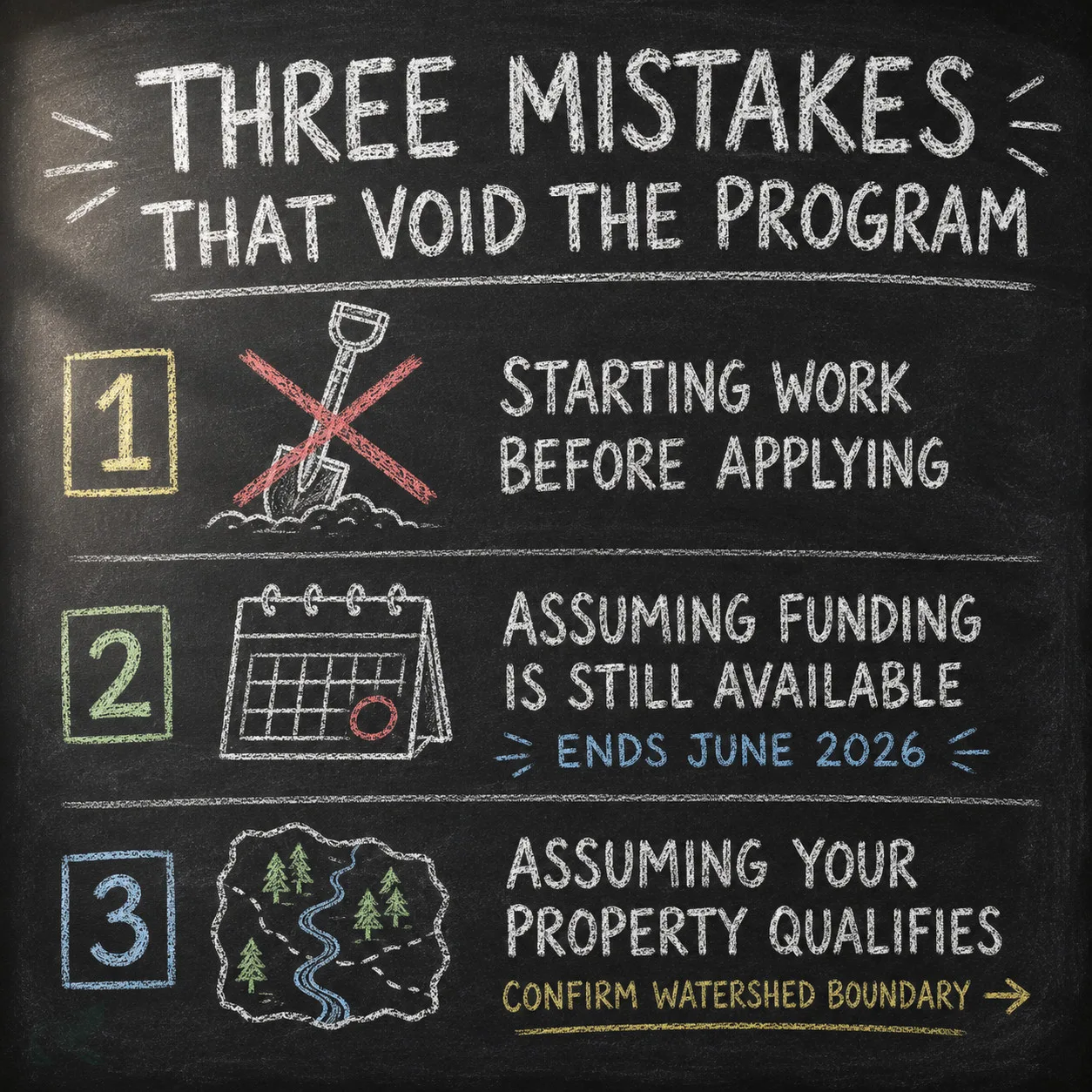
Starting construction before applying. This is the most common disqualifier — and the most avoidable. The program requires pre-construction application and approval. If a contractor has started any site work, the application window is typically closed. Apply first, get written approval, then call the contractor back.
Assuming the program is always funded. Durham’s cost-share funding is not a permanent entitlement. It can be paused, modified, or exhausted in any given year. Funding for this project ends June 2026; confirm current program status with City of Durham Public Works Department, Stormwater and GIS Services at 919-560-4326 ext. 30211 before counting on reimbursement in your project budget.
Assuming all Durham properties qualify. The watershed boundary is the eligibility gate. A property 500 feet outside the Northeast Creek watershed boundary does not qualify. Before building any project budget around the reimbursement, confirm your parcel is inside the boundary.
What If You’re Outside the Watershed?
If your property is not within the Northeast Creek watershed, the City of Durham’s cost-share program does not apply. No comparable septic-to-sewer cost-share program at the same scale is publicly known in neighboring NC counties as of May 2026.
For Durham homeowners outside the Northeast Creek boundary, the City of Durham program FAQ itself points to three general home-repair assistance organizations (these are repair-assistance programs, not sewer-conversion cost-shares, and each has its own eligibility rules):
- Habitat for Humanity of Durham — Repairs Program, (919) 682-0516
- Rebuilding Together of the Triangle — Home Repair and Renovation Services, (919) 341-5980
- North Carolina Housing Finance Agency — Urgent Repair Program, (919) 877-5700
Other avenues to check:
- City of Durham Public Works Department, Stormwater and GIS Services may be aware of other programs or future expansion of the watershed boundary — call 919-560-4326 ext. 30211 and ask directly
- Wake County operates a Well & Septic Pilot Assistance Fund (up to $20,000 for eligible homeowners) for septic repairs and replacements — not a sewer connection cost-share. No equivalent septic-to-sewer cost-share programs are publicly documented in Orange County or Guilford County.
- North Carolina’s Clean Water State Revolving Fund (administered by NC DEQ Division of Water Infrastructure) funds wastewater infrastructure projects — but only local government units (counties, cities, sanitary districts) are eligible to apply directly; individual homeowners cannot apply to the CWSRF for residential sewer connections. Homeowners outside Durham’s watershed should contact their county’s environmental health or public utilities department about local programs.
This page covers the City of Durham’s Northeast Creek cost-share program only. If you are outside Durham County entirely, see NC septic-to-sewer conversion and Durham cost-share for the broader conversion context.
For NC septic-to-sewer conversion and Durham cost-share context across the full process — from the decision to convert through final inspection — the hub page covers the full sequence. To find a licensed contractor for the conversion work itself, NC Grade and Haul’s directory of verified NC grading contractors surfaces contractors who have cleared license-board, workers’ comp, and OSHA checks.