
Silt fence shows up on almost every graded lot in North Carolina — required on any site that crosses the NC land-disturbance thresholds that trigger erosion plans. It also shows up on almost every Notice of Violation list. The gap between the two is usually installation quality, not intent — contractors who know the spec still get cited when installation crews cut corners on the keying step or stage the fence in the wrong location.
This page covers the NC installation standard, the common failure points that inspectors flag, and the maintenance requirements that most site managers underestimate.
The governing document is the NC Erosion and Sediment Control Manual (NC ESCM), published by the NC Department of Environmental Quality. That manual sets the standard; county E&S inspectors enforce it.
Why Location Matters More Than Installation Quality
A properly installed silt fence in the wrong location does nothing. Position relative to the drainage path is the first variable.
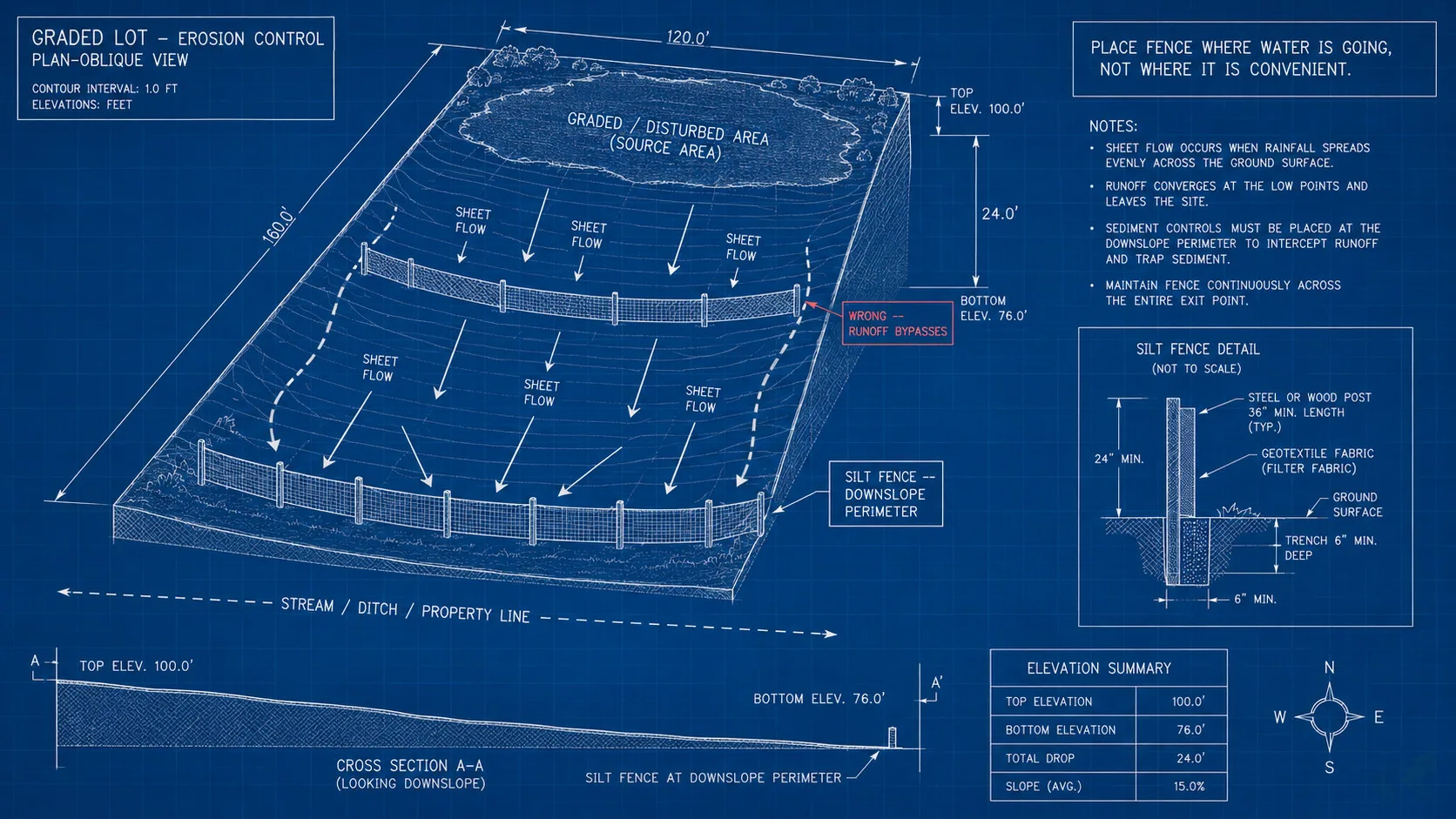
Before the first stake goes in, the site crew needs to understand where runoff leaves the site. Silt fence belongs at the downslope perimeter — the line where sheet flow would exit the graded area and reach a stream, ditch, road, or adjacent property.
Placing it upslope of that line — even five or ten feet uphill — means runoff finds a path around the fence before it ever reaches fabric. The fence looks installed. It performs nothing.
The NC ESCM calls this “downslope installation at the perimeter of disturbed areas” — the governing standard in the local permit process for NC erosion plans. In practice it means walking the graded area after a rain event and watching where water moves. The fence goes where the water is going, not where it’s convenient to stake.
On sloped lots in the Piedmont clay belt, runoff concentrates fast. Sheet flow becomes channelized flow within a few feet of grade change. Silt fence is not designed for channelized flow — it’s for diffuse sheet flow across disturbed areas. Concentrated flow requires a sediment trap or basin instead.
If your site has a natural low point, a swale, or a culvert outlet, those are concentration points. Silt fence running across a concentrated-flow path will collapse under pressure within one storm.
The NC Installation Spec
The NC standard is specific on four variables: trench depth, stake spacing, fabric type, and keying. All four matter. Shortcutting the trench is the most common failure.
Trench and keying
The NC ESCM requires the filter fabric to be keyed into the soil — not surface-staked. The standard practice is a 6-inch-deep trench dug at the fence line, fabric laid into the trench with 6 inches of fabric running along the trench bottom, and soil backfilled and compacted over the embedded fabric.
This keying step prevents the most common failure mode: sediment passing under the fence base during a rain event. Surface-staked fence looks identical from 10 feet away. It fails in the first significant rain.
Stake spacing and depth
Stakes are typically wooden 2x4s or steel T-posts. The NC ESCM specifies maximum 6-foot spacing between stakes. Stakes must be driven to adequate depth to resist the lateral force of sediment-laden water pressing against the fabric — typically 18 to 24 inches deep depending on soil conditions.
In loose fill or recently disturbed ground, stakes driven into undisturbed soil outside the graded area hold better than stakes driven into the fill itself.
Fabric specification
The NC ESCM specifies woven geotextile fabric — not landscape fabric, not shade cloth, not any fabric a crew happened to have on the truck. The distinction matters because the filtration rate (how fast water moves through the fabric while retaining sediment) is engineered into woven geotextile. Landscape fabric clogs faster, fails to strain fine particles, or tears under pressure.
The fabric should be secured to stakes with wire staples or heavy zip ties at minimum 18-inch intervals up the stake face. Loose fabric that billows or pools at the base is not filtering — it’s just there.
Installation height
Standard silt fence fabric height is 24 inches above grade. The 6 inches embedded in the trench brings total fabric length to approximately 30 inches.
Silt fence to NC standard vs the failure modes inspectors cite
Comparison. Installed to NC standard: Fabric keyed into a 6-inch trench, backfilled and compacted; Woven geotextile stakes at 6-foot maximum spacing; Fence on the downslope perimeter where runoff exits; Fabric secured taut -- it filters instead of billowing. What gets a Notice of Violation: Surface-staked, not keyed -- sediment runs underneath; Placed upslope of the drainage path -- runoff bypasses it; Collapsed under sediment load from stakes too far apart; Landscape fabric instead of woven geotextile.
- Fabric keyed into a 6-inch trench, backfilled and compacted
- Woven geotextile stakes at 6-foot maximum spacing
- Fence on the downslope perimeter where runoff exits
- Fabric secured taut -- it filters instead of billowing
- Surface-staked, not keyed -- sediment runs underneath
- Placed upslope of the drainage path -- runoff bypasses it
- Collapsed under sediment load from stakes too far apart
- Landscape fabric instead of woven geotextile
A silt fence only passes an NC E&S inspection if the fabric is keyed in and the fence sits where the water actually leaves the site.
Common Failure Points
Four failure modes account for most NC silt fence violations. Three of them happen during installation; one develops over time.
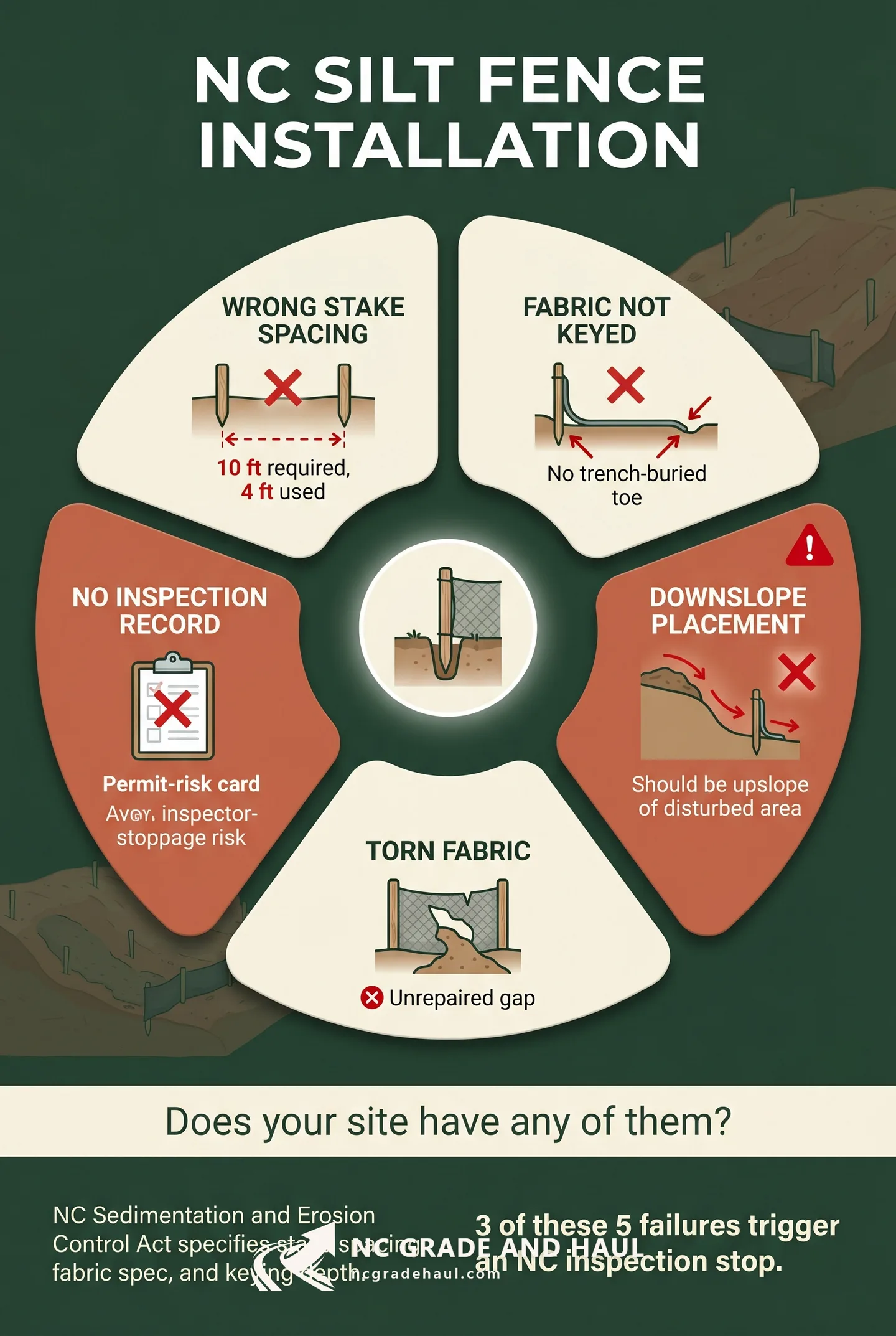
Not keyed. The fabric was surface-staked, not trenched. During the first significant rain, sediment-laden water lifts the fabric base off the soil and flows underneath. The fence looks intact above grade. The violation is under it. This is the single most common inspector finding across North Carolina E&S sites, and it appears in the overview of NC construction site regulations as a keying-compliance requirement.
Wrong location. Fence placed upslope of the drainage path, or on the wrong side of a grade break. Runoff concentrates and finds a path around the fence end or through a gap in coverage. The fence is “present” but the disturbed area’s runoff is leaving the site unfiltered. County E&S inspectors are specifically trained to trace the actual runoff path and compare it to fence placement.
Collapsed from pressure. Fence angle is wrong (should be vertical or leaning slightly upslope), stakes are too far apart, or sediment has accumulated past the maintenance threshold without removal. Accumulated sediment creates a leveraged load on the fabric. When the weight exceeds what the stakes can hold, the fence tips or the fabric tears. This failure is avoidable with routine inspection.
Fabric failure. Wrong fabric type used at installation — landscape fabric, shade cloth, or non-woven geotextile — degrades in UV exposure within one construction season. Or the right fabric was used but holes developed from equipment contact. Patching is acceptable for small tears; sections with holes larger than a few inches need replacement.
What an NC Inspector Looks For
NC E&S inspectors follow a consistent checklist. Knowing the checklist is the fastest way to avoid a Notice of Violation.
The inspection sequence typically runs:
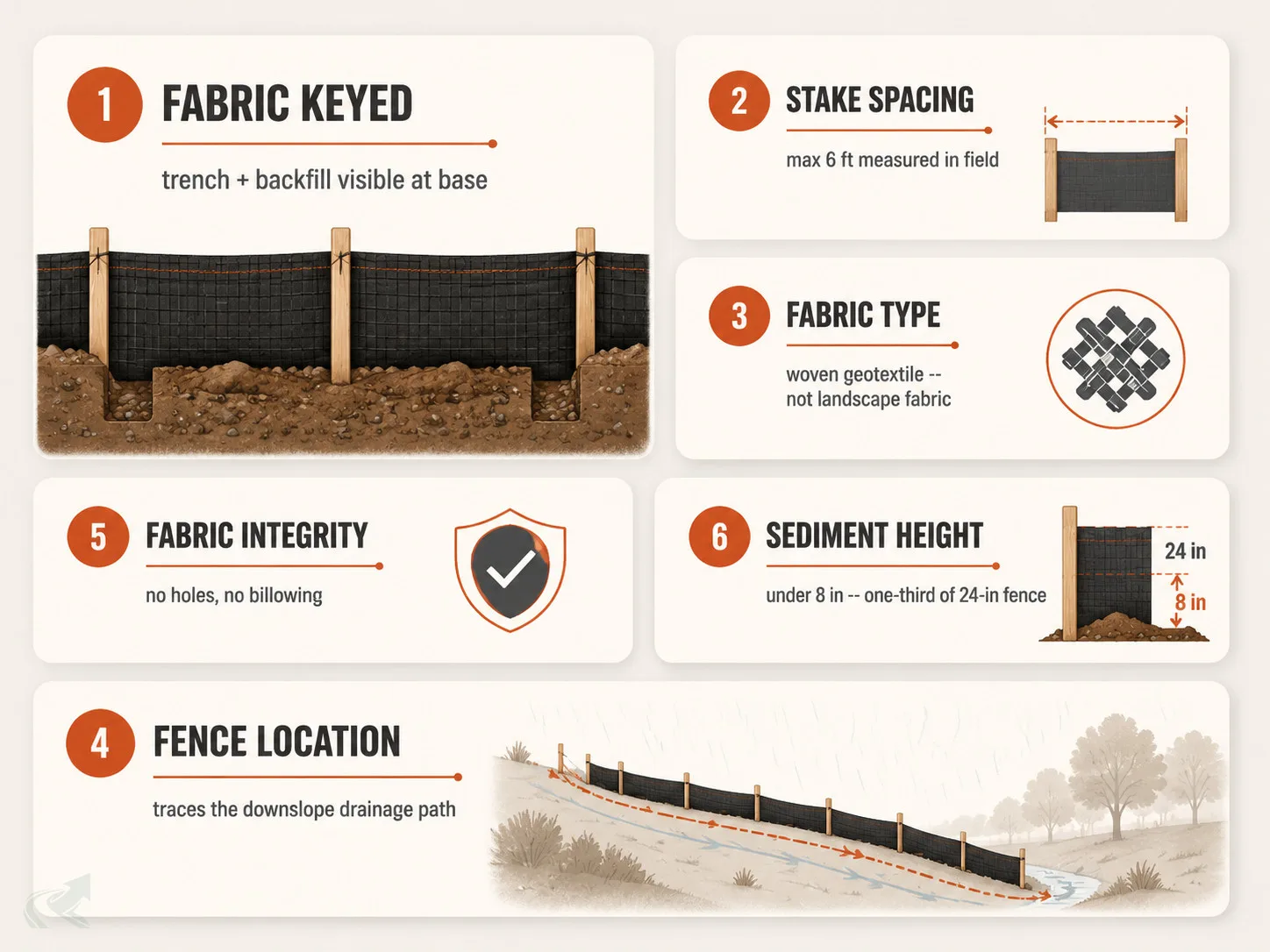
- Fabric keyed into soil — the inspector will look at the base of the fence for signs of trenching and backfill. Surface-staked fabric is immediately visible.
- Stake spacing — measured in the field. Spacing over 6 feet is a violation.
- Fabric type — inspectors can identify woven geotextile vs landscape fabric on sight. The weave pattern and weight are distinct.
- Location relative to drainage — the inspector traces the downslope perimeter and compares it to where the fence is actually staged.
- Fabric integrity — holes, tears, billowing at the base.
- Sediment accumulation height — per the NC ESCM, silt fence must be cleaned out when sediment accumulation reaches one-third of the fabric height (approximately 8 inches for a 24-inch fence). Accumulation beyond that threshold indicates the fence is past its maintenance interval and may be failing structurally.
A failing inspection generates a Notice of Violation, which requires a written response and corrective action within the inspector’s stated timeline. Repeat violations escalate to fines. On active construction sites, a stop-work order is possible.
The governing state law is the North Carolina Sedimentation Pollution Control Act, enforced through the NC Division of Energy, Mineral and Land Resources (NCDEMLR). County programs operate under delegation from the state. For the full legal framework, see the NC erosion law that governs silt fence installation.
Maintenance During the Project
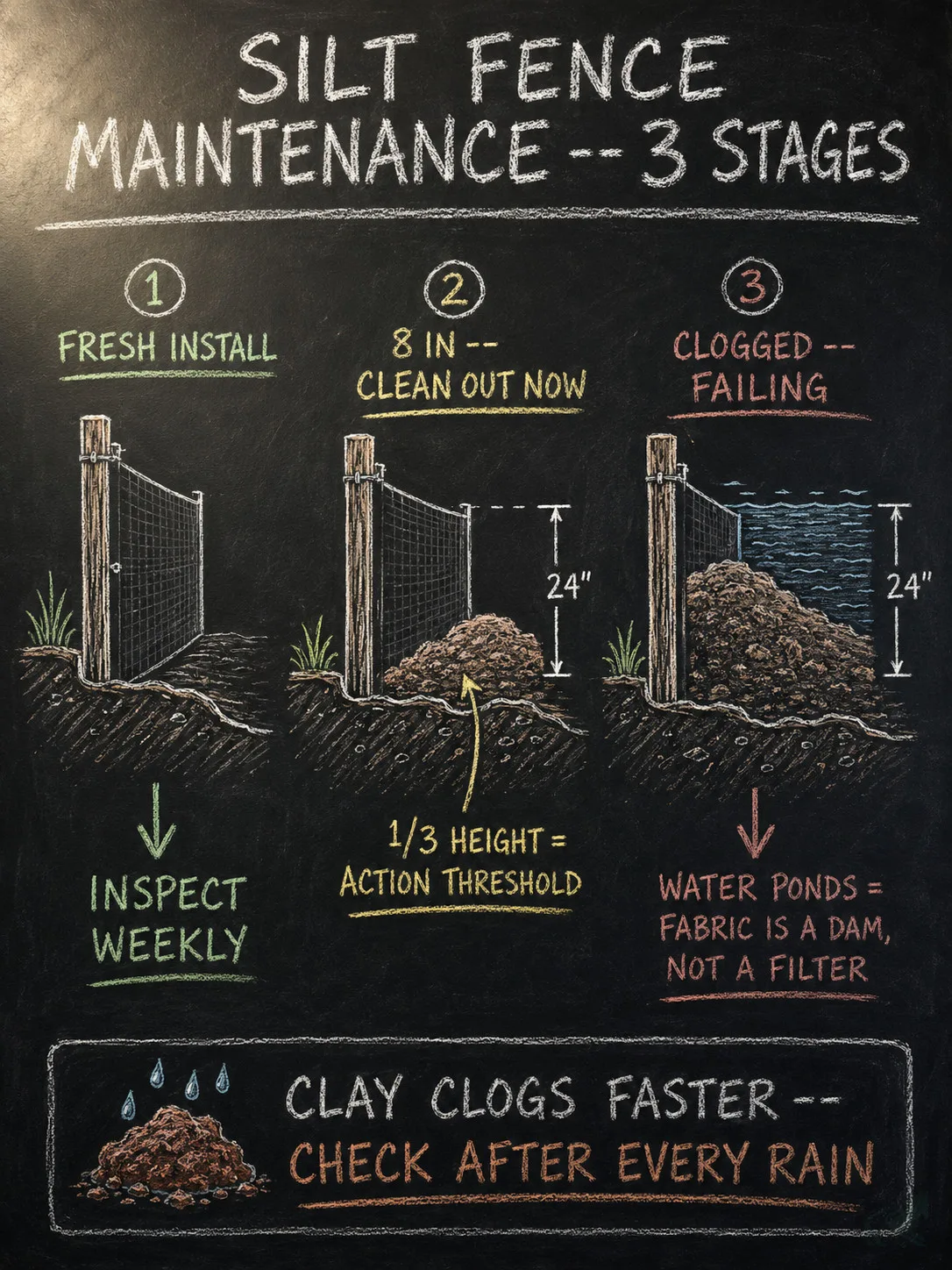
Silt fence is not install-and-forget. It requires active inspection after every significant rain event.
The NC ESCM maintenance standard:
- Inspect after each rain event and at minimum weekly during active earth disturbance.
- Remove accumulated sediment when it reaches one-third of the fabric height — approximately every 2 to 4 weeks on an active site, faster in heavy rain seasons.
- Repair or replace damaged sections promptly. Do not leave holes or torn sections in place between inspection visits.
- At project closeup, remove the fence and stabilize the disturbed area before the final inspection.
In the Piedmont clay belt, silt fence clogs faster than in sandy-soil areas because fine clay particles fill the fabric voids and reduce filtration. Sites with heavy clay content may need fabric replacement mid-project even with proper installation. The symptom is water ponding behind the fence instead of filtering through — the fabric has clogged and is functioning as a dam, not a filter.
Construction entrance installed alongside NC silt fence is the other half of the perimeter E&S package — it keeps sediment from tracking off-site via vehicles while the fence handles sheet flow. Both are typically required on sites over the land-disturbance threshold that triggers permit requirements.
Straw wattles vs silt fence covers situations where the site geometry or drainage pattern makes wattles a better fit — concentrated flow channels, slopes where fabric can’t be properly keyed, or interim protection while a sediment trap is under construction.
Find a Verified NC Grading Contractor
If you have a Notice of Violation or you’re trying to get your E&S plan right before breaking ground, a verified contractor can walk the site with you.
NC Grade and Haul lists grading contractors in North Carolina who carry active NCLBGC licenses and have been verified against public records. The directory shows license status, OSHA compliance history, and workers’ compensation coverage — not just a name and a phone number.
If your project needs silt fence installation that will pass an E&S inspection on the first try, the verified NC grading contractors in our directory specialize in site preparation to NC standards.
Get an itemized quote that includes the E&S package — silt fence, construction entrance, and any required sediment traps — as line items, not a bundled “site prep” number.