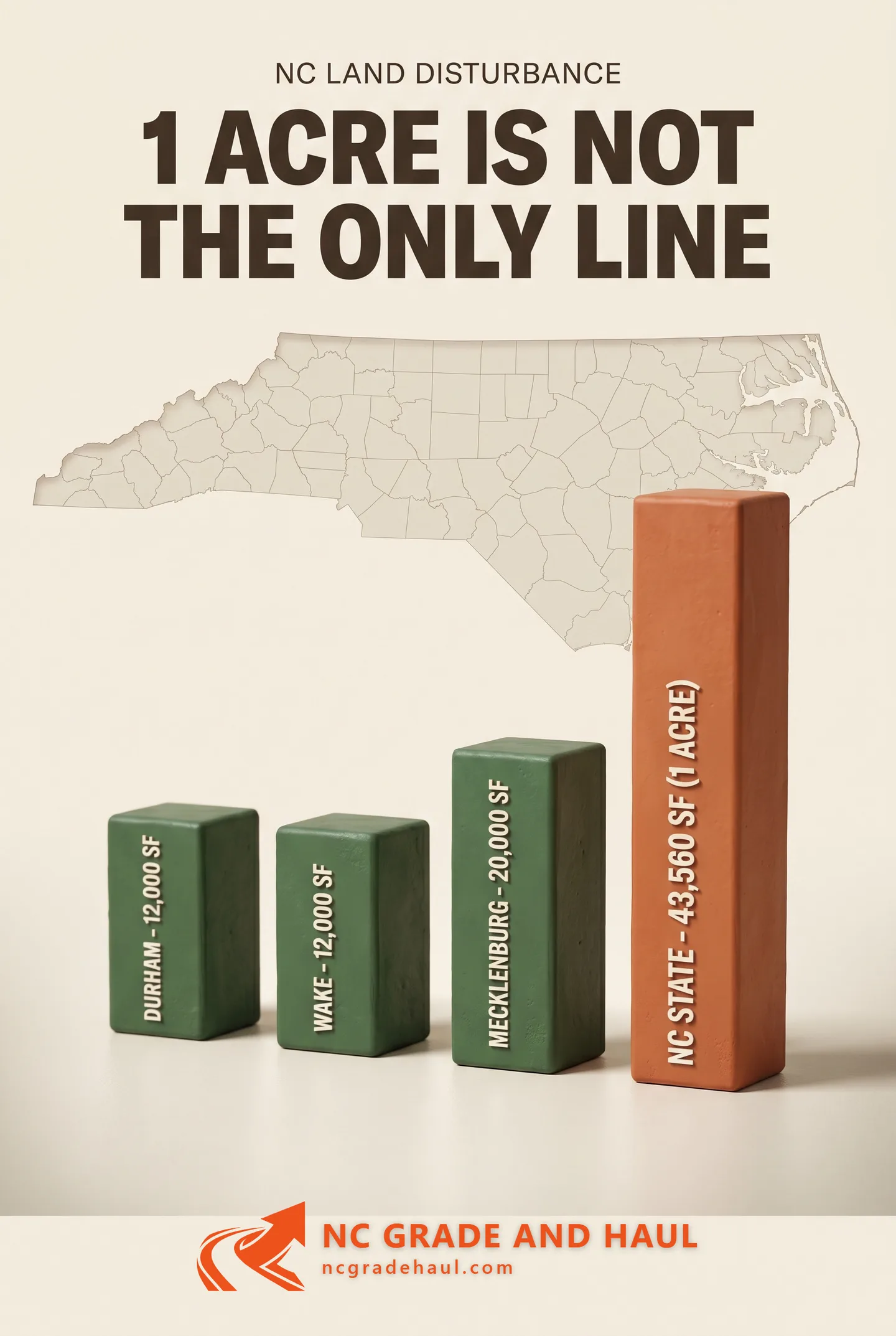
A homeowner in Durham clears land for a driveway extension and a parking pad. Counting the clearing buffer and a staging area, the disturbed footprint runs past 12,000 square feet. His contractor says he doesn’t need a permit — he’s nowhere near an acre.
Six weeks later, he gets a notice of violation from Durham City-County for unpermitted land disturbance.
The contractor knew the state acre rule. He didn’t know the Durham rule. That gap — between what North Carolina requires and what your local jurisdiction requires — is the gap this page fills.
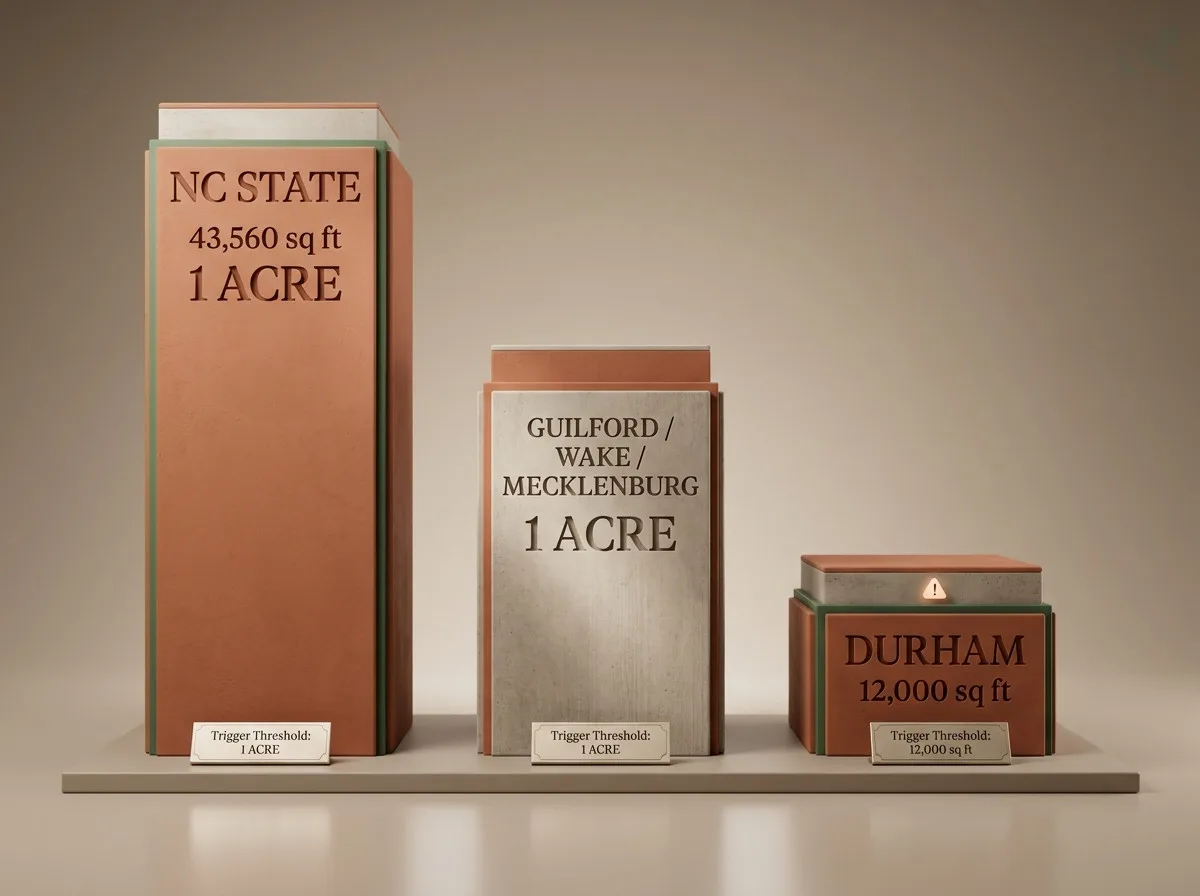
If you’re in Durham, the 1-acre state minimum is not the threshold that applies to your project — Durham City-County triggers a land disturbing permit at 12,000 square feet. Wake, Guilford, and Mecklenburg counties trigger at 1 acre, the same as the state, but many smaller NC municipalities run programs that kick in well below an acre. The jurisdiction-by-jurisdiction variation is the trap.
This page covers both tracks: what the state requires, what the four most populous NC counties require, and how to find out where your specific project lands before you break ground. The headline takeaway: do not assume the 1-acre rule covers you until you have confirmed your exact jurisdiction’s threshold.
The State Threshold: What the 1-Acre Rule Actually Covers
NC state law requires a permit through for any project disturbing 1 or more acres — but this is a state minimum, not a ceiling. Counties can and do set lower thresholds.
The state authority comes from the NC Sedimentation Pollution Control Act of 1973 (NCGS Chapter 113A, Article 4). The 1-acre trigger is set in G.S. 113A-57: no land-disturbing activity that will disturb more than one acre on a tract may begin unless an erosion and sedimentation control plan is filed with, and approved by, the agency having jurisdiction. When a project crosses the 1-acre threshold, the applicant must file an eNOI (Electronic Notice of Intent) through NCDEQ’s AccessDEQ portal before any land-disturbing activity begins.
The state process runs in three steps: file the through AccessDEQ — receive the Certificate of Coverage before starting — file an eNOT (Electronic Notice of Termination) at project completion.
“Disturbed” includes more than most homeowners expect. Clearing vegetation, grading, filling, temporary stockpile areas, and access roads all count toward the disturbed acreage. The relevant NC earthwork regulations hub at NC earthwork regulations hub covers the full regulatory landscape.
For a detailed breakdown of the underlying E&S Act requirements, see NC erosion act thresholds tied to land disturbance.
The key point: the state 1-acre threshold is a floor. It establishes when NCDEQ review is required — it does not pre-empt stricter county rules. If your county triggers at 2,400 square feet, you hit the county threshold first, and you may also hit the state threshold on larger projects.
The County Threshold Matrix: What Your County Actually Requires
Here are the land disturbance permit thresholds for NC’s four most populous counties. Durham City-County triggers below the state acre; Wake, Guilford, and Mecklenburg trigger at the same 1-acre floor as the state. Thresholds and fees below are confirmed against the NC DEQ Local Erosion and Sedimentation Control Ordinances fee listing (July 2024) — always reconfirm at the county source before relying on them, since ordinances change.
| County | Trigger Threshold | Permit Name | Where to Apply | Fee |
|---|---|---|---|---|
| NC State | More than 1 disturbed acre | E&S / Sedimentation Permit | NCDEQ AccessDEQ eNOI portal | No state filing fee for the eNOI; local-program fees may apply |
| Wake County | 1 disturbed acre | Land Disturbing Permit | Wake County Environmental Services | $250 per disturbed acre or part thereof (plan review + permit each $250/acre) |
| Durham City-County | 12,000 sq ft | Land Disturbing Permit | Durham City-County Engineering / Stormwater and Erosion Control | $275 for 12,000 sq ft to 1 acre; $525 per acre for 1-10 acres |
| Guilford County | 1 disturbed acre | Grading Permit | Guilford County Planning and Development, Soil Erosion Control | $450 for 1-3 acres; +$225 per additional acre |
| Mecklenburg County | 1 disturbed acre | Erosion Control Permit / Land Disturbing Permit | Mecklenburg County Storm Water Services | $710 per acre (erosion control permit only); land development fees may also apply |
Last checked: May 2026 against the NC DEQ fee listing dated July 2024 — thresholds and fees subject to change. Confirm at your county portal before starting any project.
About Mecklenburg County: Mecklenburg runs its own full land disturbance program through LUESA Storm Water Services. The grading / erosion control permit is required when 1 acre or more is disturbed — the same 1-acre floor as the state. The county’s erosion control permit fee is $710 per acre, and larger land-development fees may apply on top of that for commercial and subdivision projects.
Per-county notes:
Wake County operates its land disturbance permit program through Wake County Environmental Services. The trigger threshold is 1 disturbed acre (about 43,560 square feet) for projects outside a subdivision; projects inside a recorded subdivision (a common plan of development) need a permit even below an acre. The fee is $250 per disturbed acre or part thereof. Disturbances under an acre outside a subdivision still require silt fence and a stone construction entrance even though no permit is pulled.
Durham City-County is the notable exception among the four major counties — its threshold is well below the state acre. A land disturbing permit is required for any non-agricultural land-disturbing activity exceeding 12,000 square feet, in both the City of Durham and unincorporated Durham County, per Durham Unified Development Ordinance Section 12.10. The permit fee for 12,000 square feet to 1 acre is $275. Signed and sealed erosion control plans are additionally required once disturbance exceeds 20,000 square feet. Durham homeowners with a sizeable driveway-plus-clearing project should assume they need a permit and verify the exception, not the other way around.
Guilford County triggers its grading permit at 1 disturbed acre, including non-contiguous disturbance within a larger common plan of development. The fee is $450 for 1 to 3 acres, plus $225 for each additional acre. A surety bond of $1,500 per disturbed acre is required for any project of 1 acre or more. Ray Pettiford’s 14-acre land-clearing project in Guilford County would cross both the county and state thresholds — both filings would be required. See the county permit requirements beyond NC land-disturbance thresholds page for the full filing sequence.
The matrix covers four counties. For other NC counties, contact the county planning or engineering department directly, or search the county’s online permit portal. The four counties above represent the most-searched thresholds in North Carolina — but the pattern (county threshold stricter than state minimum) appears across most high-growth counties in the state.
What Counts as Land Disturbance
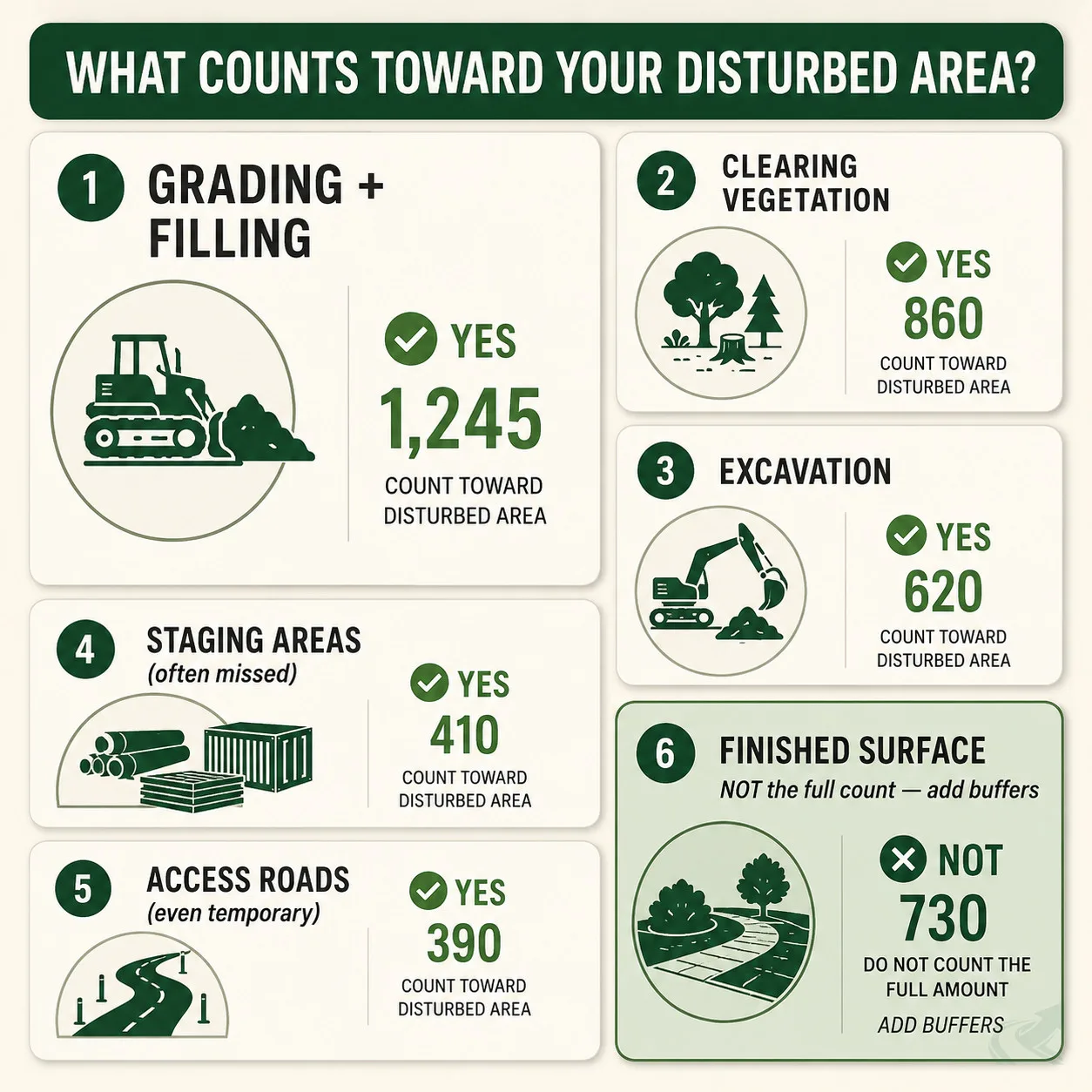
Land disturbance includes clearing vegetation, grading, filling, excavating, and any activity that exposes soil — including temporary staging areas and access roads. Delegated local programs must meet or exceed the state definition, so county definitions track the state language closely, though specific ordinance wording can differ in detail.
The state definition of land-disturbing activity under the Sedimentation Pollution Control Act (NCGS Chapter 113A, Article 4) is broad by design. It is not limited to grading. It covers any use of the land that results in a change in the natural cover or topography and that may cause or contribute to sedimentation.
Common homeowner misunderstandings:
- “It’s just a small excavation.” Counties count any soil-exposing work. A footing excavation, a utility trench, and a grading pad all qualify if they disturb enough area.
- “I’m not doing ‘real’ grading.” Clearing vegetation from a slope without moving dirt still exposes soil. Many county ordinances classify vegetation removal alone as a land-disturbing activity if it exceeds the threshold.
- “The landscaper said it doesn’t count.” Landscaping contractors are not permit agents. The county planning department determines what counts — not the contractor.
The erosion control requirements at NC land-disturbance thresholds page covers what the permit requires once you’ve crossed the threshold — silt fence installation, erosion control plans, and inspection requirements.
Because delegated local programs must meet or exceed state minimum standards, county definitions of land-disturbing activity closely track the state definition — but the exact ordinance wording, and the list of exemptions, can differ. Before relying on the state definition for a local project, check the county or municipal ordinance language.
How Counties Measure the Disturbed Area
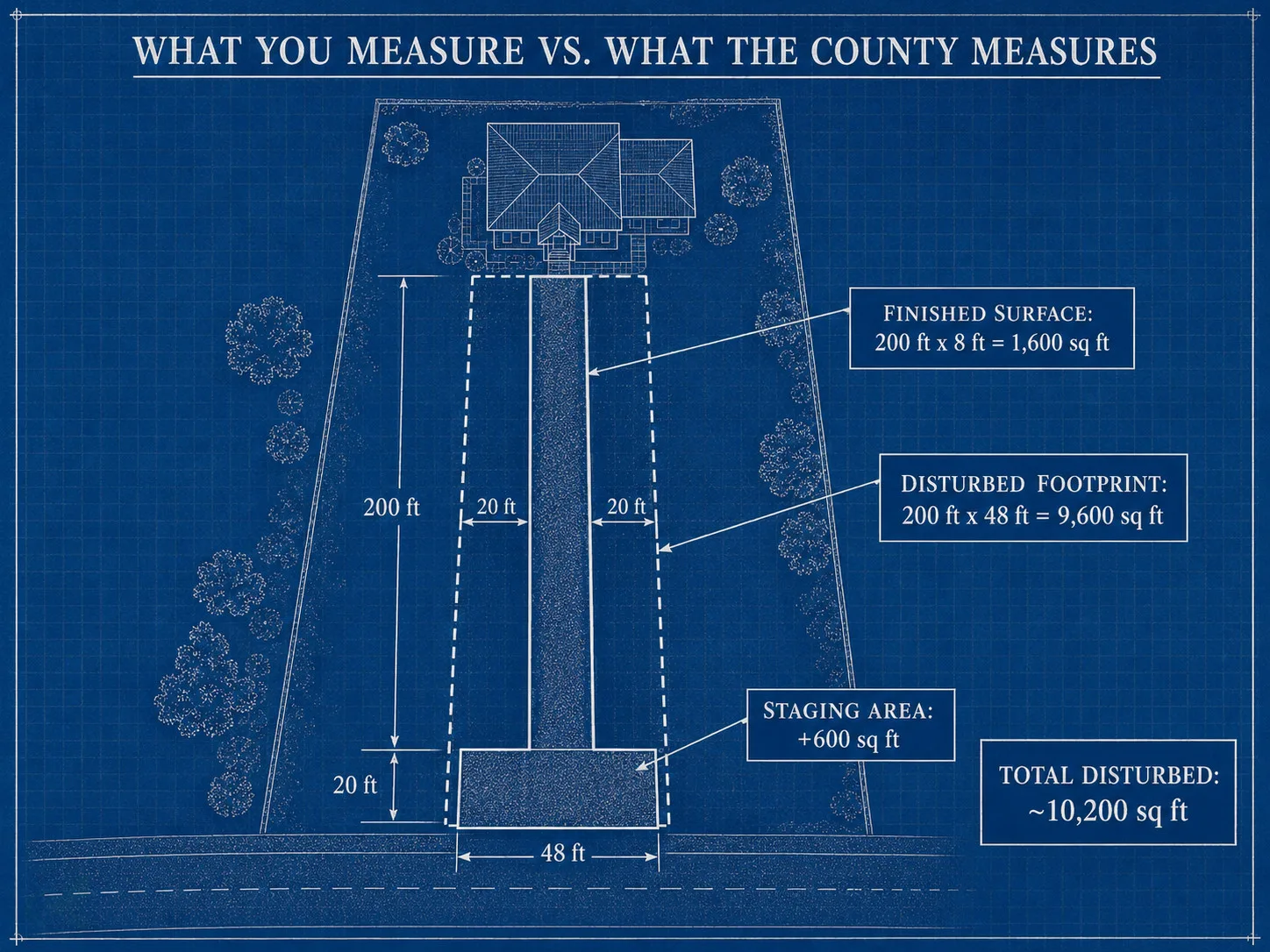
Disturbed area is typically measured from the edge of clearing or grading to the edge of undisturbed vegetation — which means the driveway plus the clearing buffer plus any staging area, not just the finished surface.
This is where most homeowners miscalculate. They measure the finished surface — the driveway, the pad, the retaining wall — and stop there. Counties measure the total disturbed footprint.
A concrete example: a 200-foot driveway with an 8-foot finished width and a 20-foot clearing buffer on each side produces a disturbed footprint of roughly 200 x 48 feet, or about 9,600 square feet. Add a 20 x 30 foot staging area at the road end and you’re at approximately 10,200 square feet. In Durham, where the permit triggers at 12,000 square feet, a project measured at 10,200 square feet of finished surface can cross the threshold once the full disturbed footprint is counted — even though the driveway itself is modest. The lesson holds in every jurisdiction: measure the disturbed footprint, not the finished surface.
The measurement methodology:
- Start from the outermost edge of clearing or soil disturbance
- Include all buffer clearing around the finished surface
- Include any access road to the work area (even if temporary)
- Include material staging areas and equipment turnaround space
- Do not subtract finished hard surface from the total
If your contractor’s estimate is based only on the finished surface area, the permit calculation will be wrong. Ask for the disturbed-area calculation, not the project-area calculation — they are not the same number.
The NC stormwater ordinances that apply to your project page covers how disturbed area also triggers stormwater review thresholds, which may run in parallel with the land disturbance permit.
What Triggers Automatic Escalation to State Review
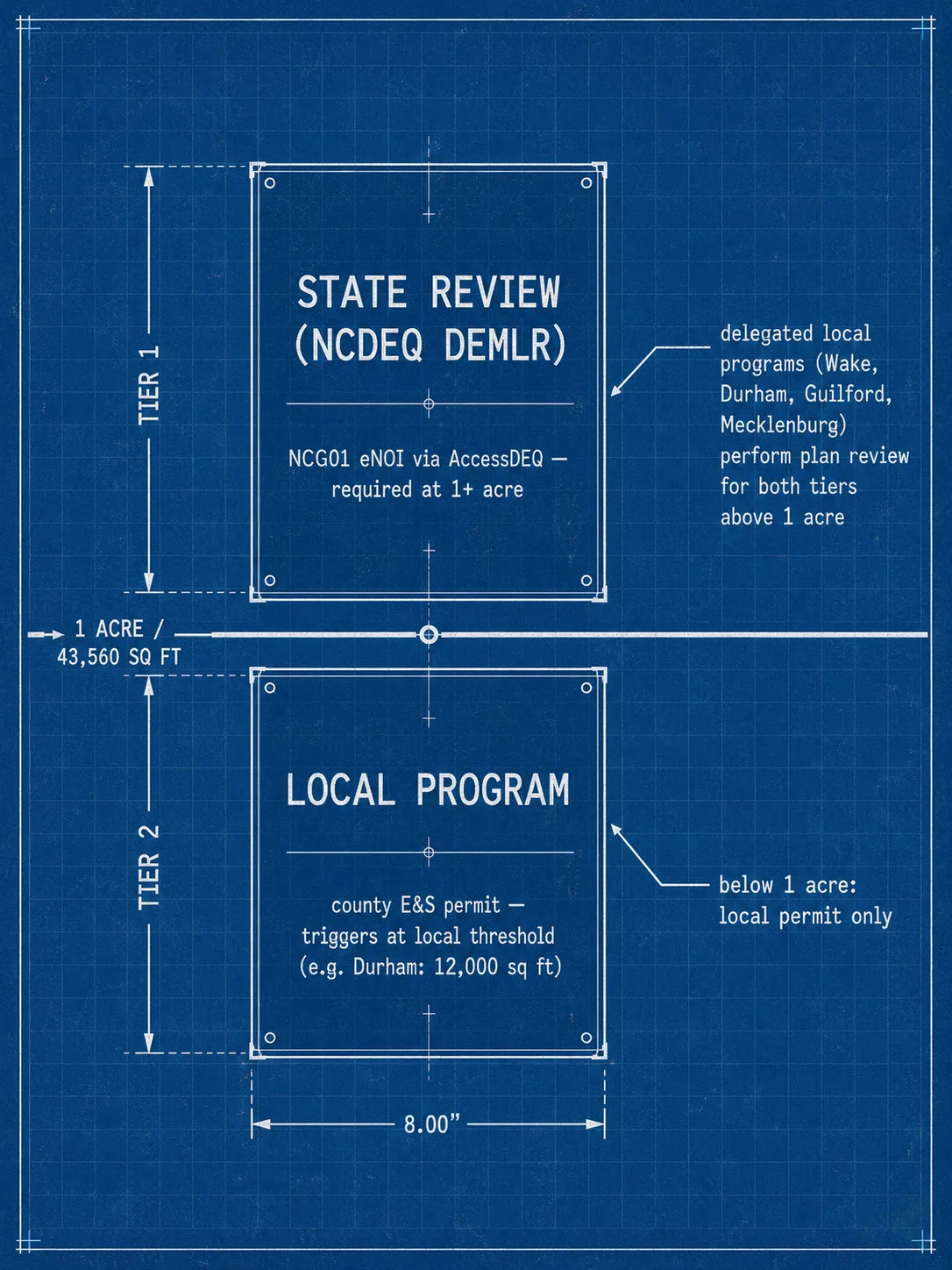
Any project that disturbs 1 or more acres triggers state-level Sedimentation Pollution Control Act review — and in most major NC counties that review is performed by the delegated local program, not separately by NCDEQ.
How the two layers interact depends on whether your jurisdiction runs a delegated local program. In Wake, Durham, Guilford, and Mecklenburg, the local program is the delegated agent for state E&S plan review, so the local erosion and sediment control filing generally also satisfies the state plan-review requirement for projects over an acre. Separately, the federal NPDES construction stormwater permit (NCG01) — filed as an eNOI through NCDEQ’s AccessDEQ portal — still applies to most projects disturbing 1 or more acres and is its own filing. Do not assume one filing covers everything.
The two-layer reality:
- Under 1 acre, at or above the local threshold (for example, 12,000 sq ft in Durham): local land disturbing permit only. File with the local erosion and sediment control program.
- At or above 1 acre: the local erosion and sediment control permit AND the NCG01 construction stormwater coverage (eNOI through AccessDEQ) are both generally required. Timeline lengthens because both reviews run.
- Jurisdictions with delegated E&S authority: Mecklenburg County, the City of Charlotte, Durham City-County, Wake County, and Guilford County all operate delegated local erosion and sedimentation control programs — they appear on the NC DEQ Local Erosion and Sedimentation Control Ordinances roster, which is the list of programs the NC Sedimentation Control Commission has delegated. In a delegated jurisdiction, the local program performs the plan review and enforcement that the state would otherwise handle, so a project above 1 acre is often reviewed through the local program rather than directly by NCDEQ. Confirm the exact filing path with your local program before assuming one filing satisfies every obligation.
The permit timeline implications are real. State E&S review adds time — typically measured in weeks, not days — before a Certificate of Coverage is issued. Large projects in NC with combined county + state review need to build that time into the schedule. Starting before receiving the Certificate of Coverage is a violation regardless of how urgent the project timeline is.
How to Determine Your Exact Threshold and Where to File
For any NC county not in the matrix above: call the county planning or engineering department before starting any grading project and ask for their land disturbance permit threshold and the application process.
Do not rely on a neighboring county’s rules. Land disturbance thresholds vary significantly across North Carolina. Some rural counties have not adopted local programs below the 1-acre state minimum. Others have adopted thresholds as low as 2,400 square feet. The variance is large enough that an assumption can put you in violation before the first shovel goes in.
Copy-to-clipboard — call your county before starting any grading project:
“What is the land disturbance permit threshold in this county? Do I need a permit for [describe project: approximate square footage, activity type]? Where do I apply? What is the fee? How long does review typically take?”
That question, asked before the contractor is hired, is worth more than any online research. County planning staff field these questions daily and will give you a straight answer.
Common mistakes to avoid:
- Assuming the state 1-acre minimum is the only threshold. In Durham, you hit the 12,000-square-foot county threshold first. In smaller municipalities the local trigger can be lower still — never assume the acre rule covers you without checking your jurisdiction.
- Measuring the finished surface instead of the disturbed footprint. The buffer zone, staging area, and access clearing all count.
- Filing with the county and assuming state review is satisfied. For projects over 1 acre, county and state filings are separate tracks.
When hiring a grading contractor for a project that involves land disturbance permits, ask them directly: which permits will you pull, in which jurisdiction, and will you handle both county and state filings if applicable? An experienced NC grading operator answers that question specifically. A vague answer is a warning sign. Find a grading operator in North Carolina who pulls the right permits for your county.
Get an itemized quote from a verified NC grading contractor who specifies which permits they will pull and which agencies they will file with — not a lump-sum estimate that leaves the permit question open.