
Two questions homeowners ask every week
What erosion controls does NC require on a construction site?
State law triggers at 1 acre of disturbance -- you need an E&S plan, silt fence at downslope edges, and a stabilized construction entrance before any dirt moves. Most NC counties have lower thresholds (often 10,000 sq ft). The grading contractor installs the controls; the permit is the owner's or GC's responsibility.
My contractor says they handle erosion control -- is that true?
Partially. The contractor installs and maintains the physical controls -- silt fence, construction entrance, straw wattles. But the permit sits with whoever owns or controls the land. If the inspector writes a violation, it goes to the permit holder, not just the contractor.
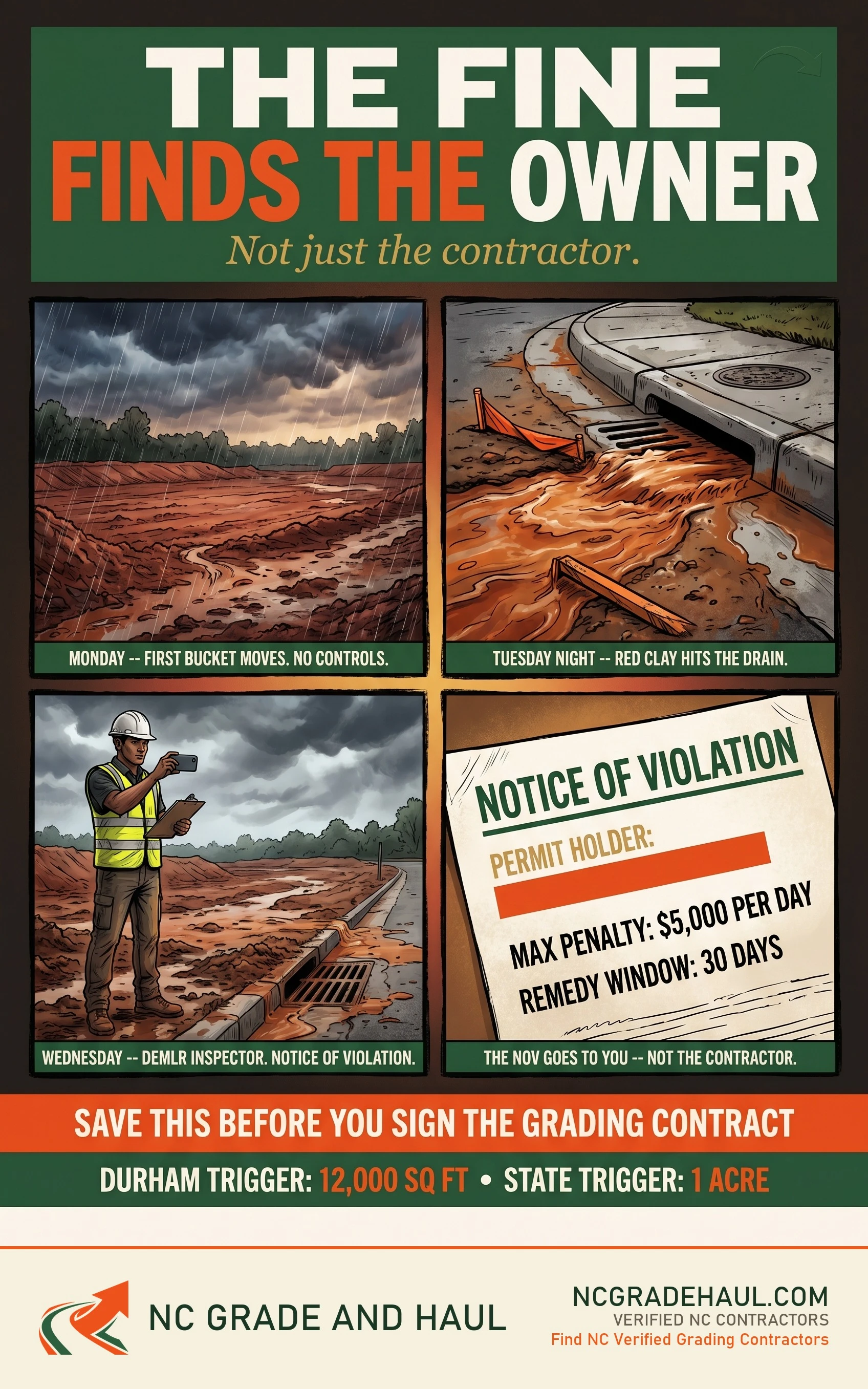
Your grading crew shows up Monday morning. By noon, the lot is scraped bare — Piedmont red clay exposed across half an acre. That night it rains.
By Tuesday, a rust-colored slick is running toward the storm drain at the street corner.
Nobody thought through E&S before the first bucket moved. Now someone’s going to get a Notice of Violation — and it might not be the contractor.
This page explains what control actually requires in North Carolina, when it applies to your project, and who’s on the hook when it goes wrong.
What “E&S” Actually Means
Erosion and sediment control is a set of physical barriers and practices that keep disturbed soil from washing off your site into nearby waterways — and North Carolina law requires them on any significant construction project.
Construction sites generate dramatically more sediment per acre than undisturbed land. When native ground cover is stripped and Piedmont clay is exposed, rain has nothing to slow it down. That sediment ends up in drainage ditches, storm drains, and downstream ponds — which is why state regulators treat it as a pollution problem, not just a landscaping issue.
The three controls you’ll see on almost every NC site:
- Silt fence — fabric barrier staked along the downslope perimeter to capture runoff before it leaves the property
- Stabilized construction entrance — gravel pad at every truck access point to knock mud off tires before they reach the road
- Straw wattles / erosion blankets — rolled barriers or blankets on steeper slopes that slow water velocity before it becomes runoff
Each of these has a spoke page with NC-specific installation specs. Start with silt fence installation to NC standards, the NC jobsite construction entrance spec, or when to use straw wattles on NC construction sites.
The 1-Acre State Trigger
North Carolina state law requires a formal E&S plan — filed through — for any project that disturbs 1 or more acres. Below that, county rules apply.
The state trigger comes from the NC Sedimentation Pollution Control Act (GS §113A-51 et seq.), administered by . At 1 acre or more of land disturbance, the project needs coverage under the Construction General Permit, specifically the NCG01 permit for North Carolina construction sites.
The three-step process:
NPDES Construction General Permit (NCG01) — Three Steps
- File eNOI (Electronic Notice of Intent) through NCDEQ AccessDEQ before breaking ground. This is how the project receives permit coverage.
- Receive Certificate of Coverage (COC) — NCDEQ issues this confirming your project is covered under NCG01. Keep it on site during construction.
- File eNOT (Electronic Notice of Termination) when the site is stabilized and construction is complete.
Source: NCDEQ deq.nc.gov
Who files: Typically the GC or developer, not the homeowner directly. But the permit obligation sits with whoever owns or controls the site. If your GC files on your behalf, confirm they’ve received the COC before clearing begins.
For most residential new-builds on a single lot, the acreage question is close. A 15,000 sq ft lot graded top-to-bottom with driveway, utilities, and drainage work can exceed 1 acre of total disturbance — especially if adjacent disturbed area is counted. When in doubt, measure.
The NC land-disturbance thresholds that trigger erosion plans has the full calculation guidance.
County Thresholds Below 1 Acre
Most major NC counties enforce erosion controls at the same 1-acre threshold as state law. Durham County is the main exception, requiring a land-disturbance permit at 12,000 square feet.
This is where most residential lot grading actually lives. A single-family home site under 1 acre — below the state trigger — often still exceeds the county threshold. County enforcement is handled by the local Soil and Water Conservation office or the building inspections department, depending on the county.
The county threshold table below was verified against county portals and ordinances in May 2026.
NC county erosion control thresholds -- verified May 2026; confirm with county before filing
| County | State Threshold | County Trigger | Enforcing Office |
|---|---|---|---|
| Wake | 1 acre | 1 acre | Wake County Soil & Water Conservation |
| Mecklenburg | 1 acre | 1 acre | Mecklenburg County Storm Water Services |
| Durham | 1 acre | 12,000 sq ft | Durham Stormwater & GIS Services |
| Guilford | 1 acre | 1 acre | Guilford County Soil & Water Conservation |
Wake
- State Threshold
- 1 acre
- County Trigger
- 1 acre
- Enforcing Office
- Wake County Soil & Water Conservation
Mecklenburg
- State Threshold
- 1 acre
- County Trigger
- 1 acre
- Enforcing Office
- Mecklenburg County Storm Water Services
Durham
- State Threshold
- 1 acre
- County Trigger
- 12,000 sq ft
- Enforcing Office
- Durham Stormwater & GIS Services
Guilford
- State Threshold
- 1 acre
- County Trigger
- 1 acre
- Enforcing Office
- Guilford County Soil & Water Conservation
The common scenario: A homeowner in Durham County is grading a 0.4-acre lot for a new home. State threshold doesn’t trigger. County threshold does — 12,000 sq ft is about 0.28 acres. The project needs a county land-disturbance permit and installed controls before clearing begins. In Wake, Mecklenburg, or Guilford County, the same 0.6-acre lot would not trigger the county E&S plan, but city stormwater rules may still apply.
County E&S permit requirements in more detail at county erosion control permit requirements NC.
The Three Controls You’ll See on Every NC Site
Silt fence along downslope edges, a gravel stabilized entrance at the driveway apron, and straw wattles or erosion blankets on slopes — these three are the baseline for almost every NC construction site.
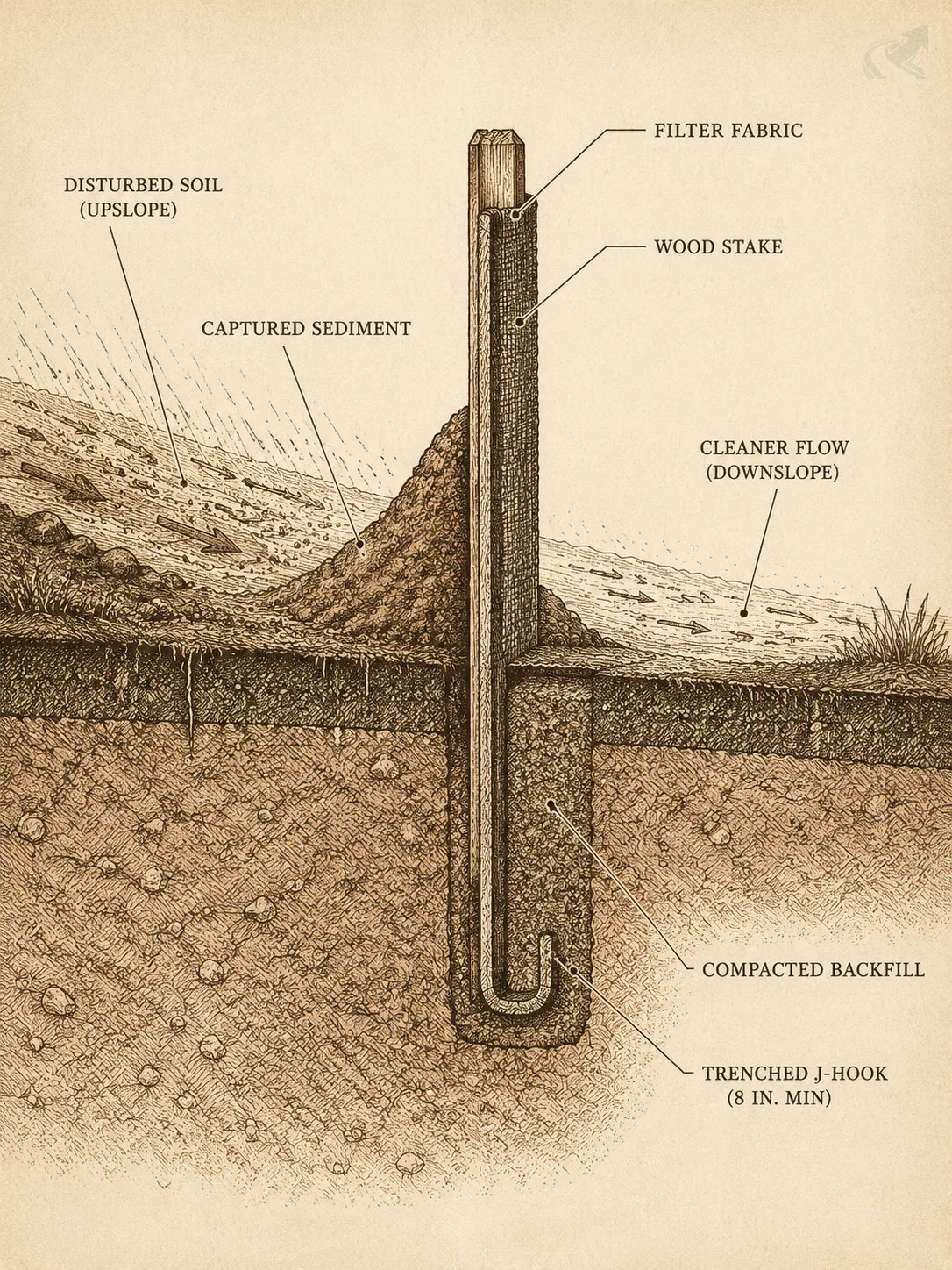
Silt fence is the most common E&S measure in North Carolina. A linear fabric barrier staked on the downslope perimeter of the site, it catches sediment-laden runoff before it leaves the property. Required at all downslope and side-slope boundaries where runoff could carry disturbed soil off site. Installing it upslope, or skipping the trenched bottom edge, are two failure modes that get sites cited. See silt fence installation to NC standards for the full spec.
Silt fence installed to NC standard vs the ways it gets cited
Comparison. Installed correctly: Staked along the downslope perimeter of the site; Filter fabric bottom edge trenched and keyed into the soil; Posts spaced to hold against runoff pressure; Sediment is captured before it leaves the property. How it fails: Bottom edge not keyed in -- sediment passes underneath; Run upslope instead of downslope -- water bypasses it; Posts too far apart -- the fence collapses under load; Sediment reaches the road drain and the site gets a violation.
- Staked along the downslope perimeter of the site
- Filter fabric bottom edge trenched and keyed into the soil
- Posts spaced to hold against runoff pressure
- Sediment is captured before it leaves the property
- Bottom edge not keyed in -- sediment passes underneath
- Run upslope instead of downslope -- water bypasses it
- Posts too far apart -- the fence collapses under load
- Sediment reaches the road drain and the site gets a violation
The Notice of Violation goes to the permit holder -- usually the owner or GC -- not just the sub who installed the fence.
Stabilized construction entrance is the gravel pad at every point trucks enter or leave the site. The NC ESCM standard (Practice 6.06) calls for 2-3 inch coarse aggregate, 6 inches deep minimum, 12 feet wide minimum, and at least 50 feet long. The pad knocks mud off truck tires before they reach the road. Without it, tracked mud on the roadway is both a violation and a hazard. Full spec at NC jobsite construction entrance spec.
Straw wattles and erosion blankets are more effective than silt fence on slopes steeper than 3:1. Where silt fence captures runoff at the property edge, wattles slow water velocity on the slope itself — before it has a chance to become concentrated runoff. NC Piedmont sites with any meaningful grade almost always need one or the other. Details at when to use straw wattles on NC construction sites.
Who Installs, Who’s Responsible, Who Gets the Fine
The grading contractor installs the controls. The permit belongs to whoever owns or controls the land. The fine goes to whoever the inspector can identify — and it’s often both.
Here’s the confusion most homeowners run into: “my contractor handles it” is true for installation, but not for the permit. When a DEMLR inspector walks a site and finds silt fence knocked over by the last rain — with sediment in the road drain — they write the Notice of Violation to the permit holder. That’s usually the owner or GC, not the subcontractor who installed it.
What an inspection failure looks like in practice:
- Inspector visits after heavy rain
- Finds silt fence collapsed, sediment tracked to the road, or runoff reaching a waterway
- Issues Notice of Violation to the permit holder
- Permit holder has a short window to remedy (usually 30 days) before civil penalties kick in
What an E&S inspection failure looks like
1. Inspector visits after heavy rain -- DEMLR inspector or county Soil and Water Conservation staff. Triggered by a complaint, routine schedule, or visible sediment at a road drain or waterway. 2. Finds controls failed or missing -- Silt fence collapsed, sediment tracked onto the road surface, or stormwater runoff reaching a drainage structure or waterway. 3. Notice of Violation to the permit holder -- The NOV goes to the permit holder -- usually the land owner or GC, not the subcontractor who installed the controls. That's a distinction that surprises most homeowners. 4. 30-day remedy window -- then daily civil penalties -- Under GS section 113A-64, maximum $5,000 per violation. Each day of a continuing violation is counted separately. The economics flip fast.
-
Inspector visits after heavy rain
DEMLR inspector or county Soil and Water Conservation staff. Triggered by a complaint, routine schedule, or visible sediment at a road drain or waterway.
-
Finds controls failed or missing
Silt fence collapsed, sediment tracked onto the road surface, or stormwater runoff reaching a drainage structure or waterway.
-
Notice of Violation to the permit holder
The NOV goes to the permit holder -- usually the land owner or GC, not the subcontractor who installed the controls. That's a distinction that surprises most homeowners.
-
30-day remedy window -- then daily civil penalties
Under GS section 113A-64, maximum $5,000 per violation. Each day of a continuing violation is counted separately. The economics flip fast.
The sequence runs faster than most homeowners expect. Getting controls right costs a few thousand dollars. Remediation plus penalties after a violation costs significantly more.
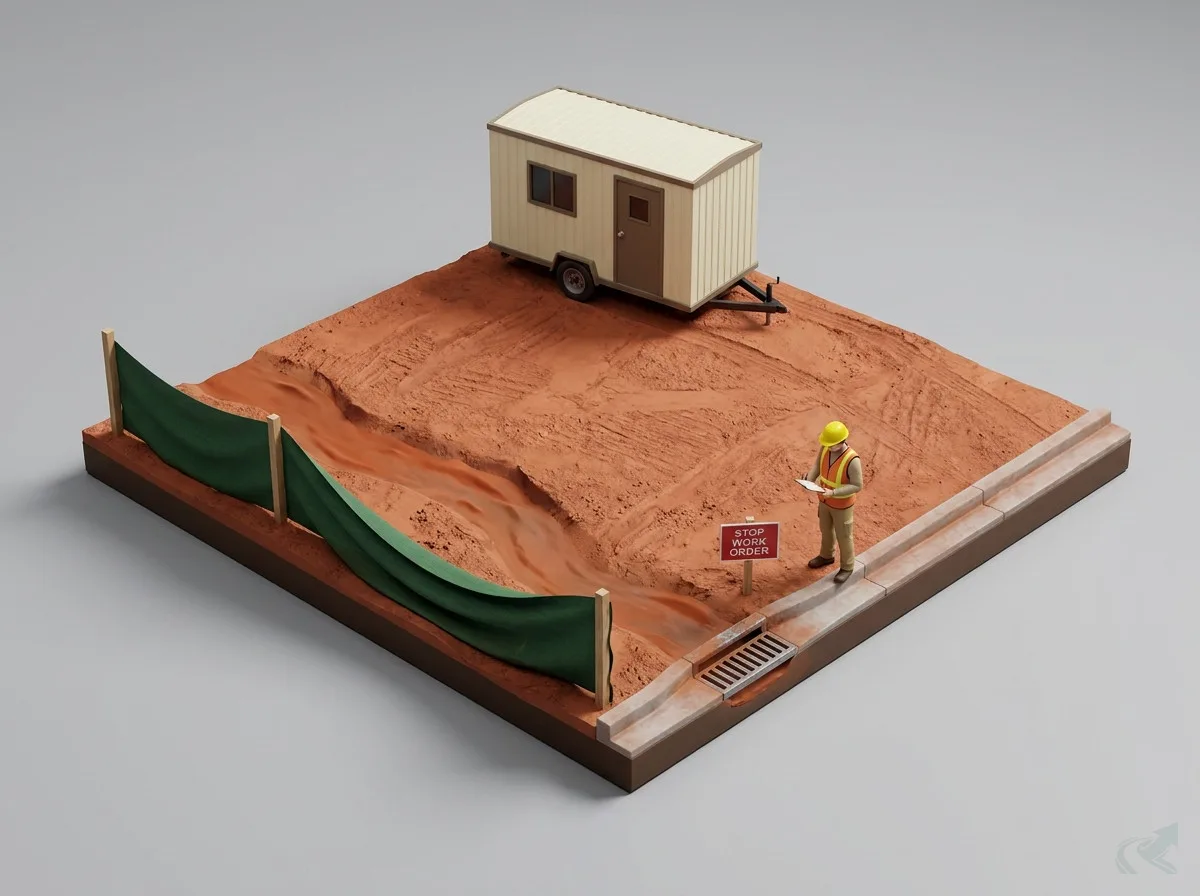
Civil penalty range under GS §113A-64: the maximum civil penalty is $5,000 per violation, and each day of a continuing violation is a separate violation. (Knowing or willful violations can additionally be charged as a Class 2 misdemeanor with a fine up to $5,000.) The economics flip fast: getting the controls right costs a few thousand dollars. Remediation plus penalties after a violation can cost significantly more.
The red flag to watch for: if your grading contractor doesn’t talk about E&S controls in the quote, ask why. A grading contractor who works North Carolina regularly should include E&S installation as a named line item in the itemized quote, not a buried allowance.
What Happens When You Skip It
If your site causes off-site sediment damage without controls, DEMLR can issue a stop-work order and require restoration — which often costs more than installing the controls correctly from day one.
The sequence runs faster than most homeowners expect. A neighbor’s retention pond fills with red clay. They call the county. County sends an inspector. The inspector finds no E&S controls, or controls that were installed but not maintained.
Stop-work order goes up. Now clearing has halted, the site is exposed, and the next rain makes the problem worse. Meanwhile, the permit holder is looking at a restoration order — which might require hauling sediment out of a downstream pond at their expense.
The erosion control triggered by NC land clearing page covers how the E&S obligation attaches at the moment land disturbance begins — not when the permit is filed.
Three things that get sites cited most often:
- Treating E&S as optional below 1 acre. In Durham County, enforcement starts at 12,000 sq ft. In other major metros, the county E&S plan threshold is 1 acre, but city stormwater rules may apply at lower thresholds. Inspectors write violations on single-family lot grading jobs every month.
- Letting the contractor handle the permit paperwork without confirming it’s filed. The obligation is the land owner’s. The contractor can help, but the liability stays with you.
- Installing silt fence after clearing begins. E&S controls must be in place before land disturbance starts — not after the first rain shows sediment running.
Statute Citation
Quotable statute — tap to copy
“North Carolina General Statute §113A-51 (Sedimentation Pollution Control Act) requires E&S plans for projects disturbing 1+ acres. DEMLR administers compliance. Source: ncleg.gov”
Find a Grading Contractor Who Knows NC E&S Rules
If you’re not sure what applies to your project, talk to a grading contractor who works in your county regularly.
They’ll know the local inspector’s thresholds, the county Soil and Water office, and what controls are standard for your soil type. Ask for an itemized quote that includes E&S installation as a separate line item — not a buried allowance or a footnote.
A contractor who omits E&S from the quote is either planning to skip it or planning to add it as a change order later. Neither is a good sign.
Find a grading operator in North Carolina working in your county.