
Shauna got two quotes for a yard regrade. One contractor said he’d “handle all the permits.” The other said “you don’t need permits for this.” Both said it with full confidence. Neither could explain which permits or why.
Here’s what’s actually happening: North Carolina layers three separate regulatory systems onto a single grading project. Most contractors know about one of them. Some know about two. All three can apply to the same job — and knowing which one your project triggers, and which agency enforces it, is the single most important piece of due diligence before work starts.
This page does NOT cover septic permits, building permits, or HOA approvals. Focus is grading, earthwork, hauling, and drainage.
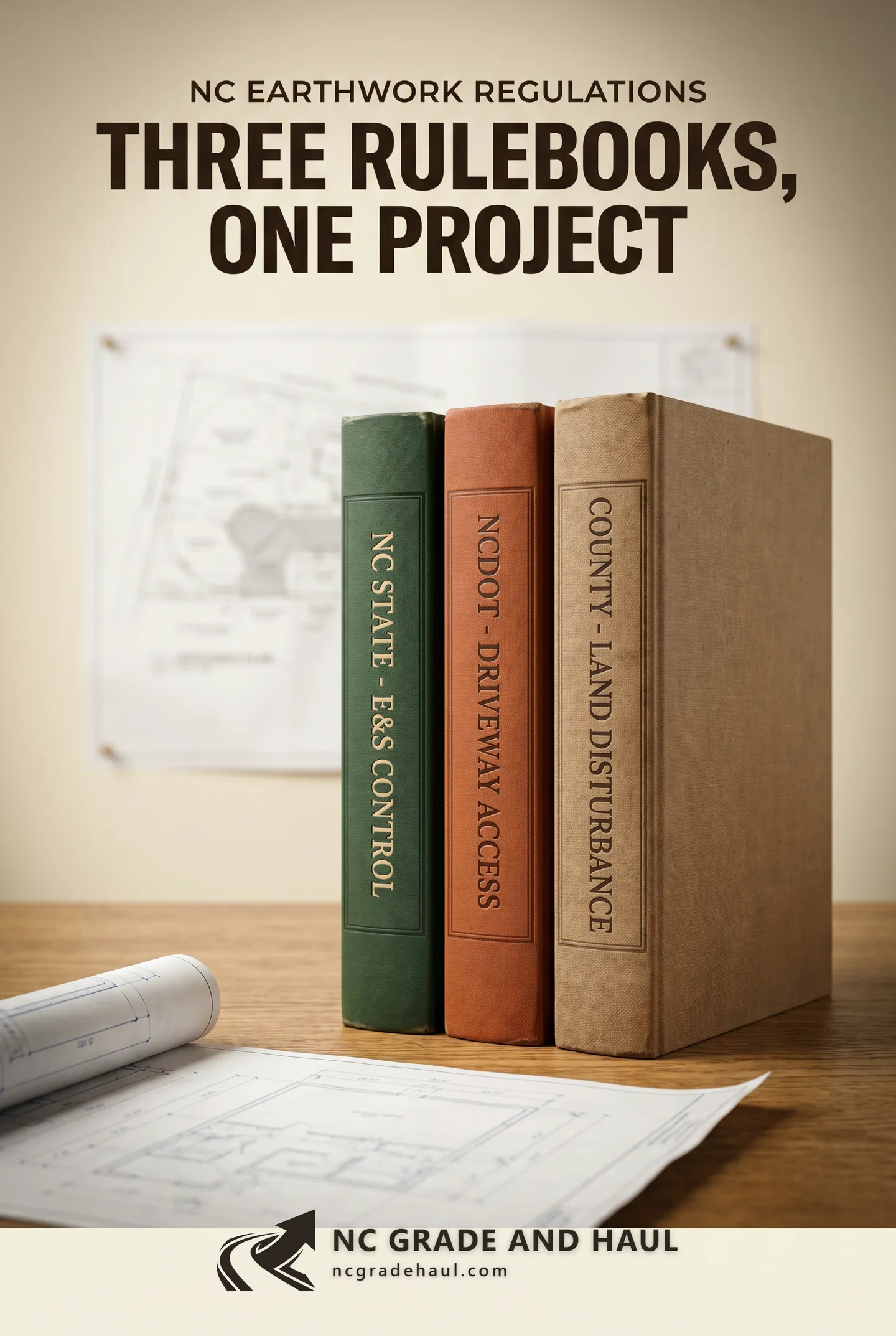
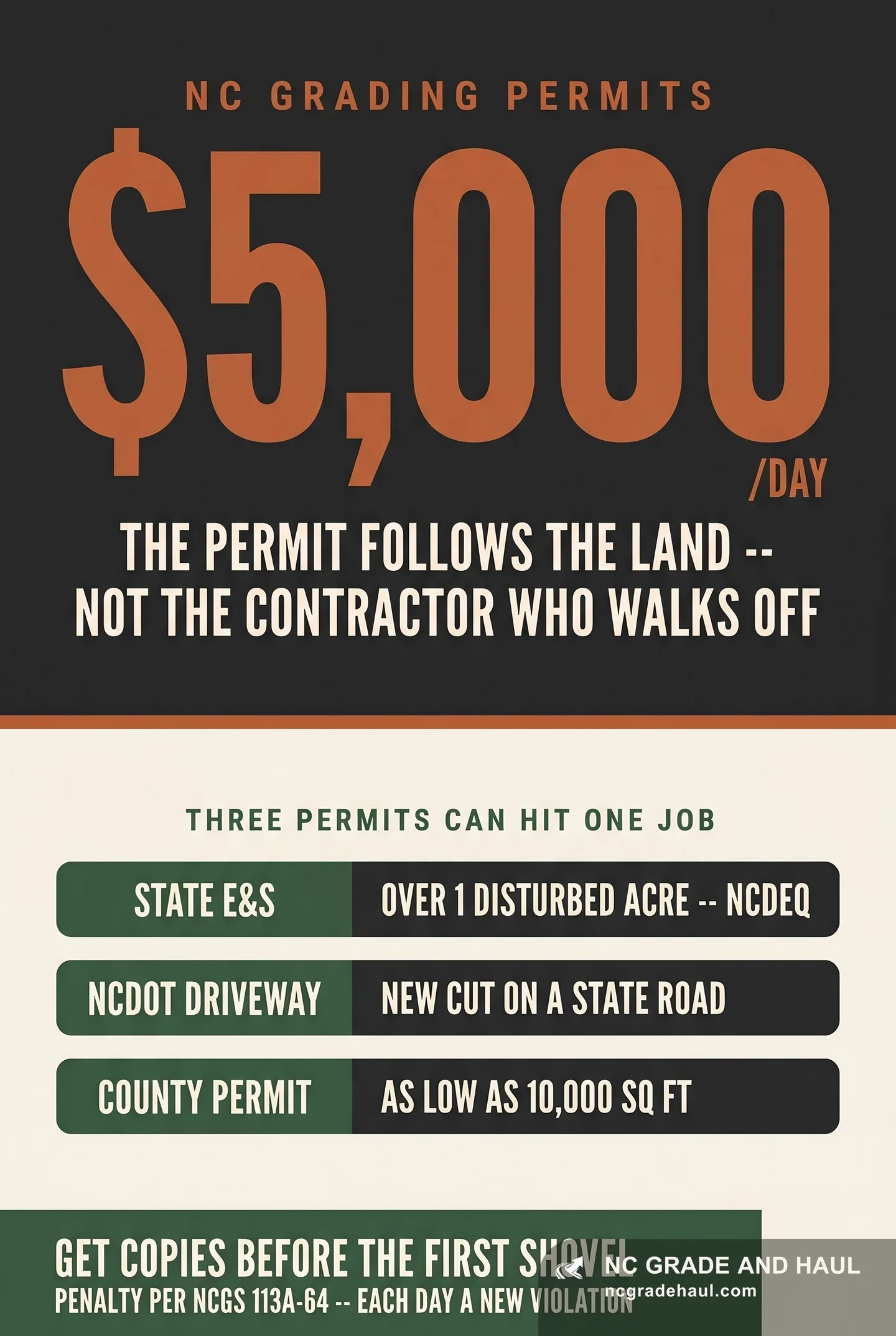
The Three NC Regulatory Systems That Affect Grading Work
NC earthwork sits under state rules, driveway rules, and county-level disturbance permits — and they can all apply to the same project.
This is the part nobody explains at the quote stage.
| Regulatory Track | Governing Body | Trigger | Where to File |
|---|---|---|---|
| State E&S | / | More than 1 disturbed acre | AccessDEQ portal |
| NCDOT Driveway | NC Dept of Transportation | New connection to state-maintained road | connect.ncdot.gov (local NCDOT District office) |
| County Permit | County Planning / Engineering | Varies by county and municipality — confirm locally | County portal |
Verify all thresholds and portal URLs at source before filing — these rules update.
Three tracks. Each has a different agency, a different threshold, and a different filing system. Missing one doesn’t mean you’re covered by the others.
State E&S: The 1-Acre Trigger and What Comes With It
Any project that disturbs more than 1 acre on a tract in North Carolina requires a state Erosion and Sediment Control plan, filed and approved before work starts.
The exact statutory language sits in NCGS 113A-57(4): “No person shall initiate any land-disturbing activity that will disturb more than one acre on a tract unless, 30 or more days prior to initiating the activity, an erosion and sedimentation control plan for the activity is filed with the agency having jurisdiction and approved by the agency.” Note the trigger is more than one acre, and the plan must be filed at least 30 days ahead.
DEMLR — the Division of Energy, Mineral, and Land Resources — is the enforcement arm inside NCDEQ. They review E&S plans, issue Certificates of Coverage, and have stop-work authority when a site isn’t in compliance.
Here’s what the procedural sequence looks like:
E&S Application Sequence (per NCDEQ)
File electronic Notice of Intent (eNOI) through NCDEQ AccessDEQ -> Receive Certificate of Coverage before starting work -> File electronic Notice of Termination (eNOT) at project completion.
Source: deq.nc.gov
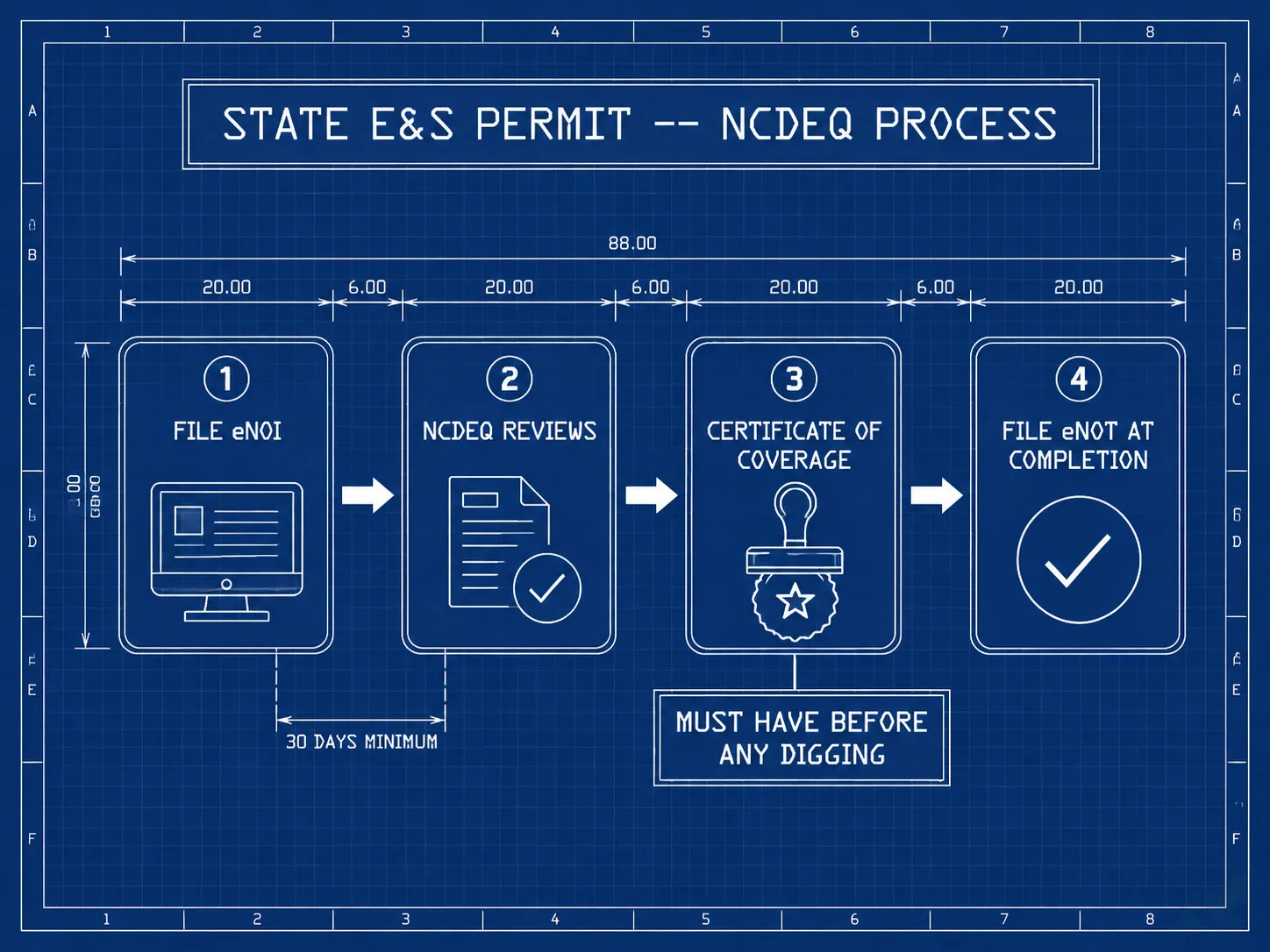
The Certificate of Coverage must be in hand before any land disturbance begins. That’s not a technicality — it’s a real enforcement point. A contractor who starts grading before the certificate arrives has opened you both to a stop-work order.
An E&S plan for a 1-acre-plus project typically requires: drainage patterns and flow directions, silt fence placement, sediment basin design, staging sequence, and a stabilization plan for when work pauses or completes. The plan is site-specific — a generic template won’t pass DEMLR review.
For the full breakdown of what an E&S plan requires and how it’s reviewed, see the NC Erosion and Sediment Control Act overview.
NCDOT: When Your Driveway or Haul Route Touches a State Road
Any new driveway connection to an NC-maintained road — and any hauling job that uses state roads at over-legal weight — requires NCDOT approval before work starts.
This catches people off guard. It’s not just subdivisions or commercial sites. A new gravel driveway that cuts a new curb onto an NC-maintained road needs a driveway permit (sometimes called an encroachment agreement) before a single shovel moves.
NCDOT driveway and encroachment forms are published at connect.ncdot.gov; applications are submitted to your local NCDOT District office. The standard Street and Driveway Access Permit carries a $50 construction inspection fee (check payable to NCDOT) — confirm the current fee with your District office, since fees can change.
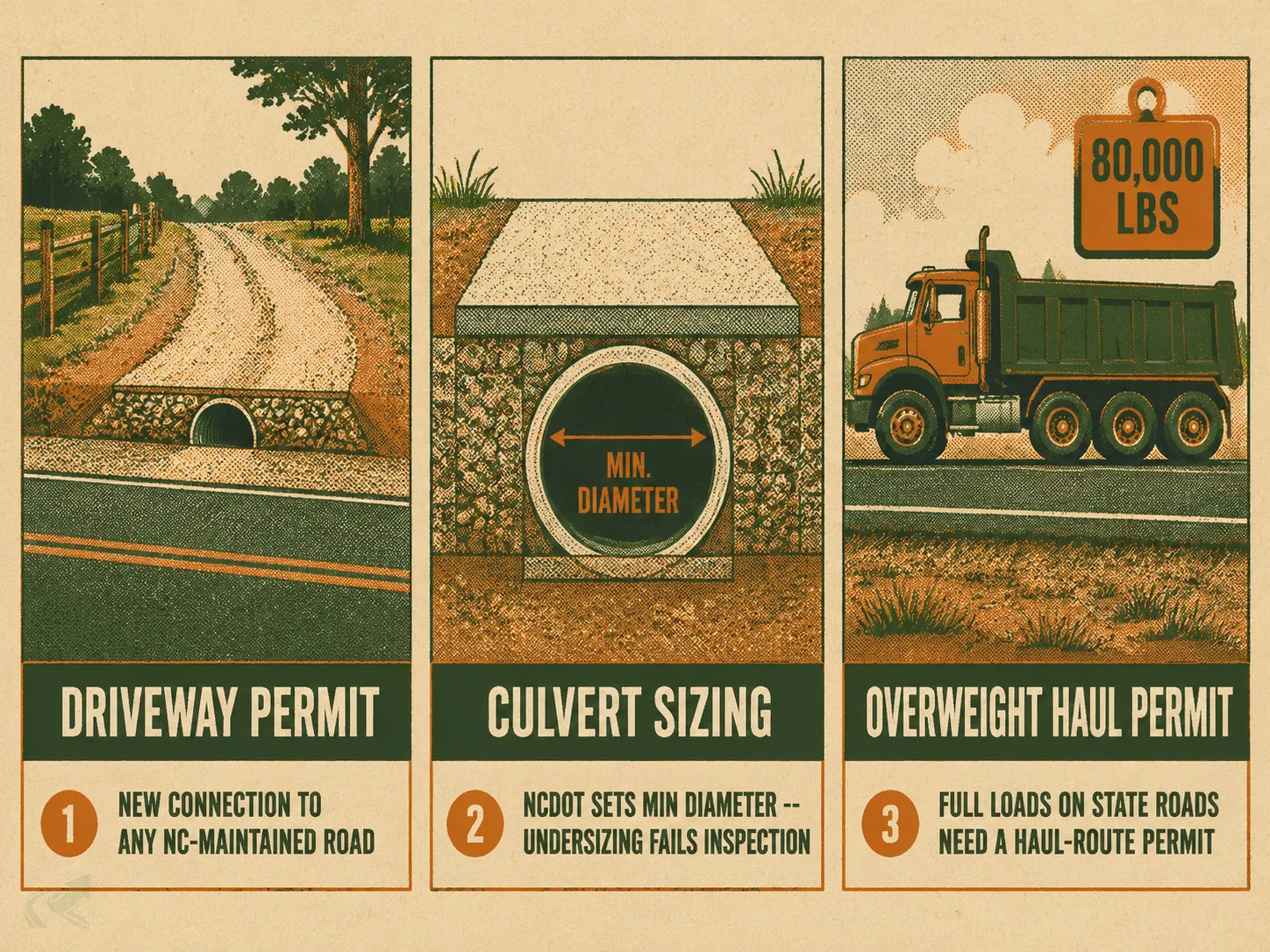
Three NCDOT requirements that apply to grading and hauling work:
- Driveway permit (encroachment agreement) — any new connection to a state-maintained road. Covers design, culvert sizing, and sight-line requirements. Filed through NCDOT Connect.
- Culvert sizing — NCDOT specifies minimum culvert diameter and installation specs for driveway crossings. Undersizing a culvert is a common reason for failed driveway inspections.
- Overweight haul-route permits — tri-axle trucks carrying full loads regularly exceed standard NC weight limits. If a contractor is hauling fill or stone across state roads at legal overweight, they need a haul-route permit. Ask for it upfront.
The NCDOT driveway and hauling regulations page covers the full encroachment process, culvert tables, and haul-route permit application steps.
County Permits: The Threshold Nobody Tells You About
Most NC counties require a grading or land-disturbance permit at thresholds well below the state’s 1-acre minimum — sometimes as low as 10,000 square feet.
Here’s what that means in practice: a project that clears 15,000 square feet of land — about 1/3 of an acre — won’t trigger the state E&S permit. But it will trigger county-level review in most urban and suburban counties in North Carolina.
Four counties as reference points — confirm current thresholds at each county’s planning or engineering portal before filing:
- Wake County — land-disturbance permit typically required for projects disturbing soil. Threshold and form at Wake’s planning portal.
- Mecklenburg County — land disturbance thresholds enforced by Charlotte-Mecklenburg Storm Water Services. Confirm current threshold before filing.
- Durham County — Unified Development Ordinance addresses land disturbance; check with Durham’s Engineering Department for current thresholds.
- Guilford County — thresholds vary; check with Guilford’s Planning and Development Department directly.
Thresholds shift with code updates. The working rule: if you’re disturbing any meaningful area of soil in an urban or suburban NC county, call the county planning office first. It’s a 10-minute call that can save a stop-work order.
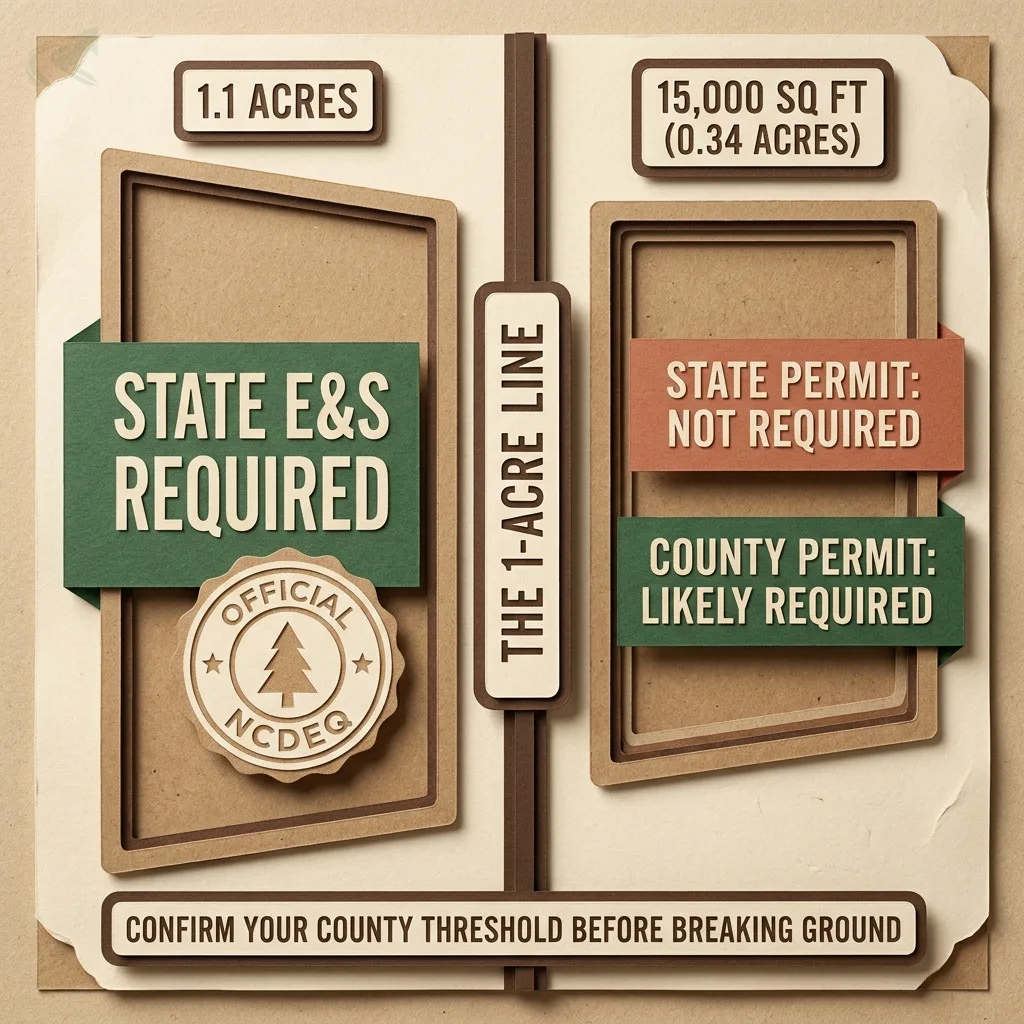
This section covers four counties. For the full matrix, see the NC county permit matrix.
NCDEQ AccessDEQ: Where You Actually File
Most North Carolina environmental permit applications — including E&S eNOI and eNOT filings — go through NCDEQ’s AccessDEQ portal.
AccessDEQ is the current portal name — it launched online Erosion and Sediment Control applications in November 2023 as part of DEQ’s Permitting Transformation Program. The landing page is deq.nc.gov/accessdeq, and the Erosion and Sediment Control application starts at deq.nc.gov/ESCforms.
AccessDEQ is where you create an account, start an eNOI application, upload your E&S plan, and receive your Certificate of Coverage. The same account handles eNOT filing at project close. You don’t need separate accounts for separate applications — one account per applicant.
Timeline from a complete eNOI submission to Certificate of Coverage varies. NCDEQ targets a review period; incomplete applications reset the clock. Common reasons for incomplete submissions: missing site plan, vague stabilization schedule, E&S plan not stamped where required.
For stormwater-specific filings and NPDES permit thresholds, the same AccessDEQ portal handles most of those too. See NC stormwater management ordinances for the stormwater layer in detail.
What Happens If You Skip a Permit
Working without a required permit can trigger stop-work orders, fines, and personal liability — and if the contractor pulled the permit in their name, they bear the enforcement exposure, not you. But if they walked off the job, the site is still yours.
DEMLR has stop-work authority for unpermitted sites that disturb 1 or more acres. A stop-work order freezes everything: no grading, no hauling, no earthwork. The site has to stabilize and a corrective E&S plan has to be submitted before work restarts.
Under NCGS 113A-64, the civil penalty for an E&S violation can reach $5,000 per day — and up to $10,000 for the first day of a violation. Each day a violation continues counts as a separate violation, so penalties accumulate while the problem persists. Confirm current figures at the source statute before relying on a specific number.
The liability split matters here. A contractor who pulls the permit in their name carries the enforcement exposure for the life of that permit. But property liability follows the land. If the job is abandoned, the erosion runs off your property, and DEMLR shows up — the enforcement conversation starts with the property owner.
Know what’s been filed before work starts. Ask for copies of the eNOI and Certificate of Coverage in writing.
NC grading site: properly permitted vs unpermitted
Comparison. Permitted and covered: eNOI filed, Certificate of Coverage in hand before digging; Certificate of Coverage posted on-site; Silt fence installed before any land disturbance; Positive drainage established, runoff controlled. Unpermitted and exposed: No Certificate of Coverage -- work started anyway; Stop-work order posted, all earthwork frozen; Exposed soil running straight to the storm drain; Civil penalty up to $5,000 per day under NCGS 113A-64.
- eNOI filed, Certificate of Coverage in hand before digging
- Certificate of Coverage posted on-site
- Silt fence installed before any land disturbance
- Positive drainage established, runoff controlled
- No Certificate of Coverage -- work started anyway
- Stop-work order posted, all earthwork frozen
- Exposed soil running straight to the storm drain
- Civil penalty up to $5,000 per day under NCGS 113A-64
Permit liability follows the land -- if the contractor walks off, the enforcement conversation starts with the property owner.
Common Mistakes
- Assuming county permits don’t exist. Most NC counties have their own land-disturbance threshold. Getting the state E&S permit and skipping county review doesn’t mean the project is fully permitted — it means the county hasn’t caught it yet.
- Filing eNOI after work starts. The Certificate of Coverage must be in hand before any land disturbance begins. Retroactive filing doesn’t protect you from a stop-work order — it just documents the violation date.
- Treating the permit as the contractor’s problem. Permit liability can follow the property. Know what’s been pulled, by whom, and what the certificate number is before a machine touches your land.
How to Check Which Permits Apply to Your Project
Start with three questions: Is your project disturbing 1 or more acres? Is it touching an NC-maintained road? What does your county require?
The decision path looks like this:
- Project footprint — estimate total disturbed area (grading zone, staging area, access route). If it’s over 1 acre, state E&S applies. If it’s under, county may still apply.
- Road connection — is there a new driveway cut or connection to a state-maintained road? If yes, NCDOT driveway permit is required regardless of project size.
- County threshold — call or check online for your county’s land-disturbance threshold. Many counties post the permit application form on their planning department site.
When you get quotes, ask each contractor to itemize which permits they’re pulling, who is listed as the applicant, and when they expect to receive the Certificate of Coverage. A contractor who can’t answer those questions specifically is a contractor who hasn’t filed yet.
If you want someone who can walk through the permit sequence and tell you exactly what applies to your project before work starts, hire a grading operator in North Carolina who can produce an itemized quote with the permit list built in.
For the NC land-disturbance permit thresholds breakdown by county, and NC erosion control compliance for construction sites with silt fence and positive drainage requirements, those spokes cover those topics in full.