
How is a building pad prepared in NC?
What are the three phases of building pad preparation in NC?
Fill placement in lifts (typically 6-8 inch layers), compaction to spec -- 95% standard Proctor on most residential pads -- and proof-roll testing: a loaded roller or truck driven over the surface to find soft spots. In NC clay, if the fill goes down wet, the pad will not hold. Ask for the compaction test report before the concrete pours.
Why does NC red clay make pad prep harder than other states?
Piedmont clay has a narrow moisture window for compaction to work. Too wet and the roller just pumps the material -- it looks compacted but bearing capacity is not there. Too dry and the clay does not bind. Experienced crews time lifts around the forecast and test moisture content before each pass.
The concrete pour is scheduled for Tuesday. The grading crew was on site last week. The pad looks flat. But “looks flat” and “is correctly prepared” are not the same thing — and once the concrete cures, the difference is invisible.
North Carolina’s Piedmont clay makes this worse than most states. A pad built on wet fill can look perfect at pour time and fail years later when the footing settles. This page maps what pad preparation actually involves, what the test methods are, and what you can ask for before the concrete truck arrives.
Fill Placement in Lifts
Fill does not go down all at once. It goes in layers — typically 6 to 8 inches at a time — and each layer gets compacted before the next one goes down.
The lift thickness matters because compaction equipment only densifies material to a limited depth. A roller or plate compactor working on 18 inches of loose fill compacts the top few inches and leaves the bottom loose. Those loose lower inches become the soft zone that causes settlement later.
Standard practice in North Carolina for residential pads: 6-8 inch loose lifts, compacted before the next lift. For deeper fills — common on sloped lots in the Piedmont — the number of lifts stacks up fast. A 3-foot fill requires four or five lift-and-compact cycles, not one pass.
In NC red clay, the moisture content of each lift determines whether compaction actually works. Wet clay placed in lifts will not reach the required density no matter how many passes the roller makes.
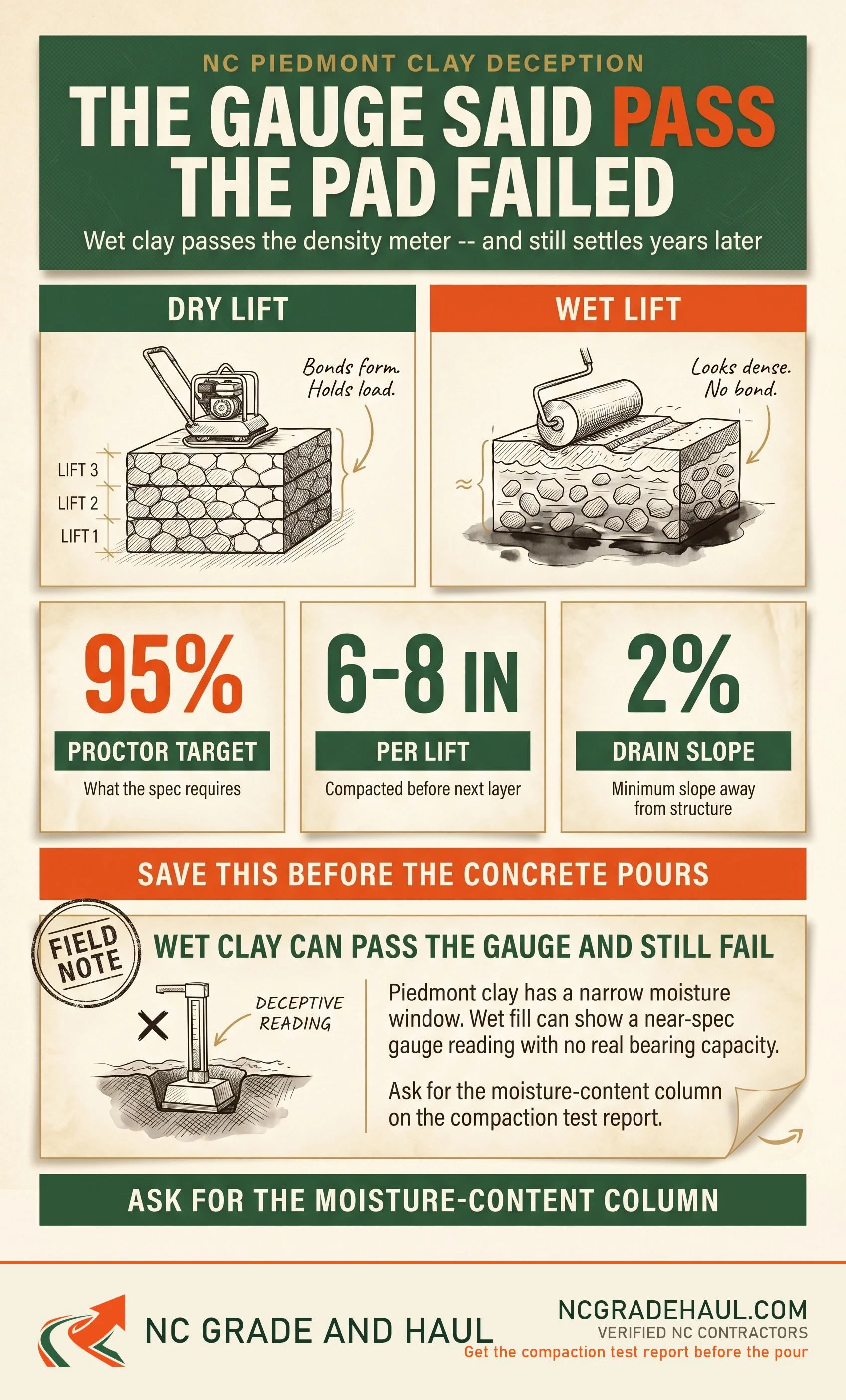
A pad built on dry lifts vs one built on wet clay
Comparison. Built on dry lifts: Each 6-8 inch lift placed at optimal moisture; Uniform lifts compacted and density-tested point by point; Proof-roll surface holds with no rutting; Pad slopes for positive drainage away from the structure. Built on wet clay: Wet lift placed over a saturated subgrade; Roller pumps the material -- looks dense, isn't; Soft zone left at the footing perimeter where load concentrates; Pad settles years later, after the concrete has cured.
- Each 6-8 inch lift placed at optimal moisture
- Uniform lifts compacted and density-tested point by point
- Proof-roll surface holds with no rutting
- Pad slopes for positive drainage away from the structure
- Wet lift placed over a saturated subgrade
- Roller pumps the material -- looks dense, isn't
- Soft zone left at the footing perimeter where load concentrates
- Pad settles years later, after the concrete has cured
Piedmont clay has a narrow compaction window -- wet clay can pass a density gauge and still lack bearing capacity. Ask for the moisture-content column on the test report.
Compaction to Specification
The target for most North Carolina residential pads is 95% standard Proctor — a density specification, not a visual standard.
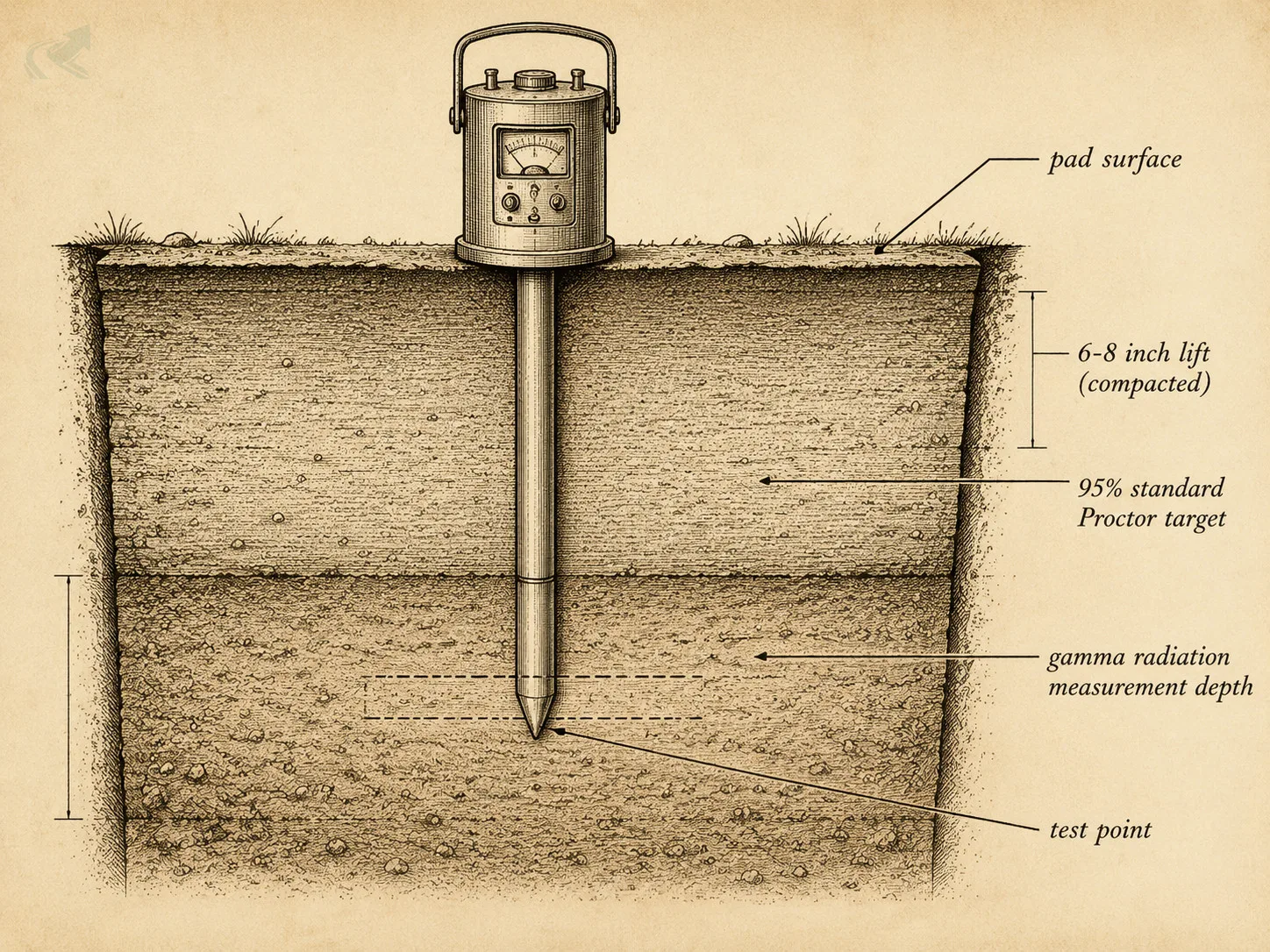
defines the benchmark. A testing lab takes a sample of the fill material, compresses it under controlled conditions at multiple moisture levels, and produces a density-moisture curve. The peak of that curve is 100% standard Proctor. Field compaction targets 95% of that number.
In practice, a geotechnical technician drives to the site with a nuclear density gauge — a device that measures in-place density by emitting gamma radiation into the soil and measuring backscatter. The technician records the result at each test point and produces a compaction test report.
That report matters. It lists:
- Test point locations (where on the pad each reading was taken)
- Compaction percentage at each point (95% or above = passes; below = more compaction passes or rework)
- Moisture content at the time of testing
- Technician name and credentials
If your builder cannot produce the compaction test report, you do not know whether the pad was actually compacted to spec. You know it looked flat when the crew left.
Copy this and send it to your builder:
“Can you provide the compaction test report for the pad? I need the test point locations, the compaction percentage at each point, and the tester’s name and credentials.”
Proof-Roll Testing
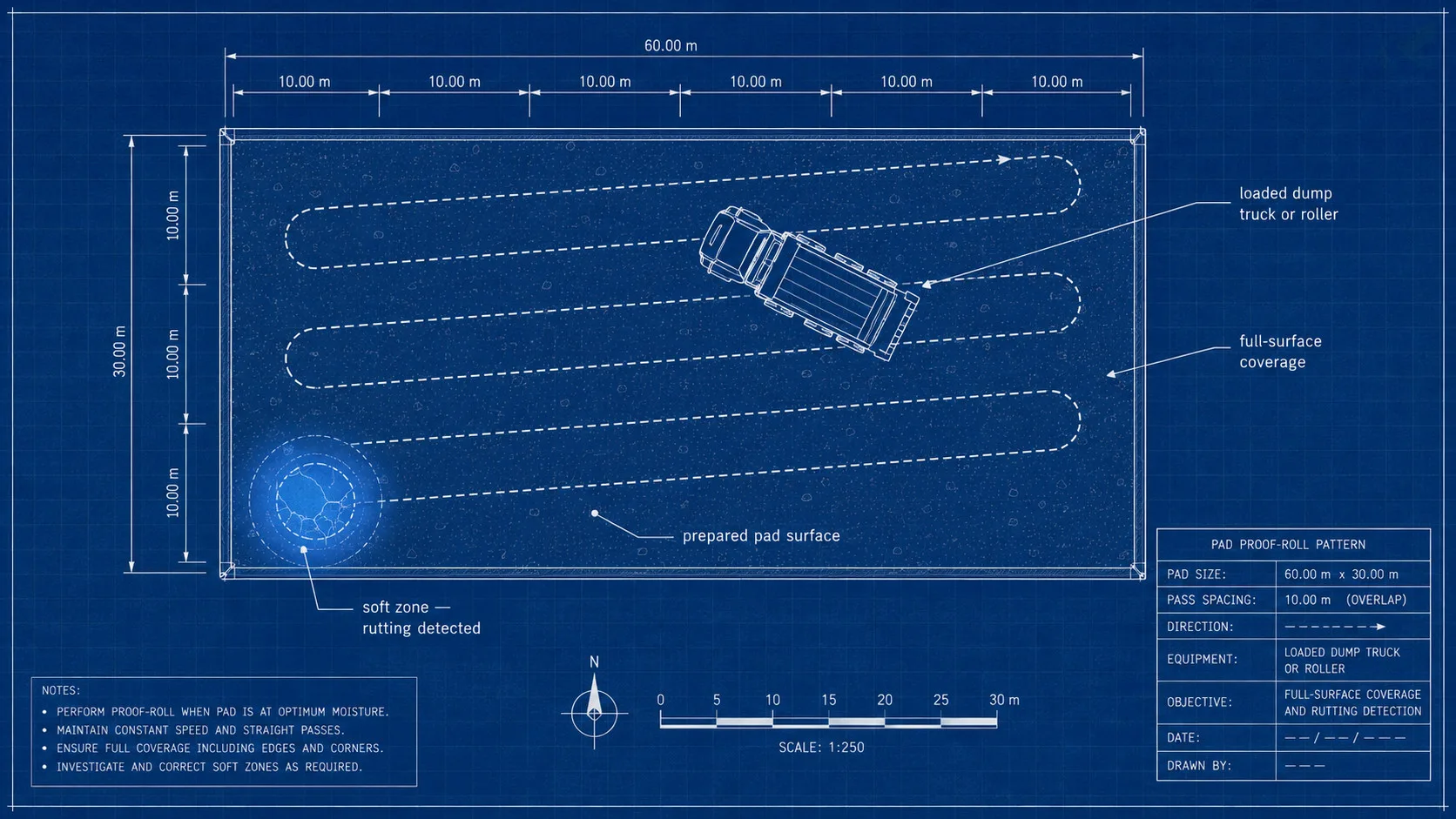
Proof-rolling is a loaded vehicle — typically a heavily loaded dump truck or roller — driven slowly over the prepared pad surface to identify soft spots that passed the density gauge but still have inadequate bearing capacity.
The logic: a nuclear density gauge takes spot readings at specific test points. Proof-rolling is a full-surface check. If any zone of the pad pumps or ruts when the loaded truck drives over it, that zone is soft — regardless of what the gauge said nearby.
In commercial construction in North Carolina, proof-rolling is standard before any concrete placement. On residential pads, it depends on the project. Custom home builders with a geotechnical engineer of record typically require it. Production builders on sites with good native subgrade may skip it and rely on density testing alone.
Whether proof-rolling happened is worth asking before the pour. If it was required by the project’s geotechnical report and the crew skipped it, that is a documentation gap — and a builder accountability question that your NC builder accountability checklist covers in detail.
NC Clay Moisture Management
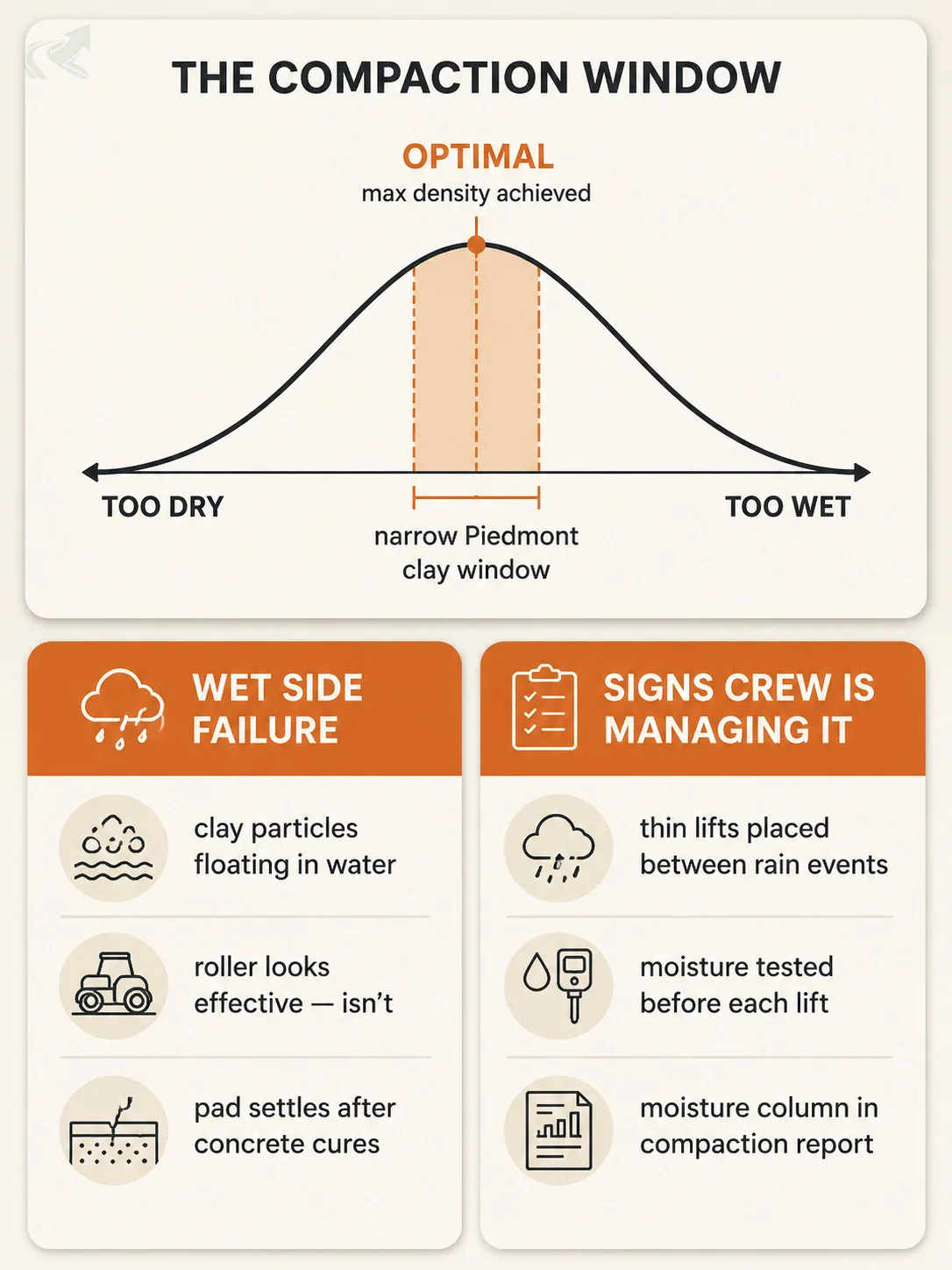
Piedmont clay has a compaction window. Hit it and the pad reaches spec in a few passes. Miss it — wet or dry — and more roller passes do not fix it.
North Carolina’s red clay behaves differently from sandy fill material. Clay particles bond when moisture is at the right level — not too low, not too high. Standard Proctor testing defines that optimal moisture content for each specific soil. Field crews test moisture on site before each lift goes down.
The wet side of the curve is where most NC pad failures happen. A clay lift placed wet — either because recent rain soaked the subgrade, or because the delivered fill was too wet — can roll out smooth, hold a density gauge reading that looks close, and still have inadequate bearing capacity. The clay particles are not properly bonded; they are floating in water. When the water eventually drains and the clay consolidates, the pad settles.
Signs a crew is managing moisture correctly:
- Lifts are thin and placed between rain events, not immediately after
- The crew is checking forecast timing before scheduling fill placement
- Test results come back with moisture content recorded alongside density
Signs they may not be:
- Fill placement proceeded immediately after heavy rain
- Compaction passes are piling up without reaching spec (more than 5-6 passes on a single lift is often a sign the material is too wet or too dry)
- No moisture content column in the compaction report
For more on using NC red clay as pad fill — when it is appropriate structural fill and when screened, spec’d fill is a better choice — the fill dirt hauling section covers that in detail.
What a Completed Pad Should Look Like
A correctly prepared NC building pad has four visible characteristics: uniform surface without soft zones, positive drainage slope away from the structure, no standing water at the perimeter, and consistent color indicating uniform moisture.
Before the pour, walk the perimeter. Here is what to look for:
- Surface consistency. Step across the pad. It should feel firm underfoot across the full surface — no bouncy or spongy zones, no areas where your foot sinks. Soft spots at the perimeter (near the footing edges) are especially concerning because that is where structural load concentrates.
- Drainage slope. The pad surface should slope away from the building footprint — typically 2% or more. Standing water on a prepared pad before the pour is a sign the drainage grade is wrong or the surface is not properly crowned.
- Perimeter condition. The pad edges where footings will sit should look the same as the interior. A common failure pattern: the center compacts well but the perimeter was never fully rolled because the equipment operator stayed away from the edges. A loaded truck proof-roll catches this; spotty density testing may not.
- Color uniformity. NC red clay that has been properly compacted has a relatively consistent rust-to-tan color. Dark wet zones or light bleached areas in a random pattern suggest uneven moisture — and possibly uneven compaction — across the surface.
This is what you are looking for before you agree that the pad is ready for concrete. For proof-rolling and compaction details for building pads, the compaction spoke covers the technical specs at deeper depth.
Related Pages in This Cluster
This hub explains what pad preparation involves. The spoke pages cover specific situations.
- New home pad grading in NC — If you are building a new home, this spoke maps what the grading crew does before your foundation goes in, how to read the grade stake markings, and what the builder is responsible for documenting. Different audience than this hub: you want to verify your specific pad, not understand the general process.
- How pad prep works for a home addition — Adding a room, garage, or accessory structure to an existing NC property involves pad prep for the addition footprint — but the surrounding grade and drainage are already set. This spoke covers the addition-specific challenges: matching the existing pad elevation, managing drainage at the tie-in, and what a separate addition pad needs in terms of compaction documentation.
Both spokes link back here for the foundational fill-compaction-proof-roll sequence.
Find a Verified NC Grading Contractor
If you need a contractor who can document pad preparation correctly — compaction test report, proof-roll if required, lift log — the NC Grade and Haul directory lists verified North Carolina grading contractors by region.
Every contractor listed has been cross-referenced against the NC Licensing Board for General Contractors, OSHA records, and workers’ compensation filings. Listings show the verification tier and the underlying source data — so you can see what was checked, not just a badge.
Pad preparation is a quality-of-execution problem as much as a materials problem. The crew’s judgment on moisture timing, lift thickness, and whether to call a stop when conditions are wrong is what separates a pad that settles from one that holds for 30 years. An itemized quote from a contractor who includes compaction testing as a line item — not an afterthought — is what to look for.
Find a grading operator in North Carolina and ask for the compaction test protocol before you sign.