
Can I use NC red clay as fill dirt?
Can I use NC red clay as fill dirt?
Yes -- when the clay is at or near optimum Proctor moisture content and the application calls for structural fill that will be compacted in 6-to-8-inch lifts away from utilities and structures. On-site clay avoids haul costs and performs well when moisture conditions qualify.
When should I import fill instead of using on-site red clay?
When the clay is saturated from recent rain, when the fill depth is too deep to manage moisture uniformly, when the application is near utilities or a building foundation requiring screened material, or when an engineered building pad design specifies imported material. Import when the clay does not qualify -- do not force it.
The Dual Nature of NC Red Clay
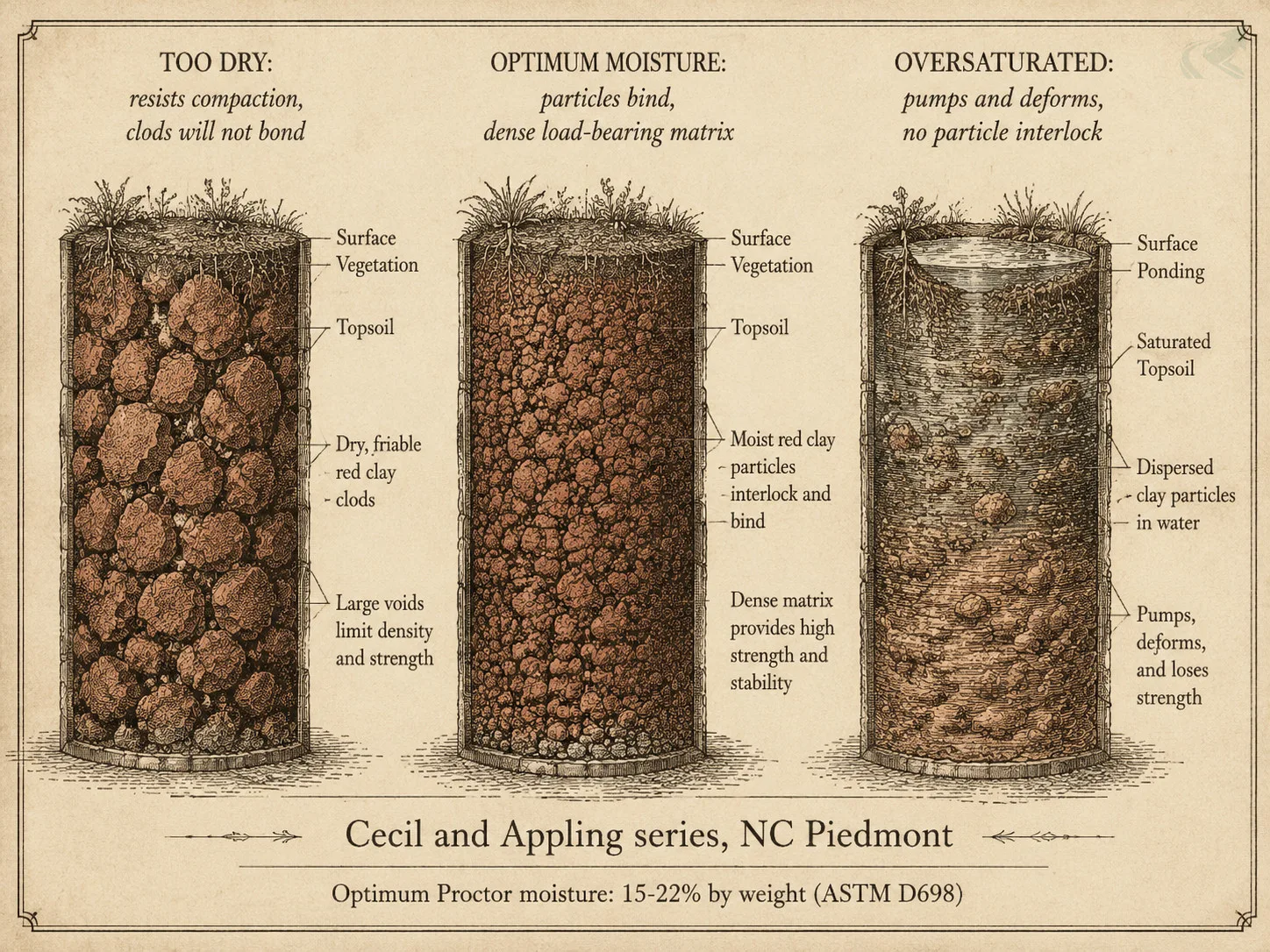
NC Piedmont red clay behaves like two different soils depending on moisture — stable and workable at the right moisture, slippery when wet, cement-hard when dry.
This three-state behavior is the central fact about using NC red clay as fill. Sandy soils have a wide workable range — they drain fast and are relatively forgiving of moisture variation. NC Piedmont clay has a narrow window.
At optimum moisture content, the clay particles bind to each other under compaction and form a dense, load-bearing matrix. This is the state where on-site red clay performs well as structural fill.
Too wet, the clay saturates and the particles lose friction. Equipment compacting oversaturated clay does not achieve density — it pumps and deforms instead. The fill looks placed, but no real compaction occurred.
Too dry, NC red clay hardens like low-grade concrete. It resists compaction equipment, sits in clods that will not bond, and can crack under load as the surrounding soil dries and contracts around the fill mass.
The NC red clay dual-nature slippery wet concrete dry reference covers the mineralogy behind this behavior. The practical consequence: before any clay fill placement, the moisture question comes first.
When On-Site Red Clay Works as Fill
On-site NC red clay can work as fill when it is at or near optimum moisture, placed in 6-to-8-inch compacted lifts, and used in a structural application away from utilities and foundations.
Ray Pettiford’s situation — excavated red clay from a dig on the same property — is a reasonable candidate. The material is already on site and haul cost is eliminated. Whether it qualifies depends on two things: current moisture and application type.
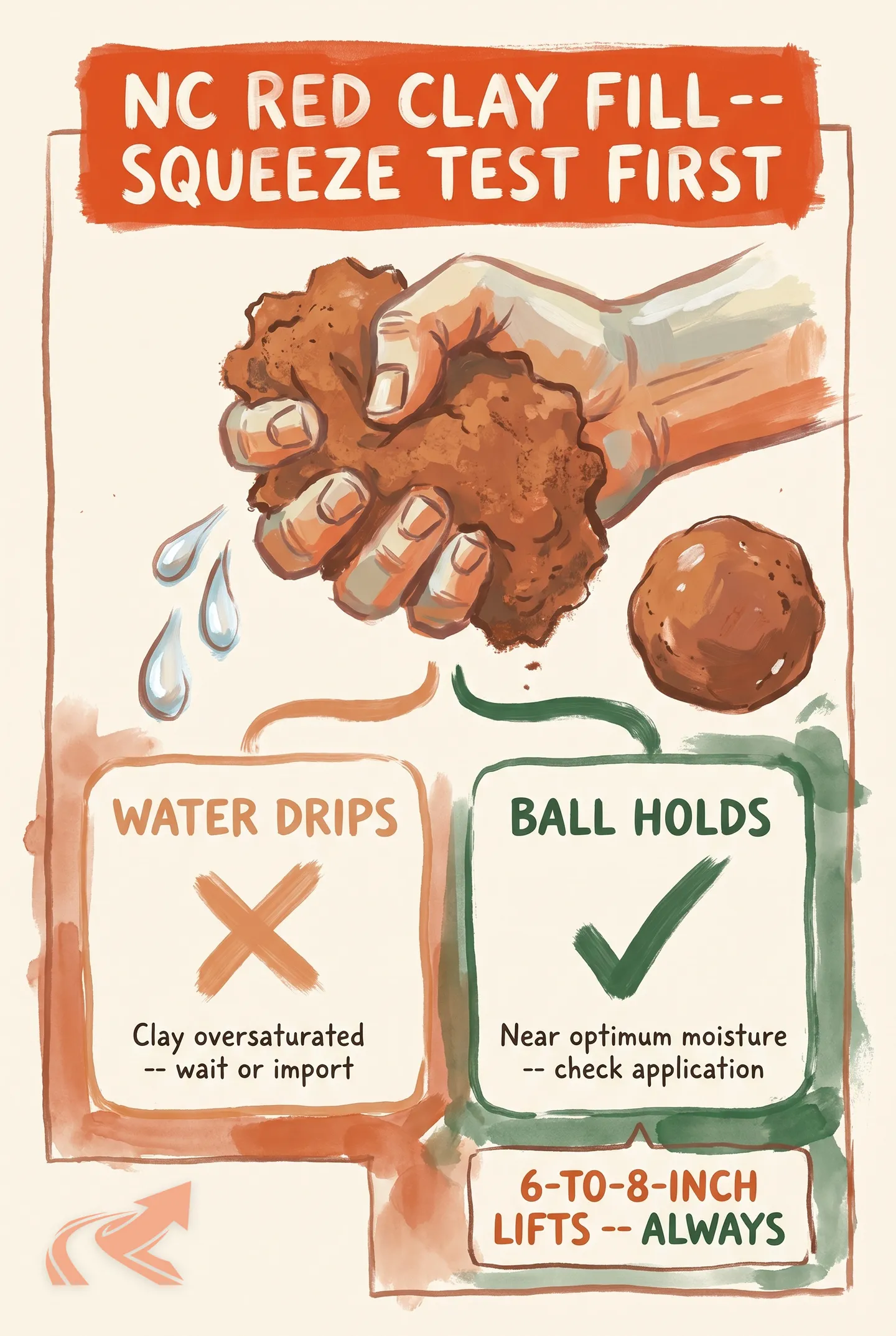
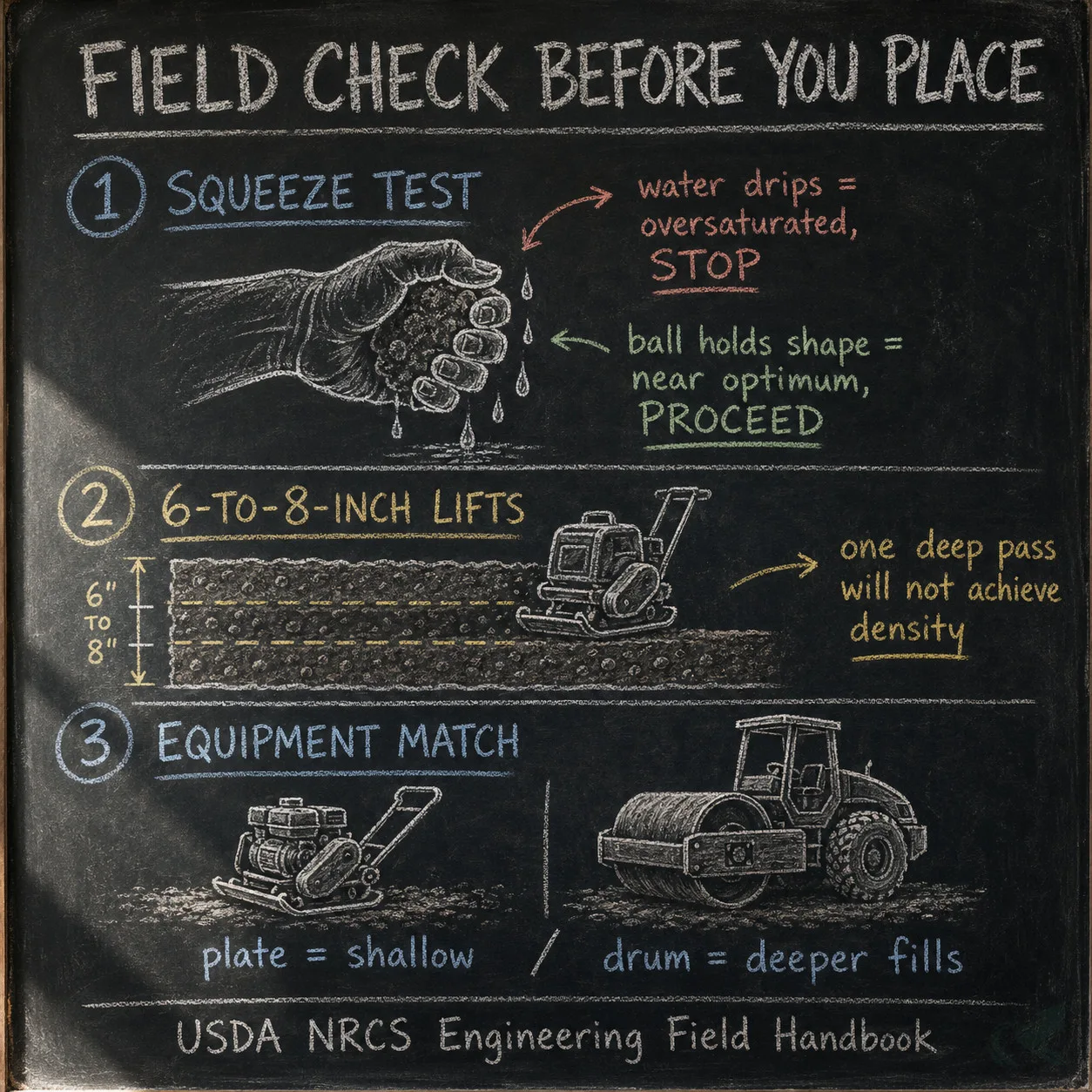
Field moisture check — the squeeze test. Take a handful of clay and squeeze firmly. If water drips out, it is oversaturated — do not place it. If the handful crumbles and will not form a ball, it is too dry — compaction will be poor. If it forms a ball that holds shape without weeping, the clay is near optimum moisture. This is a field screen, not an engineering test, but it reliably catches the failure cases.
Lift height matters. Clay fill compacted in one deep pass will not achieve uniform density. Six-to-eight-inch lifts with a compactor pass between each lift is the standard. Thin lifts allow the machine to work through the full depth of each layer before the next is added.
Equipment matters. A plate compactor is sufficient for shallow fills. A vibratory drum roller achieves better density on deeper clay fills. A jumping jack compactor works well on confined areas like around footings — but keep clay fill a safe distance from foundation walls (more on that below).
When to Import Fill Instead
Import fill when the on-site clay is too wet to qualify, when the fill depth or application requires screened material, or when time pressure makes moisture management impractical.
The most common case: heavy rain in the days before a planned fill operation. NC Piedmont clay retains moisture. A day after a two-inch rain, the clay pile is likely oversaturated and will not qualify under the squeeze test. Waiting for it to dry to optimum — especially in fall or spring — may mean a week or more of delay.
Import fill makes sense in four situations:
- Recent rain, oversaturated clay. Placing wet clay fill and compacting it does not produce a stable fill. The clay will settle as it dries and the trapped moisture works out. Import screened fill now and skip the remediation cost later.
- Deep fills requiring sustained moisture management. A 3-foot fill on a large pad means managing moisture uniformly across a large clay volume. That is difficult without controlled conditions. Screened structural fill with better drainage characteristics is more predictable.
- Near utilities or building structures. Clay fill near water lines, drain pipes, or building foundation walls creates risk. As the clay dries over time, it shrinks and can crack alongside foundation walls, creating drainage pathways directly toward the structure. Screened or select fill is the standard specification in these zones.
- Engineered building pad. If a geotechnical engineer has specified imported fill for a pad preparation project, follow the spec. On-site clay as a substitution on an engineered design is not a decision to make unilaterally. See red clay fill for building pad preparation in NC for more detail.
The Import-vs-On-Site Decision Framework
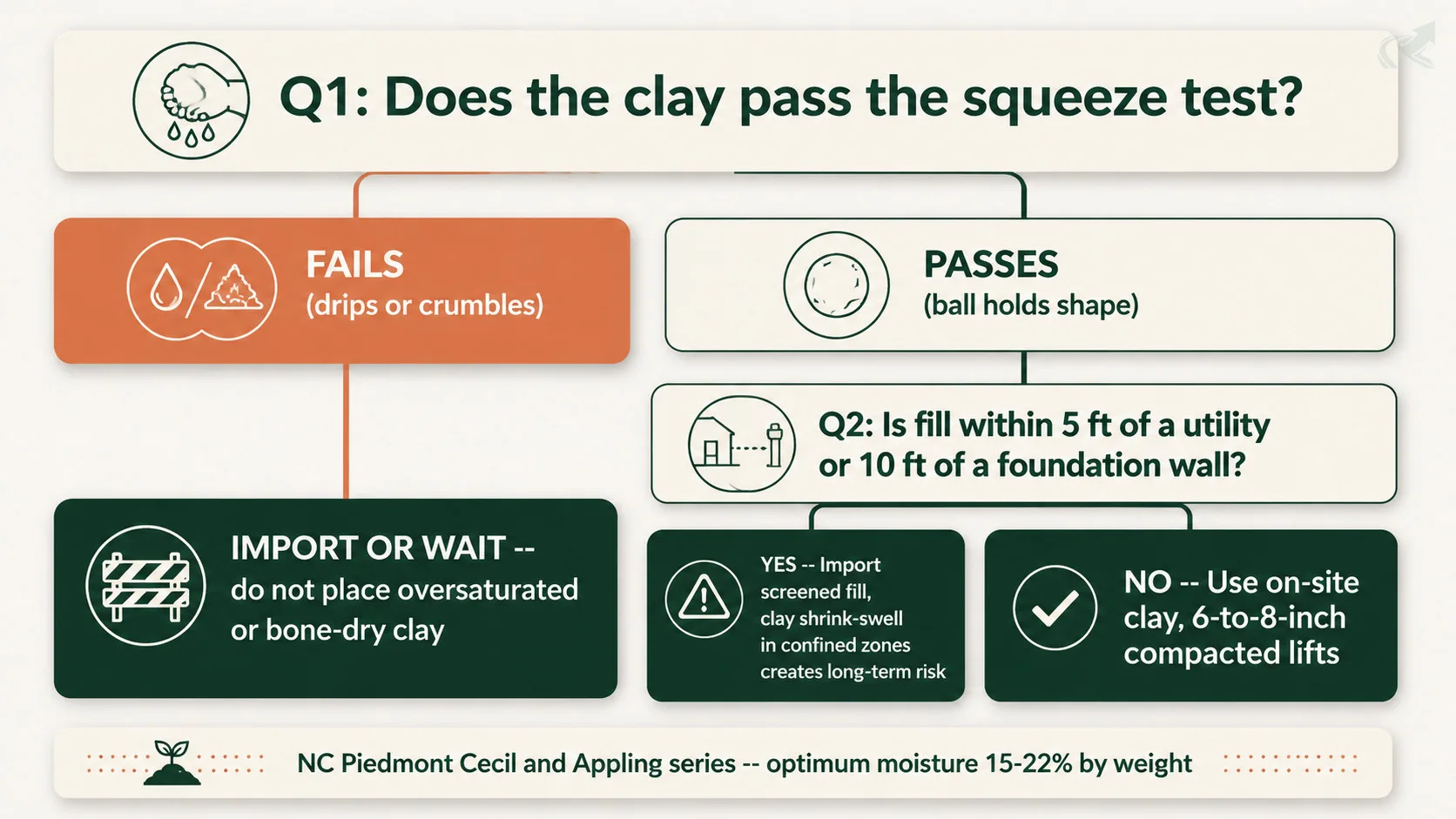
Two questions determine whether on-site NC red clay qualifies as fill. Answer them in order before any material is placed.
This is the framework. It is not complicated, but skipping either question produces the most common NC clay fill failures.
Question 1: Is the clay currently at or near optimum moisture?
Run the squeeze test. If water drips, stop — the clay is oversaturated. If the clay will not form a ball at all, it is too dry for good compaction (though dry clay is less common as a fill-placement problem). If the ball holds shape without weeping, proceed to question 2.
Question 2: Does the application require screened material?
If the fill zone is within 5 feet of a utility line, within 10 feet of a foundation wall, or under an engineered building pad specification, screened or select fill is the correct material regardless of clay moisture. Red clay shrink-swell behavior in confined zones creates long-term risk.
Decision matrix:
| Q1 moisture | Q2 screened required | Call |
|---|---|---|
| Passes squeeze test | No | Use on-site clay |
| Passes squeeze test | Yes | Import screened fill |
| Oversaturated | Either | Import or wait |
| Too dry | No | Break up clods, retest; consider importing |
If you cannot clearly answer either question for your site, get an itemized quote that names the fill material spec. A North Carolina grading contractor calibrated for Piedmont clay will have a position on this before the machine starts.
NC Clay Fill Failure Cases
The most common NC red clay fill failure: clay placed too wet, compacted with equipment that achieves no real density, then dried and settled — sometimes with surface cracking.
This failure is invisible during and immediately after placement. Wet clay under a drum roller looks compacted. The surface firms up. The fill looks done.
What actually happened: the compaction equipment displaced and deformed oversaturated clay rather than densifying it. No interlocking of clay particles occurred. As the fill mass dries over the following weeks and months, it shrinks unevenly and settles. Surface cracks appear where the clay pulled apart during dry-out.
The second common failure: dry fill applied too deep in a single lift. A 24-inch clay fill placed in one pass compacts at the surface but leaves the lower portion loose. Traffic or structure load then causes differential settlement — one area settles, the adjacent area does not, and the grade shifts.
The third failure: clay fill placed directly against a foundation wall. As the clay dries and contracts, the shrinkage gap alongside the wall becomes a drainage pathway. Water runs down the wall face where the clay pulled away from the concrete. Foundation drainage problems that appear 2-3 years after construction often trace to clay fill placed in direct contact with the wall. If this happened on your site, see the builder dispute checklist when red clay fill causes problems.
NC red clay fill placed right vs placed too wet
Comparison. Clay fill that holds: Clay placed at its optimum moisture content; Built up in 6-to-8-inch compacted lifts; Compaction equipment achieves real density; Stable mass with no shrinkage gaps. Wet-clay fill failure: Saturated clay -- the roller deforms it, not densifies it; Surface firms up but no particle interlock occurs; Fill shrinks unevenly and settles as it dries; Surface cracking shows up weeks to months later.
- Clay placed at its optimum moisture content
- Built up in 6-to-8-inch compacted lifts
- Compaction equipment achieves real density
- Stable mass with no shrinkage gaps
- Saturated clay -- the roller deforms it, not densifies it
- Surface firms up but no particle interlock occurs
- Fill shrinks unevenly and settles as it dries
- Surface cracking shows up weeks to months later
Wet clay under a drum roller looks compacted -- the failure is invisible until the fill dries and settles.
Common mistakes to avoid with NC red clay fill:
- Placing red clay fill immediately after rain. Oversaturated clay will not compact — it pumps and deforms under equipment. Run the squeeze test first. Wait for the clay to dry if it fails.
- Deep fills without lift management. A 3-foot clay fill done in one pass will not compact uniformly. Six-to-eight-inch compacted lifts are required throughout.
- Using wet clay fill near a building foundation. As the clay dries, it shrinks and can crack alongside foundation walls, creating drainage pathways directly toward the structure.
Working with a Grading Contractor on Clay Fill
For projects where clay fill conditions are borderline, a verified North Carolina grading contractor can assess moisture and specify the right material before placement begins — not after.
The decision to use on-site clay vs import fill costs nothing to get right before the first bucket-load is placed. It costs real money to remediate after wet clay fill has settled.
When getting a quote, ask the contractor to state:
- What moisture test or field assessment they will run before placing on-site clay
- What lift height and compactor specification applies to the fill zone
- Whether the fill location near any utilities, drainage features, or the building perimeter changes the material spec
A contractor who can answer all three with specifics is calibrated for NC Piedmont conditions. One who defaults to “we’ll use what’s on site” without a moisture check is skipping the step that determines whether that call is correct.
Hire a verified NC grading and hauling contractor through NCGH’s directory. Every listing includes the contractor’s NCLBGC license number for direct verification with the state board.
For more on what qualifies as NC fill dirt — including red clay options alongside screened and select fill — see NC fill dirt including red clay options.