
Six months after a driveway regrading, soft spots appear in the tire tracks. The contractor says the clay was too wet when they graded. But that’s not the real issue.
The real issue is the base was never compacted to bearing capacity. And once gravel is down, you can’t prove it was skipped.
Proof-rolling is the field test that catches this before it’s buried. It’s also the single question that separates contractors who understand compaction from ones who don’t. This page gives you that question — and the vocabulary to recognize an honest answer.
What Proof-Roll Actually Means
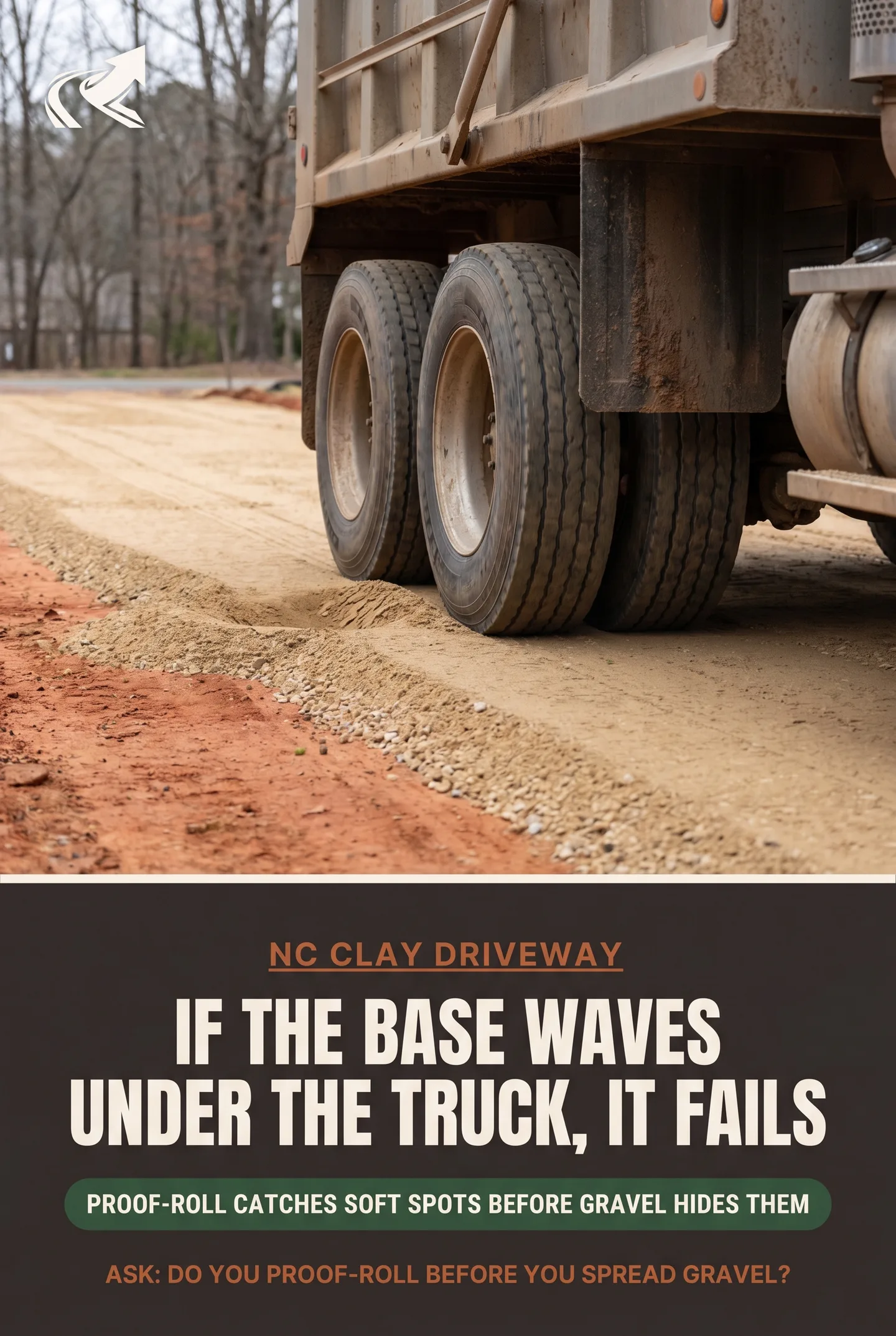
Proof-rolling means driving a loaded dump truck across the graded base and watching for deflection — visible sag or pumping means the base needs more compaction before gravel goes down.
Here’s how it works. A fully loaded dump truck — typically carrying 80,000+ lb — makes slow passes across the freshly graded base. The operator watches the surface for deflection, pumping (heave around the tire), or wave-like movement ahead of the wheel. Any of those signals: stop, compact more, run the truck again.
Standing at the edge of the driveway, you can watch this too. If the graded surface bounces or waves when the truck crosses, it fails.
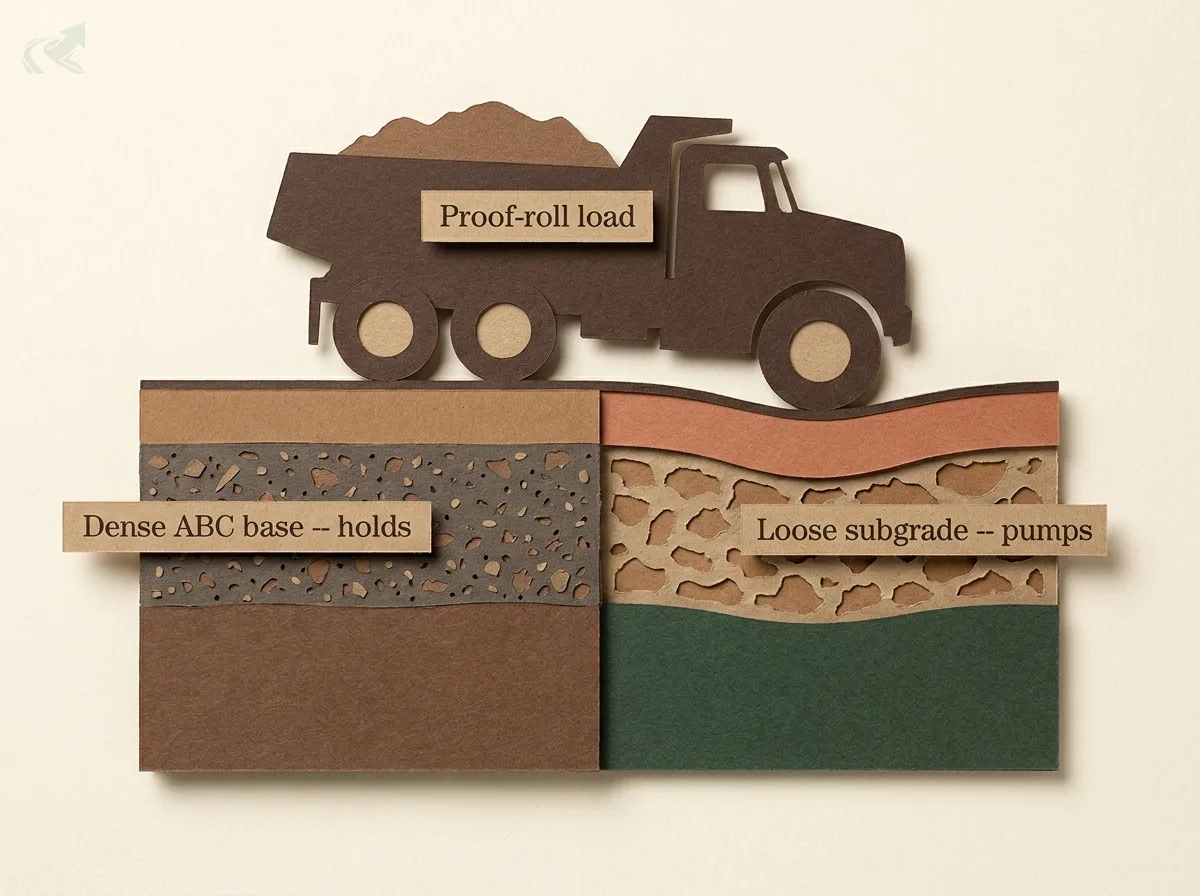
Driveway base under a proof-roll: compacted vs uncompacted
Comparison. Compacted right: Dense ABC base with tight particle contact; Loaded dump truck passes with no surface deflection; Base holds bearing capacity -- no soft spots to correct. Uncompacted: Loose clay base never densified to bearing capacity; Surface pumps and waves under the truck wheel; Soft spots become ruts and tire-track depressions in 6-18 months.
- Dense ABC base with tight particle contact
- Loaded dump truck passes with no surface deflection
- Base holds bearing capacity -- no soft spots to correct
- Loose clay base never densified to bearing capacity
- Surface pumps and waves under the truck wheel
- Soft spots become ruts and tire-track depressions in 6-18 months
The proof-roll catches a soft base before gravel buries it -- once it's covered, you can't prove the step was skipped.
What a nuclear density gauge adds. Some operators carry a nuclear density gauge — also called a Troxler gauge — that measures moisture and density in place. It gives a quantified reading (for example, 95% Proctor density) rather than a visual pass/fail. This is standard on subdivision road bases and NCDOT work. On residential North Carolina driveways, the visual proof-roll remains the more common field check — but asking whether your contractor carries one tells you a lot about their process.
The proof-roll is not a compaction method — it’s how operators test driveway compaction. That distinction matters when you’re evaluating quotes.
Why NC Clay Compaction Is Different from Sand
NC Piedmont red clay compacts in a narrow moisture window — too wet and you’re smearing it; too dry and you can’t develop density. Sand is forgiving; clay is not.
The reason comes down to soil physics. Clay particles develop binding strength at a specific moisture content — the “optimum” on what engineers call the Proctor curve. Compact below that optimum and the particles won’t lock together. Compact above it and you create a slick, saturated mat that re-saturates with the first rain and slowly loses bearing capacity under load.
Coastal North Carolina is a different situation. Sand-base driveways in Wilmington and the OBX region compact over a much wider moisture range because sand particles interlock mechanically regardless of moisture content. Contractors who work Piedmont clay know they’re operating in a narrower window — and they adjust accordingly.
The timing signal to watch for. If a contractor shows up to compact after rain, ask directly: “Is the clay at the right moisture for compaction today?” A competent operator will check — or delay until conditions are right. An inexperienced operator will compact regardless and tell you it’s fine.
What “too dry” looks like. In NC summer heat, the surface inch can crust dry while the clay an inch below is still wet. The crust feels solid underfoot but breaks under vehicle load. Clods that don’t break down under a roller are a visual tell that the surface is too dry to develop density at depth.
What Compaction Failure Looks Like
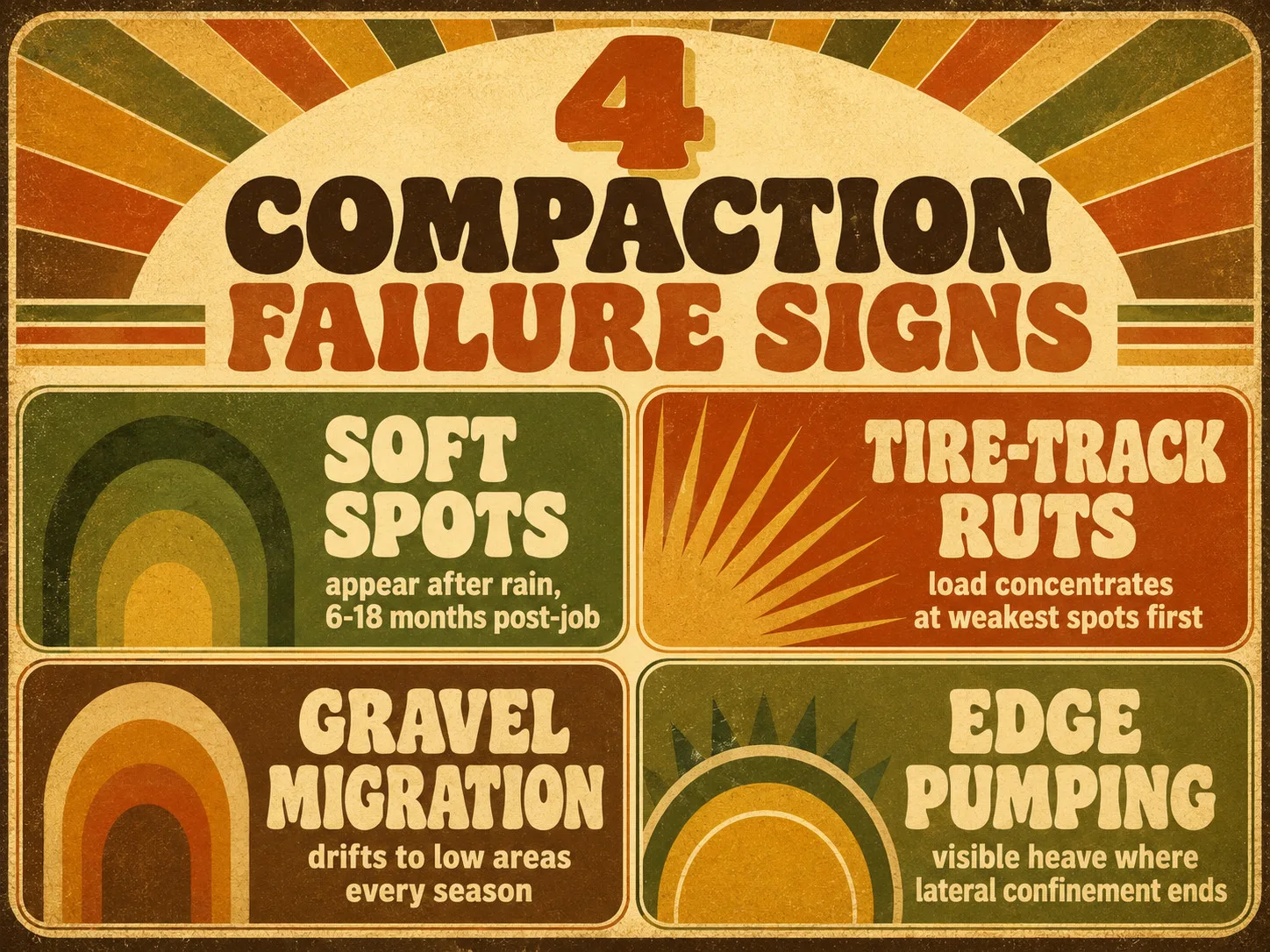
Compaction failure shows up as soft spots, diagonal ruts, and tire-track depressions that appear 6 to 18 months after the job — long after you’ve paid.
Common failure patterns and what causes them:
- Soft spots after rain: The base wasn’t densified. NC clay swells under moisture and temporarily loses bearing capacity — and how red clay changes with moisture explains why the cyclic swelling slowly degrades particle bonding over time.
- Ruts in tire tracks: Vehicle load concentrates at the weakest spots first. If the subgrade was never proof-rolled, those weak spots were never identified or corrected.
- Gravel migration toward low areas: When the base moves under load, gravel migrates with it. If you’re patching the same low spots every season, compaction is the underlying issue — not gravel quantity.
- Pumping at the edges: The edge of a driveway is always the hardest area to compact because there’s no lateral confinement. Visible pumping at driveway edges after work is where failure starts.
This is why a $900 quote and a $3,200 quote can both be for the same driveway. The question is what’s in the $900. If the answer is “grade and spread gravel,” there’s no compaction step — and no verification. The $3,200 may or may not include a proof-roll either. Ask for it in writing before you sign anything.
Compaction Methods — What Your Contractor Should Be Using
A vibratory plate compactor is the minimum; a drum roller is better; a loaded dump truck as proof-roll is the field test that verifies the result.
Equipment breakdown:
- Vibratory plate compactor: Adequate for top inch or two of loose material. Not enough for deep base correction on a driveway subgrade.
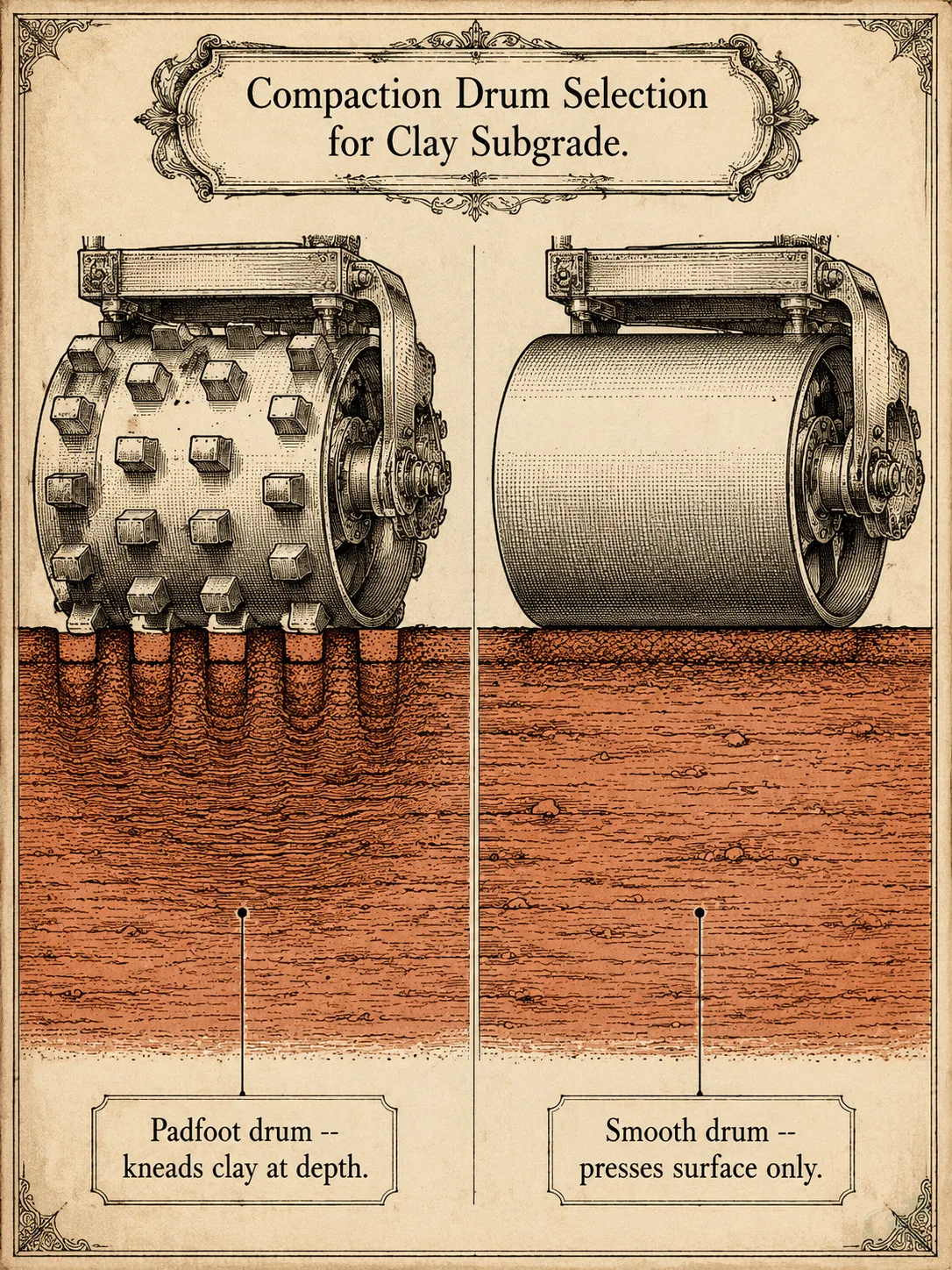
- Drum roller (smooth drum): The right tool for compacting a prepared base layer. Efficient, covers more area per pass than a plate compactor.
- Padfoot (sheepsfoot) drum roller: Better for North Carolina clay specifically. The feet knead and densify the layer rather than just pressing the surface. If your contractor mentions a padfoot roller, they understand clay behavior — the same level of knowledge to look for when you hire an NC driveway grading contractor.
- Loaded dump truck proof-roll: Final verification step — not a compaction method. Confirms the roller did its job.
- Hand tamper: For small patches only. Not appropriate for driveway base preparation.
What a competent contractor says vs a red-flag answer:
Competent: “We’ll make passes with the padfoot roller before we bring in gravel, then proof-roll with the loaded truck before we spread.”
Red flag: “We’ll grade it and compact as we go.” No defined method means no verification step — and no way for you to confirm the work was done.
Ask Your Contractor This Question
Before any driveway grading quote is signed, ask this:
Copy this question to use with any contractor:
“What compaction method are you using, and do you proof-roll before spreading gravel?”
A contractor who knows compaction will answer with specific equipment (drum roller, padfoot, plate compactor) and confirm whether a proof-roll pass is part of the process. A vague answer (“we compact as we go”) means the step isn’t built into their workflow.
An itemized quote for driveway grading should list “subgrade preparation” and “compaction” as separate line items — distinct from “material” and “spreading.” If the quote lumps everything into a single per-square-foot number, you can’t evaluate what’s being included or skipped.
If proof-roll isn’t in the scope, ask why. Sometimes the answer is reasonable (the driveway is short, the base is confirmed solid from a prior job, the operator can justify it). More often, the answer reveals whether the contractor thinks the step matters at all.
Get an itemized quote from a verified NC grading contractor who can walk you through the compaction method before work starts. Or read how driveway grading works in NC before your next contractor call.
For the full sequence — crown grading, compaction, then gravel — see gravel driveway grading and compaction sequence. For the moisture question that determines when compaction can happen, see moisture conditions for proper driveway compaction.