
Ray Pettiford inherited 14 acres in Guilford County three years ago. One low section floods every winter — his neighbor says he needs grading, a contractor he called said he needs a permit, and now he is trying to figure out which contractor handles rural drainage, what that permit actually is, and whether those two things are even connected.
They are. In unincorporated Guilford County, a drainage correction project on rural land can easily disturb more than 1 acre — and the permit trigger is 1 acre of disturbance, not 1 acre of property. Ray’s 14 acres don’t exempt him. They make the threshold more likely to apply.
This page explains which jurisdiction governs Ray’s property, what the permit requires in plain language, and how rural-scale drainage work in North Carolina differs from subdivision drainage.
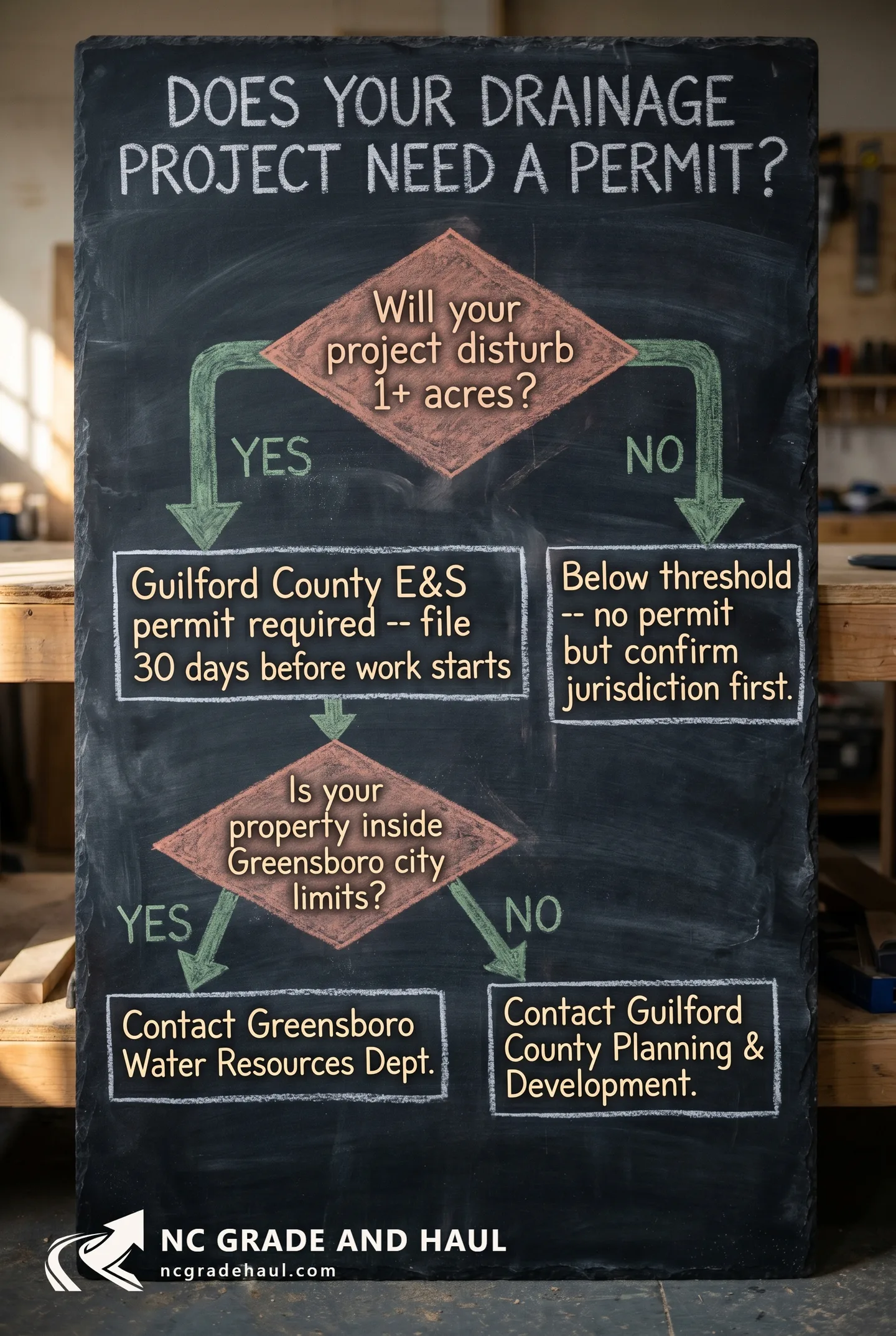
Unincorporated Guilford County vs City: Which Rules Apply to Your Property?
Guilford County has three distinct land-use jurisdictions — unincorporated county, Greensboro city, and High Point city — and they administer grading and drainage rules independently.
Your address doesn’t tell you which jurisdiction you’re in. A Greensboro mailing address can sit in unincorporated county. A rural-route address can fall inside city limits. The only reliable answer comes from looking up your parcel through the Guilford County GIS Data Viewer (gisdv.guilfordcountync.gov) or the county Parcel Search (parcelresearch.guilfordcountync.gov).
| Jurisdiction | E&S Threshold | Administering Body |
|---|---|---|
| Unincorporated Guilford County | 1 acre | Guilford County Soil Erosion Control Section |
| Greensboro city limits | 1 acre | Greensboro Sediment & Erosion Control Section |
| High Point city limits | 1 acre | High Point Erosion Control Program |
Unincorporated Guilford County
- E&S Threshold
- 1 acre
- Administering Body
- Guilford County Soil Erosion Control Section
Greensboro city limits
- E&S Threshold
- 1 acre
- Administering Body
- Greensboro Sediment & Erosion Control Section
High Point city limits
- E&S Threshold
- 1 acre
- Administering Body
- High Point Erosion Control Program
For Ray’s 14-acre property in unincorporated county, the 1-acre threshold is the operative number. Greensboro’s rules don’t apply. High Point’s rules don’t apply. The county’s rules apply — and grading a drainage channel across a field that’s seasonally flooded can disturb far more than 1 acre before the crew breaks for lunch.
For a deeper look at NC county permit requirements, see Guilford County permits for yard drainage projects.
The 1-Acre E&S Trigger: What It Means for a 14-Acre Property
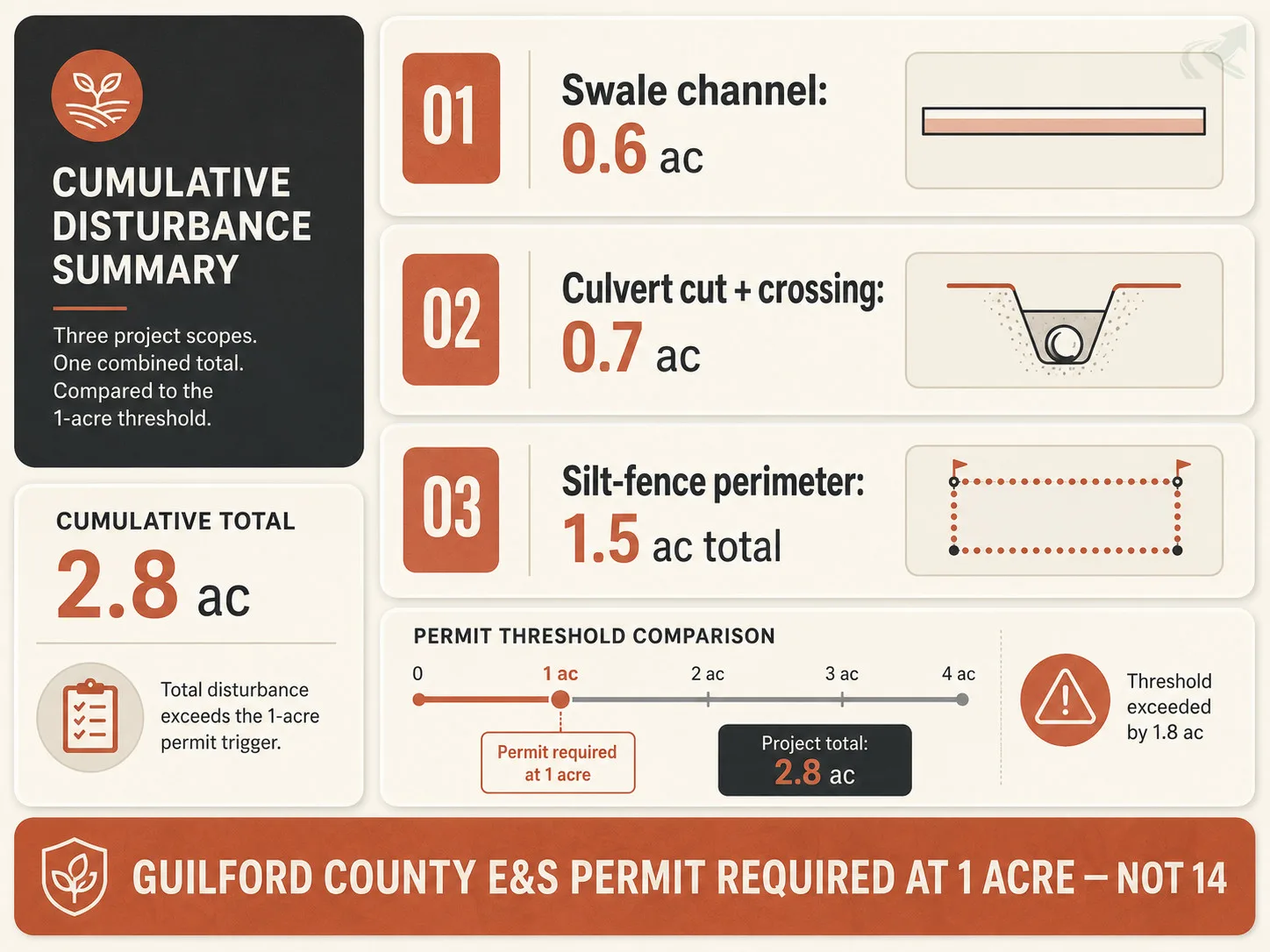
Owning 14 acres doesn’t mean you’re permitted to disturb all 14 acres — the 1-acre trigger is about how much land your project actively disturbs, not how large the property is.
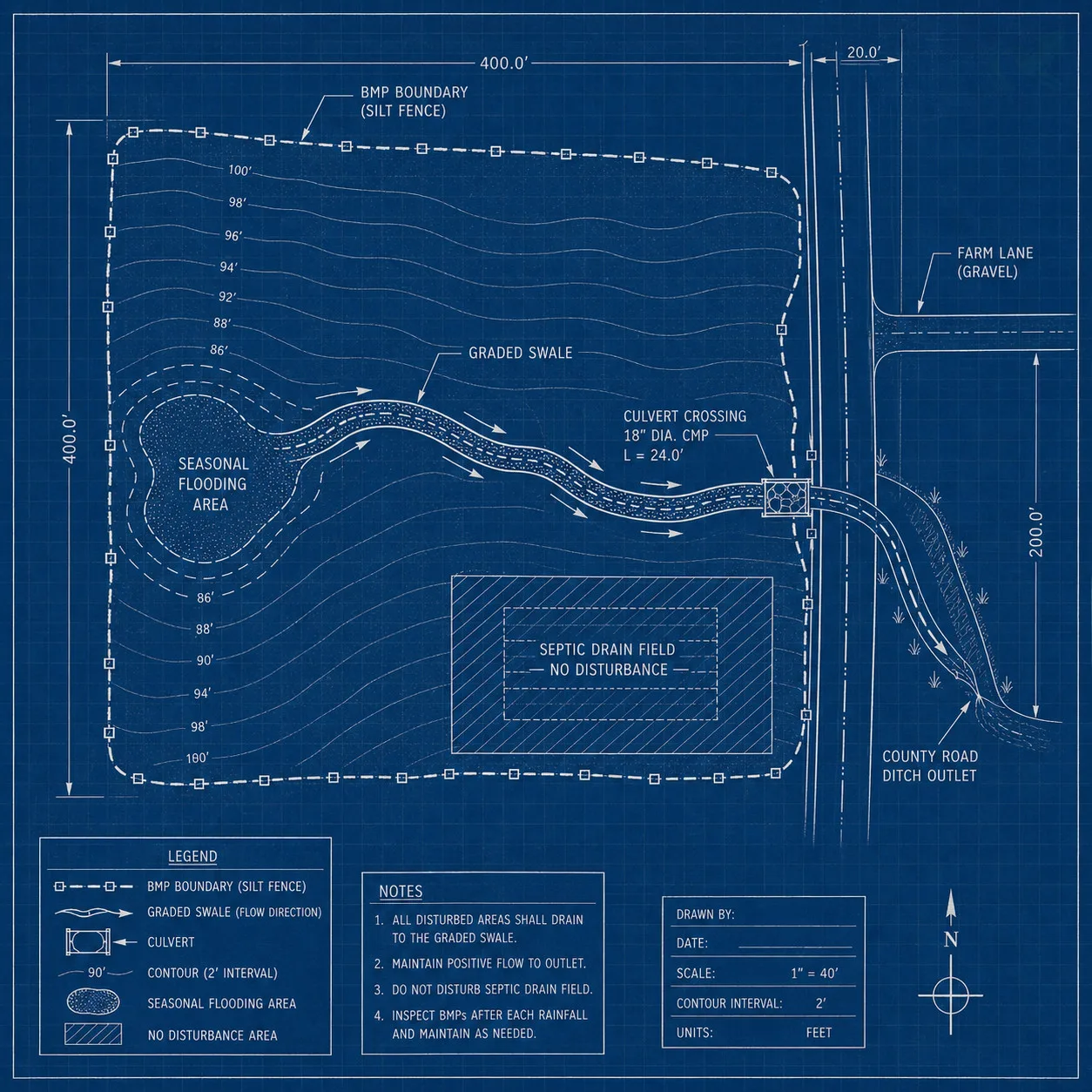
This distinction trips up rural landowners regularly. The trigger is cumulative project disturbance area. If a drainage correction requires grading a swale from a low point across 300 feet of open field, cutting a culvert crossing at a farm lane, and installing silt fence at the downslope boundary — that project may disturb 1.5 to 2 acres even though it addresses flooding in a fraction of Ray’s 14.
What the E&S permit requires:
- Submission of an erosion control plan before work begins
- Installation of silt fence and other controls before the first grade is cut
- Site inspections at key project stages
- Maintenance records during active grading
Under NC state law (G.S. 113A-57), an erosion and sedimentation control plan must be filed and approved before any land-disturbing activity that disturbs more than 1 acre begins. Guilford County administers this requirement locally through its delegated program.
The contractor submits the plan — Ray doesn’t pull this permit himself. But he needs to ask whether his contractor has pulled a Guilford County E&S permit before. That question separates operators who know the county from those who will give him an unrealistic start date because they’ve never been through the review cycle here.
Piedmont Clay in Guilford County: Rural Land vs Subdivision Lot
Piedmont red clay behaves the same whether you’re on a quarter-acre subdivision lot or 14 open acres — but the drainage solution changes completely at rural scale.
Guilford County’s rural soils run heavily to the Cecil series and its geographically associated Vance series — both characteristic Piedmont clay profiles (Cecil alone covers roughly a third of the Southeastern Piedmont). Same dense, low-permeability Piedmont clay that causes standing water in Greensboro subdivisions. The clay doesn’t care about your property lines.
Subdivision solution: a French drain with positive drainage to a street inlet or rear easement. Typical project disturbs 0.2 to 0.4 acres. Usually below the E&S threshold. For Greensboro city subdivision drainage context, see Greensboro French drain services alongside Guilford yard drainage.
Rural solution: a swale system. Graded channels that route water from low points toward a designated outlet — farm pond, stream, or county road ditch. Swale grading requires equipment that can work across open ground, not a landscaping crew with a rented mini-excavator. The project may also require culvert installation at road crossings and field crossings, which adds both scope and permit exposure.
Rural Guilford County drainage: a graded swale system vs an untouched low spot
Comparison. Graded swale system: Shaped channels route water from low points to a designated outlet; Culverts sized for peak flow at road and field crossings; Silt fence and BMP controls set at the downslope boundary; Water leaves the property by a planned path -- pond, stream, or road ditch. The unmanaged low spot: Water pools across open land every winter with nowhere to go; No outlet -- the low point just holds the runoff; Saturated Cecil and Vance clay subsoil can't release it; Flooding spreads toward the drain field and outbuildings.
- Shaped channels route water from low points to a designated outlet
- Culverts sized for peak flow at road and field crossings
- Silt fence and BMP controls set at the downslope boundary
- Water leaves the property by a planned path -- pond, stream, or road ditch
- Water pools across open land every winter with nowhere to go
- No outlet -- the low point just holds the runoff
- Saturated Cecil and Vance clay subsoil can't release it
- Flooding spreads toward the drain field and outbuildings
On acreage like Ray's 14, a drainage correction can disturb more than 1 acre -- which is when the Guilford County E&S permit applies.
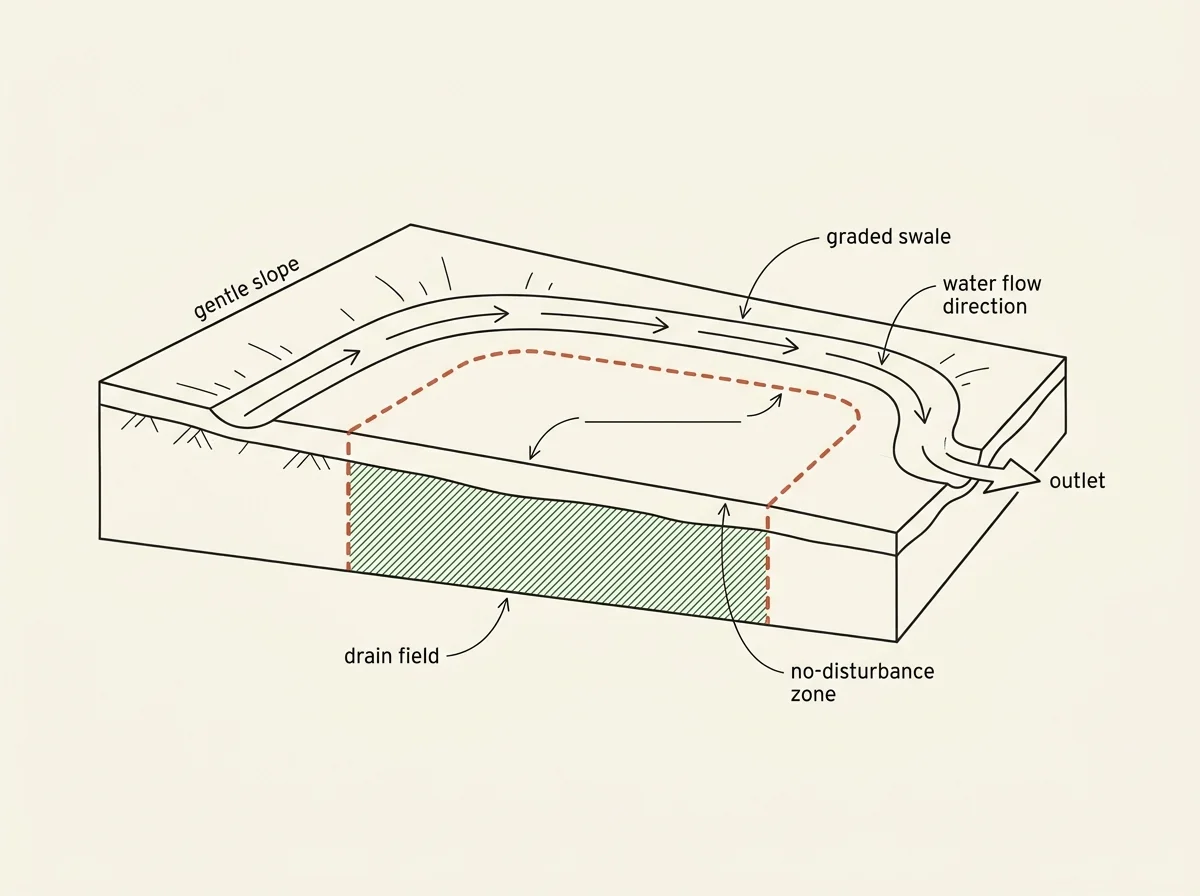
One factor Ray’s 14-acre situation adds that subdivision drainage doesn’t: septic. If his drain field sits anywhere near the seasonal flooding area, drainage correction work near the drain field requires Environmental Health coordination before grading begins. Under North Carolina’s onsite wastewater rules (15A NCAC 18A / 18E), the original soil structure of a drainfield area must be preserved — no activity beyond system construction is permitted within those areas, before or after installation. A contractor who grades into or over a drain field without prior Environmental Health sign-off can void the system’s approval. A perc test result from when the system was installed gives baseline data — a contractor working near a drain field should ask to see it, and confirm the drain field boundary before staking any grade.
What a Guilford County Yard Drainage Contractor Does at Rural Scale
Rural Guilford County drainage work differs from subdivision drainage — swale grading, culvert installation, and E&S plan submission are the key scope items, and not every drainage contractor handles all three.
What the scope looks like for a property like Ray’s:
- Swale grading: cutting and shaping drainage channels to route water away from low points toward an outlet. Requires a track skid or small dozer — not a landscaping crew.
- Culvert installation: at road crossings, field crossings, and drainage outlets where the swale transitions under a surface. Sizing the culvert for peak flow matters; undersized culverts wash out.
- E&S plan submission: if the project disturbs 1 acre or more, the contractor submits an erosion control plan to the Guilford County Soil Erosion Control Section before work starts. Ask to see their plan template — a contractor who has worked Guilford County before has one in their files.
- Septic coordination: if grading is near the drain field, coordinate with Guilford County Environmental Health before the first grade stake goes in.
Ask for an itemized quote that breaks out swale grading, culvert work, E&S plan preparation, and BMP materials separately. A single bundled number gives you no way to compare bids or understand what you’re paying for.
For NC yard drainage solutions for Guilford County see the QN hub, which covers the full drainage-method decision tree. To find a verified NC yard drainage contractor in Guilford County, the verified contractor list is filtered by county and service area.
Common Mistakes on Guilford County Drainage Projects
Three mistakes account for most Guilford County drainage project problems before the first shovel moves.
- Starting work before checking the 1-acre threshold. On a large rural property, this is the easiest way to get a stop-work order. The contractor should know the threshold and flag it before quoting. If they don’t mention it, ask directly.
- Confusing Greensboro city rules with county rules. If your address says “Greensboro” but you’re in unincorporated Guilford County, Greensboro’s drainage permit process doesn’t govern your project — and vice versa. Confirm your jurisdiction via the county parcel lookup before your contractor submits anything.
- Hiring a contractor who hasn’t pulled a Guilford County E&S permit. Under G.S. 113A-54.1, plans must be filed at least 30 days before disturbance begins; Guilford County’s Soil Erosion Control Section then has 30 days to approve, punch-list, or deny — and a punch-listed plan must be corrected and resubmitted before work can start. That cycle can add 6 to 10 weeks to a project timeline when a contractor has never been through the process here. Ask for a recent Guilford County permit number you can confirm.
From our directory
Verified contractors near you
Every listing is cross-checked against the NC Licensing Board public record before it appears. Pick your city:
Or browse the full NC contractor directory.
What This Page Does NOT Cover
This page focuses on unincorporated Guilford County rural drainage and the E&S permit threshold — it does not cover everything in the Guilford drainage universe.
- Greensboro city-specific French drain context — see Greensboro French drain services alongside Guilford yard drainage
- Foundation drainage or crawl space drainage — a different specialty; see foundation drainage
- The full statewide county permit matrix — see Guilford County permits for yard drainage projects
- Large commercial grading projects — this page covers residential and small rural properties only