
Two questions Greensboro homeowners ask first
Do I need a permit for a French drain in Greensboro?
In unincorporated Guilford County, the E&S permit threshold is 1 acre -- most residential projects don't trigger it. Greensboro and High Point each administer their own erosion and sedimentation control program, and both also use a 1-acre land-disturbance threshold (High Point adds extra triggers -- highly erodible soils, watershed critical areas). Most subdivision-lot French drain installs fall below all three thresholds.
Will a French drain actually work in Guilford County clay?
Yes -- but only with a positive outlet and the right aggregate. Guilford County sits in the same Piedmont clay zone as Wake County. Cecil and Vance series soils dominate the area and drain at roughly 0.1--0.5 inches per hour. Without proper slope to a daylight outlet and #57 or #67 stone in the trench, the system fails in 2--3 years.
Your Greensboro yard holds water for 36 hours after a hard rain. A contractor quoted you a French drain. Another said you need regrading. Your lot is in a Guilford County subdivision, and the soil is that reddish clay that doesn’t give up water without a fight.
Here’s what both contractors may have skipped: Greensboro, High Point, and unincorporated Guilford County each administer their own drainage and land-disturbance rules. Where your address falls changes which permit questions you’re even asking.
This page covers the Triad-specific facts — jurisdiction structure, Piedmont clay design requirements, and what to ask before you hire in North Carolina’s Greensboro market.
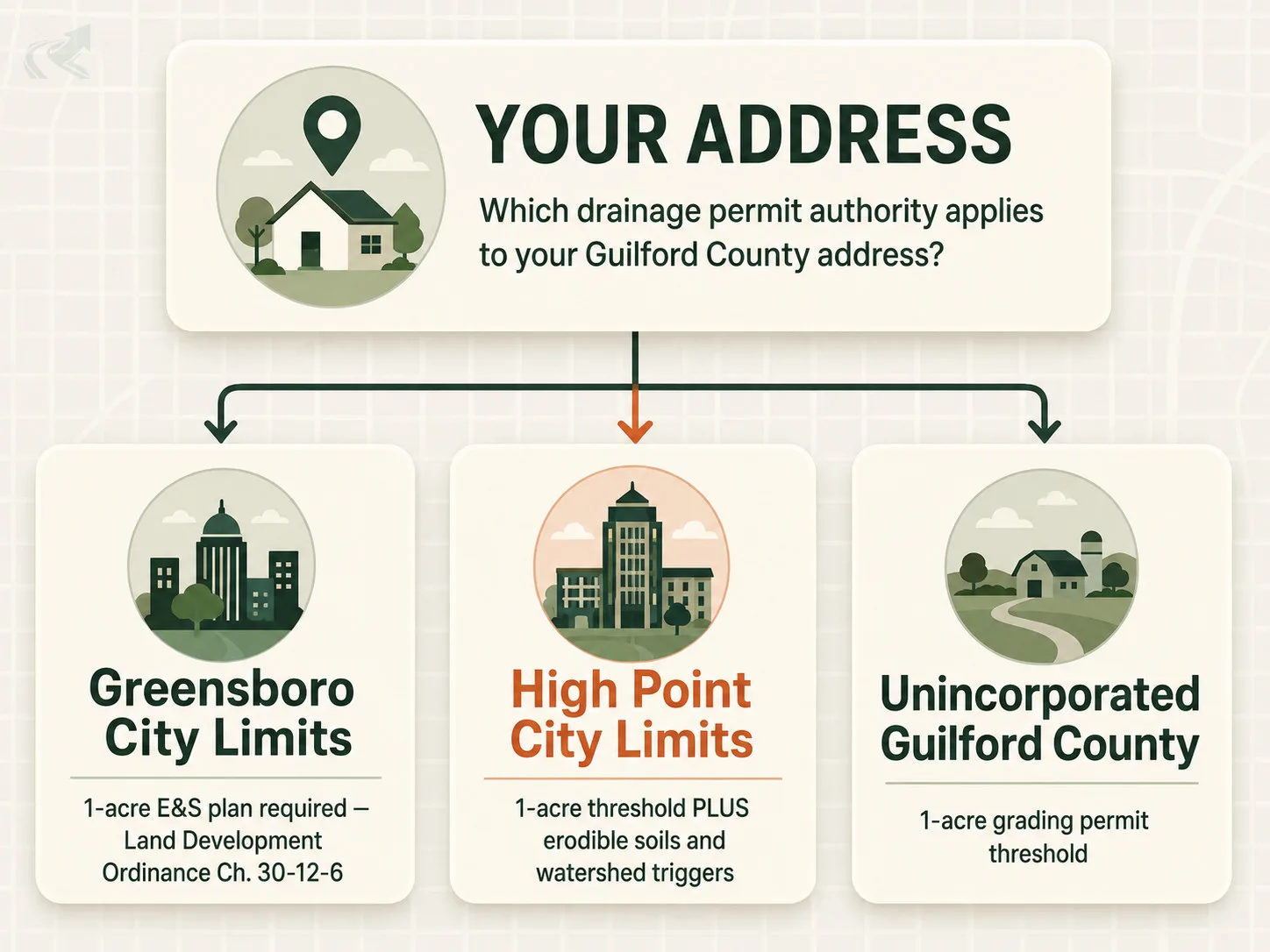
Guilford County’s Three-Jurisdiction Structure: Where Do You Fall?
Greensboro and High Point each administer their own land-disturbance rules — if your address is in one of these cities, the county 1-acre threshold isn’t your number.
Here is how the three jurisdictions break down:
-
Unincorporated Guilford County: The plan-approval and grading-permit threshold is 1 acre of land disturbance. Most residential subdivision lots sit well under this figure — but lots disturbing less than an acre are still expected to use erosion controls such as a construction entrance and silt fence. Rural and semi-rural Guilford properties often have more acreage — confirm your lot size before assuming you’re clear.
-
Greensboro city limits: Greensboro administers its own Soil Erosion and Sedimentation Control program (Land Development Ordinance Ch. 30-12-6), separate from the county. A control plan is required for land-disturbing activity of 1 acre or more and must be filed before work begins. City limits extend further than many homeowners expect — including suburban subdivisions that feel rural.
-
High Point city limits: High Point runs its own land-disturbing permit process independently as well. Its permit is triggered at 1 acre of disturbance — but also by highly erodible soils, drainage to a protected-watershed structure, or location within a Watershed Critical Area, so the threshold can effectively be lower than an acre. High Point is often bundled with “Greensboro” in casual conversation, but its permitting is a separate track.
To check which jurisdiction your address falls under, use the Guilford County parcel lookup at parcelresearch.guilfordcountync.gov or the county GIS Data Viewer. A parcel map lookup takes two minutes and tells you whether you’re in city limits or unincorporated county before you make a single call.
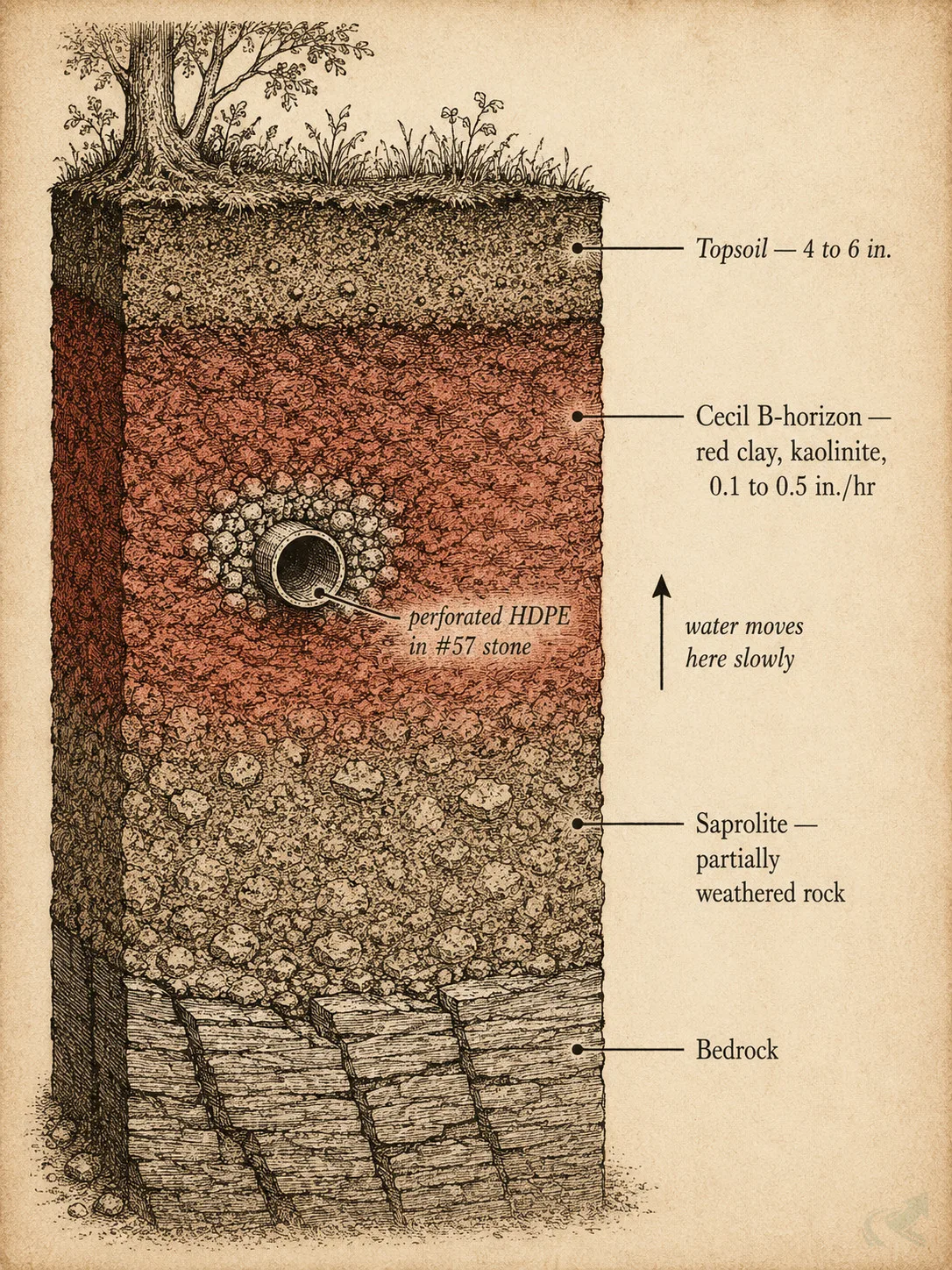
Piedmont Red Clay in Guilford: The Same Problem as Wake, Just West
Guilford County sits in the same Piedmont clay zone as Wake County — the French drain design requirements are identical.
Cecil and Vance soil series dominate the Piedmont zone through Guilford County. Cecil is North Carolina’s official state soil and the most extensive soil on the Piedmont — a deep, well-drained residual soil with significant clay accumulation in its subsoil. Vance is a companion Piedmont upland series with the same clay-heavy subsoil character. These are the same clay-heavy profiles you find through the Triangle. Hydraulic conductivity runs at roughly 0.1—0.5 inches per hour — water moves through this soil slowly, which means a French drain trench fills faster than the surrounding soil can absorb.
Greensboro’s topography is moderately rolling. The Triad generally has more terrain relief than south Wake County, which creates more natural outlets — but also more concentrated flow paths when a heavy storm hits a low-lying backyard.
The design logic does not change based on which Piedmont county you’re in: positive drainage to a real outlet, correct aggregate, correct slope. That’s the non-negotiable part.
NC Homeowner Takeaway — on French Drain Man content: His core instinct — use clean, washed, open-graded stone and skip silty aggregate — is correct in NC clay. His fabric-sock debates apply here too. Where the Piedmont context differs: his outlet assumptions often presume soils that move water more freely. In Guilford County’s Cecil clay, the outlet design and slope requirements are less forgiving. His pipe-wrap recommendation holds. His assumption that any low-point outlet is adequate needs checking against your specific lot grade and soil profile.
What Greensboro’s French Drain Market Looks Like
Greensboro has a smaller contractor pool than Charlotte or Raleigh — but the Triad verified cohort is live as of 2026.
NC Grade and Haul launched with a Triad-first verified cohort (Greensboro and Guilford County). Verified contractor counts update dynamically as the database grows — [developer: render verified contractor count for Triad/Guilford County here].
What “verified” means for contractors in this directory: active license confirmed against state board public records, OSHA history reviewed, and workers’ comp status on file.
Hire a grading operator in North Carolina serving Greensboro and ask for an itemized quote that breaks out materials, labor, and any permit fees. A single round number on a drainage job is a yellow flag.
The Right French Drain Design for Guilford County Clay
A French drain without a positive outlet fails in Piedmont clay — the design rules are non-negotiable in Guilford County.
Here is what the spec looks like when it’s done right for North Carolina clay conditions:
- Aggregate: #57 or #67 stone, not pea gravel. Pea gravel clogs with clay fines within 2—3 years in Piedmont soil. The void ratio collapses, flow stops, and the trench becomes a static water feature.
- Pipe: 4-inch perforated wrapped in non-woven geotextile. Use a heavier-weight fabric than you would in sandy soils — the clay fines load is higher and will push through lighter fabric over time.
- Slope: 1% minimum grade toward the outlet. 2% preferred. No slope means no flow — water sits in the pipe and backs up into the trench.
- Outlet options: daylight to street or curb line, discharge to a stormwater swale, or connect to a catch basin. All three work in Guilford County terrain. The right choice depends on what’s accessible from your specific lot.
One important distinction from Wake County pages: Guilford County drains to the Cape Fear and Yadkin River basins — not the Neuse River basin. That means the Neuse riparian buffer rules that apply in Wake County do NOT apply here. Guilford County does, however, have its own buffer rules: properties in the Randleman Lake or Jordan Lake watersheds fall under state-mandated riparian buffer protections, administered locally by Guilford County’s Watershed Protection and Stormwater Management Section. Check with Guilford County Watershed Protection (or NCDEQ) before any project near a stream or pond.
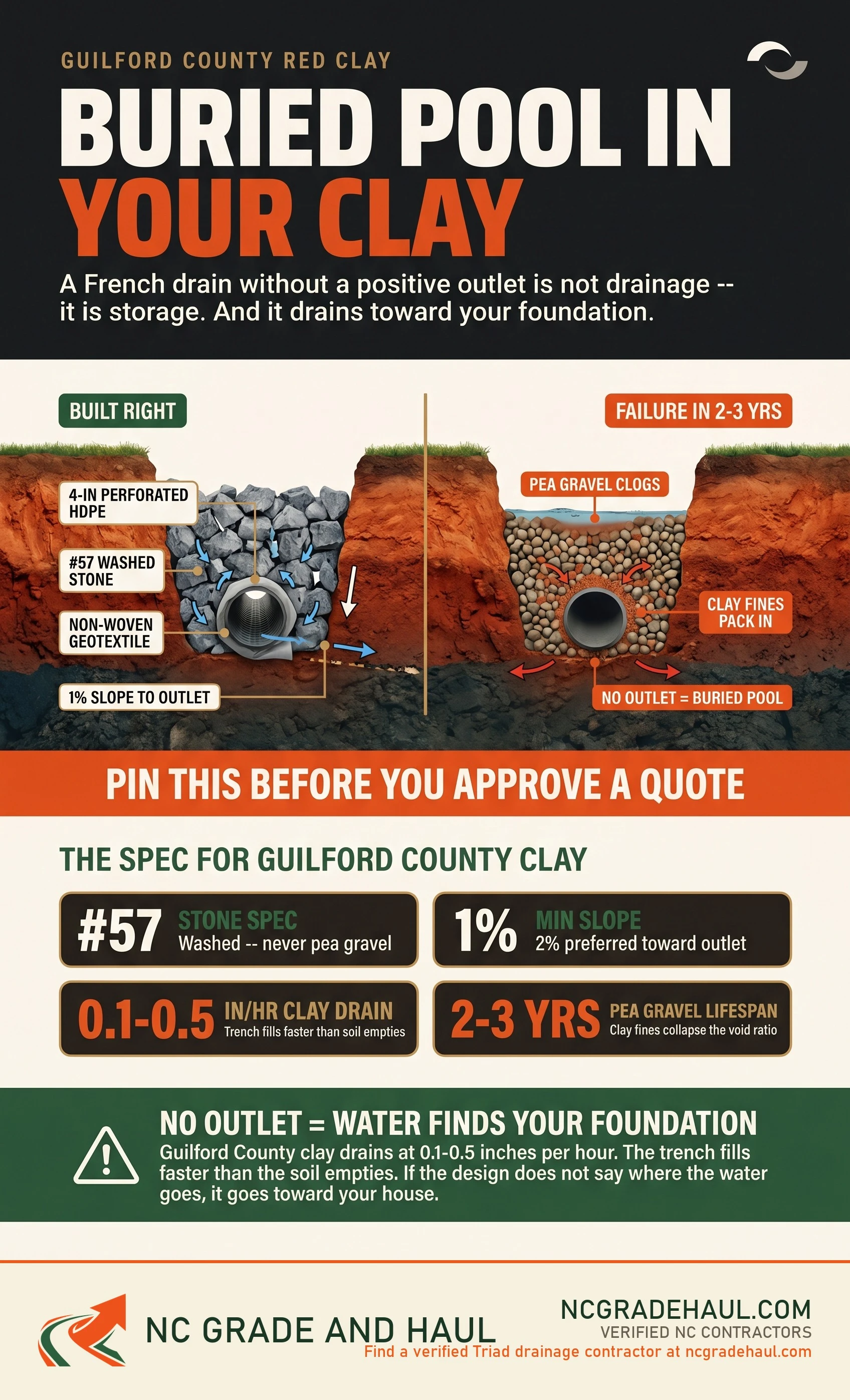
French drain in Guilford County clay: the spec that works vs the buried pool
Comparison. Built for Cecil and Vance clay: #57 or #67 washed stone keeps the void ratio open; 4-inch perforated HDPE pipe in heavier-weight non-woven geotextile; 1% minimum grade, 2% preferred, toward the outlet; Daylights to a real outlet -- curb line, swale, or catch basin. The 2-to-3-year failure: Pea gravel voids collapse as Piedmont clay fines pack in; Closed-end trench with no outlet -- a buried pool in the clay; No slope means no flow; water sits and backs up in the pipe; Water finds its own path, usually toward the foundation.
- #57 or #67 washed stone keeps the void ratio open
- 4-inch perforated HDPE pipe in heavier-weight non-woven geotextile
- 1% minimum grade, 2% preferred, toward the outlet
- Daylights to a real outlet -- curb line, swale, or catch basin
- Pea gravel voids collapse as Piedmont clay fines pack in
- Closed-end trench with no outlet -- a buried pool in the clay
- No slope means no flow; water sits and backs up in the pipe
- Water finds its own path, usually toward the foundation
Guilford clay drains at roughly 0.1 to 0.5 inches per hour -- without a positive outlet the trench fills faster than the soil can empty it.
Common Mistakes on Greensboro French Drain Projects
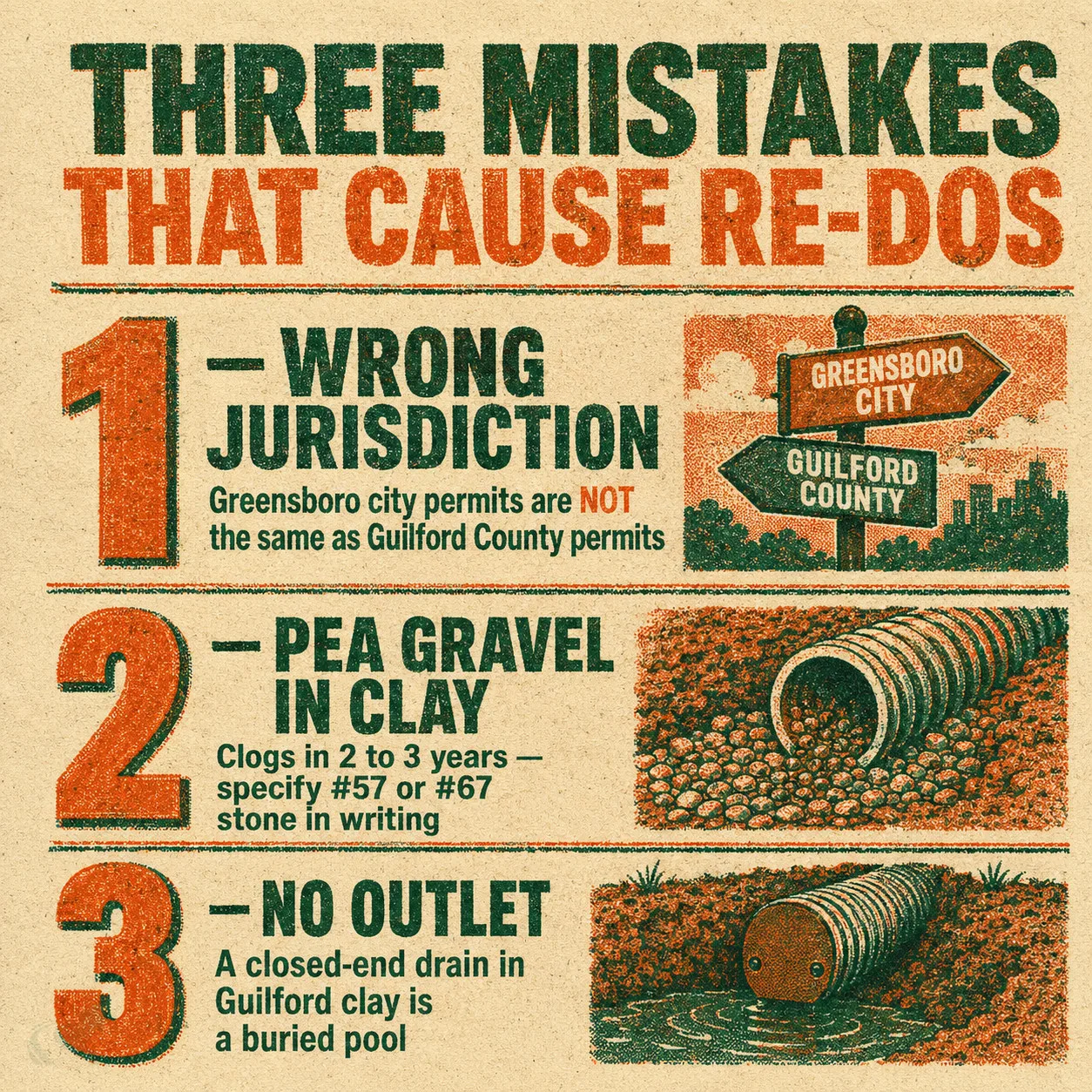
Three mistakes account for most of the re-dos in Guilford County subdivision work.
- Assuming Guilford County rules apply inside Greensboro city. The 1-acre E&S threshold is for unincorporated county only. Greensboro city has its own permit process. If your address is inside Greensboro city limits, the county threshold is not your number — call Greensboro Development Services.
- Pea gravel in Piedmont clay. Same failure mode as Wake and Mecklenburg — use #57 or #67 stone and get that spec in writing on the itemized quote. “Drainage gravel” without a named aggregate size is a yellow flag.
- No outlet. In Guilford’s rolling terrain, it’s tempting to skip the outlet when there’s no obvious daylight point. But a closed-end French drain in clay is a buried pool. The water has to go somewhere — if the design doesn’t specify where, it will find its own path, usually toward your foundation.
What to Ask Before Hiring a Greensboro Drainage Contractor
Two questions separate contractors who know Guilford County from contractors who just know drainage.
Ask your contractor this before any quote:
“Am I in Greensboro city limits, High Point city limits, or unincorporated Guilford County — and which permit process applies to my project?”
If they don’t know the three-jurisdiction structure, they’re not working Guilford County regularly. A contractor who understands the Triad market can answer this before they’ve walked your lot.
The second question is simpler: “Where does the water outlet, and what’s the slope to that point?” If the answer is vague — “we’ll figure that out once we start” — that’s a signal. Any contractor designing for North Carolina clay drainage can answer both questions before the first shovel goes in.
Find a verified Triad grading contractor for Greensboro French drain work and request an itemized quote. Guilford County permits for Greensboro French drain projects covers the permit matrix in detail.
What This Page Does NOT Cover
- Guilford County yard drainage beyond French drain scope — see Guilford County yard drainage services alongside Greensboro French drains
- French drain installation in NC for Greensboro homeowners at the methodology level — see French drain installation in NC for Greensboro homeowners
- French drain methodology for Greensboro’s red clay in depth — see French drain methodology for Greensboro’s red clay
- County permit matrix for other NC counties — see Guilford County permits for Greensboro French drain projects
From our directory
Verified contractors near you
Every listing is cross-checked against the NC Licensing Board public record before it appears. Pick your city:
Or browse the full NC contractor directory.