Two questions builders hope you never ask
What do you do when your builder won't fix the drainage?
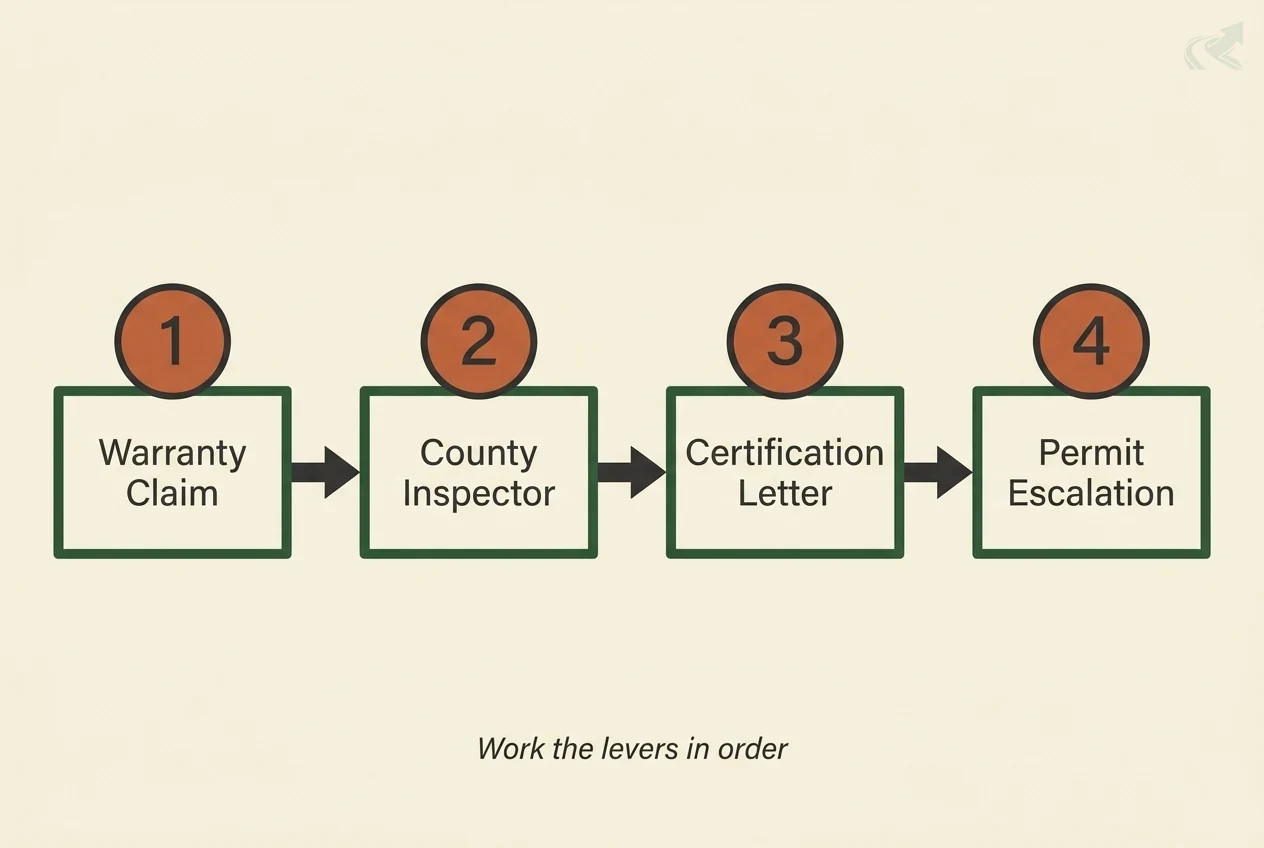
Four levers, in order: formal written warranty claim, county inspector complaint, certification letter demand, permit escalation. Each one creates documentation for the next. Don't skip steps -- escalating too fast destroys your leverage.
Does NC's 1-year warranty actually cover drainage failures?
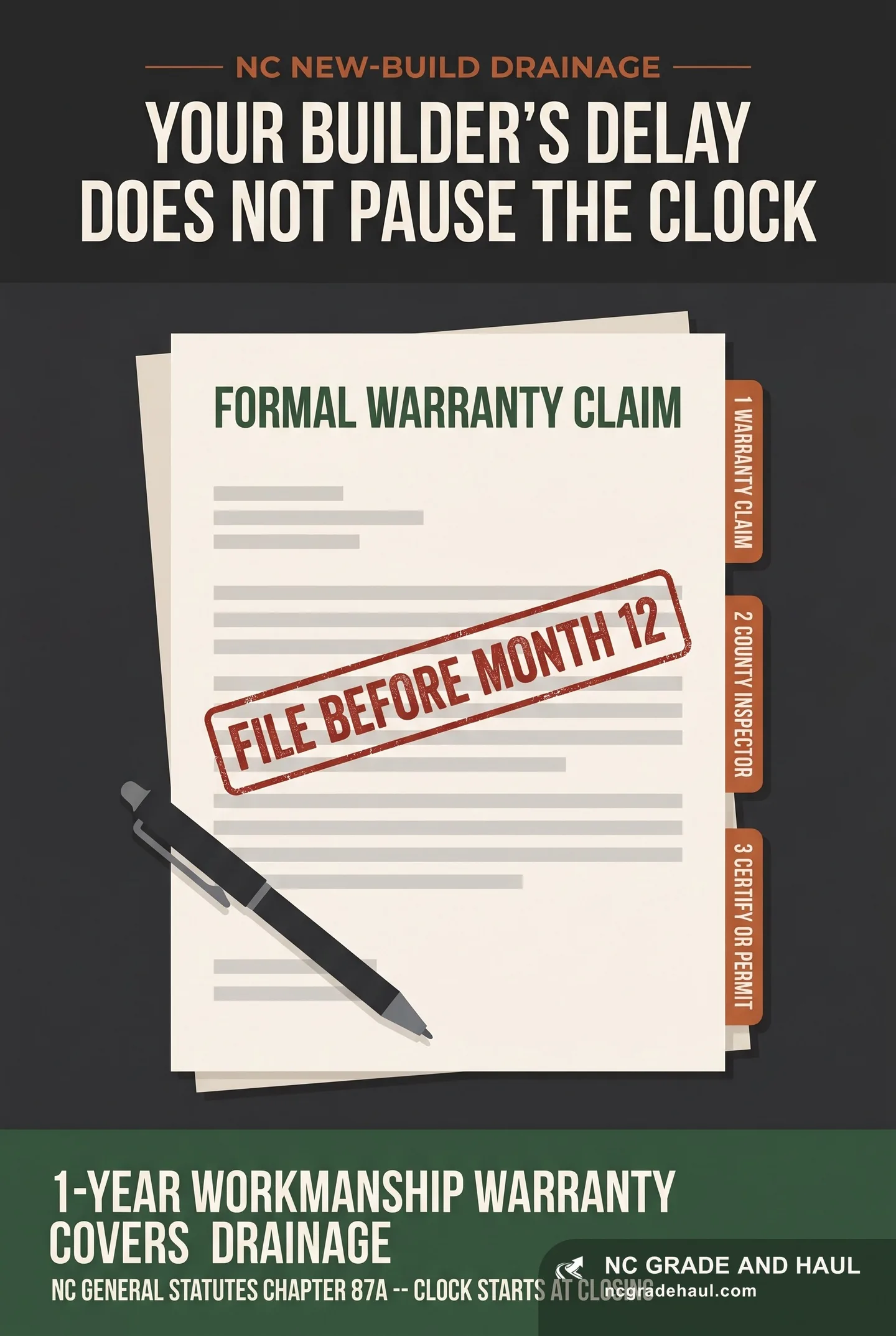
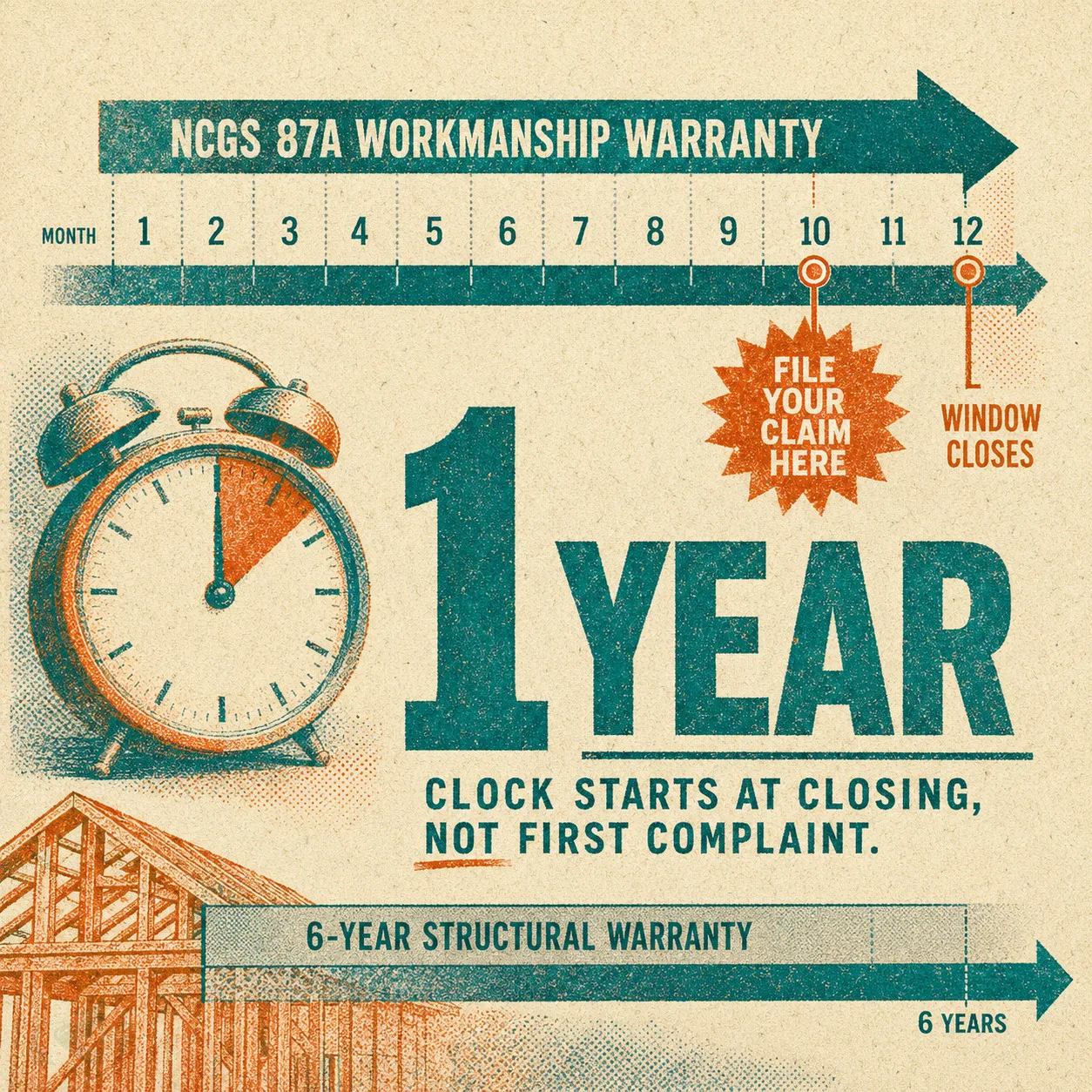
Yes -- grading and drainage fall under the workmanship warranty under North Carolina General Statutes Chapter 87A. But the clock starts at closing. A builder's dismissal doesn't pause the window. Your written claim must be on file before month 12.
Karen filed her warranty claim eight months ago. The builder sent someone out. He said the grading meets code. She still has standing water at the foundation perimeter after every storm.
She has photos. She has dates. She has a written complaint that went nowhere.
This page is what she does next. Four levers for the foundation drainage new build NC dispute that builders hope homeowners never pursue in order. The sequence is not arbitrary — each step creates the documentation that makes the next one credible.
Why Sequence Matters
Each lever creates a paper trail that makes the next lever more powerful — and skipping one can undermine your legal position later.
A county inspector complaint filed before you have a written warranty denial gives the builder grounds to say you didn’t give them a chance to remedy. Permit escalation before a written certification demand gives them grounds to say you escalated without cause.
This is not legal advice. It is a practical pattern from how these disputes tend to resolve in North Carolina. The sequence is strategic because builders know it too.
Go out of order and you hand them an objection. Work the sequence and every step is documented, reasonable, and hard to dismiss.
Lever 1: Formal Written Warranty Claim (Before Month 10)
If you haven’t filed a formal written warranty claim, stop and do that now — before anything else.
North Carolina’s implied statutory warranty under Chapter 87A gives you a 1-year workmanship warranty from the date of closing. Grading and drainage are workmanship items — water problems in newly built NC homes follow exactly this pattern, and the statute is what gives you standing to demand a fix. The builder’s own warranty document doesn’t override the statutory minimum.
Month 10 is the target submission date. The builder typically has 30 days to respond and additional time to remedy. File at month 10 and you have room inside the window if they stonewall.
Your written claim needs:
- Full name and property address
- Closing date
- Description of the drainage failure with specific dates and frequency
- Photo references with dates (“photo dated 2024-09-12 shows standing water at northeast corner”)
- Specific corrective ask: re-grade to achieve positive drainage of at least 6 inches of fall in the first 10 feet from the foundation, per the NC 6-inch-in-10-foot foundation slope rule
Send via email AND certified mail to the builder’s warranty department. Keep copies of both receipts.
Lever 2: County Building Inspector Complaint (After Builder’s First Response)
The county building inspector can cite the builder for a code violation — and a violation on record changes the dynamic.
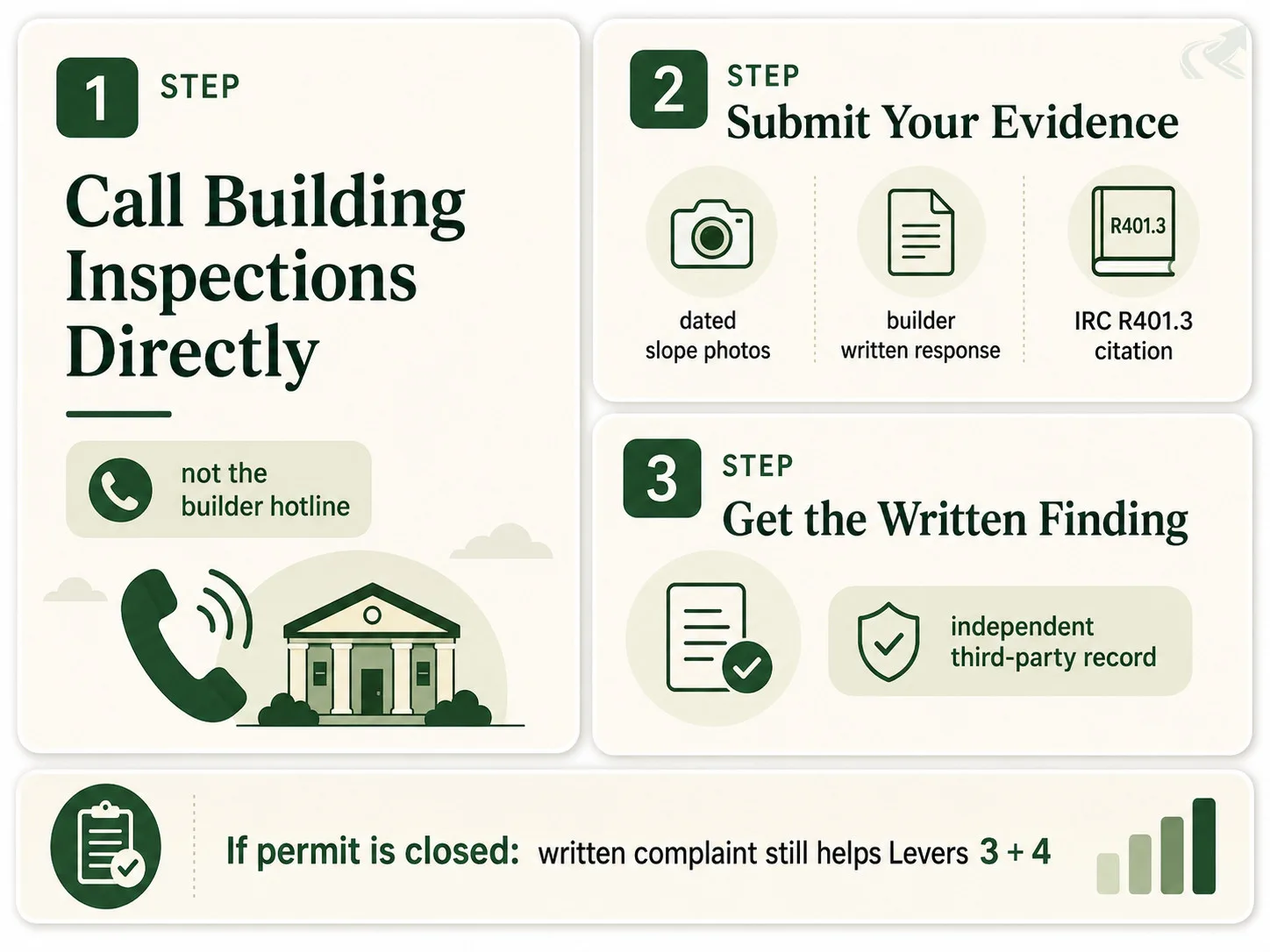
The county building inspections department is independent of the builder. Contact them directly — not the builder’s customer service line. Explain that you are filing a homeowner complaint about a drainage deficiency at a property that received final inspection.
When you file, include:
- Your dated photos showing the negative slope or standing water in yard NC solutions and its frequency after rain events
- The builder’s written response (or documented lack of response)
- The specific code citation you believe was not met: IRC R401.3 requires a minimum 6-inch drop in the first 10 feet from the foundation
What may happen: the inspector visits and issues a written finding. That written finding is independent third-party documentation. The builder cannot dismiss an inspector’s finding the way they dismissed your phone calls.
One practical note: some counties can only act on permits that are still open. If your home’s permit is closed and final inspection has passed, the inspector may not be able to issue a formal citation — but they can still generate a written record of your complaint. That record still helps with Levers 3 and 4.
In Wake, Durham, and Johnston counties, the building inspections department accepts homeowner drainage complaints via their online portal or a phone call to the building inspections division.
Lever 3: Certification Letter Demand
Ask your builder in writing to certify that the drainage is correct — most will not, and the refusal is itself evidence.
A certification letter is a written statement that the contractor stands behind their work. Specifically: that the current grade meets code and the drainage system is functional.
Most builders who know their grading doesn’t hold up will not sign one. That refusal matters. It signals to any future inspector, mediator, or attorney that the builder is not confident their own work is compliant.
The full detail on how to use a certification letter is at holding your NC builder accountable for foundation drainage and the deeper resource at certification letter — make your builder put the fix in writing.
If they sign the certification: they have accepted that the fix they deliver must meet that standard. If they refuse to sign: document the refusal date and the explanation they give (or note that they gave none), and move to Lever 4.
Lever 4: Permit Escalation (Last Resort Before Legal)
If the county inspector found a violation and the builder still hasn’t acted, the permit revocation pathway becomes available.
On new builds, the builder’s permit is sometimes still open until all final inspections are completed. A documented code violation can hold up permit closure — and permit closure matters to a production builder running multiple active sites.
This is a last resort. Permit escalation tends to harden the builder’s position. It signals that the dispute has entered adversarial territory. Use it only when Levers 1 through 3 have produced no movement.
The detailed mechanics of NC permit revocation escalation are covered at the linked page. The short version: a documented IRC R401.3 violation on a still-open permit gives the county authority to withhold final sign-off until the builder corrects the deficiency.
When to stop and call an attorney: if you have worked all four levers and the builder still has not acted, the dispute has moved into legal territory. A real estate attorney familiar with North Carolina warranty law is the next call. The NC State Bar’s lawyer referral service can connect you with one who handles new-home warranty disputes.
What the NC Warranty Window Actually Covers
North Carolina’s 1-year workmanship warranty covers drainage failures — but you have to document and claim within the window.
The statutory warranty under NCGS Chapter 87A applies regardless of what the builder’s own warranty brochure says. The brochure cannot strip rights the statute creates. The 1-year clock runs from closing date, not from when you first noticed the problem.
Grading and drainage fall under workmanship, which carries the 1-year window. Structural defects (foundation integrity, structural framing) carry a longer window — typically 6 years under NCGS 87A. The drainage failure Karen is dealing with is a workmanship claim, not a structural one.
Two things builders count on: that you don’t know about the statutory warranty, and that you miss the window because the dispute drags out. Don’t let either one happen.
Get an independent review before the window closes. An itemized quote from a grading contractor in North Carolina documents the scope of the problem independently — scope, method, and corrective cost on paper. That quote is evidence the builder has to address.
Three Things That Undermine Your Position
Verbal warranty claims. Phone calls don’t exist in builder records. Every call you think you had is a conversation the builder has no record of. Everything goes in writing, sent in a way you can prove was received.
Accepting a partial fix without written confirmation of what was done. “We re-graded” is not sufficient. If they re-grade and the written scope just says “grading work performed,” you have nothing to hold them to if the problem returns. Get the specific corrective scope in writing — what they did, what slope they achieved, who did the work.
Missing the 1-year window. The builder’s dismissal does not pause the statutory clock. Their dragging the process out is not an extension of your rights. File your written warranty claim before month 12, regardless of where the dispute stands at that moment.