
Denise’s neighbor laughed at her drainage system in August. No standing water anywhere. The same yard in March had looked like a retention pond.
Her contractor had said everything was graded correctly. The neighbor was right too — in August. They were both describing the same yard in different seasons, with different clay.
That’s the North Carolina Piedmont red clay pattern. The soil is the variable. Understanding it explains why a French drain can work fine for two seasons and then underperform in year three, why a driveway cracks on a well-installed base, and why a contractor who hasn’t designed for North Carolina soil behavior is solving a different state’s problem.
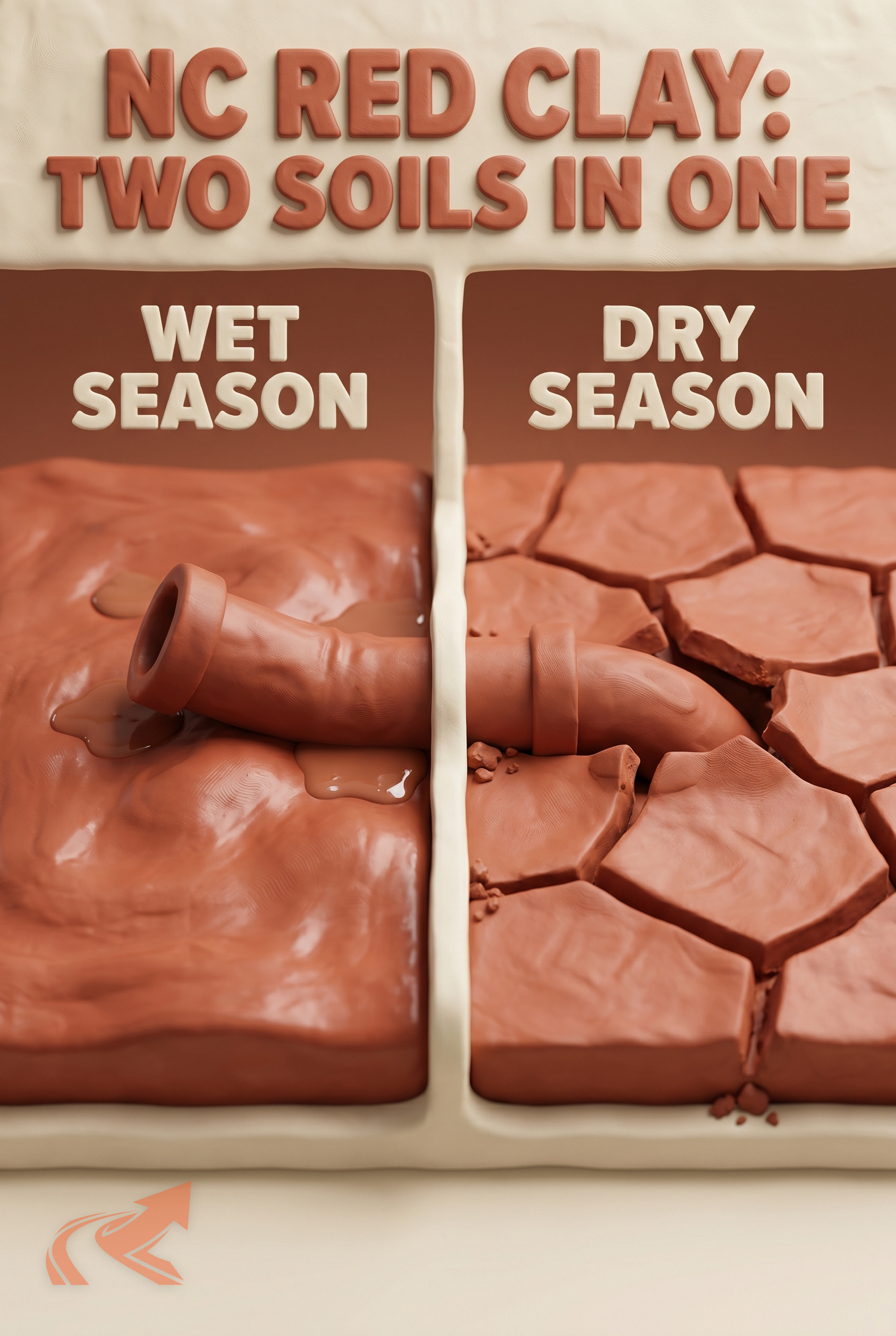
The Science: What North Carolina Kaolinite Clay Does With Moisture
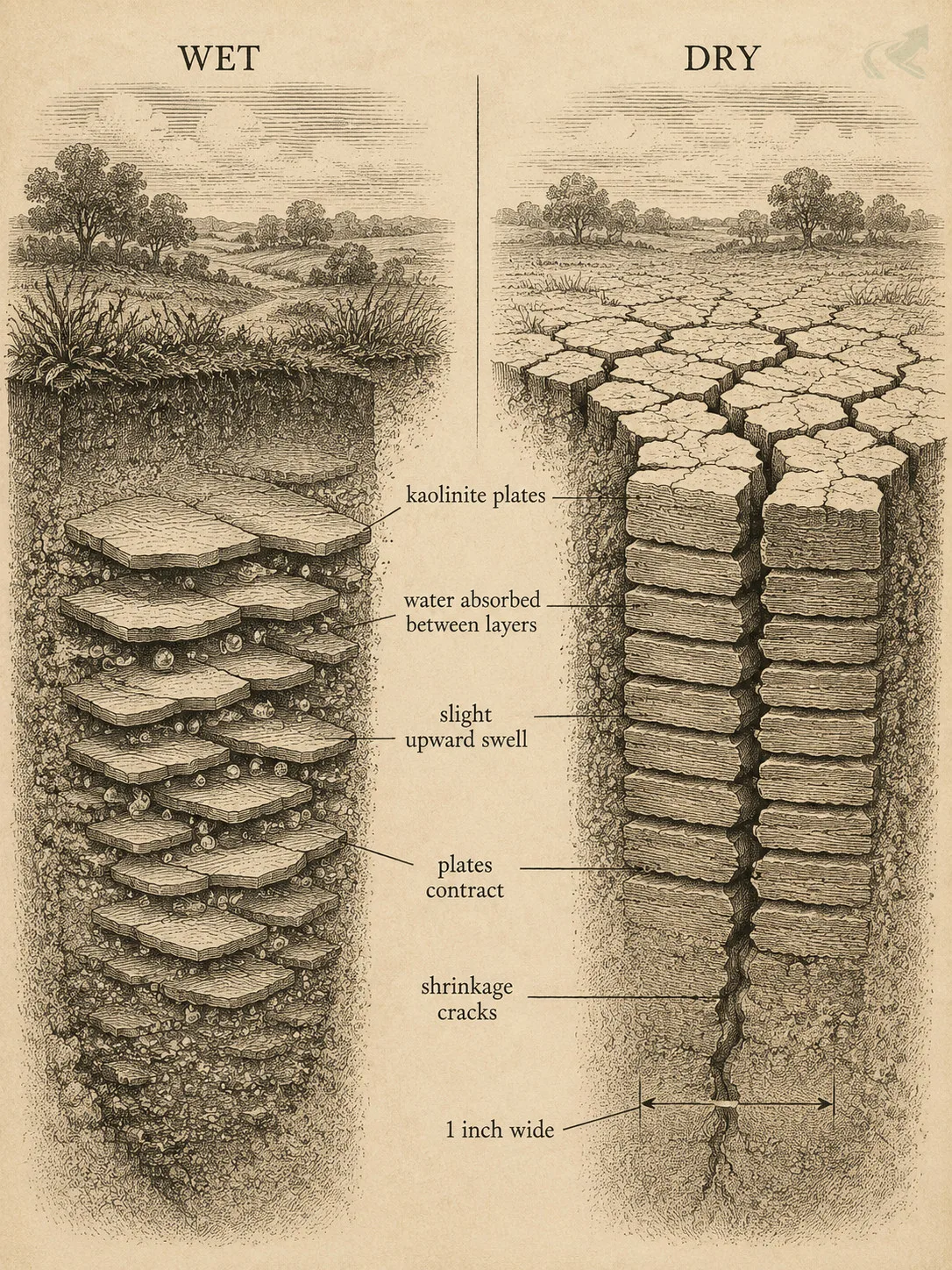
North Carolina Piedmont clay absorbs water into its mineral structure when wet, causing slight swelling and the characteristic slippery, plastic behavior — then releases water and contracts when dry, causing shrinkage cracks and hardening.
Kaolinite is a 1:1 clay mineral — one silica sheet bonded to one aluminum hydroxide sheet per layer. That structure stacks tightly and holds water between plates when moisture is present. When wet, the plates separate slightly, the soil becomes plastic, and surface friction drops. You slide on it.
When moisture leaves, the plates collapse back together. The shrink cycle opens the cracks visible in dry North Carolina clay — deep, geometric fractures in the soil surface that can run an inch wide in a hot summer.
The magnitude matters for context. Kaolinite has lower shrink-swell potential than montmorillonite or bentonite — the clays dominant in Texas Black Gumbo or Midwest prairie soils. Bentonite can swell 20x its dry volume. Kaolinite expands a fraction of that.
But “lower than bentonite” is not “negligible.” North Carolina Piedmont kaolinite still moves enough to shift a drain pipe, open a driveway crack, and create cumulative stress on a foundation footing over multiple seasons. The mechanism is the same — just slower and less dramatic than the Midwest comparison.
It’s not that your yard has two different soil types. It’s the same soil behaving differently across seasons.
What Seasonal Clay Movement Does to Drain Pipes
Drain pipe slope is set at installation — but the clay that surrounds and supports the pipe shifts seasonally. A pipe installed at 1% slope may be running at 0.5% or reversed in a specific section three years later, depending on how the clay moved.
This is the hidden mechanism behind the “good install that started failing after two seasons” pattern — the most common mid-term drainage complaint in North Carolina Piedmont installations.
The is set in the clay bed under the pipe. When North Carolina clay swells upward in wet seasons, it can push against the pipe and create a local high spot mid-run. When the clay dries and shrinks in summer, it can leave a void under the pipe that lets it settle — but not uniformly. Different sections move different amounts based on local moisture, compaction, and tree root activity.
Over three or four seasonal cycles, what started as a continuous downward slope acquires a local reversal. Water ponds behind the high spot instead of moving to the outlet.
A drain pipe in NC clay: day one vs three seasons later
Comparison. Newly installed: Pipe set at a continuous 1.5% fall; Clay bedding is stable and undisturbed; Slope runs straight to the outlet; Water moves freely the whole length. Three seasons on: Clay has swelled and shrunk around the pipe; A high spot lifts mid-run; Slope there drops to 0.2% or reverses; Water ponds behind the high spot.
- Pipe set at a continuous 1.5% fall
- Clay bedding is stable and undisturbed
- Slope runs straight to the outlet
- Water moves freely the whole length
- Clay has swelled and shrunk around the pipe
- A high spot lifts mid-run
- Slope there drops to 0.2% or reverses
- Water ponds behind the high spot
NC clay shrinks and swells with the seasons -- a perfect slope on installation day does not stay that way.
This is not a contractor failure in most cases. It’s the soil being the soil. But it does mean drainage systems in North Carolina need periodic slope checks — every two to three seasons is a reasonable cadence. The NC French drain installation context covers the maintenance implications for buried systems.
What Seasonal Clay Movement Does to Driveways
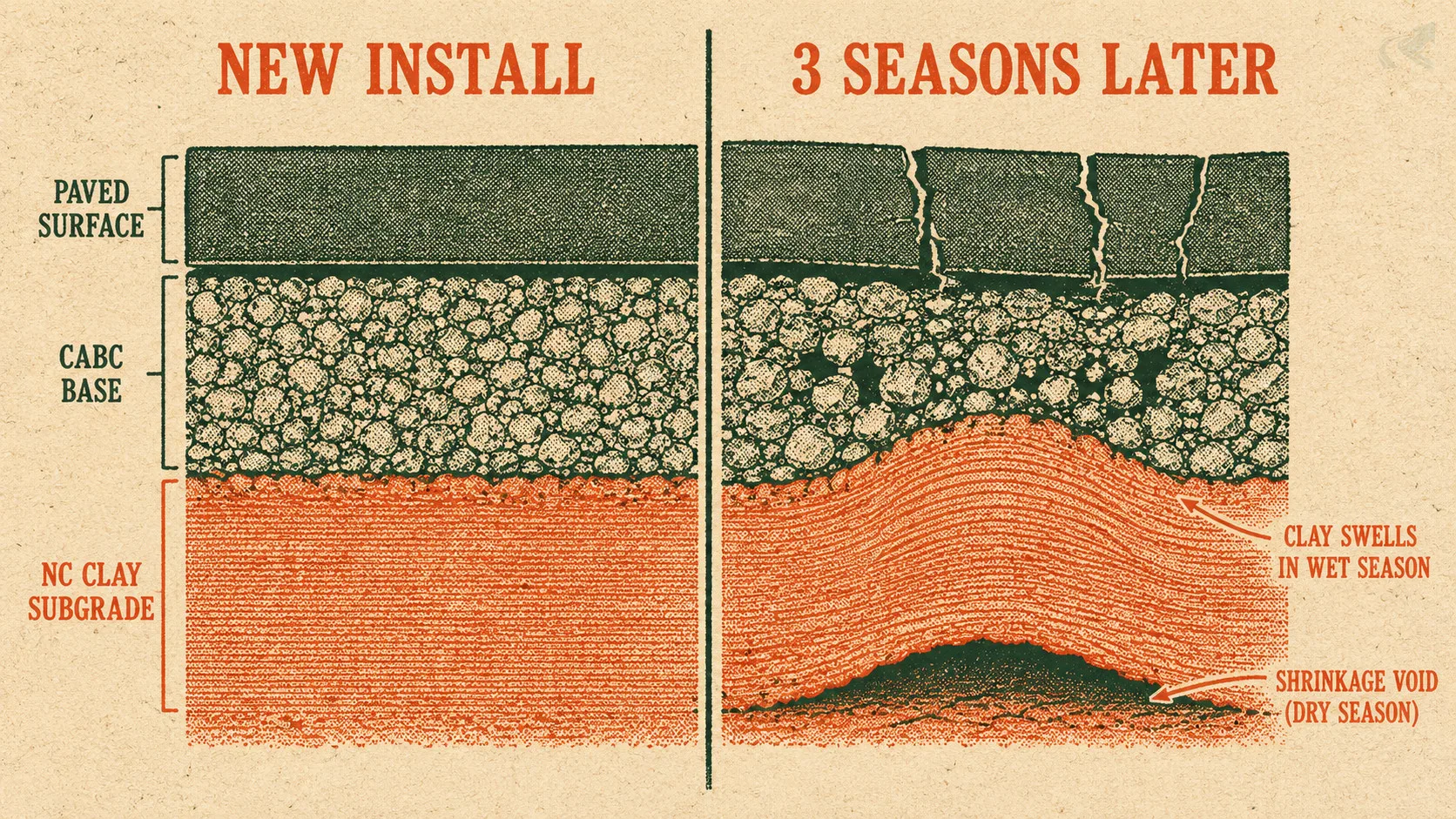
Driveway cracking in North Carolina Piedmont clay is a seasonal phenomenon — the wet-season swell pushes up, the dry-season shrink pulls apart, and the aggregate base settles into the void. Over several cycles, this creates heaving and cracking regardless of initial installation quality.
The standard mitigation in North Carolina is a proper base layer. CABC (Crusher Run Aggregate Base Course) is specified for North Carolina driveways because it serves two purposes: it distributes load across the clay below, and it allows some drainage so that moisture doesn’t accumulate directly under the paved surface.
A driveway on a thin base over directly compacted clay is more vulnerable because there’s no cushion between the pavement and the moving soil. The clay heaves in spring, the surface cracks. The clay shrinks in summer, the aggregate falls into the gap. Over multiple cycles, the surface breaks apart from below.
The check and proper of the subgrade before CABC placement are the two operations that determine how well the base weathers the seasonal cycle.
For the full driveway-specific context — including base depth requirements for North Carolina clay and how slope is specified — see NC driveway grading and clay base.
What Seasonal Clay Movement Does to Foundations
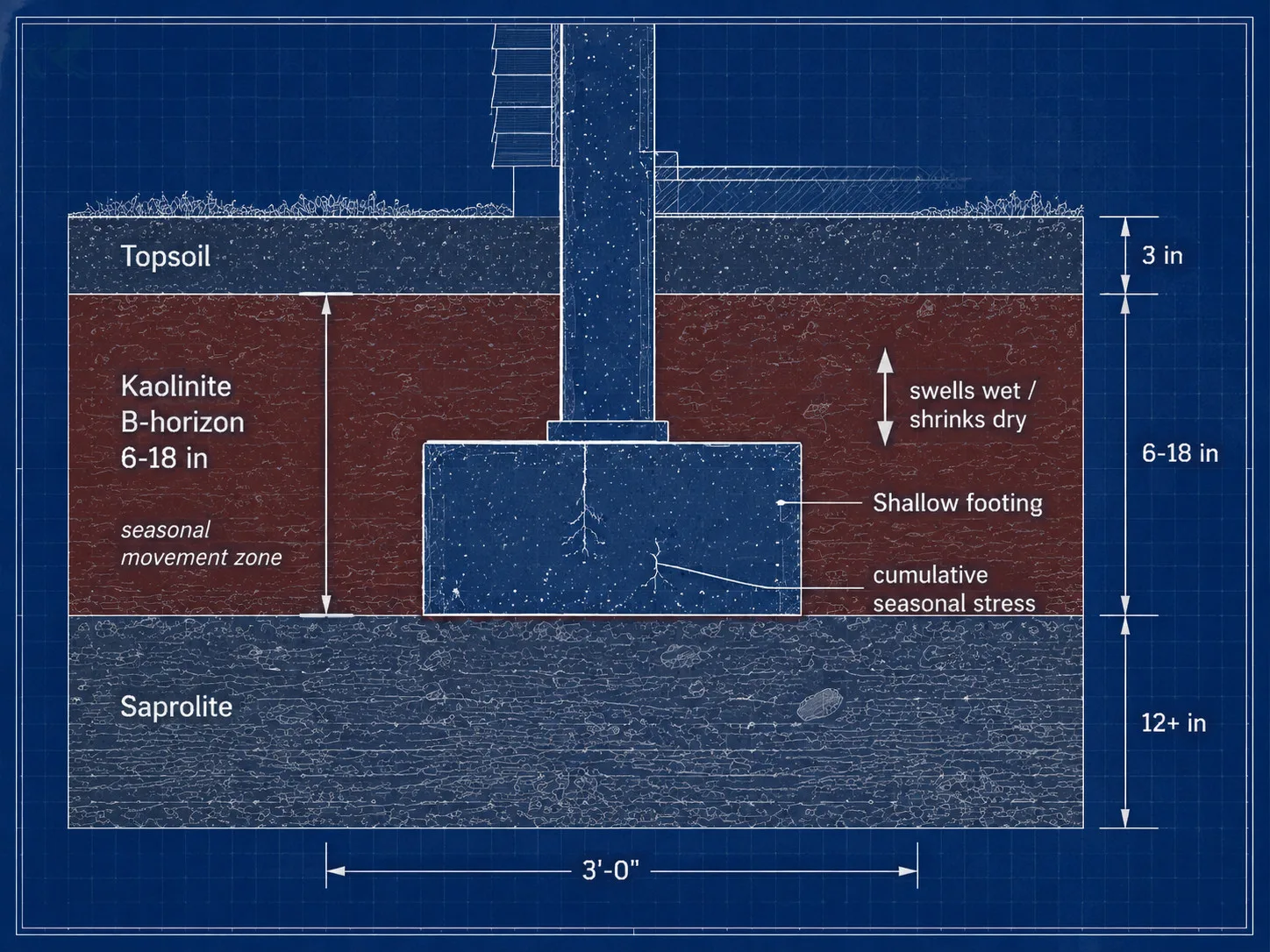
Seasonal clay movement is one of the mechanisms behind foundation cracking in North Carolina Piedmont homes — particularly in homes on shallow footings where the clay directly under the footing expands and contracts with season.
This is not catastrophic foundation failure. Seasonal clay movement under a footing is slow and cumulative — hairline cracks in drywall corners, doors that stick in spring and loosen in fall, minor step cracking in brick veneer. The process happens over years, not overnight.
The primary mitigation for North Carolina Piedmont homes is managing moisture consistency around the foundation. Clay that stays at a consistent moisture level — neither soaking wet after every rain nor baked dry in August — moves less. That’s why foundation drainage in North Carolina is spec’d differently than in states with more permeable soil: the goal is to keep the moisture content stable, not just to move water away.
The depth in a given site determines how close the seasonal movement zone is to the footing base. Shallow B-horizons — common in eroded hillside sites throughout the North Carolina Piedmont — mean the movement zone can be directly under the footing.
For the drainage design implications, see foundation drainage in NC soil zones.
The North Carolina Contractor’s Response: Designing for the Seasonal Cycle
An experienced North Carolina Piedmont contractor accounts for seasonal clay movement in drain pipe installation by using flexible joint connections, specifying minimum slope above what drainage math requires, and positioning outlets where slight pipe shift won’t block flow.
Three specific adaptations distinguish North Carolina-calibrated drainage design from standard national specs:
Minimum slope buffer. When 1% is the code minimum for a 4-inch drain pipe, an NC Piedmont contractor in North Carolina designs to 1.5% minimum. That 0.5% buffer is the allowance for seasonal clay settling. A system that starts at 1% and loses 0.5% to clay movement over three seasons is now at the functional minimum. A system that starts at 1.5% still has margin.
Flexible pipe joints. Rubber-gasketed or mechanically coupled joints allow slight angular deviation without cracking the pipe or breaking the seal. Fully glued PVC joints in a clay-bed system are rigid — when the clay moves, the pipe either deflects at the joint (stress-cracking the glued collar) or the run buckles. In North Carolina Piedmont installations, gasketed joints are the correct spec for any buried drain in a clay bed. ASTM D3034 — the PVC sewer and drain pipe standard — recognizes elastomeric gasketed joints as an acceptable joint type alongside solvent-cemented joints, and standardizes pipe laying lengths at 14 or 20 feet, so a gasketed joint naturally falls at each pipe length along the run. There is no separate code-mandated joint interval for clay-bed installations; the relevant decision is gasketed-versus-glued, not spacing.
Outlet positioning. The pipe outlet should sit at the lowest point on the site — not just the lowest end of the pipe run. If the clay settles slightly toward the outlet, slope is maintained or improved. If the outlet is at a mid-elevation point, settling in any direction can reduce effective slope to the outlet. Outlet placement is often the last decision in a drainage design and the one most often compromised by site constraints — in North Carolina Piedmont clay, it’s worth treating it as a primary constraint, not an afterthought.
The the clay-stops-water debate and NC red clay covers how kaolinite’s low hydraulic conductivity interacts with drain design — a related piece of the same soil behavior pattern.
What to Ask Your Contractor
Ask any drainage contractor: “How are you accounting for seasonal clay movement in pipe slope and joint design?” A contractor who hasn’t thought about this for a North Carolina Piedmont installation is designing for Michigan, not for NC.
The answer reveals whether the contractor has worked in North Carolina Piedmont clay long enough to design for it. The right answer includes a slope buffer above minimum, a joint spec that allows movement, and an outlet positioned for worst-case clay settling.
A useful follow-on: “What slope buffer above the minimum are you specifying, and what type of pipe joints are you using in the clay zone?” Copy this question to your notes before the first call.
When the contractor gives you a number and a joint spec, ask them to put it in the itemized quote. That way the design decision is documented, not just remembered.
Find a verified North Carolina grading contractor who designs for seasonal clay behavior at hire a grading operator in North Carolina.
Seasonal Clay Behavior Comparison
| Season | NC Clay Behavior | Effect on Drain Pipes | Effect on Driveways |
|---|---|---|---|
| Wet (spring/fall) | Absorbs water, swells slightly, becomes plastic | Pipe may shift up at wet sections | Surface heaves, aggregate spreads |
| Dry (summer) | Loses moisture, shrinks, cracks appear | Pipe may settle into shrinkage voids | Deep cracks, aggregate falls in |
| Net effect over 3+ seasons | Cumulative slope shift | Slope loss in specific sections | Progressive cracking and aggregate loss |
Common Mistakes
- Designing for minimum pipe slope without a buffer. A 1% minimum in North Carolina Piedmont clay leaves no room for seasonal settling. Buffer to 1.5% minimum on any buried drain run.
- Using rigid glued PVC joints throughout a clay-bed drainage system. In North Carolina Piedmont, gasketed or coupled joints allow the clay to move without stressing the pipe. ASTM D3034 recognizes elastomeric gasketed joints as an acceptable joint type; with standard 14- or 20-foot pipe lengths, a gasketed joint occurs at each length without any special spacing requirement.
- Assuming a well-installed system will maintain its slope indefinitely. Schedule a slope check every 2-3 years on any North Carolina Piedmont drainage system, especially after three or more wet/dry cycles.
- Skipping the CABC base depth spec. A thin base on compacted clay gives the seasonal movement zone direct contact with the paved surface. Full CABC depth appropriate for load and clay type is not optional in North Carolina.