
What makes NC red clay different for French drains?
What is NC Piedmont clay actually made of?
It is dominated by kaolinite -- a platey clay mineral that stacks into dense, near-impermeable layers. This is not the loose, crumbly clay from TV commercials or YouTube tutorials filmed in the Midwest.
Does water move down through NC clay or sideways?
Mostly sideways. NC Piedmont clay has low vertical hydraulic conductivity. Any French drain design built around vertical percolation is going to underperform here. The trench has to intercept the lateral flow path -- not just catch surface water.
Why do most national tutorials skip trench-wall prep?
Because most tutorials are filmed in sandy soil. When an excavator bucket scrapes through NC clay, friction polishes the trench wall into a near-impermeable slick. Water cannot enter through that sealed surface. A scratch pass breaks it open. Most contractors working from a national template never do this step.
Most French drain tutorials were filmed in Michigan, Florida, or the Pacific Northwest. The soil in those videos is not the soil in a Piedmont NC yard. The national playbook was built for different physics.
This page covers the specific physical properties of North Carolina Piedmont red clay that determine what works and what does not. Not to make you a soil scientist — to give you enough vocabulary to tell the difference between a contractor calibrated for NC clay and one copying a national template.
The three load-bearing properties: kaolinite mineral structure, lateral flow dominance, and trench-wall sealing. All three affect installation decisions. None of them appear in most standard tutorials.
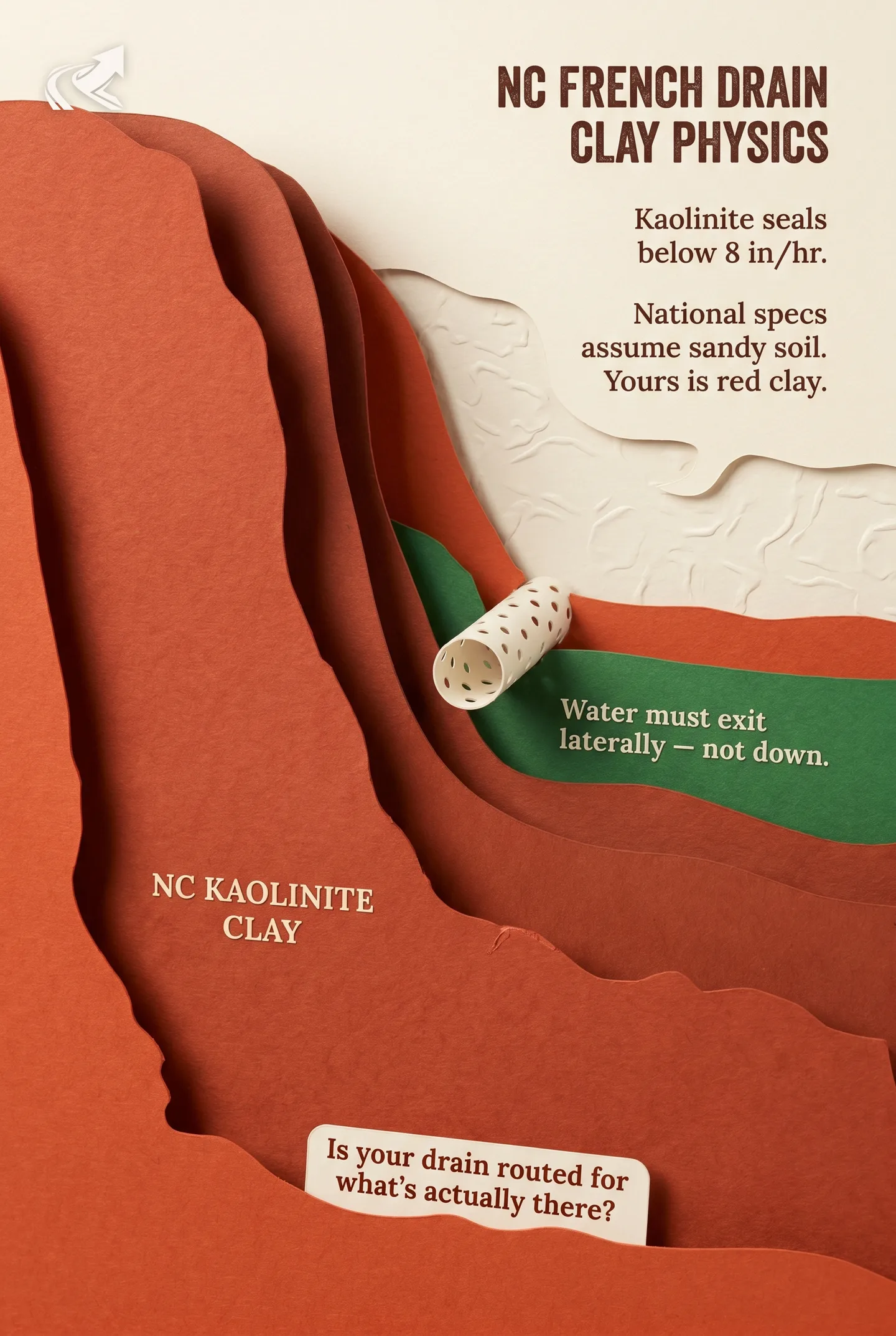
Kaolinite — What NC Piedmont Clay Actually Is
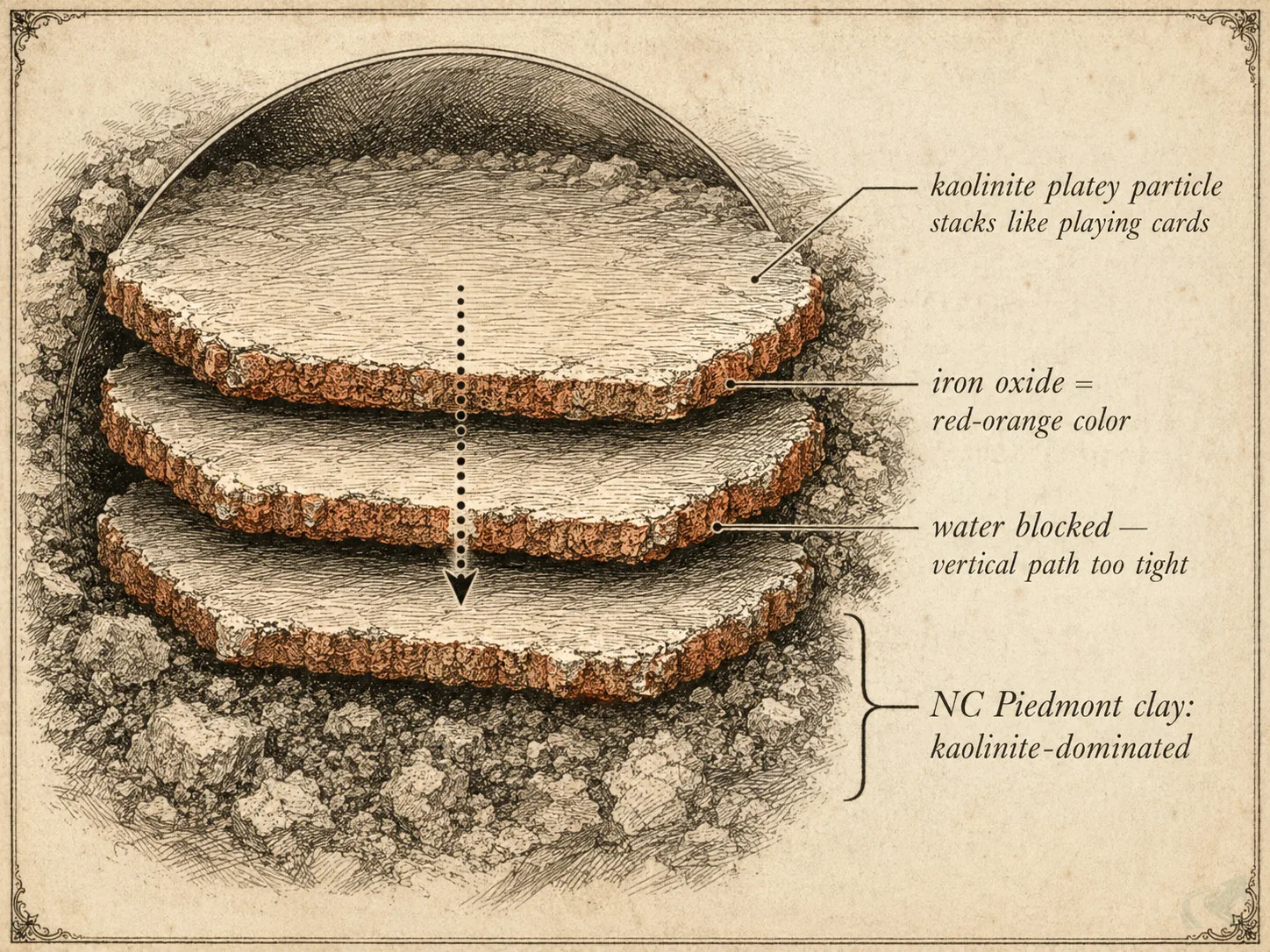
NC Piedmont red clay is dominated by kaolinite — a platey clay mineral that stacks into dense, water-resistant layers. It is not the loose, crumbly clay of TV commercials.
Kaolinite particles are flat and sheet-like. Under a microscope they look like stacked playing cards. They bond tightly via hydrogen bonding, which means the stack resists being pulled apart by water moving through it.
This matters because particle shape controls soil permeability and French drain design. A rounded-particle soil like sandy loam has large, irregular voids between grains — water finds paths through easily. A kaolinite stack has tiny, constrained voids that water struggles to penetrate vertically.
The red-orange color that defines North Carolina Piedmont clay is not a different mineral. It is an iron oxide coating on the kaolinite particles — the same chemistry that gives rust its color. The hue intensity signals iron content, not drainage quality.
Compared to montmorillonite — the high-shrink-swell clay mineral common in Texas, Oklahoma, and parts of the Great Plains — kaolinite has lower shrink-swell behavior. But “lower” is relative. NC clay still shifts meaningfully with seasonal moisture change. That shift matters for pipe depth, as the brief covers below.
Lateral Flow Dominance — Why Vertical Percolation Methods Fail
Water moves mostly sideways through NC clay, not down. Any drainage method that depends on vertical percolation is going to underperform on a Piedmont lot.
Soil scientists measure hydraulic conductivity in two directions: horizontal (lateral flow, parallel to the surface) and vertical (percolation, downward). In well-structured sandy or loamy soils, both values are roughly similar. In North Carolina kaolinite clay, they are not.
The platey kaolinite structure creates strong horizontal layering. Water moving through that layer system finds the path of least resistance — which runs parallel to the layers, not perpendicular through them. The result: saturated clay transmits water laterally before it transmits it downward.
French drain in NC clay: cut across the flow, not along it
Comparison. Intercepts the flow: Wide trench cut across the lateral flow path; Water enters the stone column from the uphill side; Catches the subsurface flow doing the real damage. Misses the flow: Narrow slot aligned along the flow path instead; Lateral subsurface water runs around and past it; Surface-only catch -- water bypasses and pools downslope.
- Wide trench cut across the lateral flow path
- Water enters the stone column from the uphill side
- Catches the subsurface flow doing the real damage
- Narrow slot aligned along the flow path instead
- Lateral subsurface water runs around and past it
- Surface-only catch -- water bypasses and pools downslope
In NC kaolinite clay, water moves sideways before it moves down. A trench has to cross the flow path, not run parallel to it.
The practical consequence: a narrow French drain slot catches surface water but misses the lateral subsurface flow that is doing most of the damage — and that subsurface saturation is what produces persistent standing water in yard NC solutions that don’t resolve on their own between rain events. The trench has to be positioned to intercept flow as it moves — wide enough and positioned across the flow path, not parallel to it.
This also changes where you place the pipe. A national-template install often defaults to a single central pipe. An NC-calibrated install starts by reading where the lateral flow is traveling and placing the trench to cut it off.
Trench-Wall Sealing — The Clay Slick Problem
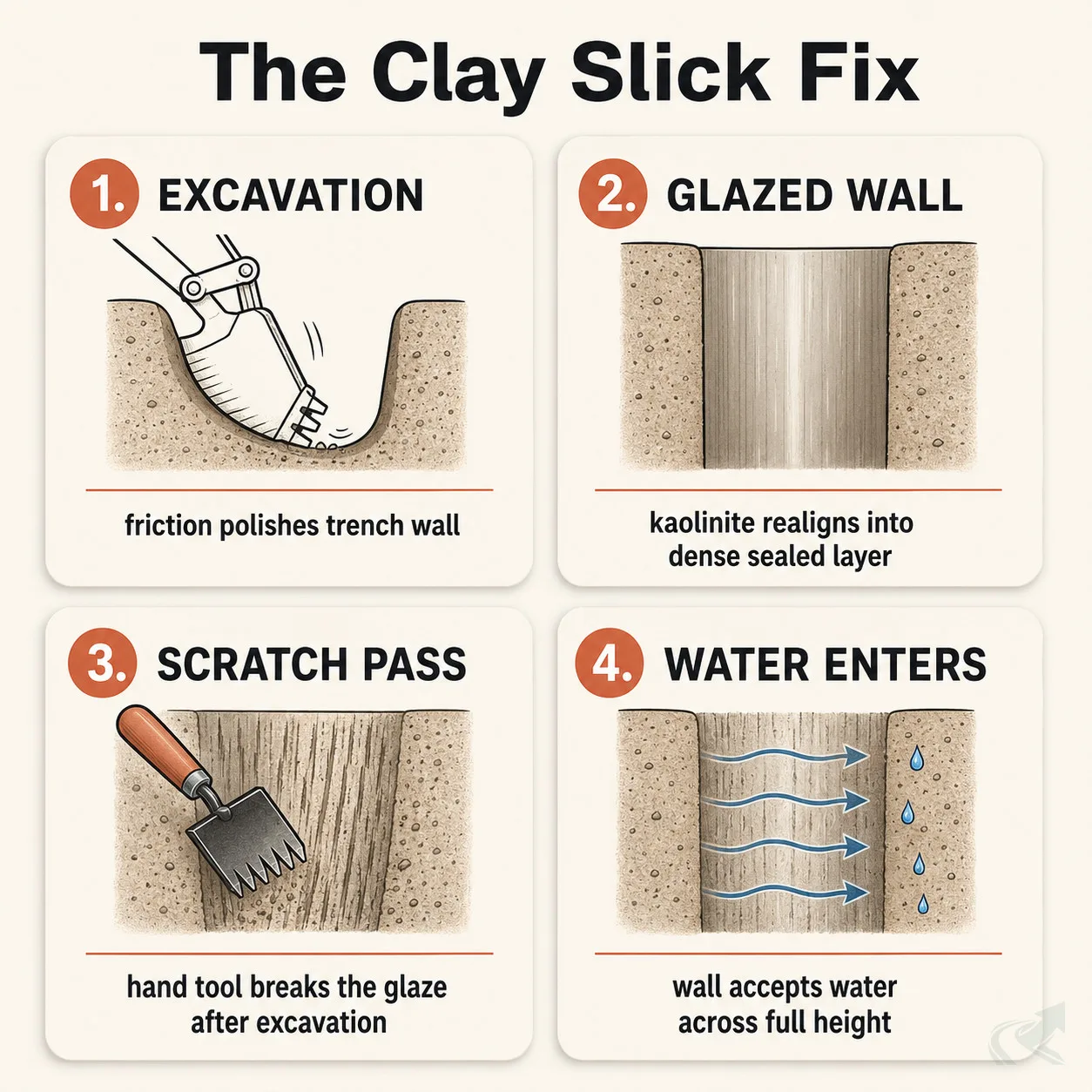
When an excavator bucket scrapes through NC clay, the pressure and friction polish the trench wall into a near-impermeable surface. Water cannot enter through that wall. A scratch pass breaks the seal.
Excavation in sandy or loamy soil leaves a rough, porous cut face. Water can enter the trench through that face along its full height.
Excavation in NC Piedmont clay does something different. The shear stress from the bucket blade compresses and realigns the surface kaolinite particles — smoothing them into a dense, glazed layer. This is called trench-wall glazing, or informally the “clay slick.”
That glazed surface is functionally impermeable. Water that should be entering the trench through the wall cannot. Instead it migrates around the trench and pools downslope.
The fix is a scratch pass — using a hand tool or the bucket edge to roughen the wall surface after excavation and before gravel placement. This breaks the glaze and restores the wall’s ability to accept water.
Most national tutorials skip this step entirely. They are filmed in soils where glazing does not occur. A contractor working from a national template who has never installed in NC clay may not know this step exists — it is one of the patterns behind what goes wrong with DIY French drains in clay and uninformed contractor installs alike. It is a reasonable question to ask before a job starts.
The Dual-Nature Paradox — Slippery Wet, Concrete Dry
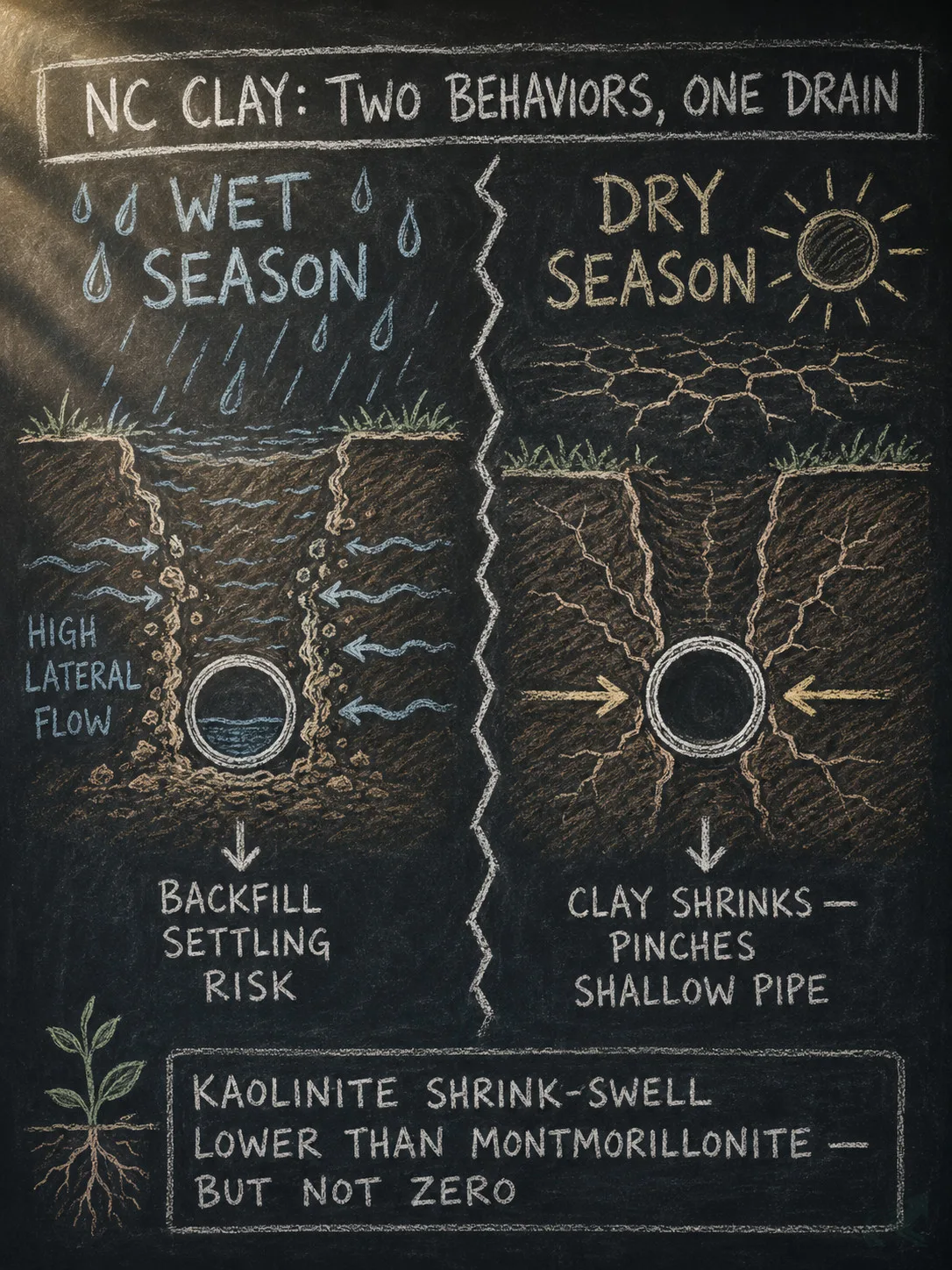
NC clay behaves like two different soils depending on moisture. Saturated, it is slippery and unstable. Dry, it is rigid and cracks. Both states affect French drain performance. Understanding how clay moisture changes drainage behavior helps explain why French drain performance varies dramatically between seasons on the same lot.
In wet season, saturated NC clay is at its highest lateral flow rate — which is exactly when the French drain is working hardest. Trench walls are most unstable at this point. Backfill settling is more likely. A trench opened and filled during a wet period needs more attention to compaction and aggregate placement.
In dry season, NC clay shrinks. The shrink-swell behavior of kaolinite is lower than montmorillonite, but it is not zero. Clay that shrinks can pinch a pipe installed at insufficient depth. The standard minimum pipe depth for NC Piedmont clay accounts for this — a pipe placed too shallow may be squeezed as the surrounding clay contracts around it over summer.
Both failure modes are seasonal and invisible once the system is backfilled. The contractor who accounts for them specifies pipe depth based on local clay behavior, not a national-template default.
How These Properties Change the French Drain Installation
Every clay-specific property changes at least one installation decision: kaolinite changes fabric choice; lateral flow changes trench placement and depth; clay slick changes trench-wall prep; dual nature changes pipe depth.
| Clay property | How it changes the install decision |
|---|---|
| Kaolinite platey structure | Fabric selection matters more here than in sandy soil. The wrong fabric sock can clog with fine kaolinite particles within a season. NC drainage contractors calibrated for Piedmont clay specify sock type based on the local clay fraction — see fabric vs no-fabric French drain NC clay for the full breakdown. |
| Lateral flow dominance | Trench placement is determined by flow path interception, not by proximity to the wet area. Depth must be sufficient to catch lateral flow at the subsurface horizon where it is traveling — not just at the surface. This often means a wider, deeper trench than a national-template install would specify. |
| Trench-wall glazing (clay slick) | A scratch pass to break the glazed wall surface is a required prep step before aggregate placement. Skip this and the wall cannot admit water regardless of the stone and pipe specification. |
| Shrink-swell / dual nature | Pipe depth must exceed the seasonal shrink zone. NC Piedmont clay’s active shrink zone is typically shallower than high-montmorillonite soils, but it is not zero. Minimum pipe depth in NC clay is set by both the lateral flow horizon and the shrink threshold — the deeper number governs. |
The Dr Drainz NC drainage method addresses several of these adaptations in its NC-specific install protocol. The ‘the clay stops the water’ debate explained covers the fabric-and-flow mechanics in more detail.
For the broader question of why NC requires a different drainage approach than other states, see why NC requires different drainage methods.
NC Homeowner Takeaway
What this means for the contractor conversation: a contractor who cannot name any of these properties — or who copies a national-template install without modification — is probably not calibrated for NC Piedmont clay.
The vocabulary test is simple. Ask your contractor to explain how they account for lateral flow and trench-wall prep in their French drain design for your site.
A contractor calibrated for North Carolina Piedmont will know what those terms mean. One working from a generic national tutorial will not. That gap in vocabulary is a gap in installation practice — and it shows up as a failed drain two seasons later.
Before you book, ask for an itemized quote that names the pipe depth spec, the aggregate spec (ideally #67 washed stone), the fabric choice with the reason, and whether a scratch pass is in the scope.
See the NC Piedmont red clay soil engineering reference for the geotechnical background behind these specs, and NC French drain installation for red clay for the full install overview.
When you are ready, hire a licensed NC grading contractor through NCGH’s verified directory — every listing includes the contractor’s NCLBGC license number so you can confirm their credential directly with the state.