
You received a fill dirt quote with two line items: screened fill at one price, unscreened fill at a lower price. The question is whether the screening matters for your application — and the honest answer is: sometimes it does, sometimes it doesn’t.
This page tells you when to pay for screened fill and when unscreened is the correct choice for a North Carolina project.
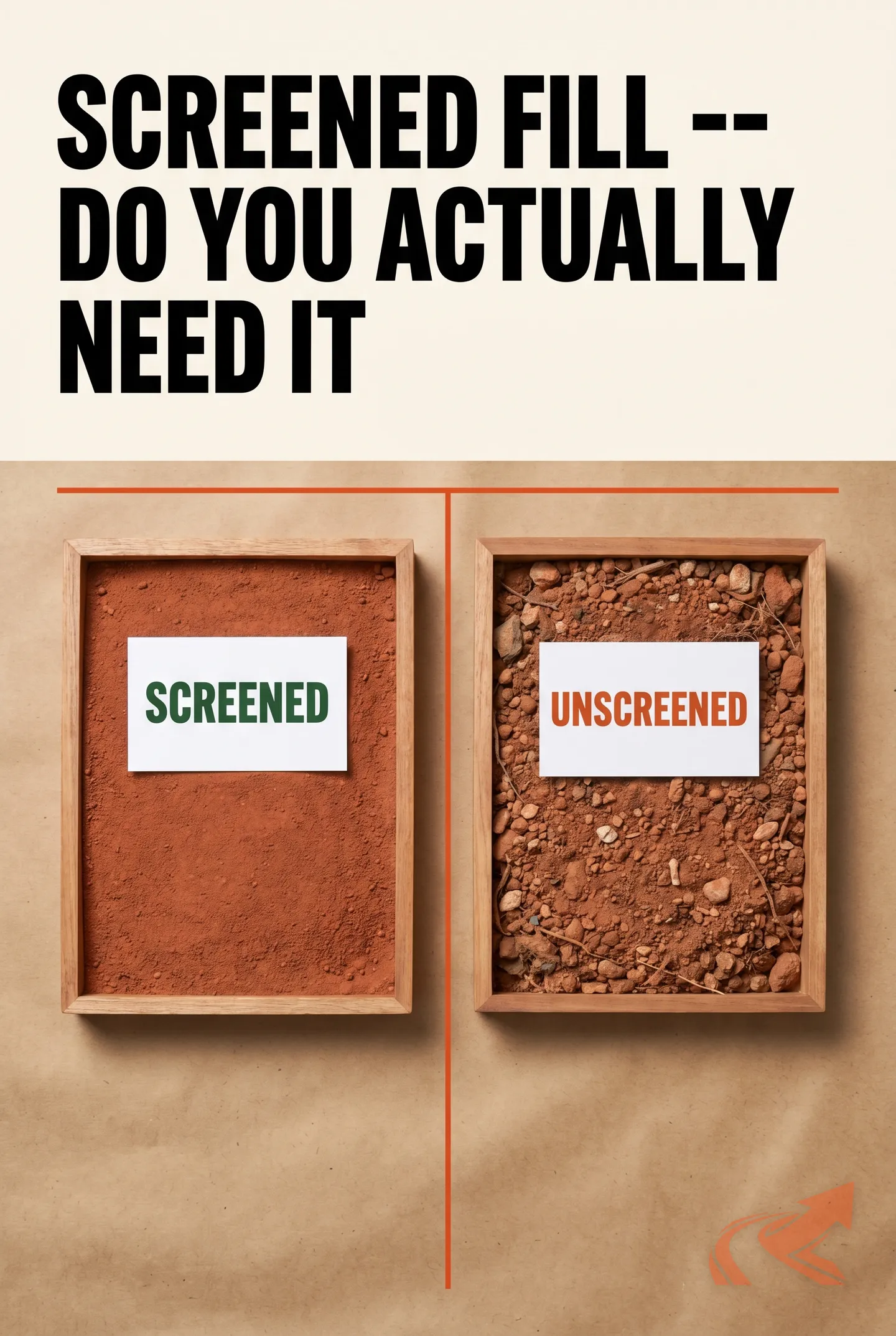
What Screening Actually Does
Screening removes material above a specified size from fill dirt — rocks, root fragments, clods, and debris — while leaving the fine particle fraction intact.
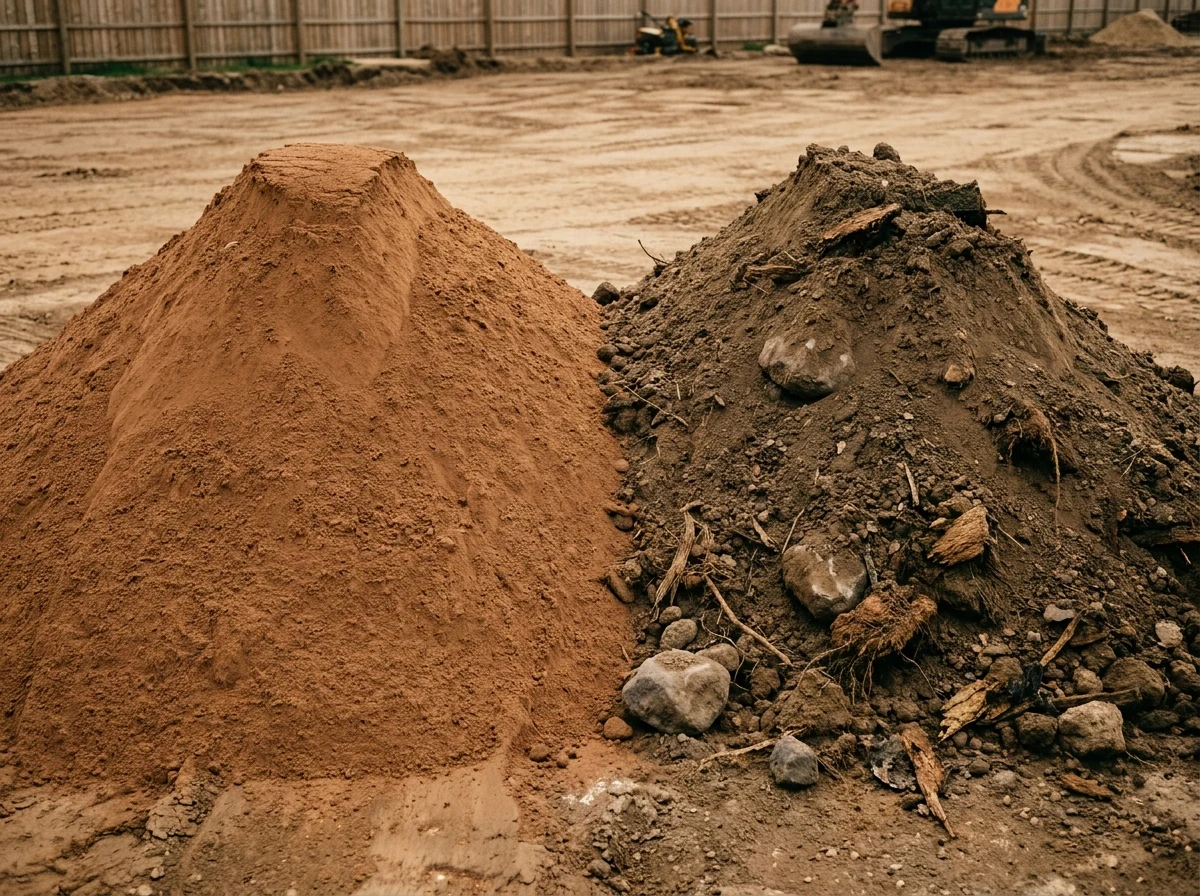
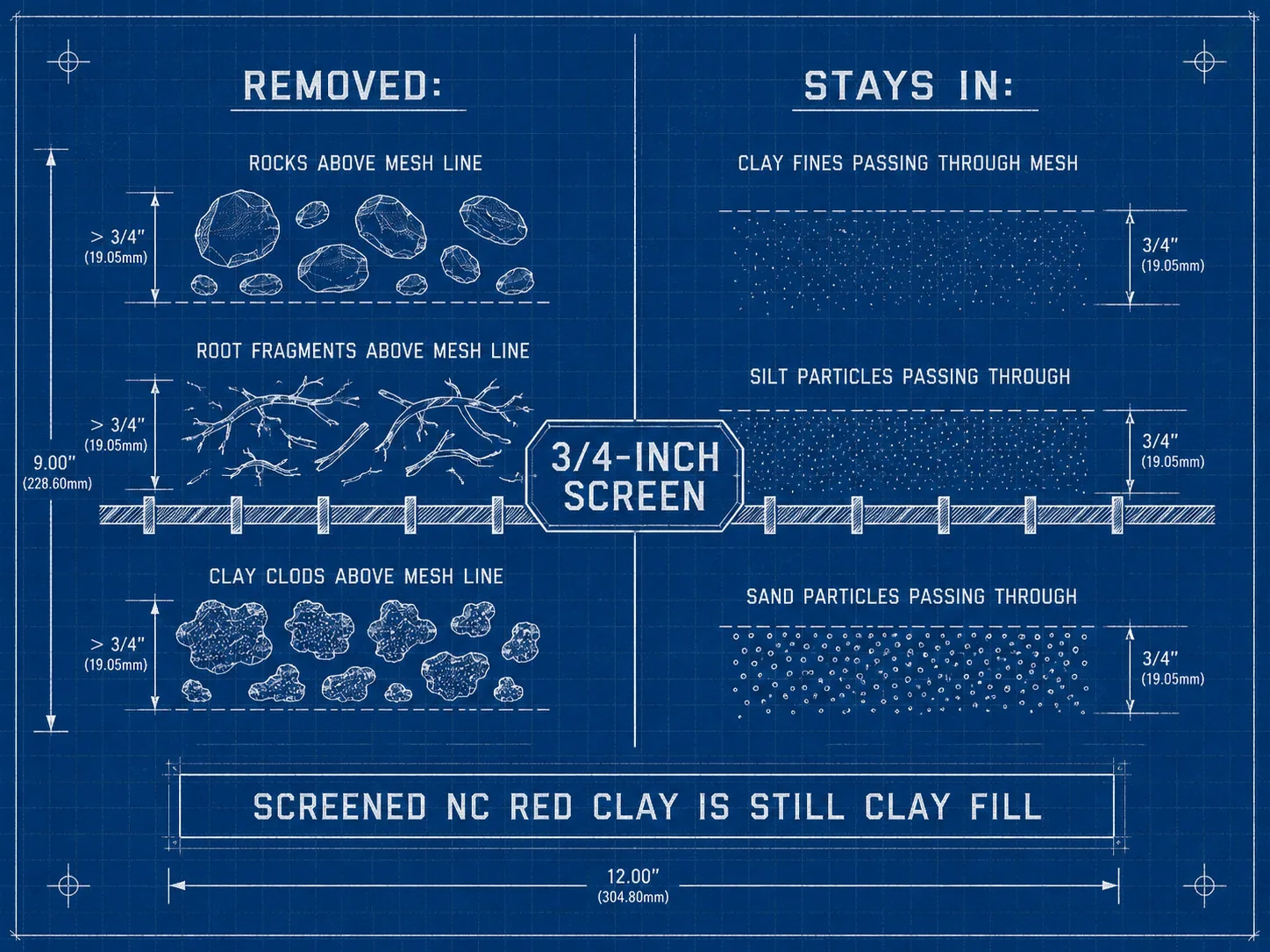
Fill dirt runs across a mesh screen — typically 3/4 inch opening for fine fill or 1-1/2 inch for bulk applications where only larger material needs separating. The 3/4 inch size is the most common for NC fill dirt hauling and screening options in North Carolina markets. Material larger than the mesh opening separates out. Material smaller than the opening falls through.
What gets removed from unscreened NC fill: rocks and gravel above mesh size, root fragments and root mat pieces, organic matter clods, clay aggregates that haven’t broken down.
What stays in screened fill: all the fines — including clay particles, silt, and fine sand fractions. Screening is not a way to reduce clay content. North Carolina red clay fill that gets screened is still red clay fill — it just has the oversized inclusions removed.
The mesh size specified matters. A 3/4-inch screen removes smaller debris than a 1-1/2-inch screen. Always ask your contractor: what mesh size does your screened fill use?
When Screened Fill Is Required
Screened fill is required any time material uniformity affects the outcome — utility trench backfill, near-structure fill, and any application with a compaction spec.
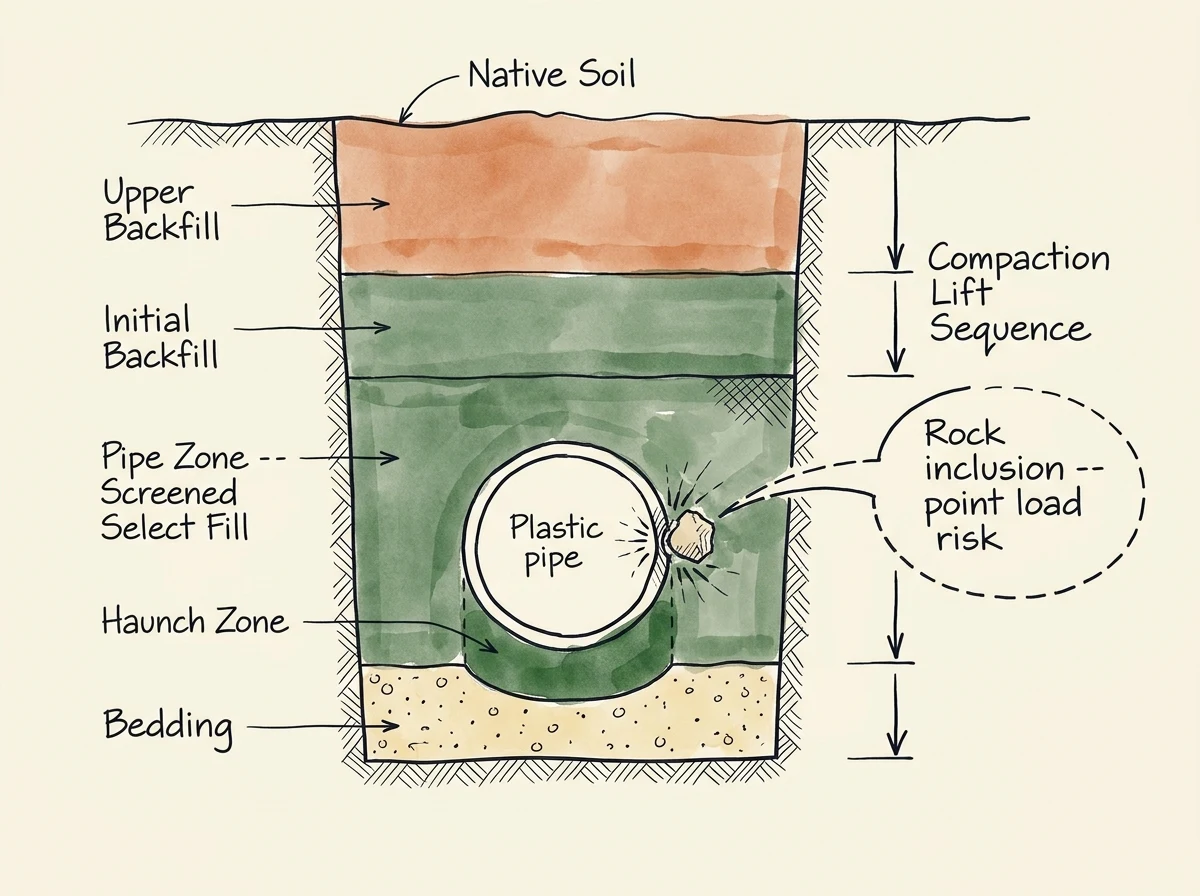
The clearest case is utility trench backfill. Rocks in unscreened fill can damage plastic pipes, puncture flexible conduit, or create point loads that cause long-term settlement around buried utilities. Most utility specifications in North Carolina require compactable, clean backfill within a defined zone around the pipe — unscreened fill typically doesn’t meet that specification. The NCDOT 2024 Standard Specifications (Section 300, Pipe Culverts, Article 1016-3) require classified Select Material (Class II Type 1 or Class III) in the pipe zone, not run-of-pit fill.
Near-structure fill has the same argument from a different angle. Compaction uniformity near foundations, footings, and building pads depends on consistent material. A large rock or root clod in the fill zone creates an inconsistent density pocket — the surrounding material compacts to spec while the inclusion doesn’t, producing differential settlement over time.
The application matrix covers the full decision set:
| Application | Screened required? | Reason |
|---|---|---|
| Utility trench backfill | Yes | Protects pipes from rock damage; compaction spec |
| Near-foundation fill | Yes | Compaction uniformity prevents differential settlement |
| Building pad subgrade | Yes | Compaction spec requires consistent material |
| Landscape / garden base | Yes | Consistent texture; roots and rocks disrupt planting |
| Bulk rough fill (away from structures) | No | Rock and root presence is acceptable at this stage |
For landscape and garden applications, the concern is texture rather than structural compaction. A raised garden bed or planting area filled with unscreened material will have rocks and root fragments disrupting plant establishment. Most North Carolina landscaping contractors specify screened fill or screened fill as a topsoil substitute in NC for any planting application.
When Unscreened Fill Is Fine
Unscreened fill is the correct choice for bulk rough-fill applications — large grade changes, base layer fills, and any location away from structures and underground utilities.
If you are raising a low spot on a residential lot that sits 40 feet from any structure or utility, unscreened fill is the right material. The rocks and root fragments do not affect the outcome. The fill will compact acceptably, drainage will follow grade, and the lower price is the correct trade-off.
Unscreened fill also works as a base layer under screened material. A common approach for large fill projects: bring in unscreened fill to establish rough grade, then cap the top 12-18 inches with screened material for the surface that contacts structures, utilities, or landscaping. Estimating fill dirt volume in yards vs tons before ordering keeps the bulk material cost low while meeting the specification at the critical zone.
The key qualifier in every case is distance from structures and utilities. NC projects with utility lines, buried drainage, or structures within a few feet of the fill zone should not use unscreened material in that proximity — use screened fill in the zone that matters and unscreened fill for the bulk below and away.
NC Red Clay and Screening
Screening removes large inclusions from North Carolina red clay fill — but it does not remove the clay fines. Screened NC red clay is still clay fill.
This is the distinction that catches homeowners. When you order screened red clay fill, you are ordering fill that has been processed to remove rocks, root mat, and oversized clods. The fine particle fraction — including all the clay minerals that give NC red clay its characteristic behavior — remains in the screened material.
What this means for drainage: screened NC red clay fill still drains slowly. It still expands when wet and contracts when dry. Screening improves compaction consistency by eliminating large inclusions that create irregular density pockets, but it does not change the drainage or shrink-swell behavior of the clay fraction.
For most structural fill applications in North Carolina — near-foundation fills, utility zone backfill, building pad subgrade — screened red clay meets the compaction requirement when properly placed and compacted in lifts. Find a verified NC grading and hauling contractor who knows NC clay to confirm the right lift thickness and compaction method for your site. The NC State Building Code (Appendix J, Grading) requires all fill to be compacted in lifts not exceeding 12 inches in depth, to 90 percent of maximum density per the ASTM D1557 Modified Proctor test, with no rock or irreducible material larger than 12 inches in any dimension.
Where unscreened NC red clay creates the most visible problem is utility trench backfill. Unscreened clay fill contains root mat pieces and clay clods that don’t break down uniformly under compaction. The result is inconsistent density around the pipe — which shows up as surface settlement over the trench line 1-2 growing seasons after installation.
For more on how NC red clay behaves as a fill material, see NC red clay fill screened vs unscreened.
Price Difference and When It Is Worth It
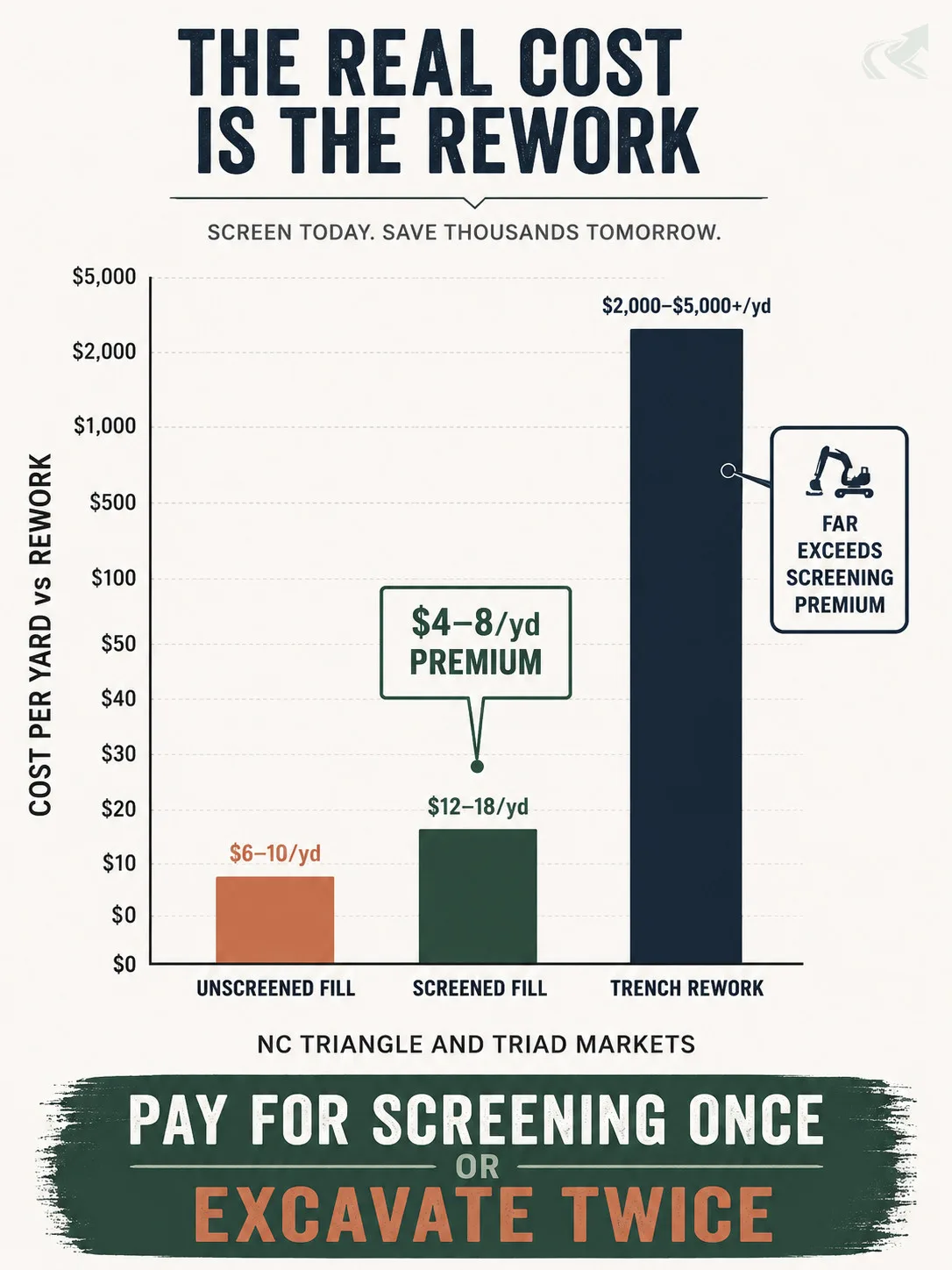
Screened fill costs more because it is a processed material — expect a $4-8 per yard premium in Triangle and Triad markets, though this varies by supplier and season.
The break-even calculation is straightforward: if the application requires screened fill, pay for it. Reworking improperly backfilled utility trenches or correcting differential settlement near a foundation costs more than the screening premium per yard on the original order.
If the application does not require screened fill — bulk rough grade fill, base layers, non-structural fills away from structures — there is no break-even calculation. Screened fill in those applications is overhead with no structural benefit.
The one case to specify screened fill for liability reasons even when not technically required: any fill placed in the zone that a future utility, structure, or hardscape might occupy. If you are not certain what gets built over a fill area within the next 3-5 years, screened fill in the top 18-24 inches is cheap insurance against having to excavate and re-specify later.
For current pricing by yard across North Carolina, see cost difference between screened and unscreened fill NC.
Question Card — What to Ask Before You Order
Before placing a fill dirt order in North Carolina, use this three-part check:
(1) Is this application near a utility, structure, or building pad? If yes — screened fill is required. Do not substitute unscreened fill to save money at the zone that matters.
(2) Is this bulk fill away from all structures and utilities? If yes — unscreened fill is acceptable and significantly cheaper. Use it.
(3) What mesh size is your screened fill? Ask your contractor or supplier. The most common size in NC markets is 3/4 inch, which removes debris down to roughly 3/4 inch. A 1-1/2 inch screen is sometimes used for bulk fill applications where only the largest rocks and root masses need separating. The answer tells you what actually gets separated from your material.
Find a Verified NC Contractor Who Specs Fill Correctly
The difference between a properly-specced fill order and a rework job later often comes down to whether the contractor asked what the fill is for before recommending screened or unscreened.
Verified North Carolina grading and hauling contractors on this directory have confirmed active NCLBGC licenses. Browse fill dirt options including screened and unscreened NC to understand the full material decision, then hire an NC hauling operator who will put the material specification in writing before the truck rolls.