
Traffic control for NC hauling -- quick answers
When do NC hauling operations require traffic control?
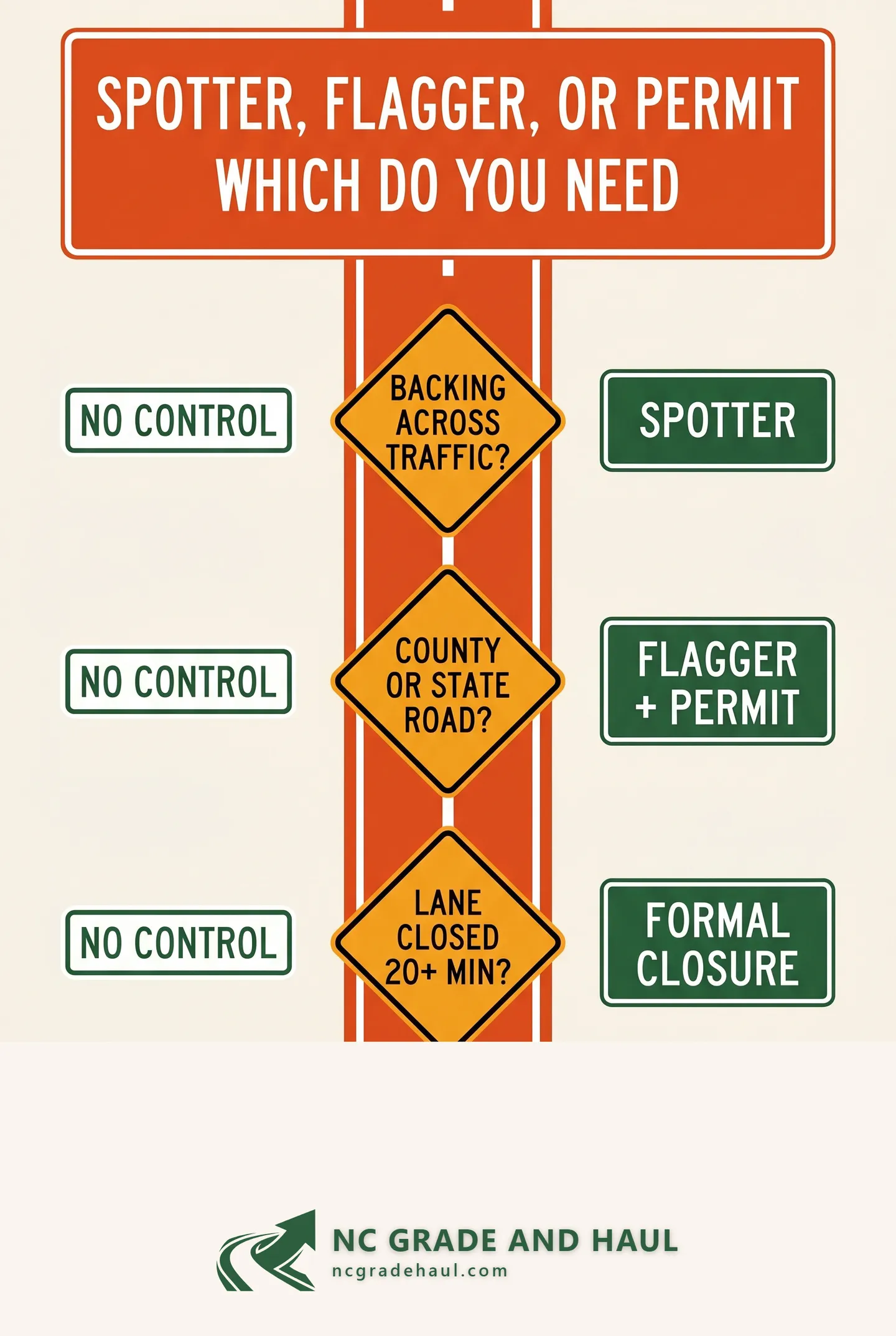
Traffic control is required when: trucks block a travel lane during delivery, trucks must back across active traffic, or operations create sight-line hazards. On residential streets -- a spotter at the apron for backing maneuvers. On county and state roads -- a flagperson and signage per NCDOT MUTCD standards. The specific requirement depends on the road class and the maneuver involved.
My hauling quote has a 'traffic control' line item -- is that legitimate?
In many cases, yes. If your delivery requires a truck to back across an active road or block a travel lane, traffic control is a real operational requirement -- not a fee addition. The line item should specify what it covers: a spotter, a flagperson, or a lane closure permit. Ask the contractor to explain the trigger condition for your specific job.
You received a hauling quote with a traffic control line item. Before deciding whether to push back on it, you need to know the specific trigger conditions — because in some situations, traffic control is a genuine legal and liability requirement, not a contractor preference.
This page walks through when each type of traffic control applies in North Carolina, who is responsible for providing it, and how it affects your total hauling cost.
What Traffic Control Means for Hauling
Traffic control in hauling operations covers three distinct tools: spotters, flagpersons, and lane closure devices — each applies to a different situation.
A spotter stands near the truck during a backing maneuver, clears pedestrians and oncoming vehicles, and directs the driver. Spotters are used on residential deliveries where a dump truck must cross or block a travel lane to reach a driveway.
A flagperson (also called a flagger) is a trained, certified traffic control worker who manages vehicle flow using a flag or stop/slow paddle. Flagpersons are used on county and state roads where active lanes must be controlled during loading, dumping, or staging operations.
Lane closure devices — cones, signs, and arrow boards — are the physical infrastructure that marks the closure zone. On roadways subject to NCDOT jurisdiction, these must meet the standards set out in the as adopted by North Carolina under G.S. § 136-30, which requires all traffic control devices on the state highway system to conform to the Uniform Manual and any NCDOT supplement. The NCDOT supplement defines specific sign spacing, taper lengths, and device requirements by road speed and classification.
Lane Closure Components -- Approach to Work Zone
1. Advance Warning Signs -- Posted at MUTCD-required distances before the closure zone -- signal approaching drivers that a lane is ahead 2. Merge Taper Cones -- Channelizing devices angled across the lane to guide traffic out of the closed lane and into the open lane 3. Flagperson Station -- Certified flagger positioned at the taper end to manage two-way traffic flow through the single open lane 4. Buffer Space -- Protected gap between the flagperson station and the work zone -- keeps workers clear of traffic 5. Arrow Board -- Required on higher-speed roads -- mounted on a vehicle or stand, points traffic toward the open lane 6. Work Zone -- Area where the dump truck is loading, dumping, or staging -- protected by the full closure setup upstream
-
Advance Warning Signs
Posted at MUTCD-required distances before the closure zone -- signal approaching drivers that a lane is ahead
-
Merge Taper Cones
Channelizing devices angled across the lane to guide traffic out of the closed lane and into the open lane
-
Flagperson Station
Certified flagger positioned at the taper end to manage two-way traffic flow through the single open lane
-
Buffer Space
Protected gap between the flagperson station and the work zone -- keeps workers clear of traffic
-
Arrow Board
Required on higher-speed roads -- mounted on a vehicle or stand, points traffic toward the open lane
-
Work Zone
Area where the dump truck is loading, dumping, or staging -- protected by the full closure setup upstream
MUTCD Part 6 and NCDOT Division 11 Work Zone Traffic Control specifications govern sign spacing, taper lengths, and device requirements by road speed and classification.
The contractor is responsible for determining which type of control applies to a given job and for providing it. The property owner is not responsible for directing or controlling traffic — and taking on that role without authorization creates liability exposure (covered in the liability section below).
Residential Street Delivery — The Spotter Standard
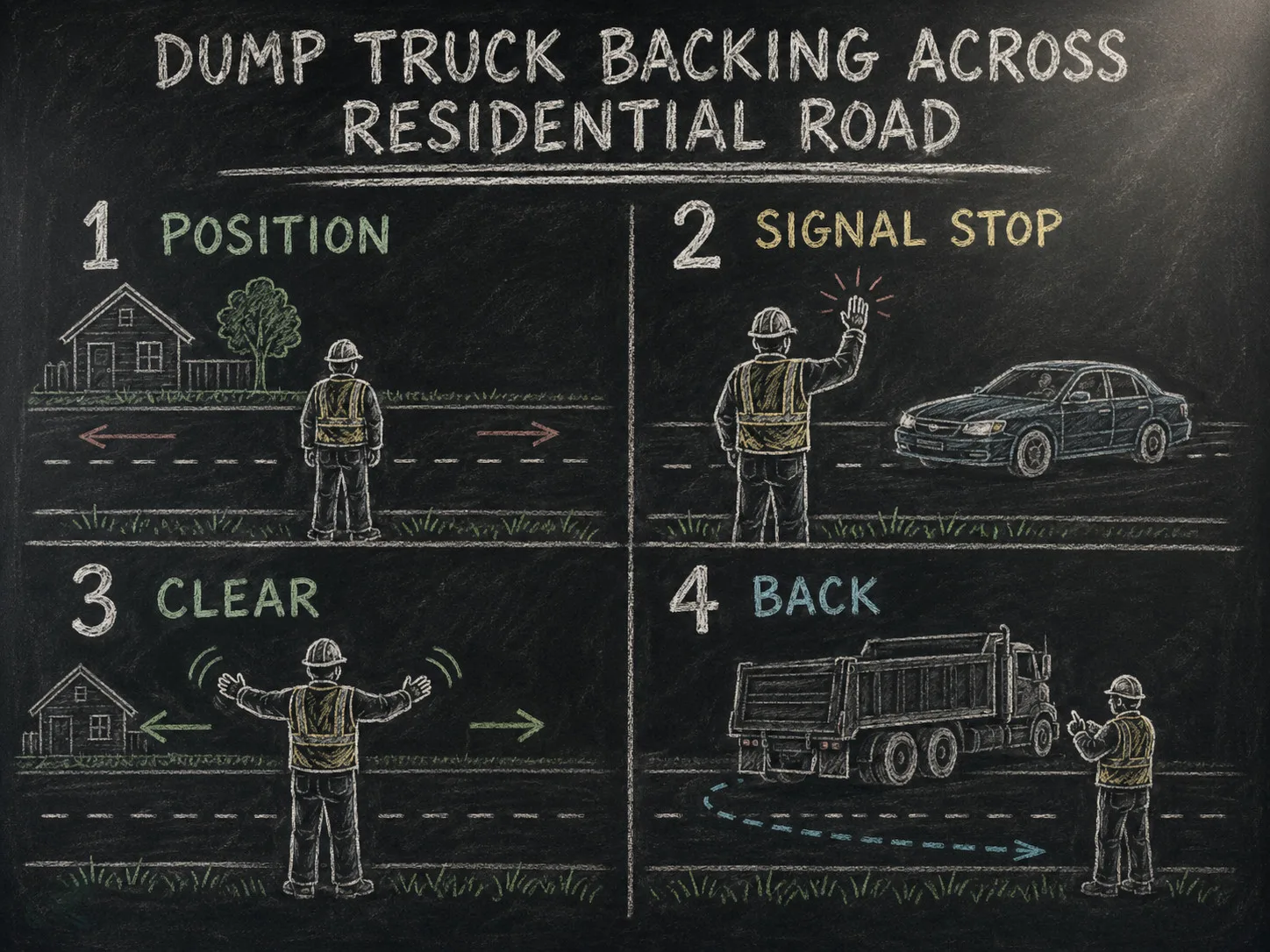
On residential streets, a spotter is required any time a dump truck must back across an active travel lane to reach the delivery point.
The most common residential hauling scenario is a gravel or fill delivery where the driveway entry is too narrow or too short for a full-length dump truck to pull in straight. The driver must back across the road from the opposite lane or block a portion of the travel lane while maneuvering. Without a spotter, there is no warning for approaching vehicles or pedestrians.
North Carolina does not publish a single statewide residential spotter standard that applies universally to private hauling deliveries. NCDOT’s work zone traffic control requirements apply to NCDOT right-of-way and state-maintained roads; there is no equivalent statute or rule that universally governs a private contractor’s backing maneuver on a local residential street. Requirements can vary by municipality. In practice, the contractor’s duty of care and liability exposure are the operative drivers: a loaded dump truck backing across an active road without any traffic warning creates serious liability for the contractor and the property owner if there is an incident.
What a spotter does during a residential backing maneuver:
- Positions at the edge of the road with a clear view of approaching traffic from both directions
- Signals the driver to stop when a vehicle or pedestrian is approaching
- Clears the lane before signaling the driver to continue backing
- Does not direct traffic — spotters manage the driver, not the road
One important constraint: an informal spotter — a homeowner, a family member, or a bystander — is not a substitute for a contractor-provided spotter. A contractor who proposes to back a loaded truck across an active road without a designated spotter is showing warning signs in NC hauling contractor quotes that warrant a conversation before work starts. If an incident occurs and the person directing the maneuver was not a designated employee of the contractor, the liability picture shifts. See the liability section for what this means in practice.
County and State Road Operations
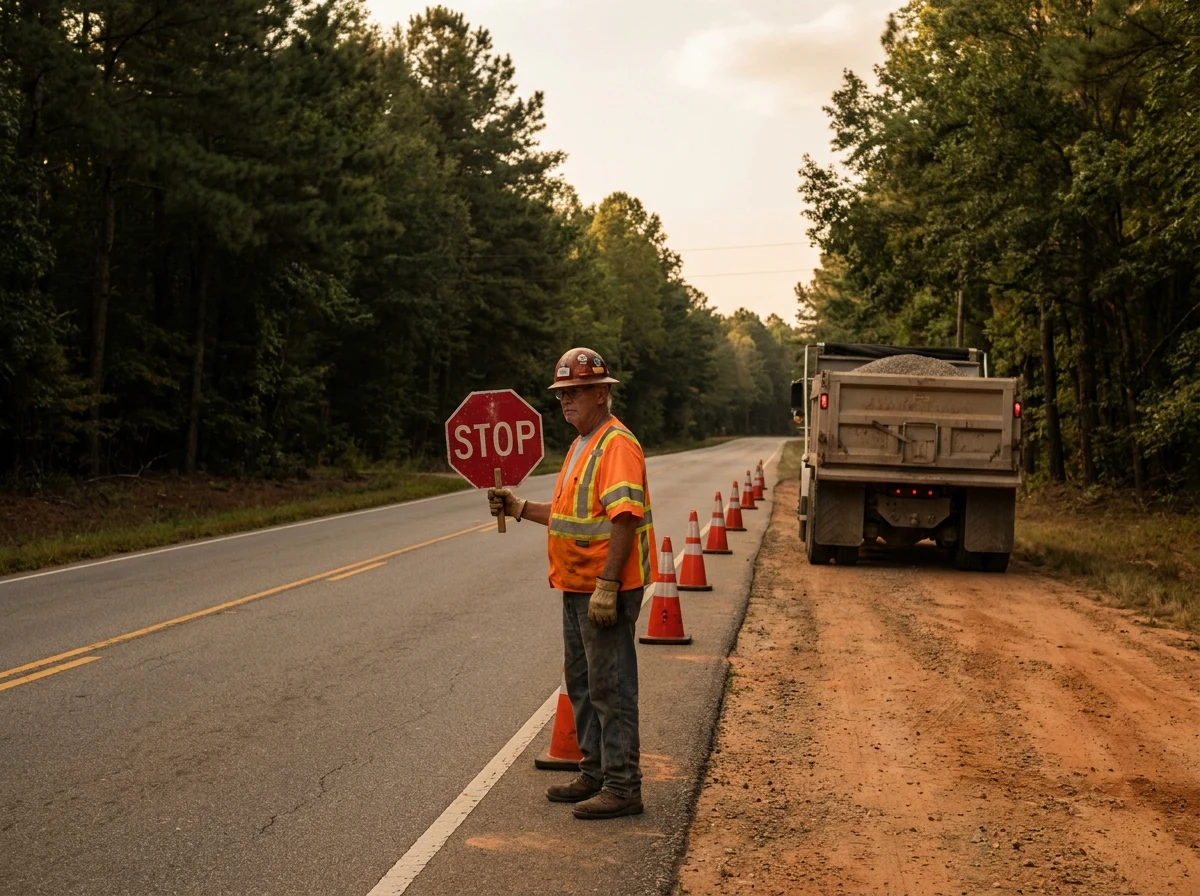
On county and state roads in North Carolina, any hauling operation that encroaches on a travel lane requires a certified flagperson and may require an NCDOT encroachment permit.
Road classification determines which standard applies. North Carolina roads fall into several classification tiers — primary highways (US/NC routes), secondary roads (SR numbers maintained by NCDOT), and municipally maintained roads. The higher the road classification and posted speed, the more formal the traffic control requirement.
For operations on NCDOT-maintained roads, any work or delivery that places equipment, vehicles, or materials within the right-of-way requires an encroachment agreement from the relevant NCDOT Division of Highways District Engineer’s office. Applicants submit six copies of the appropriate agreement form with six copies of plans to the District Engineer; NCDOT requires a minimum two-week review period for utility encroachments, and complex encroachments requiring review by multiple NCDOT units take longer. The encroachment agreement specifies what activity is permitted, the duration, and the required traffic control measures.
Flagpersons providing certified traffic control on North Carolina roadways must be trained in MUTCD standards. The contractor — not the property owner — is responsible for providing certified flagging and obtaining any required permits.
Typical elements of a county or state road lane closure for a hauling operation:
- Advanced warning signs placed at MUTCD-required distances from the closure zone (spacing tables in MUTCD Part 6 and NCDOT Division 11 Work Zone Traffic Control specifications, adopted under G.S. § 136-30)
- A flagperson at each end of the active zone if two-way traffic is maintained
- Cones or channelizing devices defining the taper and buffer
- Arrow boards on operations involving higher-speed roads
Duration matters. A short residential gravel delivery may require 20 minutes of lane encroachment. A longer cut-and-haul operation on a state road may require a formal lane closure that needs advance notice to the NCDOT division office. The permit and flagging cost scales with complexity and duration. The same road classification that governs traffic-control requirements also governs NC dump truck weight limits — a factor in route planning for larger hauling jobs.
For permit-related requirements on NCDOT roads, see NCDOT traffic control requirements for hauling operations.
Cost Impact — What Traffic Control Adds
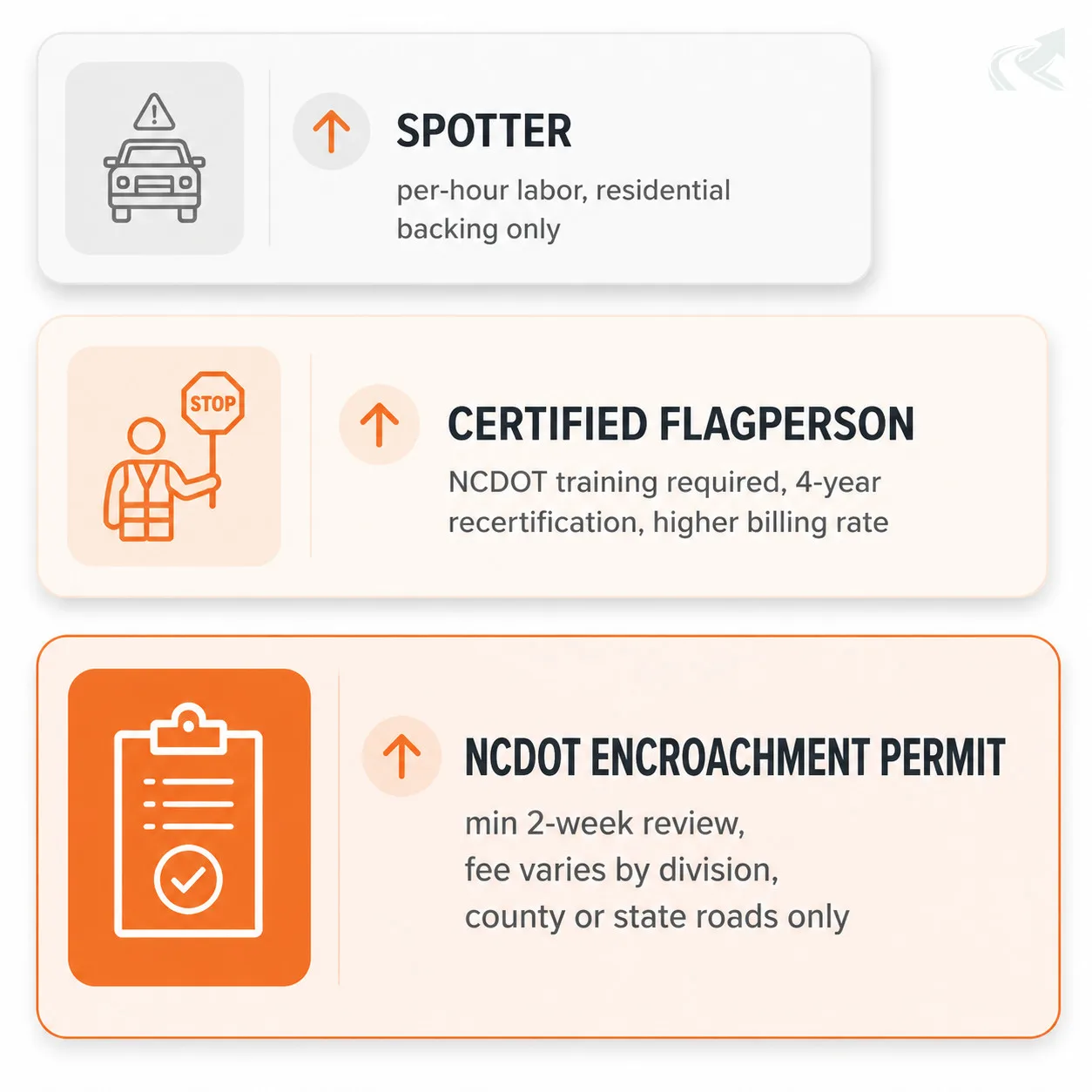
Traffic control is a real line item cost, and evaluating what each item covers in your hauling bid is the first step: a spotter adds labor, a flagperson adds certified-worker billing, and a lane closure permit adds a fee separate from either.
Spotter labor on a residential delivery is typically priced as a per-hour add-on. For a simple gravel delivery requiring 30-45 minutes of backing maneuvers, the spotter cost may be modest. Longer or more complex deliveries on busy streets push the time and cost up.
Certified flagperson billing runs higher than general labor because of the NCDOT-required training certification (every four years via an approved provider) and the liability the flagperson assumes by controlling public road traffic. North Carolina does not have a state prevailing wage law, so flagperson rates are set by each contractor and vary by market. On federally-funded projects, federal Davis-Bacon wage determinations may apply — but most private residential and commercial hauling jobs operate under contractor-set rates.
NCDOT encroachment permit fees vary by division and by the scope of the encroachment. NCDOT does not publish a single uniform lane-encroachment fee schedule; contact the relevant Division of Highways District Engineer’s office for current fees. The permit application process also takes time — the minimum NCDOT review period is two weeks, so a same-day permit is not available.
One way to reduce traffic control cost on large deliveries: batch loads. If a job requires 10 loads of fill and each load requires a spotter, scheduling all 10 loads in a single morning session may require the spotter for a 4-hour block rather than 10 separate callouts. Ask the contractor whether the traffic control cost in the quote assumes batched delivery scheduling.
Liability — Who Is Responsible
The contractor bears primary liability for traffic incidents during a hauling maneuver — but that exposure transfers to the property owner in specific situations.
The contractor is responsible for ensuring safe maneuvers during delivery. If a dump truck backing across a road strikes a vehicle or pedestrian, the contractor’s Commercial Auto policy and General Liability policy are the first line of defense. A contractor who provides a properly trained spotter, follows MUTCD standards on road encroachments, and obtains required permits has documented their due diligence.
Property owner liability enters the picture in two situations:
Directing the maneuver without authority. If a homeowner waves the driver back, tells the spotter to clear traffic, or otherwise takes control of the maneuver sequence and an incident occurs, the homeowner’s action (or inaction) is now part of the causation chain. Directing traffic on a public road without authorization also raises a separate issue under NC traffic law.
Providing an informal spotter. If the homeowner nominates a family member or neighbor to stand at the road and “watch for cars,” that person is not a designated traffic control worker under the contractor’s liability coverage. An incident involving that person acting as a spotter creates an exposure gap that neither the contractor’s policy nor a standard homeowner’s policy is likely to cover cleanly.
Before signing a hauling contract, confirm:
- Does the contractor’s explicitly cover commercial auto and general liability for hauling operations?
- Does the policy cover traffic control incidents — spotters and flagpersons are typically covered under GL, but confirm this with the contractor’s certificate.
- If the job is on a county or state road, confirm that any NCDOT encroachment permits are the contractor’s responsibility, not yours.
The certificate holder on the COI should be you (the property owner) for any job where trucks are maneuvering across or within a public road right-of-way.
Common Mistakes
Using a homeowner or family member as an informal spotter. An unlicensed informal spotter creates liability for the homeowner if there is an incident. If the contractor’s quote does not include a spotter and the job requires backing across traffic, the right move is to add a spotter to the scope — not to fill the gap informally.
Assuming traffic control is automatically included. Some contractors bundle a spotter or flagperson cost into the base delivery rate. Others quote it as a separate line item. Others do not include it at all and expect the property owner to manage the road. Confirm in writing whether traffic control is included and what it covers before work starts.
Backing a loaded dump truck across an active road without any traffic control. A driver proceeding without a spotter or warning — even briefly — is creating real exposure. One vehicle or cyclist approaching from a blind angle is enough for a serious incident. If the contractor proposes to back without any traffic warning, that is a flag worth addressing before the truck rolls.
Questions to Ask Before Signing
Before signing a hauling contract where delivery requires road maneuvering:
- Does the delivery require backing across an active travel lane?
- If yes — does the quote include a spotter or flagperson? What is their role exactly?
- If the job is on a county or state road — is an NCDOT encroachment permit included? Who pulls it?
- What is the contractor’s coverage for traffic incidents?
Getting clear answers to these four questions determines whether the traffic control line item in your quote is appropriately scoped — or whether something is missing.
For a broader look at traffic control within NC hauling regulations, the hub page covers permit requirements, weight limits, and the regulatory framework that applies to hauling operations across North Carolina.
To hire a verified NC grading and hauling contractor who handles traffic control as part of their hauling scope, the directory lists contractors by county with license verification source links.