
A homeowner in WNC was replacing a washed-out driveway culvert after Helene. His contractor told him it was a simple swap — no permits, just pull the old pipe and set a new one. Two weeks later, flagged the work. The replacement culvert was undersized per NCDOT standards. The driveway connection had never been permitted. The culvert came out again — at the homeowner’s expense.
That’s the NCDOT trap. Most experienced contractors know it. A lot of homeowners don’t find out until after the work is done.
This page explains the three NCDOT regulatory tracks that affect residential grading, driveway, and hauling work in North Carolina. It won’t tell you what to do — that’s what a licensed contractor is for. It will tell you what to ask before you sign anything.
For the full statewide regulations picture, start with the NC earthwork regulations hub. For county-level permit requirements, see the NC county permit matrix.
What NCDOT Regulates on Private Projects
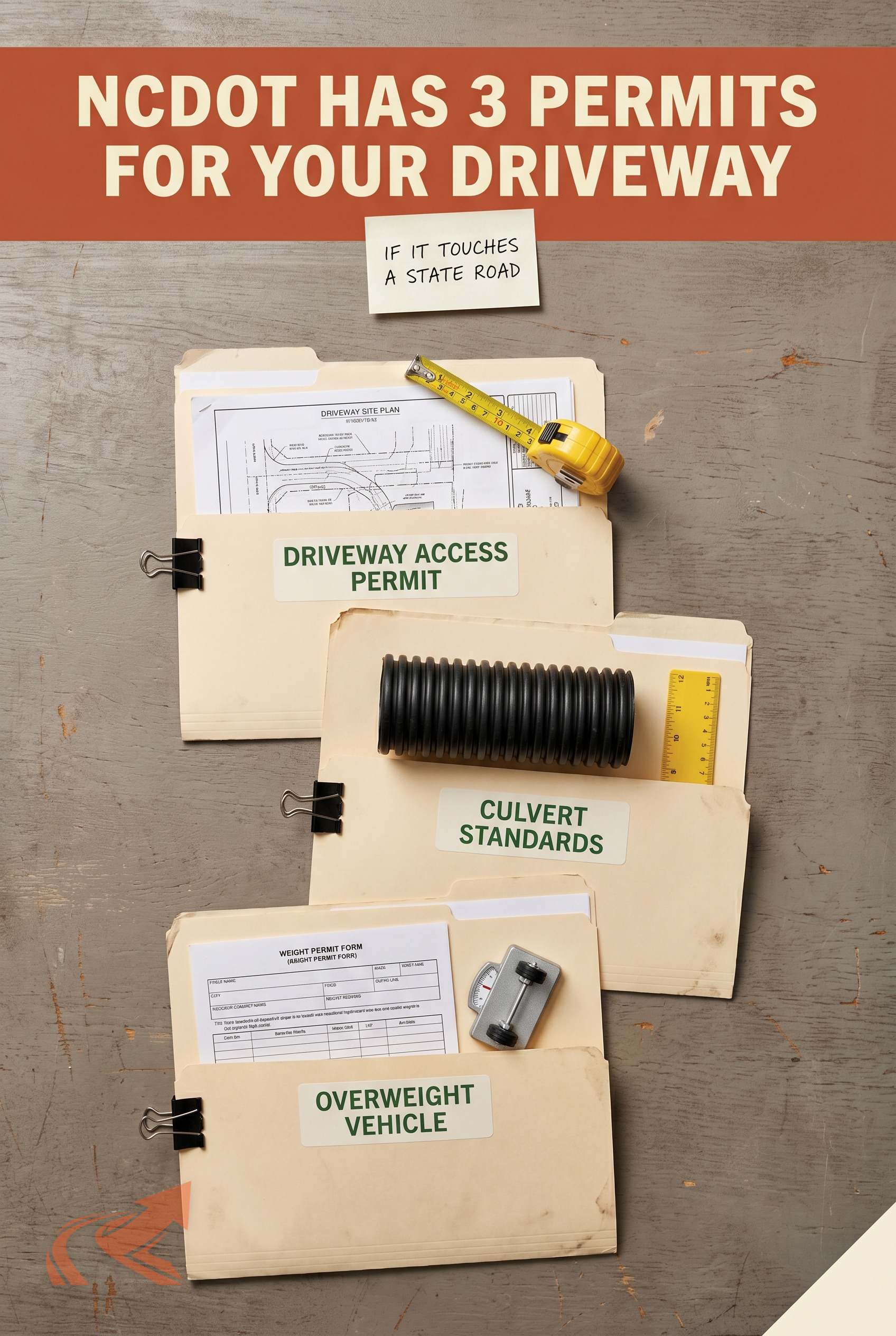
NCDOT has jurisdiction over anything that connects to, drains onto, or puts loads on NC-maintained roads — including driveways, culverts under driveway aprons, and haul trucks.
Most homeowners think of NCDOT as the agency that maintains state highways. That’s correct. But “NC-maintained road” includes a lot of roads that don’t look like highways — rural secondary roads, subdivision collector streets, and the two-lane in front of a WNC mountain property. If NCDOT maintains the road, the driveway connecting to it falls under NCDOT authority.
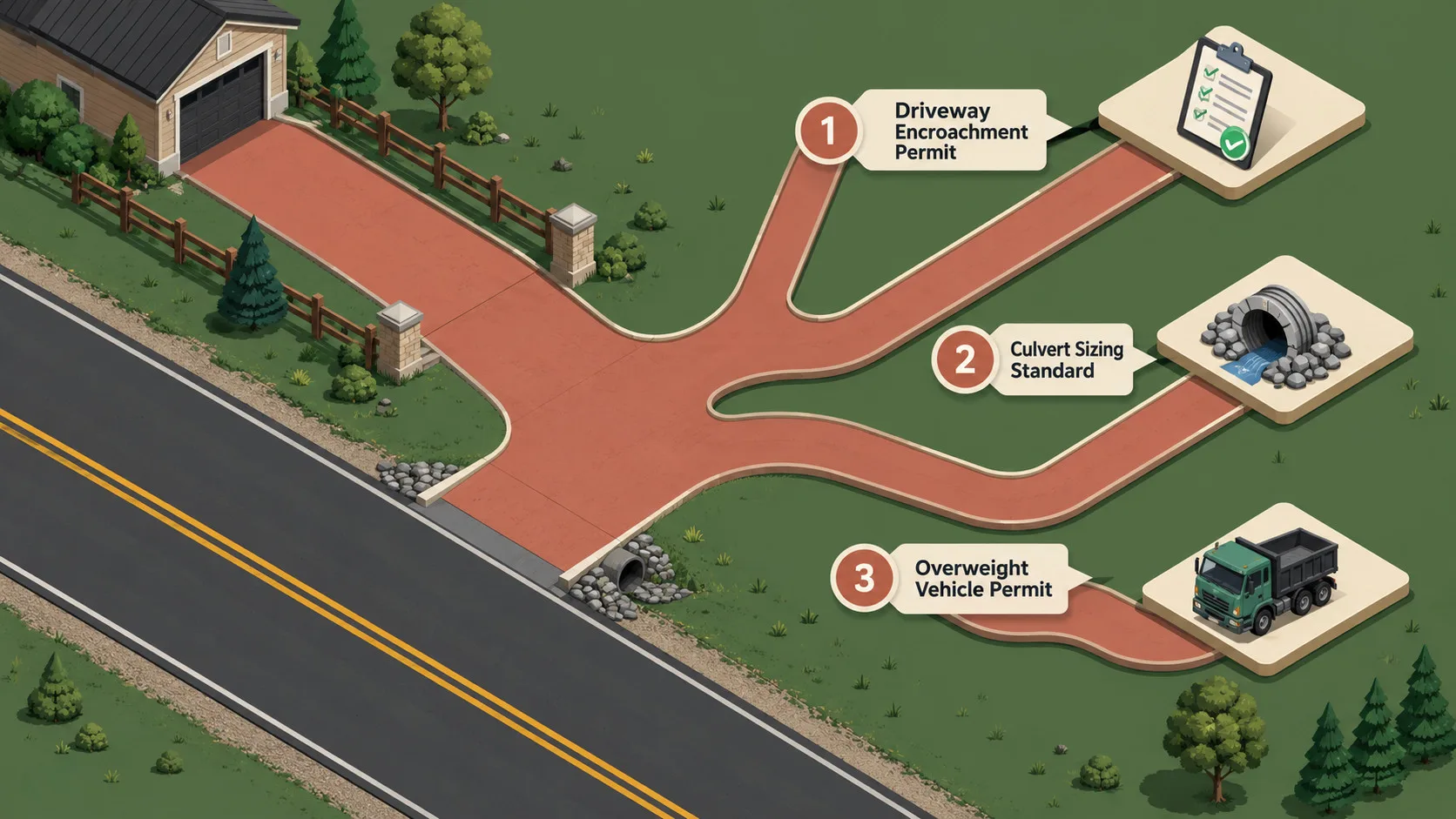
Three regulatory tracks apply to private projects:
- Driveway encroachment permits — required when a new driveway connection is made to an NC-maintained road, or when an existing connection is significantly modified.
- Culvert sizing and installation standards — NCDOT publishes minimum culvert diameter and material standards for driveways on state roads.
- Overweight vehicle permits — tri-axle dump trucks and any haul vehicle exceeding posted axle-weight limits need NCDOT authorization before using state roads.
Each track has its own application process. Missing one can stop a project or require re-work after the fact.
Driveway Encroachment Permits: What They Are and When You Need One
Any new driveway connection to an NC-maintained road — or a significant modification to an existing one — requires an encroachment agreement from NCDOT.
An encroachment agreement is NCDOT’s formal authorization for any work that “encroaches” on the state’s right-of-way. A new driveway apron is encroachment. Widening an existing driveway connection is encroachment. Replacing a driveway apron’s culvert is encroachment. This means NC driveway grading projects that touch a state-road connection typically need an encroachment agreement before equipment arrives.
NC-maintained vs. county-maintained vs. private — this is the distinction most homeowners miss. NCDOT maintains state routes and secondary roads that meet certain standards — roughly 80 percent of public roadways in the state. Many roads that look like county roads are actually state-maintained. NCDOT’s Public Street Information Database Map (HB620) at connect.ncdot.gov/resources/gis/Pages/Database-Map-HB620.aspx shows which roads fall under which authority; a separate Secondary Roads lookup is at apps.ncdot.gov/srlookup/. Do not assume based on appearances.
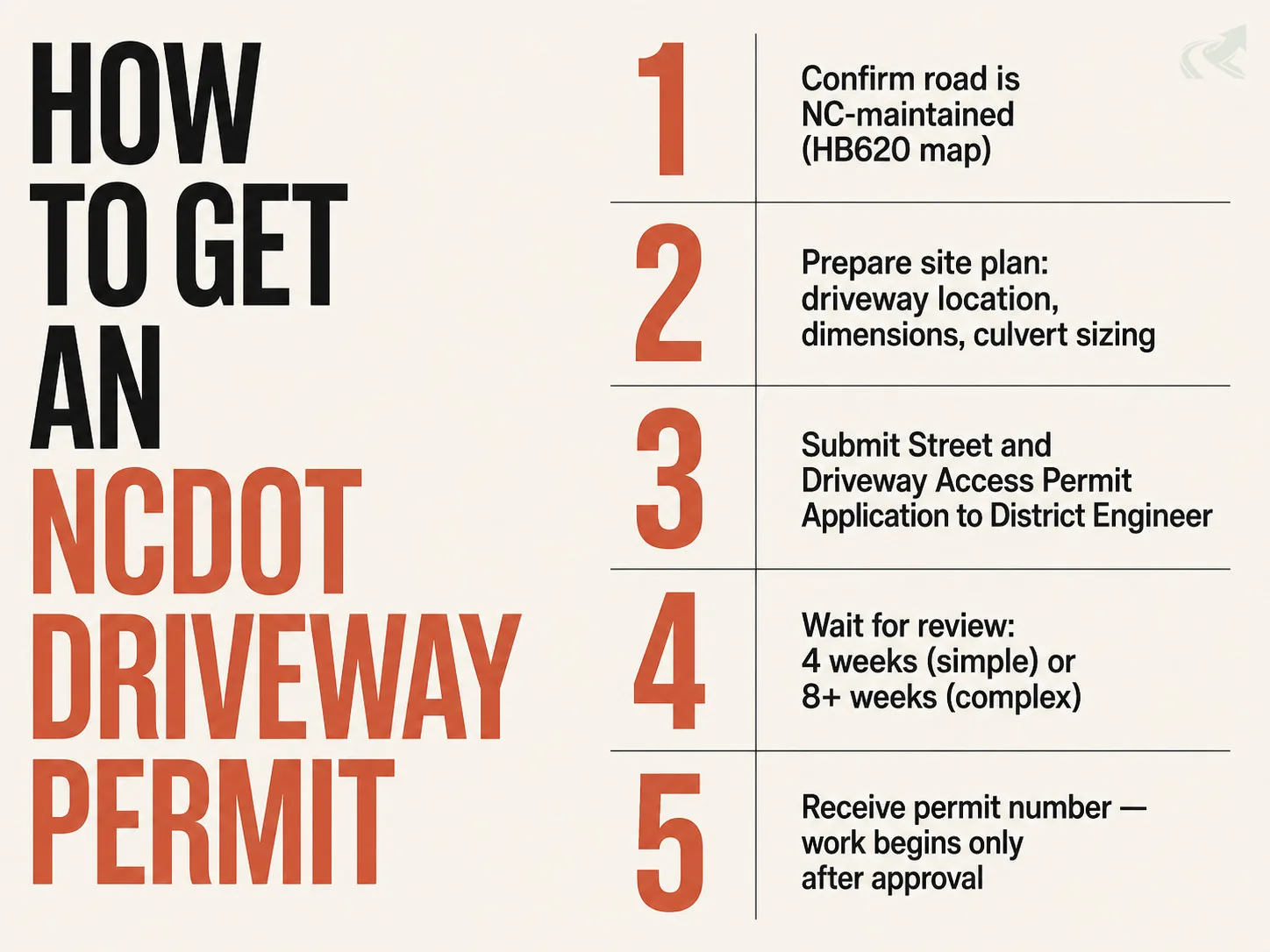
To apply for a driveway permit, the homeowner or contractor contacts the local NCDOT District Engineer’s office and submits a Street and Driveway Access Permit Application with a site plan showing the driveway location, connection geometry, and culvert sizing. NCDOT does not charge a fee for applying for a driveway permit, though charges may be incurred for services such as inspections and traffic signal plan review.
Review happens at the NCDOT district level. For small or simple residential requests, NCDOT processes the permit in four weeks or less after formal submittal to the District Engineer’s office; complex requests can take eight weeks or more. Work before approval = work without authorization.
For detailed guidance on the culvert portion of a driveway encroachment application, see the NCDOT driveway culvert permit guide.
Culvert Requirements: Sizing, Material, and Inspection
NCDOT has published culvert sizing standards — if your culvert drains under a driveway that connects to a state road, it must meet those standards or NCDOT can require it to be replaced.
Culvert sizing is not at the contractor’s discretion on state-road driveways. North Carolina rule 19A NCAC 02D .0421 restricts driveway pipe to a minimum inside diameter of 15 inches and a maximum of 48 inches unless otherwise directed by the Department, with a minimum installed length of 20 feet. The specific size required for a given driveway is determined by NCDOT based on the property’s drainage conditions, not chosen by the contractor.
The culvert must also be installed per NCDOT specifications and pass inspection before the encroachment agreement is closed out.
State-road driveway culvert: NCDOT-compliant vs flagged
Comparison. Meets NCDOT spec: Pipe sized by NCDOT for the site's drainage; Inside diameter within the 15-to-48-inch rule; Installed per spec and passed inspection; Encroachment agreement closed out clean. Flagged after the fact: Undersized culvert -- fit the budget, not the spec; Road ditch backs up and erodes; NCDOT issues a notice to replace the pipe; Homeowner pays to dig it out and redo it.
- Pipe sized by NCDOT for the site's drainage
- Inside diameter within the 15-to-48-inch rule
- Installed per spec and passed inspection
- Encroachment agreement closed out clean
- Undersized culvert -- fit the budget, not the spec
- Road ditch backs up and erodes
- NCDOT issues a notice to replace the pipe
- Homeowner pays to dig it out and redo it
Culvert sizing on a state-road driveway is NCDOT's call, not the contractor's -- get the sizing documented before signing.
The #1 reason NCDOT flags driveway work after the fact is an undersized culvert. A contractor installs the pipe that fits the project budget, not necessarily the pipe that meets NCDOT’s minimum spec. Two years later, the road ditch backs up, NCDOT investigates, finds the culvert, and the homeowner is on the hook for the replacement.
The fix: before signing a driveway contract that involves a state-road connection, ask the contractor specifically whether the culvert has been sized per NCDOT standards and whether sizing documentation will be submitted with the encroachment application.
Overweight Vehicle Permits: When Your Haul Trucks Need NCDOT Authorization
Tri-axle dump trucks loaded near legal limits — and any truck over the state’s posted axle-weight limits — require an overweight permit from NCDOT before using state roads.
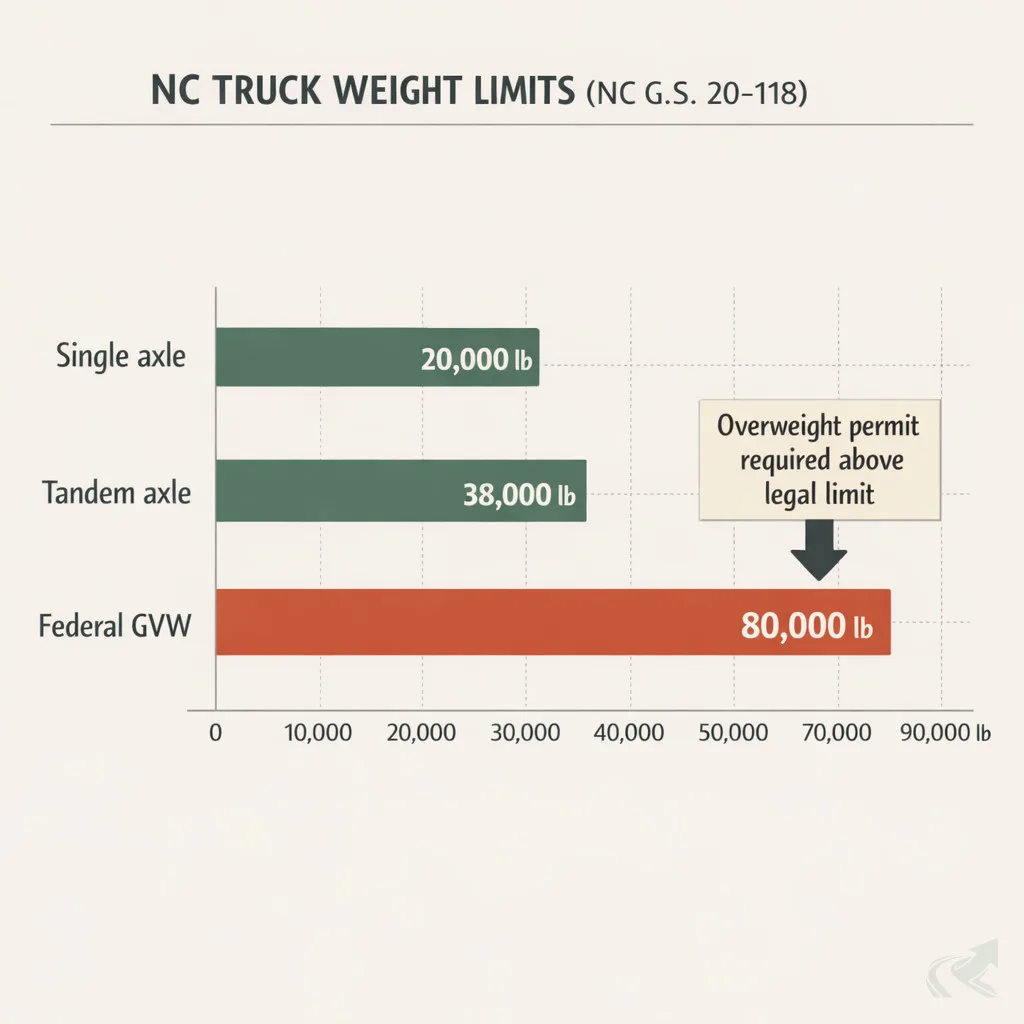
The federal gross vehicle weight limit is 80,000 lb. North Carolina General Statute 20-118 sets the axle limits that govern this: a single axle may not exceed 20,000 lb and a tandem axle may not exceed 38,000 lb. Any vehicle exceeding the legal weight set by NC law needs a permit from NCDOT’s Oversize/Overweight Permit Unit before using state roads.
A standard tandem dump truck in NC carries around 14-16 tons of payload before hitting weight limits. Tri-axle trucks carry more per load — but a fully loaded tri-axle on a posted-weight secondary road may require a permit or a modified haul route to stay legal.
The haul route matters. Some secondary roads in NC carry weight-limit postings that restrict heavy trucks. A contractor hauling fill dirt or gravel for a large site project should identify the haul route and confirm whether any overweight permits are required before the first truck rolls. That plan should be in writing.
For the full picture on NC hauling regulations, including haul-route ordinances, see NC hauling regulations and NCDOT weight limits.
Right-of-Way Work: Grading Near a State Road
Any grading, fill, or drainage work within NCDOT’s right-of-way — even on your own property’s edge — requires NCDOT encroachment authorization.
The right-of-way extends beyond the paved road surface. It includes shoulders, roadside ditches, and in many cases a strip of your property that NCDOT controls for road maintenance purposes. The ROW width varies by road classification. NCDOT’s Subdivision Roads Minimum Construction Standards set the minimum right-of-way at 45 feet for local subdivision streets, 50 feet for collector roads, and 60 feet for minor thoroughfares — and a recorded thoroughfare plan can require more. Older secondary roads predate these standards and their ROW can be narrower or irregular, which is why the boundary is worth confirming rather than estimating.
Homeowners frequently don’t know where the property line ends and the NCDOT right-of-way begins. The two are not the same thing. Grading right up to the edge of a roadside ditch, redirecting drainage into a road ditch, or placing fill near a shoulder can all fall within NCDOT’s ROW — which means NCDOT encroachment authorization applies even if no driveway is involved. Projects aimed at fixing NC standing water yard drainage that route water toward a state-road ditch are a common example where homeowners unexpectedly trigger ROW encroachment rules.
Practical check: if your project involves grading within 30-50 feet of a state-maintained road — or any work on a roadside ditch — ask your contractor to confirm whether any portion of the work falls within NCDOT’s ROW before the equipment arrives.
How to Apply and What to Expect
Driveway permit applications go to the local NCDOT District Engineer’s office; small or simple residential requests are processed in four weeks or less, complex ones in eight weeks or more.
Applications start with the local NCDOT District Engineer’s office covering your county, using the Street and Driveway Access Permit Application. The District Engineer can also identify safety and design issues and coordinate culvert pipe installation. Your contractor should know which District office covers your area.
Documents you’ll typically need:
- Site plan showing the driveway location, dimensions, and connection geometry
- Culvert sizing calculation or specification (if a culvert is involved)
- The contractor’s and compaction plan (for driveways requiring subbase documentation)
- Contractor’s North Carolina license number
- COI (Certificate of Insurance) — request a copy showing the contractor carries liability and workers’ comp before the permit is submitted; it’s needed for the application and protects you if something goes wrong during installation
After submission, NCDOT reviews and issues a permit number. Work should not begin on the encroachment until the permit is in hand. After work is complete, an NCDOT inspection closes out the permit. Get the closed permit documentation in writing — it’s your proof of compliance if the work is questioned later.
NCDOT division and district office contacts are listed in the Policy on Street and Driveway Access document and through the NCDOT District Engineer’s office covering your county.
What to Ask Your Contractor
Before signing a contract for driveway work touching a state road, ask the contractor specifically which NCDOT permits they’re pulling and whether the culvert has been sized per NCDOT standards.
A verified NC grading contractor who has done this work in North Carolina will answer this question without hesitation. They’ll name the permit type (encroachment agreement), confirm they’re familiar with the NCDOT Connect portal, and tell you whether the culvert spec meets state requirements. A contractor who says “you don’t need a permit for that” on a state-road driveway connection is either wrong or hoping you won’t check.
Ask for the permit application copies before work starts and the closed permit documentation after work is complete. Both go in your project file. If the project ever changes hands or NCDOT investigates, you have the paper trail.
Also ask for an itemized quote — one that breaks out the encroachment permit fee, culvert material and labor, and any haul-route or overweight permit costs separately. A single round number won’t tell you whether the contractor has priced the regulatory work correctly.
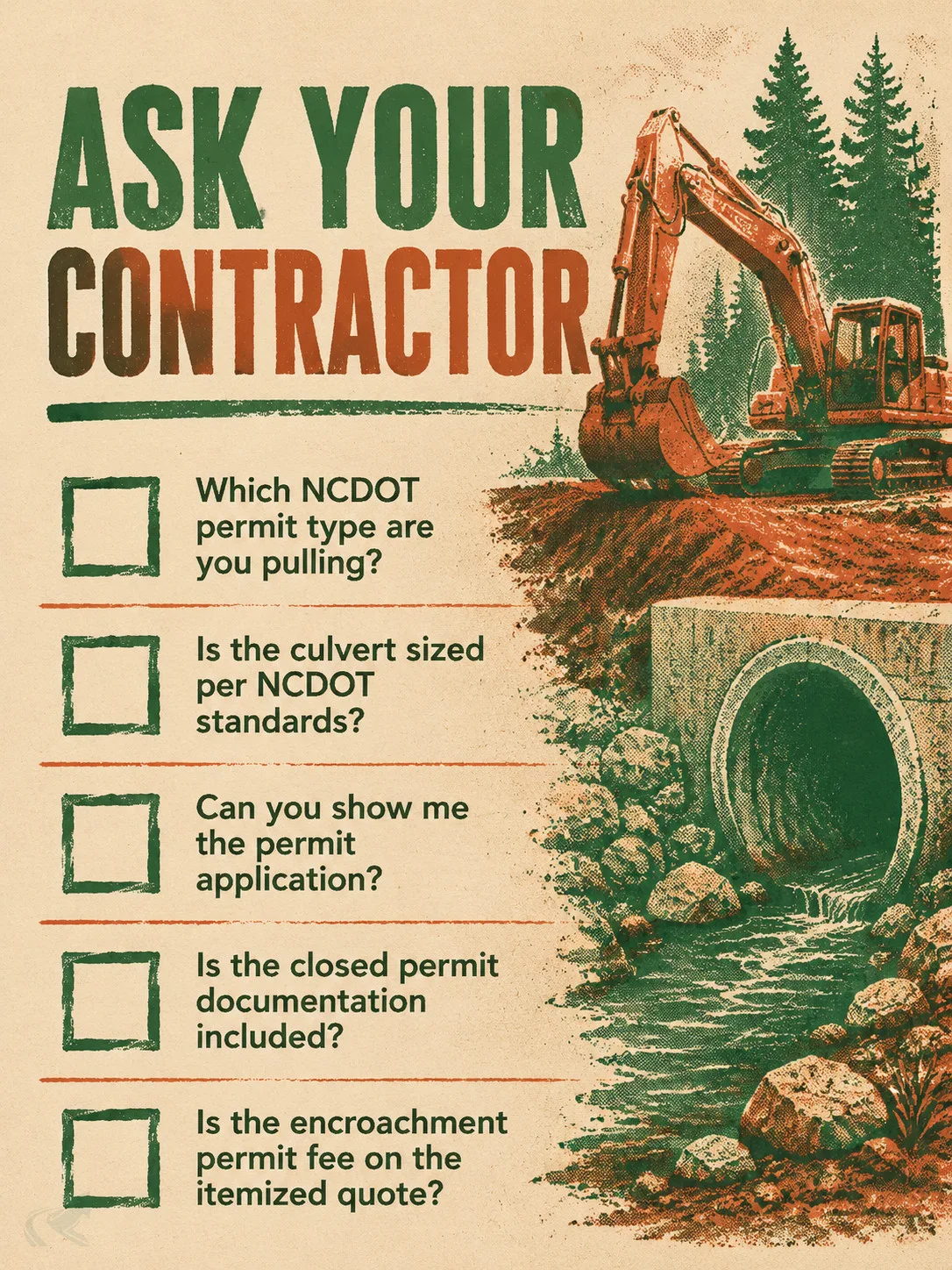
Copy and ask your contractor
”Ask your contractor: Does this project require an NCDOT driveway approach permit, and who pulls it?”
“Is this driveway connecting to an NC-maintained road? If so, which NCDOT permits are you pulling — encroachment, culvert sizing, or overweight? Can you show me the permit applications?”
A contractor who handles NCDOT encroachment work regularly will answer this in one sentence. Hesitation is diagnostic.
To find a grading operator with verified NCDOT encroachment experience, find a grading operator in North Carolina.
NCDOT Permit Type Summary
NCDOT permit types for residential grading and driveway projects -- confirm current figures at NCDOT source before relying on them for permitting decisions.
| NCDOT Permit Type | When Required | Where to Apply | Key Spec to Know |
|---|---|---|---|
| Driveway Access Permit | New driveway connection to NC-maintained road, or significant modification to existing | Local NCDOT District Engineer's office | Site plan required; no NCDOT application fee |
| Culvert Standards Compliance | Any culvert under a state-road driveway connection | Submitted with the driveway permit application to the NCDOT District Engineer | Min. 15" / max 48" inside diameter, min 20 ft length (19A NCAC 02D .0421) |
| Overweight Vehicle Permit | Haul truck exceeding NC legal weight limits on state roads | NCDOT Oversize/Overweight Permit Unit (pims.services.ncdot.gov) | Federal GVW limit: 80,000 lb; NC single-axle 20,000 lb / tandem 38,000 lb |
Driveway Access Permit
- When Required
- New driveway connection to NC-maintained road, or significant modification to existing
- Where to Apply
- Local NCDOT District Engineer's office
- Key Spec to Know
- Site plan required; no NCDOT application fee
Culvert Standards Compliance
- When Required
- Any culvert under a state-road driveway connection
- Where to Apply
- Submitted with the driveway permit application to the NCDOT District Engineer
- Key Spec to Know
- Min. 15" / max 48" inside diameter, min 20 ft length (19A NCAC 02D .0421)
Overweight Vehicle Permit
- When Required
- Haul truck exceeding NC legal weight limits on state roads
- Where to Apply
- NCDOT Oversize/Overweight Permit Unit (pims.services.ncdot.gov)
- Key Spec to Know
- Federal GVW limit: 80,000 lb; NC single-axle 20,000 lb / tandem 38,000 lb
Common Mistakes
Assuming county-maintained roads don’t require NCDOT permits. Some roads that look county-maintained are actually NC-maintained secondary roads. Check NCDOT’s Public Street Information Database Map (HB620) at connect.ncdot.gov/resources/gis/Pages/Database-Map-HB620.aspx before assuming your driveway isn’t subject to encroachment rules.
Installing a culvert without NCDOT sizing verification. A culvert that’s too small will be flagged on inspection and may have to be replaced at project cost — after the driveway apron is already poured. Get the sizing confirmed before material is ordered.
Letting haul trucks run overweight without a permit. NCDOT enforcement weighs trucks on state roads. An overweight citation delays the project, exposes the hauler to fines, and can create liability questions about who authorized the haul plan. The permit is the contractor’s job to pull; confirm it’s on the itemized quote.