
Hiring a driveway grading contractor
What should I ask a driveway grading contractor before hiring?
Three questions: What crown angle are you targeting? What compaction method and equipment are you using? What aggregate spec are you recommending for NC clay -- and why that spec for my specific driveway?
Why do driveway grading quotes vary so much?
Different scope -- specifically, how much base preparation and compaction the contractor includes. A quote covering only surface grading and a thin gravel cap will be 40-60% cheaper than one with proper base compaction and adequate aggregate depth. They're not pricing the same job.
You’ve had two contractors work on the driveway. Both added gravel and graded the surface. Neither fixed the problem. Ruts came back within three months.
This is the most common driveway failure pattern in North Carolina clay. Surface grading without adequate compaction and a proper crown doesn’t solve the underlying issue — it delays it. The gravel migrates, the water wins, and you call another contractor.
Before you sign anything, there are three questions that will tell you whether the contractor in front of you actually understands driveway grading or is repeating what’s worked well enough on other jobs.
The Crown Question — Why It Matters and What the Answer Should Sound Like
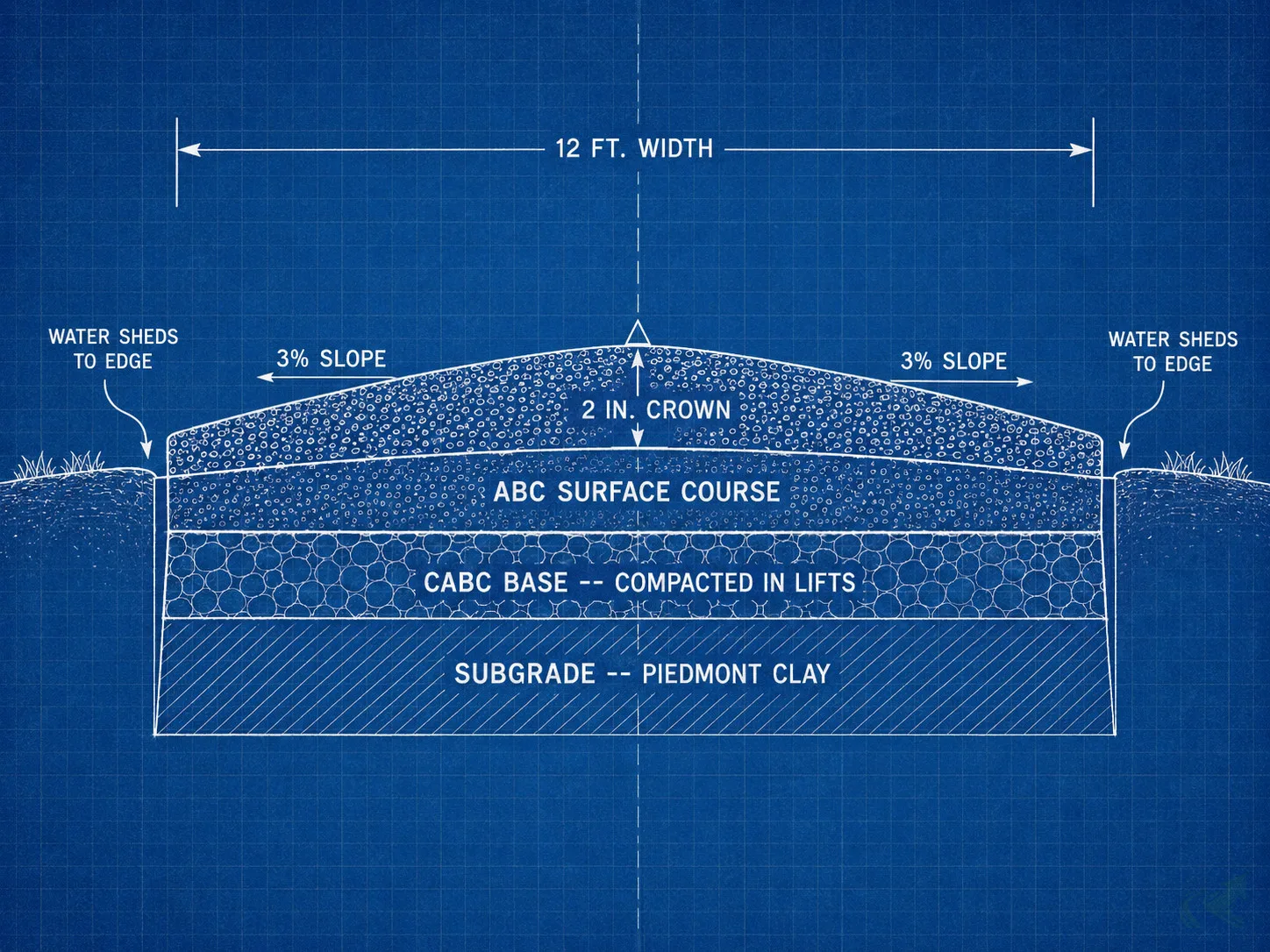
Crown is the slight peak down the centerline of the driveway that sheds water to both sides — without it, water sheets across the surface and strips your gravel outward after every rain.
The centerline of a properly built driveway sits 2-4 inches higher than the edges, depending on width. North Carolina operator consensus for residential gravel driveways runs 3-4% crown — roughly 2 inches of rise over a 12-foot-wide driveway.
In Piedmont clay, this isn’t optional. NC clay is essentially impermeable. Water laid over it has one place to go: across the surface. A flat or reverse-crowned driveway becomes a water channel down its own middle.
Ask this before signing: “What crown angle are you targeting, and how do you verify it after compaction?”
A good answer names a measurement: “I target about 2 inches of crown on a 12-foot-wide drive and check it with a level on the final grading pass.” A vague answer — “I’ll make it look right” — means there’s no measurement standard, and you’ll be calling again in six months.
For more on what driveway crown actually does and how to check your existing driveway, see driveway crown explained.
The Compaction Question — What You’re Actually Paying For
Compaction is what keeps the driveway from rutting. A contractor who can’t specify their compaction method is doing surface-level work.
Uncompacted gravel is just gravel dumped on dirt. Compaction presses the aggregate and sub-base together so there are no air pockets for loaded vehicles to collapse. Without it, every delivery truck or heavy vehicle is a rut waiting to happen.
The equipment question matters. What machine is the contractor using? A vibratory plate compactor, a jumping jack, or a drum roller? Each achieves a different compaction depth. A plate compactor is adequate for thin final-surface passes. A drum roller is what you want for base course compaction on a driveway with real vehicle loads.
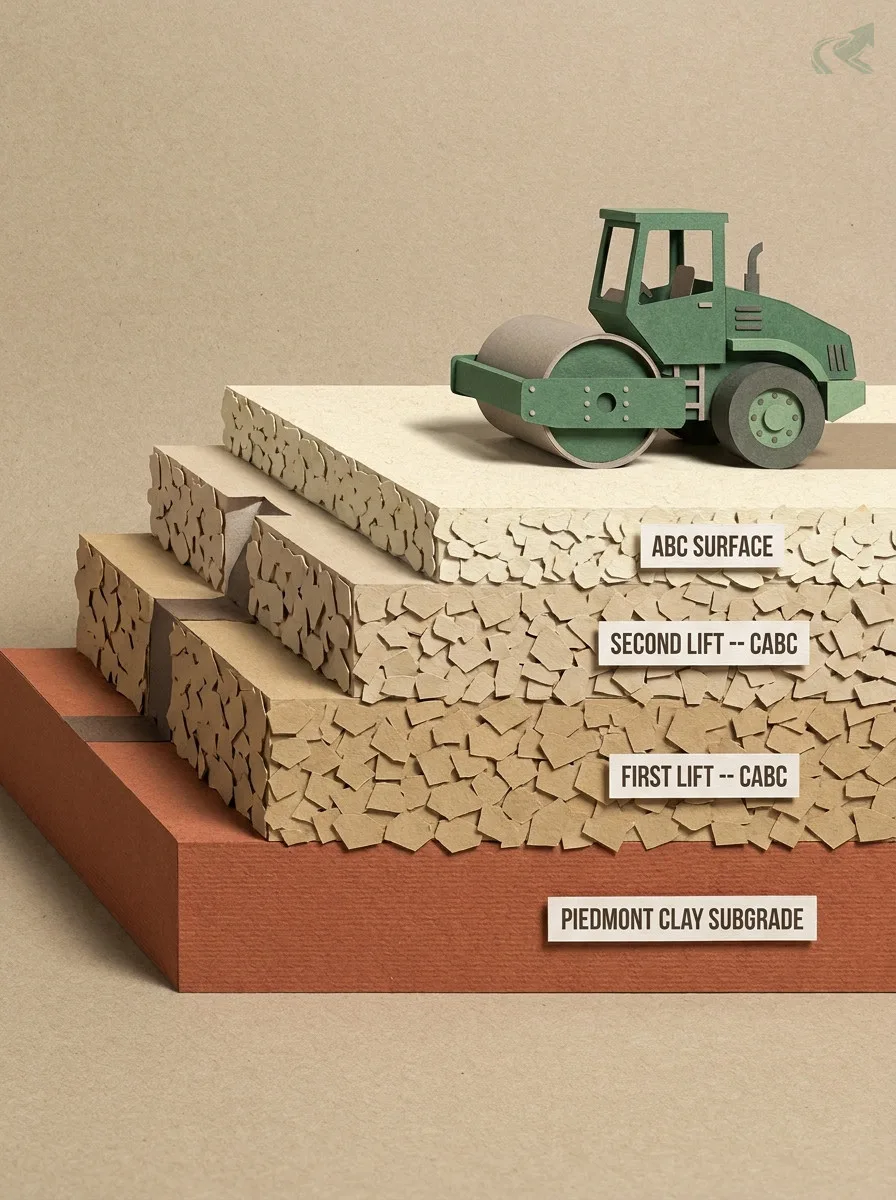
Lifts are the other half of the equation. Good base compaction happens in layers — called lifts — not all at once. A contractor who adds 8 inches of in a single pass and compacts at the end isn’t compacting adequately. Ask how many lifts they use and at what depth.
Ask about the proof-roll. A proof-roll is a loaded dump truck driven across the freshly compacted base before the surface course goes on. Soft spots deflect visibly under the load. This is a 5-minute test that catches sub-base failures before they’re buried under gravel. Most residential driveway contractors skip it. The ones who don’t are doing better work.
For what compaction standards actually look like on an NC driveway project, see proof-rolling a driveway.
Driveway base built in lifts vs dumped in one pass
Comparison. Compacted in lifts: Base course compacted, then an intermediate lift; Final gravel cap applied over a sound base; Drum roller for base course, not just a plate; Proof-rolled with a loaded truck before surfacing. Surface-level work: 8 inches of CABC placed in a single pass; Gravel cap laid on a soft, uncompacted sub-grade; Contractor cannot name their compaction method; Base ruts under the first loaded vehicle.
- Base course compacted, then an intermediate lift
- Final gravel cap applied over a sound base
- Drum roller for base course, not just a plate
- Proof-rolled with a loaded truck before surfacing
- 8 inches of CABC placed in a single pass
- Gravel cap laid on a soft, uncompacted sub-grade
- Contractor cannot name their compaction method
- Base ruts under the first loaded vehicle
A contractor who works the base in lifts and proof-rolls it is doing the job; one who dumps and caps is not.
The Stone Spec Question — What Aggregate for NC Clay
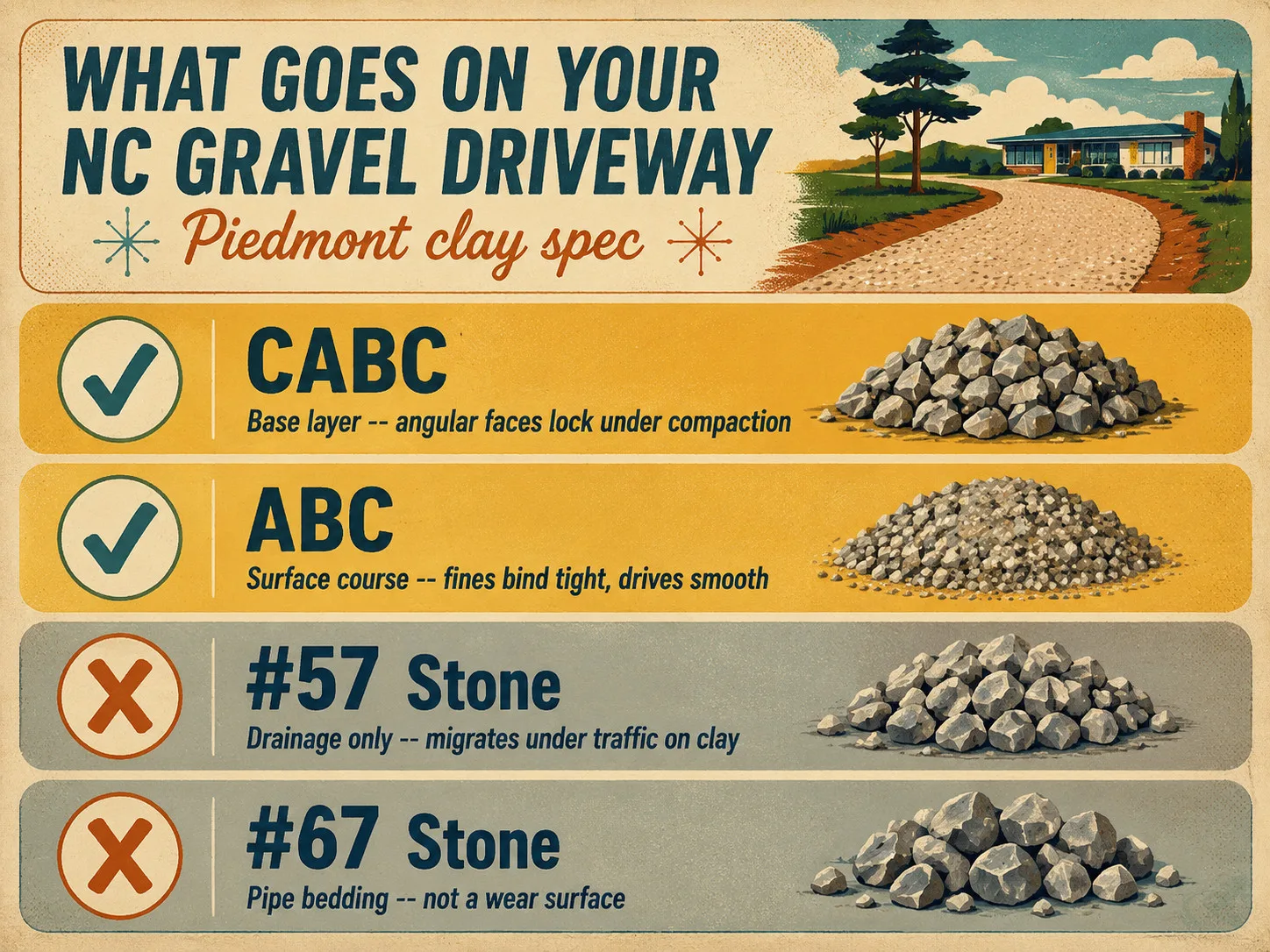
NC clay driveways need a crushed stone aggregate with angular faces — not round river gravel, not pea gravel, and not #57 stone as the primary wear surface.
Angular stone interlocks under compaction. Round stone rolls under load. This distinction matters more on clay sub-base because there’s nothing for the gravel to key into below — the aggregate’s own structure has to hold.
Common aggregate types for North Carolina driveways:
- : the standard base layer material; angular faces lock together under compaction. This is what goes down first on an NC driveway rebuild.
- : includes fine material that fills voids and binds; this is the standard top course for gravel driveways across North Carolina, and it drives smoother than open-graded stone.
- #57 stone: clean, open-graded crushed stone. Excellent for drainage layers and French drain backfill. Not ideal as the primary driveway surface on clay — it migrates laterally under traffic without a binding material to hold it.
- #67 stone: larger aggregate, good for drainage applications and pipe bedding. Not a primary wear surface.
Ask this before signing: “What aggregate are you recommending for the base layer and what for the surface? Why those specs for NC clay specifically?”
A contractor who can answer without consulting their supplier is thinking about what they’re building, not just what it costs. The answer you want is something like: “CABC base, compacted in lifts, ABC surface course on top.” Generic “gravel” is what contractors say when they haven’t thought it through.
The Quote Comparison — Driveway-Specific Line Items
A legitimate driveway grading quote names the aggregate, specifies the compaction method, and states the total depth of base material being installed.
Most quote variation isn’t contractor markup — it’s scope difference. A surface-grade-and-cap quote is genuinely cheaper because it’s a different, shorter job. What you need to compare is scope.
Line items to look for in any NC driveway grading quote:
- Aggregate type and quantity: “X tons of CABC base course” + “X tons of ABC surface course.” If it says “gravel” with no spec, ask.
- Compaction spec: “Compacted in X-inch lifts using vibratory drum roller.” If compaction isn’t mentioned, it may not be included at that level.
- Crown spec: “Target crown of X inches over Y-foot width.” This tells you they’ve measured, not eyeballed.
- Haul-off: if existing rut-damaged material is being removed, confirm where it goes and whether disposal is included in the price.
- Drainage scope: if water is the underlying problem, is a French drain or side-ditch spec included, or is the crown expected to handle all of it?
For a full breakdown of what an itemized quote should look like vs. a lump-sum bid, see itemized driveway quote breakdown. Understanding what a fair driveway bid includes is the next step before signing.
Common Mistakes When Hiring a Driveway Grading Contractor
Three decisions that send homeowners back to the quote process six months later:
- Choosing the contractor who adds the most gravel. Volume is not the same as proper base preparation. Eight inches of uncompacted aggregate on soft clay will rut just as fast as two inches — it just looks more impressive for the first week.
- Not asking about the proof-roll. Most residential contractors skip it. It’s a 5-minute test that costs nothing to perform if a dump truck is already on site. If your contractor hasn’t mentioned it, ask directly.
- Accepting “we’ll make it look right.” Without a crown spec, compaction method, and aggregate spec in writing, that’s not a commitment — it’s an intention. Intentions don’t hold up when the ruts come back.
Understanding driveway contractor red flags beyond these three will give you the full picture on what to watch for before the work starts.
Three questions to ask before signing — copy and use
Paste these into a text or email to any driveway grading contractor:
- “What crown angle are you targeting, and how do you verify it after compaction?"
- "What compaction method and equipment are you using? How many lifts?"
- "What aggregate spec are you recommending for my driveway — base course and surface course — and why those specs for NC Piedmont clay?”
Ready to Find a Driveway Grading Contractor Who Can Answer All Three?
NC Grade and Haul lists verified grading contractors across North Carolina — each one cross-referenced against the NC Licensing Board, OSHA records, and workers’ compensation coverage before appearing in the directory.
Find a grading contractor in North Carolina to compare contractors who know what crown angle means.