
You’ve gotten two driveway quotes. Neither contractor mentioned the word crown. One said “we’ll level it out” — which sounds reasonable until you understand that a level driveway sheds no water.
Here’s the board test. Lay a straight 2x4 across the widest part of your driveway. The middle should be visibly higher than the edges. If the board sits flat, you’ve already found why your driveway keeps failing.
Crown isn’t a finishing touch. It is the load-bearing drainage mechanism of the entire driveway surface.
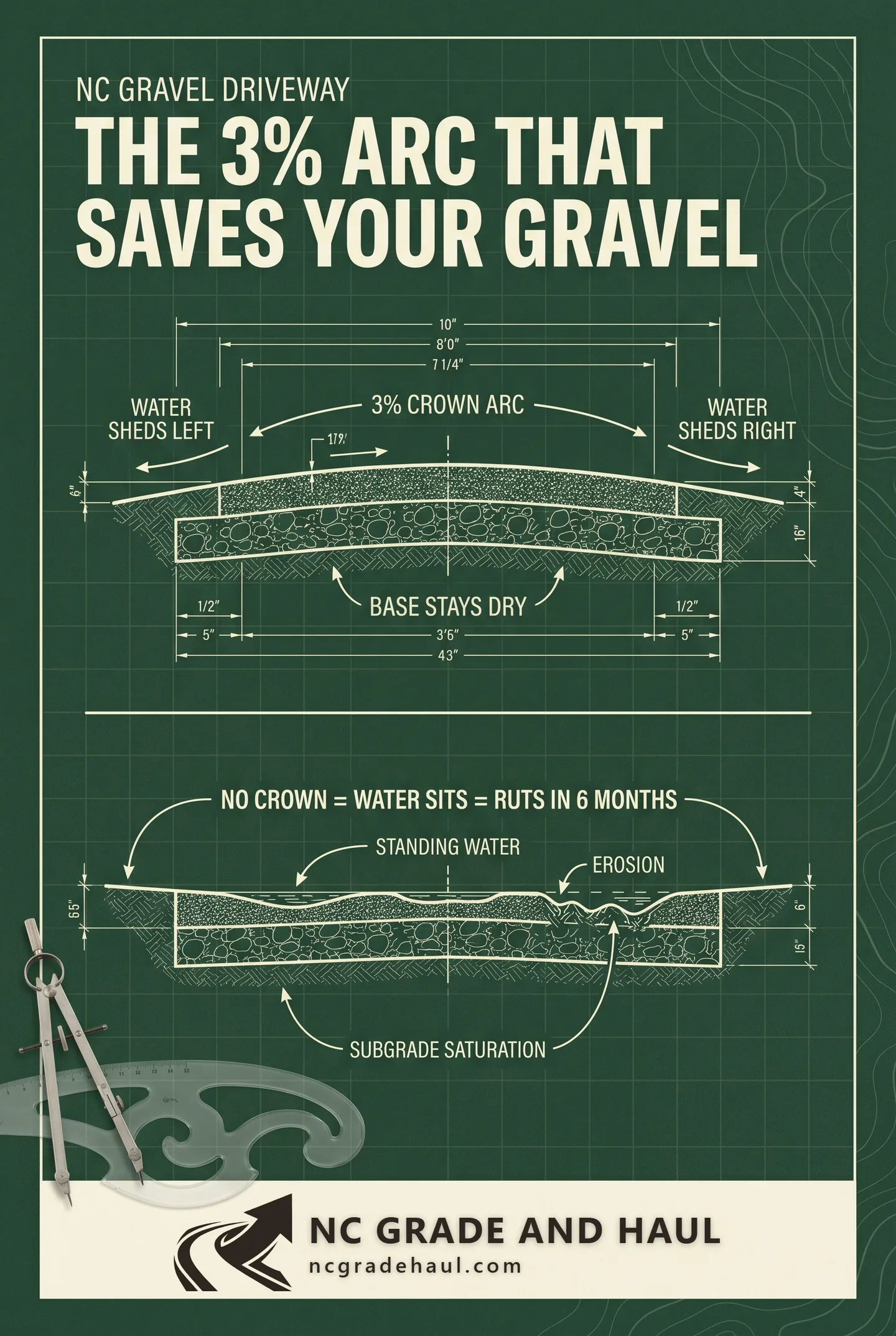
What Crown Actually Means
Crown is the arc from the centerline down to both edges — and it’s the only thing that keeps water from pooling and stripping your driveway surface.
North Carolina operator consensus for residential gravel driveways runs 3-4% crown. On a 12-foot-wide driveway, that puts the center roughly 2 inches higher than each edge. You should be able to see it when you stand at the end of the drive and look down its length.
Why Piedmont red clay makes this critical: gravel laid over NC Piedmont clay sits on an essentially impermeable base. Water doesn’t percolate down through the clay. The only place it goes is sideways — off a crowned surface, or down the middle of a flat one.
The tire-track problem compounds it. Every vehicle that uses the driveway creates two parallel depressions along its tire path. Without deliberate crown maintenance, those ruts become the lowest point of the surface. Water channels directly into them, then runs along the driveway stripping gravel as it goes.
Gravel driveway: a real crown vs the flat, rutted failure
Comparison. Crowned right: 3-4% crown -- center sits 2 inches above the edges; Water sheds off both edges into drainage swales; Gravel stays locked in place across the surface. Flat or rutted: No crown -- center has dropped below the edge grade; Water pools and channels down the tire tracks; Gravel migrates to the edges, base erodes beneath the surface.
- 3-4% crown -- center sits 2 inches above the edges
- Water sheds off both edges into drainage swales
- Gravel stays locked in place across the surface
- No crown -- center has dropped below the edge grade
- Water pools and channels down the tire tracks
- Gravel migrates to the edges, base erodes beneath the surface
NC Piedmont clay won't drain vertically -- the crown is the only passive drainage a gravel driveway has.
What 3-4% Crown Looks Like in Practice
On a standard 12-foot driveway, 3% crown means the center is about 2 inches higher than the edge — visible when you look down the length of the drive.
The eye test. Stand at one end of the driveway and look straight down its length. You should see a distinct ridge at the centerline. If the surface looks flat, it probably is.
The board test (actionable version). Lay a 6-foot level or straight board across the driveway. There should be visible daylight under both ends where they overhang the edges. If the board rocks or sits flat, the crown has worn off.
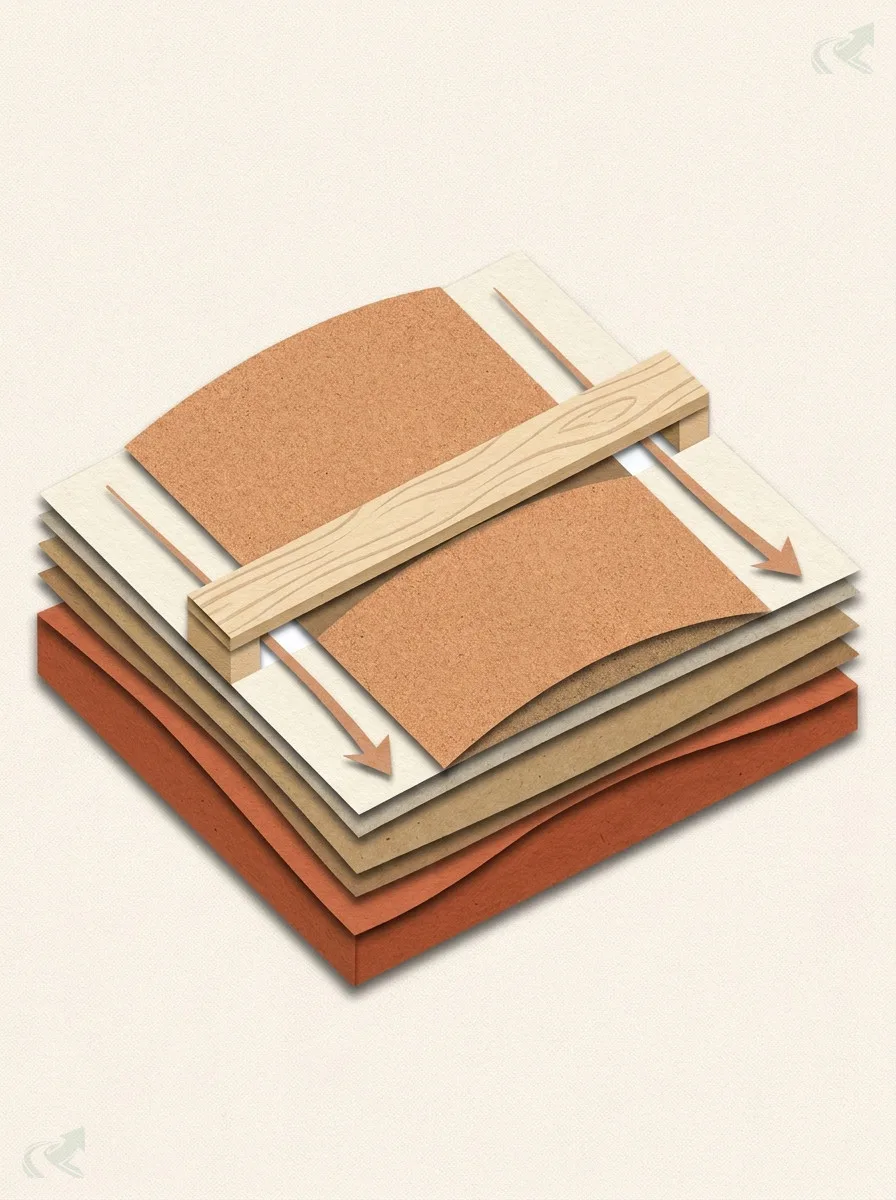
How a contractor cuts crown. The operator uses the blade of a motor grader — or a box blade on a tractor — in a series of passes that pull material toward center and shape the arc. This isn’t leveling. It requires deliberate blade angle management through each pass. Ask your contractor specifically: “How do you cut the crown?” A straight answer tells you a lot.
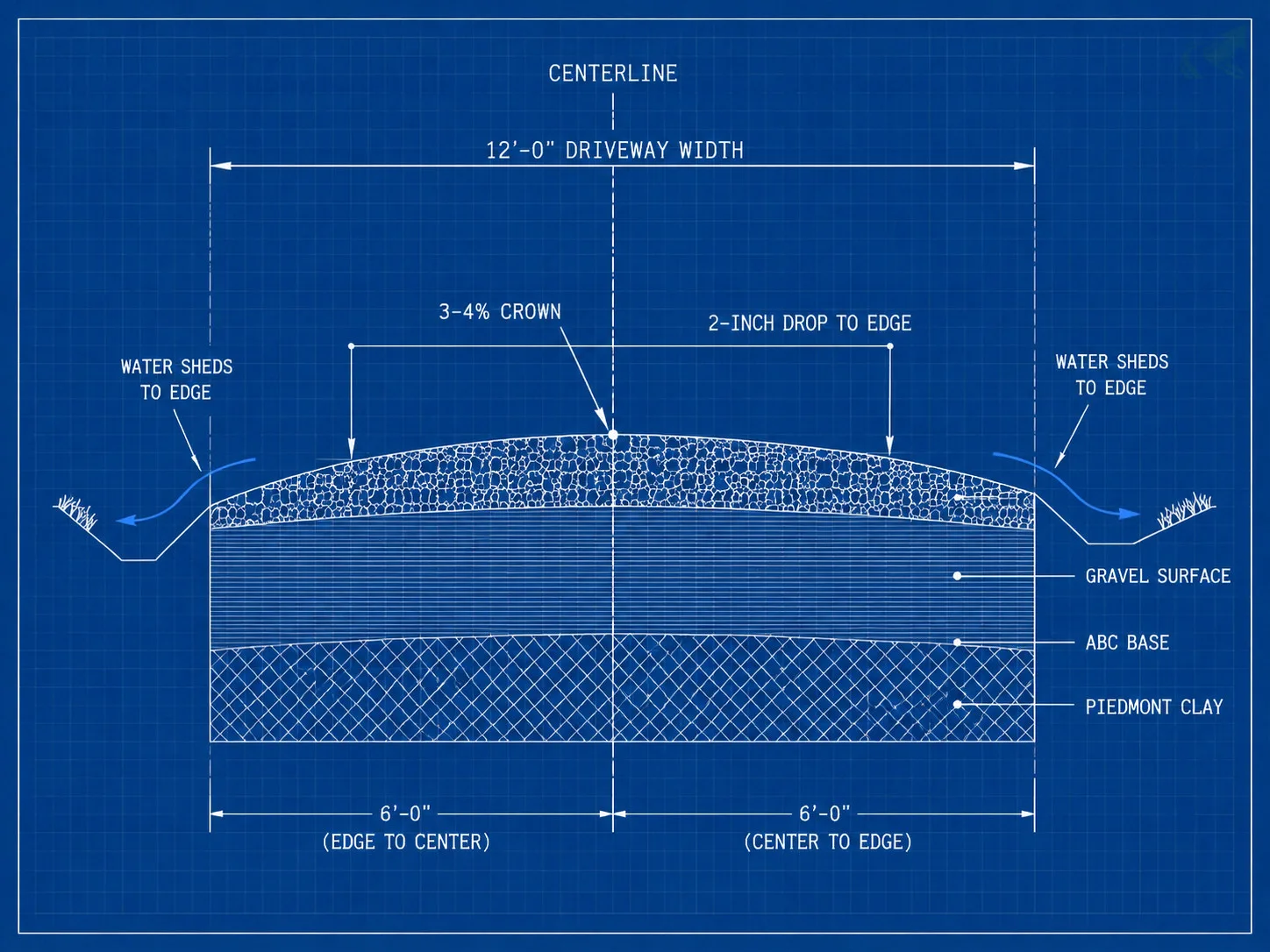
Long driveways (Ray’s scenario). On a 400-foot North Carolina driveway, crown needs drainage outlets every 100-150 feet. A continuous crown without side swales or culvert relief backs water up at the low end and defeats the purpose entirely.
Contractor question — copy and use
Ask this before signing any driveway grading quote:
“What crown percentage are you planning for this driveway, and where does the water go when it reaches the edge?”
Why NC Clay Makes Crown Non-Negotiable
NC Piedmont clay doesn’t drain — it holds water until it has no choice but to run. A crowned gravel surface is the only passive drainage mechanism a gravel driveway has.
Compare that to a sand-base driveway on the NC coast. Sandy subgrade lets surface water percolate down through the base. A coastal gravel drive can run nearly flat and still drain reasonably well. Piedmont clay stops vertical drainage entirely. Crown is the only outlet.
What happens in a 2-inch North Carolina rain: roughly 2,400 gallons fall on every 1,000 square feet of surface. On a flat 100-foot driveway, that water has nowhere to go except along tire tracks and out the low end — pulling gravel with it on every pass.
Crown loss accelerates because of this. Once the center drops below the edge grade, water sheets to center. Ruts deepen. The subgrade softens. The next storm strips more material. The deterioration isn’t linear — it compounds. That’s why a driveway that “just needs some gravel” two years ago now needs a full regrade.
A proper crown connects all the way to the road apron. For detail on road apron drainage and the driveway crown relationship, that’s a separate issue worth checking — a well-crowned driveway that dead-ends at a flat apron creates an erosion point right at the street.
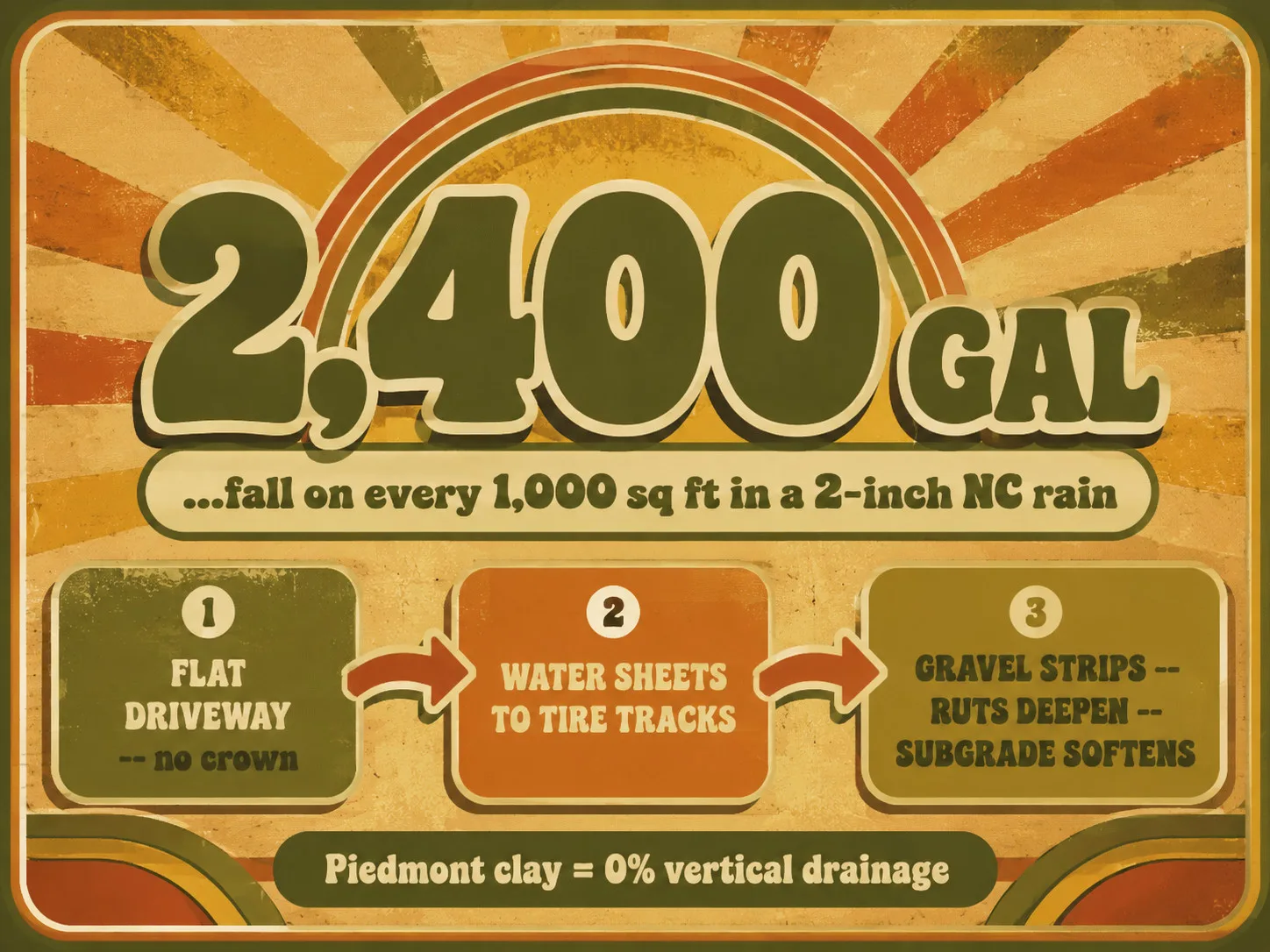
Crown Failure vs Crown Success — Contractor Evaluation
A contractor who doesn’t mention crown in their quote is either planning to skip it or doesn’t know it matters — and you can find out in one question.
Common mistakes NC homeowners see in failed driveway jobs:
- Grading flat then adding crown “later.” Crown must be cut into the shaped base before gravel is spread. Once gravel is down and compacted, the material locks. You can’t crown it after the fact without regrading from scratch.
- Crown without drainage outlets. Crown sheds water to the edge. If there’s nowhere for it to go — no swale, no natural grade runoff — the water pools along the driveway edge and undercuts the base from the side. The erosion barriers for sloped NC driveways page covers what a proper edge treatment looks like.
- Forgetting the apron. Crown must connect smoothly to the road apron grade. A well-crowned driveway that dead-ends at a flat apron creates a scour point right at the street.
Three questions that separate a competent operator from a gravel-dumper:
- “What crown percentage are you cutting, and what’s your method?” A competent operator answers with a number and a technique immediately. “We’ll grade it level” is a red flag — level is the failure state.
- “Where does the water go after it leaves the crown?” The answer should name a specific destination: swales, drainage ditches, natural grade. “It just drains away” is not an answer.
- “How long will the crown hold, and what causes it to flatten?” An honest answer: traffic load over time, typically 3-7 years on a gravel driveway with normal use before the next maintenance regrade. Crown doesn’t last indefinitely — it needs periodic upkeep.
An operator who knows how to do this work answers all three without hesitation.
Crown, Compaction, and Drainage — How the Three Connect
Crown without compaction is temporary; compaction without crown is pointless; both without drainage still fails.
Crown sheds surface water. -licensed operators doing this work understand the three-part relationship.
Compaction prevents the surface from rutting and losing its crown geometry under load. A properly proof-rolled base holds the crown angle through years of normal traffic. Without compaction, the crown flattens under the first heavy truck.
Drainage removes the water the crown sheds. Positive drainage at the edge — a swale, a culvert, or natural grade slope — completes the system. Crown that sheds water into a standing area at the driveway edge just moves the erosion point.
All three are required. For how compaction after crowning a driveway works, that spoke digs into the proof-roll process specifically. For how gravel driveway grading with proper crown affects material selection, that spoke covers the ABC and #57/#67 stone layering.
If a quote addresses only one of the three — crown, compaction, or drainage — it’s a partial fix. You’ll be back in a few years.
What to Ask For in Writing
Ask for an itemized quote that line-items three things: the crown specification (percentage and method), the compaction plan, and how drainage is handled at the edge.
“We’ll regrade it” is not a scope — it’s a sentence. A quote without a crown spec isn’t a driveway grading quote. Before you sign anything for a NC driveway regrade, ask the question on the card above and listen to how fast the answer comes back.
When you’re ready to compare verified operators, hire a grading operator in North Carolina with confirmed license status through the NC Licensing Board.
For a broader picture of how driveway grading works in North Carolina, the hub page covers the full scope — from initial site evaluation through final gravel placement. And if your driveway has already lost its crown and washed out, fixing washout from a flat NC driveway covers what a repair scope actually involves.