
A contractor hands you a quote with a license number at the top. The number looks official. Whether it means anything is a question you can answer in about five minutes, for free, without calling anyone.
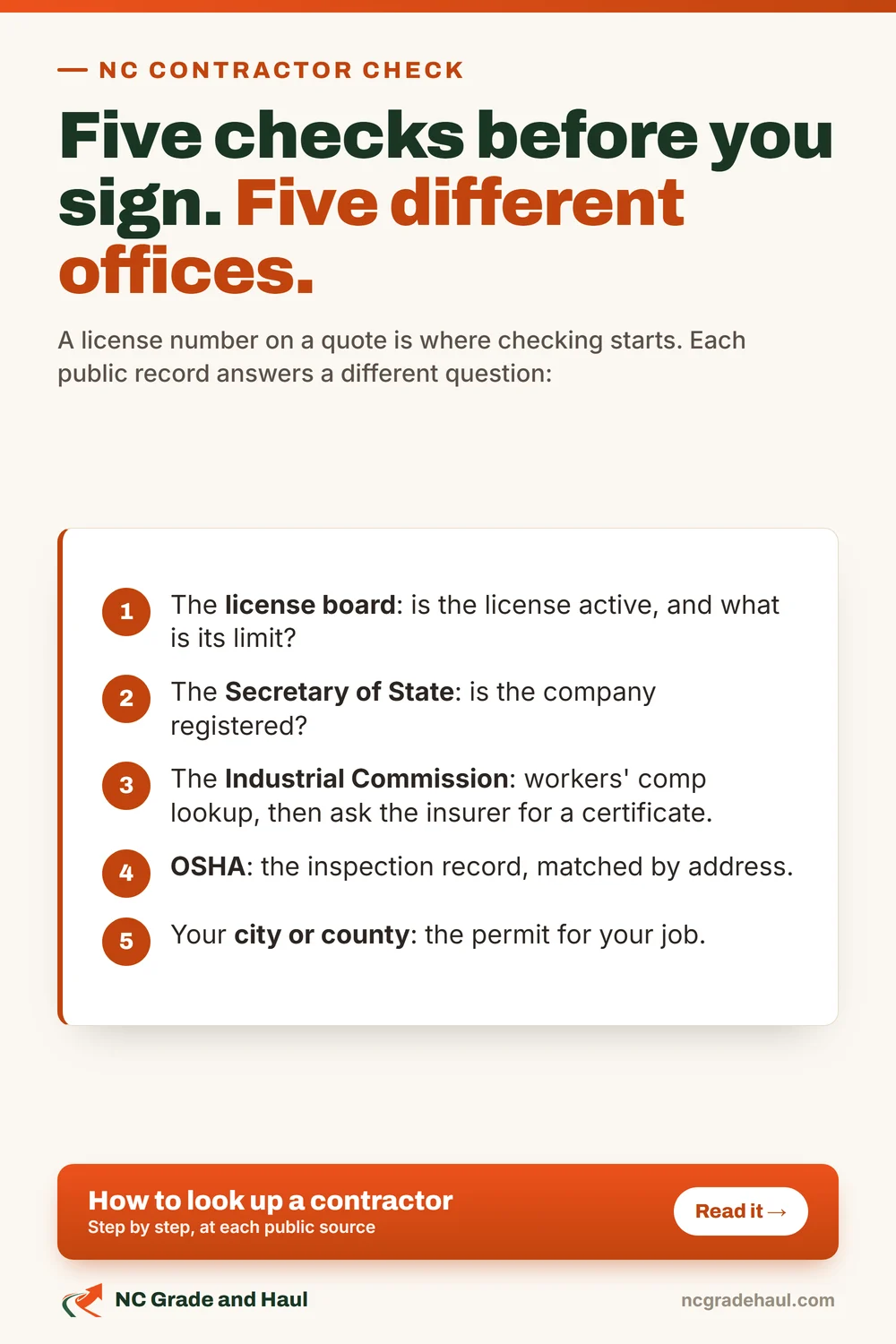
The catch is that North Carolina doesn’t keep the answer in one place. The license is at one office, the company’s registration is at another, and the insurance and safety records sit in two more. This page walks through each one the way you’ll see it on screen. We’re a directory of site-work contractors, checked against public records, and these are the same records we check. We don’t do the work ourselves.

Step 1: The License Board
The NC Licensing Board for General Contractors ( ) issues and tracks general contractor licenses. Its public search is at portal.nclbgc.org, under “Verify License Search”. It needs no account.
Looking up a license at the NCLBGC portal
1. Open the Verify License Search page -- The form says all fields are optional, but you must fill in at least one. 2. Enter what you have -- A license number is the cleanest search. A company name works too, and there is a box to include like-sounding names. You can also search by a person's name, phone number or address. 3. Scan the results list -- Each row shows an account number, whether it is a license or a qualifier, and the owner's name. A red "License Not Active" tag sits beside any license that is not active. 4. Open the record -- Click the account number. The details open with the status, the dates, the license limitation, the classifications and the qualifiers.
-
Open the Verify License Search page
The form says all fields are optional, but you must fill in at least one.
-
Enter what you have
A license number is the cleanest search. A company name works too, and there is a box to include like-sounding names. You can also search by a person's name, phone number or address.
-
Scan the results list
Each row shows an account number, whether it is a license or a qualifier, and the owner's name. A red "License Not Active" tag sits beside any license that is not active.
-
Open the record
Click the account number. The details open with the status, the dates, the license limitation, the classifications and the qualifiers.
If you don't have a name or number yet, the same site has a Find License Near Me search by zip code, city and distance.
Here is what that looks like. The company below is made up. We don’t show real contractors on this page.
1. The results list
License Not ActiveLicenseSample Grading Co.
The red tag is the first thing to look for.
2. The record you open
Name: Example Site Works LLC
License #: L.EX-0001
Status: Active
Expiration Date: 12/31/2026
License Limitation: Limited
Active Classifications: Building
Qualifier: Pat Example, Q.EX-0001, Active
Fields shortened. The real record also shows the address, phone and first-issued date.
Reading the Record, Line by Line
Status. This is the line that decides everything else. “Active” is what you want. We saw a not-active record that read “Archived - License Not Valid” and showed no expiration date at all. If your contractor’s license isn’t active, the other lines don’t matter.
Would an expired passport still get you onto an international flight, because you’re still holding it?
A license works the same way. Having the number on a quote is not the same as holding a license that is in force. The expiration date is the second thing to check. North Carolina licenses run on the calendar year, and the statute gives a license 60 days past its January 1 expiration before it becomes invalid, so when you see a date in the past, believe the status line over the date.
License limitation. This is a dollar ceiling on one project. By statute, an unlimited license has no ceiling. An intermediate license covers a single project worth up to $1,500,000. A limited license covers a single project worth up to $750,000. Both ceilings leave out the cost of the land and the cost of improving it.
A regular driver’s license is perfectly valid. Would you still hire that driver to take a loaded tractor-trailer across the state?
Same idea. A limited license is real and current, and it still stops at $750,000. For a backyard regrade the ceiling never comes up. For a large site-prep contract, read it before you read the price.
Active classifications. The state licenses general contractors in five classes: Building, Residential, Highway, Public Utilities and Specialty. The portal’s classification list is more specific than those five. It includes entries such as “H (Grading & Excavating)”, “PU (Sewer Lines)” and “PU (Water Lines & Sewer Lines)”. The record lists the ones the license holds. Which class a given job needs is a different question, and our guide to NC contractor licensing takes it up.
The Qualifier Line
A company doesn’t take the licensing exam. A person does, and the board calls that person the qualifier. The record lists each qualifier with a qualifier number and a status.
This matters for one reason. The license belongs to the company, and the qualifier is the person whose exam stands behind it. State law says that if the qualifier stops being connected to the company, the license stays in force for 90 days, and the company can’t bid on or start new contracts during that time. So if the qualifier line shows no active qualifier, ask the contractor about it before you sign.
It also helps to know what the lookup doesn’t tell you. It doesn’t tell you who will be standing in your yard. In one North Carolina thread, a homeowner described a technician who “operated under the owner’s license” while the license holder never came to check the work. The thread was about electrical work, a different board, but the lesson carries over: the record names the company and its qualifier, not the crew. Ask who is running your job.
One more limit. The board can only act on the license. Its own consumer FAQ says it can’t make a contractor make repairs, repay you or pay a fine. The lookup tells you who is licensed, and a complaint to the board is not a way to get your money back.
Septic Work: A Different Board
Septic installers and inspectors aren’t tracked in the general contractor search. The North Carolina Onsite Wastewater Contractor Inspector Certification Board ( ) certifies them, and it keeps its own list at ncowcicb.info, under “Certification List”.
The board publishes the list as PDFs: one sorted by last name, one by county, plus a separate list of authorized onsite wastewater evaluators. Each row shows the county, the name, the company, a level, a certification number, whether the person is also an inspector, a city, a phone number and the date certified. The file header carries an effective date and an expiration date, so check that you’re reading the current one.
The level tells you what the person may install. Grade Level II covers single-tank conventional gravity systems and similar simpler designs. Grade Level IV covers everything in Level II plus more complex systems: dual pumps, low-pressure dispersal, drip dispersal and systems with no flow limit.
Two notes from the board’s own pages. First, the board says the $40,000 general contractor threshold doesn’t apply to a certified installer when the work covers only the onsite wastewater system, so a septic installer may have no entry in the license search and that is not a red flag by itself. Second, the board doesn’t regulate pumpers or system operators. Those sit with other state offices. Our septic guide covers who does what.
The Company: NC Secretary of State
A license number tells you about the license. It doesn’t tell you whether the business behind it is a registered company today. That’s the Secretary of State’s job. The business registration search is at sosnc.gov, under “Search Business Registration”.
You can search by company name, by Secretary of State ID number, by company officials or by registered agents, and you can choose how the words match: starting with, all, any or an exact match. Open the company’s page and read its status. A company that isn’t active is worth a question before any deposit.
The site says its search is for people searching in real time, so use it by hand and not with a script. And don’t be alarmed if a one-person operation working under a personal name has no entry. Not every contractor is a registered company. A person who trades under a business name instead of their own name has to file an assumed business name certificate, and the same page has a separate search for assumed names (the “doing business as” names), so try that one too.
Workers’ Comp: The Industrial Commission
If a worker gets hurt on your property, whether the contractor carries workers’ compensation matters to the worker and can matter to you, so ask your own insurer what it would mean for you. The NC Industrial Commission runs an Insurance Coverage Search System, with four searches: by employer name, city and state; by employer name and an injury date, which shows who the employer had coverage with on that date; by insurance carrier; or by policy number, which shows a policy’s effective dates and coverage details.
Read the disclaimer before you trust a result. The Commission says what the site shows is “not proof of, evidence or verification of workers’ compensation insurance,” and that it may not show a recent cancellation or reinstatement, including ones reported in the last 30 days. It says to verify with the employer or the insurer.
A restaurant has a framed fire-insurance certificate by the door. Does that tell you the kitchen passed its health inspection?
No, and it’s the same split here. Use the Commission’s lookup as a first look, then ask the contractor to have the insurer send you a certificate with your address on it. Our contractor quote guide covers what to ask for.
The Safety Record: OSHA
The federal Occupational Safety and Health Administration ( ) keeps an Establishment Search of inspections at osha.gov/ords/imis/establishment.html. You can search by the company’s name, by state, by OSHA office or by site zip code.
Pick an inspection from the results, and if a citation was issued, it lists under “Violation Items”. Select the citation ID for the details. By default the search shows closed cases from the last five years.
North Carolina runs its own state workplace safety program, so many inspections here are done by the NC Department of Labor. Those are in the same database: OSHA says it is updated from its own offices and the state plan offices, the state filter lets you pick federal inspections, state inspections or both, and the NC Department of Labor offices are in the office list. One limit: OSHA describes its citation detail as covering violations that Federal OSHA cited, so a state inspection may show less detail.
OSHA warns about two traps on that same page. Entries are corrected until a case closes, so what you see can change. And different companies can have similar names, so match the address before you read anything into a result.
An inspection isn’t a verdict, and no result often just means nobody inspected the company. Our Verified label needs fewer than three serious violations on the OSHA record, and you can use the same line as a prompt for questions.
Permit History: Your City or County
A permit is a record of real work being done. Some North Carolina cities and counties keep an online permit search. Where yours does, look up your own address once the job starts, and you should see the permit for your work.
A North Carolina thread shows why that matters. One commenter said they gave a contractor the money for a permit, were told it was paid, and the work was done without an approved permit. A permit search on your address is one way to catch that. Not every place publishes permits online, so if yours doesn’t, call the inspections office and ask.
What We Check, and What Is Still Yours
NC Grade And Haul runs most of these same lookups on the contractors we list. Every listing shows four checks: the license, the OSHA record, the Secretary of State registration and workers’ comp, and each one links to the public record it came from. A listing is labeled Verified only when the license is active, the OSHA lookup shows fewer than three serious violations, and the Secretary of State shows the business in good standing or has no entry on file. Workers’ comp is shown but doesn’t decide the label. Permit history comes from two county feeds, Wake and Guilford, so contractors elsewhere won’t have it from us. Our hiring guide spells out the full rule, and our transparency page explains why we check public records at all.
Two things to keep in mind. Our check is a snapshot from when we ran it. A license can lapse next month, so run the lookup yourself before you sign. And for coverage, the Commission’s own disclaimer applies to us too, which is why we still want the insurer’s certificate in your hands. Start at our hiring guide, see the red flags to watch for and browse the directory when you’re ready for names. If your job is a dig, the excavation guide is the next stop.
What would you do?
Read what the record shows, decide your next move, then tap to check.
1 The results list shows a red "License Not Active" tag next to your contractor's license number.
Stop and ask the contractor about it before any deposit.
Then: Ask whether they hold a different, active license number, and look that one up yourself.
2 The record is active, the limitation reads Limited, and your project is worth well over $750,000.
Ask the contractor how they're licensed for a job that size.
Then: A limited license covers a single project up to $750,000, not counting land and the cost of improving it.
3 The record is active, but the qualifier line shows no active qualifier.
Ask about it directly and get the answer in writing.
Then: State law gives a license 90 days after a qualifier leaves, and the company can't take on new contracts in that window.
4 You're hiring a septic installer and the general contractor search finds nothing.
Check the septic certification board's list instead.
Then: The board says certified installers doing only the onsite wastewater system don't fall under the $40,000 general contractor threshold.
5 The company is licensed, but you can't find it at the Secretary of State.
Ask whether it trades under a different name or as a person, and check again under that name and in the assumed-name search.
Then: A one-person operation under a personal name may have no entry, so this is a question and not a verdict.
6 The contractor says "fully insured" and the Industrial Commission search shows a policy.
Ask the insurer to send you a certificate with your address on it.
Then: The Commission says its listing is not proof of coverage and may not show a recent cancellation.
Where This Page Stops
This page is the how-to. For what the license is, when North Carolina requires one and what each class covers, read NC contractor licensing.