
Two questions people ask first
Do I call an excavator, a grader, a landscaper or a foundation company?
It depends on what the dig is for. A trench, a footing, a pond or a lot that has to be opened up is excavation. Reshaping the surface so water runs off is grading, usually the same firms. A dig against a foundation that is cracking is a foundation question first. The table below sorts the common jobs.
What should I check before anyone digs on my property?
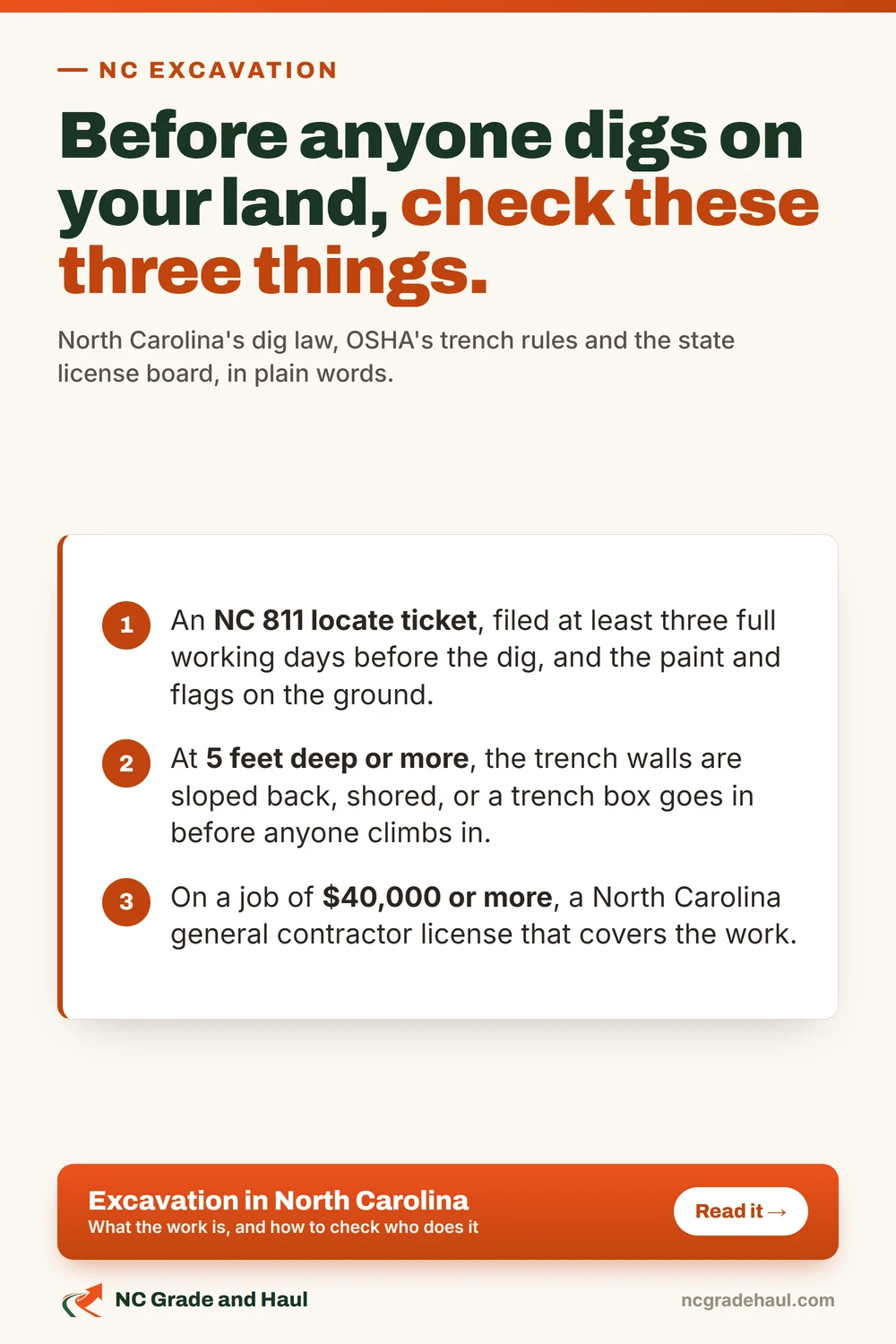
Three things. That an NC 811 locate ticket was filed and the marks are on the ground. That anyone working in a trench is protected from a cave-in, with no exceptions once it is 5 feet deep. And, on a job of $40,000 or more, a general contractor license in the right classification.
Excavation is digging with a purpose: opening the ground to put something in it, take something out of it, or reshape it. A trench for a water line or a French drain. A footing or a basement. A pond. A building pad cut out of a slope. A stump hole, a buried tank, an old slab.
Most people searching for an excavation contractor in North Carolina don’t search for the job. They search for the machine, or they ask a neighbor “who do I even call for this?” That question is the right one, and it has a real answer, because excavation is a trade you hire by what the dig touches: the ground, the pipes and wires under it, and anyone working in the hole.
We’re a directory of site-work contractors, each checked against public records. We don’t dig. This page is what we’d want a friend to know before they let a machine onto their land.
What Excavation Covers
The word covers more than most people expect. On a residential property in NC, the common excavation jobs are:
- Trenching for water, sewer, power, drainage pipe or a French drain.
- Footings and foundations: digging for a house, an addition, a garage, a retaining wall.
- Site preparation: cutting and filling a lot to a building pad, then compacting it.
- Ponds: digging, shaping the bank and building up a dam.
- Removal: stumps, old slabs, a buried oil or septic tank, a filled-in pool.
- Drainage repairs: opening the ground to find out why water is going where it is.
Grading is the close cousin. Grading reshapes the surface so it sits at the right level and sheds water. Excavation goes below the surface. In practice the same firms do both, and North Carolina’s general contractor law names “grading” by name among the work it covers (G.S. 87-1). If your job is mostly surface shaping, start with the grading guide.
Which Trade Does Which Dig
The hardest part for most owners is knowing which kind of firm to call. Here is how the common jobs sort.
Which trade does this dig?
Read the job, guess who you would call, then tap to check.
1 A trench for a water, sewer or drain line
An excavation or grading contractor digs it; a plumber usually handles the pipe itself.
Ask first: Who files the 811 ticket, and who connects the pipe?
2 Footings, a basement or a building pad
An excavation or grading contractor, often hired by your builder.
Ask first: Who checks the soil before the concrete, and who signs off the pad?
3 A yard that holds water after rain
A grading or drainage contractor. Sometimes it is the slope, sometimes it needs a drain.
Ask first: Is this a grading problem or a drain problem? A good firm tells you which.
4 Sinking or cracked ground right at the foundation
A foundation or drainage specialist first, then whoever digs.
Ask first: What is causing it? Digging before you know can make it worse.
5 A pond
An excavation contractor with pond experience.
Ask first: Will the soil hold water, and does the dam need a permit?
6 Tearing out a slab, a shed or a pool
A demolition or excavation contractor.
Ask first: Where does the debris go, and what fill goes back in?
A landscaper can be the right call for shallow work in a planting bed. Once the job needs a machine bigger than the landscaper owns, or the hole is deep enough that someone will stand in it, you’re hiring an excavator.
The Order of a Proper Dig
A careful excavation job runs in the same order every time. If a contractor’s plan skips a step, ask why.
The order of a proper dig
1. Locate -- Before any machine digs, someone files a locate request with NC 811 and the utilities mark their lines with paint and flags. 2. Plan -- The route, the depth, and where the dirt goes while the hole is open. 3. Dig -- Machine work away from the marks, careful work close to them. 4. Protect -- Once anyone has to work in a trench, the walls are sloped back, shored, or a trench box goes in. 5. Backfill and compact -- Dirt goes back in layers and is packed down, so the ground doesn't settle later. On a building pad this is tested, not guessed. 6. Haul -- Whatever won't go back in leaves the site. That's often a second trade, and a second line on the bill.
-
Locate
Before any machine digs, someone files a locate request with NC 811 and the utilities mark their lines with paint and flags.
-
Plan
The route, the depth, and where the dirt goes while the hole is open.
-
Dig
Machine work away from the marks, careful work close to them.
-
Protect
Once anyone has to work in a trench, the walls are sloped back, shored, or a trench box goes in.
-
Backfill and compact
Dirt goes back in layers and is packed down, so the ground doesn't settle later. On a building pad this is tested, not guessed.
-
Haul
Whatever won't go back in leaves the site. That's often a second trade, and a second line on the bill.
A contractor who starts at step 3 has skipped the two steps that protect you.
Step 5 on a building pad has its own guide: preparing a building pad. Step 6 is covered in hauling and fill dirt.
Why Small Digs Are Hard to Get Quoted
A complaint that comes up again and again from North Carolina owners: “I just need a short ditch dug, and nobody will come out, or they quote a price that seems crazy for a small job.”
Ever noticed a taxi charges you something the moment you sit down, before the car has moved a foot?
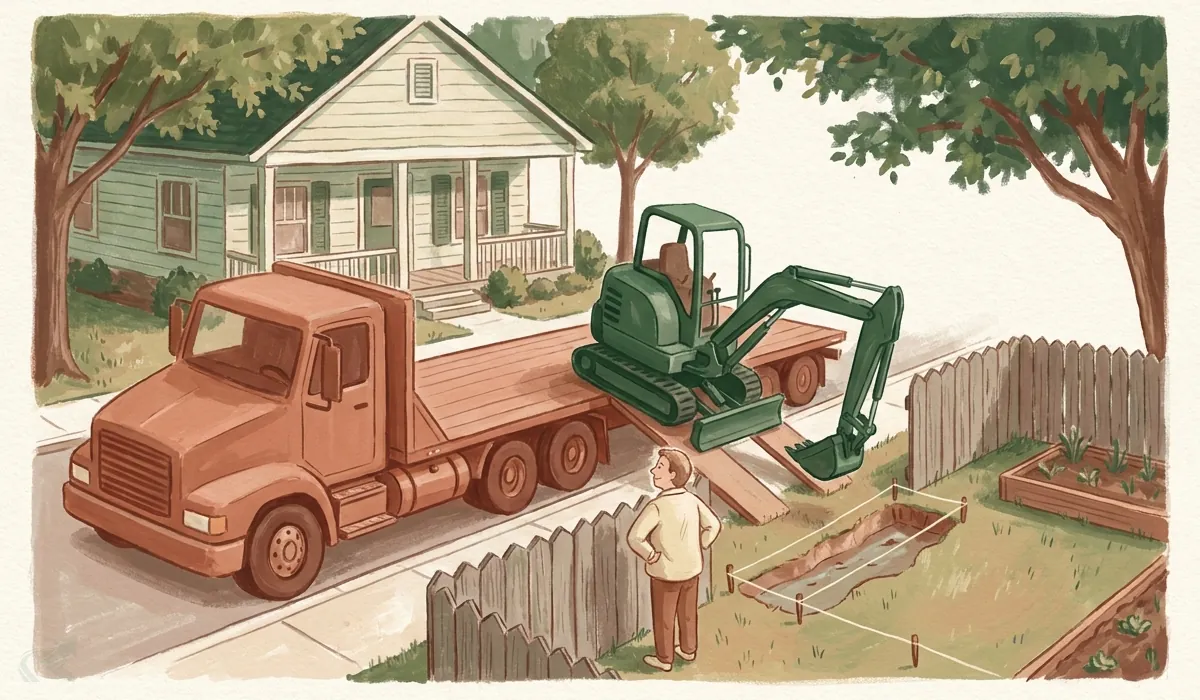
Excavation works the same way. The machine has to be loaded on a trailer, driven to you, unloaded, and taken home again. That trip costs the same whether the job is an hour or a week, so it sits at the front of every quote. Many firms set a minimum for exactly that reason. On a small job the trip is most of the price, which is why small digs either cost more than you expect or don’t get answered at all.
What helps:
- Bundle the work. If you have three small digs, ask for all three at once. One trip, three jobs.
- Be exact about the job. Length, depth, what it’s for, how a machine gets into the yard. Vague requests get vague, padded quotes.
- Ask what is in the number. Mobilization, digging, backfill, hauling and cleanup are separate pieces of work. A quote that names each one is easier to compare. The hire guide walks through comparing quotes.
What the Law Asks of Whoever Digs
Three sets of rules govern excavation on a North Carolina property. A good contractor follows all three without being asked. Knowing them lets you tell.
Call 811 Before Anyone Digs
North Carolina’s Underground Utility Safety and Damage Prevention Act requires whoever is responsible for an excavation to notify the NC 811 Notification Center at least three full working days before digging (G.S. 87-122). The utilities then mark their lines. The law also sets a tolerance zone around each mark, generally 24 inches either side of it. Inside that zone, ordinary digging machines may not be used until the line has been exposed and seen, by hand or with soft-dig equipment designed to protect it (G.S. 87-117 and 87-122).
There is a narrow exemption from the notice requirement for owners. An owner of a single-family home digging on their own land doesn’t have to give notice, as long as the dig stays off any utility’s right-of-way, easement or permitted use, or is done with hand tools (G.S. 87-124). The law puts the duty on the person responsible for the excavation. When you hire a firm to dig, that is usually the contractor, so ask who is filing the notice and ask to see the ticket number.
Protect Anyone in the Trench
OSHA calls trench collapses the greatest risk to workers’ lives in excavation, and its rules are specific about preventing them. Anyone working in a trench must be protected from a cave-in: the walls sloped back, shored, or a trench box. There are only two exceptions. A trench dug entirely in stable rock. And a trench less than 5 feet deep, where a competent person has examined the ground and found no sign of a possible cave-in. At 5 feet or more, in anything but stable rock, protection is required ( 29 CFR 1926.652). Dirt and equipment must be kept at least 2 feet back from the edge or held back by a retaining device, and a competent person must inspect the trench before work each day and after every rainstorm while anyone is working in it (29 CFR 1926.651).
These rules bind employers whose crews work in the hole. They are also the clearest sign of a careful firm. If you see a crew standing in a deep, straight-walled trench with the spoil piled at its lip, that firm is taking a risk with people, and it will take risks with your property.
Check the License on Larger Jobs
North Carolina’s general contractor law covers anyone who contracts for grading or other construction where the cost of the undertaking is $40,000 or more (G.S. 87-1), and that work requires a general contractor license. The law has narrow exceptions, such as an owner building a house for their own use. The sorts licenses into classifications and limitations, and a license card shows which ones a contractor holds. The licensing guide explains how to read one.
Below $40,000 a general contractor license isn’t required, though other trade licenses can still apply, such as a plumber’s for the pipe. Insurance and a clean safety record still matter, because the dig is still on your land.
How to Check an Excavation Contractor
Before you let anyone dig, check these four things. Every one is a public record or a document the contractor can hand you.
- The license, on a job of $40,000 or more. Look the firm up on the NC Licensing Board’s free public search and confirm the classification and limitation cover your job.
- Insurance. Ask for a certificate of insurance sent to you directly by the insurer, not a copy from the contractor. It should show general liability, and workers’ compensation where the firm is required to carry it.
- The safety record. OSHA inspection records are public. Repeated serious violations are a warning, especially on trench work.
- The locate ticket. On the day the work is booked, ask for the 811 ticket number and look for the paint and flags on the ground.
This is the work our directory does for you. We check contractors against the state licensing board, the Secretary of State’s business registry, OSHA’s inspection records and the NC Industrial Commission’s workers’ compensation coverage. A contractor marked verified has passed those checks, with a link to the record behind each one. A contractor with three or more serious OSHA violations doesn’t carry the verified badge. Find a checked contractor near you.
Where to Go Next
- The surface work: grading land and yards.
- Building on the dig: preparing a building pad.
- Moving the dirt: hauling, fill dirt and gravel, and demolition debris.
- The machines: excavators and when the boom makes the difference.
- Water at the house: foundation drainage and the French drain.
- Hiring: how to compare quotes and check a contractor.