
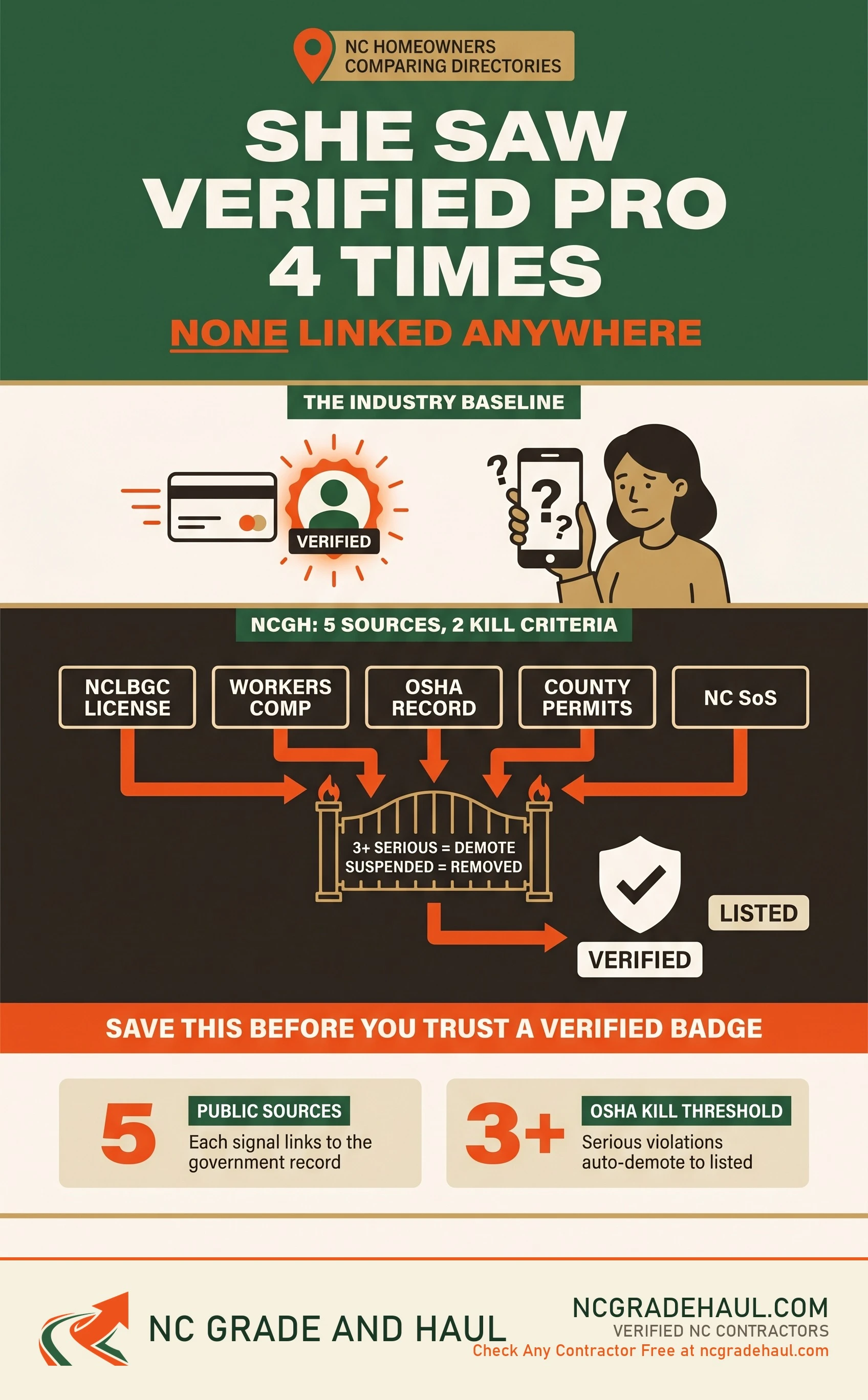
She has seen “Verified Pro” on four contractor sites tonight. None of them link anywhere. None name a source. She asked one contractor what the badge meant — he said he paid a subscription. That is the industry baseline.
North Carolina has no shortage of directories willing to call a contractor verified for a monthly fee. NCGH is not that. Every signal on every listing links to a primary-source government record. This page explains what we check, what we skip, and what automatically demotes a contractor regardless of what they paid or how long they’ve been listed.
Why most directory badges mean nothing
Most “verified” badges are subscription badges. The directory gets paid; the contractor gets the sticker.
A homeowner trying to sort legitimate contractors from unvetted ones runs into the same wall every time. One Reddit user put it bluntly: “I have no idea how to evaluate which one is legitimate and which ones are padding.” That frustration is the right read of the market. The pay-to-play model is the industry norm — a contractor buys a plan, the badge appears on the profile, and neither the directory nor the homeowner has any way to know whether the underlying license is active — making comparing NC contractor bids on meaningful criteria nearly impossible.
None of that is fraud, exactly. But it means “verified” has been emptied of meaning across most of the major directories. The word signals nothing because the standard for earning it is a credit card number.
NCGH can’t fix the industry. It can describe a different system clearly enough that a skeptical homeowner can check every claim on the page without asking us to trust them.
What “verified” means at NCGH
Every signal links to a primary-source government record the homeowner can check.
Five sources feed every verified listing. Each one is a public record, not a self-report.
-
license. The license number appears on the listing and links to
portal.nclbgc.org. Active status is confirmed at time of verification. Suspended, expired, or revoked licenses are dead-letter — NCGH does not process contractors with inactive NCLBGC credentials any further. -
Workers’ comp. Coverage is confirmed against the database at
ic.nc.gov. If a contractor has no workers’ comp coverage, uninsured workers on your property expose you to liability. The NC IC record is the check — not the contractor’s word. -
OSHA inspection history. The federal inspection database (DOL public API) logs every workplace inspection. Three or more serious violations on the record automatically demote a contractor from verified to listed — regardless of license status or anything else. When two bids price the same job differently and one contractor carries a clean OSHA record while the other doesn’t, that compliance gap explains part of the price divergence.
-
County land-disturbance permits. Active permit history from county feeds (Wake and Guilford counties) shows where a contractor has actually worked recently — concrete evidence of presence that sits alongside the rain-check photos as contractor trust signal a quality operator provides after every job. A contractor with permits on file has a real footprint; one without has only a profile.
-
NC SoS business registration. The confirms the business entity is registered and in good standing at
sosnc.gov. A contractor operating without a registered entity is a structural red flag regardless of what their license shows.
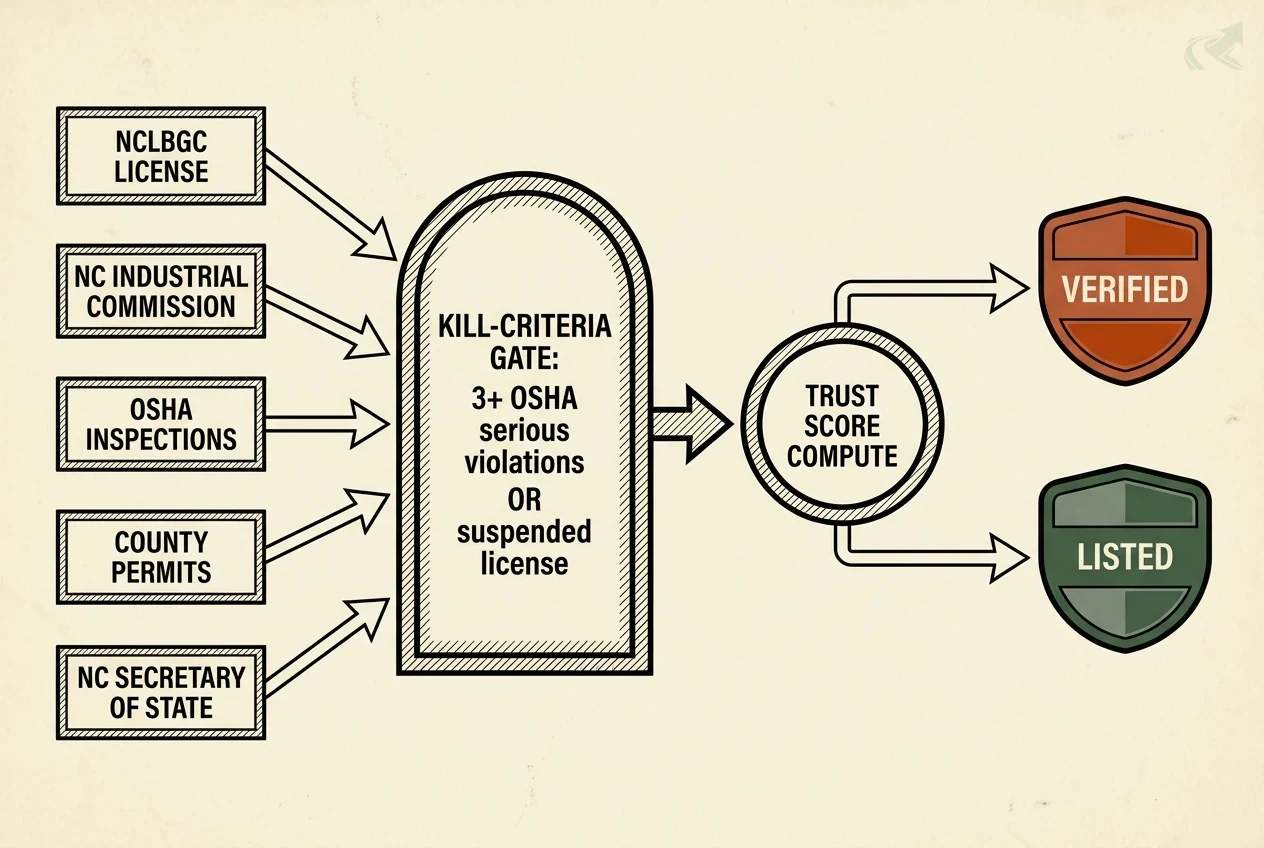
Below is how NCGH stacks up against a generic directory on each of these five factors:
| Factor | Generic directory | NCGH |
|---|---|---|
| License verification | Self-reported | NCLBGC portal lookup, link on profile |
| Workers’ comp | None | NC Industrial Commission record |
| OSHA history | None | Federal DOL inspection database |
| County permits | None | ArcGIS Hub permit feed (Wake, Guilford) |
| Business registration | None | NC Secretary of State |
| Placement model | Pay-to-play | Trust Score (public criteria) |
| Kill criteria | None | 3+ serious OSHA violations; suspended license |
The verification tier — what each level means
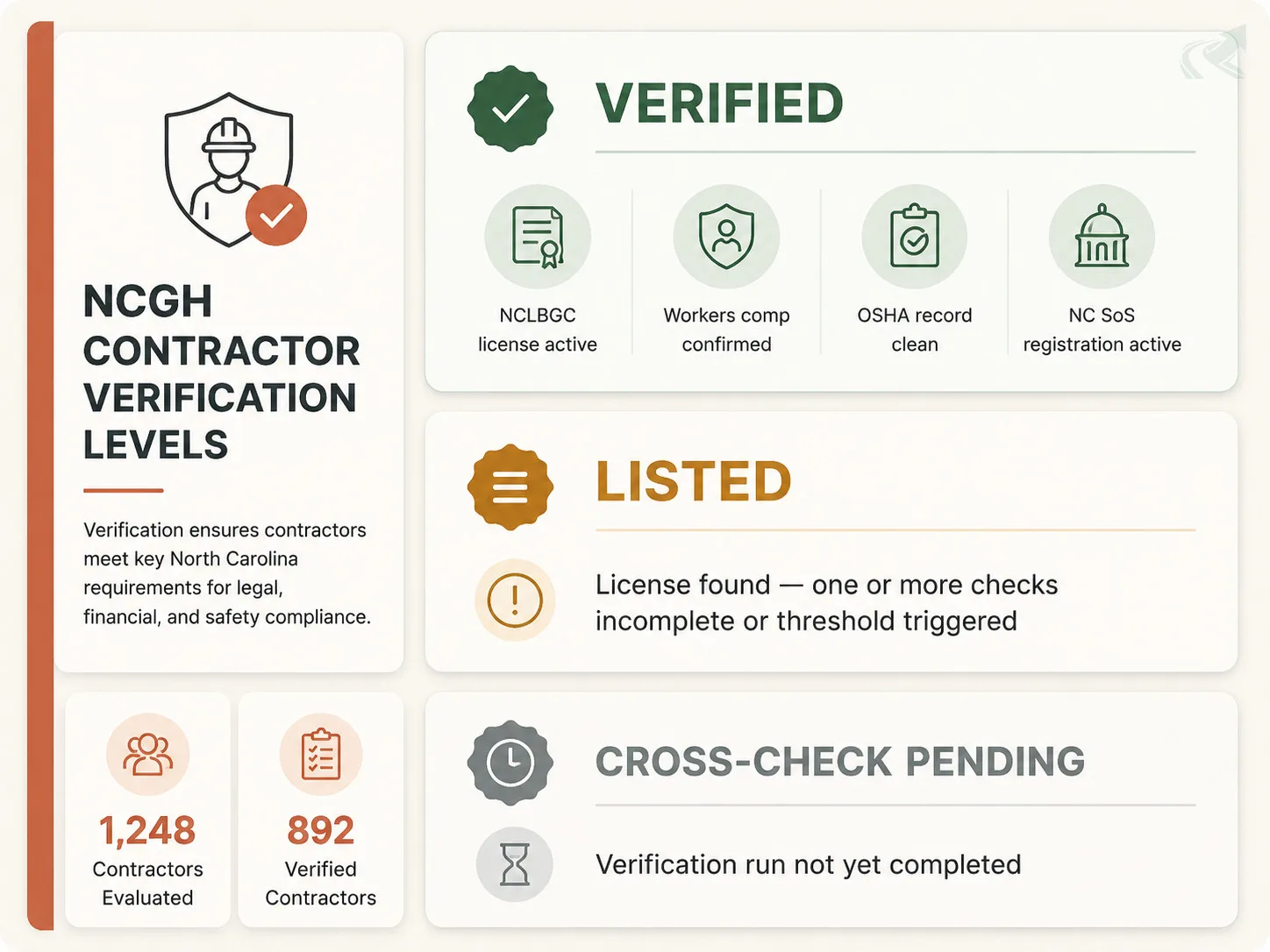
“Verified” requires passing all five sources. “Listed” means NCGH found the contractor but one or more checks couldn’t be completed.
Three tiers appear on contractor profiles:
- Verified — NCLBGC license active + workers’ comp confirmed via NC IC + OSHA record clean (fewer than three serious violations) + NC SoS business registration active. All five sources checked out.
- Listed — NCLBGC license found, but at least one additional check couldn’t be completed. Coverage data pending, permit history unavailable for that metro, or the OSHA violation threshold triggered an automatic demotion. The contractor exists and has a valid license; the full cross-check isn’t done or didn’t pass — meaning their NC grading before-and-after portfolio and references carry more weight than usual as trust inputs.
- Cross-check pending — Contractor is in the NC cohort but the verification run hasn’t been completed yet. Not a negative signal — just an incomplete one.
The tiers describe what the data shows. They are not editorial opinions about whether a contractor is good at their job.
What NCGH does not do
No pay-to-play placement. No sponsored badges. No hidden criteria.
- NCGH does not sell verified status. A contractor cannot pay for a higher tier. Verification is computed from the five public sources above, full stop.
- NCGH does not accept payment for search position. Sort order is Trust Score, not check size. A contractor who buys an ad slot gets banner placement — they do not move up the verified list.
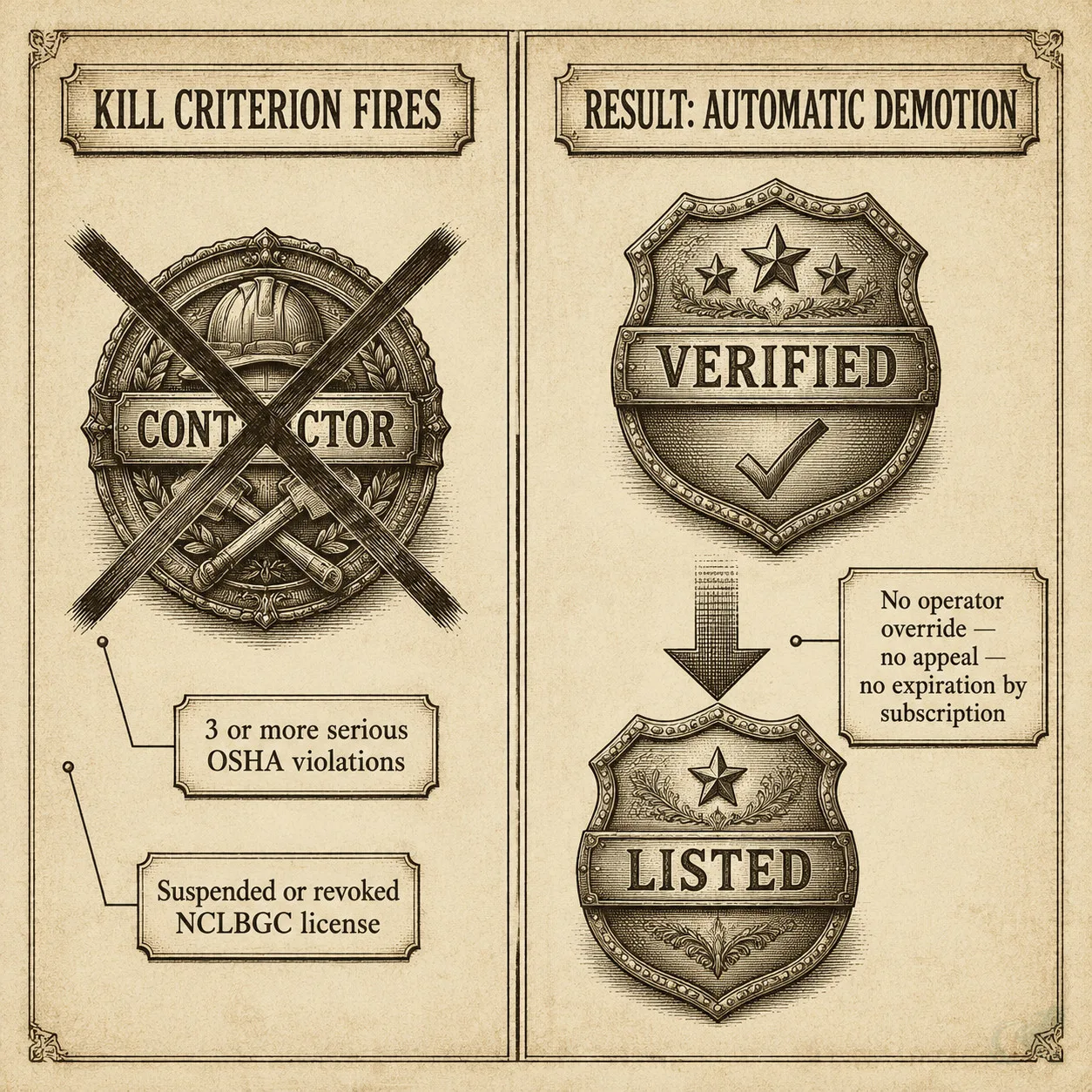
- NCGH does not remove negative signals. If a contractor has four serious OSHA violations on the federal record, the demotion holds until the violation history changes. No override, no appeal process, no expiration by subscription.
How NCGH stays honest — the kill criteria
Two conditions automatically demote a verified listing, with no operator override.
-
OSHA serious-violations threshold. Three or more serious violations on the federal DOL inspection record trigger an automatic demotion from verified to listed. The threshold is three serious violations — not total violations, not citations of any type, not informal notices. Three serious. That count comes directly from the OSHA inspection database at
osha.gov/establishment-search. If the count drops below three in a future inspection cycle, the tier recalculates. -
Suspended, expired, or revoked NCLBGC license. A contractor whose NCLBGC license is not in active standing is filtered out of the verification queue entirely. They are not listed as listed — they do not appear. Per NCGH policy: if the business license is suspended, there is no reason to cross-check anything else. This filter runs at the point the contractor enters the verification queue, not at the scoring stage. It applies across all NC metros.
These two rules exist because any directory can define kill criteria. The test is whether those criteria fire automatically and without override. At NCGH, they do.
How to use the verification yourself
Every signal on a contractor’s profile links directly to the public source. You do not need to trust NCGH.
Here are the three concrete steps for verifying a contractor independently:
-
Check the NCLBGC license directly. Find the contractor’s listing and click the NCLBGC badge — it links to the NC Licensing Board public search at
portal.nclbgc.org. If you want to be certain the link wasn’t redirected, type the license number into the search form yourself. The portal shows license status, expiration date, and any disciplinary actions. This is the same database NCGH queries. NC contractor licensing thresholds explains what license class your project requires. -
Check OSHA inspection history. The OSHA indicator on the profile shows “clean” or flags violations. Confirm it yourself at the federal OSHA inspection search — search by the contractor’s business name. Any serious violations appear in the inspection record with the violation description and penalty. Three or more serious violations and you are looking at a contractor NCGH has already demoted to listed.
-
Check workers’ comp at NC IC. The NC Industrial Commission self-insurance and exemption search at
ic.nc.govis public. A contractor without workers’ comp coverage creates real exposure — if an uninsured worker is injured on your property, the liability question lands on you. The NC IC lookup takes 30 seconds. It is the check most homeowners skip and contractors count on.
Before you sign anything, consider asking the contractor directly:
Question to send your contractor
“Your listing on NC Grade and Haul shows your NCLBGC license as [number]. Can you confirm that’s current? And can you share your before we sign anything?”
A legitimate contractor answers this question without hesitation. Copy and paste — no explanation needed. For more on what insurance documents to request, see how to verify NC contractor insurance.
For a full checklist of contractor red flags to watch for — quote behavior, permit evasion, pressure tactics — see the red flags guide. For reading a bid line by line, see how to read a grading bid line-by-line.
If a contractor you are considering isn’t on the directory yet, the NCLBGC license number is still searchable at portal.nclbgc.org. What NCGH adds is the cross-check — five sources, one place, with the demotion criteria applied automatically. If you want an itemized quote from a verified contractor in your county, start at NC grading contractor near me.