
What is a rain check -- and should you ask for one?
What is a rain check in NC grading work?
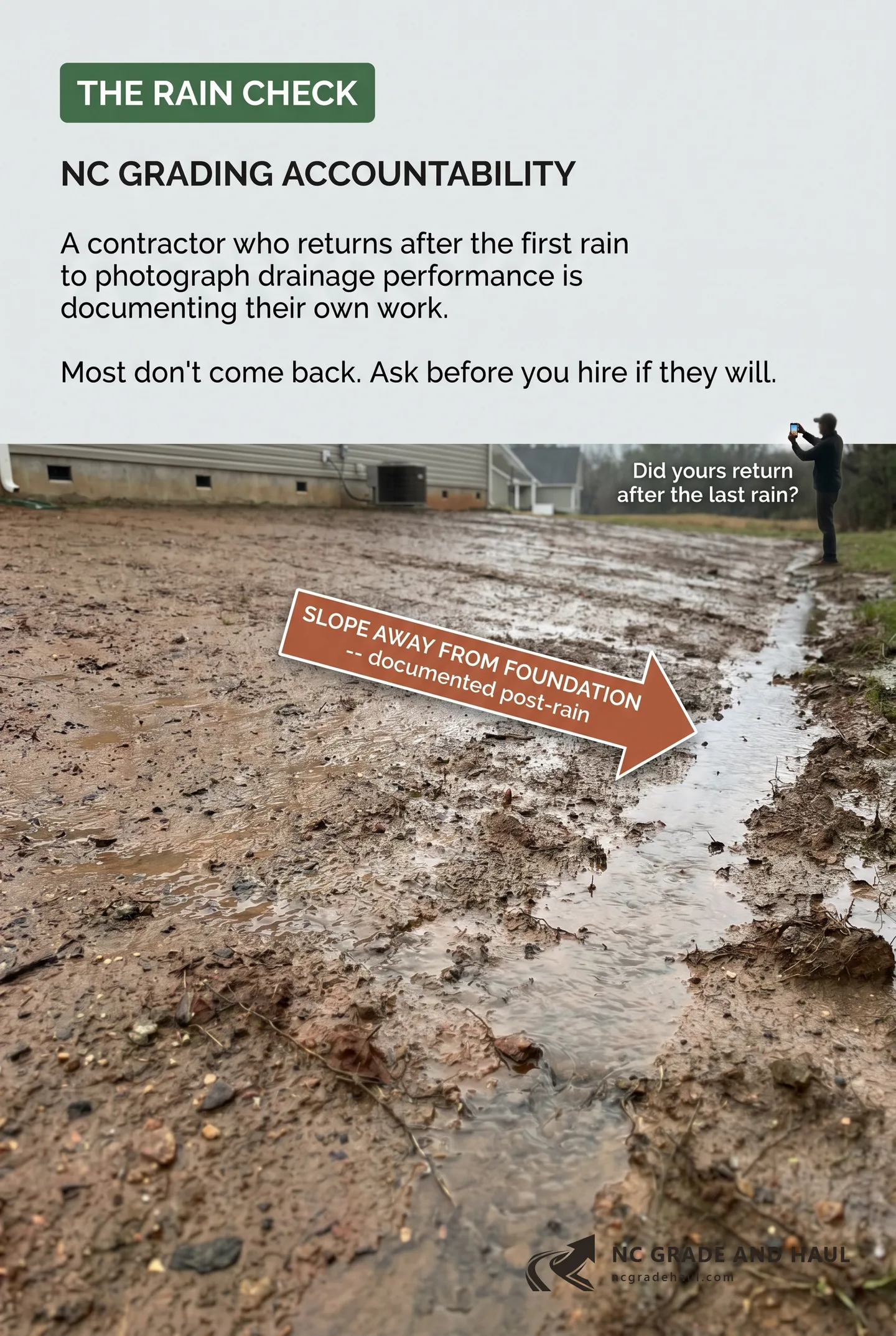
A contractor returns to your property after the first significant rain following the job and photographs the drainage performance. They document that water is flowing correctly, the grade has not shifted, and no new pooling has appeared. It takes 30 minutes and produces photos you keep.
Should I ask for one even if the contractor does not offer it?
Yes -- and ask before they leave the job site, not after. The language is simple: 'Can you come back after the first rain and document how the drainage is performing?' A legitimate contractor will say yes without hesitation.
The grading crew left at 3pm. The yard looks different — regraded, tamped down, silt fence staked along the lower edge. The contractor shook Carla’s hand and said: “Looks good. Call us if you have any issues.”
She doesn’t know whether to ask for anything else.
She doesn’t know that a rain check is something she could have requested before they pulled out of the driveway. And she doesn’t know that the photos from a rain-check visit are the same photos she would want in her hands if this drainage work becomes part of a builder dispute 18 months from now.
This page explains what a rain check is, how to request one, what to observe during the visit, and why the documentation it produces matters beyond simple reassurance.
What the Rain-Check Practice Actually Involves
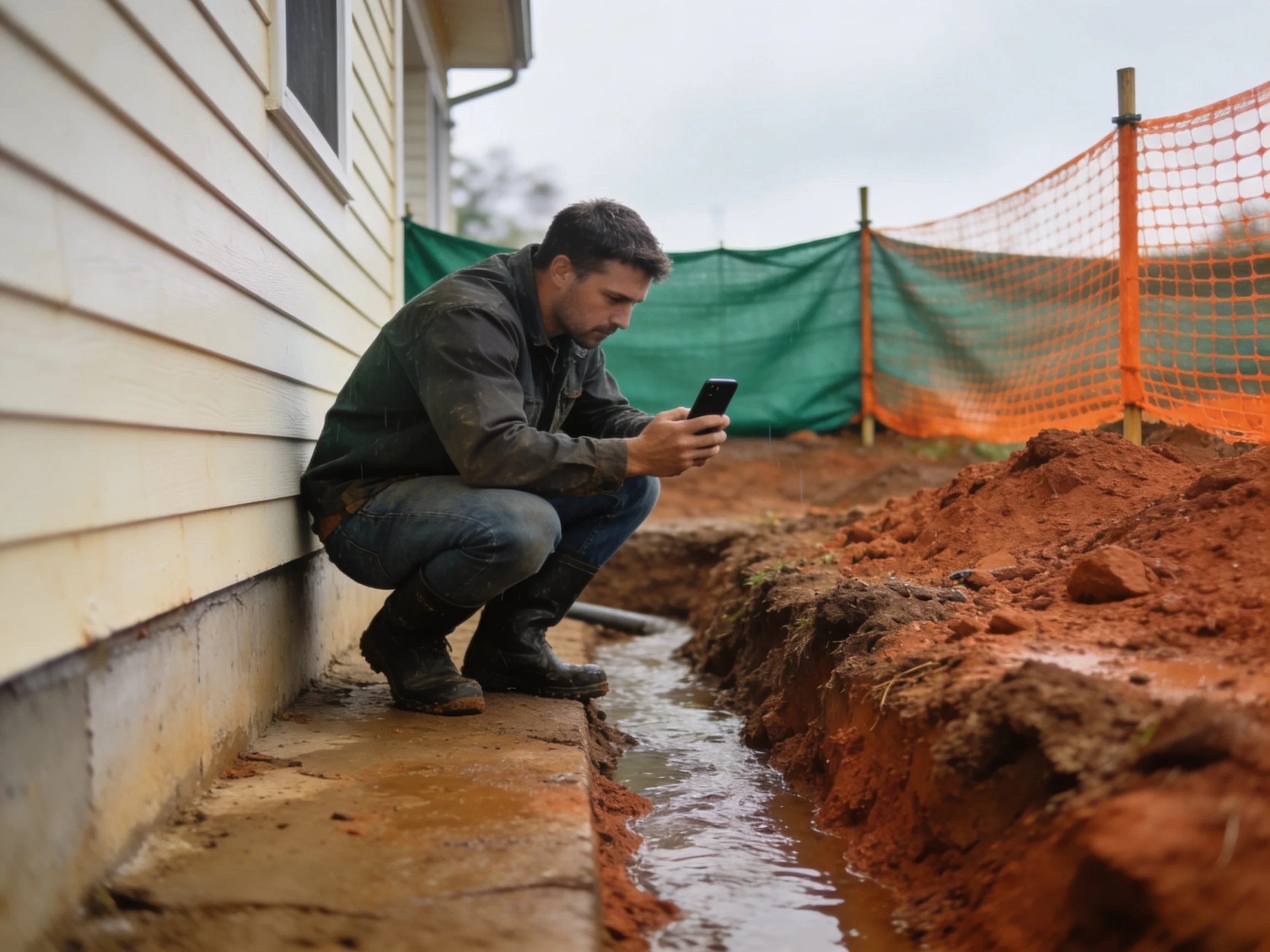
The contractor returns after half an inch or more of rain, walks the site, photographs drainage performance, and provides the dated photos to the homeowner.
A rain-check visit typically runs 20 to 45 minutes per site. What happens during it:
- Foundation clearance: They photograph water movement at the foundation perimeter. Water should be flowing away from the house on all sides — not collecting within the first 10 feet.
- Slope verification: They check the graded areas for signs of settled low points. Any new dip in the grade that wasn’t there at job completion is worth flagging.
- Downspout discharge: They verify that water is reaching its intended destination — the swale, the drainage easement, or the daylight point at the lot perimeter. Standing water directly below a downspout means the discharge is not making it through.
- Silt fence integrity: On a fresh job with disturbed soil, the silt fence should be holding. A collapsed section means sediment is moving off the site.
- Adjustment documentation: Any area that needs adjustment gets noted and photographed, not just the areas that are performing correctly.
What you receive: dated photos with annotations, or a brief written or email walkthrough of what they observed.
Why It Matters More Than You Think — The Evidence Angle
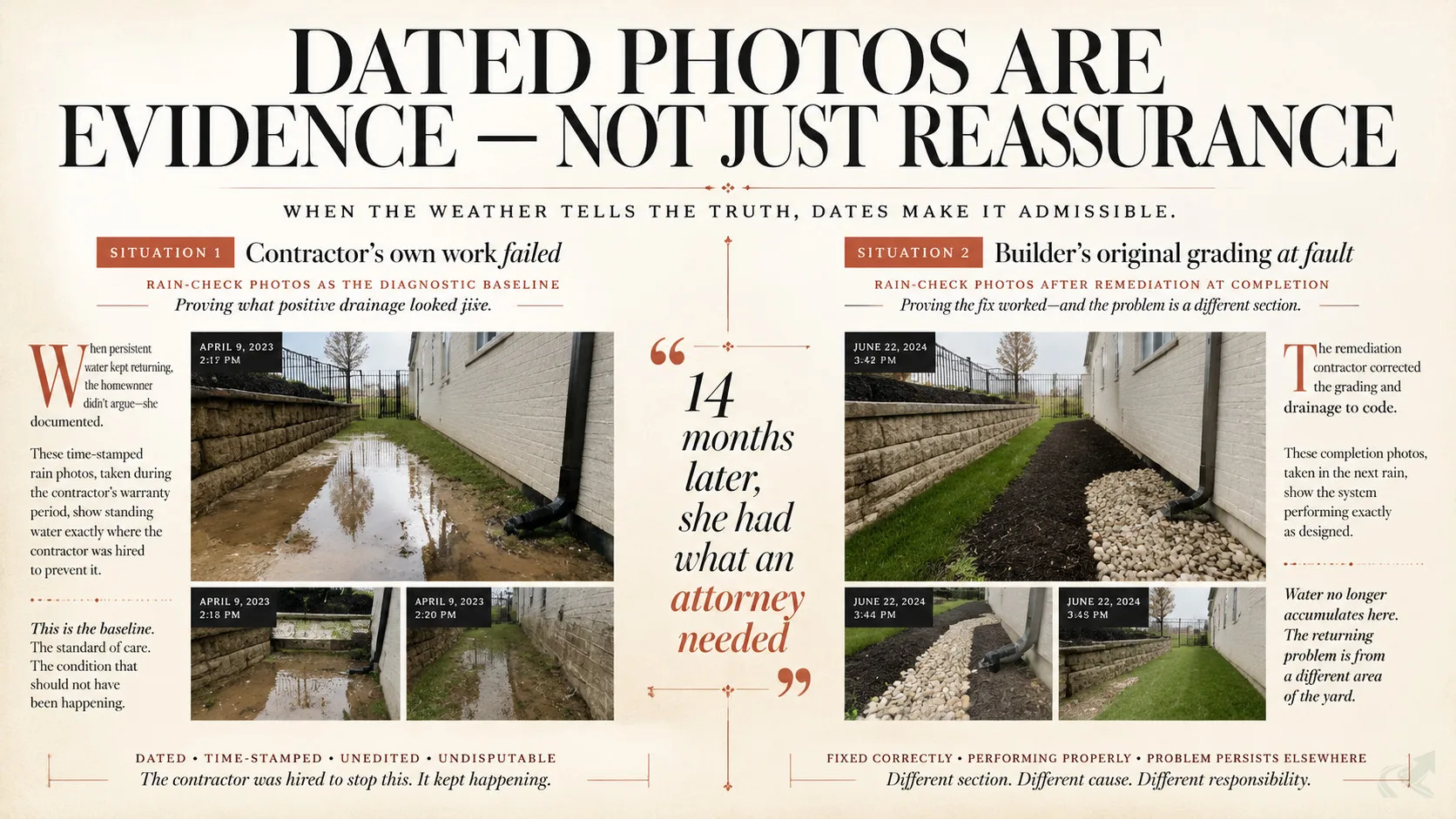
Rain-check photos are not just reassurance — they are dated evidence of drainage performance that can be used in a builder dispute or county-inspector escalation.
Most homeowners who receive rain-check photos treat them as proof of quality. That is true. But there is a second function most people miss entirely.
If Carla’s yard develops a drainage problem 14 months after the grading work, she has two distinct situations:
Situation 1: The grading contractor’s own work failed. Rain-check photos document what positive drainage looked like two weeks after the job. That baseline is exactly what a contractor, inspector, or attorney needs to diagnose what changed.
Situation 2: A remediation contractor fixed a drainage problem caused by a builder’s original grading — and the underlying issue has returned in a different area. Rain-check photos demonstrate that the remediation contractor’s work was correct at the time of completion. That distinction matters when Carla calls the builder’s warranty team again.
In either case, dated photos showing drainage performance at the foundation perimeter, at downspout discharge points, and across the graded surface are evidence — not just reassurance.
A contractor who takes rain-check photos is building a paper trail. That trail protects the homeowner and the contractor both. For more on how photo documentation connects to the full accountability picture, see NC builder accountability documentation and the certification letter for NC drainage disputes.
How to Request a Rain Check Before the Contractor Leaves
Ask before they leave the job site — “can you come back after the first rain and document how the drainage is performing?” A legitimate contractor will say yes without hesitation.
The moment to make this request is before the crew packs up — not the next morning, not by phone later. If you ask before they leave, the contractor can confirm the threshold, exchange a phone number for the rain-alert call, and build the return visit into their schedule. After they have left the site, it becomes a harder conversation.
The language to use, word for word:
What a good answer sounds like: “Sure — give us a call when it rains. We will come back after half an inch or more.”
What a concerning answer sounds like: “It’ll be fine, you don’t need that.” Or: “That’s not something we do.”
A contractor who will not return for a rain-check visit is a contractor who does not want documentation of how their work performs. That tells you something worth knowing before they finish loading the equipment.
If you are still in the contractor-selection stage, finding a verified NC grading contractor includes contractors whose accountability practices — including rain-check willingness — are part of the verification record.
What to Look For During the Rain-Check Visit
Water flowing away from the foundation, grade intact at the same slope, no new pooling within 10 feet of the structure.
Bring your phone and walk the site alongside the contractor. Four things to observe:
Foundation clearance: Positive drainage means water moves away from the house on all sides. Standing water that collects within 10 feet of the foundation and does not drain within a few hours is a performance failure worth discussing during the visit — not after.
Slope integrity: After rain, look at the graded areas. Has the slope shifted? Use a visual reference point you established before the rain — a stake, a chalk mark on the driveway edge — to confirm the grade reads the same.
Downspout discharge: Water should be reaching its intended drainage destination: the swale, the daylight point at the perimeter, or the drainage easement. A puddle sitting directly below the downspout indicates the discharge is not making it through. The swale or daylighting endpoint should have visible flow.
Silt fence performance: On a fresh job with disturbed soil, the silt fence controls erosion runoff. A collapsed or torn section means sediment is moving off the site and toward neighboring property or the storm drain. Document it the same day.
What a rain-check visit should show vs what signals a failure
Comparison. Grade performing: Water channeling away from the foundation; Slope reads the same against your reference mark; Downspout discharge reaching the swale or daylight point; Silt fence intact and holding sediment on site. Worth raising on the spot: Water pooling within 10 feet of the structure; Grade has shifted from the pre-rain reference; Puddle sitting directly below a downspout; Collapsed or torn silt fence section.
- Water channeling away from the foundation
- Slope reads the same against your reference mark
- Downspout discharge reaching the swale or daylight point
- Silt fence intact and holding sediment on site
- Water pooling within 10 feet of the structure
- Grade has shifted from the pre-rain reference
- Puddle sitting directly below a downspout
- Collapsed or torn silt fence section
A rain-check visit catches drainage failures while the contractor is still on site -- not after final payment.
When Rain-Check Photos Connect to a Builder Dispute
If a drainage problem traces back to the builder’s original grading, rain-check photos from a remediation contractor can document that the remediation worked — and that the returning problem sits in a different section of the yard.
Here is the scenario in concrete terms:
Carla’s North Carolina home was graded by the builder in 2022. By 2024, she hired a grading contractor to regrade and install a French drain along the north side of the yard. The contractor does a rain-check visit and documents: drainage performing correctly, water flowing to daylight, no standing water at the foundation perimeter.
Eight months later, the problem returns — in a section of the yard the remediation did not touch. That section is part of the builder’s original grading.
The rain-check photos are now evidence. They show that the remediation contractor’s work was performing correctly at the time of the return visit. The returning problem is located in a different part of the yard. That distinction is the exact thing Carla needs when she contacts the builder’s warranty department again.
For detailed guidance on the NC foundation drainage pattern in new builds, see the protect your new-build foundation from water. For documentation strategy when a builder dispute is already in motion, see NC builder accountability documentation.
NC grading work done after a major weather event — including regrading required after a hurricane — has its own scheduling and documentation considerations. See booking a grading contractor after a hurricane for that context.
Three Common Mistakes
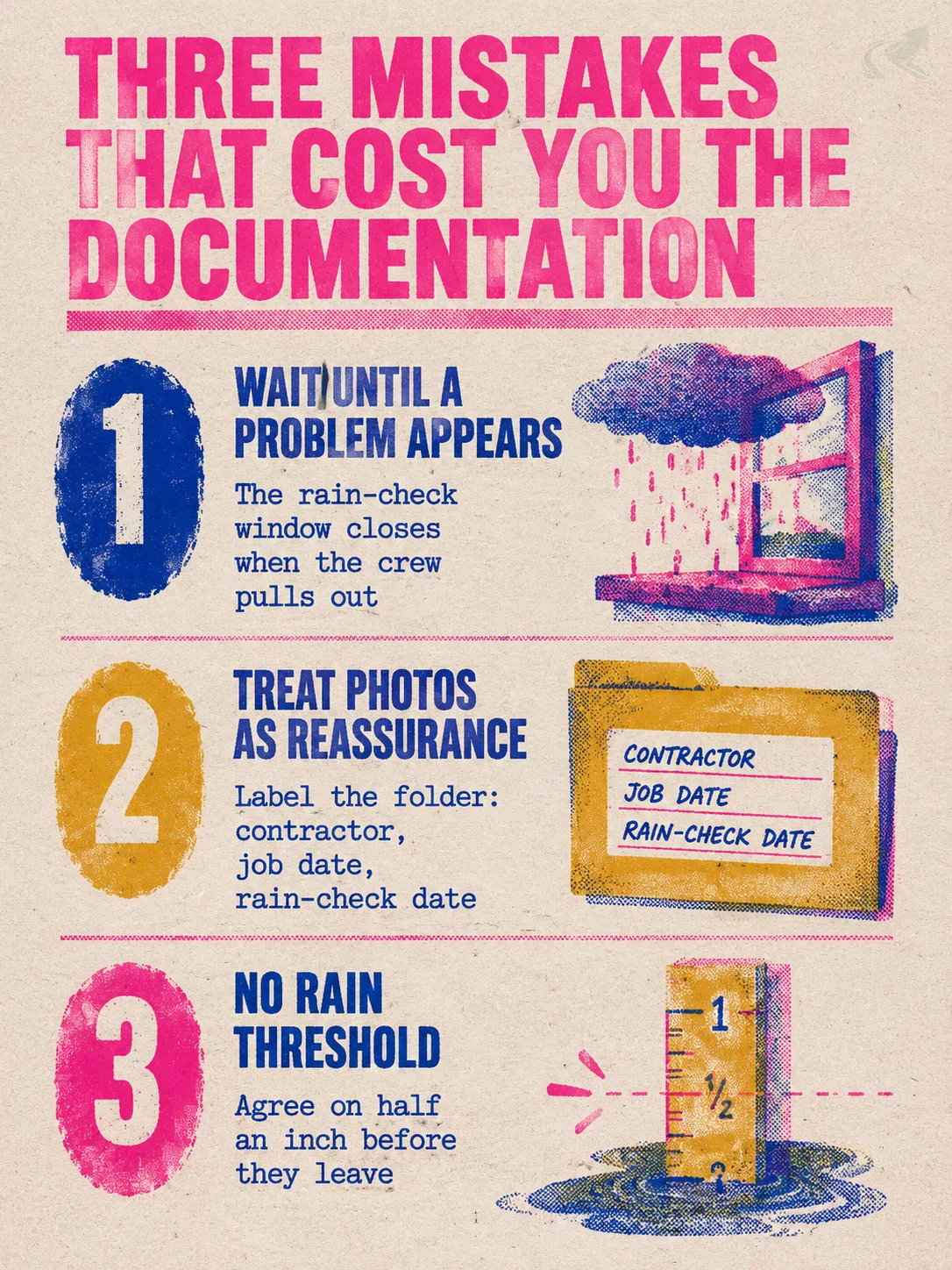
Waiting until a problem appears to ask for documentation. Once the crew has packed out, the moment for an easy rain-check agreement has passed. Ask before they leave — it costs you nothing to ask and costs them only 30 minutes to return.
Treating rain-check photos as reassurance instead of evidence. Save them in a dated folder, not buried in your camera roll. Label the folder: contractor name, job date, rain-check date. If you need them 14 months from now, you will need them fast.
Not specifying the rain threshold. “Come back after it rains” is ambiguous. A contractor who is not expecting to come back until a meaningful rain event needs a concrete trigger: “Call me when we get at least half an inch.” That threshold is a measurable cue that avoids a post-drizzle visit that tells neither of you much. It is not a formally codified standard — NC’s NPDES construction stormwater permits require erosion-control site inspections after 0.25 inches (a lower bar that serious contractors are already trained to meet), but there is no state rule specifying a homeowner rain-check trigger. The 0.5-inch figure is a practical floor used in NC grading trade practice.
Rain-Check Observation Checklist
Four items to check while walking the site alongside the contractor. Formatted for a quick phone reference:
For contractor selection and what an itemized quote from a grading contractor near me in NC looks like before work begins, NC Grade and Haul’s directory surfaces contractors who have cleared license-board, workers’ comp, and OSHA checks.
To see what documentation looks like across a full project — from before-and-after photos to completion records — see the NC grading before-and-after portfolio.