
You watched French Drain Man say always wrap the trench in fabric. Then you found Apple Drains — Chuck out of Florida — saying never use fabric in clay. Both are experienced operators. Both sound completely sure of themselves. And they’re giving opposite answers to the same question.
You’re not imagining the contradiction. They’re both telling the truth. The problem is neither of them is talking about your back yard in Holly Springs or Kernersville.
This page gives you the NC-specific answer, explains the physics behind it, and gets you to a point where you can ask an informed question before you sign any quote.
Why Says Always Use Fabric
French Drain Man’s fabric recommendation is correct for Michigan loam, where fines migration through the stone column is the primary failure mode.
In Michigan’s soil profile — loamy, with significant fine-particle content — the gravel trench is physically adjacent to loose fine soil. Without a barrier, those fines migrate laterally into the stone column over time, gradually filling the voids and reducing drainage capacity. Fabric wrapped around the entire trench prevents that fines infiltration. For that soil, it works.
The reasoning is sound. The application is regional.
NC Homeowner Takeaway: FDM’s trench-wrap logic is valid wherever loose fines surround the gravel column and can migrate inward. If your yard has sandy loam or mixed fill soil — not pure Piedmont clay — his recommendation may apply to you. The key variable is whether fines are migrating into the stone from the sides, or whether fabric itself will become the clog point. In high-clay zones, the latter risk dominates.
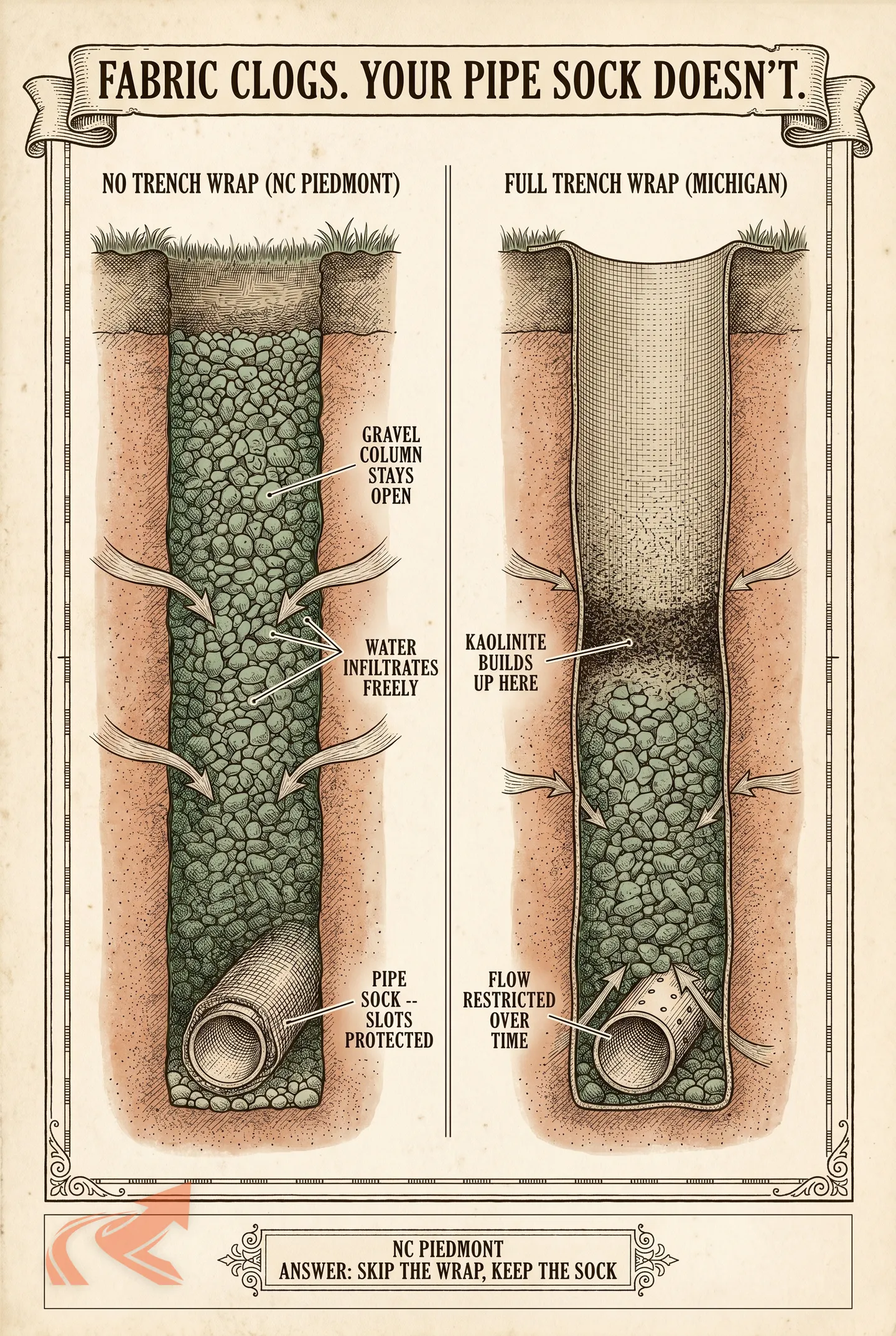
French drain in NC clay after 10 years: no trench-wrap vs trench-wrapped
Comparison. No trench-wrap (with pipe sock): Stone column stays open, pipe slots clear; Kaolinite fines do not surge through stone the way sand would; Water keeps entering the column from the trench walls; Sock on the pipe still guards the perforations from fines. Full trench-wrap in clay: Kaolinite platelets migrate into the geotextile structure; Fabric pores progressively clog over seasons of cycling; Water entry restricts -- slowly, hard to diagnose; Standing water returns above a trench that once drained.
- Stone column stays open, pipe slots clear
- Kaolinite fines do not surge through stone the way sand would
- Water keeps entering the column from the trench walls
- Sock on the pipe still guards the perforations from fines
- Kaolinite platelets migrate into the geotextile structure
- Fabric pores progressively clog over seasons of cycling
- Water entry restricts -- slowly, hard to diagnose
- Standing water returns above a trench that once drained
In NC Piedmont clay the trench-wrap becomes the filter failure mode -- the Michigan 'always wrap' rule degrades performance here.
Why Apple Drains (Chuck, FL) Says Never Use Fabric
Chuck’s no-fabric position is correct for Florida’s sandy, high-permeability soil, where fabric clogs quickly and the soil’s own behavior makes a geotextile barrier counterproductive.
Florida’s soil is sandy and highly permeable. Water moves through it fast. In that environment, the geotextile fabric becomes the hydraulic bottleneck before the pipe ever does. The fabric clogs with fine organics and silt, flow rate drops, and the drain underperforms. Skip the fabric, and Florida sand behaves itself — it doesn’t surge into the stone column the way Michigan loam would.
Chuck is describing a real failure mode. It’s just Florida’s failure mode, not NC’s.
NC Homeowner Takeaway: Chuck’s “no fabric” position is about avoiding a hydraulic bottleneck in a high-permeability environment. In North Carolina Piedmont clay, the failure mode is different — kaolinite fines don’t surge through stone the way sand would, but they can clog the fabric surface over time. Chuck’s conclusion (no fabric) may still be right for NC high-clay zones, but for a different reason than he gives. The logic doesn’t translate directly — the NC answer requires understanding your specific soil, not just picking a side in the YouTube debate.
What NC Piedmont Clay Actually Does to Fabric
NC red clay’s kaolinite fines are fine enough to pass through or lodge in most non-woven geotextile over time — not rapidly, but enough that a fabric-wrapped trench in high-clay soil is more likely to restrict flow than an unwrapped one.
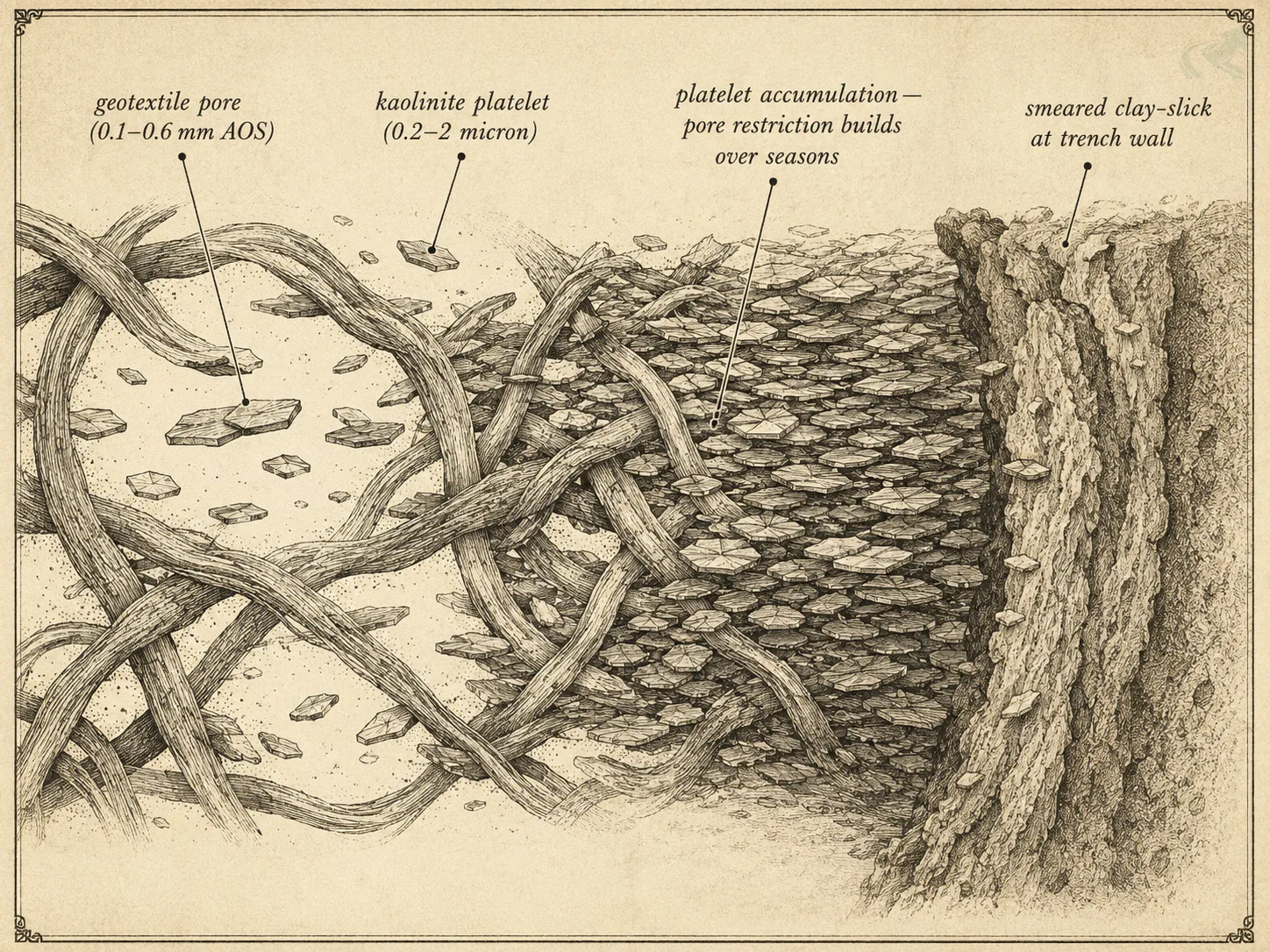
Kaolinite is the dominant clay mineral in North Carolina’s Piedmont red clay. Kaolinite particles are plate-shaped and very small — on the order of 0.2 to 2 microns. Standard non-woven geotextile fabrics have an Apparent Opening Size (AOS) typically in the 0.1 to 0.6 mm range, which is orders of magnitude larger than kaolinite platelets. Kaolinite doesn’t filter out at the fabric surface the way coarser silt would; instead, the plates migrate into the fabric structure itself and accumulate there over time.
The result is a clay-slick effect at the trench wall. NC Piedmont red clay smears and seals when disturbed during excavation. That smeared surface, combined with kaolinite fines working into the geotextile pores over seasons of drainage cycles, progressively reduces fabric permeability. The drain still works at first. Restriction builds over time.
This is why the NC working position differs from both Michigan and Florida. It’s not about soil rushing into the pipe (Michigan’s problem) or fabric clogging with organics (Florida’s problem). It’s about kaolinite fines gradually reducing fabric throughput in a slow, hard-to-diagnose way.
For technical detail on woven vs non-woven fabric selection, see woven vs non-woven geotextile for NC soil.
The NCGH Working Position on Fabric
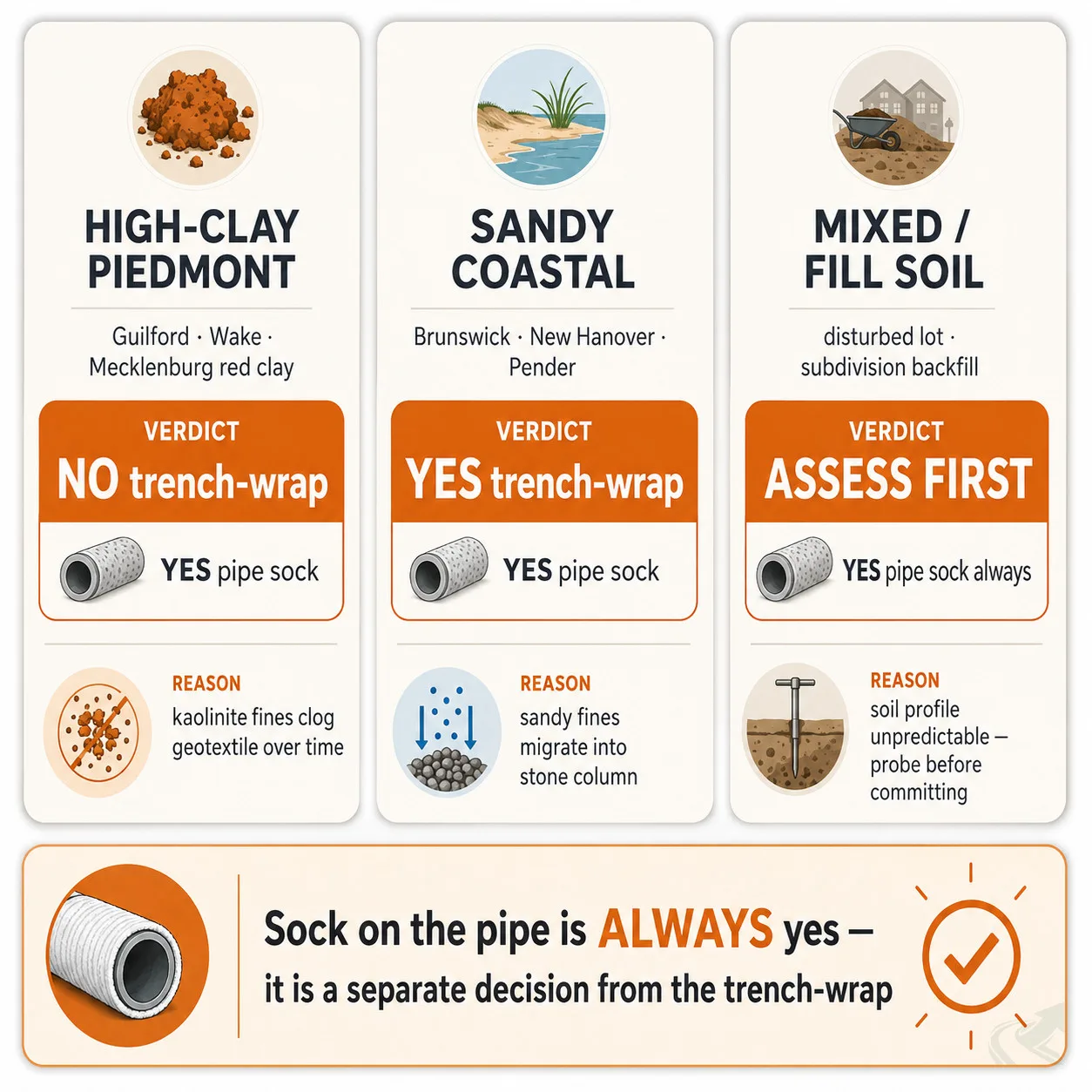
Skip the trench-wrap fabric in high-clay zones. Use a sock on the pipe in high-clay zones. Use full trench-wrap fabric in sandy or mixed-soil zones. Confirm the soil profile before making this call.
This is the NCGH position informed by NC Piedmont conditions. It is not a universal rule. A contractor who hasn’t assessed your specific soil profile cannot give you a correct fabric recommendation — and that assessment matters more than any YouTube channel does.
| Soil type | Trench-wrap fabric | Pipe sock | Reasoning |
|---|---|---|---|
| High-clay Piedmont (Guilford, Wake, Mecklenburg red clay) | No | Yes | Kaolinite fines clog geotextile over time; sock protects pipe slots from fines entering the pipe directly |
| Sandy coastal transition (Brunswick, New Hanover, Pender sandy soil) | Yes | Yes | Sandy fines can migrate into stone column; fabric barrier is warranted; sock still needed for pipe slot protection |
| Mixed or fill soil (disturbed lot, backfill, subdivisions with variable subgrade) | Assess first | Yes | Soil profile is unpredictable; contractor should probe or hand-auger before committing; sock always goes on the pipe regardless |
Two mistakes NC homeowners make because of the YouTube debate:
-
Mistake 1 — Using full trench-wrap fabric in high-clay zones based on YouTube advice. The Michigan logic sounds solid. The NC Piedmont application degrades performance over time as kaolinite fines accumulate in the geotextile. The drain works fine for a few years and then develops restriction that’s hard to diagnose without excavating.
-
Mistake 2 — Skipping the pipe sock in clay because “no fabric.” The pipe sock and the trench-wrap fabric are different decisions. “No fabric” means no trench-wrap. The pipe sock — the fabric wrapped directly on the perforated pipe — protects the pipe’s slots from fines entering the pipe itself, regardless of what you do with the trench wrap. Dropping both is a different call than dropping the trench-wrap alone.
For more on fabric vs no-fabric in NC clay — the real answer, that page goes deeper on the soil-condition decision logic.
What to Ask Your Contractor About Fabric
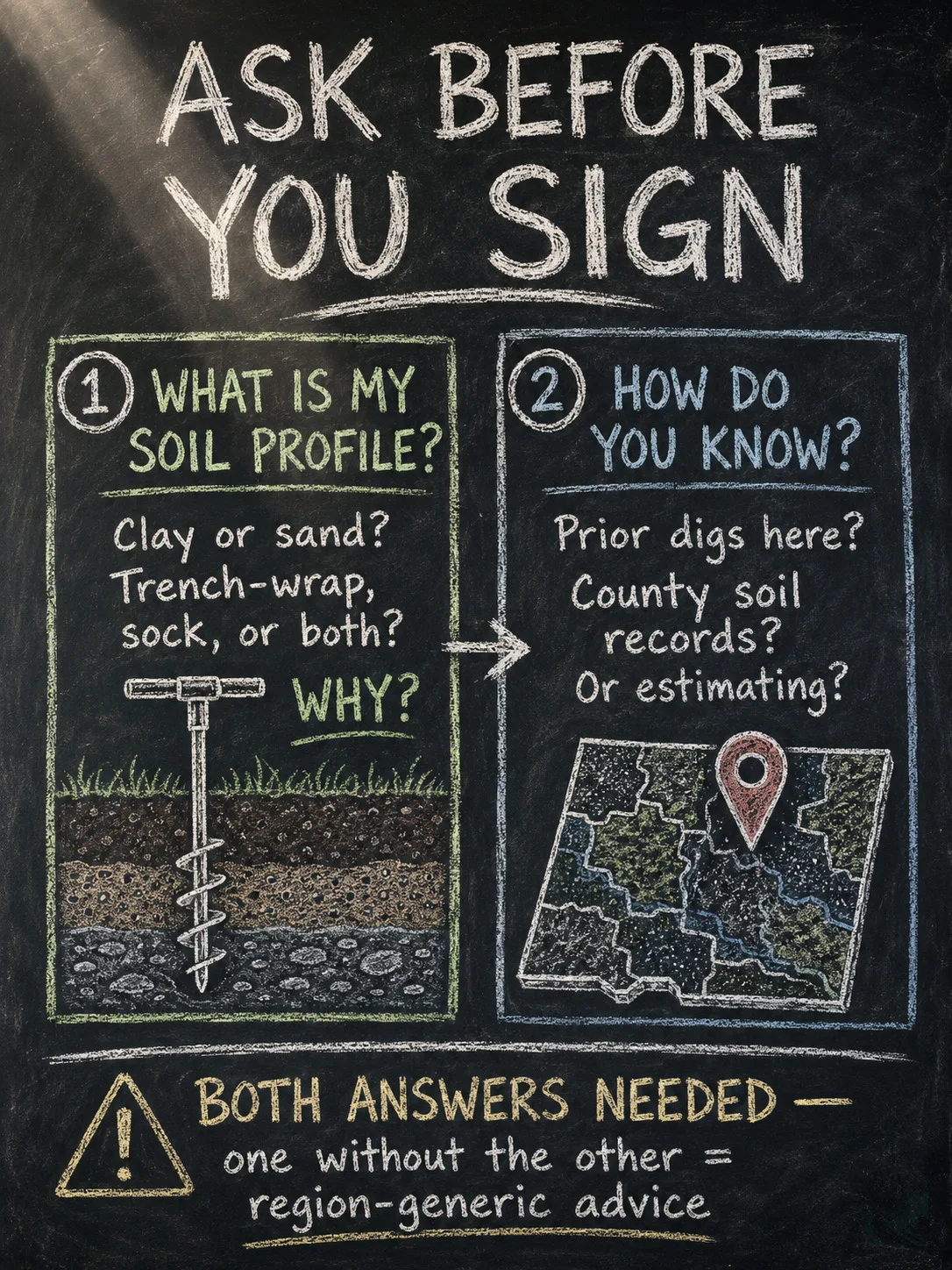
Ask what the soil profile in your specific yard is — a contractor who hasn’t assessed the soil profile can’t give you a correct fabric recommendation.
Before signing any quote for a French drain installation, ask these two questions directly:
-
“What’s the soil profile in my yard — specifically, how much clay versus sand? And based on that, are you using trench-wrap fabric, pipe sock, or both? Why?”
-
“Have you dug here before or pulled county soil records, or are you estimating based on the neighborhood?”
A contractor who gives a confident fabric answer without first identifying your soil type is giving you a region-generic answer, not a yard-specific one. That answer may be right — or it may be the Michigan answer applied to NC Piedmont clay.
Request an itemized quote that specifies fabric or no-fabric and explains why for your yard. “We use fabric on all our installs” and “we never use fabric” are both red flags. The correct answer is “it depends on your soil, and here’s what we found.”
To hire a verified NC grading contractor who can assess your soil before recommending a drainage approach, the NCGH directory lists contractors by county with their verified license numbers.
NC Homeowner Takeaway
Neither operator is lying. French Drain Man describes Michigan correctly. Chuck describes Florida correctly. Your NC Piedmont clay is the variable they didn’t account for, and it demands a different answer than either soil type they’re working in.
What survives from FDM: the logic that soil type drives the fabric decision. That’s true everywhere. What doesn’t transfer: the specific recommendation for a trench-wrap in high-clay NC soil.
What survives from Chuck: the observation that fabric can become the bottleneck. That’s also true — in NC Piedmont clay, it’s the mechanism that eventually restricts a fabric-wrapped trench. What doesn’t transfer: skipping the pipe sock because “no fabric.” Those are two separate decisions.
Now you know how to ask the right question. For the full picture on French drains in NC red clay and how North Carolina soil conditions shape every design choice, that page covers the broader drainage engineering context for the Piedmont.