
Before you read
Is NC Coastal Plain drainage different from NC Piedmont drainage?
Yes -- significantly. Sandy soils percolate water faster, so French drain methods designed for percolation-dominant soils work closer to spec in the Coastal Plain. The drainage challenges here are different: flat topography with no natural grade, high seasonal water tables, and tidal influence in some coastal counties.
What are the main drainage problems in the NC Coastal Plain?
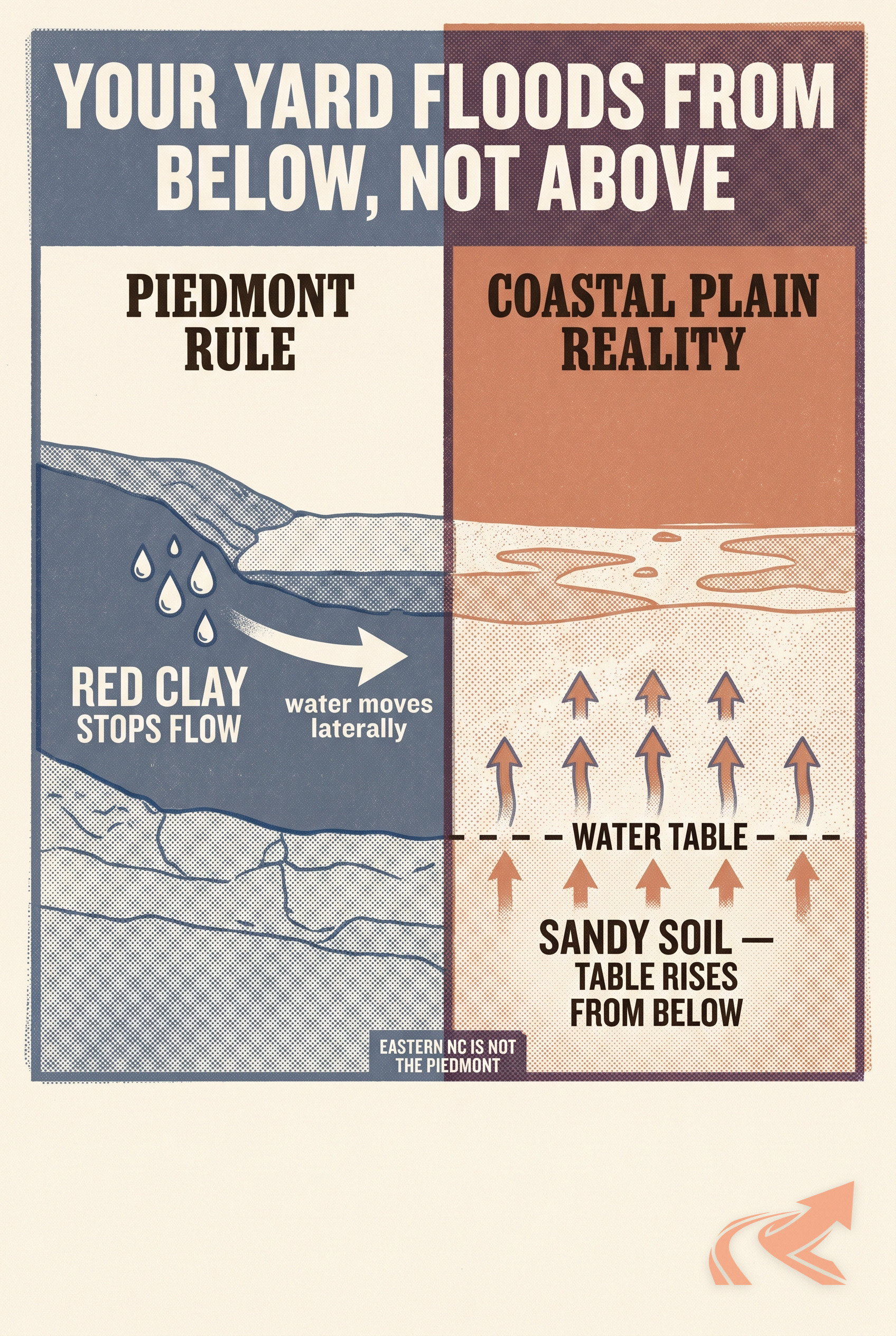
The problems aren't about soil permeability. They're about what happens when the water table rises faster than the soil can drain: no natural slope to route water toward an outlet, seasonal flooding from below rather than above, and in coastal counties like New Hanover and Brunswick, tidal backflow that limits when drainage systems can discharge.
A homeowner in Wilmington watches NC drainage videos and recognizes none of it. The presenter talks about red clay blocking lateral flow, about B-horizon impermeability, about socks clogging from kaolinite fines.
His yard has none of that. His soil is sandy. Water doesn’t pool on top — it comes up from below after a heavy rain or a sustained wet season. His problem isn’t clay blocking percolation. It’s a water table that rises faster than the soil can drain it away.
He’s a North Carolina coastal homeowner reading Piedmont content. The physics is wrong for his zone.
This page is written for him. The Coastal Plain — roughly the eastern third of North Carolina, east of Interstate 95 — has its own soil type, its own drainage failure modes, and its own design responses. Piedmont reasoning doesn’t transfer.
NC Coastal Plain Soils: What You’re Working With
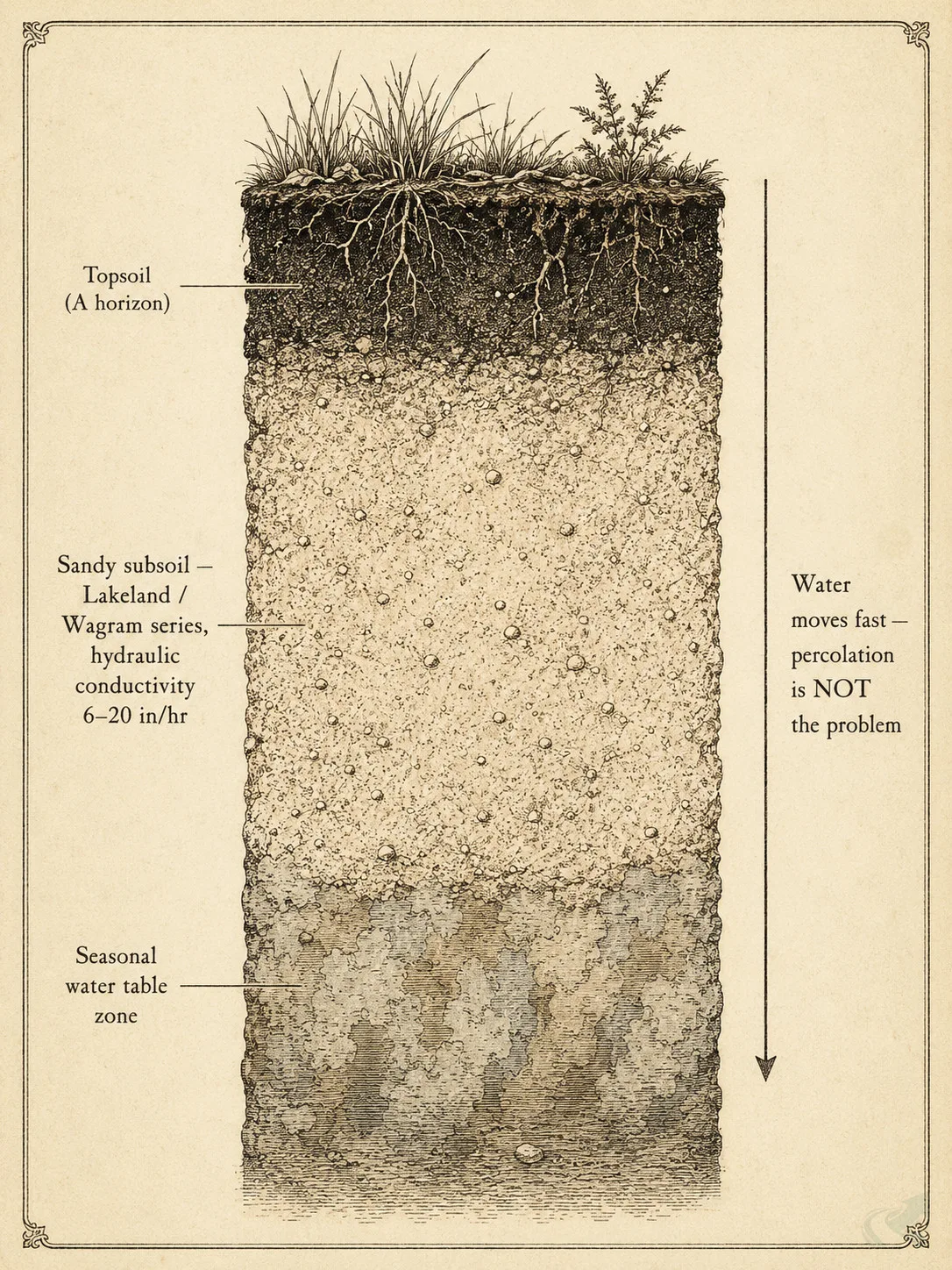
NC Coastal Plain soils are primarily sandy — Lakeland, Wagram, and Norfolk series dominate — with hydraulic conductivity 10 to 100 times higher than Piedmont clay, which means water moves through them quickly.
The Coastal Plain extends across eastern North Carolina from the fall line near Interstate 95 through counties like New Hanover, Brunswick, Pender, Onslow, Carteret, Craven, and Dare. The soils that dominate are light-colored, coarse-textured sands.
Lakeland and Wagram soils are excessively well-drained in upland positions — hydraulic conductivity can reach 6 to 20 inches per hour. Norfolk series soils, more common in lower positions, have moderate conductivity but can still move water roughly 10 to 50 times faster than Piedmont Cecil clay.
This matters because most drainage content written for North Carolina is written for Piedmont clay — where conductivity is 0.01 to 0.2 inches per hour and water barely moves vertically. In Coastal Plain sandy soil, the physics is different. For a broader overview of all three NC soil zones, see the NC soil guide covering Coastal Plain and other zones.
Why National French Drain Methods Work Closer to Spec Here
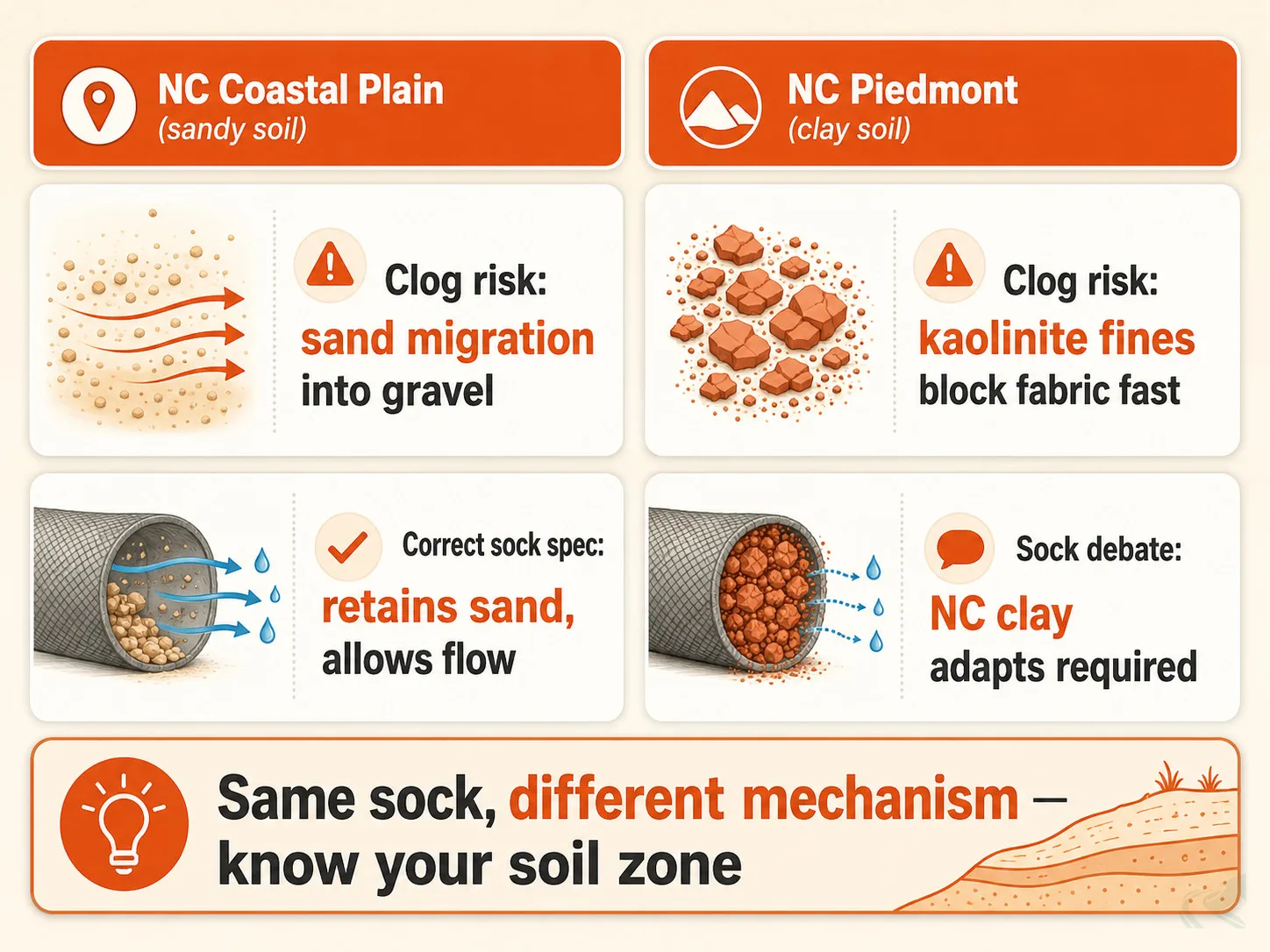
In Coastal Plain sandy soil, water does percolate vertically into a gravel-filled French drain trench — which is exactly what national drainage tutorials assume. The no-sock-in-clay debate doesn’t apply here; sock clogging is less aggressive in sand.
National French drain videos and installation guides assume a soil that will let water percolate down into the gravel bed. That assumption is valid in Coastal Plain sandy soil in a way it isn’t in Piedmont clay.
In the Piedmont, that percolation model breaks down. Clay blocks vertical movement, water moves laterally instead, and the system design has to account for it. The controversy about filter fabric socks in NC comes from that Piedmont dynamic — kaolinite clay fines clog fabric relatively fast. See the clay-stops-water debate and NC red clay contrast for that argument in full.
In Coastal Plain sandy soil, the sock question is different. Sand migration into gravel is the actual clogging concern — fine sand particles moving through or around filter fabric and filling void space in the gravel bed. A properly specified sock that retains sand without restricting flow is appropriate in sandy soils. It’s a different clogging mechanism, not the same one operating at lower severity.
The takeaway: if you’re in New Hanover County reading a Piedmont-focused argument against socks, that argument doesn’t apply to your situation.
The Coastal Plain’s Actual Drainage Challenges
The Coastal Plain’s drainage challenges aren’t about soil permeability — they’re about what happens when the water table rises faster than the soil can drain: flat topography with no natural outlet, seasonal flooding, and in coastal counties, tidal influence on drainage timing.
Understanding which problem you have determines which solution applies.
Flat topography. The Coastal Plain is, by definition, flat. There’s no grade for water to follow toward an outlet. A French drain installed in flat terrain with no daylighted outlet simply fills with water and stops draining. Positive drainage — moving water consistently from a high point to a low point to an outlet — requires grade that often doesn’t exist naturally. Creating it is the design challenge, not specifying pipe or gravel.
Coastal Plain drainage: a real outlet vs no outlet
Comparison. Graded to an outlet: Yard grade raised to create positive fall; Swale routes water from high point to low; Water discharges to a ditch outlet; System keeps moving water in sandy soil. No outlet route: Flat lot offers no natural grade; French drain trench has nowhere to drain; Rising water table fills the trench; Trench holds water -- the yard floods.
- Yard grade raised to create positive fall
- Swale routes water from high point to low
- Water discharges to a ditch outlet
- System keeps moving water in sandy soil
- Flat lot offers no natural grade
- French drain trench has nowhere to drain
- Rising water table fills the trench
- Trench holds water -- the yard floods
On the flat Coastal Plain the design challenge is creating an outlet, not specifying pipe or gravel.
High seasonal water table. In lower Coastal Plain positions, the water table can sit 12 to 36 inches below the surface during wet seasons. After sustained rain, it rises. The water that shows up in a crawl space or wet yard isn’t necessarily surface runoff — it’s groundwater intrusion from below. Installing a French drain to intercept surface flow doesn’t fix a rising water table. Raising finished grade to create more vertical separation above seasonal saturation is often the correct first response.
Tidal backflow. In tidal coastal counties — New Hanover, Brunswick, Carteret, Dare, Pender, and others where drainage outlets discharge to tidal creeks or estuaries — drainage systems face a timing problem. When the outlet is submerged at high tide, the system can’t discharge. Water backs up. A drainage system that works correctly at low tide can reverse at high tide without a check valve at the outlet. This is a design consideration for any coastal Outer Banks or Sound-adjacent property whose drainage outlet terminates near a tidal body.
What Changes in System Design for Coastal Plain Projects
Coastal Plain drainage design prioritizes grade creation and outlet routing rather than interceptor-trench positioning — because the problem is outflow path, not percolation.
In the Piedmont, interceptor placement matters: you’re cutting off lateral clay-borne flow before it reaches the foundation. In the Coastal Plain, the interceptor isn’t the primary tool. Grade creation is.
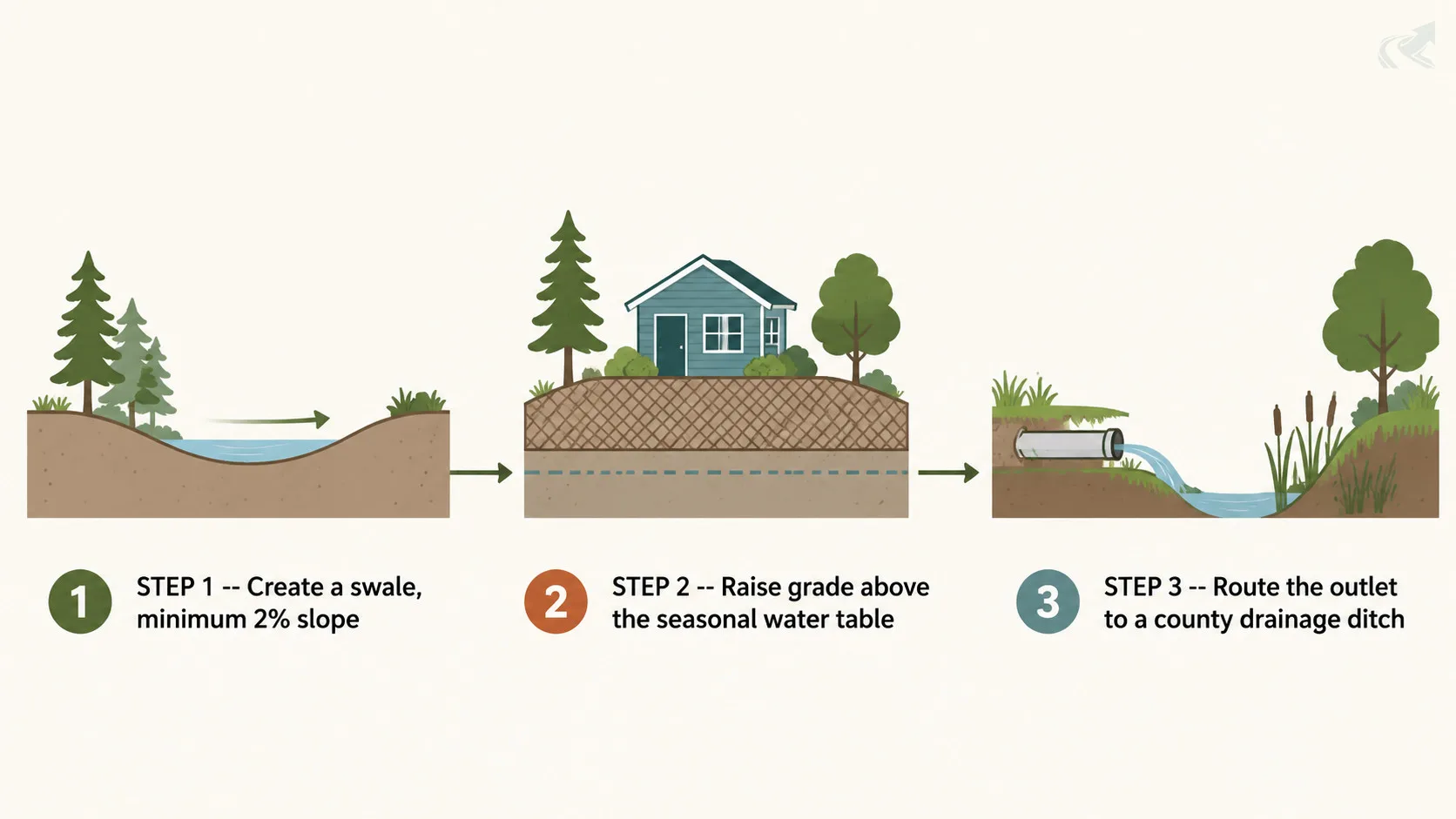
Swale and berm design. Where natural grade doesn’t exist, designers create it. A shallow swale — a gently graded channel, typically 1 to 2 feet deep with sloped sides — routes surface water from a problem area toward an outlet. The 2% slope minimum (2 feet of drop per 100 feet of run) is the working threshold for reliable flow; below that, water stalls and sediment accumulates. On flat Coastal Plain lots, building that grade into a swale sometimes requires importing fill.
Yard filling to raise finished grade. Where seasonal water table intrusion is the problem rather than surface runoff, raising finished grade above the high-water-table elevation is a primary intervention. This is particularly relevant for crawl spaces in eastern North Carolina counties where the seasonal water table is shallow. Grade-raising and drainage trench work are often combined — raise the yard to increase separation, then install a perimeter collection system at the new grade.
Outlet routing to drainage ditches. Rural Coastal Plain counties maintain networks of county-managed drainage ditches — open channels that carry water across flat agricultural land to streams and estuaries. In many eastern NC counties, the correct outlet for a residential drainage system is a permitted connection to one of these ditches, not a dispersal point on the property. Verify your county’s drainage ditch connection requirements before routing an outlet.
For yard-level drainage patterns and standing water causes, see NC yard drainage solutions.
What Stays the Same: Contractor Vetting Principles
Regardless of soil zone, the contractor vetting questions remain: is the outlet daylighted? Is there a 2% minimum slope from the problem area to the outlet? Is the pipe spec appropriate for the volume?
The Coastal Plain changes which drainage failure mode is most likely — but it doesn’t change the standard the work should meet.
Ask any contractor before committing to a Coastal Plain drainage project:
- Where is the outlet? Is it a county drainage ditch connection, a natural feature, or a discharge point on the property?
- What is the slope from the problem area to the outlet? Can they confirm at least 2% grade throughout?
- If the outlet discharges near a tidal area, is there a check valve specified?
- What is the expected seasonal water table depth, and does the proposed system account for it?
These questions apply whether the soil is Coastal Plain sand or Piedmont clay. The answers differ by zone — but the obligation to ask them doesn’t. To find a grading operator in North Carolina who can address Coastal Plain conditions, use the NC Grade and Haul verified contractor directory.
Coastal Plain vs. Piedmont: Quick Comparison
| Factor | NC Coastal Plain | NC Piedmont |
|---|---|---|
| Primary soil | Sandy (Lakeland, Norfolk, Wagram) | Kaolinite clay (Cecil, Appling) |
| Hydraulic conductivity | High (1 to 20 in/hr) | Low (0.01 to 0.2 in/hr) |
| French drain method | National methods work closer to spec | Requires NC clay adaptations |
| Primary drainage problem | Flat topography plus high water table | Lateral flow plus clay impermeability |
| Outlet challenge | No natural grade to outlet | Clay saturation limits outlet performance |
| Filter fabric sock concern | Sand migration into gravel | Kaolinite fines clog sock faster |
For a full breakdown of how soil permeability comparison coastal vs Piedmont NC affects drainage system design, see the permeability resource page. See NC Piedmont red clay for comparison if your property is west of the fall line.