Two questions people often ask
What is soil permeability and why does it matter for drainage?
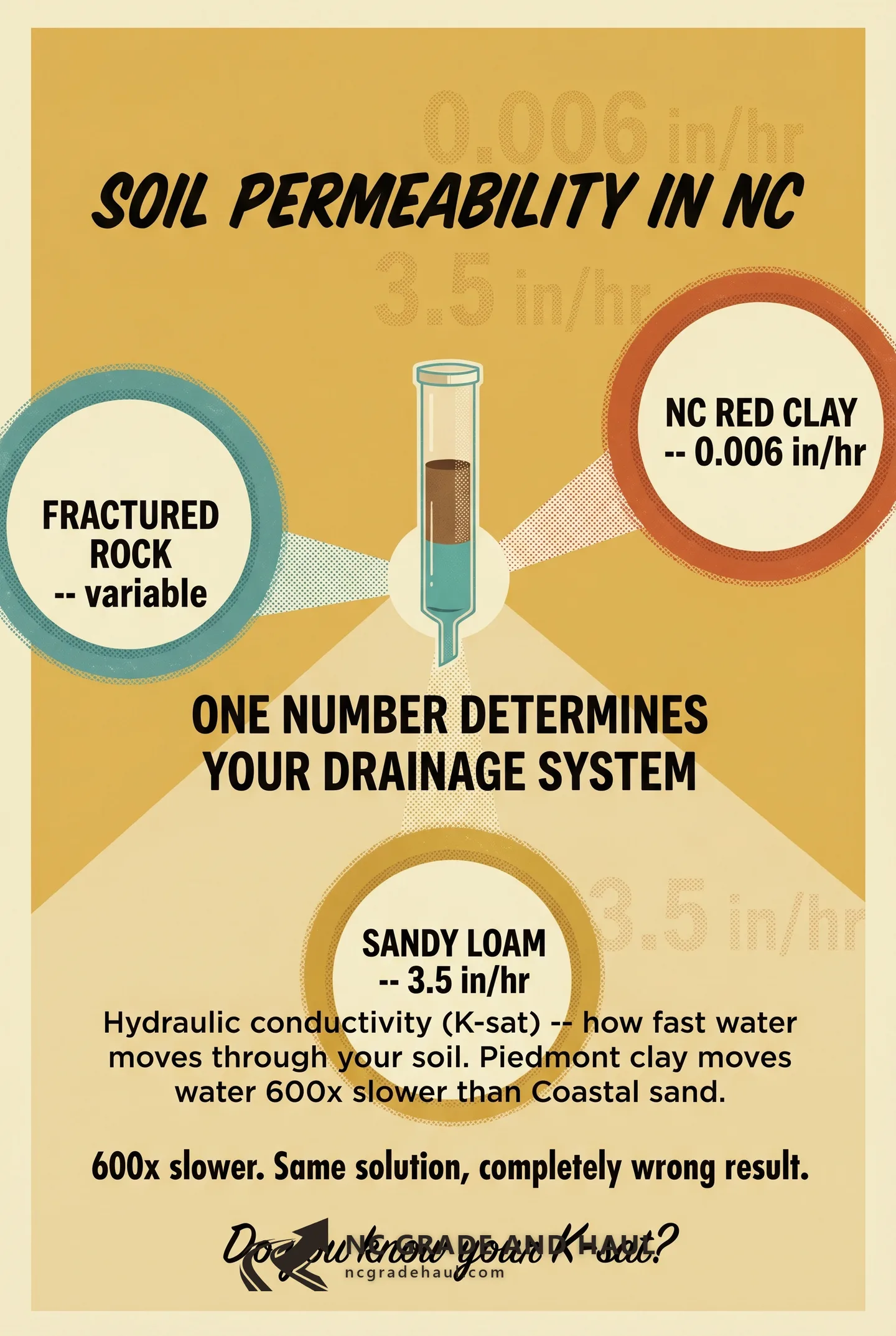
Soil permeability -- measured as hydraulic conductivity in inches per hour -- tells you how fast water moves through your soil. High means water drains quickly (Coastal Plain sand). Low means water barely moves (NC Piedmont clay). That number determines whether a French drain works by percolation or by intercepting lateral flow.
What is NC Piedmont clay's hydraulic conductivity?
Cecil series clay -- the dominant Piedmont soil -- runs roughly 0.01-0.2 inches per hour. That puts it in the USDA 'slow to very slow' permeability class. Standard percolation-dependent drainage systems designed for Florida sand or Michigan loam will not perform correctly in it without significant design adaptation.
What is a perc test and how does it relate to hydraulic conductivity?
A perc test is the field-measured version of hydraulic conductivity. An engineer digs a test hole, saturates it, then measures how fast water drops per hour. The result tells you whether your soil can support a conventional septic drain field -- and gives a practical real-world number to compare against the laboratory KC value.
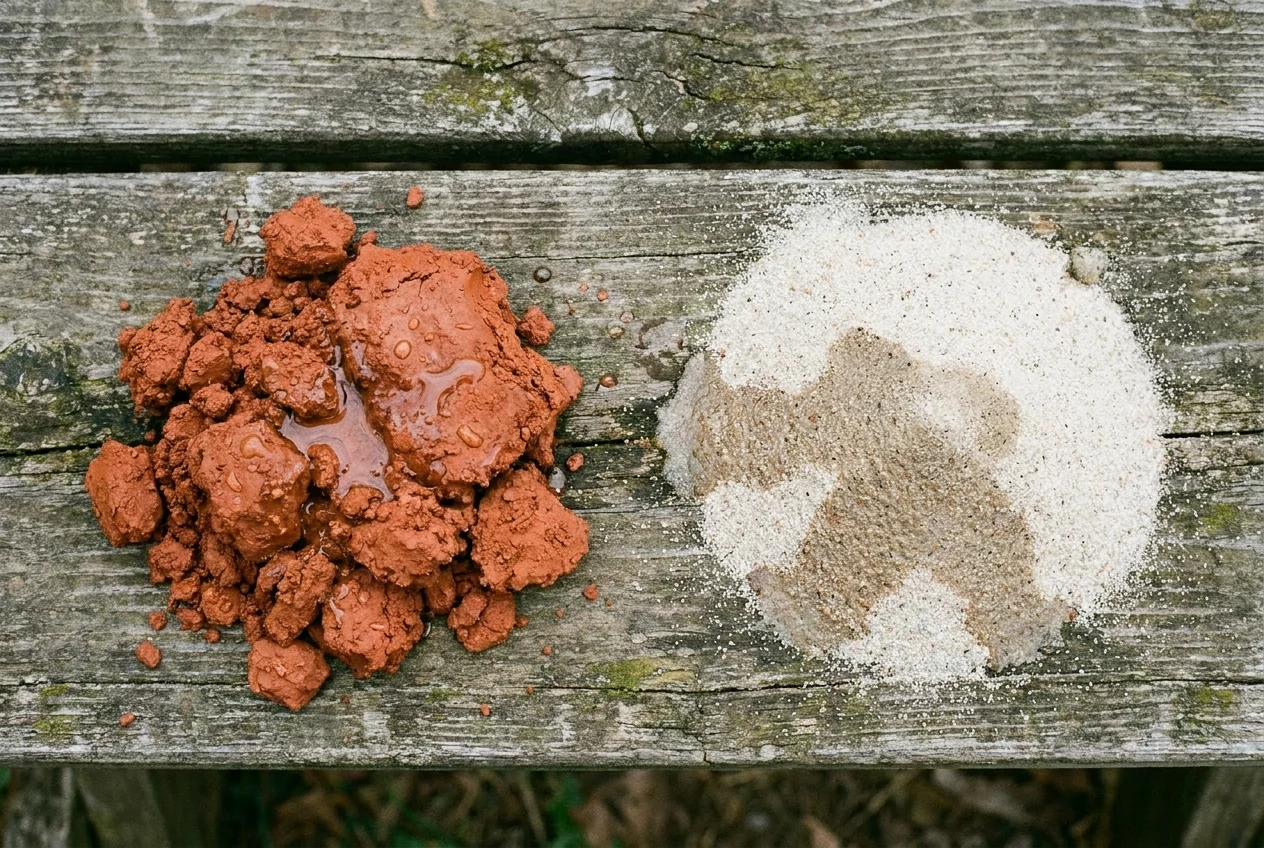
A contractor tells a homeowner that her NC clay soil has “poor drainage.” She wants to know what “poor” actually means — not as a feeling, but as a number.
That number is hydraulic conductivity. In Piedmont clay, it runs roughly 0.01-0.2 inches per hour. In Florida sand, it runs 1-10 inches per hour or higher. That 10-to-100x difference is not a regional quirk or a contractor opinion. It is a measurable physical property of the soil, and it determines whether a drainage system that works well in other states will work at all on your North Carolina lot.
This page explains what the number means, how it’s measured in the field, and how it should drive the drainage system your contractor designs. If a contractor can’t name your soil’s permeability class and explain how it shaped their proposal, they’re working from a template — not from your site.
What Hydraulic Conductivity Is and How It’s Measured
measures how fast water moves through a unit volume of soil under a pressure gradient — expressed in inches per hour. A high KC means water moves quickly (sand and gravel); a low KC means it moves slowly (clay).
Think of it this way. Water poured onto a coarse gravel bed moves through almost instantly. Water poured onto a solid brick moves through at a rate so slow it’s effectively zero. Soil falls somewhere between those extremes, and the position on that scale determines everything about how your drainage system has to work.
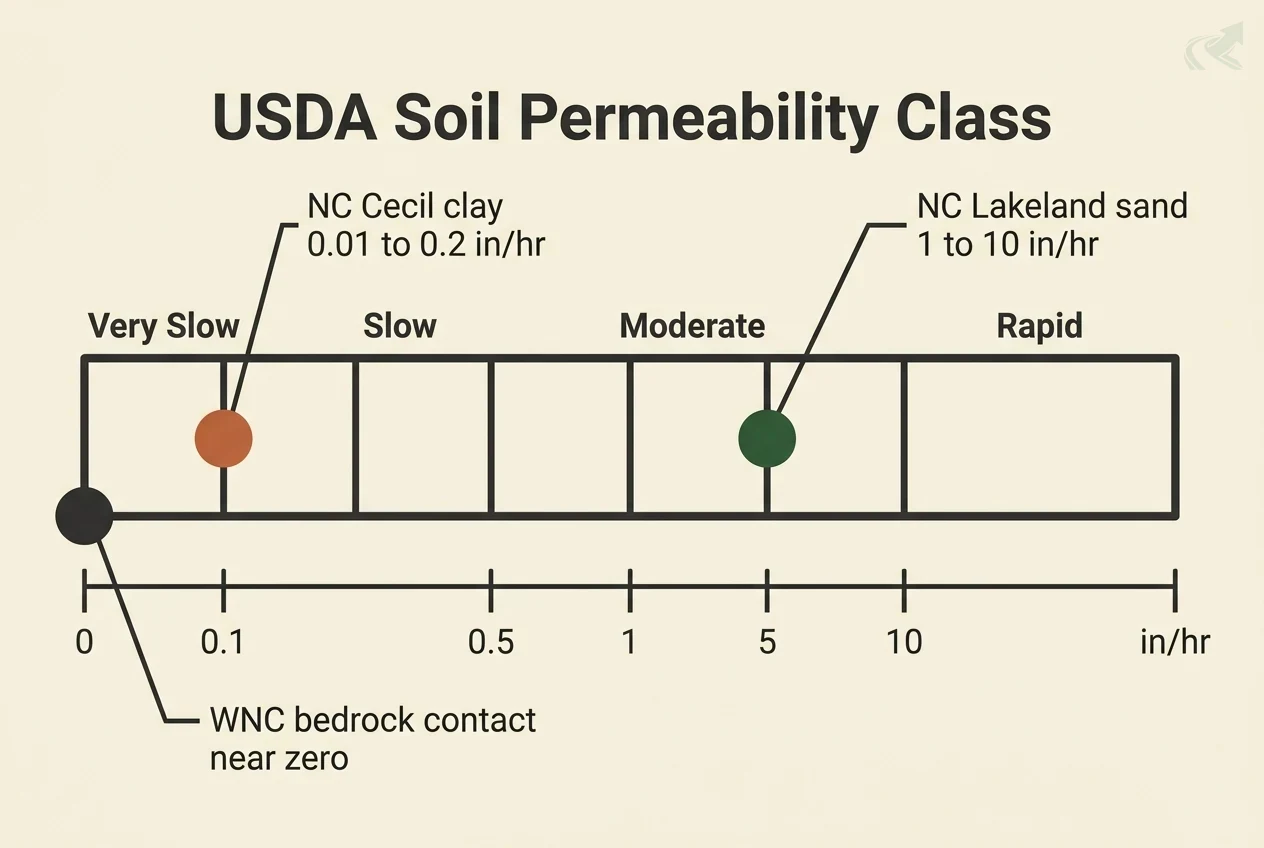
The Natural Resources Conservation Service classifies soils into permeability categories based on KC values. Approximate thresholds:
- Rapid: greater than 6 inches per hour (coarse sands, gravels)
- Moderate: roughly 0.6-6 inches per hour (loams, silt loams)
- Slow: roughly 0.06-0.6 inches per hour (clay loams, some silty clays)
- Very Slow: less than 0.06 inches per hour (heavy clays, tight subsoils)
NC Piedmont clay lands at the bottom of slow and into very slow. That classification is not “poor drainage” as an aesthetic judgment. It is a statement about a measured physical property of the soil.
NC Soil Types and Their Hydraulic Conductivity
North Carolina’s three soil zones span most of the USDA permeability class scale — from Coastal Plain sand (rapid to moderately rapid) to Piedmont clay (slow to very slow) to WNC mountain rock (nearly zero, with surface runoff instead).
Understanding which zone you’re in is the first step to understanding why your drainage problem exists and which system will actually solve it.
NC Piedmont Clay — Cecil Series
The Cecil series dominates the Piedmont from Wake County westward through Alamance, Guilford, and Forsyth. It is kaolinite-rich, densely structured clay with a hydraulic conductivity of roughly 0.01-0.2 inches per hour. That puts it firmly in the slow-to-very-slow USDA class.
NC Piedmont red clay permeability page covers the Cecil series in more depth, including how the clay mineralogy (kaolinite specifically) is what drives the low KC.
NC Coastal Plain Sand — Lakeland and Norfolk Series
Coastal Plain soils shift dramatically. The Lakeland and Norfolk series — dominant across the eastern part of the state — run 1-10 inches per hour in many profiles. That puts them in the moderate-to-rapid range.
A French drain on a Coastal Plain site can often rely on true percolation into the surrounding soil. The same design on a Piedmont site relies primarily on interception and lateral routing — not percolation — because the soil can’t absorb water fast enough.
NC Coastal Plain sandy soil permeability vs Piedmont goes deeper on the design implications of that contrast.
WNC Mountain Soils — Shallow Profile and Bedrock Contact
Western North Carolina is different from both. Soils are shallower, bedrock is often within 18-36 inches, and the effective drainage problem isn’t clay mineralogy — it’s the bedrock hydraulic conductivity, which approaches zero. Surface routing is the primary design tool. The soil column above bedrock may drain reasonably well; the rock itself doesn’t.
WNC mountain soils and shallow rock covers the Ashe and related series in more detail.
Three-Zone Comparison
| NC Soil Zone | Representative Series | Hydraulic Conductivity | USDA Class | Drainage Design |
|---|---|---|---|---|
| Piedmont | Cecil clay | 0.01-0.2 in/hr | Slow-Very Slow | Interceptor system required |
| Coastal Plain | Lakeland/Norfolk sand | 1-10 in/hr | Moderate-Rapid | Standard percolation system |
| WNC Mountain | Ashe/rock contact | Variable / near-zero through rock | Very Slow + bedrock | Surface routing only |
The NC soil guide covering all zones links all three zone pages with the hydraulic conductivity data in one place.
What a Perc Test Actually Measures
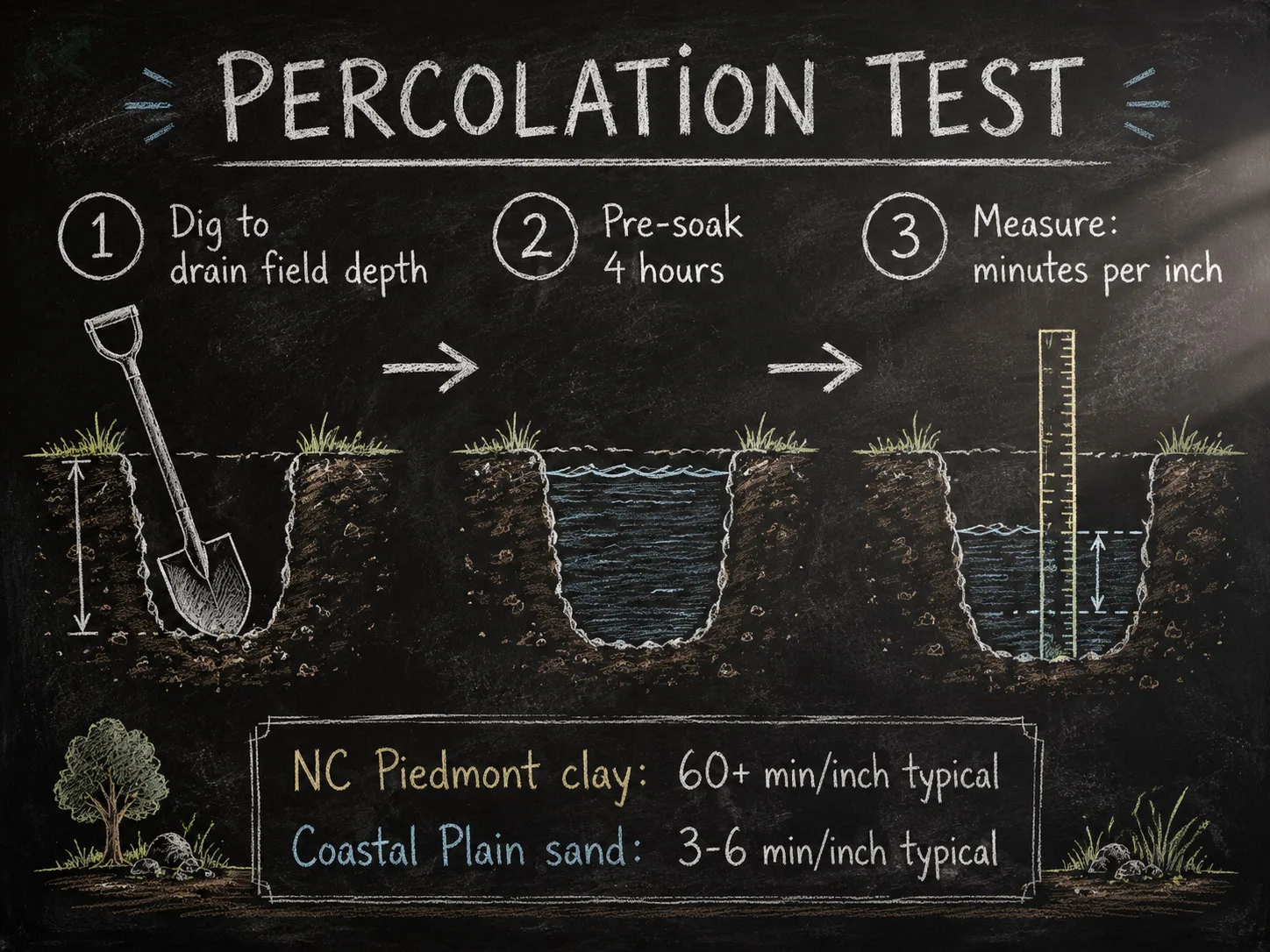
A perc test (percolation test) is a field measurement of how fast water drains from a hole in your soil — it’s the practical version of hydraulic conductivity, used by septic system engineers to determine whether your soil can handle a conventional drain field.
The procedure is straightforward. An engineer digs a test hole to the depth the drain field will be installed, fills it with water to pre-soak the soil, then measures how many minutes it takes for the water level to drop one inch. That rate — minutes per inch — is the perc rate.
A fast perc rate (low minutes per inch) means the soil absorbs water quickly. A slow perc rate (high minutes per inch) means the soil is borderline or failing for a conventional system. NC’s ONSITE septic rules under 15A NCAC 18A set minimum acceptable perc rates for drain field approval — verify current thresholds with your county sanitarian, as the standards have been updated periodically.
Perc rate and KC are related but not identical. KC is a laboratory measurement of saturated flow under controlled pressure. Perc rate is a field measurement that includes site-specific variables (soil structure, degree of saturation at time of test, local soil heterogeneity). A site in Piedmont clay will almost always show a slow perc rate for the same reason it shows a low KC — the kaolinite clay structure limits water movement whether you measure it in a lab or in the field.
For the soil permeability context for NC septic system decisions, see the gravity-vs-pumped discussion on that page.
How Permeability Determines Drainage System Design
Drainage system design is essentially an answer to one question: what does this soil’s permeability allow? High KC soils can use standard percolation-dependent systems. Low KC soils require interception design — and NC Piedmont clay is definitively in the low-KC category.
Three specific design decisions hinge directly on KC:
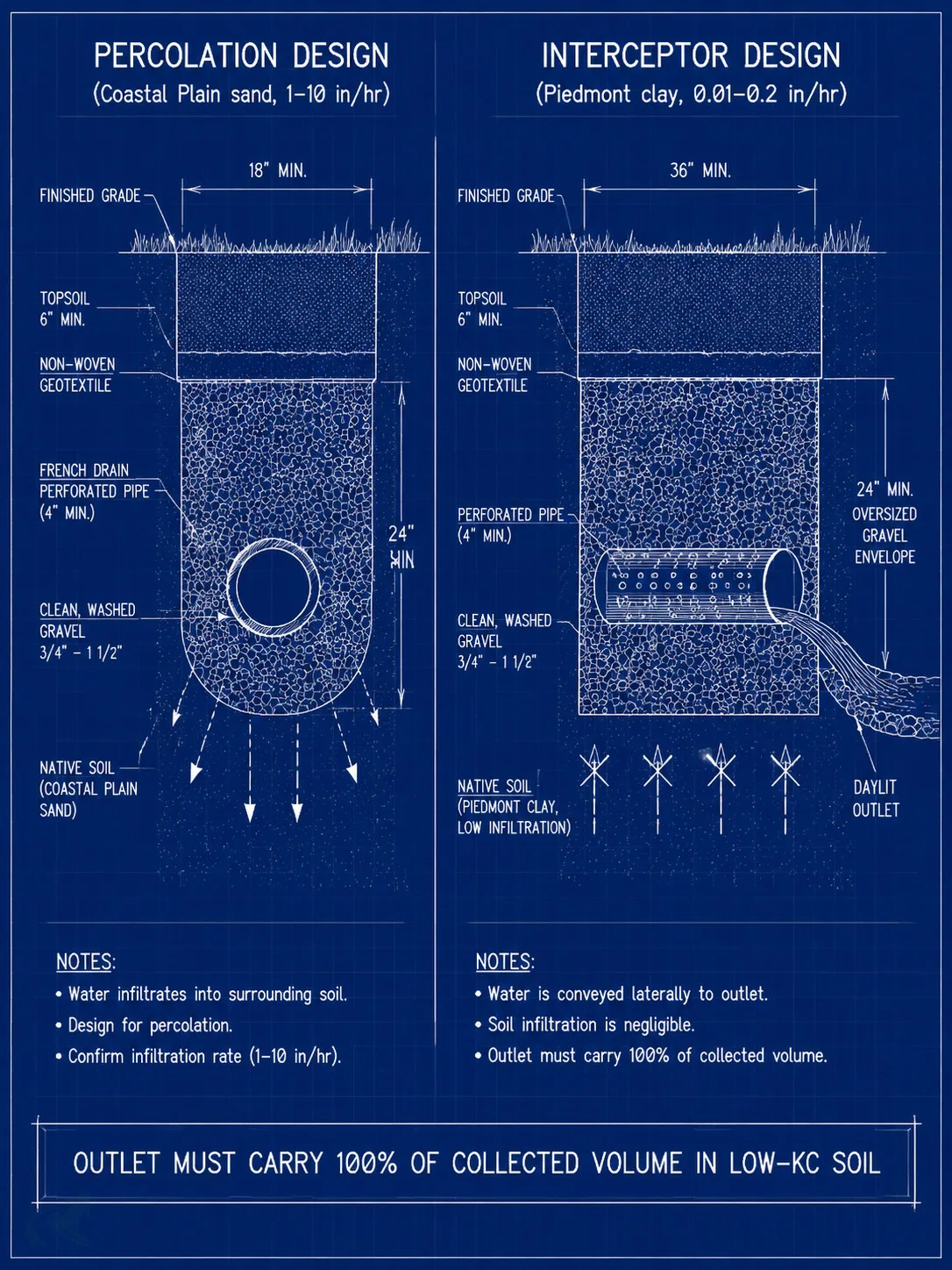
French Drain Design Type — Interceptor vs. Percolation-Dependent
A percolation-dependent French drain collects water through its perforated pipe and relies on the surrounding soil to absorb the collected water. This works in Coastal Plain sand. It does not work in Piedmont clay at design storm volumes — the soil absorbs water too slowly to keep up.
An interceptor trench intercepts lateral flow and routes it to a positive drainage outlet — a daylit pipe end, a surface swale, or a storm drain connection. The soil is not expected to absorb the water. This is the correct design type for NC Piedmont clay in most residential drainage applications.
This distinction — interceptor vs. percolation-dependent — is exactly what why NC drainage methodology differs documents in detail.
Gravel Envelope Sizing
The gravel envelope around the drain pipe serves two functions: it admits water to the pipe, and it provides temporary storage. In high-KC soils, the temporary storage function matters less because the surrounding soil absorbs water fast enough to prevent backup. In low-KC soil, the gravel envelope is the only temporary storage available between rainfall events. More gravel means more storage capacity.
A properly sized gravel envelope for NC Piedmont clay is significantly larger than what a standard Florida-derived French drain spec calls for. If your contractor’s bid shows a narrow trench with minimal gravel volume, ask specifically about the design rationale for your soil’s KC class.
Outlet Sizing and Type
In low-KC soil, the outlet must handle essentially all the water the system collects — because the soil won’t take it. Undersized outlets back up, saturate the gravel envelope, and eventually push water back to the surface at the wrong location. An itemized quote for a Piedmont clay drainage project should specify the outlet size, type, and surface or connection point explicitly.
The Permeability Number That Changes Everything in NC
NC Piedmont clay’s hydraulic conductivity of roughly 0.01-0.2 inches per hour means a 1-foot cube of soil passes approximately 0.01-0.2 gallons of water per hour — compared to Coastal Plain sand at 1-10 gallons per hour. That 10-to-100x difference is why out-of-state methods fail in North Carolina.
Here’s what those numbers mean in plain English. Imagine a standard bathroom faucet filling a container at roughly 1 gallon per minute. NC Piedmont clay, across a 1-square-foot face, passes that much water in approximately 5-100 hours depending on where in the KC range your specific site falls.
Coastal Plain sand passes the same volume in 6-60 minutes. WNC bedrock contact: days to never.
A drainage contractor who designs from Florida case studies, online French drain tutorials, or generic national specs has implicitly assumed a KC value that does not exist on your Piedmont site. The gravel envelope is too small. The outlet is undersized. The system may work in wet years with below-average rainfall. It will not work in the 2-inch-per-hour rain events that North Carolina produces in May and September.
The KC number is not trivia. It is the engineering basis for every sizing decision in the design.
How to Use Permeability When Vetting a Contractor
Ask any drainage contractor: “What is the hydraulic conductivity class of my soil, and how does that drive your system design?” If they can’t answer that, they’re designing from a template, not from your soil.
A contractor who knows your soil zone can answer in 30 seconds. They will name the soil series (Cecil, Lakeland, or similar), give you the approximate KC range, and explain whether their design is interceptor-based or percolation-dependent — and why.
A contractor who says “we’ll put in a French drain” without naming the design type is not answering the question.
Get an itemized quote from a verified NC grading contractor who bases their design on your soil’s actual permeability. The KC question is free to ask. The answer tells you more than the price does.