
Two questions people often ask
What is a driveway crown?
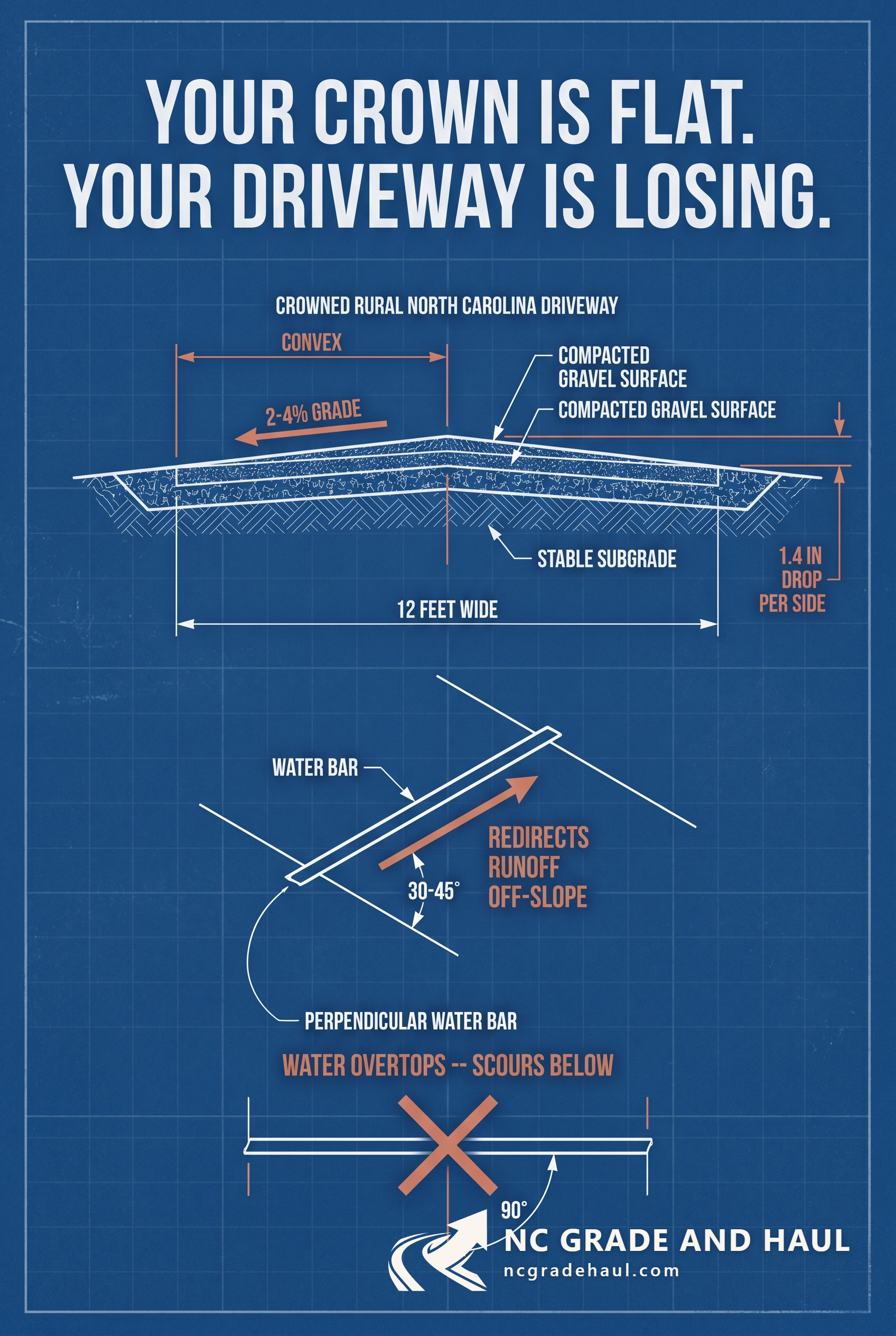
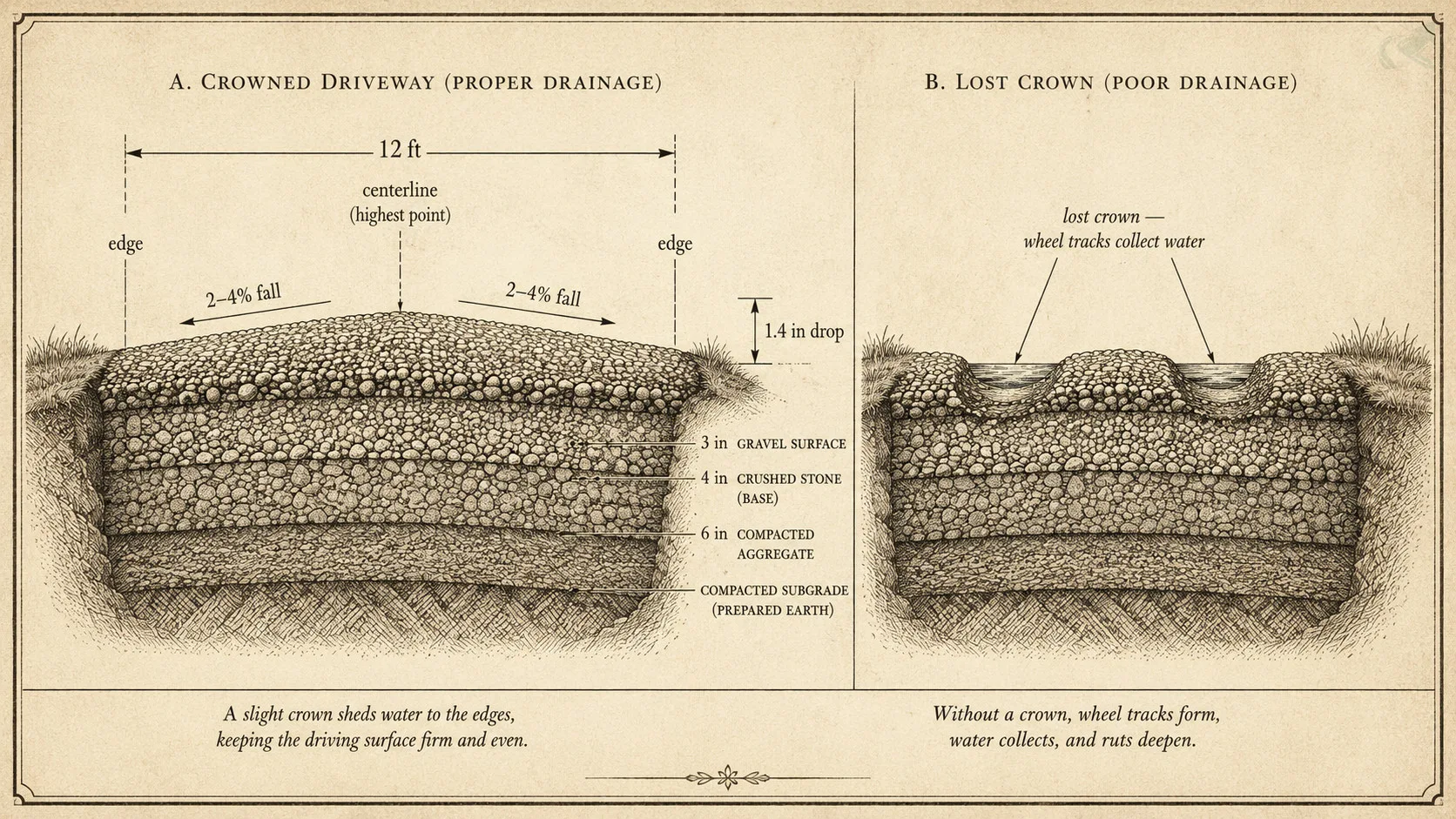
Crown is the slight rise at the center of the driveway surface. Water falls off both sides rather than running down the center. A proper crown is 2-4% fall from center to edge -- roughly 1.4 inches per side on a 12-foot-wide driveway. No crown means water runs in the wheel tracks and erodes them.
What is a water bar?
A water bar is a low ridge, drain, or angled channel across the driveway that intercepts water running down the slope and redirects it off to the side before it gains erosion velocity. Water bars are spaced based on driveway slope -- steeper slope, closer spacing.
Dave Kowalski’s driveway in Bat Cave runs 400 feet down a 12% slope. After every significant rain, water runs down the center for 300 feet, picking up speed. It scours a channel. The water bars near the top are undersized. The crown through the middle section has been lost to years of tire compaction.
The result is predictable: a washout that costs more to fix every time.
Crown and water bars are two tools that work together to prevent that outcome. This page defines both, explains the NC clay context, and tells you what a correctly designed system looks like — so you can evaluate whether a contractor’s plan will actually hold on your site.
Driveway Crown — What It Is and How to Check It
A correctly crowned NC driveway falls 2-4% from center to edge, so water sheds laterally rather than flowing down the tire tracks.
A crowned driveway is highest at the centerline and falls evenly toward both edges. The math: a 2% crown equals 2.4 inches of fall per 10 feet of driveway width. On a 12-foot-wide driveway, each side falls about 1.4 inches from center to edge.
How to check: stand at the center of the driveway with a 4-foot level. One side should read low. If the level reads flat, the crown has been lost to compaction or erosion. That’s the point where water stops shedding and starts running down the middle.
NC clay compacts tightly under tire pressure over time — the same Piedmont clay compaction and drainage behavior that affects every grading spec on a red-clay site. It gradually flattens whatever crown was installed at grading. A gravel-surfaced driveway can lose its crown within 2-3 years of regular use without re-grading.
This isn’t a minor inconvenience. A flat or inverted driveway in North Carolina clay is an active erosion machine. Every rain event deposits water in the wheel tracks, deepening them slightly, until you have two parallel channels running the length of the drive.
Re-grading to restore crown is not complex work. It is, however, work that has to be done — and budgeted for — as a maintenance item, not a one-time fix.
Water Bars — What They Are and How They Work
A water bar intercepts surface flow running down the driveway slope and redirects it off to the side before velocity increases enough to cause scouring.
Three types are common on NC rural driveways:
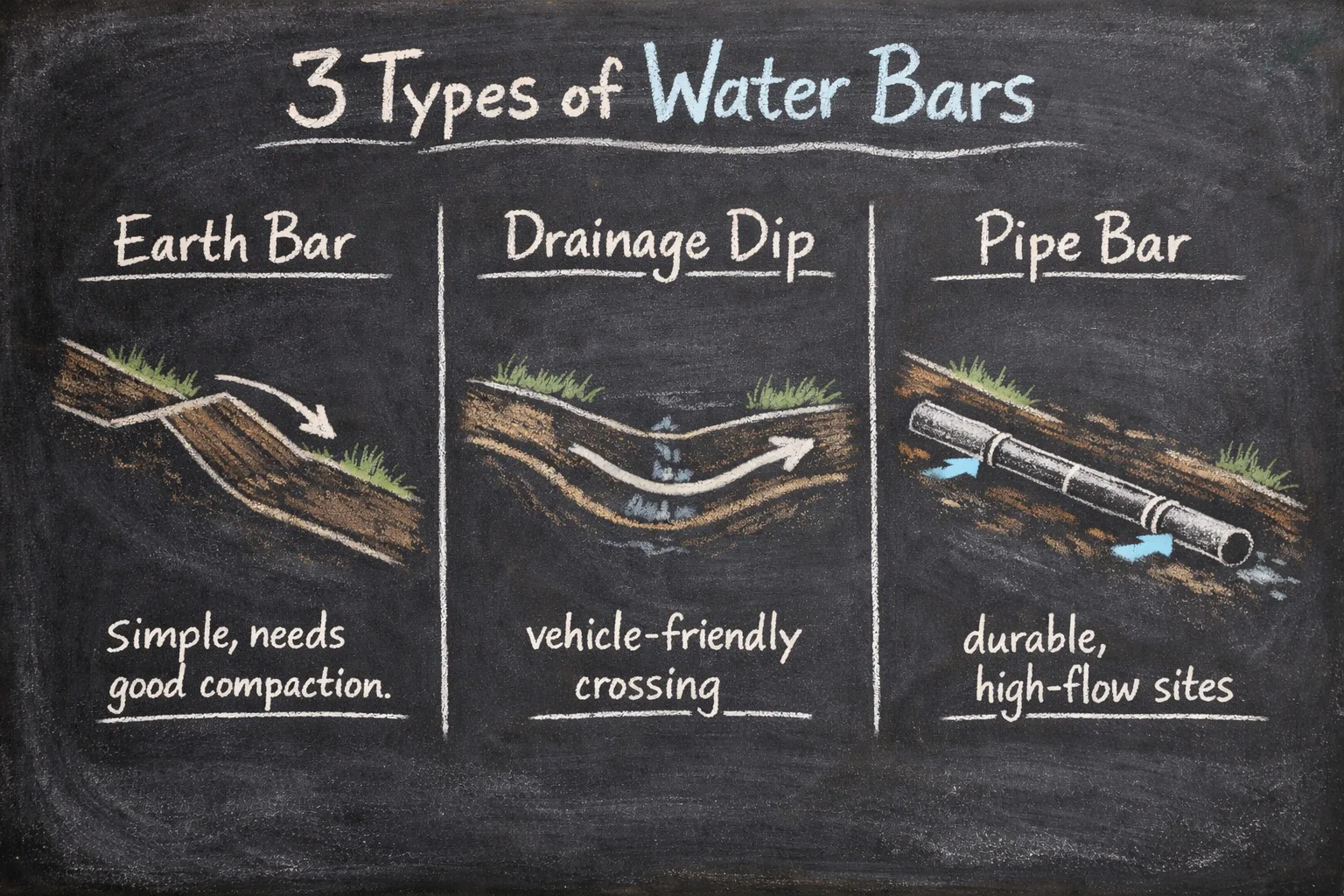
- Compacted earth or gravel bar — an angled ridge across the driveway that forces water off the side. Simple to install; washes out if not correctly compacted and sized. Common on lower-traffic drives.
- Drainage dip — a shallow V-shaped channel across the driveway that directs water to one or both sides. Works like a speed bump for water. Easier for vehicles to cross than a raised bar.
- Pipe water bar — a pipe installed diagonally across the driveway subgrade that carries water through and out the side. More durable than compacted earth; harder to install correctly. Better suited to high-flow sites.
Each type has a different maintenance profile. An earth bar that survives its first rainy season intact is probably sized correctly. One that washes partially away during the first heavy rain was undersized or not compacted adequately.
Water bars are not swales. A swale runs parallel to the driveway and carries water away from the slope — a separate tool addressed in the NC yard drainage solutions by slope condition guide. A water bar runs across it and intercepts water before it gains downslope velocity. Both have a role on a well-designed rural North Carolina driveway — they are not interchangeable.
Water Bar Spacing for NC Driveway Slopes
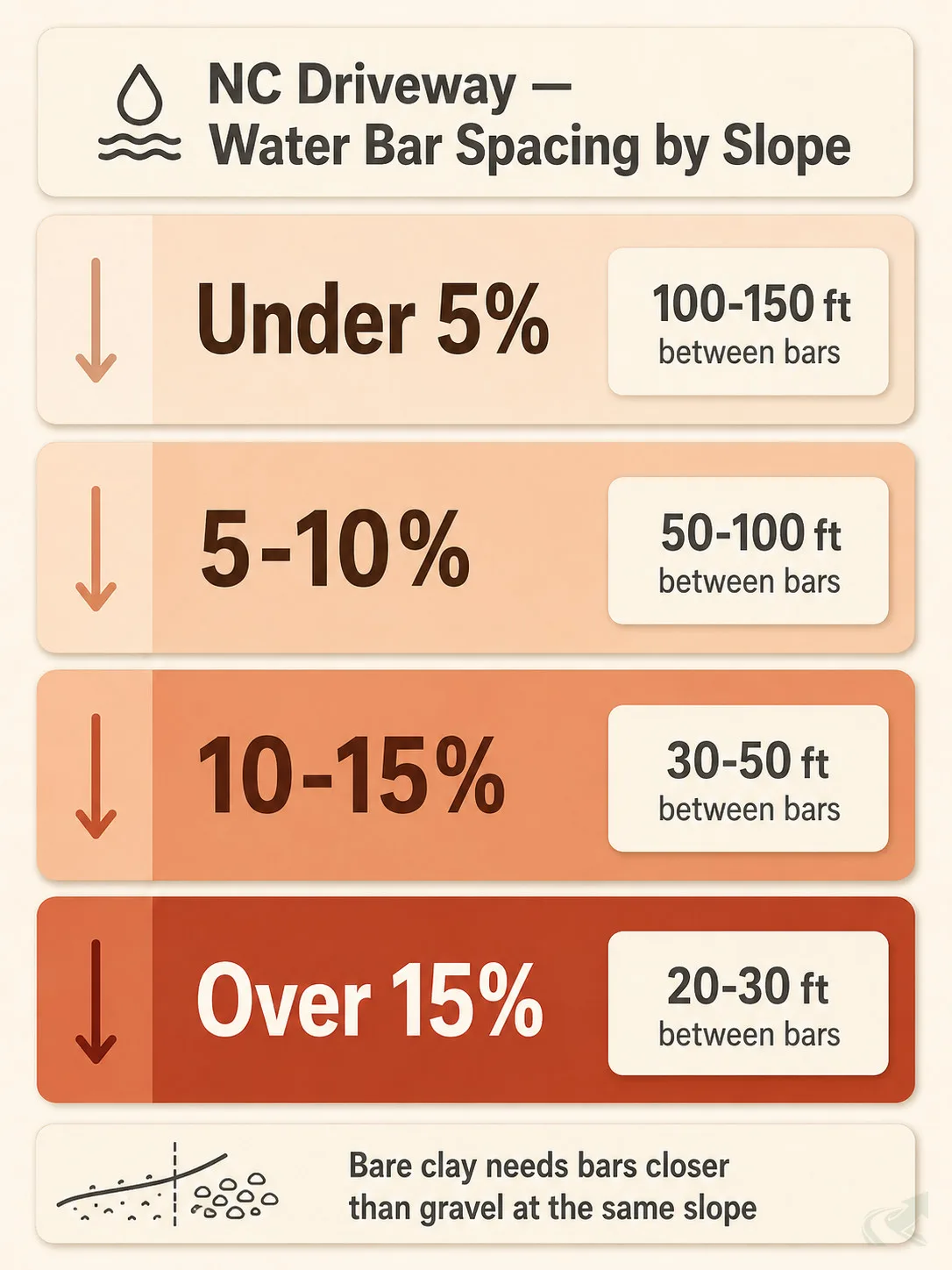
Water bar spacing depends on slope — steeper driveways need more bars, spaced closer together, to intercept water before it gains erosion velocity.
Spacing guidance by slope, based on NC forestry road and design references:
| Driveway slope | Recommended water bar spacing |
|---|---|
| Under 5% | 100-150 feet between bars |
| 5-10% | 50-100 feet |
| 10-15% | 30-50 feet |
| Over 15% | 20-30 feet |
These are approximate guidelines for NC conditions. Actual spacing also depends on soil erodibility, vegetative cover, and driveway surface material. A bare-clay drive needs bars closer together than a graveled one at the same slope.
NC clay makes spacing more critical than it would be in sandier soil. Bare clay exposed to high-velocity runoff scours fast. A missing or undersized water bar on a 12% NC clay driveway can lose 2-3 inches of surface material in a single heavy rain event.
Dave’s 12% driveway in Bat Cave should have water bars spaced no more than 30-50 feet apart through the steepest section. If the bars present are at 100-foot intervals, they are not spaced for his site. They are spaced for a site half as steep.
Contractors working in WNC and the NC mountains are generally familiar with this spacing logic. Contractors more used to Piedmont flatland work may not apply it by default — it’s worth asking explicitly when you find a grading operator in North Carolina who has the right regional experience for your slope and soil.
Common Crown and Water Bar Failures in NC
Three patterns show up repeatedly on NC rural driveways — crown loss, water bar erosion, and bars installed at the wrong angle.
Crown loss (flat driveway): Years of tire pressure and freeze-thaw impact on NC driveways and grading flatten the crown. Water pools in the wheel tracks. Each rain event deepens the tracks slightly. By the time the damage is visible, the crown has been gone for two or three seasons and the tracks are already channeled.
Water bar erosion: An earth bar that wasn’t compacted or sized correctly washes away in the first heavy rain, taking the surface material with it. The bar disappears and leaves a depression that concentrates the next rain in the same spot.
Wrong bar angle: This is the most common installation failure. A water bar must be angled to direct water to one or both sides — not installed perpendicular to travel. A perpendicular bar creates a speed bump but doesn’t redirect water. The water overtops it, continues downslope, and often scours a channel immediately below the bar.
Water bar on a WNC mountain driveway: angled vs perpendicular
Comparison. Angled correctly: Bar set on a diagonal across the drive; Runoff is steered along the bar; Water discharges to the uphill ditch; Driveway surface stays put. Wrong angle: Bar runs straight across, square to the slope; Water pools behind it instead of moving off; Pool overtops the bar; A scour channel cuts in below.
- Bar set on a diagonal across the drive
- Runoff is steered along the bar
- Water discharges to the uphill ditch
- Driveway surface stays put
- Bar runs straight across, square to the slope
- Water pools behind it instead of moving off
- Pool overtops the bar
- A scour channel cuts in below
A water bar has to be angled to carry runoff to a ditch -- square to the slope, it just dams water until it fails.
The angle matters because water doesn’t stop at the bar — it redirects or overtops. The bar’s job is to make redirection the easier path. A correctly angled bar does that. A perpendicular one doesn’t.
In North Carolina, the wrong-angle failure is common enough that it’s worth asking about explicitly before work starts. A contractor who designs the bar angle based on slope direction and ditch location has thought it through. One who says “we’ll put a bar across every 50 feet” may not have.
What to Ask When Getting a Quote for Crown or Water Bars
Two questions tell you whether the contractor has designed the crown and water bar system for your specific slope and soil.
A contractor who knows their work will answer both parts without hesitation. Crown percentage is a number — 2%, 3%, or 4%. Water bar count is a number. Spacing is a number. Type is a word. If the answer is “we’ll make sure it drains” with no specifics, the design hasn’t been done yet.
The question also tells you something about the itemized quote. A contractor who can answer slope-specific spacing questions is probably giving you a line-item bid that reflects your site. One who can’t may be quoting off a template.
For how crown and water bars apply to NC driveway grading, see the full driveway grading guide. The NC grading glossary including crown and water bars covers additional terminology. When you’re ready to compare contractors, hire a licensed NC grading contractor who can speak to your site’s specific slope and soil before the bid is written.