
Contractors use shorthand because they say these words twenty times a day. A homeowner hears them once and they sound like contractor jargon. They’re not jargon — they’re precise vocabulary for specific things in clay-and-gravel earthwork. Here is every term used across this site, defined in plain English. Each definition covers what the term means and why a contractor uses it in the context of your project.

Aggregates and Materials
These are the fill and surfacing materials that show up in every quote. Knowing which material goes where is the difference between a driveway that drains and one that turns into a pond.
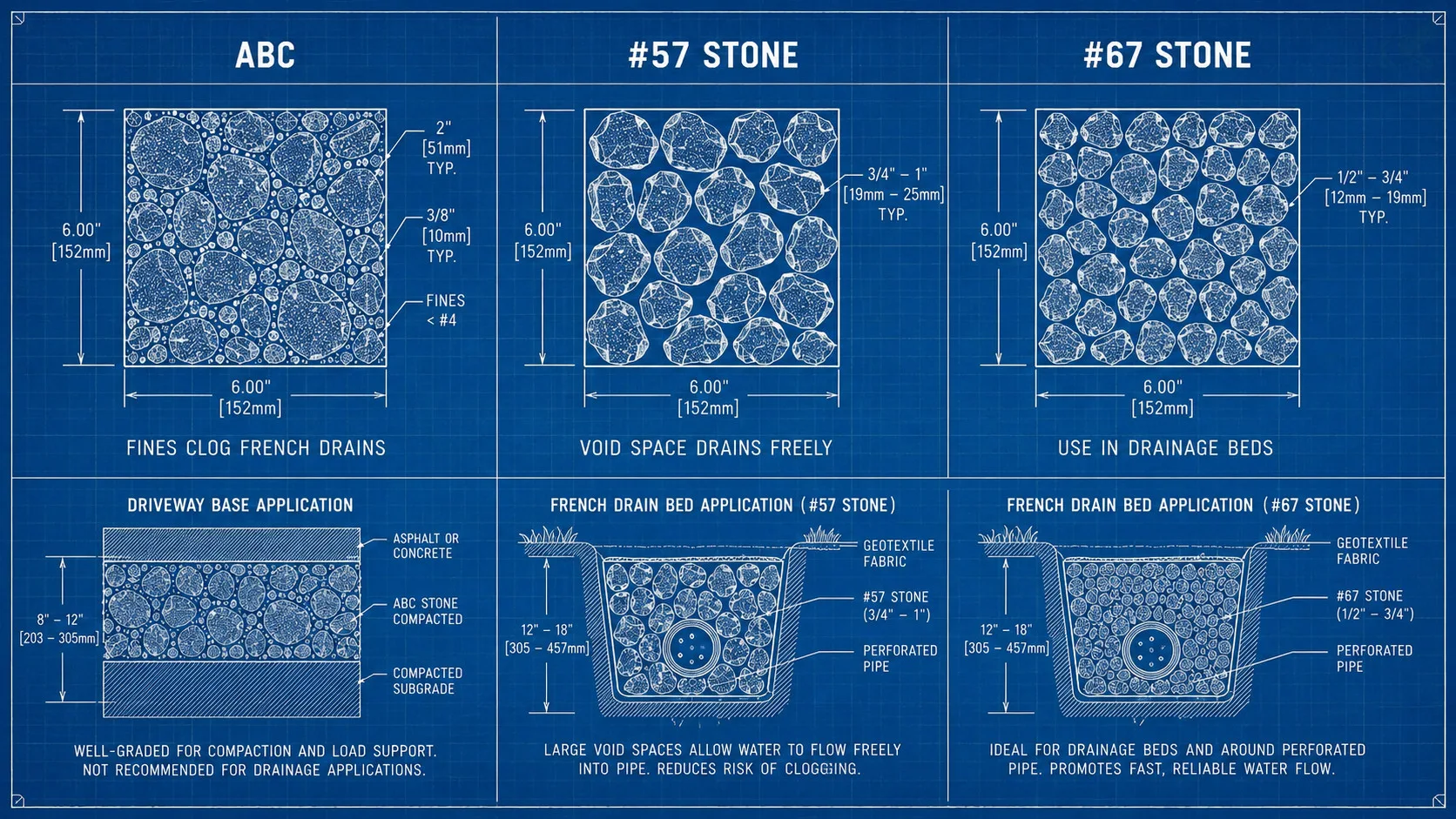
ABC (Aggregate Base Course) — The compacted gravel base layer used under driveways and in drainage beds. has a mix of graded particle sizes that compact together into a firm surface. The fine particles are what make ABC compact well — but those same fines can clog a French drain if ABC is used where open-graded stone belongs. See the ABC vs #67 vs CABC reference for a full comparison.
#57 Stone — A uniformly graded crushed stone, approximately 3/4 to 1 inch in diameter. Used in French drain beds because the uniform size creates void space that allows water to move through freely. Does not compact into a solid surface. If a quote calls for #57 in a driveway base, that’s the wrong spec.
#67 Stone — Similar to #57 but slightly smaller (approximately 1/2 to 3/4 inch). Also used in drainage applications. Performs comparably to #57 in most North Carolina drainage contexts. Either can work in a French drain bed — confirm which the contractor is pricing.
CABC (Compacted Aggregate Base Course) — A dense, fine-graded aggregate used as a sub-base layer for higher-load applications. Similar to ABC but with specific compaction requirements. Sometimes used interchangeably with ABC in NC contractor conversation. Confirm with your contractor which spec they’re using — the distinction matters for load-bearing and long-term performance.
Fill dirt — Subsoil used to raise grade or fill in low areas. NC Piedmont fill dirt is typically red clay subsoil. Not suitable for growing anything. Fill dirt goes below topsoil and finish grade — it’s structural fill, not planting medium.
Topsoil — The upper 4 to 6 inches of soil with organic matter that supports plant growth. Different from fill dirt. When a contractor says “6 inches of topsoil,” they mean the loam-and-organic layer placed over compacted fill. If a quote doesn’t separate fill from topsoil, ask.
Grading and Earthwork Terms
These terms describe what the operator is doing to the ground — how it’s shaped, tested, and finished. A contractor who uses this vocabulary correctly is describing actual operations, not sales language.
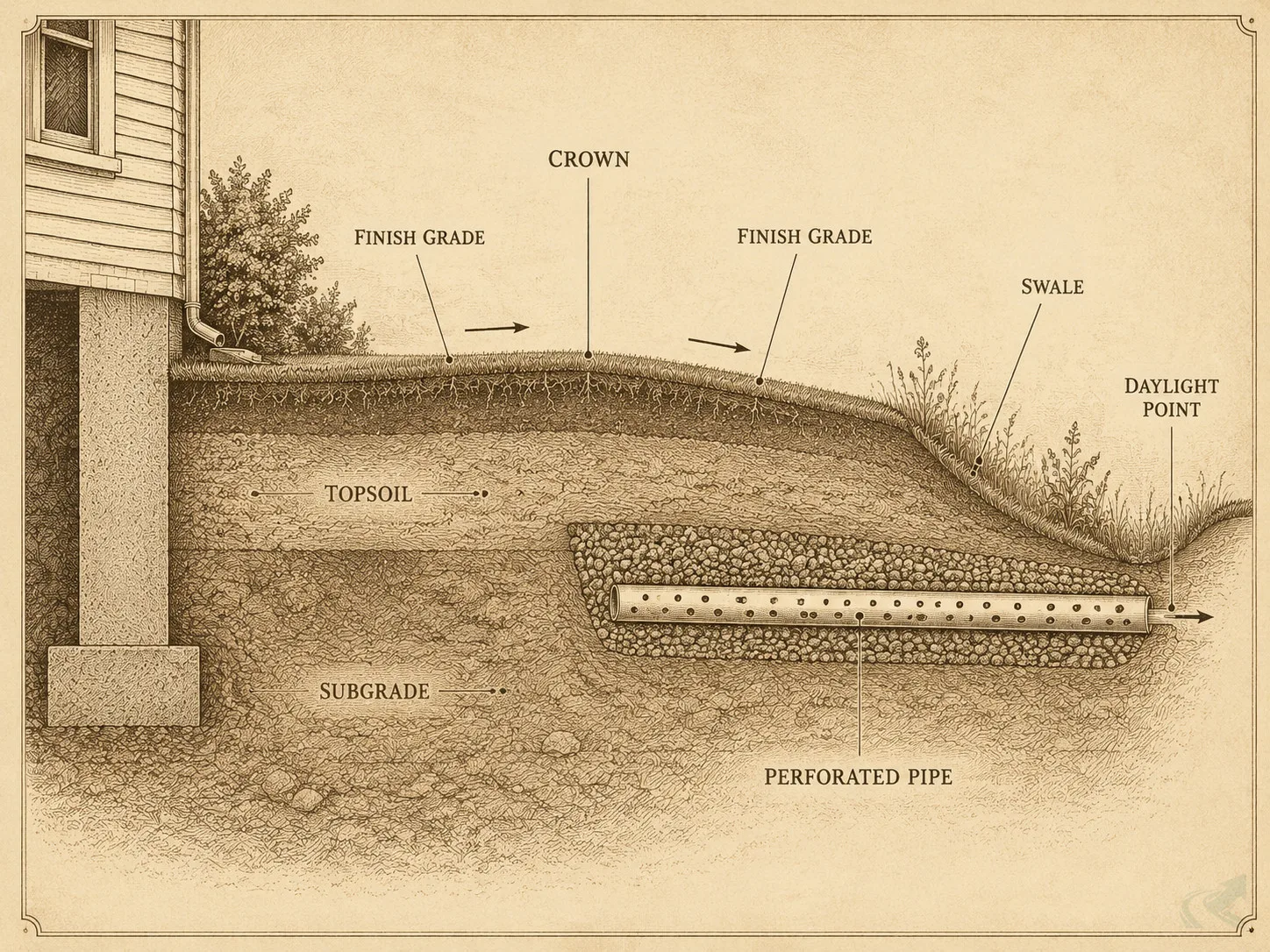
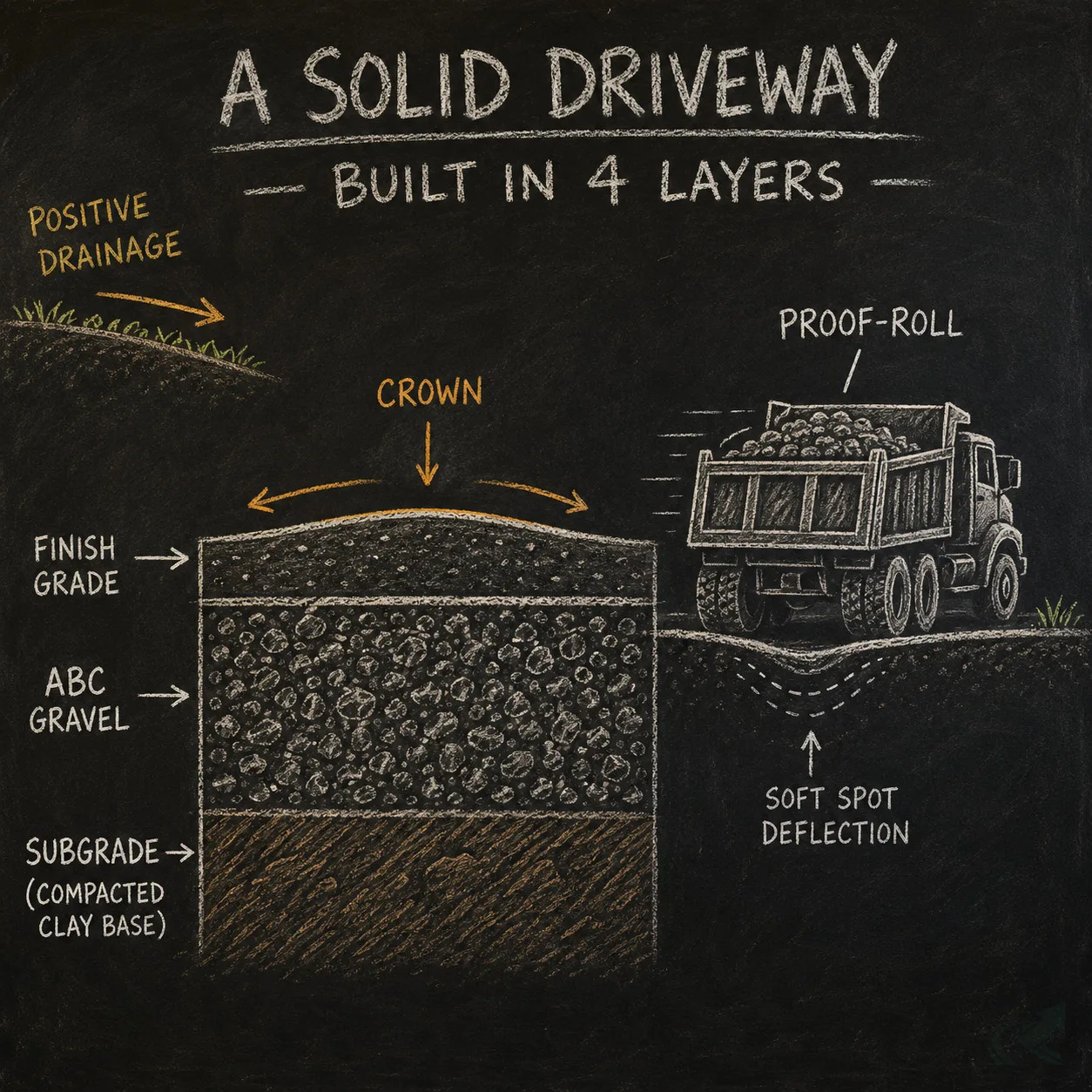
Crown — The slight rise in the center of a road or driveway that causes water to shed to both sides rather than pooling in the middle. A crowned driveway has its highest point at the centerline and falls off evenly left and right. No crown means water sits in the wheel tracks. See the crown and water bars in NC driveway context guide for the full treatment.
Compaction — The process of mechanically densifying soil to reduce void space and increase load-bearing capacity. Uncompacted fill settles unevenly after the first rain. Residential driveways typically target 95% standard Proctor density — ask your contractor what spec they’re hitting and how they verify it.
Proof-roll — A quality-control check where a loaded dump truck or roller makes passes over the finished subgrade. Soft spots deflect under the load, revealing uncompacted or unstable areas before paving or graveling begins. A contractor who proof-rolls before surface placement is checking their own work. See proof-roll explained in full.
Positive drainage — Surface drainage that moves water away from structures in a controlled direction. “Positive drainage” means water has a path — the surface falls in the right direction at sufficient slope so water flows rather than ponds. A site without positive drainage near a foundation or crawl space is a long-term moisture problem.
Finish grade — The final surface elevation after all grading work is complete. The number the contractor is committing to when they say a driveway or yard will drain at a specific slope. This is what you’re buying — confirm it’s in the quote.
Subgrade — The prepared soil layer below the aggregate base or surface material. The subgrade’s condition — moisture content, compaction, stability — determines how long the surface above it holds. A failed subgrade is why driveways settle unevenly three years later.
Float the bucket — A skid steer finishing technique where the operator disengages hydraulic lift pressure and lets the bucket ride the surface contour. Float mode produces a smoother finish grade than manual passes on NC clay. An operator who uses float technique leaves a cleaner surface. See the float-the-bucket technique defined and applied page for the full method.
Heel grading — Using the rear corner of a skid steer bucket to shave isolated high spots before the float finish pass. The corner provides precision that a full-width bucket pass can’t deliver. Useful on tight spots and around structures where you can’t swing a full pass.
Box blade — A grading attachment for tractors. Uses front and rear scarifiers to cut high spots and distributes the material to low spots. Best for driveway crown restoration and rough leveling on longer runs.
Grade stakes / grade pins — Painted wooden or metal stakes set by the operator or layout crew to mark the target elevation at specific points across a site. The operator grades to the stake tops. No grade stakes on a site means the contractor is working by eye — acceptable for experienced operators on simple cuts, but stakes are the verifiable standard.
Spoil — Material removed from a site during excavation or grading that isn’t reused on-site. Spoil requires disposal — either hauled to a licensed fill site or listed as a haul-off charge on your quote. If a quote doesn’t account for spoil, clarify who’s responsible for it.
Drainage Terms
Drainage vocabulary is where quotes get the most opaque. These definitions explain both the physical thing and why it’s specified — so you can check whether a contractor’s drainage design actually matches your site’s problem.
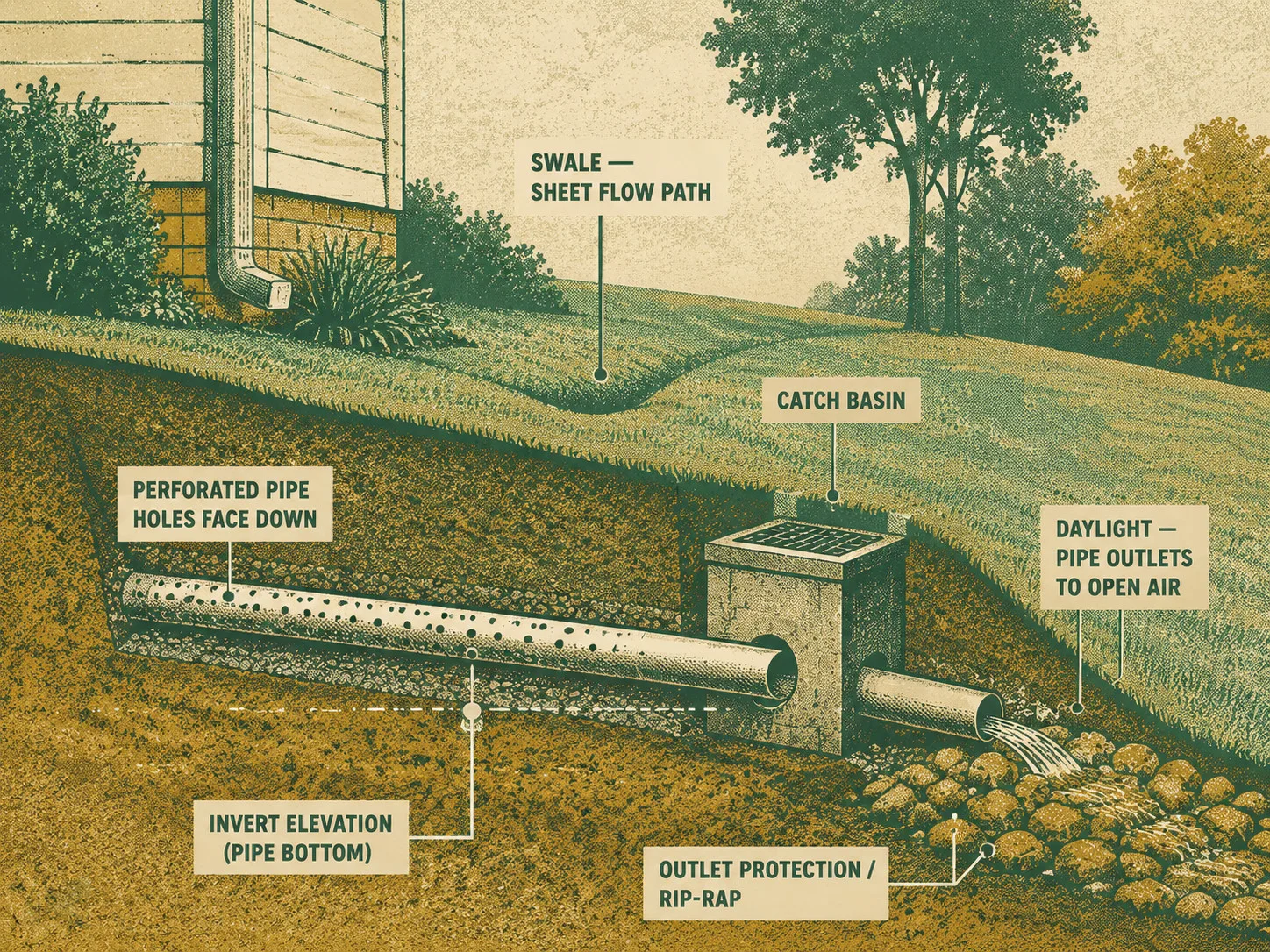
Swale — A shallow, elongated depression that directs surface water from one location to another. Swales are vegetated (grass or groundcover) and slow water while moving it. Different from a ditch — swales handle sheet flow, not concentrated stream flow. See drainage arc vs swale for when each is the right call.
Daylight — The point where a drainage pipe or French drain outlets to open air, allowing collected water to discharge. “Daylighting the pipe” means running it from the low collection point to a surface outlet where it free-discharges. A drain without a daylight just fills up and stops working.
Invert elevation — The elevation of the inside bottom of a pipe at a specific point. The invert determines the pipe’s slope and whether water flows in the right direction. A culvert installed with the wrong invert elevation drains backward — a mistake that isn’t obvious until the first big rain.
Perforated pipe — Drainage pipe with holes or slots that allow water to enter from surrounding soil and flow toward the outlet. Used in French drains and foundation drainage. The holes go down in a French drain (water enters from below). Wrong orientation defeats the system.
Headwall — The concrete, masonry, or metal structure at the inlet or outlet of a culvert pipe. The headwall prevents erosion at the pipe ends and maintains the pipe opening against soil pressure. A washed-out headwall is a structural failure, not a cosmetic issue — it requires repair before the culvert itself fails.
— Controls required on construction sites to prevent soil from leaving the site in stormwater runoff. Common measures include silt fence, sediment basins, rock check dams, and seeding. Required by NC law when land disturbance exceeds the county permit threshold.
Silt fence — A temporary permeable barrier (typically woven fabric staked into the ground) installed downslope from disturbed soil to catch sediment before it reaches a waterway. A site without silt fence on disturbed soil is out of E&S compliance. Not the same as erosion control blanket — silt fence is a perimeter barrier, blanket is surface protection.
Catch basin — A below-grade drainage structure with a grate at the surface. Water enters through the grate, collects in the basin, and drains through a pipe at the bottom or side. Used where surface water concentrates — at the base of a slope, at driveway edges, in low yard areas.
Outlet protection / rip-rap — Stones placed at the outlet of a culvert or swale to absorb the energy of the discharging water and prevent erosion. A culvert without outlet protection scours the soil at the pipe end over time. The scour hole grows until the pipe itself undermines — it’s not a someday problem.
French drain — A below-grade drainage system consisting of perforated pipe in a gravel bed, wrapped in geotextile fabric, used to intercept and redirect subsurface water. Named for Henry Flagg French, who documented the design in his 1859 agricultural drainage handbook. See French drain installation context and history for the full treatment and NC clay considerations.
Permits, Regulations, and Contracts
These terms define the legal and contractual framework of a North Carolina grading project. Knowing them protects you before you sign anything.
Land-disturbance permit — A county-issued permit required before disturbing soil above a threshold area. Each NC county has its own threshold and terminology. Wake County uses “land-disturbance permit”; Mecklenburg uses “grading permit.” Thresholds vary from 1/4 acre to 1 acre depending on the county. See the NC county permit matrix for your county’s specific requirement.
— The document proving a contractor carries liability and workers’ compensation insurance. Ask for it before work starts. The COI should name your project address as the certificate holder. A contractor who won’t produce a COI shouldn’t be on your property.
Itemized quote — A contractor proposal that separates material quantities, unit prices, and labor costs. If a quote just says “$8,500 for drainage work,” that is a lump-sum quote — not itemized. Itemized quotes allow comparison between bids and hold contractors accountable to the specified work. Always ask for an itemized quote.
Lump sum — A single total-price proposal without line-item breakdown. Harder to compare against other quotes. When work scope changes mid-project, lump-sum contracts are harder to adjust fairly. Prefer itemized when you have the option.
Yank-permits — Industry shorthand for pulling permits at the county office. A contractor who “yanks permits” is handling the permit application as part of their scope. Standard practice for any project above the county land-disturbance threshold. If a contractor is billing for permit fees, confirm they’re actually yanking — not leaving it to you.
— The state agency that licenses North Carolina general contractors, including grading and drainage specialty contractors. License lookup is at nclbgc.org. Any contractor doing grading work above the NC licensing threshold should have an active license. Verify before calling — license status is public. Hire a grading operator in North Carolina to see NCGH-verified records with active license confirmation.
— The NC state agency that administers the Sedimentation Pollution Control Act, issues state-level E&S permits, and regulates land disturbance at the 1-acre state threshold. Part of the NC Department of Environmental Quality. County programs run parallel to DEMLR for projects under the state threshold.
Hauling and Material Delivery
Hauling terms come up when you’re ordering aggregate, disposing of spoil, or comparing delivery costs. The volume-to-weight conversions here matter when a quote prices in tons versus yards.
Tri-axle — A dump truck with three rear axles. Typical payload: 14 to 16 cubic yards. The standard delivery truck for aggregate and fill-dirt delivery on primary North Carolina roads. Weight limits on secondary roads sometimes restrict tri-axle access — your contractor should flag this.
Tandem (axle) — A dump truck with two rear axles. Payload: 10 to 12 cubic yards. More common on secondary roads where tri-axle weight limits apply. Costs slightly more per yard to deliver the same volume — normal on restricted-access sites.
Yards-to-tons — The conversion between cubic yards (volume) and tons (weight) for aggregate materials. The conversion factor varies by material type. ABC runs approximately 1.4 to 1.5 tons per cubic yard; #57 stone runs approximately 1.2 to 1.3 tons per cubic yard. NC grading and drainage calculators include a gravel yard-to-ton converter.
Quarry ticket — The scale ticket issued by the quarry when material is loaded onto the delivery truck. Shows material type, net weight in tons, and load date. Ask for the quarry ticket on delivery to verify you received the quantity and material type quoted. Legitimate operators expect the question.
Ready to apply what you just read? Find a grading contractor in North Carolina — filter by county and confirm an active NCLBGC license before the first call. If you want to verify your own quote line by line, use the NC grading and drainage calculators to check material quantities before signing.