
Renee’s contractor pulls an permit for her yard-grading project in Holly Springs. Her neighbor — adding a concrete parking pad — gets a letter from the town about a stormwater management plan approval. Same neighborhood. Different triggers.
The neighbor’s project doesn’t disturb an acre, so no E&S permit is required. But it’s adding roughly 2,400 square feet of impervious surface in a high-growth municipality. That alone can trigger local stormwater review.
Renee wants to know: are these the same thing? The answer is no — and the distinction matters before any project that adds concrete, asphalt, or hardscaped area to a North Carolina site.
This page explains how stormwater ordinances work, what separates them from E&S requirements, and which situations put a residential project in scope. For the broader NC earthwork regulations hub including stormwater context, start at the NC regulations overview.
E&S vs. Stormwater: The Key Distinction
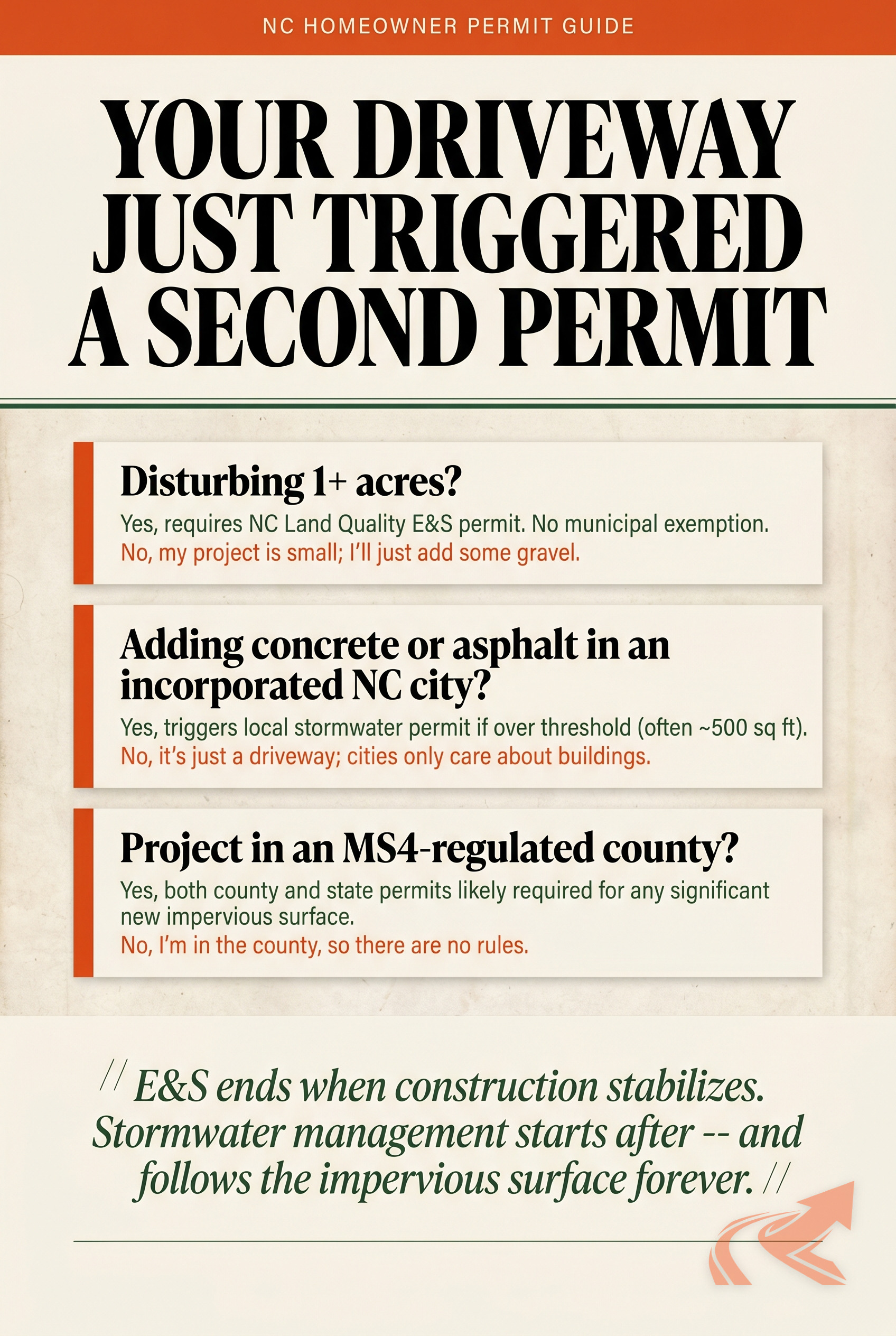
E&S permits control construction-phase erosion — temporary. Stormwater ordinances govern how a completed project handles runoff from impervious surfaces long-term — permanent.
These are separate programs. An E&S permit does not satisfy a local stormwater management ordinance. Treating them as interchangeable is the most common mistake on projects that trigger both.
Here is the core difference in a single table:
| Permit | Stormwater Ordinance | |
|---|---|---|
| Purpose | Control erosion during construction | Manage runoff from completed impervious surfaces |
| Governing body | NCDEQ / DEMLR | NCDEQ + local municipality |
| Trigger | 1+ acres disturbed | Varies by locality; threshold set by local ordinance and watershed overlay |
| Timeframe | Construction phase only | Long-term, permanent |
| Where to apply | AccessDEQ | Municipal planning/engineering dept |
The E&S program ends when your project is stabilized and the permit is closed. The stormwater management obligation starts after that — and follows the impervious surface forever.
For a full explanation of NC erosion act and E&S permit requirements, see the E&S act and permit guide.
State-Level Stormwater Requirements: The NCDEQ Phase II Program
NC participates in the federal Phase II stormwater program — which applies to construction sites disturbing 1 or more acres and to MS4 communities (cities and counties with municipal storm sewer systems). For most residential projects, the state-level stormwater trigger is the 1-acre construction threshold.
The Phase II program operates under the federal framework. States administer their own Phase II programs within that federal structure. In North Carolina, NCDEQ runs the program.
An community is any city or county whose storm sewer infrastructure — curbs, gutters, pipes, ditches — discharges to surface waters without going through a treatment plant. Most incorporated NC municipalities with meaningful population qualify. Once a municipality is designated as MS4-regulated, it must develop a stormwater management program and local ordinances — which is why high-growth NC cities often have rules stricter than state minimums.
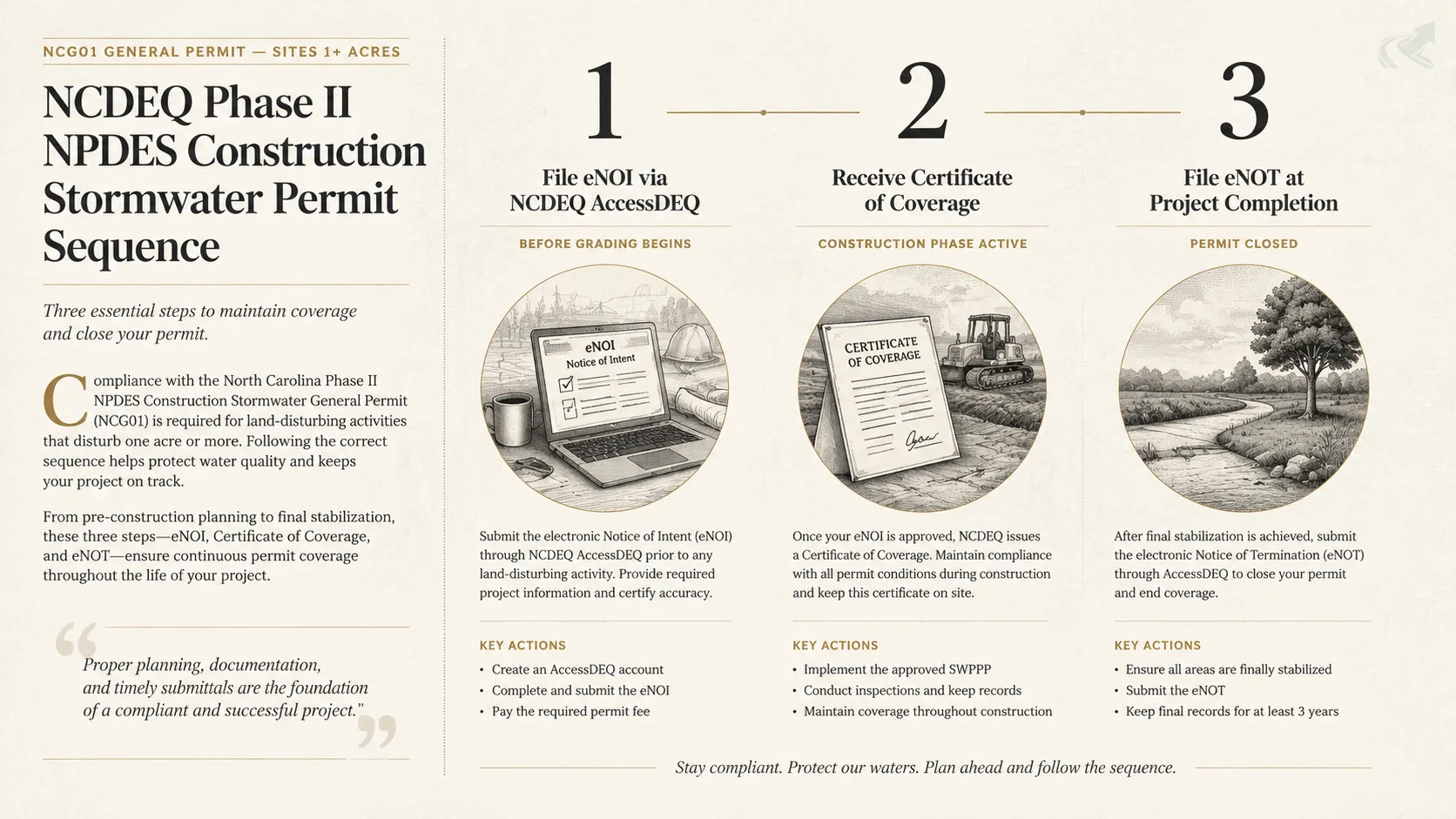
The 1-acre E&S threshold and the state NPDES construction stormwater coverage are separate but linked permit tracks. A project disturbing 1 or more acres needs an approved E&S plan AND construction stormwater permit coverage (the NCG01 general permit applies to projects subject to the DEMLR sediment program). Confirm your project sequencing with NCDEQ or your local jurisdiction before starting.
NCDEQ Phase II NPDES stormwater permits: procedural outline
File an electronic Notice of Intent (eNOI) through NCDEQ AccessDEQ — Receive Certificate of Coverage before starting work — File an electronic Notice of Termination (eNOT) at project completion. Source: deq.nc.gov
For NC land-disturbance thresholds that feed both the E&S and stormwater programs, see NC land-disturbance thresholds.
Local Stormwater Ordinances: Where the Stricter Rules Live
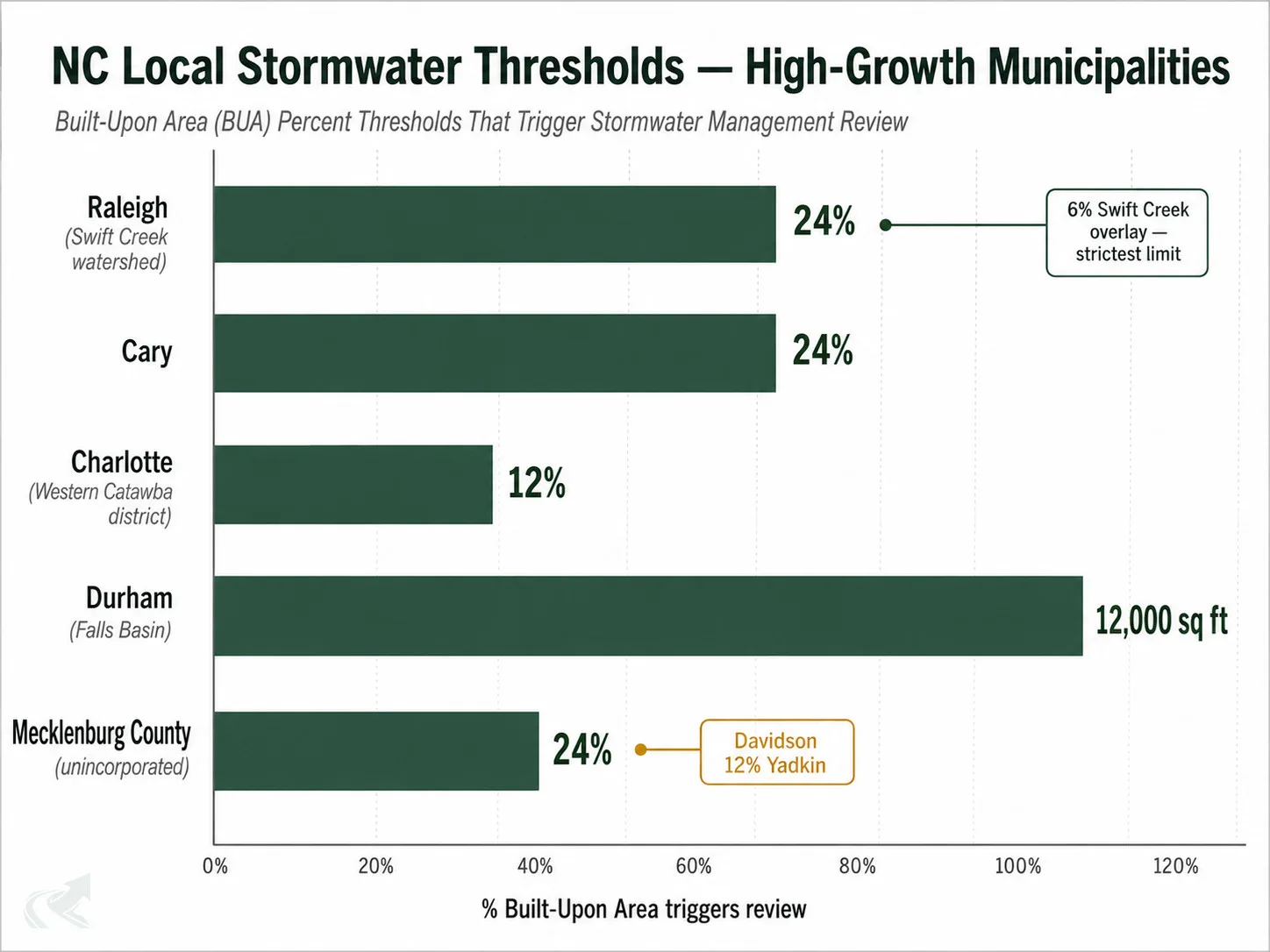
NC municipalities with high growth rates — Raleigh, Cary, Chapel Hill, Charlotte, Durham — have adopted stormwater management programs significantly stricter than state minimums, often triggering at impervious surface percentages or acreage thresholds well below the state’s 1-acre minimum.
These local programs operate under state delegation. NCDEQ authorizes municipalities to administer stormwater programs within their boundaries, then monitors those programs for compliance with state and federal minimums. The city or county program can be stricter than the state floor — and in practice, the fast-growing NC municipalities almost always are.
What triggers local review is typically the addition of new impervious surface (also called built-upon area). In NC stormwater context, impervious surface generally includes buildings, rooftops, driveways, patios, parking areas, sidewalks, and compacted gravel areas where natural infiltration is impeded. The threshold — the square footage above which you need a stormwater management plan — varies by municipality.
What local stormwater thresholds look like:
- Raleigh — projects exceeding 24% built-upon area require onsite stormwater treatment or participation in a regional stormwater control measure under UDO Sec 9.2.2. Impervious surface limits vary by zoning district (for example, R-1 20%, R-2 25%, R-4 38%, R-6 51%, R-10 and other districts 65%). Watershed overlay districts (Article 9.5) impose stricter limits — for example, the Swift Creek Primary Water Supply watershed limits built-upon area to 6% or 3,500 sq ft, whichever is less.
- Cary — low-density projects with 24% or less impervious surface (or 2 or fewer dwelling units per acre) are not required to install engineered stormwater controls. High-density projects exceeding those thresholds must provide engineered controls per LDO Sec 7.3.5. The Watershed Protection Overlay (LDO Sec 4.4.6) applies additional sub-area limits in the Swift Creek and Jordan Lake watersheds.
- Charlotte — the Post-Construction Stormwater Ordinance exempts projects that cumulatively disturb less than 1 acre AND create less than 5,000 sq ft of new built-upon area (Article 25.2.d). For non-exempt projects, district thresholds determine low vs high density: Central Catawba >24% BUA; Western Catawba >12% BUA; Yadkin-Southeast Catawba >10% BUA. High-density projects must treat the first inch of rainfall for 85% TSS removal.
- Durham — thresholds vary by basin per City Code Ch 70 Art X Sec 70-739 Table 1: the Jordan Basin triggers at 1 acre for limited residential and 0.5 acre for other uses; the Falls Basin triggers at 0.5 acre for limited residential and 12,000 sq ft for other uses; the Lower Neuse Basin triggers at 1 acre for limited residential and 0.5 acre for other uses. A 200 sq ft increase in impervious area also triggers peak-flow control (Sec 70-738).
- Chapel Hill — single-family, duplex, and recreational projects disturbing less than 1 acre are exempt from stormwater management plan requirements; commercial, industrial, institutional, and multi-family projects disturbing less than 0.5 acre are exempt (LUMO Sec 5.19.4(b)). Some single-family or two-family dwellings with 5,000 sq ft or less of land disturbance may also be exempt from stormwater impact statement requirements.
Mecklenburg County operates a particularly active stormwater program through Charlotte-Mecklenburg Storm Water Services — both the city and the unincorporated county portions. In unincorporated Mecklenburg, the county’s Post-Construction Storm Water Ordinance generally requires structural BMPs when built-upon area exceeds 24%, with lower thresholds in some towns (for example, Davidson >12%, Matthews Yadkin >10%).
The takeaway for a homeowner: if your project is in any incorporated NC municipality with active growth, assume local stormwater rules exist and call the planning or engineering department to confirm the threshold before permitting.
For county-level context, the county permits matrix alongside NC stormwater ordinance compliance maps out how these layers interact by county.
When Your Project Triggers Stormwater Review
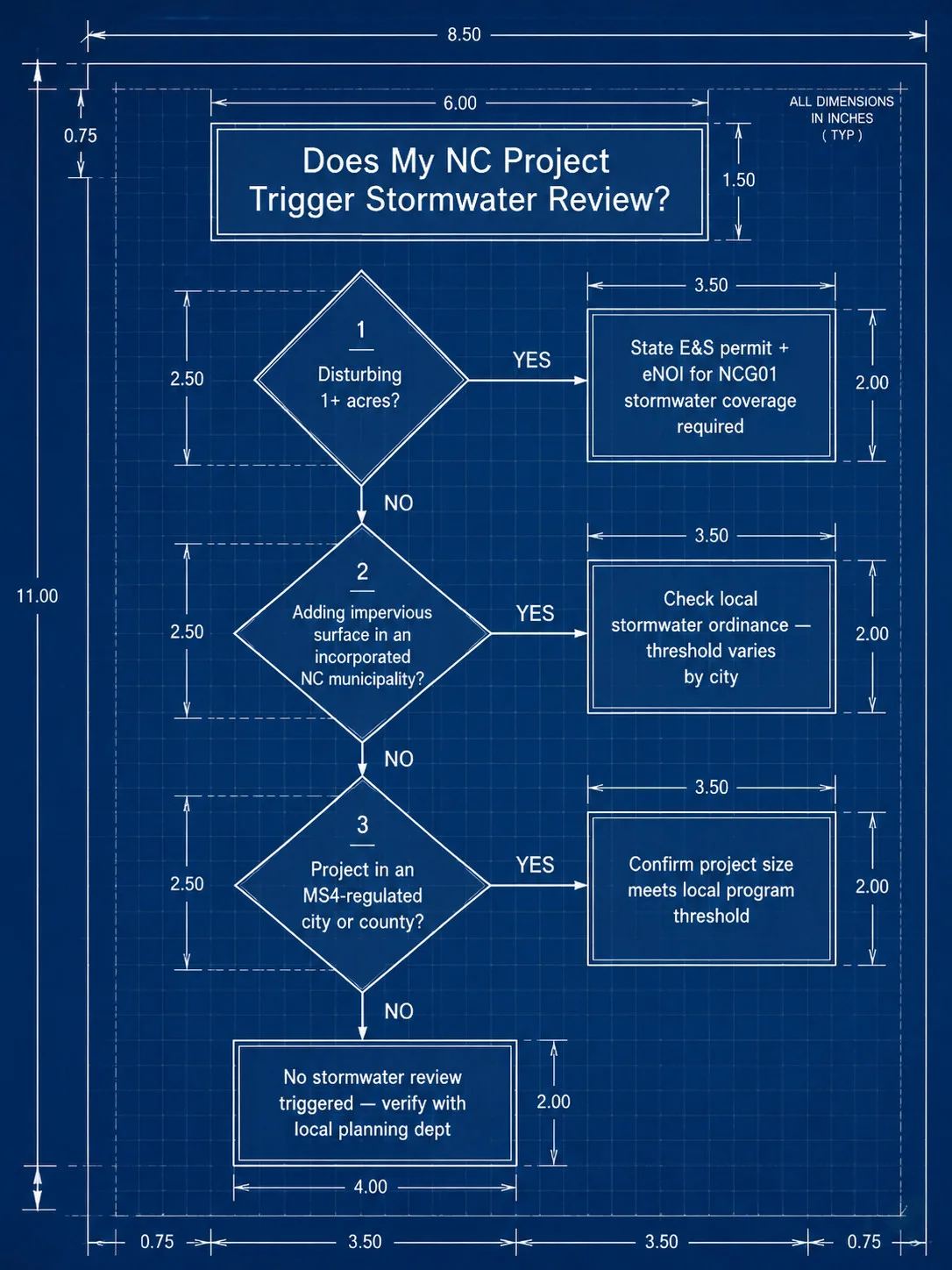
Three situations commonly trigger NC stormwater review for residential projects: adding a large impervious area (driveway, parking pad, addition), grading a site in an MS4-regulated municipality, or disturbing 1 or more acres on any site. Each can independently trigger a separate review track.
Here is the decision flow in plain terms:
Disturbing 1 or more acres? — State E&S permit required. May also trigger state NPDES stormwater coverage. These are linked but separate: the E&SC plan is approved first, then the eNOI is submitted through NCDEQ AccessDEQ for NCG01 coverage.
Adding impervious surface in a high-growth NC municipality? — Check the local stormwater ordinance for that municipality’s specific threshold. Do this before design — not after the contractor pours.
Project located in an MS4-regulated city or county? — Confirm whether your project size meets the local threshold. MS4-regulated status means the municipality has a stormwater program. Whether your project is large enough to hit it depends on that program’s rules.
Common combinations:
- Small driveway addition in Cary (under 1 acre disturbed): probably local stormwater review only — no state E&S.
- Land-clearing project in Guilford County (2 acres): state E&S required; NPDES stormwater may apply separately; no incorporated-city stormwater ordinance if outside city limits.
- Addition in Durham (1,800 sq ft new impervious): local Durham stormwater review under the Falls Basin limited residential threshold of 0.5 acre; may not trigger state NPDES if under 1 acre disturbed.
If you are unsure which bucket your project falls into, call your municipal planning department before design. Reworking a site plan after a stormwater review requires is more expensive than a phone call.
What Stormwater Management Compliance Actually Requires
Stormwater management compliance typically requires either a stormwater management plan submitted to the municipality or on-site treatment infrastructure — rain gardens, bioretention cells, detention ponds — that manages runoff from the added impervious surface.
A stormwater management plan is a technical document. It identifies the impervious surface being added, calculates the runoff volume increase from that surface, and specifies infrastructure or design measures that offset it. For residential-scale projects, the plan is often prepared by a licensed engineer — most homeowners cannot prepare it themselves.
On-site infrastructure options vary by site constraints:
- Rain gardens — shallow depressions planted with deep-rooted vegetation; manage modest volumes from small impervious areas.
- Bioretention cells — engineered systems with specified soil media, drainage layers, and overflow structures; sized by the runoff volume from the contributing impervious area.
- Detention ponds — hold runoff temporarily, release it at a controlled rate; more common for larger commercial projects but sometimes required on larger residential lots.
Project that adds impervious surface: stormwater-managed vs not
Comparison. Managed: Stormwater management plan submitted to the municipality; Bioretention cell sized to the new impervious area; Runoff from the new driveway captured and controlled; Released at a controlled rate, not dumped downstream. Unmanaged: New driveway added with no stormwater plan; Runoff sheets onto the neighbor's yard and storm drain; Notice of violation posted by the local program; E&S compliance does not cover this -- separate program.
- Stormwater management plan submitted to the municipality
- Bioretention cell sized to the new impervious area
- Runoff from the new driveway captured and controlled
- Released at a controlled rate, not dumped downstream
- New driveway added with no stormwater plan
- Runoff sheets onto the neighbor's yard and storm drain
- Notice of violation posted by the local program
- E&S compliance does not cover this -- separate program
A closed E&S permit does not satisfy a local stormwater ordinance -- in an MS4 municipality, added impervious surface triggers its own review.
NCDEQ publishes the Stormwater Design Manual (minimum design criteria codified in 15A NCAC 2H) that governs how these systems are sized and built in North Carolina. Ask any contractor quoting a project with stormwater requirements whether a stormwater management plan is included in their scope — or whether that is a separate engagement.
For yard drainage solutions under NC stormwater ordinances — including bioretention and grade-based approaches at the residential scale — see the standing water and yard drainage resource.
Common Mistakes
- Assuming E&S compliance covers stormwater management. They are separate programs. A closed E&S permit does not satisfy a local stormwater management ordinance.
- Assuming rural projects don’t trigger stormwater review. If the project is in an MS4-regulated municipality — even in a rural-feeling area within city limits — local stormwater ordinances apply. City limits extend farther than most homeowners assume.
- Not checking impervious surface area before starting a driveway or pad project. If you are adding more than a few thousand square feet of new impervious surface in any incorporated NC municipality, call the local stormwater program first. The threshold may be lower than you expect.
What to Ask Before Starting Any Significant Grading or Paving Project
Before any project that adds impervious surface or disturbs significant acreage: call your municipal stormwater or planning department and ask specifically whether a stormwater management plan is required.
Write down the answer and ask who you spoke with. If the answer is yes, the follow-up question is whether plan preparation must be done by a licensed North Carolina engineer.
Ask your contractor:
- “Are you familiar with the stormwater ordinance for [municipality]?”
- “Is stormwater management plan preparation included in your scope?”
- “If a bioretention cell or detention structure is required, can you specify and install it — or do I need a separate engineer?”
A contractor who has worked inside high-growth NC municipalities will know these questions are routine. One who looks confused by them has not been doing permitted work in those jurisdictions.
Copy this question and send it to any contractor before you commit:
“Before any project adding impervious surface, I want to confirm: Does this project require a stormwater management plan under our municipality’s ordinance? What is your impervious surface threshold? Are you including stormwater management plan preparation in your scope?”
To find a verified NC grading contractor who knows whether your municipality requires stormwater review — and can specify it in an itemized quote — use the NC Grade and Haul verified contractor directory.