
Two questions after watching French Drain Man
Does French Drain Man's methodology work in NC clay?
His raked-wall aggregate technique works anywhere -- it's a superior installation method for getting gravel to pack correctly around pipe. His system design assumptions (water percolates into the gravel from surrounding soil) do not apply to NC Piedmont clay, where water moves laterally along the clay layer rather than downward. What you keep: his craftsmanship standards. What you adjust: pipe positioning, outlet type, and how the interceptor intercepts flow.
What specifically from his channel applies to a North Carolina drainage project?
Keep the raked-wall technique and the aggregate sizing standards. Adjust the outlet type (pop-up emitters fail under NC clay load), the pipe depth (NC clay requires positioning at the clay-sand interface, not a generic depth), and the system design logic (Michigan loam accepts vertical percolation; NC Piedmont clay moves water laterally, not downward).
Nicole spent two evenings watching French Drain Man’s videos. His production quality is high. His explanations of aggregate sizing, pipe perforation patterns, and trench-wall preparation are detailed in a way most contractor channels aren’t. She came away with a mental model of what a well-built French drain looks like.
Then she got a quote. Different pipe size. No raked-wall aggregate technique. A pop-up emitter instead of a daylighted outlet. She wanted to know: was she right to be concerned?
She was right that craftsmanship matters. Some of what she learned applies directly to any NC project. The gap isn’t in his technique — it’s in the soil physics his system design assumes. Michigan loam and NC Piedmont clay are not the same material, and that difference changes where the drain intercepts water, how the outlet must be sized, and what depth the pipe actually needs to be.
This page maps what transfers from French Drain Man’s channel to North Carolina — and what has to change.
Who French Drain Man Is and What Makes His Channel Different
French Drain Man (Robert Sherwood) is a Michigan-based drainage contractor with the largest national drainage audience on YouTube — and his production quality and technical specificity are genuinely higher than most contractor channels.
Robert Sherwood operates out of Michigan under the French Drain Man brand. His channel has built the largest national following in the drainage contractor space, a position earned through consistent production quality and detailed explanations of why installation choices matter.
Most contractor YouTube content explains what to do. Sherwood tends to explain why: why aggregate distribution matters, why pipe positioning is not arbitrary, why trench-wall preparation affects long-term system performance.
That specificity is why Nicole’s investment in his content is rational. He’s teaching principles, not just steps. The translation problem is that the principles are calibrated to a soil type his camera rarely leaves — Michigan loam — and NC Piedmont clay operates under different physics.
What French Drain Man Gets Right: The Raked-Wall Technique
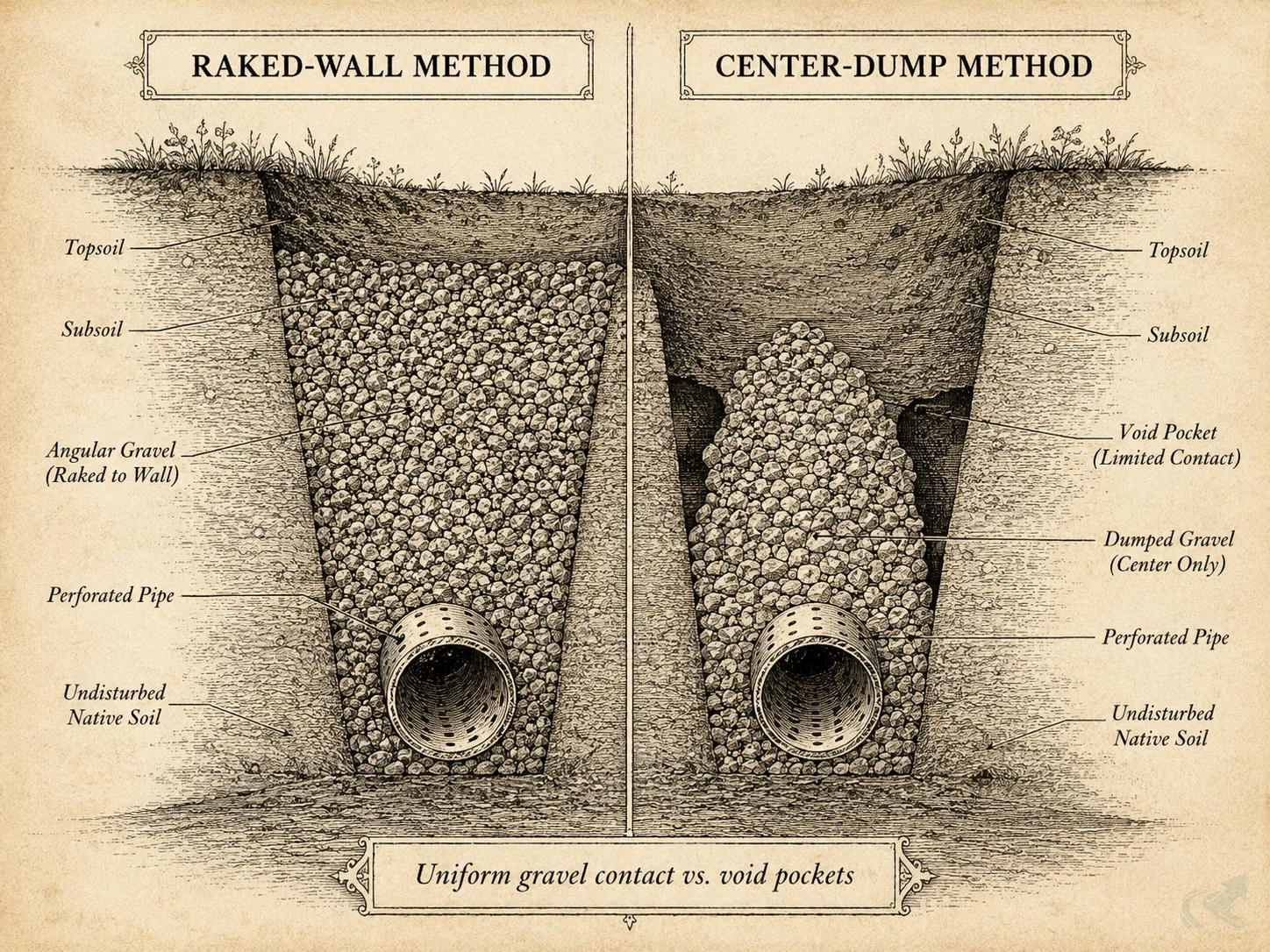
His raked-wall aggregate technique — raking gravel up the sides of the trench instead of just filling the center — is correct and transferable to NC. It’s a superior installation method for packing aggregate around pipe in any soil type.
The raked-wall technique refers to the practice of distributing aggregate laterally up the trench walls during installation, rather than dumping stone and expecting it to settle evenly around the pipe. The goal is consistent gravel contact on all sides of the pipe — no void pockets, no channels where water can bypass the pipe without entering it.
Why it works: a pipe sitting at the bottom of a loose-filled trench with air gaps alongside it captures less water and creates settlement pathways over time. A pipe surrounded by uniformly packed angular aggregate — gravel packed up the walls, not just under it — intercepts water across its full perforation pattern and remains stable as soil load shifts seasonally.
In Michigan loam, the raked-wall technique is solving a trench-wall compaction problem specific to that soil. In NC Piedmont clay, the same technique is solving an aggregate distribution problem that exists in any soil type.
The technique transfers. It’s not Michigan-specific — it’s a quality standard for aggregate installation. When Nicole flagged that her contractor’s proposal didn’t include it, she was applying a legitimate craftsmanship filter.
Use the raked-wall standard to evaluate any NC contractor. Ask whether their crew rakes aggregate up the trench walls or fills from the top. The answer is a proxy for installation care.
What French Drain Man Gets Right: Aggregate Sizing and Pipe Specs
His aggregate sizing recommendations and pipe diameter and perforation pattern recommendations reflect real engineering. These apply in NC clay — the aggregate spec doesn’t change based on surrounding soil.
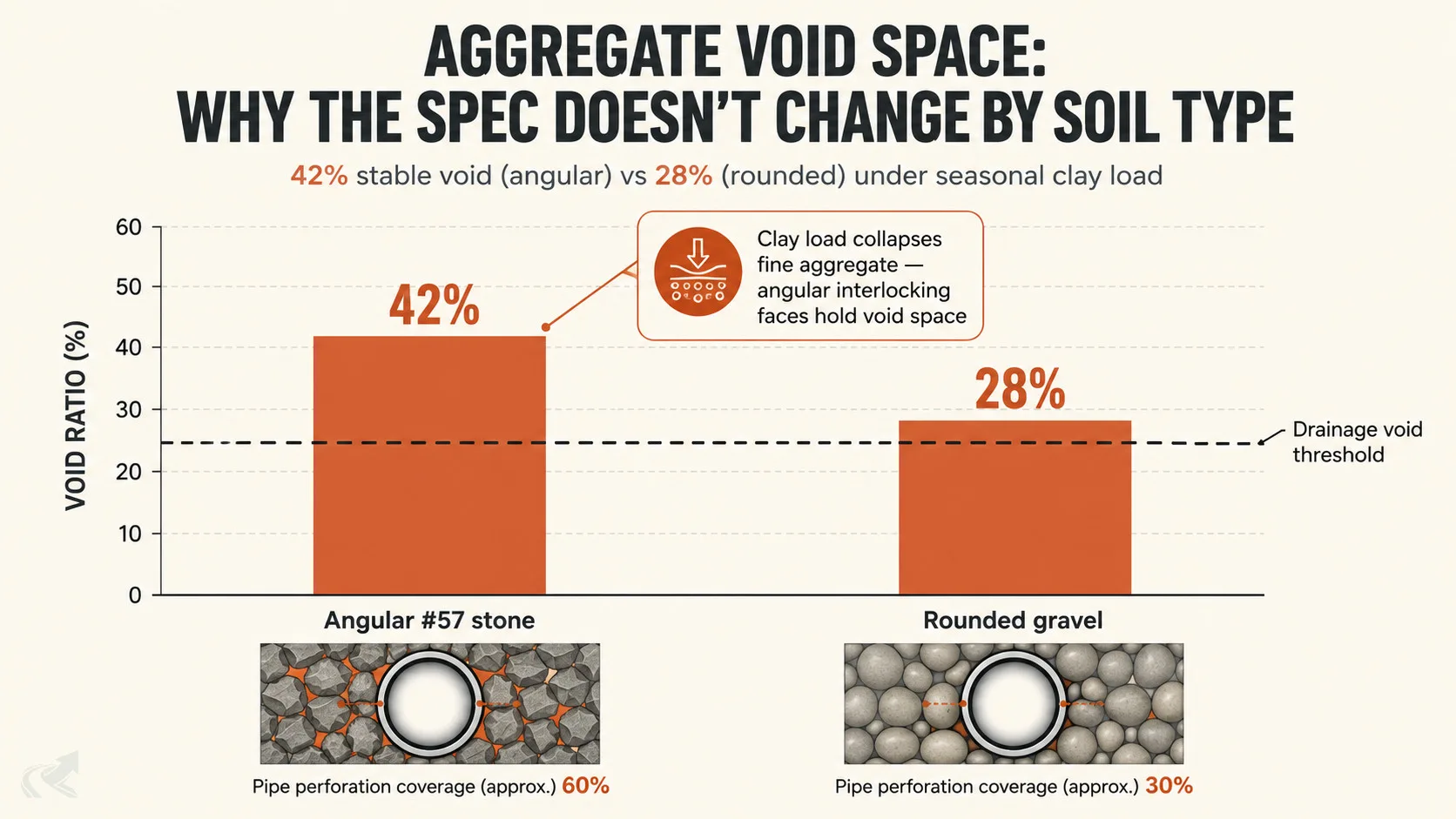
Aggregate sizing is not aesthetic. The void space in the gravel envelope determines how fast water moves through the system toward the pipe. Too fine an aggregate and the void collapses under clay load. Too coarse and aggregate may shift, especially in a trench that sees seasonal moisture cycles.
Sherwood’s recommendations on aggregate grade — angular, clean, washed stone in the range commonly sold as #57 stone in most markets — are consistent with standard drainage engineering. Angular stone packs with interlocking faces and maintains stable void space better than rounded gravel. Clean stone (no fines) avoids premature clogging of the gravel envelope.
Pipe diameter and perforation pattern matter for the same reason: the pipe has to move water faster than the system receives it. An undersized pipe creates backpressure under heavy NC storm events that clay soils don’t drain quickly enough to buffer.
If Nicole’s contractor proposed different aggregate or undersized pipe, she was right to question it. The aggregate spec is one of the few elements of French Drain Man’s recommendations that translates directly across soil types.
The Michigan Loam Gap: What the Soil Difference Means for NC
Michigan loam has moderate hydraulic conductivity — water percolates down through it relatively quickly. NC Piedmont clay has very low hydraulic conductivity — water does not percolate down through it. This changes where the drain intercepts water and how the outlet must be placed.
Hydraulic conductivity is the rate at which water moves through a saturated soil. Michigan loam runs in the moderate range — roughly 0.2 to 2 inches per hour for common loam series. NC Piedmont clay (Cecil series, the dominant Piedmont soil) runs 0.01 to 0.06 inches per hour. That is a 10x to 200x difference in the rate at which water moves through the soil.
That difference has a system-design consequence that Sherwood’s content does not address, because his soil doesn’t surface it.
In Michigan loam, a gravel trench functions as a percolation collection zone. Water moves vertically down through the loam, enters the gravel from above and from the sides, and is intercepted by the pipe. The system is designed around vertical percolation.
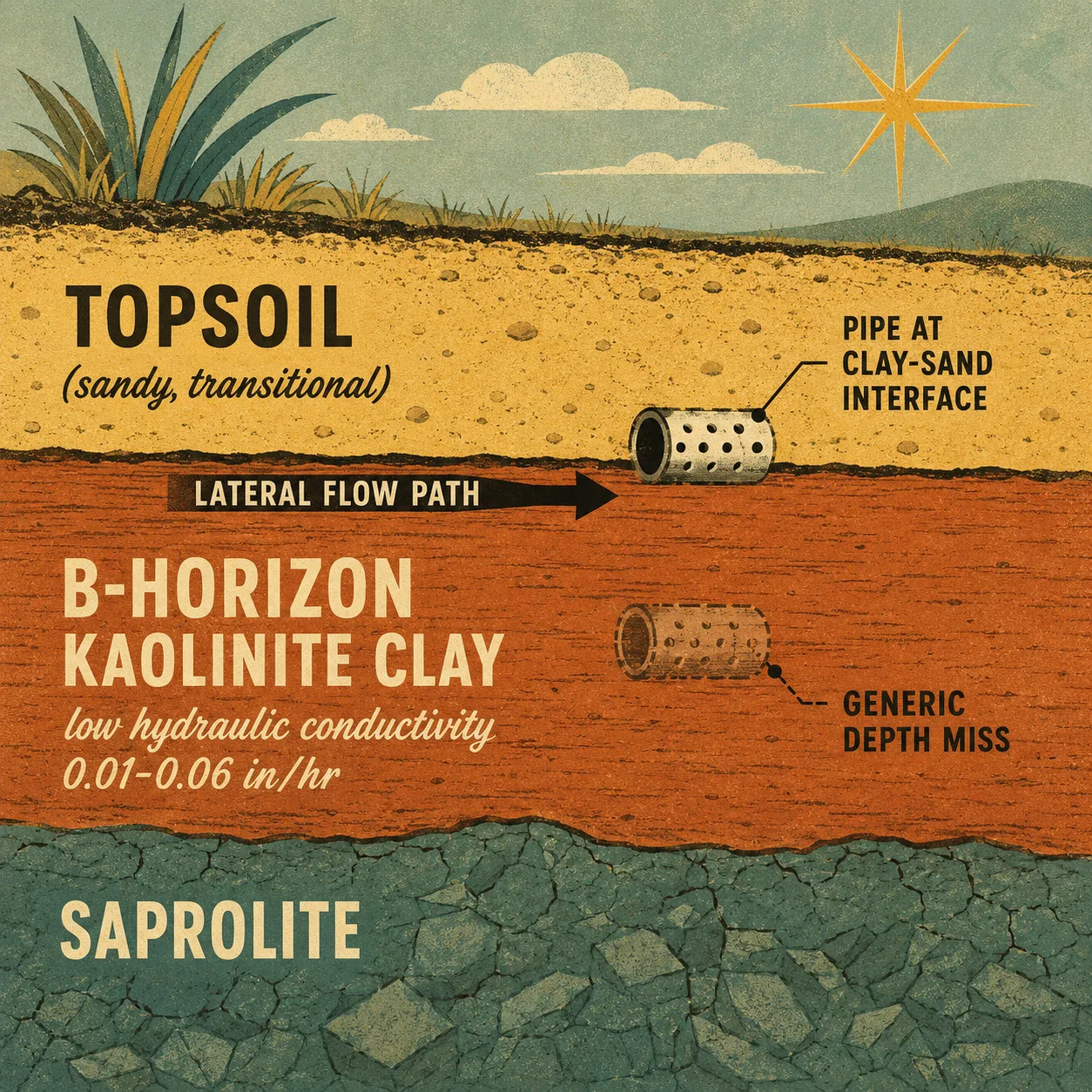
In North Carolina Piedmont clay, water does not move vertically through the clay mass. Kaolinite clay — the dominant mineral in NC Piedmont Cecil series soils — has such low hydraulic conductivity that water cannot percolate down through it fast enough to feed a buried gravel trench the way loam does. Instead, water moves laterally: along the surface, along hardpan layers, along the interface between topsoil and the dense clay B-horizon below.
A French drain designed around vertical percolation collection does not intercept NC lateral flow in the same way. The gravel trench sits in the clay mass but the water isn’t arriving from above — it’s arriving sideways.
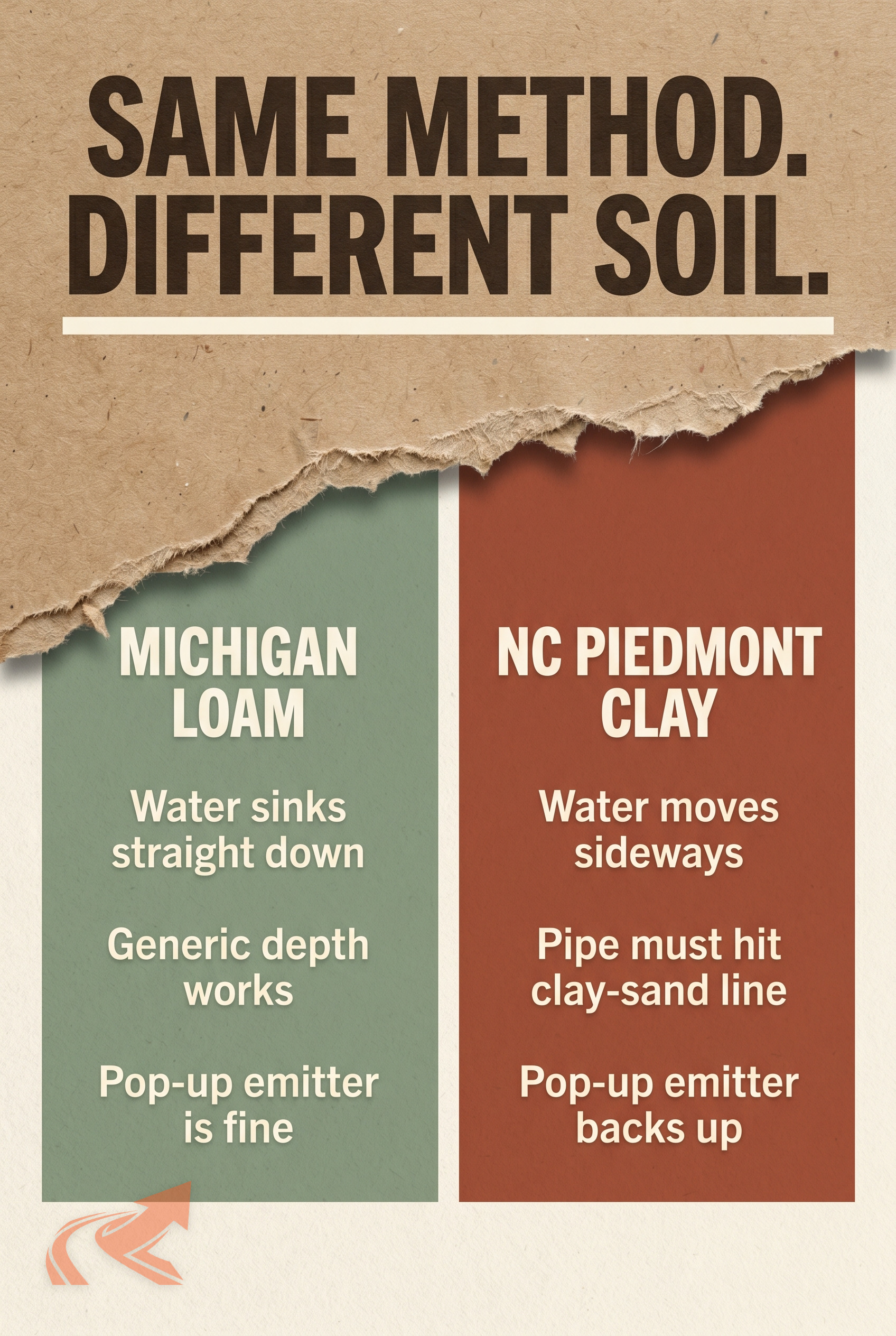
The same French Drain Man spec: Michigan loam vs NC Piedmont clay
Comparison. Michigan loam -- it works: Water percolates down through loam into the gravel; Pipe at a generic depth still intercepts the flow; Pop-up emitter discharges into turf the loam can absorb; System is designed around vertical percolation. NC clay -- same spec fails: Kaolinite clay won't percolate -- water arrives sideways; Generic depth misses the clay-sand interface; Pop-up emitter backs up under storm load; Water sits above the trench instead of draining.
- Water percolates down through loam into the gravel
- Pipe at a generic depth still intercepts the flow
- Pop-up emitter discharges into turf the loam can absorb
- System is designed around vertical percolation
- Kaolinite clay won't percolate -- water arrives sideways
- Generic depth misses the clay-sand interface
- Pop-up emitter backs up under storm load
- Water sits above the trench instead of draining
His raked-wall craftsmanship transfers anywhere -- but his system-design assumptions are calibrated to a soil NC doesn't have.
The outlet consequence is direct. In Michigan, a pop-up emitter that discharges into turf can function adequately because the surrounding loam accepts modest backflow from the emitter zone. In North Carolina Piedmont clay, the turf around a pop-up emitter is sitting on low-permeability clay. The emitter zone saturates under heavy storm load, discharge resistance increases, and the system backs up.
NC systems need outlets that daylight to open air — a pipe end that discharges freely, not into a zone that can saturate. Sherwood’s system design doesn’t specify pop-up emitters for every application, but his soil doesn’t create the failure condition that NC clay creates.
The depth consequence is equally direct. Michigan installations may follow a generic depth rule calibrated to loam percolation patterns. In North Carolina, the pipe depth has to be calibrated to soil horizon — specifically, the clay-sand interface where lateral flow concentrates, not the generic depth that might be correct for loam.
For the full hydraulic conductivity comparison and soil science basis, see why the Michigan French Drain Man method doesn’t translate to NC clay.
Michigan Loam vs. NC Piedmont Clay — System Design Comparison
| Factor | Michigan Loam | NC Piedmont Clay | Implication for System Design |
|---|---|---|---|
| Hydraulic conductivity | Moderate (0.2-2 in/hr) | Low (0.01-0.06 in/hr) | NC clay won’t accept water from gravel trench by vertical percolation |
| Primary water movement | Vertical percolation + lateral | Primarily lateral | NC drain must intercept lateral flow, not percolating groundwater |
| Raked-wall technique | Recommended | Recommended | Transferable — superior installation in any soil type |
| Pipe sock / geotextile | Standard non-woven geotextile | Zone-specific (clay face: no sock; sand interface: sock may apply) | Blanket sock use in NC clay risks kaolinite clogging |
| Outlet type | Pop-up emitter viable | Daylighted outlet required | NC clay saturation prevents pop-up from working under storm load |
| Pipe depth | Generic depth rule viable | Must be at clay-sand interface | NC depth is soil-horizon specific, not a generic rule |
Read the French drain methodology wars hub for how this comparison fits the broader creator landscape.
The NC Step He Never Shows: Positioning at the Clay-Sand Interface
There is a step that matters specifically in NC clay that French Drain Man’s content doesn’t cover: positioning the interceptor trench at the clay-sand interface, not at a generic depth in the middle of the clay mass.
In NC Piedmont sites, the soil profile typically runs: topsoil (a few inches), a transitional zone, then dense B-horizon kaolinite clay that extends to significant depth. Water moving laterally concentrates at the interface where permeability changes — typically where the sandy topsoil or transitional zone meets the dense clay B-horizon below.
An interceptor trench that misses this interface — sitting too deep in the clay mass, or too shallow to intercept the flow at the horizon boundary — captures less water than one correctly positioned at the lateral-flow concentration point.
This is not something French Drain Man gets wrong. His Michigan loam doesn’t have the same sharp clay-sand horizon boundary that creates this issue in NC Piedmont profiles. The step doesn’t come up in his content because his soil doesn’t require it.
For NC installations, this is the depth question to ask any contractor: “Is the pipe depth calibrated to the clay-sand interface, or is it a generic depth rule?” The answer distinguishes contractors who have worked NC Piedmont clay from those applying out-of-region methods directly.
For the full soil-science basis, see NC Piedmont red clay engineering properties and the clay-stops-water debate.
NC Homeowner Takeaway
Here is what you keep from French Drain Man’s content when you are in NC Piedmont clay — and what specifically changes.
Nicole’s investment in his channel was not wasted. She learned real quality standards. The translation work is specific, not wholesale rejection.
-
Keep: The raked-wall technique. It is a superior aggregate installation method regardless of soil type. Use it as a quality filter when evaluating contractor proposals. Ask any contractor: “Do you rake aggregate up the trench walls or fill from the top?” A crew that doesn’t know what the question means hasn’t been trained to that standard.
-
Keep: Aggregate sizing and pipe specs. Sherwood’s aggregate grade recommendations (#57 stone or equivalent angular, washed stone) and pipe sizing standards apply in North Carolina. If a contractor’s proposal uses undersized pipe or rounded gravel, that is a legitimate concern — the soil type doesn’t change those specifications.
-
Adjust: Pipe positioning. In NC Piedmont clay, the pipe needs to be at the clay-sand interface to intercept lateral flow — not at a generic depth rule calibrated to loam percolation. Ask any contractor: “Is the pipe depth in your proposal based on the clay horizon boundary on this site, or is it a standard depth?” The answer is diagnostic.
-
Adjust: Outlet type. Pop-up emitters that discharge into turf may not be adequate for NC clay systems under storm load. Ask whether the outlet daylights to open air or terminates in turf. A daylighted outlet at positive grade to a swale or drainage channel is the standard for North Carolina Piedmont clay sites.
For the full soil-science basis on why NC drainage methods differ from the national playbook, see why NC French drain methodology differs from other states.
The copy-to-clipboard question before any NC contractor call:
“Two questions after watching French Drain Man: Do you use a raked-wall technique for aggregate installation? And is the pipe positioned at the clay-sand interface for NC lateral flow interception — not just a generic depth?”
The first question checks craftsmanship. The second checks NC soil knowledge. Both together tell you what you need to know before signing.
Using French Drain Man’s Standards to Evaluate NC Contractors
French Drain Man gave you a quality standard. Now use it: ask any NC contractor whether their aggregate spec and pipe diameter match what you saw in his videos. The answer filters for craftsmanship. Then ask the NC clay questions separately.
The two-pass evaluation protects against two different failure modes. An NC contractor who uses French Drain Man’s aggregate and pipe specs but doesn’t understand NC clay lateral flow will build a well-constructed system in the wrong location. A contractor who understands NC clay but cuts aggregate costs will build a correctly positioned system that fails over time.
Ask both sets of questions. Then check the outlet. A proposal that clears all three — craftsmanship spec, NC clay positioning, daylighted outlet — is a proposal from a contractor who has worked the soil.
Find a grading contractor in North Carolina working in your soil zone who understands NC clay lateral flow and can answer both sets of questions before the contract is signed.
For the NC clay French drain methodology applied step by step, including aggregate spec, pipe positioning, and outlet design for Piedmont clay sites, see that resource before finalizing any scope of work.