
Ray Pettiford has watched a lot of drainage video. He’s seen Florida contractors explain French drain physics on sandy lots that look nothing like his 14 acres in Guilford County. He’s watched a Michigan operator demonstrate the fabric-sock method on loamy soil that behaves differently from the red clay under his feet.
Then he found Gate City Foundation and Drainage. He recognized the terrain immediately — rolling Piedmont hills, red clay cut-banks, the drainage challenges specific to Guilford County lot development. Something clicked.
That recognition is not just visual. Shawn at Gate City is working the same Piedmont clay as Ray, in the same county, solving the same problems. This page explains what specifically makes that local grounding matter at a technical level — and translates it into concrete questions Ray can bring into any contractor conversation.
For the full four-channel comparison, see the Methodology Wars hub.
Who Shawn Is and Why Guilford County Matters
Gate City Foundation and Drainage is a Guilford County, NC operation — Greensboro/High Point market. Shawn’s content is filmed in the same NC Piedmont clay that affects the Triangle, Charlotte metro, and Triad.
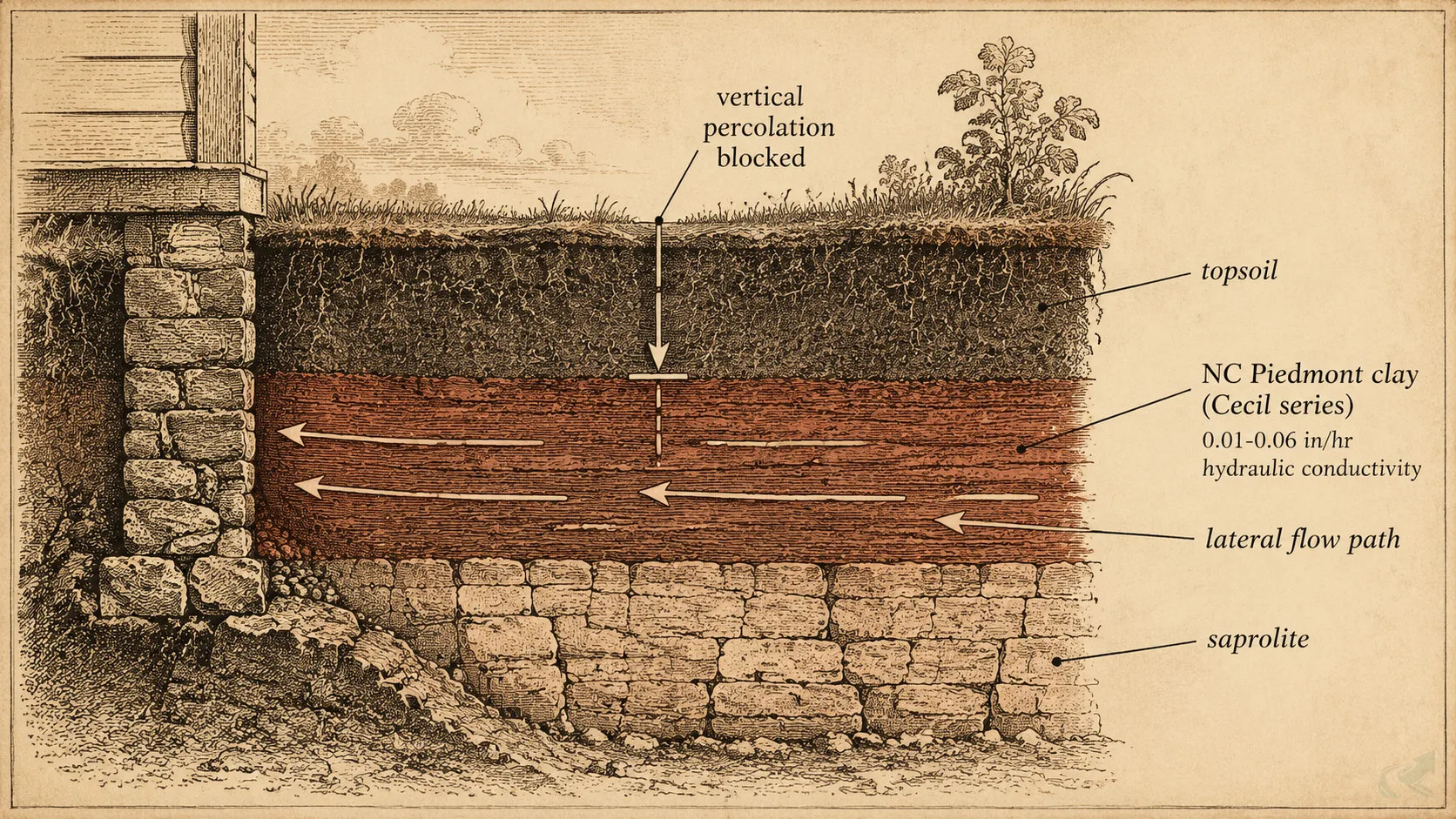
“Gate City” is the traditional nickname for Greensboro — the geographic center of the Piedmont Triad. Guilford County sits squarely in the Cecil soil series: kaolinite-dominated Piedmont clay with hydraulic conductivity in the 0.01-0.06 inches/hour range. This is the same soil Ray is clearing.
That local grounding matters in a way it doesn’t for creators filming in Florida or Michigan. When Shawn grades a foundation edge in Guilford County, he’s working with soil that behaves the way NC Piedmont clay actually behaves under load and saturation — not how sandy or loamy soils behave.
The methodology wars between national YouTube drainage channels exist partly because each creator is right for their own soil. Shawn doesn’t have that translation problem for Piedmont NC work. For why NC foundation drainage methods differ from national approaches, the soil-science basis is covered in depth on that page.
What Shawn Gets Right: Foundation Drainage in NC Clay
Shawn’s foundation drainage approach reflects field-tested experience with NC Piedmont clay — specifically the grading corrections, downspout management, and positive-slope-away-from-foundation requirements that are the most common failure points on NC residential lots.
Three specific elements translate directly to Piedmont clay conditions:
Positive grade away from the foundation. The minimum 2% slope requirement — the foundation edge draining away from the structure — is not a generic best practice. It is the most critical design parameter for NC clay foundations specifically. NC Piedmont clay does not drain vertically. When the ground at the foundation edge is flat or pitched inward, water intercepts the foundation directly rather than shedding laterally to a lower drainage point.
Downspout extension to daylight. Terminating a downspout at the foundation wall is one of the single most common causes of NC foundation water problems. NC Piedmont clay saturates at the foundation wall; once the soil is saturated, each rain event loads the wall directly. Extending downspouts past the foundation drainage zone — to a point where water daylights away from the structure — is the correct interceptor approach for this soil type.
Window-well drainage integration. Window wells that don’t drain properly in NC clay create a reservoir condition: the clay around the well saturates, water has nowhere to go vertically, and the well fills against the window. Shawn’s approach to integrating window-well drainage with the overall foundation drainage system reflects real Piedmont-clay field experience.
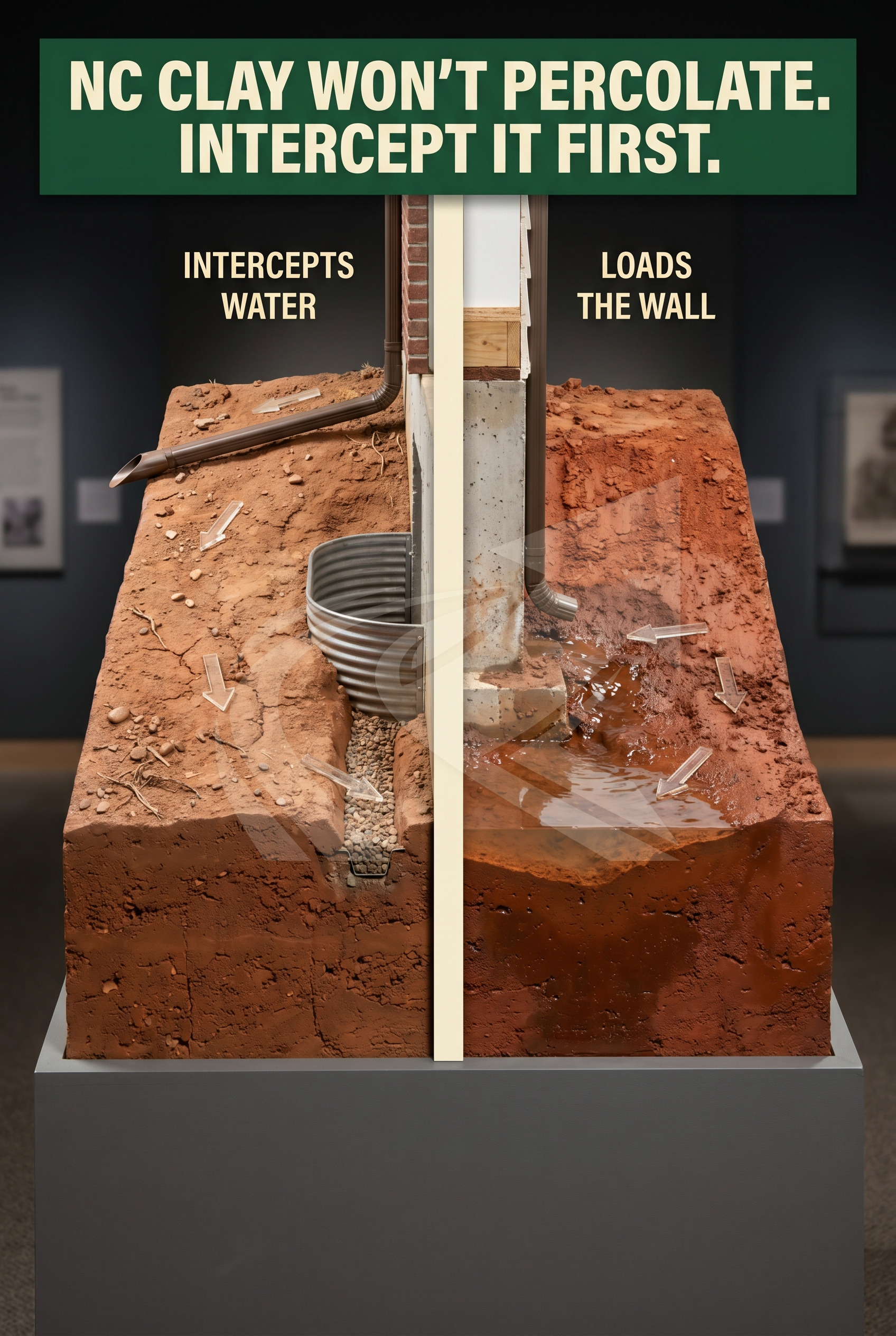
NC foundation drainage: graded right vs graded wrong
Comparison. Sheds water away: Positive slope away from the foundation, 2% minimum; Downspouts extended past the drainage zone to daylight; Foundation edge drains laterally to a lower point; Window wells tied into the overall drainage system. Loads the wall: Flat or inward-pitched clay at the foundation edge; Downspout terminates right at the foundation wall; Water pools against the structure every rain; Saturated clay loads the wall directly, with nowhere to drain.
- Positive slope away from the foundation, 2% minimum
- Downspouts extended past the drainage zone to daylight
- Foundation edge drains laterally to a lower point
- Window wells tied into the overall drainage system
- Flat or inward-pitched clay at the foundation edge
- Downspout terminates right at the foundation wall
- Water pools against the structure every rain
- Saturated clay loads the wall directly, with nowhere to drain
NC Piedmont clay won't drain vertically -- foundation drainage works by intercepting water before it reaches the wall, not by letting the soil soak it away.
For the NC foundation drainage QN, the technical requirements for each of these elements are covered in detail.
The Technical Basis: Why His Methods Work in Piedmont Clay
The foundation drainage methods that work in NC Piedmont clay are based on intercepting water before it reaches the foundation — not on relying on soil percolation to drain water away from it.
This is the core technical reason a locally-grounded approach matters. Florida sandy soil allows vertical percolation: water enters at the surface, moves down through the sandy profile, and the drainage problem is mostly about directing where it goes horizontally. Michigan loam has moderate percolation. Design can account for some downward movement.
NC Piedmont clay does not percolate vertically in any meaningful volume. Hydraulic conductivity for the Cecil series runs 0.01-0.06 inches per hour. At the wet end of that range, one inch of rain takes 17-100 hours to move one inch down through the soil profile. Effectively, it doesn’t move down at all during a rain event.
What happens instead is lateral flow. Water moves sideways — along the soil surface, along hardpan clay layers, along impermeable subsoil horizons. A foundation drainage system that relies on percolation will miss this lateral flow entirely.
Interceptor-based design catches water before it reaches the foundation. The positive grade, the extended downspouts, the window-well tie-in — these are all interceptor elements. They redirect water that is moving laterally or loading from above before it reaches the structure.
This is why how Gate City’s methodology fits NC foundation drainage is worth reading before any contractor conversation. The interceptor principle is the load-bearing concept.
See the NC Piedmont red clay full engineering reference for the soil-science foundation behind these claims.
What Could Be More Explicit for Piedmont Clay
The one area where any NC foundation drainage channel can go deeper: the seasonal swelling behavior of Piedmont clay and its effect on drain pipe performance over multiple seasons.
This is not a criticism of Shawn’s approach — it is a technical refinement that any NC homeowner should carry into contractor conversations regardless of which channel’s methods they’re evaluating.
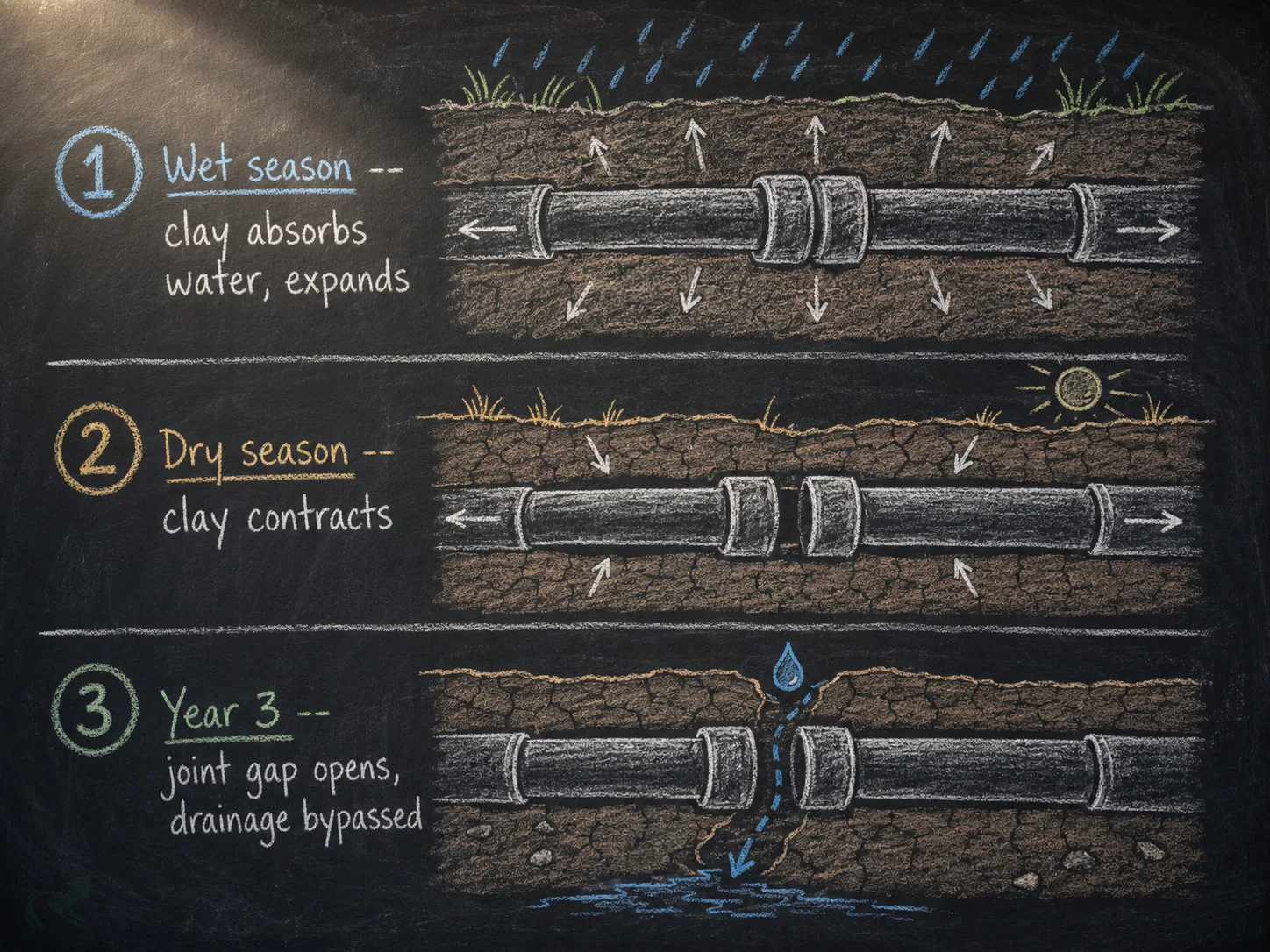
Piedmont clay has lower shrink-swell than smectite clays, but it moves. Wet season: the clay absorbs water and expands. Dry season: it contracts. Over multiple cycles, this movement acts on drain pipes and their joints. A drainage system installed with correct slope in year one may have shifted by year three as the surrounding clay moved.
The joint-seal question is particularly important for NC Piedmont clay. Where drain pipes are connected at couplings or at outlet transitions, seasonal movement can open gaps. Water that was being intercepted before the foundation now bypasses the system through the joint gap.
The practical ask for any contractor: how are joints sealed against seasonal movement? What pipe spec and coupling type are used? Is there any provision for inspecting the system in year three without excavation?
The full treatment of seasonal clay behavior is at NC red clay dual nature and seasonal movement.
NC Homeowner Takeaway
Here’s what you carry from Shawn’s Gate City methods into your own contractor conversations — especially in Guilford County and across the NC Piedmont.
Of the four channels in the Methodology Wars series, this page carries the most directly applicable guidance for North Carolina Piedmont homeowners. Shawn is working NC clay in NC conditions. The translation gap that applies to Florida and Michigan channels is minimal here.
Three things to carry forward:
-
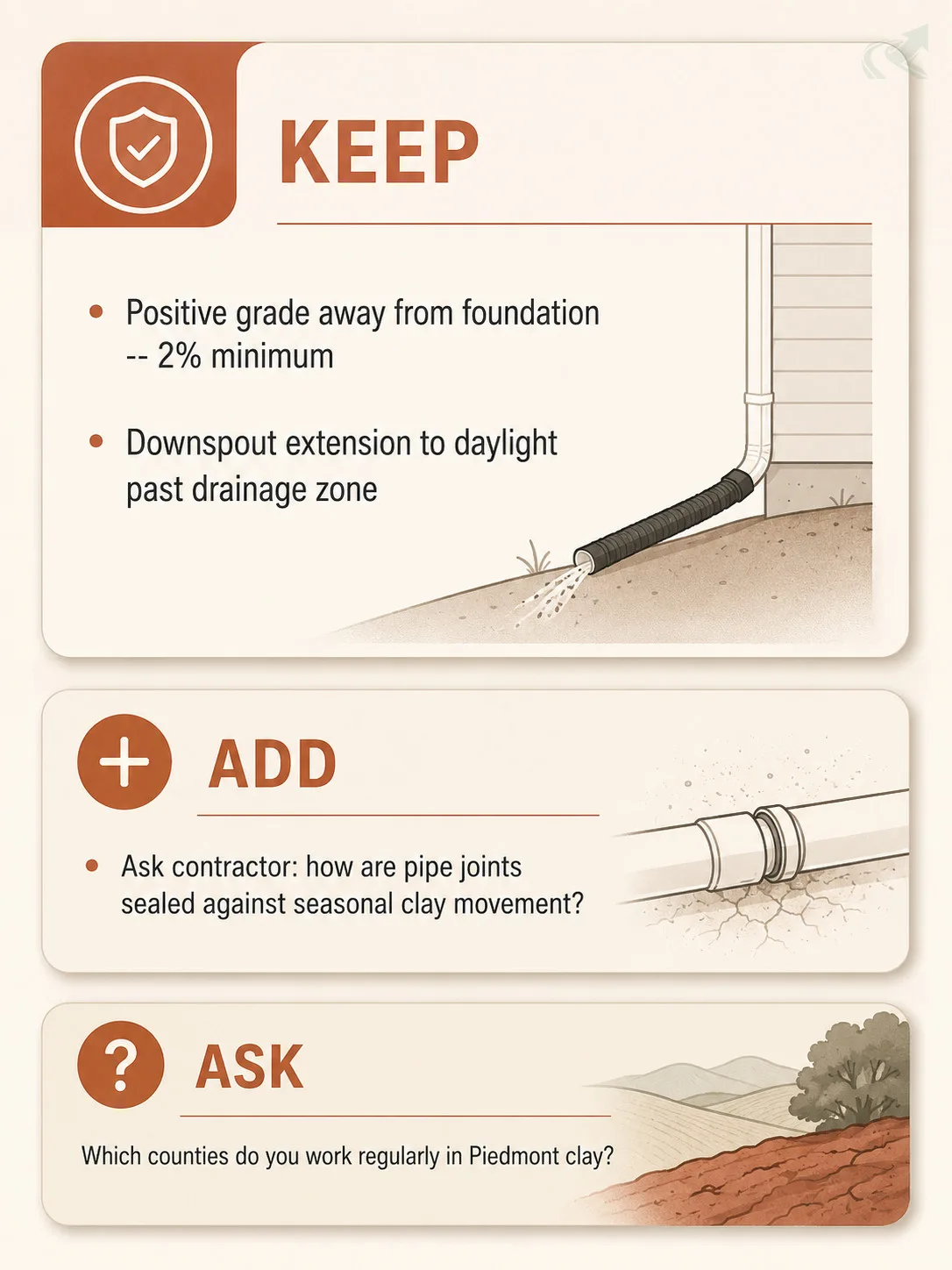
Keep: His foundation drainage sequencing — positive grade away from foundation, downspout extensions, window-well drainage integration. These are right for NC clay. The positive-slope requirement and the downspout-extension-to-daylight approach are the correct interceptor-first response to NC Piedmont clay’s near-zero vertical percolation.
-
Add: Ask any contractor about the clay swelling cycle. A drainage system that performs correctly in year one may have shifted pipe slope by year three if the clay moved seasonally around the drain pipe. Ask specifically how joints are sealed against seasonal movement and what pipe coupling spec is being used. This question is not on most contractors’ standard script — the ones who answer it well have worked NC Piedmont clay enough seasons to have seen the problem.
-
Ask your contractor: “Are you familiar with Gate City Foundation and Drainage’s approach to Guilford County lots? What specifically differs for my lot versus a standard installation?” Local name recognition is a useful signal — it is not definitive, but a contractor working regularly in Guilford County-type Piedmont clay is more likely to recognize the reference than one who learned foundation drainage on sandier soil.
For the deeper context on why NC conditions require this level of specificity, see why NC foundation drainage methods differ from national approaches.
Using This When Evaluating Local Contractors
Shawn’s content gives you a field-tested NC reference point. Use it to evaluate whether your local contractor is solving the same problem — or a generic one.
A contractor who can explain the interceptor logic — positive grade, downspout extension to daylight, window-well integration — in NC clay terms has worked in this soil. A contractor who quotes a Florida or Michigan-sourced method without adjusting for Piedmont clay lateral flow has not thought through the soil-specific variables.
Ask for an itemized scope that names the outlet location, the slope target, and how downspouts are handled. A quote that says “foundation drainage, 40 feet, $X” does not tell you whether the contractor understands the site-specific soil conditions.
North Carolina has 93 verified contractors in the Triad area alone — many of them working in the same Guilford County Piedmont clay Shawn films in. Hire a verified NC grading contractor who works regularly in Piedmont clay.
Common Mistakes
-
Assuming “local NC operator” equals “Piedmont clay specialist.” Shawn works in Guilford County — which is Piedmont. But not all NC operators have the same soil-zone experience. Always ask which counties they work regularly and how many seasons they’ve worked in Piedmont clay conditions specifically.
-
Applying foundation drainage methods to yard drainage without adjusting slope requirements. Foundation drainage and yard drainage have different priority zones and slope targets. The 2% positive-slope-away-from-foundation requirement is a foundation-specific parameter — yard drainage intercepts at a different elevation and with different outlet priorities.