
Ray Pettiford is looking at an $8,000—$15,000 number and asking a fair question: is this money I’m spending, or money I’m investing?
The honest answer is both — but the framing matters. The direct appraisal value increase from sewer conversion is real. In most NC markets it doesn’t equal the full conversion cost on a dollar-for-dollar basis. But that’s only part of the picture.
The rest of the picture is NC Chapter 47E. When Ray eventually sells, he has to disclose his sewage disposal system. Buyers see that information. Some renegotiate. Some walk. That friction has a market cost that no appraisal captures — and conversion eliminates it entirely.
This page covers what NC appraisers actually look for, what Triangle market evidence suggests, how the Chapter 47E disclosure requirement works in practice, and the ROI math across three scenarios.
The Value Question — What NC Appraisers Look For
Appraisers value utility type through paired-sales analysis — comparing homes that are nearly identical except one connects to public sewer and one uses septic.
When an appraiser values a property, they look for comparable sales — homes in the same market with similar square footage, lot size, age, and condition. When utility type differs between comps, appraisers apply a utility adjustment to account for the value difference.
That adjustment isn’t a fixed number. It’s market-derived. In a Triangle-area subdivision where sewer is standard, a septic comp may carry a meaningful negative adjustment. In rural Guilford County where most comparable properties also use septic, the adjustment is smaller.
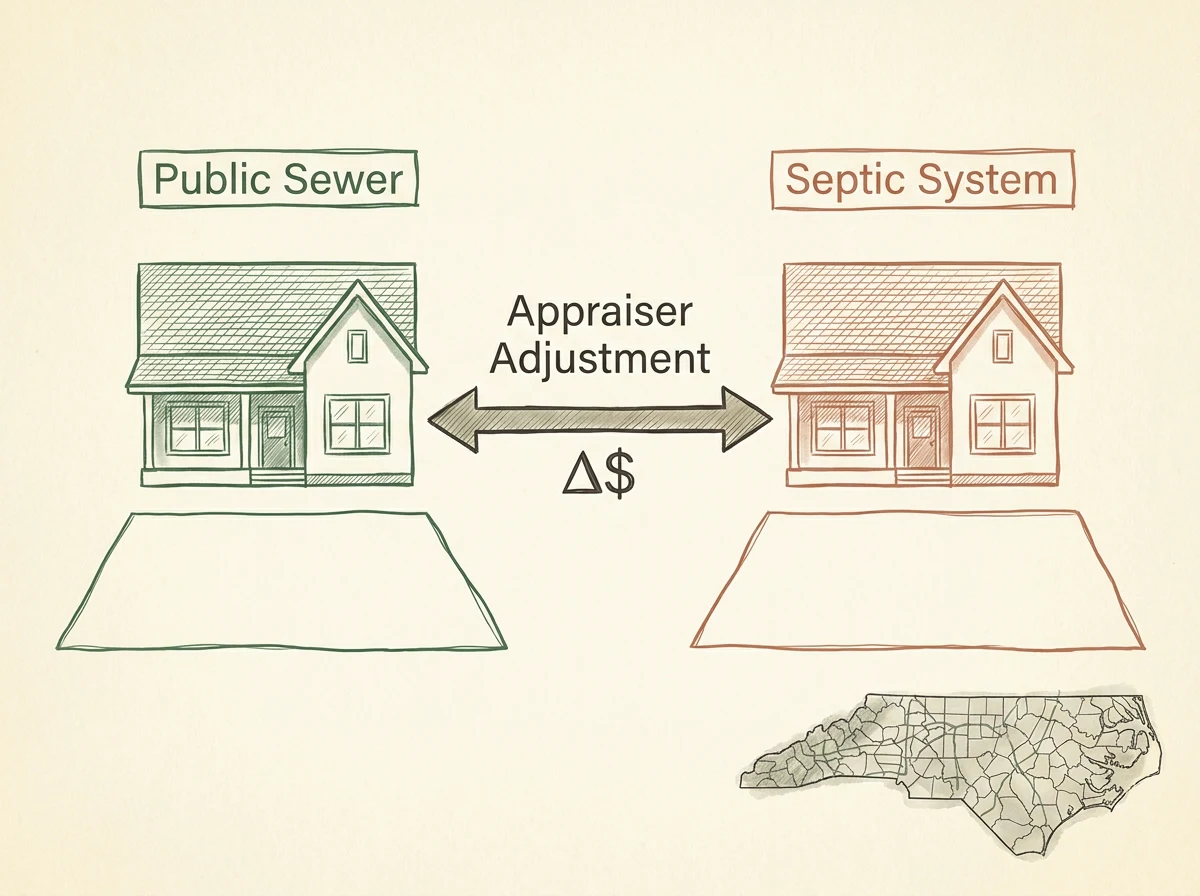
North Carolina appraisers follow USPAP (Uniform Standards of Professional Appraisal Practice) as required by the NC Appraisal Board for developing utility adjustments. The key variable is what the local market supports — not a national average.
Proximity to the municipal sewer line can also affect land value even before connection. A lot that sits directly on an available sewer main has connection as an option; one that requires a long lateral run — or sits against gravity relative to the main — does not. That optionality shows up in land value assessments.
Triangle Market Evidence
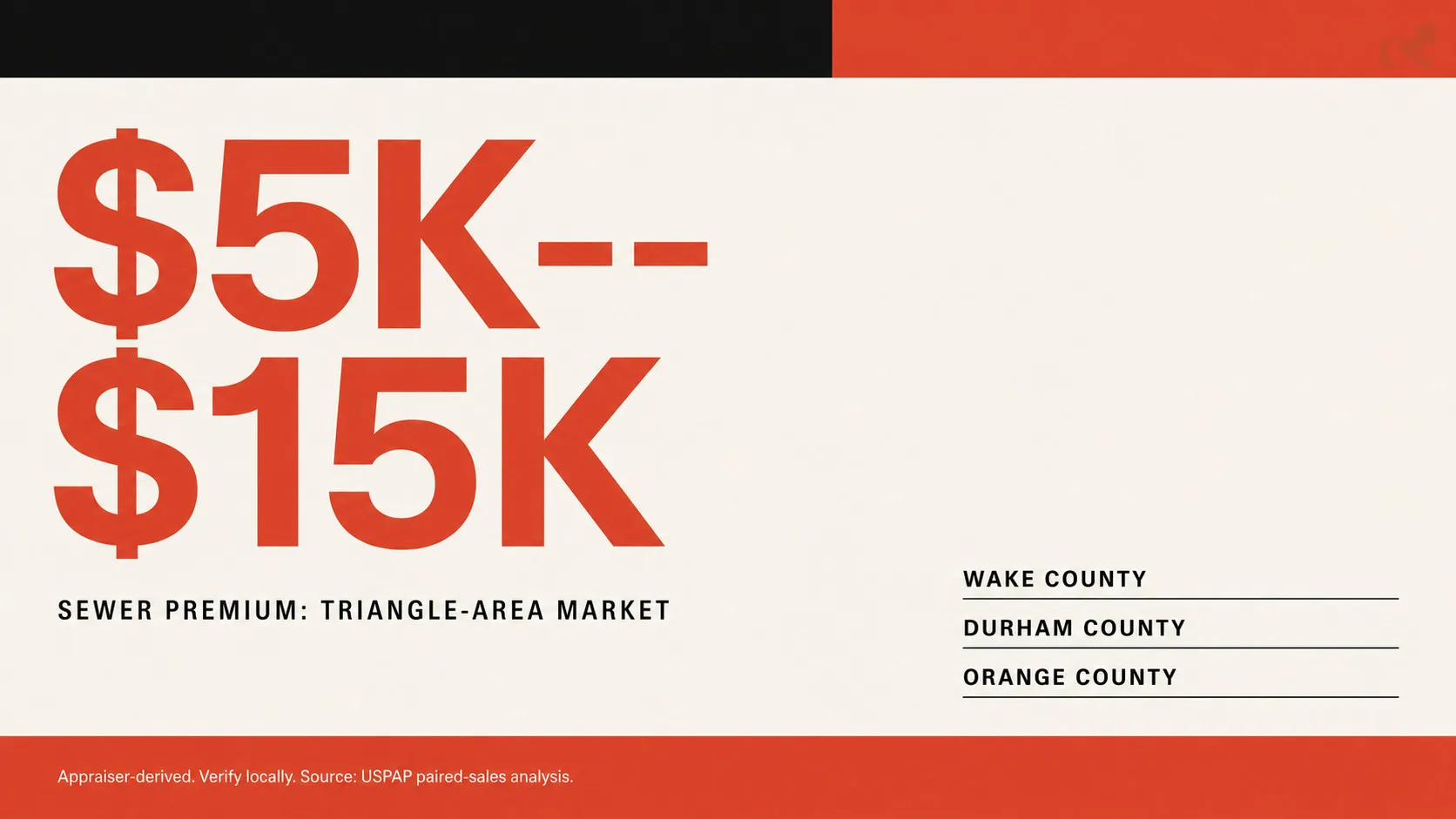
Local appraisers in the Triangle report value differentials between comparable sewer and septic homes in sewer-available subdivisions — commonly cited in the $5,000—$15,000 range — but this figure is market-derived and no published peer-reviewed NC research confirms a single number. Verify with a local appraiser using actual paired-sales data for your subdivision.
The Triangle — Wake, Durham, and Orange counties — is where the evidence is clearest. Suburban infill pressure, rapid appreciation, and a large inventory of both septic and sewer homes in similar subdivisions make it the strongest NC market for observing this differential.
The premium is generally larger where sewer is the dominant utility among comparable sales. A $600,000 home in a Wake County suburb where all surrounding comparables connect to public sewer may show a larger negative septic adjustment than a $250,000 home in a more rural area where septic is the norm among comparable sales. This is the standard USPAP paired-sales logic: the adjustment reflects what buyers in that specific market will pay for the utility difference, not a national average.
The Triad — Guilford, Forsyth, and surrounding counties — tells a different story in most subdivisions. Rural Guilford properties where septic is standard among all comparable sales may show little or no measurable utility premium. The conversion value argument is strongest where sewer is the expectation.
All specific dollar figures in this section require local verification with an NC appraiser who has access to actual Triangle MLS paired-sales data. The ranges cited are reported estimates from appraiser forums and practitioner experience, not published research.
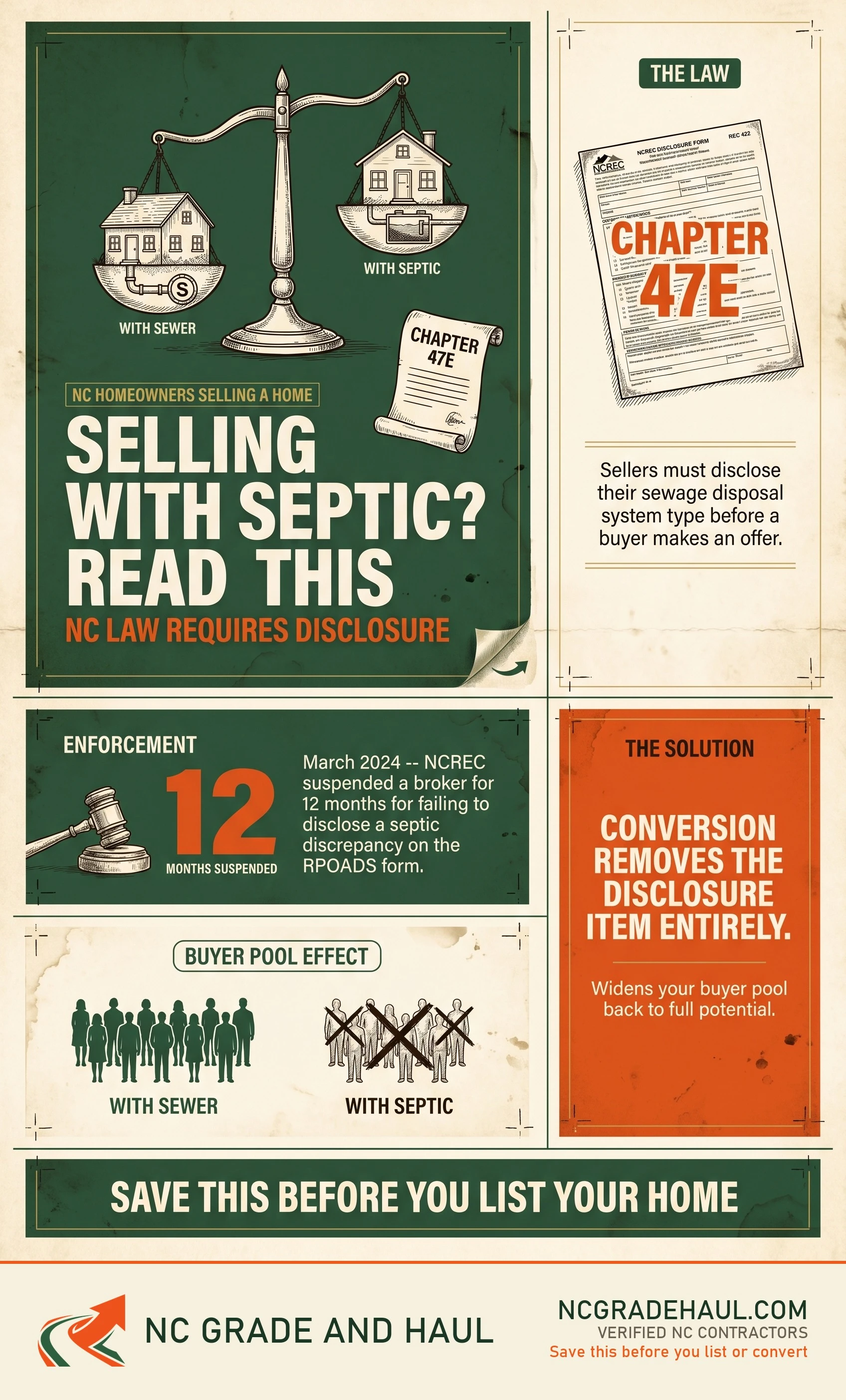
NC Chapter 47E — The Disclosure Requirement
Under the , sellers must disclose the type of sewage disposal system on the required disclosure form — buyers see this before making an offer.
North Carolina Chapter 47E requires residential sellers to complete the Residential Property Disclosure Statement before a contract is signed. The form asks about the property’s sewage disposal system. The current NCREC form (REC 422) lists options including septic tank, connected to city/county system, community system, drip system, and straight pipe. NCREC Rule 58A .0104(a)(9) explicitly requires disclosure of the type of water supply source and sewage disposal system, and if serviced by a septic system, the number of bedrooms allowed pursuant to permit.
When a buyer receives this form, they make decisions. Some accept a septic disclosure and price their offer accordingly — factoring in the absence of sewer connection as a negotiating point. Others withdraw from consideration entirely, particularly buyers relying on FHA or USDA financing where working septic system documentation requirements add process friction.
The result is a narrower buyer pool and stronger negotiating position for the buyer who does proceed. That’s not an appraisal adjustment — it’s a market reality that affects your actual sales price and time on market.
Staying on a working septic system in a sewer-available area is a legal, disclosed position — unless your county has issued a forced sewer hookup notice. The cost isn’t legal exposure; it’s market friction. Conversion eliminates the disclosure item entirely and widens the buyer pool back to its full potential.
Non-disclosure of a known condition is a separate issue with real legal exposure. The Chapter 47E form creates the obligation; filling it out accurately is not optional. NCREC disciplinary records confirm enforcement: in March 2024, the Commission suspended a Wilmington broker for 12 months (stayed, with probation) for failing to notice and disclose that a property’s RPOADS form listed a septic system while the MLS listing advertised city sewer.
The ROI Math
Sewer conversion rarely returns dollar-for-dollar in appraised value — but when Durham cost-share is available, the net position can turn positive before you count the disclosure friction savings.
The three most common scenarios for North Carolina homeowners:
Sewer Conversion ROI -- Three Common Scenarios
Comparison. Gravity Connection (No Cost-Share): Conversion cost: $5,000--$8,000 typical; Estimated value increase: $5,000--$15,000 market-dependent; Cost-share offset: $0; Net position: varies widely by market. Gravity + Durham Cost-Share: Conversion cost: $5,000--$8,000 typical; Estimated value increase: $5,000--$15,000 market-dependent; Cost-share offset: contact Durham for current amounts; Net position: often positive.
- Conversion cost: $5,000--$8,000 typical
- Estimated value increase: $5,000--$15,000 market-dependent
- Cost-share offset: $0
- Net position: varies widely by market
- Conversion cost: $5,000--$8,000 typical
- Estimated value increase: $5,000--$15,000 market-dependent
- Cost-share offset: contact Durham for current amounts
- Net position: often positive
Grinder pump scenarios (cost $8,000--$20,000+) with no cost-share often land net negative short-term. All figures are illustrative -- get an itemized contractor quote and local appraiser verification.
| Scenario | Conversion cost | Value increase (estimated) | Cost-share offset | Net position |
|---|---|---|---|---|
| Gravity connection, no cost-share | $5,000—$8,000 (typical range) | $5,000—$15,000 (market-dependent) | $0 | Varies widely by market |
| Gravity connection, Durham cost-share | $5,000—$8,000 (typical range) | $5,000—$15,000 (market-dependent) | Verify with Durham (program funding ends June 2026) | Often positive |
| Grinder pump installation NC, no cost-share | $8,000—$20,000+ | $5,000—$15,000 (market-dependent) | $0 | Often negative short-term |
A concrete example: $10,000 conversion cost, $8,000 appraised value increase, no cost-share. Net position: -$2,000. But that math doesn’t account for the disclosure friction eliminated or the wider buyer pool.
With Durham cost-share: same $10,000 conversion, a cost-share offset (contact Durham Water Management at 919-560-4326 for current amounts and eligibility — the Northeast Creek program is income-based and funded through June 2026) reduces your net cost. Combined with the value increase, the net position can turn positive. That’s the scenario where conversion clearly makes financial sense.
For a full look at what NC sewer conversion costs vs property value gained, see the cost spoke. For Durham cost-share and its effect on conversion ROI, including current program eligibility, see the dedicated spoke.
All cost and value figures require itemized quotes from licensed NC contractors and current appraiser verification — the ranges cited here are illustrative, not guaranteed.
When Conversion Pencils Out vs When It Doesn’t
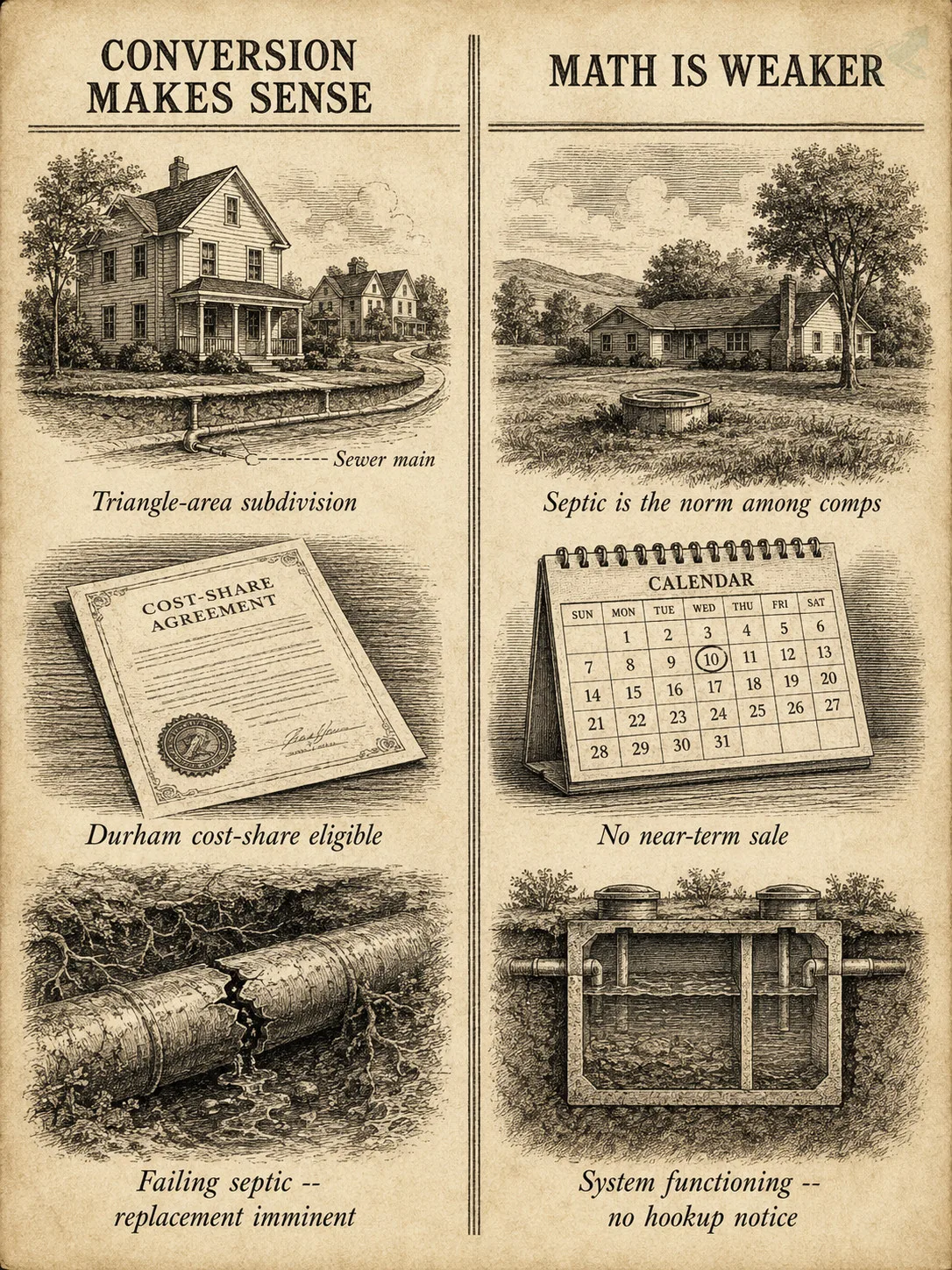
Conversion makes the strongest financial case when you’re near a Triangle-area sale, eligible for cost-share, or facing a mandatory hookup notice — and the weakest case in rural markets with no near-term sale.
When conversion makes strong sense:
- Forced hookup. If your county has issued a mandatory connection notice, the conversion is happening regardless of ROI. The question shifts to how to minimize cost and qualify for any available assistance.
- Near-term sale in a Triangle-area subdivision. The value premium is largest where buyer expectations are highest. If sewer is standard in your neighborhood and you’re listing within 2—3 years, the math is more favorable.
- Durham cost-share eligibility. The program materially improves the net position. If you’re in Durham and your home qualifies, run the numbers with cost-share included.
- Aging or failing septic system. A failing system that needs replacement anyway changes the comparison: you’re not comparing conversion cost against nothing, you’re comparing it against a new septic system plus the ongoing disclosure friction.
When the math is weaker:
- Rural property where septic is the norm. If comparable sales in your area are also on septic, the utility premium is smaller. The value case doesn’t disappear — but it’s thinner.
- No plans to sell in the foreseeable future. Disclosure friction is a resale concern. If you’re not selling, the Chapter 47E calculus doesn’t apply to your timeline.
- Working septic system, no hookup notice. A functioning septic system with a standard maintenance schedule isn’t costing you money today. The case for conversion is prospective — it’s about future sale conditions, not present ones.
- Long lateral run with grinder pump required. If your lot topology requires a grinder pump, the conversion cost climbs significantly. A grinder pump system in a market where the value premium is at the low end of the range may not recover.
The non-financial case for conversion is real regardless of the ROI math: an aging septic system carries maintenance costs, failure risk, and disruption that a sewer connection eliminates. That’s a quality-of-life calculation Ray makes separately from the investment analysis.
Three Common Mistakes
Expecting dollar-for-dollar ROI from conversion. The appraisal value increase is real — local Triangle appraisers report differentials in the $5,000—$15,000 range for comparable properties, though the number is market-derived and requires local verification. It usually doesn’t equal the full conversion cost without a cost-share offset. The case is stronger when you count disclosure friction reduction and buyer-pool widening alongside the appraised value.
Not disclosing septic status accurately under Chapter 47E. The NC Residential Property Disclosure Statement creates a legal obligation. Filling it out accurately is not optional, and non-disclosure of a known condition creates real legal exposure at resale. Verify the current NCREC form for the exact language — requirements can change.
Ignoring the buyer-pool effect. Some buyers won’t make offers on septic properties in sewer-available areas. That’s not captured in an appraisal — it shows up in days on market and offer counts. Conversion widens the pool back to its full potential.
ROI Calculator Prompt
Use this to run your own conversion math before getting an itemized quote:
What to Do Next
If you’ve run the math and conversion makes sense for your situation, the next step is an itemized quote from a licensed NC contractor who has experience with lateral installation, gravity vs grinder pump site assessment, and the county permit process.
NC septic-to-sewer conversion and property value impact has the full picture of what the conversion process involves — permits, timeline, utility coordination — before you go out for quotes.
Sewer connection permits by NC county covers the application process specific to your county, including Guilford, Wake, Durham, and Mecklenburg.
For a grading contractor near me in NC who has cleared license-board, workers’ comp, and OSHA checks, NC Grade and Haul’s directory surfaces contractors with that documentation on file.