
Ray Pettiford opened the certified letter on a Tuesday. It said sewer was now available at his Guilford County property and he was required to connect within a stated period.
He didn’t know if the notice was legally binding. He didn’t know what happened if he didn’t respond. He didn’t know whether his fixed income made him eligible for anything.
This page answers those three questions, in order, using NC’s actual legal framework — not general utility-company talking points. The core statutory citations (authority to require connection, cost-based exemptions, lien authority) are verified against current NC General Statutes. Jurisdiction-specific details — compliance windows, hardship criteria, fine amounts — are not set by state law and vary by county ordinance. Confirm those against your county’s current ordinance before relying on them in correspondence with the issuing authority.
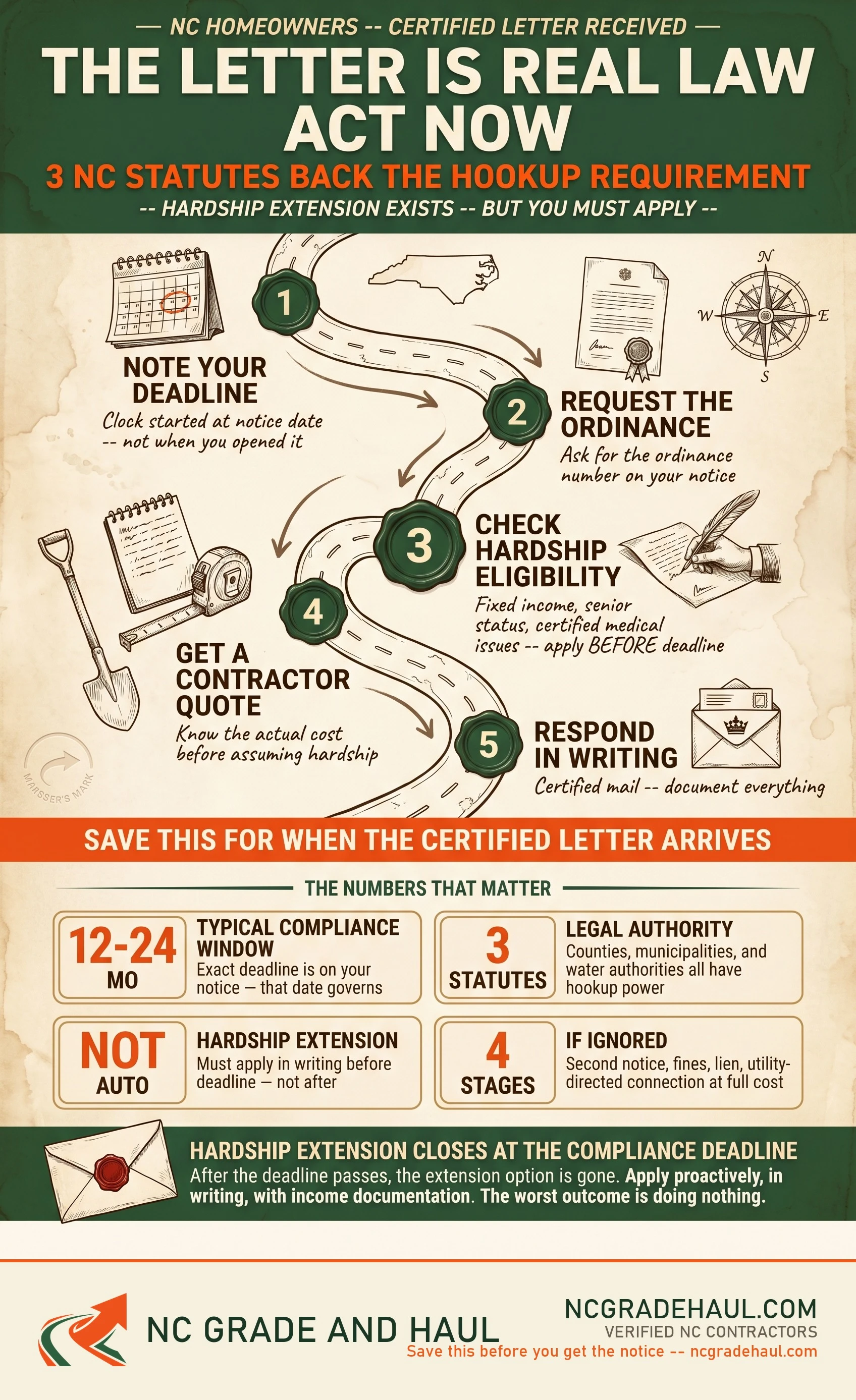
The Legal Authority — Can They Actually Make You Do This?
Yes. North Carolina authorizes local governments and utility authorities to require sewer connection when sewer is available to your property. The requirement is legally enforceable.
The authority derives from the framework governing local utilities and municipal service areas. Counties derive this power from SS153A-284, municipalities from SS160A-317, and water/sewer authorities from SS162A-6(14d). Note that SS162A-2 contains only definitions; the operative authority provision for water/sewer authorities is SS162A-6(14d), which applies only to authorities in counties with a population of at least 40,000.
Local governments and utility authorities derive connection-requirement power from their service-area designation. When a property falls within a defined sewer service area AND sewer becomes physically available, the utility can issue a mandatory hookup notice.
“Available” has a specific legal meaning. In most NC ordinances, it means sewer infrastructure has been extended to within a certain distance of your lot — often the property boundary or the street right-of-way. The distance standard is not set by state statute; it is defined in your county or municipality’s ordinance, and the definition varies. If sewer runs past your street but does not reach a connection point reachable from your lot, the notice may not apply. That is a grounds-for-dispute scenario covered later in this page.
The short answer Ray needed: the notice is real. It’s not a suggestion.
The Compliance Timeline
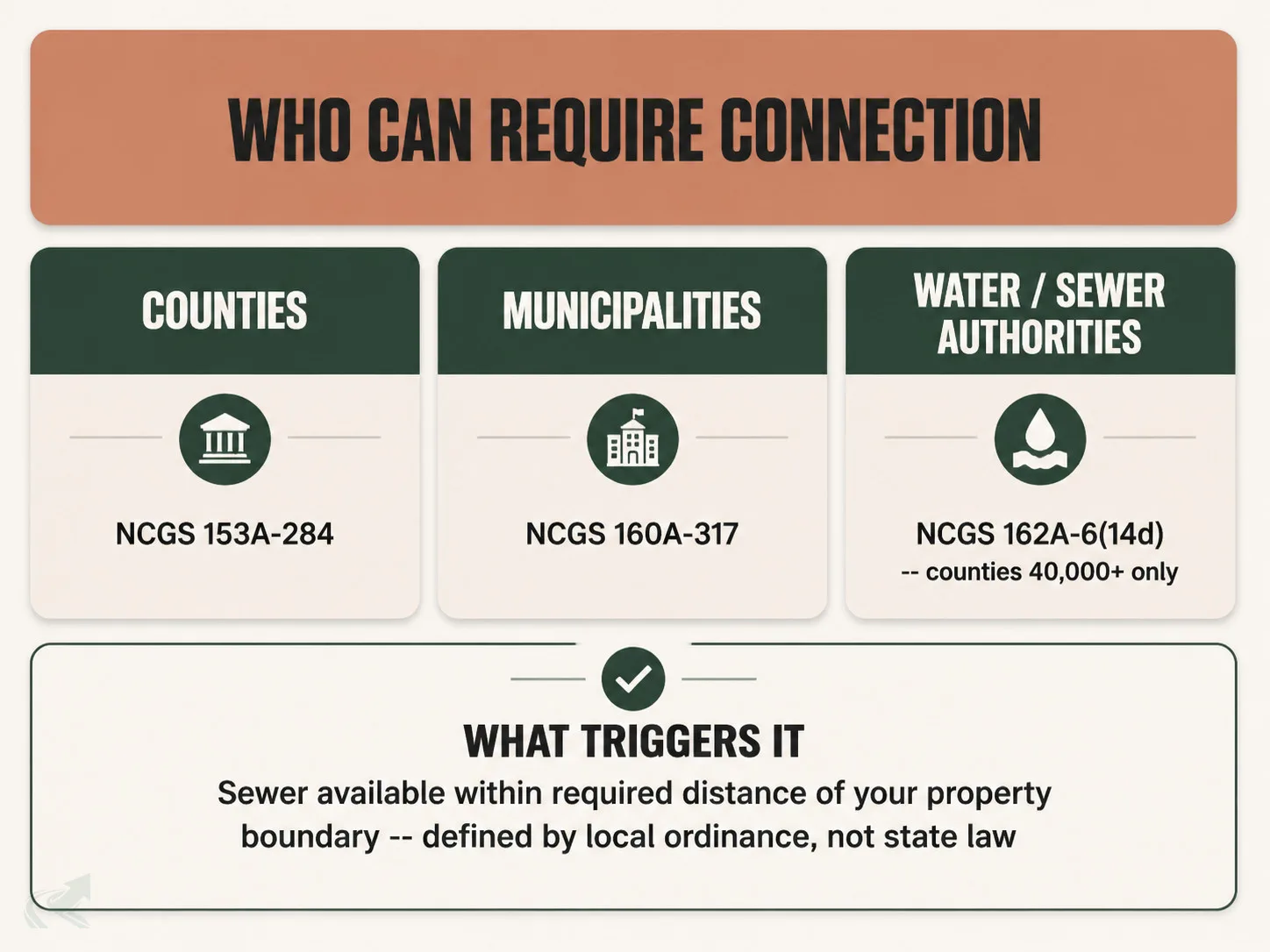
Most NC forced-hookup notices give 12 to 24 months from the notice date. The exact deadline is in the notice itself — that number governs.
Compliance windows are set by local ordinance, not by state law — there is no uniform NC deadline. The window stated on your notice is the operative deadline. Wake, Durham, Mecklenburg, and Guilford each set their own timelines by ordinance; to find your county’s specific window, ask the issuing authority for the ordinance number cited on the notice.
The compliance clock typically starts at the notice date, not the date you receive it. If you’re reading a notice that’s been sitting in a pile for three weeks, that three weeks is gone.
What the enforcement sequence typically looks like in North Carolina:
NC Forced-Hookup Enforcement Escalation
1. Initial Notice -- States the compliance deadline, governing ordinance, and contact for questions. Most options still available -- act here. 2. Follow-Up / Reminder Notice -- Issued when deadline approaches with no compliance confirmed. Hardship extension window is closing -- engage now or lose the option. 3. Final Notice -- Signals the start of formal enforcement action. Appeal and extension options are largely exhausted at this stage. 4. Enforcement Action -- Fines (daily accumulation possible), property lien (limited jurisdictions), or utility-directed connection billed to homeowner at full cost. No remaining options.
-
Initial Notice
States the compliance deadline, governing ordinance, and contact for questions. Most options still available -- act here.
-
Follow-Up / Reminder Notice
Issued when deadline approaches with no compliance confirmed. Hardship extension window is closing -- engage now or lose the option.
-
Final Notice
Signals the start of formal enforcement action. Appeal and extension options are largely exhausted at this stage.
-
Enforcement Action
Fines (daily accumulation possible), property lien (limited jurisdictions), or utility-directed connection billed to homeowner at full cost. No remaining options.
Options narrow at every stage. Ignoring the initial notice is the most expensive path.
- Initial notice — states the compliance deadline, the governing ordinance, and the contact for questions.
- First reminder / follow-up notice — issued when the deadline approaches with no confirmation of compliance.
- Final notice — typically signals the start of formal enforcement action.
- Enforcement action — fines, lien, or utility-directed connection at homeowner expense.
To find your specific ordinance: call the issuing authority and ask for the ordinance number cited on your notice. That document contains the exact compliance timeline, the appeal process (if any), and the enforcement mechanism. Get it in writing.
Hardship Exemption — What It Is and Who Qualifies
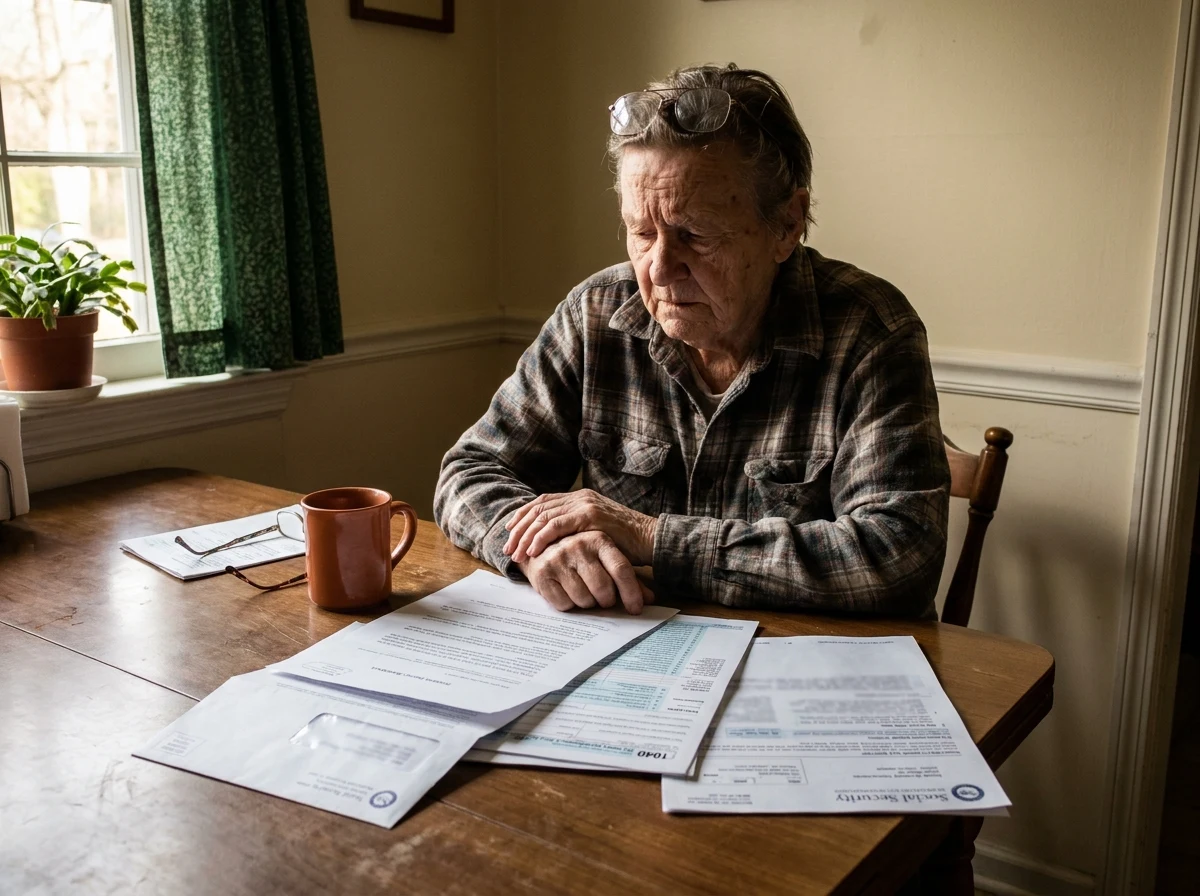
A hardship extension can delay or reduce the compliance obligation — but you must apply for it proactively, before the deadline.
“Hardship” in the forced-hookup context typically means a financial or physical burden that makes compliance within the standard window unreasonably difficult. Common qualifying conditions across NC jurisdictions include:
- Fixed income or limited income — senior homeowners on Social Security or pension income with documented inability to finance the conversion
- Senior status — some jurisdictions maintain a senior-specific extension track, independent of income; whether your county has a separate senior track or reviews all hardship cases under a single income-based standard varies by local ordinance
- Property-specific access issues — unusual lot topography, setback constraints, or access road conditions that make the lateral connection physically complicated and more expensive
What hardship does NOT do: it does not eliminate the hookup requirement. It buys time — the extension duration varies by county ordinance; ask the issuing authority for the specific extension window available in your jurisdiction — for the homeowner to arrange financing or otherwise prepare.
How to apply: contact the issuing authority in writing, before the compliance deadline. Ask specifically for the hardship extension application and the documentation required. Most counties want income verification (tax returns, Social Security income statements) and sometimes a contractor’s assessment documenting the access difficulty.
If you are in Durham County, the Durham cost-share program for forced hookups may offset enough of the conversion cost that a hardship extension becomes less necessary. Check cost-share eligibility before assuming hardship is the only lever.
What Happens If You Don’t Comply
Ignoring the notice removes options at each stage. The worst outcome is the utility making the connection and billing the full cost to you.
North Carolina utility authorities do not permanently drop forced-hookup requirements. The enforcement path is real, even if the timeline varies by county and some counties have been slower to enforce than others.
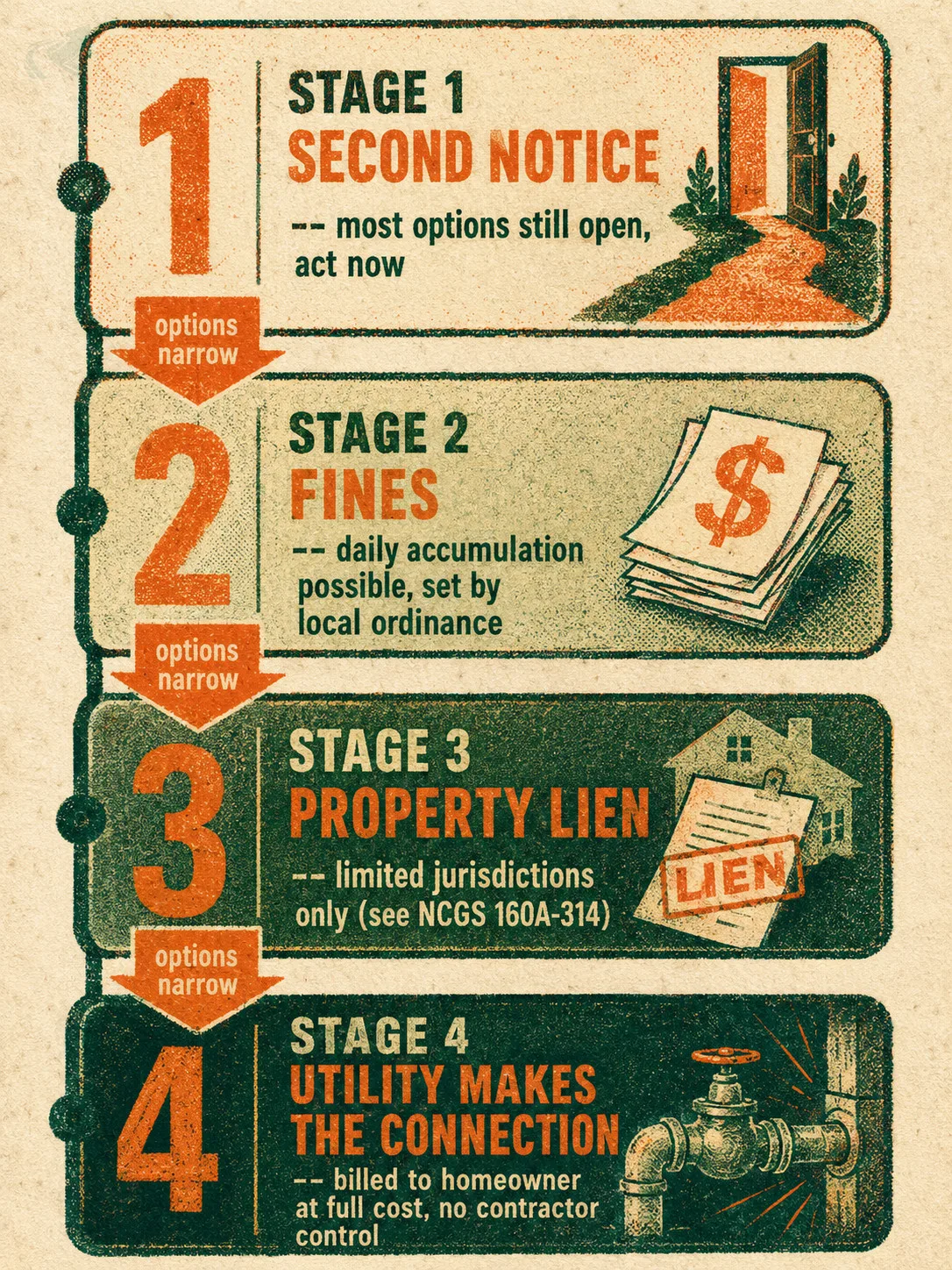
Typical escalation sequence:
Stage 1 — Second notice and deadline confirmation. Most counties send at least one follow-up before moving to formal enforcement. This is the last easy opportunity to engage — request the ordinance, ask about hardship options, confirm your eligibility for any county cost-share program.
Stage 2 — Fines. Some NC jurisdictions assess daily fines for continued non-compliance after the final deadline. Fine amounts and whether daily accumulation applies are set by local ordinance, not state law — they vary by county and municipality. Do not assume a specific fine amount without confirming against the governing ordinance cited on your notice.
Stage 3 — Property lien. Under NCGS SS160A-314(c), sewer service fees are generally a personal obligation of the customer and “shall in no case be a lien upon the property or premises served” for most North Carolina localities. A limited exception in SS160A-314(f) allows certain specific towns and cities to adopt lien ordinances — this applies only to the City of Locust and the Towns of Bolton, Fairmont, La Grange, New London, Pembroke, Proctorville, Rowland, St. Pauls, and Stanfield. If your issuing municipality is not on that list, lien authority for unpaid sewer fees does not exist under SS160A-314 state law. A lien affects your ability to sell the property with clear title.
Stage 4 — Utility-directed connection. In the most serious enforcement scenarios, the utility authority makes the physical sewer connection and charges the cost to the homeowner. This removes any control over which contractor does the work or what the cost is.
For an escalation-and-documentation approach similar to what forced-hookup disputes require, the NC builder accountability escalation playbook covers the paper-trail practices that apply to any utility-authority engagement.
Disputing the Notice — When It’s Worth Challenging
A dispute is worth pursuing when your property may have been incorrectly included in the service area or when sewer is not actually reachable from your specific lot.
Three grounds for a valid dispute:
-
Your property is not in the service area. Utility service areas are mapped. If your parcel was included by error — wrong address, wrong parcel ID, or a mapping line that cuts through an ambiguous area — that’s correctable. Ask the issuing authority for the parcel-level service-area map and compare it against your legal description.
-
Sewer is not actually available to your lot. “Available” means a connection point is within the required distance from your property boundary. The distance standard and access-route requirements are defined in your county or municipality’s ordinance — not by state statute — and vary by jurisdiction. If the nearest connection is across a creek, past a right-of-way constraint, or requires crossing a third party’s property, the availability standard may not be met. Get this determination in writing from the utility engineering department before accepting the notice at face value.
-
Your existing septic is permitted and you are exempt. NCGS SS160A-317 provides two statutory exemptions from mandatory municipal sewer connection: (a) the city has inadequate capacity to transport and treat the additional wastewater, or (b) the total cost of connection (including underground piping to the dwelling) exceeds the cost of installing an on-site wastewater system, as assessed by a licensed soil scientist, on-site wastewater contractor, or plumbing contractor. Some counties may also have ordinance-specific exemptions for recently installed or upgraded systems — check whether your county’s ordinance adds any exemption beyond these two statutory grounds. If your perc test is current and the septic system passed its last inspection, ask explicitly whether any exemption applies.
How to initiate a dispute: write to the issuing authority by certified mail within the compliance window, stating the specific grounds for your dispute. Ask for the parcel-level service-area boundary and the technical standard for “sewer availability” as defined in the governing ordinance.
When to consult an attorney: if the utility denies your dispute and you believe the denial is incorrect — especially on service-area mapping questions — a real property attorney familiar with NC utility law is worth the consultation. For county permit requirements related to sewer conversion, the permit office can sometimes clarify service-area boundaries faster than the utility’s customer service line.
Your Action Checklist
Seven steps from notice date to resolution. Step 1 is time-sensitive.
Three mistakes to avoid:
Ignoring the notice and hoping it goes away. It doesn’t. Each unanswered notice moves you closer to enforcement with fewer options. The window for requesting a hardship extension closes at the compliance deadline.
Assuming the hardship extension is automatic. It is not. You apply for it — in writing, with documentation, before the deadline. After the deadline, that option is typically gone.
Not requesting the specific ordinance. The notice invokes county authority. The ordinance has the exact timeline, the appeal process, and the enforcement mechanism. Get it and read it. The issuing authority is required to provide it.
Where to Go From Here
The NC septic-to-sewer overview covers the full conversion sequence — from the notice through the lateral connection, the abandonment permit, and final inspection. That context matters if you are moving toward compliance and want to understand the full scope of work before you get quotes.
The first step in understanding actual cost is an itemized quote for NC sewer conversion by gravity vs pump — the two connection methods have meaningfully different price ranges, and your lot’s elevation determines which applies.
If you need a contractor for the grading side of a lateral trench — excavation, compaction, site restoration — verified NC grading contractors in the directory have cleared license-board, workers’ comp, and OSHA checks. Ask for an itemized quote that separates the grading scope from the plumbing scope.